This book combines the Introduction to Writing in College by Melanie Gagich and ENG 102: Reading, Writing and Research by Emilie Zickel, which were both supported by Cleveland State University’s 2017 Textbook Affordability Small Grant. The book was then revised, edited, and formatted by Melanie Gagich, Emilie Zickel, Yvonne Bruce, Sarah Lacy, John Lanning, Amanda Lloyd, Charlotte Morgan, and Rashida Mustafa. This work was made possible through the generous support of the Cleveland State University Office of the Provost.
Within each chapter there are sections written by Melanie Gagich, Emilie Zickel, or other members of the textbook team (see above) and authorial attributions are given. This book also contains other resources integrated under Creative Commons licenses. These open access resources include complete and also remixed chapters from Monique Babin, Carol Burnell, Susan Pesznecker, Nichole Rosevear, and Jamie Wood’s The Word on College Reading and Writing, links to several essays from the open source textbook series Writing Spaces: Readings on Writing, and several links to articles from the open source website Writing Commons. Additionally, parts of this book also come out of a remixed version of Robin Jeffrey’s, About Writing, which have been rearranged, amended, edited, and enhanced with digital reading experience by including videos and visual reading features. Shared and remixed materials will be denoted with attribution information when necessary.
Our Philosophy
When Melanie and Emilie decided to combine our individual textbooks, we decided that we wanted the new text to function more like a manual or guide to rhetorical concepts and writing genres, to composing in a college setting, and to helping students succeed in FYW at Cleveland State rather than a formal textbook. Together we conceptualized a text that does not necessarily answer all student questions or cover all material taught by FYW instructors at CSU or at other institutions. Instead, we wanted to create a text that is less prescriptive than a traditional textbook and allows for the picking and choosing of content by instructors and by students. We believe this type of text fosters student-centered pedagogies because it is a tool for students that supports them during many different writing moments such as when the instructor isn’t there to reinforce concepts that have been discussed already in class.
Further, the text lacks a unifying tone because we feel that one of the central philosophies behind Open Access Educational Resources is the need for and importance of collaboration and the sharing and “remixing” of others’ content. Our text was not written by one or even two authors, rather it is a collection of a diverse array of viewpoints and writing styles, which, to us, exemplifies one of the many ways that our book is different from a traditional, printed, and academic textbook. We feel that the inclusion of work by multiple authors can also provide a starting point for conversations in writing class about how writing “actually works in the real world” (Wardle and Downs).
In sum, the book cannot and should not replace the voice of the instructor. We envision it as a manual or guide also because we want all instructors to be able to use it how they see fit. We hope that this text will reflect not only our voices and the voices of our team of part-time instructors but also offer students resources for navigating and succeeding in college and support for working on writing assignments.
A Note About Citations
This text was written in and chapters have been edited to reflect the 8th edition of MLA.
A Note About the Use of Color
Within this text you will find links to works within the book and to outside works. These links will be indicated by the use of the color green.
Also within this text you will find a series of defined words. These words will be indicated by the use of the color blue and you can hover over them or click on them to see each definition.
About the Authors
Melanie Gagich is an Associate College Lecturer in the First-Year Writing Program at Cleveland State University. If you would like to contact her, she can be reached at m.gagich@csuohio.edu or mgagich@gmail.com.
Emilie Zickel is an Assistant Lecturer in First-Year Writing at Cleveland State University. If you would like to contact her, she can be reached at e.zickel@csuohio.edu or at ezickel@gmail.com
Cover Image
The cover image was created by Chad Q. Berry and is licensed under a Creative Commons license as CC-BY-NC-SA 4.0.
Creative Commons Licensing
This book is licensed under a Creative Commons as CC-BY-NC-SA 4.0.
Students often enter college writing courses believing they will be taking an “English” course that revolves around reading literature, writing creatively, and/or focusing on grammar. In fact, that is rarely the case.
At Cleveland State University, each student is required to take either ENG 100: Intensive College Writing or ENG 101: College Writing I and also ENG 102: College Writing II. Although each course is tagged as “ENG”, the official titles of each course include the words “College Writing.” Their official titles show that they are situated within the academic discipline, or the field of, Composition and Rhetoric. As members of that field, college writing instructors create, critique, and/or draw from pedagogical (teaching) theories and practices. Instructors might gather information from or publish in various discipline specific academic journals or conferences such as the College Composition and Communication Conference.
In practice, college writing courses teach students about writing and composing processes, how to think critically, use rhetorical knowledge to evaluate sources, integrate legitimate research in formal writing assignments, and write formal expository texts.
Cleveland State University’s First-Year Writing Sequence
ENG 100/101 helps you learn basic academic writing techniques while also examining rhetorical situations and rhetorical appeals. These skills connect to the “real world” in multiple ways. For instance, think of the last political ad you saw or an article you read online–how do you know if it was legit? Do you know who paid for the ad/article or who will profit from it? If you do know, what does that mean? Do you ask yourself, “whose agenda is this?” when you interact with popular media like reality tv shows, news programs, commentary programs, blogs, articles, etc.? In ENG 100/101, you will address some of these questions in various contexts to help you learn how to think critically about the world around you.
ENG 102 teaches you how to do research—find information—and how to use it, which is necessary for any major. We read, research and write to learn, and additionally by doing so, we gain the ability to read and follow both directions and instructions—a skillset desired by all employers. Then, unspoken and perhaps not emphasized is the confidence you gain in a first-year writing class when you discover your voice which after taking a year of composition results in a more mature outlook. This newfound connection to the human world and the natural world is what the critical thinker experiences. Overall, ENG 100/101 and ENG 102 are complimentary to but also different from most “English” courses you might have experienced in the past.
Why Should I Care About College Writing Courses?
Manystudents who enter college writing courses may at first feel apprehensive or may not see how these courses connect to their intended majors. In reality, college writing courses teach students to use writing to communicate and use critical thinking skills to become savvier consumers of information. Additionally, according to data gathered by Cleveland State’s Undergraduate Studies and Academic Programs using the third-party software platform, Civitas Illume, a student’s successful completion (earning a C or higher) in both ENG 100/101 and ENG 102 have been linked to increased persistence and graduation rates.
The data show that students who earn a B or higher in their college writing courses have an above average likelihood of graduation. Even though some students might find the idea of earning a B or higher daunting, it is important to remember that you are generally evaluated based on completing process-driven and reflective writing assignments, attending class regularly, and participating. Even more exciting is that the data also suggest that a student who simply raises their grade by one letter, for instance increasing your grade from a C to a B or a D to a C, also has a stronger likelihood of graduating. What this means is whether or not you conceptualize yourself as a B or A student in writing, any student who participates in revision opportunities, attends class, participates in class discussions, and communicates clearly with their instructor can increase their course grade, which positively affects the likelihood that he or she will graduate.
This all goes to support the notion that while writing class does not need to be scary it should be taken seriously and it does matter.
1.2 Things to Know
2
Melanie Gagich
What is a Syllabus?
The syllabus is a contract between you and your instructor. Yes, a contract. By reading the syllabus and not withdrawing from a class, you are entering into a contract with your instructor and the university. This sounds scary. It isn’t, just so long as you READ THE SYLLABUS. The syllabus describes required materials, course goals, expectations, mandatory attendance policies, how you will be graded, and so on. Generally, when a question comes up about the course, you can find it on the syllabus.
What is the Attendance Policy?
Time and again, professors are asked by students, “Do I really have to come to class?” And, the answer is nearly always the same, “Yes, you really have to come to class.”
You might ask, “Is this true for all classes?” The answer is, it is definitely true for your First-Year Writing courses (ENG 100/101 and ENG 102). The First-Year Writing Program has a strict attendance policy which is explained below:
The First-Year Writing Program Attendance Policy
If you do not attend class regularly, you will not pass. If you miss eight or more fifty-minute periods you will receive a course grade of “F” (fail). You may miss up to four fifty-minute periods without penalty. Each absence beyond the fourth will reduce your grade in the course by ⅓ a letter grade (for an example, an A will become an A-, an A- will become a B+, etc.).
If you leave early you will be marked absent on that day. If you are ten or more minutes late to class you will be counted as tardy. Four accumulated tardies will count as one absence.
You will not be granted additional absences after you have reached the maximum allowable
Absences required by religious observance, disability and Title IX accommodations, university-authorized activities, and military service are exempt from this policy. In order for these absences to be excused, you must provide advance notice to your instructor, no later than the end of the second week of class. For disability and Title IX accommodations, university-authorized activities, and military service, you must provide your instructor with appropriate documentation.
Class Meetings and Minutes
Total Allowed Absences
Total Absences Resulting in Failure
Three Days a Week (50 mins)
4
8
Three Days a Week (65 mins)
3
6
Four Days a Week (50 mins)
4
8
Two Days a Week (75 mins)
3
5
Two Days a Week (110 mins)
2
4
Once a Week (170 mins)
1
3
How do I Communicate with my Professors?
Email
Part of “doing college” means understanding that how you communicate to others impacts how he or she perceives your maturity and/or professionalism. That said, most instructors do not mind receiving and responding to emails but often mind very much if those emails do not include a formal address/sign off, your full name, and your class and section number. Please use the example below as a reference when crafting your emails.
Example Email
Hello Instructor/Professor/Dr. [be sure to choose the appropriate title],
This is Sally Sue from your ENG 101 Section 12 class. After rereading the syllabus, I still do not understand XXX. Can we please meet to discuss it?
Thank you for your time.
Sincerely,
Sally Sue
Office Hours
Another thing that may be new to some of you is the opportunity to work and talk one-on-one with your professor. It is definitely one of the perks of the college environment. Instructors are required to set aside time to be available to students in their offices. In general, it is always good to introduce yourself to your professor because introductions during office hours are a great way to stand out from the crowd. Furthermore, attending office hours can help answer questions concerning difficult assignments or concepts. Check the syllabus to make sure you’re visiting during scheduled office hours, unless you have scheduled an appointment with the instructor via email or Starfish.
1.3 Resources to Use
3
Melanie Gagich
Using Face-to-Face Resources
The Michael Schwartz Library
The library is probably the most important and useful resource you have on campus. Entrance to it is located on the 1st floor of Rhodes Tower and it consists of eight floors. At the library, you will find many resources including the following:
Access to electronic resources, including the web, at more than 100 PCs within the Library.
On-demand access to over 29,000 journal titles available on Library PCs and from your home computer.
An on-site collectionincluding 975,000 print volumes and an additional 1,000,000 items, such as sound recordings, video recordings, DVDs, and microforms.
Friendlystaff ready to help you with your information needs.
Freeinterlibrary loan service, providing access to an almost unlimited number of library materials owned by other libraries world-wide, through a web-based interface putting you in control of your own borrowing activities. (“Welcome to the Library” by the Director Glenda Thornton)
Be sure to visit the library and see how else it can help you succeed!
The Writing Center
The Writing Center is located on the 1st floor of the library in the back left corner. You can make an appointment through Starfish, by calling 687-6981, or in person at RT 124. The Writing Center is open Monday – Thursday from 9:30am – 7:00pm and on Fridays from 9:30am – 4:00pm.
The Writing Center is not an editing service. Rather, it is a place to go and get feedback about your writing, not only your grammar. In order to get the most out of your 30-minute session, we suggest the following:
Bring a paper with instructor feedback;
Write at least two questions on the paper about issues you want to address;
Bring the assignment and/or rubric so that you can get help talking out organization;
Be polite and be on time.
The Writing Center is an excellent place to get help for all of you classes and for all assignments including but not limited to; lab reports, research papers, group projects, writing assignments, and grammar.
The Tutoring and Academic Success Center (TASC)
The TASC office uses “research-based strategies and approaches for learning in order to help students achieve their academic goals and ultimately to graduate. We do this in an informal, student-centered environment that assists students to not only achieve academically but to also socially integrate into college life.” They offer Success Coaching, Tutoring, Supplemental instruction (SI) for various courses, and provide Structured Learning Assistance (SLA) in our ENG 101 courses. You can contact them at 216-687-2012. They are located in Main Classroom room 233 and you can visit their website here.
Structured Learning Assistance (SLA)
Structured Learning Assistance (SLA) is an academic support program that is available to students enrolled in English 101 courses. The SLA leaders work as a part of the Tutoring and Academic Success Center (TASC). SLA features weekly study and practice “labs,” or “sessions,” built into the class time in which students master course content to develop and apply specific learning strategies for the course, as well as strengthen their study skills to improve performance in their current English 101 course. The SLA lab times are formally attached to the student’s class schedule and there is no additional charge to the student for this support. These mandatory sessions are facilitated by successful upper-level students, who, in collaboration with the professor, develop collaborative learning sessions to guide students as they learn how to write. The SLA facilitators clarify lecture points for the students and assist them in understanding the expectations of the professor, while additionally focusing on improved study skills. SLA activities frequently include study guides, collaborative learning/group activities, and study skills — such as discovering your preferred learning style, efficient note-taking, and time management.
The Center for International Services & Programs (CISP)
CISP “provides services to international students through International Orientation, International Student Services, as well as domestic and international students through Education Abroad and the National Student Exchange.” Students can visit their office in Main Classroom room 412 Monday – Thursday from 1 – 3pm. For more information pertaining to the services and opportunities CISP offers please visit their website here.
The CSU Counseling Center
CSU offers counseling services to students, faculty, and staff. If you feel that you could use support for personal, academic, or other stresses or challenges and would like to speak to a CSU counselor, you can contact the Counseling Center at 216-687-2277. They are located at UN 220 and are open Monday – Friday from 9 – 5pm, with sessions are available by appointment from 8 – 5pm on weekdays. They also have walk-in appointments from 1 – 3pm Monday – Friday. If you need to speak to a counselor outside of office hours, you can still dial the Counseling Center number and you will be able to speak to someone, 24 hours a day. For more information about the CSU Counseling Center, please visit their website here.
Using Digital Resources and Tools
Blackboard
Some of you might be familiar with course management systems from high school while for others this might be a very new. CSU’s management is system is Blackboard. An instructor may choose to use or not use Blackboard in his or her classroom; however, the FYW program recommends that instructors do so. Your instructor is urged to use Blackboard as a way to foster communication between students and their classmates and students and their instructors. When integrated into the classroom, students will mostly likely be able to access course documents, check their grades, and participate in online discussions.
Starfish
Starfish is “an online program that makes it easier for undergraduate students to communicate and make appointments with support services and faculty on campus.” Again, your instructor is urged to use Starfish in his or her classroom as a way to increase communication between professors and students.
To access Starfish, students must login to CampusNet, choose the “Students” tab, and then click the “Starfish” link. Once students are logged in, they can use Starfish to
Find your assigned advisor
Look for communication from your support network about your academic progress
Schedule an appointment to meet with an advisor or tutor
Schedule a tutorial with the Writing Center
Schedule Supplemental Instruction (for certain courses)
Course Conferences (with participating faculty)
For more information pertaining to Starfish, please visit their website here.
Cleveland State University Computer Labs
In order to provide opportunities for in-class drafting and research sessions, many FYW instructors will reserve a computer lab. Below are the locations of the most commonly used computer labs:
Lab
Location
RT 302
Third floor of the Michael Schwartz Library
RT 401
Fourth floor of the Michael Schwartz Library
RT 502
Fifth floor of the Michael Schwartz Library
LCLC Back Lab/Front Lab
First floor, to the left, near the Writing Center, in the Michael Schwartz Library
Mobile Campus
Because of the limited amount of available computer labs, instructors might require students to bring and use laptop computers during class. Since not all students own or have access to a laptop, CSU offers a Mobile Campus, a 48-hour laptop loan service. Students can find Mobile Campus in the Student Center room 128A and at the circulation desk in the Michael Schwartz library. For more information, please visit Mobile Campus’s website here.
Information Services and Technology (IS&T)
IS&T provides computer assistance to CSU students with student-owned PCs, Macs, and laptops. Services include system and disc clean-up, anti-spy and anti-virus software, software installation, virus removal, and printing help. To contact the IS&T help desk, call 687-5050, email help.desk@csuohio.edu, or visit RT 1106 between 8 a.m. and 5 p.m. Monday through Friday.
University Resources
Office of Disability Services (ODS)
The following statement should appear in your syllabus: Note for Students with Disabilities: Educational access is the provision of classroom accommodations, auxiliary aids and services to ensure equal educational opportunities for all students regardless of their disability. Any student who feels he or she may need an accommodation based on the impact of a disability should contact the Office of Disability Services at (216) 687-2015. The Office is located in MC147. Accommodations need to be requested in advance and will not be granted retroactively.
The Community Assessment Response & Evaluation (CARE) Team
The CARE team “collaboratively […] support[s] the wellbeing and safety of students, faculty, staff, and to promote a culture on campus that encourages reporting of concerns.” The CARE Team can help students receive suicide prevention counseling, health and wellness resources, access CSU’s food pantry, and more. You can visit the CARE Team office in the Student Center room 319 or reach them by calling 216 -687-2048. For more information please visit https://www.csuohio.edu/care/csu-care-team and use the links on the righthand side to navigate the site.
Chapter 2: Reading in Writing Class
II
2.1 Why We Read
4
Melanie Gagich and Charlotte Morgan
“At the center of all academic writing is a curiosity about how the world works and a desire to understand it,” Stuart Greene and April Lidinsky write in the introduction of the text, From Inquiry to Academic Writing.Colleges and universities provide students with the education and through research, to develop new technologies to compete in the 21st century global economy. College writing starts with asking questions. To get those answers we must read.
The Liberal Arts were once concerned with the study of that which is true. To make the adjustment from high school writing to writing at the collegiate level you must realize academic writing today is all about current beliefs which change over time. You will have to practice learning not only how to think like an academic, but how to read like one as well until this becomes a habit. We read, we research, and write about what we have learned.
Learning how to read in college also helps you develop content knowledge. This section includes a brief discussion of what it means to read to build content knowledge.
Reading to Build Content Knowledge
“Content knowledge” refers to your knowledge about a subject, topic, controversy, current event, or area of study. Creating content knowledge is important to the writing process because you must have something to write about before you can actually begin writing. Many students assume that they can simply read one or two articles and then write an entire essay, but that is hardly ever an accurate assumption. Whether you are writing about yourself, responding to a topic chosen by the instructor, or crafting a research essay for history class, you need to build knowledge about the content area first.
Scenario 1
In your creative writing class, you are asked to write about a scary moment in your life.
Before writing, you need to sit and think about what scares you, what it means for you to be frightened, what experiences you have had with fright, etc.
This process, even though it is content only about your experience(s), is part of the content knowledge building process because you need to sift through many life experiences in order to determine which one was the scariest. To do so, you must also define what “fear” or “scared” means to you, which might require some outside reading or research. Both defining and pinpointing an experience requires building knowledge about the topic and occurs before you actually begin writing.
Scenario 2
Your college writing instructor assigns everyone a debatable topic and you are asked to write about the benefits of the death penalty. You are excited because you have seen a lot of Law and Order episodes and have decided that the death penalty is a “good thing” for American society. So, you sit down and write your essay using all of your ideas about the death penalty.
Sounds good, right? Wrong.Forming an argument based solely on a television show or on only one source does not lead to a strong or well-informed text. Also, a writer must consider all sides of an argument. In this scenario the student doesn’t really have a lot of experience with the topic, which means he or she must build content knowledge first. This will most likely require finding opinion-based (or popular articles), research-based (or scholarly articles), credible statistics from independent researchers, and any other legitimate source to develop an understanding of the topic. From there, an ethical writer (which you are working to become) must evaluate those sources to ensure credibility because if a writer relies on faulty sources, then his or her work becomes faulty or inaccurate, too. Once all of this content knowledge building work has been completed, then the you are ready to write a paper supporting the death penalty.
Building content knowledge is key part of the writing process, which is why reading effectively is an important skill to master.
Good writing begins with good reading. Almost all good readers are good writers because they have familiarized themselves with and are not afraid of different styles, genres, diction, grammar, and levels of difficulty.
But many students don’t like to read and don’t read for pleasure. Unfortunately for them, college is reading intensive. You must be able to read effectively to perform effectively in college, and it helps if you can turn the process from a chore into a pleasure. So how can you learn to approach confidently the difficult texts you will encounter during your study?
In other words, how can you become a reader, or a better reader?
Good readers almost always annotate the text as they read.
Good readers know that almost all non-fiction texts—no matter the discipline, level of difficulty, or genre—follow pretty much the same pattern. The main idea comes at the beginning, the body paragraphs support the main idea, and the conclusion wraps up the whole thing. All the way back in grade school, you may have learned this formula for presenting your work: “Say what you are going to say, then say it, then say what you just said.” This describes a PhD dissertation as well as it did your fifth-grade book report.
Good writers don’t write to obscure; they write to clarify. (Mostly.) In order to be clear, they use the conventions of standard professional or academic non-fiction prose writing. If you know these conventions and their purpose, you will never get lost in someone’s written statement. You already know that most non-fiction texts have an intro, a supporting body, and a conclusion (see #2 above). These elements too are conventions. Other conventions to look for:
The title: Most times, the title is a phrase that conveys the author’s stance, thesis questions, or argument. Occasionally, in popular literature and especially in news and social media, titles can be somewhat miseading because they are meant to generate readership. But titles always give you a clue to the authors’ topic.
The main idea or thesis: Sometimes students tell us that the thesis should come at the end of the first paragraph, but a more accurate place to look for the thesis is at the end of the introduction, which may or may not be a paragraph in length. In a book, for example, the introduction may be a full chapter on its own. In other texts, where does the introduction end? It depends—in a scholarly work, it may end before the first subsection. In a lengthy magazine essay or article, after a few paragraphs. Sometimes, in an essay that began as a speech or a in written essay that speaks directly to the reader, the main idea may come immediately at the beginning of the work in its own separate sentence or paragraph and then be followed by a more traditional introduction. Think about what you’re reading and the author’s purpose and look for clues to guide you to the main idea. If you can’t find it at the beginning, look for it in the conclusion, where the author usually restates the main idea.
The body: Where does the the author often go after the introduction? To a history of the topic. To shocking statistics or vivid personal stories. To a definition of the problem under discussion. What do all these examples have in common? They set up a context for the development of the main idea. They tell you what you have to understand in order to appreciate the train of the authors’ thinking.
Transitions: Look for transitional sentences at the beginning of paragraphs that introduce new ideas and sections of the work. “There are numerous reasons for the rapid decline in the creation of new social media outlets after 2010” clearly is introducing a section that may be several paragraphs or pages in length. “But not all scholars agree with my interpretation of the data” clearly introduces a section of counterargument AND suggests that a restatement of the author’s main idea or a supporting idea has just come before in the previous paragraph. Pay attention to what these transition sentences are telling you.
Conclusions: Hard to write but easy to find in your reading. Look also for “pre-conclusions,” or transitional statements like “Before ending, there is one final point that must be made . . . or “Finally, let me turn to . . . ” that suggest the author is wrapping up the main argument. Sometimes, there is no transition to this pre-conclusion, but the author may still introduce a new point that is less important than or peripheral to the main points. Many times, the conclusion proper will begin with a coordinating conjunction (but, so, and). Look for these subtle cues.
If you are not already a good reader with an extensive vocabulary, it can be difficult to pick up rhetorical subtleties and to keep previous points in mind as you continue to read—especially with long works. Here, as with so many other difficult tasks, the key is to understand the big picture and break the task up. Using your pen or pencil (see #1 above), mark off the key conventional elements of the text (see #3 above) and any other important features you notice at a glance. Then, read the introduction and conclusion. Next, read the first and last sentence of each paragraph. If that doesn’t give you the main idea of each paragraph, keep reading from the outside in until you get it. Write down the main points of these sections in the margins, on Post-its, or in your notes. This focused reading and writing will help you keep track of the main ideas of the whole article or essay or chapter, and when you see what you have written, you may be able to understand the work at a deeper level simply by imagining the connections between your annotations.
Good readers are alert to other rhetorical features, like tone, purpose, audience, and context. Once you have the main ideas of your text at least partly understood and written down, then you can start to appreciate these other features, which are the subject of the next chapter, “How to Read Rhetorically.”
Do Quick Research
As you read, you might run into ideas, words, or phrases you don’t understand, or the text might refer to people, places, or events you’re unfamiliar with. It’s tempting to skip over those and keep reading, and sometimes that actually works. But keep in mind that when you read something written by a professional writer or academic, they’ve written with such precision that every word carries meaning and contributes to the whole. Therefore, skipping over words or ideas could change the meaning of the text or leave the meaning incomplete.
When you’re reading and come to words and ideas you’re unfamiliar with, you may want to stop and take a moment to do a bit of quick research. Google is a great tool for this—plug in the idea or word and see what comes up. Keep on digging until you have an answer, and then, to help retain the information, take a minute to write a note about it.
When we read rhetorically, we are moving beyond simply trying to comprehend what an author is saying at a basic level. Instead, one who reads rhetorically seeks to understand how meaning in a text is shaped not only by the text itself, but also the context.
Rhetorically focusing on the text might include observing the following: what the author says, how he or she arranges information, the types of information that he or she includes.
Rhetorically focusing on the context might include observing and researching the following: the context of the text; the author’s identity, values and biases; the audience’s interests and needs; the medium in which the author composes; the purpose for creating the text, and more.
Rhetorically Reading the Text: Understanding What the Author is Trying to Say
Who is the author? What else has he or she written? What is the author’s occupation? Is the author a journalist, professor, business person, or entertainer? Is the author an expert on the topic he or she is writing about?
When and where was the piece originally published? Research the original publication. Does that publication have a perceived bias? Is the original publication highly regarded?
What is the author’s main idea? The main idea is the author’s central claim or thesis. Describe the author’s main idea in your own words. Does the author make his or her claim successfully? Is the claim held consistently throughout the text? Does the thesis appear in one sentence or in bits and pieces throughout the text?
What information does the author provide to support the central claim?Making a list of each key point the author makes will help you analyze the overall text. Hint: each paragraph should address one key point, and all paragraphs should relate to the text’s central claim.
What kind of supporting evidence does the author use?Is the evidence based more on fact or opinion, and do you feel those choices are effective? Where does this evidence come from? Are the sources authoritative and credible?
What is the author’s main purpose?Note that this is different that the text’s main idea. The text’s main idea (above) refers to the central claim or thesis embedded in the text. The author’s purpose, however, refers to what he or she hopes to accomplish. Is the author’s goal to persuade his or her readers to adopt a viewpoint or to act in some way? Does the author intend to provide information or to entertain?
Describe the tone in the piece. Is it friendly? Authoritative? Does it lecture? Is it biting or sarcastic? Comedic or dire?
Describe the diction in the piece. What word choices does the author make? Does the author use simple or technical language? Is it full of jargon? Does the language feel positive or negative? Formal or conversational? Does the author use figurative language?
Is the author objective? Why does the author try to persuade you to adopt his or her viewpoint? If the author is biased, does this interfere with the way you read and understand the text?
Does the textseem to be aimed at readers like you or at a different audience? What assumptions does the author make about his or her audience? Would most people find these reasonable, acceptable, or accurate? Is the author trying to reach a certain age group, ethnicity, gender, or educational background?
Does the author try to appeal to your emotions?Does the author use any controversial words in the piece? Do these affect your reading or your interest?
How is the piece organized? Where does the thesis appear? Toward the beginning or the end of the text and why? Are there sections with bolded subheadings, and if so, do these subheadings accurately reflect the content of the section.
Does the piece include images or graphics? Are there illustrations, photographs, or graphs? Do these images add to or detract from the written text?
In addition to these textual questions, we need to look at contextual considerations when we read rhetorically.
Rhetorically Reading the Context: Understanding Context
Let’s define context as the time and place and setting of the event, the writing of a text, a film, etc., in a society. In the First-Year Writing class, you will read essays, news articles, scholarly research findings, and to help make sense of it all, you must contextualize these texts. Why? Well, today is not like yesterday. Remember, the current beliefs change over time.
An example of how yesterday is different
Think about your smartphone. You may have been born at the end of the 20th century or the start of the 21 stcentury. Your family had a cordless phone. Thirty years ago, most households had landline phones and had to dial a number (see the above photo), which was called a rotary phone. In most households today, there is no landline.
Everything you read, and all that you write must be considered contextually. Some instructors refer to rhetorical context, or the writing situation. As writers, you have to think of this as you begin any reading or writing assignments. Below are a few questions you might want to consider when analyzing the time, place, and setting of a text:
Where was the text published?
Was it published online or in print?
When was the text published? What does this tell you about the time it was written? Is it still relevant information or outdated?
What is the author’s main idea? Is it a current belief?
As a student, if you begin to read contextually, you can shift to reading critically. These are the skills a critical thinker employs to make inquiries about the world.
Rhetorically Reading the Context: Understanding Author Bias and Authority
Most reputable websites and news sources will list or cite an author, even though you might have to dig into the site deeper than just the section you’re interested in to find it. Most pages will have a home page or “About Us”/”About This Site” link where an author will be credited
Often, understanding the author’s bias or authority will require some research that goes well beyond any blurb that might be included with the actual article. Google the author, or consider looking at his or her LinkedIn profile. Look at several different sources instead of relying on just one website to understand who the author is.
Does the author support a particular political or religious view that could be affecting his or her objectivity in the piece?
Is the author supported by any special-interest groups (i.e. the American Library Association or Keep America Safe)?
Is the author a highly educated expert on that topic who is choosing to publish an article for a popular, mainstream audience?
Is he or she a journalist who specializes in the topic? A journalist whose specialty is unclear? A citizen who is weighing in?
Is the author writing from personal experience, or is he/she synthesizing and offering commentary on others’ experiences?
Each of these different levels of expertise will confer a different level of authority on the topic. It is important to understand whether or not an author is truly an expert on the content.
Be careful that you are not using an article that is actually a middle school student essay published in a school newspaper!
Rhetorically Reading the Context: Understand the Publication Ideology and Bias
Certain newspapers or magazines are subject to corporate owners’ political ideologies or biases. Just as you can do some background research on an individual author, do some research on the publication that hosts the article you would like to use. Again, google research can help. Look at several different sources — do not rely on just one website.
Does the publication have an ideological bias? (conservative? liberal?)
Is the publication religious? Secular?
Is the publication created for a very specific target audience?
If you are looking at a website, what is its purpose? Was the site created to sell things, or are the authors trying to persuade voters to take a side on a particular issue?
If you are looking at a website, the sponsor of the site (the person or organization who is footing the bill) will often be listed in the same place as the copyright date or author information. If you can’t find an explicit listing for a sponsor, double check the URL: .com indicates a commercial site, .edu an educational one, .org a nonprofit, .gov a government sponsor, .mil a military sponsor, or .net a network of sponsors. The end part of a URL may also tell you what country the website is coming from, such as .uk for the United Kingdom or .de for Germany.
A note on publication bias
You can find many articles indicating that a bias exists in academic publishing. This publication bias means that only certain types of research studies get published in academic journals. In the sciences, the publication bias favors studies that have positive results (“we got some results!”) rather than negative results (“this did not work as we had hypothesized”). In the Arts and Humanities, some have argued that prestigious academic journals favor articles that come from professors at elite colleges and universities. Other speculation about publication bias in academic journals focuses on the bias in the peer reviewer: that a peer reviewer is more likely to accept an article for publication if that article confirms his or her own thinking.
Responding to texts in college is different from high school. Professors want you to engage in constructive reading whereby you process the complex ideas and meanings frequently found in scholarly texts.
We read, research, and write about what we have learned. Academic discourse is how we communicate those ideas, or findings. As you become accustomed to source-based writing and reading rhetorically which means that you consider the context of the source: the author’s bias, his audience, writing situation, and use of rhetorical appeals, doing so will become your habit of mind. To complete your assignments, often you will read the text(s) and use the skill sets of academic writing: annotating, summarizing, quoting and paraphrasing to either critique, argue, summarize or synthesize.
The constructive reader or the reflective reader is skeptical. You do not take the text at face value, nor do you believe the meaning can be found strictly in the words. The authors of academic texts are adept at using logos, ethos, and pathos to support their theses.
How do you respond while reading? You must consider the context, writer bias, etc., and that there exists a deeper meaning which you cannot find by reading the text once or even twice. You must reflect on what you have read and consider the broader questions raised by the author. Reading and writing are connected in a way that perhaps you were not taught in high school; in college, writing is thinking on paper.
Chapter 3: The Writing Process, Composing, and Revising
III
3.1 The Writing Process
8
Sarah M. Lacy and Melanie Gagich
What is The Writing Process?
Donald M. Murray, a Pulitzer Prize winning journalist and educator, presented his important article, “Teach Writing as a Process Not Product,” in 1972. In the article, he criticizes writing instructors’ tendency to view student writing as “literature” and to focus our attentions on the “product” (the finished essay) while grading. The idea that students are producing finished works ready for close examination and evaluation by their instructor is fraught with problems because writing is really a process and arguably a process that is never finished.
Murray explains why writing is an ongoing process:
What is the process we [writing instructors] should teach? It is the process of discovery through language. It is the process of exploration of what we know and what we feel about what we know through language. It is the process of using language to learn about our world, to evaluate what we learn about our world, to communicate what we learn about our world. Instead of teaching finished writing, we should teach unfinished writing, and glory in its unfinishedness. (4)
You will find that many college writing instructors have answered Murray’s call to “teach writing as a process” and due to shifting our focus on process rather than product, you will find yourself spending a lot of time brainstorming, drafting, revising, and editing. Embracing writing as a process helps apprehensive writers see that writing is not only about grammatical accuracy or “being a good writer.”
The Writing Process
“The Writing Process” image was created by Sarah M. Lacy
The most important lesson to understand about the writing process, is that it is recursive, meaning that you need to move back and forth between some or all of the steps; there are many ways to approach this process. Allowing yourself enough time to begin the assignment before it is due, will give you time to move from one step to the other, and back as needed. Perhaps the easiest way to think about this process is as a series of steps that you can move from one to the other and back again.
The Writing Process in 6 Steps
The following steps have been adapted from the work of Paul Eschholz and Alfred Rosa, found in their book Subject & Strategy. The authors focus on discussing writing as a series of steps that can be adapted to meet any writer’s needs; below, the steps have been modified to fit your needs as first-year writers. While reading through the steps below, remember that every writer has a unique approach to the writing process. The steps are presented in such a way that allow for any writer to understand the process as a whole, so that they can feel prepared when beginning a paper. Take special note of all the tips and guidance presented with each step, as well as suggested further reading, remembering that writing is a skill that needs practice: make sure to spend time developing your own connection to each step when writing a paper. You can also watch an introductory video on the steps:
Always read over the entire assignment sheet provided to you by your instructor. Think of this sheet as a contract; by accepting the sheet, you are agreeing to follow all guidelines and requirements that have been provided. This sheet is a direct communication from your instructor to you, laying out every expectation and requirement of an assignment. Follow each to ensure you are conducting and completing the assignment properly.
See Section 3.2 for a closer look at how to use an assignment sheet.
Step 2 – Gather Ideas and Form Working Thesis
Once you understand the assignment, you will need to collect information in order to understand your topic, and decide where you would like the paper to lead. This step can be conducted in various ways. Researching to build content knowledge is always a good place to start this step, so make sure to check out Chapter 8: The Research Process for a more specified look at various research methods.
After you have conducted some research begin brainstorming. You can do this in a variety of ways:
Free Writing
Listing ideas
Generate a list of questions
Clustering/ Mapping (creating a bubble chart)
Create a basic outline
Then, you will want to formulate a Working Thesis. A working thesis is different than the thesis found in a final draft: it will not be specific nor as narrowed. Think of a working thesis as the general focus of the paper, helping to shape your research and brainstorming activities. As you will later spend ample time working and re-working a draft, allow yourself the freedom to revise this thesis as you become more familiar with your topic and purpose.
After completing Steps 1 and 2, you are ready to begin putting all parts and ideas together into a full length draft. It is important to remember that this is a first/rough draft, and the goal is to get all of your thoughts into writing, not generating a perfect draft. Do not get hung up with your language at this point, focus on the larger ideas and content.
Organization is a very important part of this step, and if you have not already composed an outline during Step 2, consider writing one now. The purpose of an outline is to create a logical flow of claims, evidence, and links before or during the drafting process; experiment with outlines to learn when and how they can work for you.
Outlines are great at helping you organize your outside sources, if you need to use some within a particular assignment. Start by generating a list of claims (or main ideas) to support your thesis, and decide which source belongs with each idea, knowing that you may (and should) use your sources more than once, with more than one claim.
Step 4 – Revise the Draft(s)
This is the step in which you are likely to spend the majority of your time. This section is different from simply “editing” or “proof reading” because you are looking for larger context issues; for example, this is when you need to check your topic sentences and transitions, make sure each claim matches the thesis statement, and so on. Return to Steps 1 and 2 as needed, to ensure you are on the right track and your draft is properly adhering to the guidelines of the assignment.
The revision portion of the writing process is also where you will need to make sure all of your paragraphs are fully developed as appropriate for the assignment. If you need to have outside sources present, this is when you will make sure that all are working properly together. If the assignment is a summary, this is when you will need to double check all paraphrasing to make sure it correctly represents the ideas and information of the source text.
It is likely that your professor will instruct you to complete Peer Editing. Learn more about this process in Section 3.4.
Step 5 – Proof-Read/Edit the Draft(s)
Once the larger content issues have been resolved and you are moving towards a final draft, work through the paper looking for grammar and style issues. This step is when you need to make sure that your tone is appropriate for the assignment (for example, you will need to make sure you have remained in a formal tone for all academic papers), that sources are properly integrated into your own work if your assignment calls for them, etc. Consider using the checklist offered in Section 3.6.
When entering the final step, go back to the assignment sheet, read it over once more in full, and then conduct a close reading. Doing this will help you to ensure you have completed all components of the assignment as per your instructor’s guidance.
Step 6 – Turn in the Draft, Receive Feedback, and Revise (if needed)
Once your draft is completed, turned in, and handed back with edits from your instructor, you may have an opportunity to revise, and turn in again to help raise your grade. As the goal of the FYW class is to improve your writing, this is an essential step to consider so that you get the most out of the course. Ask your instructor for more detail.
Works Cited
Eschholz, Paul and Alfred Rosa. Subject & Strategy: A Writer’s Reader. 11th ed., Bedford/St. Martin, 2007.
3.2 Knowing Your Audience
9
Melanie Gagich
What is Audience?
Knowing and addressing an audience is one of the components of the rhetorical situation (the author, the setting, the purpose, the text, and the audience). For more information about the rhetorical situation, see section 6.2
Although addressing an audience seems simple enough, it can be difficult for writers to ascertain exactly who they are writing to. This is exacerbated by the proliferation of writing assignments that ask students to “write to an academic audience.” Although not all audience members are academic, according to the National Council of Teachers of English (NCTE), students in a writing classroom may write to “specific audiences designed into a writing assignment, their colleagues in a peer review exercise, [or] a teacher who provides final assessment.” The NCTE also point out that “In a rhetorical context, the audience typically is a public one, whether real or imagined. In a composition context, the audience can be an audience of the self, an audience of an implied reader, and/or an audience of people the author knows.”
Think about the last time you wrote a paper; who were you writing to? It is likely that you assumed you were writing to the teacher, so you may have focused on writing “correctly” rather than exploring who you were really trying to address and how that should affect your style, language, tone, evidence, etc.
Now, think about the last time you posted on Facebook or crafted a Tweet. It is likely that you were hyperaware of your audience and how what you posted or shared might affect your audience. Knowing that you already have experience(s) with audience expectations when posting or creating social media texts should help you understand how important knowing your audience is when writing in the college composition classroom.
Types of Audience
Writing to an Imagined Audience
When writing, especially in college classes, you might be asked to write an “imagined” audience, which can be difficult for any writer, but specifically for emerging writers. As stated by Melanie Gagich below:
Invoking an audience requires students to imagine and construct their audience, and can be difficult for emerging or even practiced writers. Even when writing instructors do provide students with a specific audience within a writing assignment, it is probable that this “audience” will likely be conceptualized by the student as his or her teacher. This “writing to the teacher” frame of mind often results in students guessing how to address their audience, which hinders their ability to write academically.
Thinking of audience as someone or a group beyond the teacher will help you see various ways you can use language, evidence, style, etc. to support your message and to help you build credibility as the writer/creator.
Writing to a Real Audience
You may also be called upon to address a real and interactive audience. For instance, if your instructor asks you to write an entry for Wikipedia, create a multimodal text, or present your work to your peers; then, the audience is not imagined but concrete and able to “talk back.” Writing for real audience members can be difficult, especially online audiences, because “we can’t always know in advance who they are” (NCTE), yet writing to these audience members can also be a helpful experience because they can respond to your work and offer feedback that goes beyond a teacher’s evaluative responses. Composing in 21st century spaces makes interacting with, talking back to, and learning from audience members much easier.
Addressing an interactive audience also gives you the opportunity to embrace diversity through the act of sharing your work digitally and to explore what it means to be rhetorically aware. Being rhetorically aware means that you understand how the integration of various language(s), cultural references/experiences, linguistic text, images, sounds, documentation style, etc. can help you form a cohesive and logical message that is carefully shared with an interactive audience in an appropriate online space.
What are Discourse Communities?
Knowing the type of audience you’re being asked to address is the first step to becoming aware of your audience. The second step is to determine whether the audience you’re addressing are members of a discourse community. According to NCTE, a discourse community is “a group of people, members of a community, who share a common interest and who use the same language, or discourse, as they talk and write about that interest.” Though you may not address a discourse community every time you write, when you are asked to address an academic audience you are addressing a discourse community .
Generally, everyone is a member of a discourse community. For example, members of movie trivia sites, video gamers, Cleveland Cavaliers fans, etc. are all examples of discourse community membership. Members can often distinguish each other based on their use (or misuse) of language, jargon, slang, symbols, media, clothing, and more. In academia, discourse communities are connected to academic disciplines. For instance, a literature professor’s interests may be very different from a social science professor’s. Differences will also be evident in their use of documentation styles, manuscript formatting, the language they use, and the journals they submit their work to.
You may wonder why it matters? Why not just write in MLA all the time and use the same word choices and tone every time you write? Well, it comes back to illustrating your credibility and awareness of the conventions and communication genres of a discourse community. NCTE explains that “When we write it is useful to think in terms of the discourse community we are participating in and whose members we are addressing: what do they assume, what kinds of questions do they ask, and what counts as evidence?” You earn credibility when discussing a basketball team’s performance when you know all the names of the team member. In a different context, you also demonstrate credibility when you know to use APA rather than MLA in various academic contexts.
Before you begin working on an essay or a writing assignment, don’t forget to spend some quality time analyzing the assignment sheet. By closely reading and breaking down the assignment sheet, you are setting yourself up for an easier time of planning and composing the assignment.
Understanding what you need to do
First, carefully read the assignment sheet and search for the required page length, due dates, and other submission-based information.
Second, determine the genre of the assignment
Third, identify the core assignment questions that you need to answer
Fourth, locate the evaluation and grading criteria
Writing Genre
What, in the broadest sense, are you being asked to do? What writing genre is expected?
Analysis – Analysis questions often contain words like how, in what ways, what are some of the ____. Analysis asks you to examine small pieces of the larger whole and indicate what their meaning or significance is
Synthesis – If you are asked to draw from and connect several different sources, then you will be synthesizing
Explanation – Any text in which you merely report (as opposed to attempting to persuade) is going to be an explanation paper. None of your own opinion is being sought. Summaries, annotations, and reports are often explanatory
Argument – Any text in which you are attempting to get a reader to accept your claim. Argument is persuasive writing, and it can include things like argument based research papers or critiques/evaluations of others’ work.
How to Answer the Assignment Question/s
Sometimes, a list of prompts or questions may appear with an assignment. It is likely that your instructor will not expect you to answer all of the questions listed. They are simply offering you some ideas so that you can think of your own questions to ask.
Circle all assignment questions that you see on the assignment sheet
Put a star next to the question that is either the most important OR that you will pursue in creating the assignment
Recognizing Implied Questions
A prompt may not include a clear ‘how’ or ‘why’ question, though one is always implied by the language of the prompt. For example:
“Discuss the effects of the No Child Left Behind Act on special education programs” is asking you to write how the act has affected special education programs.
“Consider the recent rise of autism diagnoses” is asking you to write why the diagnoses of autism are on the rise.
Identifying Writing Requirements
Some instructors offer indications of what certain parts of the essay/composition should contain. Does the assignment sheet offer suggestions or requirements for the Intro paragraph? For the thesis statement? For the structure or content of the body paragraphs or conclusion paragraphs?
Identifying Evaluation Criteria
Many assignment sheets contain a grading rubric or some other indication of evaluation criteria for the assignment. You can use these criteria to both begin the writing process and to guide your revision and editing process. If you do not see any rubric or evaluation criteria on the assignment sheet — ask!
Recognizing Disciplinary Expectations
Depending on the discipline in which you are writing, different features and formats of your writing may be expected. Always look closely at key terms and vocabulary in the writing assignment, and be sure to note what type of evidence and citations style your instructor expects.
does the essay need to be in MLA, APA, CMS or another style?
does the professor require any specific submission elements or formats?
Now that you have begun or are well into the process of reading and drafting, you will have to create a thesis for any paper you are assigned. A thesis is simply an expression of the main idea of what you are writing about.
The thesis will be determined by the kind or genre of paper you are asked to write, but even a summary assignment—a paper in which you summarize the ideas of another writer without adding your own thoughts—must have a thesis. A thesis for a summary would be your expression of the main idea of the work you are summarizing. The presence of a thesis, and paragraphs to support that thesis, is what distinguishes a summary from a list.
Imagine, for example, that you are summarizing last night’s football game to a friend. You would not summarize it this way, unless you wanted to put your friend to sleep: “First the Falcons came out on the field, and then the Steelers came out on the field, and then there was a coin toss, and then the Falcons kicked off, and then the Steelers returned the ball for thirty yards, and then . . .”
What you would do instead is organize your summary around what you thought was the most important element of that game: “Last night’s game was all defense! The Steelers returned the ball for thirty yards on the first play, but after that, they hardly even got any first downs. The Falcons blocked them on almost every play, and they managed to win the game even though they only scored one touchdown themselves.”
For most papers, however, you will take a more active role in the content of the composition, creating a thesis that expresses your main idea about a topic, often in response to what others think about that topic.
In some cases you will be allowed to create a thesis about a topic of your choice; in most cases, you will required to create a thesis about a topic related to the subject or theme of the class.
Let’s say you have to create a thesis on a topic like The American Dream or Technology and Society or The Rhetoric of Climate Change. Maybe you’ve already read some essays or material on these subjects, and maybe you haven’t, but you want to start drafting your thesis with a claim about your subject. Bring to your claim what you know and what you think about it:
You’re already off to a good start: this thesis makes a claim, it demonstrates some knowledge or authority, and it includes two sides to the issue. How can you make it better? Remember, you have to be able to write a paper in support of your thesis, so the more detailed, concrete, and developed your thesis is, the better. Here are a couple suggestions for improving any thesis:
Define your terms
Develop the parts of your thesis so it answers as many who, what, when, where, how, and why questions as possible
Defining your terms
In your draft or working thesis above, are there any terms that would benefit from more definition? What do you mean by people, for example? Can that word be replaced with young people, or teenagers and young adults? If you replaced people with these more specific terms, couldn’t you also then write your paper with more authority, as you are one of the people you’re writing about?
You might also define “can’t seem to live without,” which sounds good initially but is too general without explanation, with something more exact that appeals to your reader and can be supported with evidence or explained at greater length in your paragraphs: people “use their phones in the classrooms, at the dinner table, and even in restroom stalls.”
Making sure your thesis answers questions
Your thesis is a snapshot or summary of your paper as a whole. Thus, you want your thesis to be something you can unfold or unpack or develop into a much longer work. And if your thesis makes a claim, that means it also answers a question. Thus, you want your thesis to answer or discuss the question as deeply and fully as possible. You can do this grammatically by adding prepositional phrases and “because” clauses that bring out the specifics of your thinking and tell your reader who, what, when, where, how, and/or why:
“Teenagers and young adults seem to use their phones everywhere—in the classroom, at the dinner table, even in restroom stalls—because they want to stay connected to their friends and peers at all times, but I think spending that much time online is detrimental to their social skills and mental health.”
Notice that this thesis, while not substantially different from the draft or working thesis you began with, has been substantially revised to be more specific, supported, and authoritative. It lays out an organized argument for a convincing paper. Because it is so complete and specific, in fact, it can be easily changed if you find research that contradicts your claim or if you change your mind about the topic as you write and reflect:
“Teenagers and young adults seem to use their phones everywhere—in the classroom, at the dinner table, even in restroom stalls—because they want to stay connected to their friends and peers at all times, and research suggests that this connection has primarily positive psychological and emotional benefits.”
You have a draft! In many ways, you have done a lot of the hard work by getting ideas down on paper or on the screen.
There are many steps to drafting and revising, so try to resist going straight to the editing, in other words, looking for grammar errors or a misplaced or misused word. Those are important things to look at eventually, but in the early stages of revision, you have the opportunity to focus more on major concerns (we sometimes call them global concerns) : idea development, essay focus, coherence among your ideas, whether or not you are meeting the assignment goal and purposes.
Here are some strategies for approaching the first revision, the “shape up” phase of your draft.There is a lot of opportunity here, for you to add, delete, rearrange, expand, and realize what you would like to rethink or express differently.
Early Draft Questions: Reading Your Draft to Look at Structure and Content
Your introductory section of the essay
Do you have a working thesis? Does that thesis respond to the question on the assignment sheet?
Are you beginning the paper with an introductory paragraph that leads the reader up to your thesis?
Is your thesis at the end of the intro?
The body of the essay
Does each paragraph focus on only one idea? When you begin to discuss a new idea, do you make a paragraph break?
Have you cited the sources that you have integrated into the draft?
Do you have a Works Cited page for those sources you referenced?
The conclusion of the essay
The conclusion may be the last thing that you write. Some writers choose to take sentences that feel out of place or perhaps repetitive and copy and paste them into a draft conclusion paragraph, which can be edited later. Do you have a conclusion? If so, great. If not, keep working on it for the final draft.
As you continue working on your paper, think about using your rhetorical reading skills to examine your work.
Early Draft Revisions: Reading Rhetorically
What is your main point? Is the point held consistently throughout the text, or does it wander at any point?
What information do you provide to support the central idea? Making a list of each point will help you analyze. Each paragraph should address one key point, and all paragraphs should relate to the text’s central idea.
What kind of evidence are you using? Is your evidence based more on fact or opinion? Which type of evidence does this assignment require? Where does your evidence come from? Are the sources authoritative and credible?
What is your main purpose? Note that this is different that the text’s main idea. The text’s main idea (above) refers to the central claim or thesis embedded in the text. Your purpose, however, refers to what you hope to accomplish in your essay (or assignment). Do you need to be objective or persuasive? Be sure to revisit the assignment sheet if you are not clear on what the assignment’s purpose is!
What is your tone in the piece? Authoritative? Sarcastic? Are you using simple language? Informal language? Does the language feel positive or negative? Most importantly, is the tone that you are using appropriate for the audience for your text?
Once you have gone through your own early draft review, peer reviews, and any other read-throughs and analyses of your draft, you may be ready for the final stage of revision. This is not simply editing — checking for misspelled words or missing commas.
Once again, you have the opportunity to “re-see” your paper, to look closely and deeply at it to make sure that it is making sense, that it flows, that it is meeting the core assignment requirements, to re-envision what the paper can be. You still have time to make major changes, such as providing additions or deleting entire sections. Those are all wonderful things to do at this final revision stage in order to make your paper stronger.
Later Draft Revisions: Making Final Changes and Getting Ready to Submit the Assignment
Carefully consider all feedback – Based on that feedback from readers – peer reviewers, tutors, your instructor, friends, etc., where can you make your essay more reader-friendly? Where does it need more effort and focus?
Revisit the Assignment Sheet – If there are evaluation criteria, use them to evaluate your own draft. Identify in the paper where you are adhering to those criteria, where you feel like you still need work.
Consider your Sources – Are you engaging with required source materials as much or as deeply as you need to be? Would your paper be stronger if you reread the sources another time to better understand them? Do you need more source support in the paper? Do you need to enhance your source integration (signal phrases, citations)?
Revisit feedback on previous papers – Often, we make consistent errors in our writing from paper to paper. Read over feedback from other papers – even from other classes – and review your paper with special attention to those errors. There is still time to come talk to your professor about fixing them if you don’t understand how to avoid them!
Visit the Writing Center – It never hurts to have an objective pair of eyes look over your work. Bring the assignment sheet with you so that the Writing Center tutors can see what the instructor’s requirements for the assignment are. Communicate to the tutor about your key areas of concern or areas of focus.
Read your paper aloud – slowly – This can help you to hear any missing words or components. We often miss things when we only read because we read so quickly.
Ask for Instructor Feedback – If there are areas of your paper that you are struggling with, talk to your professor and ask for some guidance. It is best to visit office hours or schedule an appointment with your professor several days before the due date of the essay.
Students tend to have a love or hate relationship to peer review. Some have had wonderful, helpful, rich histories with classmates offering feedback on their work; others have the perspective that peer review is pointless.
When it works, both giving and receiving peer feedback can be a great learning opportunity. If you look at other people’s work in progress, you undoubtedly get some ideas about how you could do something different or better in your own draft. But even if you are looking at a draft that is weaker than yours, you may learn a lot: about what writing looks like when it is not working, perhaps why it is not working, or even what specific choices or revisions that writer could make to strengthen the draft. Identifying what makes things work – so important in the learning process – can be hard to detect in our own work.
Remember that in peer review, you don’t need to cast judgment on a classmate’s work.
You don’t need to take on the role of a “grader” or offer suggestions to fix the paper. You don’t need to correct things. Sometimes, what is more valuable is if you share your experience as a reader of the draft, explaining what felt easy and clear to you, and also where you struggled to understand what the writer was trying to accomplish. Be honest, accurate, detailed, and descriptive. Write in such a way that you offer your genuine readerly perspective to your partner, not a list of directions or directives.
Rhetorical Reading Questions for Peer Feedback
The use of rhetorical reading questions can offer feedback on the effectiveness of the text-in-progress. Ask yourself the following while reading your own or a peer’s draft:
What is the writer’s main point? Can you see what your partner’s main point is in this draft? Is the point held consistently throughout the text, or did you get lost while reading at any point? If so, can you point out where reference to or reiteration of to the main point would have helped your reading experience?
What information does the writer provide to support the central idea?Did you need more information to feel like the central idea was well supported? Do all paragraphs relate to the text’s central idea?
What kind of evidence does the writer use? Is it based more on fact or opinion? Can you clearly identify where this evidence come from? Are the sources authoritative and credible?
Is the writer working towards achieving the assignment’s purpose? This is a question that is easiest to answer if you fully understand the assignment’s purpose. What are the goals of the assignment? What are the goals of this particular writer? Do those goals overlap?
Describe the tone in the draft. Is it friendly? Authoritative? Does it lecture? Is it biting or sarcastic? Does the author use simple language, or is it full of jargon? Does the language feel positive or negative? Now, consider the audience for this essay. Does the tone seem appropriate for that audience?
Using “I” statements to offer feedback on others’ work
Offer observations of assignment goals met/not met
I see your thesis at the end of your intro paragraph
I see transition phrases at the beginning of each new paragraph
I can see that you ___________, which is a goal of this paper
In your ________ paragraph I see….but I do not see….
I do not see a Works Cited
Express your experience as a reader
My understanding is that the thesis of this paper should _______. I did not clearly see ______ in your thesis. Instead, I see (explain).
I was confused by this sentence (share the sentence) and I took it to mean (explain how you read that sentence).
In paragraph ______ I thought that, based on what you said in the first sentence, the whole paragraph would discuss X. But it looks to me like at the end of the paragraph, you begin discussing Y, which felt to me like a new and different idea.
Express places where, as a reader, you were drawn in to the writing
I thought that the second paragraph was really clear and interesting because….
I like the way that you structured paragraph X because ….
I appreciate your use of (signal phrases? citations? MLA format? transitions? etc) because I have been struggling with that in my own writing. Thanks for the example
Phrases that can be ineffective
These types of phrases are telling the writer what to do and/or simply offering judgment. They are “you” statements, not “I” statements. Try to avoid these types of peer assessment phrases:
You should fix
The assignment says to _____ but you didn’t do that
You have drafted, received feedback, revised, redrafted, received more feedback, revised, redrafted…and now you are ready to polish the paper up and hand it in.
To help you engage with this step, consider using a variety of the following strategies:
Proof-Reading and Editing Strategies
Close/specific reading
This strategy is always important to complete, as it requires intense analysis of your paper and prose. Use any rhetorically-based reading skills you have learned and apply these to this close read.
Be careful not to only rely on this tactic. It can be very easy to accidentally overlook an issue if you are only reading the essay in one way. Make sure to use this strategy in conjunction with any of these other options.
Reading aloud
This strategy is specifically helpful when checking the flow of your sources once integrated into your own work. By reading aloud, you can hear how you have synthesized the sources amongst your own work, allowing you to check that there is no break in the narrative.
Reading aloud also forces you to experience your writing in a different medium; in so doing, many structural and word choice issues can become clear, among others.
Shift your start point
What this means is that you start reading over your essay in the middle of the essay, rather than always from the beginning.
Reading an essay out of order can help your mind experience each part of the essay in a new way, keeping you from becoming tired during a read though.
Print the paper, then edit
Only working on an assignment through one medium (a computer screen, tablet, etc.) can cause your eyes to gloss over the same error over and over again. By printing out your work, you are allowing yourself a chance to physically see your work, which often leads to the recognition of additional errors.
Walk away
Sometimes the best move is to give yourself a day or two away from your paper and then come back to it with fresh eyes. Doing so will allow you to gain some perspective on your topic and some psychological distance from your work.
Note that this means you will need to give yourself plenty of time before the paper is due.
In addition to practicing proof-reading and editing strategies, it is also a good idea to create a checklist of common errors that many writers make. Below is a general checklist for the final editing stage of a paper. Any assignment will have additional specific requirements, and those should be found on the assignment sheet. What follows is a general checklist for ensuring general submission readiness:
Final Editing Checklist
Document Format
Is your paper laid out in the formatting that the assignment requires? (MLA, APA, CMS, etc). If you are not sure of how to meet the formatting guidelines, Google can help! There is a plethora of information out there about how to format documents, and image searches can give you a visual example.
Spacing
Almost all of the papers that you write in college will require a double spacing throughout. Have you checked to be sure that your paper is double spaced without any additional spaces after the header, the title, or any body paragraph?
Indentations
Indenting a new paragraph is a rhetorical move that signals to the reader that you are beginning a new idea in a new paragraph. You can hit tab at the beginning of each paragraph to indent.
Thesis
Is your thesis at the end of the Intro section? Does it directly respond to the assignment question?
Transition phrasing
Have you used transitional phrases at the beginning of new body paragraphs (except for the very first paragraph to follow the intro) to help guide the reader from one idea to the next?
Even if you have used only one source in the paper, you must include a Works Cited page. Is your Works Cited in alphabetical order by the first letter in the work that you are referencing? Is the Works Cited formatted according to what the assignment requires(MLA, APA, CMS, etc)?
Grammar check
Have you gone through the essay to ensure that you’ve corrected spelling or wording errors?
3.8 Grammar Overview
15
Rachel Rickel
Let’s face it: knowing when and how to use a comma – let alone a semicolon – can get all of us worried and upset. Highschool seemed so long ago. That class, maybe English, where the teacher droned on and on about adjectives and adverbs, clauses and conjunctions, and perhaps even went into prepositions, is slightly hazy in your memory. We get it; there is a lot to keep track of. Yet, your college instructors are going to expect you to use all of these elements appropriately in your college papers. Not only will your grammar and use of mechanics in your writing be important to your academic career, but also to your everyday life when you are out and about composing inner-office memos and emails to colleagues. This text is not meant to be the answer to all of your sentence structure questions; however, the items covered here should serve as an overview for your basic grammar problems when it comes to drafting your papers.
Parts of Speech
Before knowing anything about setting up a sentence and properly punctuating it, you should know the terminology for the building blocks of the English language. Grammarians sort the different types of words that make up the English language into different categories that make up what we call the parts of speech. The main categories are:
Each of these items are then broken down further into smaller and more specific categories. We will not go into that much detail here, but there are additional resources that can guide you through more of the intricate parts of speech, such as our Cleveland State University’s Writing Center page, which you can look over Here
How Do I Write A College-Level Sentence?
Some of the bigger items to focus on in your writing will be determining if you are making some of the most common mistakes, such as writing in run-ons and fragments. How can you determine which is which? The first step is recognizing what goes into writing clauses – both independent and dependent. Typically there will be subjects and verbs involved. For recognizing the different parts that make up sentences, see the Writing Center’s helpful tips Here
After you visit the Writing Center’s web page, you should be able to recognize if a grouping of words can stand alone as a full sentence. Check your knowledge with the small set of questions below:
After being able to recognize what constitutes a full sentence, you should be aware of the common problems that most of us have when it come writing: those pesky run-on sentences and sentence fragments.
How to recognize and use FANBOYS (also known as Coordinating Conjunctions)
Your instructor will often point out in your papers that you have either run-on sentences, or that you have not included the appropriate punctuation with the necessary coordinating conjunctions. They may even call the coordinating conjunctions FANBOYS, which is a mnemonic device for remember the seven most common coordinating conjunctions: For, And, Nor, But, Or, Yet, So. As you may remember from the definition of coordinating conjunctions earlier in the section, these are linking words that work to join other groups of words, such as clauses – especially independent clauses.
Here are two independent clauses: I like cheese. I do not like bleu cheese.
We can combine them to make something a little more complex by adding a comma and a coordinating
conjunction in between like so: I like cheese, butI do not like bleu cheese.
If you would like to learn more about coordinating conjunctions, you may watch a series of videos by Khan Academy Here
After reading the information above and possibly watching the videos, I suggest you try the activity below in order to make sure you are truly comfortable with the concept of Coordinating Conjunctions, or FANBOYS.
“What is Academic Writing” written by Lennie Irvine can be found here.
In this essay, Irvine aims to provide an in-depth explanation of all of the things that academic, college-level reading and writing are. You, a first year college student, are his audience. His purpose is to demystify the expectations that you will face in both your Composition courses (English 100, 100, and 102) and other writing-based courses. To achieve that purpose, he discusses some of the ways in which college reading and writing may be different from the writing that you have done previously. He outlines some myths about what writing is and what writers do. He defines typical genres of writing that you will be asked to produce in college and offers strategies and suggestions for approaching writing assignments in a critical way.
This article was originally published on WritingSpaces.org, an Open Textbook Project. The site features many articles about writing and composition that may be useful to you.
Essays written for an academic audience follow a structure with which you are likely familiar: Intro, Body, Conclusion. Here is a general overview of what each of those sections “does” in the larger essay.
Be aware, however, that certain assignments and certain professors may ask for additional content or require unusual formatting, so always be sure to read the assignment sheet as carefully as possible.
Introductory Section
This paragraph is the “first impression” paragraph. It needs to make an impression on the reader so that he or she becomes interested, understands your goal in the paper, and wants to read on. The intro often ends with the thesis.
begin by drawing your reader in – offer a statement that will pique their interest in your topic
offer some context or background information about your topic that leads you to your thesis
conclude with the thesis
For more information about composing a strong introduction, you can visit “How to Write an Engaging Introduction,“ by Jennifer Janechek, published on Writing Commons, is an excellent resource that offers specific tips and examples of compelling introduction paragraphs
Body of the Essay
The Body of the Essay is where you fully develop the main idea or thesis outlined in the introduction. Each paragraph within the body of the essay enlarges one major point in the development of the overall argument (although some points may consist of several sub-points, each of which will need its own paragraph). Each paragraph should contain the following elements:
Clearly state the main point in each paragraph in the form of a topic sentence.
Then, support that point with evidence.
Provide an explanation of the evidence’s significance. Highlight the way the main point shows the logical steps in the argument and link back to the claim you make in your thesis statement.
Remember to make sure that you focus on a single idea, reason, or example that supports your thesis in each body paragraph. Your topic sentence (a mini thesis that states the main idea of the paragraph), should contain details and specific examples to make your ideas clear and convincing) (Morgan).
Details on how to build strong paragraphs can be found in section 4.2.
Conclusion
Many people struggle with the conclusion, not knowing how to end a paper without simply restating the paper’s thesis and main points. In fact, one of the earliest ways that we learn to write conclusions involves the “summarize and restate” method of repeating the points that you have already discussed.
While that method can be an effective way to perhaps begin a conclusion, the strongest conclusions will go beyond rehashing the key ideas from the paper. Just as the intro is the first impression, the conclusion is the last impression–and you do want your writing to make a lasting impression.
Below are some things to consider when writing your conclusion:
what is the significance of the ideas you developed in this paper?
how does your paper affect you, others like you, people in your community, or people in other communities?
what must be done about this topic?
what further research or ideas could be studied?
Jennifer Yirinic’s article, “How to Write a Compelling Conclusion,” which was published on Writing Commons, is an excellent resource that can help you to craft powerful and interesting closing paragraph.
4.2 Body Paragraphs: An Overview
18
Amanda Lloyd
Body Paragraph Development
The term body paragraph refers to any paragraph that appears between the introductory and concluding sections of an essay. A good body paragraph should support the claim made in the thesis statement by developing only one key supporting idea. This idea is often referred to as a sub-claim.
Some sub-claims will take more time to develop than others, so body paragraph length can and often should vary in order to maintain your reader’s interest. When constructing a body paragraph, the most important objectives are to stay on-topic and to fully develop your sub-claim.
When constructing a body paragraph, make sure that you never begin or end with a quotation or a paraphrase. Rather, you should think of a body paragraph as conforming to the following pattern.
Typically, a body paragraph contains three main elements:
While body paragraphs in some essay assignments (certain summary assignments for example) may not adhere to this pattern exactly, for the most part, following this basic formula will help you to construct a focused and complete body paragraph.
See section 4.3 for information on topic sentences, section 4.4 for information on supporting evidence, and section 4.5 for information on explaining the evidence.
A topic sentence is usually the first sentence of a body paragraph. The purpose of a topic sentence is to identify the topic of your paragraph and indicate the function of that paragraph in some way.
In order to create an effective topic sentence, you should do the following:
Use a transitional device to effortlessly segue from the idea discussed in the previous paragraph.
When choosing a transitional device, you should consider whether your new paragraph will build onto the topic of your previous paragraph, begin to develop a new key idea or sub-claim, or present a counterargument or concession.
See section 4.6 for information regarding when to begin a new paragraph and section 4.7 for help with transitional words and phrases.
Clearly identify the key idea or sub-claim that you intend to expand upon in your new paragraph.
Even if you are building onto the idea of the previous paragraph, you will still need to identify the sub-claim in your topic sentence. When constructing a topic sentence, you may feel as though you are stating the obvious or being repetitive, but your readers will need this information to guide them to a thorough understanding of your ideas.
Make a connection to the claim you make in your thesis statement.
It might help to think of your topic sentence as a mini thesis statement. In your body paragraph, you should be expanding upon the claim you make in your thesis. For this reason, you should link your topic sentence to your thesis statement. Doing so tells your readers, “This is the point I mentioned in my thesis that I now intend to support and either prove or explain further.”
To connect to your thesis, you should consider the function of the body paragraph, which will usually depend upon the type of essay you are writing; for example, your topic sentence should suggest whether your goal is to inform or persuade your readers (your topic sentence should indicate whether or not you have an opinion or perspective on the topic).
Supporting your ideas effectively is essential to establishing your credibility as a writer, so you should choose your supporting evidence wisely and clearly explain it to your audience.
Present your supporting evidence in the form of paraphrases and direct quotations. Quotations should be used sparingly; that said, direct quotations are often handy when you would like to illustrate a particularly well-written passage or draw attention to an author’s use of tone, diction, or syntax that would likely become lost in a paraphrase.
Types of support might include the following:
Statistics and data
Research studies and scholarship
Hypothetical and real-life examples
Historical facts
Analogies
Precedents
Laws
Case histories
Expert testimonies or opinions
Eye-witness accounts
Applicable personal experiences or anecdotes
Varying your means of support will lend further credibility to your essay and help to maintain your reader’s interest. Keep in mind, though, that some types of support are more appropriate for certain academic disciplines than for others.
Direct quotations and paraphrases must be integrated effortlessly and documented appropriately. See section 11.4 for information on integrating supporting evidence with signal phrases and section 12.2 for information about citations.
Providing Context for Supporting Evidence
Before introducing your supporting evidence, it may occasionally be necessary to provide some context for that information. You should assume that your audience has not read your source texts in their entirety, if at all, so including some background or connecting material between your topic sentence and supporting evidence is frequently essential.
The information contained in your evidence selection might need to be introduced, explained, or defined so that your supporting evidence is perfectly clear to an audience unfamiliar with the source material. For example, your supporting evidence might contain a reference to a concept or term that is not explained or defined in the excerpt or elsewhere in your essay. In this instance, you would need to provide some clarification for your audience. Anticipating your audience is particularly important when incorporating supporting evidence into your essay. See section 3.2 for more information about audience awareness.
Now that we have a good idea what it means to develop support for the main ideas of your paragraphs, let’s talk about how to make sure that those supporting details are solid and convincing.
Good vs. Weak Support
When you’re developing paragraphs, you should already have a plan for your essay, at least at the most basic level. You know what your topic is, you have a working thesis, and you have at least a couple of supporting ideas in mind that will further develop and support your thesis. You need to make sure that the support that you develop for these ideas is solid. Understanding and appealing to your audience can also be helpful in determining what your readers will consider good support and what they’ll consider to be weak. Here are some tips on what to strive for and what to avoid when it comes to supporting evidence.
Good Support
is relevant and focused (sticks to the point)
is well developed
provides sufficient detail
is vivid and descriptive
is well organized
is coherent and consistent
highlights key terms and ideas
Weak Support
lacks a clear connection to the point that it’s meant to support
lacks development
lacks detail or gives too much detail
is vague and imprecise
lacks organization
seems disjointed (ideas don’t clearly relate to each other)
Remember not to conclude your body paragraph with supporting evidence. Rather than assuming that the evidence you have provided speaks for itself, it is important to explain why that evidence proves or supports the key idea you present in your topic sentence and (ultimately) the claim you make in your thesis statement.
This explanation can appear in one or more of the following forms:
Analysis
Evaluation
Relevance or significance
Comparison or contrast
Cause and effect
Refutation or concession
Suggested action or conclusion
Proposal of further study
Personal reaction
Try to avoid simply repeating the source material in a different way or using phrases like “This quote means” to begin your explanation. Keep in mind that your voice should control your essay and guide your audience to a greater understanding of the source material’s relevance to your claim.
4.6 Breaking, Combining, or Beginning New Paragraphs
22
Paragraph Flow
Like sentence length, paragraph length varies. There is no single ideal length for “the perfect paragraph.” There are some general guidelines, however. Some writing handbooks or resources suggest that a paragraph should be at least three or four sentences; others suggest that 100 to 200 words is a good target to shoot for. In academic writing, paragraphs tend to be longer, while in less formal or less complex writing, such as in a newspaper, paragraphs tend to be much shorter. Two-thirds to three-fourths of a page is usually a good target length for paragraphs at your current level of college writing. If your readers can’t see a paragraph break on the page, they might wonder if the paragraph is ever going to end or they might lose interest.
The most important thing to keep in mind here is that the amount of space needed to develop one idea will likely be different than the amount of space needed to develop another. So when is a paragraph complete? The answer is, when it’s fully developed. The guidelines above for providing good support should help.
Some signals that it’s time to end a paragraph and start a new one include that
You’re ready to begin developing a new idea
You want to emphasize a point by setting it apart
You’re getting ready to continue discussing the same idea but in a different way (e.g. shifting from comparison to contrast)
You notice that your current paragraph is getting too long (more than three-fourths of a page or so), and you think your writers will need a visual break
Some signals that you may want to combine paragraphs include that
You notice that some of your paragraphs appear to be short and choppy
You have multiple paragraphs on the same topic
You have undeveloped material that needs to be united under a clear topic
Finally, paragraph number is a lot like paragraph length. You may have been asked in the past to write a five-paragraph essay. There’s nothing inherently wrong with a five-paragraph essay, but just like sentence length and paragraph length, the number of paragraphs in an essay depends upon what’s needed to get the job done. There’s really no way to know that until you start writing. So try not to worry too much about the proper length and number of things. Just start writing and see where the essay and the paragraphs take you. There will be plenty of time to sort out the organization in the revision process. You’re not trying to fit pegs into holes here. You’re letting your ideas unfold. Give yourself—and them—the space to let that happen.
4.7 Transitions: Developing Relationships between Ideas
23
Monique Babin, Carol Burnell, Susan Pesznecker, Nicole Rosevear, Jaime Wood
Transitioning
So you have a main idea, and you have supporting ideas, but how can you be sure that your readers will understand the relationships between them? How are the ideas tied to each other? One way to emphasize these relationships is through the use of clear transitions between ideas. Like every other part of your essay, transitions have a job to do. They form logical connections between the ideas presented in an essay or paragraph, and they give readers clues that reveal how you want them to think about (process, organize, or use) the topics presented.
Why are Transitions Important?
Transitions signal the order of ideas, highlight relationships, unify concepts, and let readers know what’s coming next or remind them about what’s already been covered. When instructors or peers comment that your writing is choppy, abrupt, or needs to “flow better,” those are some signals that you might need to work on building some better transitions into your writing. If a reader comments that she’s not sure how something relates to your thesis or main idea, a transition is probably the right tool for the job.
When Is the Right Time to Build in Transitions?
There’s no right answer to this question. Sometimes transitions occur spontaneously, but just as often (or maybe even more often) good transitions are developed in revision. While drafting, we often write what we think, sometimes without much reflection about how the ideas fit together or relate to one another. If your thought process jumps around a lot (and that’s okay), it’s more likely that you will need to pay careful attention to reorganization and to providing solid transitions as you revise.
When you’re working on building transitions into an essay, consider the essay’s overall organization. Consider using reverse outlining and other organizational strategies presented in this text to identify key ideas in your essay and to get a clearer look at how the ideas can be best organized. See the “Reverse Outlining” section in the “Revision” portion of this text, for a great strategy to help you assess what’s going on in your essay and to help you see what topics and organization are developing. This can help you determine where transitions are needed.
Let’s take some time to consider the importance of transitions at the sentence level and transitions between paragraphs.
Sentence-Level Transitions
Transitions between sentences often use “connecting words” to emphasize relationships between one sentence and another. A friend and coworker suggests the “something old something new” approach, meaning that the idea behind a transition is to introduce something new while connecting it to something old from an earlier point in the essay or paragraph. Here are some examples of ways that writers use connecting words (highlighted with red text and italicized) to show connections between ideas in adjacent sentences:
To Show Similarity
When I was growing up, my mother taught me to say “please” and “thank you” as one small way that I could show appreciation and respect for others. In the same way, I have tried to impress the importance of manners on my own children.
Other connecting words that show similarity include also, similarly, and likewise.
To Show Contrast
Some scientists take the existence of black holes for granted; however, in 2014, a physicist at the University of North Carolina claimed to have mathematically proven that they do not exist.
Other connecting words that show contrast include in spite of, on the other hand, in contrast, and yet.
To Exemplify
The cost of college tuition is higher than ever, so students are becoming increasingly motivated to keep costs as low as possible. For example, a rising number of students are signing up to spend their first two years at a less costly community college before transferring to a more expensive four-year school to finish their degrees.
Other connecting words that show example include for instance, specifically, and to illustrate.
To Show Cause and Effect
Where previously painters had to grind and mix their own dry pigments with linseed oil inside their studios, in the 1840s, new innovations in pigments allowed paints to be premixed in tubes. Consequently, this new technology facilitated the practice of painting outdoors and was a crucial tool for impressionist painters, such as Monet, Cezanne, Renoir, and Cassatt.
Other connecting words that show cause and effect include therefore, so, and thus.
To Show Additional Support
When choosing a good trail bike, experts recommend 120–140 millimeters of suspension travel; that’s the amount that the frame or fork is able to flex or compress. Additionally, they recommend a 67–69 degree head-tube angle, as a steeper head-tube angle allows for faster turning and climbing.
Other connecting words that show additional support include also, besides, equally important, and in addition.
A Word of Caution
Single-word or short-phrase transitions can be helpful to signal a shift in ideas within a paragraph, rather than between paragraphs (see the discussion below about transitions between paragraphs). But it’s also important to understand that these types of transitions shouldn’t be frequent within a paragraph. As with anything else that happens in your writing, they should be used when they feel natural and feel like the right choice. Here are some examples to help you see the difference between transitions that feel like they occur naturally and transitions that seem forced and make the paragraph awkward to read:
Too Many Transitions: The Impressionist painters of the late 19th century are well known for their visible brush strokes, for their ability to convey a realistic sense of light, and for their everyday subjects portrayed in outdoor settings. In spite of this fact, many casual admirers of their work are unaware of the scientific innovations that made it possible this movement in art to take place. Then, In 1841, an American painter named John Rand invented the collapsible paint tube. To illustrate the importance of this invention, pigments previously had to be ground and mixed in a fairly complex process that made it difficult for artists to travel with them. For example, the mixtures were commonly stored in pieces of pig bladder to keep the paint from drying out. In addition, when working with their palettes, painters had to puncture the bladder, squeeze out some paint, and then mend the bladder again to keep the rest of the paint mixture from drying out. Thus, Rand’s collapsible tube freed the painters from these cumbersome and messy processes, allowing artists to be more mobile and to paint in the open air.
Subtle Transitions that Aid Reader Understanding: The Impressionist painters of the late 19th century are well known for their visible brush strokes, for their ability to convey a realistic sense of light, for their everyday subjects portrayed in outdoor settings. However, many casual admirers of their work are unaware of the scientific innovations that made it possible for this movement in art to take place. In 1841, an American painter named John Rand invented the collapsible paint tube. Before this invention, pigments had to be ground and mixed in a fairly complex process that made it difficult for artists to travel with them. The mixtures were commonly stored in pieces of pig bladder to keep the paint from drying out. When working with their palettes, painters had to puncture the bladder, squeeze out some paint, and then mend the bladder again to keep the rest of the paint mixture from drying out. Rand’s collapsible tube freed the painters from these cumbersome and messy processes, allowing artists to be more mobile and to paint in the open air.
Transitions between Paragraphs and Sections
It’s important to consider how to emphasize the relationships not just between sentences but also between paragraphs in your essay. Here are a few strategies to help you show your readers how the main ideas of your paragraphs relate to each other and also to your thesis.
Use Signposts
Signposts are words or phrases that indicate where you are in the process of organizing an idea; for example, signposts might indicate that you are introducing a new concept, that you are summarizing an idea, or that you are concluding your thoughts. Some of the most common signposts include words and phrases like first, then, next, finally, in sum, and in conclusion. Be careful not to overuse these types of transitions in your writing. Your readers will quickly find them tiring or too obvious. Instead, think of more creative ways to let your readers know where they are situated within the ideas presented in your essay. You might say, “The first problem with this practice is…” Or you might say, “The next thing to consider is…” Or you might say, “Some final thoughts about this topic are….”
Use Forward-Looking Sentences at the End of Paragraphs
Sometimes, as you conclude a paragraph, you might want to give your readers a hint about what’s coming next. For example, imagine that you’re writing an essay about the benefits of trees to the environment and you’ve just wrapped up a paragraph about how trees absorb pollutants and provide oxygen. You might conclude with a forward-looking sentence like this: “Trees benefits to local air quality are important, but surely they have more to offer our communities than clean air.” This might conclude a paragraph (or series of paragraphs) and then prepare your readers for additional paragraphs to come that cover the topics of trees’ shade value and ability to slow water evaporation on hot summer days. This transitional strategy can be tricky to employ smoothly. Make sure that the conclusion of your paragraph doesn’t sound like you’re leaving your readers hanging with the introduction of a completely new or unrelated topic.
Use Backward-Looking Sentences at the Beginning of Paragraphs
Rather than concluding a paragraph by looking forward, you might instead begin a paragraph by looking back. Continuing with the example above of an essay about the value of trees, let’s think about how we might begin a new paragraph or section by first taking a moment to look back. Maybe you just concluded a paragraph on the topic of trees’ ability to decrease soil erosion and you’re getting ready to talk about how they provide habitats for urban wildlife. Beginning the opening of a new paragraph or section of the essay with a backward-looking transition might look something like this: “While their benefits to soil and water conservation are great, the value that trees provide to our urban wildlife also cannot be overlooked.”
Evaluate Transitions for Predictability or Conspicuousness
Finally, the most important thing about transitions is that you don’t want them to become repetitive or too obvious. Reading your draft aloud is a great revision strategy for so many reasons, and revising your essay for transitions is no exception to this rule. If you read your essay aloud, you’re likely to hear the areas that sound choppy or abrupt. This can help you make note of areas where transitions need to be added. Repetition is another problem that can be easier to spot if you read your essay aloud. If you notice yourself using the same transitions over and over again, take time to find some alternatives. And if the transitions frequently stand out as you read aloud, you may want to see if you can find some subtler strategies.
Exercise: Try Out Some New Transition Strategies
Choose an essay or piece of writing, either that you’re currently working on, or that you’ve written in the past. Identify your major topics or main ideas. Then, using this chapter, develop at least three examples of sentence-level transitions and at least two examples of paragraph-level transitions. Share and discuss with your classmates in small groups, and choose one example of each type from your group to share with the whole class. If you like the results, you might use them to revise your writing. If not, try some other strategies.
Monique Babin, Carol Burnell, Susan Pesznecker, Nicole Rosevear, Jaime Wood
Tone, Voice, and Point of View
Yo! Wassup?
Hey, how you doin’?
Hello, how are you today?
Which of the above greetings sounds most formal? Which sounds the most informal? What causes the change in tone?
Your voice can’t actually be heard when you write, but it can be conveyed through the words you choose, the order you place them in, and the point of view from which you write. When you decide to write something for a specific audience, you often know instinctively what tone of voice will be most appropriate for that audience: serious, professional, funny, friendly, neutral, etc.
For a discussion of analyzing an author’s point of view when reading a text, seePoint of Viewin the “Writing about Texts” section.
What is point of view, and how do I know which one to use?
Point of view can be tricky, so this is a good question. Point of view is the perspective from which you’re writing, and it dictates what your focus is. Consider the following examples:
I love watching the leaves change in the fall. (First person point of view)
You will love watching the leaves change color. (Second person)
The leaves in fall turn many vibrant colors. (Third person)
Which of the above sentences focuses most clearly on the leaves? Third person, right? The first person sentence focuses on what “I” love and the second person sentence focuses on what “you” will love.
First person uses the following pronouns: I, me, my, us, we, myself, our, ours…. Any words that include the speaker/writer turn the sentence into first person.
Second person uses any form of the word “you,” which has the effect of addressing the reader.
Third person uses pronouns like he, she, it, they, them…. Any words that direct the reader to a person or thing that is not the writer or reader turn the sentence into third person.
That’s a lot to think about. When is it okay to use each of these points of view?
Many of your college instructors will ask you to write in third person only and will want you to avoid first or second person. Why do you think that is? One important reason is that third person point of view focuses on a person or topic outside yourself or the reader, making it the most professional, academic, and objective way to write. The goal of third person point of view is to remove personal, subjective bias from your writing, at least in theory. Most of the writing you will do in college will require you to focus on ideas, people, and issues outside yourself, so third person will be the most appropriate. This point of view also helps your readers stay focused on the topic instead of thinking about you or themselves.
The best answer to your question is that the point of view you choose to write in will depend on your audience and purpose. If your goal is to relate to your audience in a personal way about a topic that you have experience with, then it may be appropriate to use first person point of view to share your experience and connect with your audience.
The least commonly used point of view is second person, especially in academic writing, because most of the time you will not know your audience well enough to write directly to them. The exception is if you’re writing a letter or directing your writing to a very specific group whom you know well. (Notice that I’m using second person in this paragraph to directly address you. I feel okay about doing this because I want you to do specific things, and I have a pretty good idea who my audience is: reading and writing students.) The danger of using second person is that this point of view can implicate readers in your topic when you don’t mean to do that. If you’re talking about crime rates in your city, and you write something like, “When you break into someone’s house, this affects their property value,” you are literally saying that the reader breaks into people’s houses. Of course, that’s not what you mean. You didn’t intend to implicate the readers this way, but that’s one possible consequence of using second person. In other words, you might accidentally say that readers have done something that they haven’t or know, feel, or believe something that they don’t.
Even when you intend to use third person in an academic essay, it’s fine in a rough draft to write “I think that” or “I believe” and then to delete these phrases in the final draft. This is especially true for the thesis statement. You want to eliminate the first person from the final draft because it moves the focus—the subject and verb of the sentence—to the writer rather than the main point. That weakens the point because it focuses on the least important aspect of the sentence and also because it sounds like a disclaimer. I might say “I think” because I’m not sure, or “I believe” because I want to stress the point that this is only my opinion. Of course, it’s okay to use a disclaimer if you really mean to do so, and it’s also fine to use first person to render personal experience or give an anecdote.
Does anything else affect the tone of my writing?
Yes! Many times writers are so focused on the ideas they want to convey that they forget the importance of something they may never think about: sentence variety. The length of your sentences matters. If you start every sentence with the same words, readers may get bored. If all of your sentences are short and choppy, your writing may sound unsophisticated or rushed. Some short sentences are nice though. They help readers’ brains catch up. This is a lot to think about while you’re writing your first draft though, so I recommend saving this concern for your second or third draft.
Visit the Purdue OWL page, “Strategies for Variation” for some examples of sentence variety and exercises that will improve your sentence variety superpowers.
Deeper Reading: "I Need You to Say I"
25
Kate McKinney Maddalena
“I Need You to Say ‘I’: Why First Person is Important in College Writing” by Kate McKinney Maddalena can be found here.
One of the rules that many writers have heard throughout high school is that in an academic essay, “I”, signifying the presence of your own voice, is not appropriate. Maddalena offers a counterargument to that anti-I perspective in this essay. She provides a thorough explanation of all of the reasons if, when, and where first-person references might actually enhance your writing. She also explains why and how first-person references could weaken it. Knowing how and when to use your own “I” is a big step in finding your voice as an academic writer. If you find yourself struggling to differentiate your authors’ ideas from your interpretations or analyses of those ideas, this is an article that can clarify how to do so more effectively.
This article was originally published on WritingSpaces.org, an Open Textbook Project. The site features many articles about writing and composition that may be useful to you.
A summary is a comprehensive and objective restatement of the main ideas of a text (an article, book, movie, event, etc.) Stephen Wilhoit, in his textbook A Brief Guide to Writing from Readings, suggests that keeping the qualities of a good summary in mind helps students avoid the pitfalls of unclear or disjointed summaries. These qualities include:
Neutrality – The writer avoids inserting his or her opinion into the summary, or interpreting the original text’s content in any way. This requires that the writer avoids language that is evaluative, such as: good, bad, effective, ineffective, interesting, boring, etc. Also, keep “I” out of the summary; instead, summary should be written in grammatical 3rd person (For example: “he”, “she”, “the author”, “they”, etc).
Brevity – The summary should not be longer than the original text, but rather highlight the most important information from that text while leaving out unnecessary details while still maintaining accuracy.
Independence – The summary should make sense to someone who has not read the original source. There should be no confusion about the main content and organization of the original source. This also requires that the summary be accurate.
By mastering the craft of summarizing, students put themselves in the position to do well on many assignments in college, not just English essays. In most fields (from the humanities to the soft and hard sciences) summary is a required task. Being able to summarize lab results accurately and briefly, for example, is critical in a chemistry or engineering class. Summarizing the various theories of sociology or education helps a person apply them to his or her fieldwork. In college, it’s imperative we learn how to summarize well because we are asked to do it so often.
College students are asked to summarize material for many different types of assignments. In some instances, summarizing one source is often the sole purpose of the entire assignment. Students might also be asked to summarize as just one aspect of a larger project, such as a literature review, an abstract in a research paper, or a works consulted entry in an annotated bibliography.
Some summary assignments will expect students to condense material more than others. For example, when summary is the sole purpose of the assignment, the student might be asked to include key supporting evidence, where as an abstract might require students to boil down the source text to its bare-bones essentials.
What Makes Something a Summary?
When you ask yourself, after reading an article (and maybe even reading it two or three times), “What was that article about?” and you end up jotting down–from memory, without returning to the original article to use its language or phrases–three things that stood out as the author’s main points, you are summarizing. Summaries have several key characteristics.
You’re summarizing well when you
use your own words
significantly condense the original text
provide accurate representations of the main points of the text they summarize
avoid personal opinion.
Summaries are much shorter than the original material—a general rule is that they should be no more than 10% to 15% the length of the original, and they are often even shorter than this.
It can be easy and feel natural, when summarizing an article, to include our own opinions. We may agree or disagree strongly with what this author is saying, or we may want to compare their information with the information presented in another source, or we may want to share our own opinion on the topic. Often, our opinions slip into summaries even when we work diligently to keep them separate. These opinions are not the job of a summary, though. A summary should only highlight the main points of the article.
Focusing on just the ideas that best support a point we want to make or ignoring ideas that don’t support that point can be tempting. This approach has two significant problems, though:
First, it no longer correctly represents the original text, so it misleads your reader about the ideas presented in that text. A summary should give your reader an accurate idea of what they can expect if we pick up the original article to read.
Second, it undermines your own credibility as an author to not represent this information accurately. If readers cannot trust an author to accurately represent source information, they may not be as likely to trust that author to thoroughly and accurately present a reasonable point.
How Should I Organize a Summary?
Like traditional essays, summaries have an introduction, a body, and a conclusion. What these components look like will vary some based on the purpose of the summary you’re writing. The introduction, body, and conclusion of work focused specifically around summarizing something is going to be a little different than in work where summary is not the primary goal.
Introducing a Summary
One of the trickier parts of creating a summary is making it clear that this is a summary of someone else’s work; these ideas are not your original ideas. You will almost always begin a summary with an introduction to the author, article, and publication so the reader knows what we are about to read. This information will appear again in your bibliography, but is also useful here so the reader can follow the conversation happening in your paper. You will want to provide it in both places.
In summary-focused work, this introduction should accomplish a few things:
Introduce the name of the author whose work you are summarizing.
Introduce the title of the text being summarized.
Introduce where this text was presented (if it’s an art installation, where is it being shown? If it’s an article, where was that article published? Not all texts will have this component–for example, when summarizing a book written by one author, the title of the book and name of that author are sufficient information for your readers to easily locate the work you are summarizing).
State the main ideas of the text you are summarizing—just the big-picture components.
Give context when necessary. Is this text responding to a current event? That might be important to know. Does this author have specific qualifications that make them an expert on this topic? This might also be relevant information.
So, for example, if you were to get an assignment asking you to summarize Matthew Hutson’s Atlantic article, “Beyond the Five Senses” (found at www.theatlantic.com) an introduction for that summary might look something like this:
In his July 2017 article in The Atlantic, “Beyond the Five Senses,” Matthew Hutson explores ways in which potential technologies might expand our sensory perception of the world. He notes that some technologies, such as cochlear implants, are already accomplishing a version of this for people who do not have full access to one of the five senses. In much of the article, though, he seems more interested in how technology might expand the ways in which we sense things. Some of these technologies are based in senses that can be seen in nature, such as echolocation, and others seem more deeply rooted in science fiction. However, all of the examples he gives consider how adding new senses to the ones we already experience might change how we perceive the world around us.
However, you will probably find yourself more frequently using summary as just one component of work with a wide range of goals (not just a goal to “summarize X”).
Summary introductions in these situations still generally need to
name the author
name the text being summarized
state just the relevant context, if there is any (maybe the author has a specific credential that makes their work on this topic carry more weight than it would otherwise, or maybe the study they generated is now being used as a benchmark for additional research)
introduce the author’s full name (first and last names) the first time you summarize part of their text. If you summarize pieces of the same text more than once in a work you are writing, each time you use their text after that initial introduction of the source, you will only use the author’s last name as you introduce that next summary component.
Presenting the “Meat” (or Body) of a Summary
Again, this will look a little different depending on the purpose of the summary work you are doing. Regardless of how you are using summary, you will introduce the main ideas throughout your text with transitional phrasing, such as “One of [Author’s] biggest points is…,” or “[Author’s] primary concern about this solution is….”
If you are responding to a “write a summary of X” assignment, the body of that summary will expand on the main ideas you stated in the introduction of the summary, although this will all still be very condensed compared to the original. What are the key points the author makes about each of those big-picture main ideas? Depending on the kind of text you are summarizing, you may want to note how the main ideas are supported (although, again, be careful to avoid making your own opinion about those supporting sources known).
When you are summarizing with an end goal that is broader than just summary, the body of your summary will still present the idea from the original text that is relevant to the point you are making (condensed and in your own words).
Since it is much more common to summarize just a single idea or point from a text in this type of summarizing (rather than all of its main points), it is important to make sure you understand the larger points of the original text. For example, you might find that an article provides an example that opposes its main point in order to demonstrate the range of conversations happening on the topic it covers. This opposing point, though, isn’t the main point of the article, so just summarizing this one opposing example would not be an accurate representation of the ideas and points in that text.
Concluding a Summary
For writing in which summary is the sole purpose, here are some ideas for your conclusion.
Now that we’ve gotten a little more information about the main ideas of this piece, are there any connections or loose ends to tie up that will help your reader fully understand the points being made in this text? This is the place to put those.
This is also a good place to state (or restate) the things that are most important for your readers to remember after reading your summary.
Depending on your assignment, rather than providing a formal concluding paragraph where you restate the main points and make connections between them, you may want to simply paraphrase the author’s concluding section or final main idea. Check your assignment sheet to see what kind of conclusion your instructor is asking for.
When your writing has a primary goal other than summary, your conclusion should
discuss the summary you’ve just presented. How does it support, illustrate, or give new information about the point you are making in your writing? Connect it to your own main point for that paragraph so readers understand clearly why it deserves the space it takes up in your work. (Note that this is still not giving your opinion on the material you’ve summarized, just making connections between it and your own main points.)
Yvonne Bruce, Melanie Gagich, and Svetlana Zhuravlova
Synthesis as Conversation Among the Authors of Your Source Materials
To synthesize is to combine ideas and create a completely new idea. That new idea becomes the conclusion you have drawn from your reading. This is the true beauty of reading: it causes us to weigh ideas, to compare, judge, think, and explore—and then to arrive at a moment that we hadn’t known before. We begin with simple summary, work through analysis, evaluate using critique, and then move on to synthesis.
How do you synthesize?
Synthesisis a common skill we practice all the time when we converse with others on topics we have different levels of knowledge and feeling about. When you argue with your friends or classmates about a controversial topic like abortion or affirmative action or gun control, your overall understanding of the topic grows as you incorporate their ideas, experiences, and points of view into a broader appreciation of the complexities involved. In professional and academic writing, synthesizing requires you to seek out this kind of multi-leveled understanding through reading, research, and discussion. Though, in academic writing, this is another kind of discussion: you set the goal for the discussion, organize the discussion among the authors of your found researched materials, orchestrate the progress of the discussion, provide comments and build logical guidance for your audience (readers of your Synthesis Essay), and finally you draw your conclusion on the topic.
Below are some steps you can use to help you synthesize research:
Determine the goal(s) for your discussion such as reviewing a topic or supporting an argument
Organize the discussion among the authors of your found researched materials
Lead the discussion among the authors of your sources
Provide comments and build logical guidance for your audience
Summarize the most vivid of the authors’ examples and explanations
Finally, draw your unique conclusion on the topic: in fact, the answer to your research question
Synthesizing does not mean summarizing everyone’s opinion: “Julia is pro-life, and Devon is pro-choice, and Jasmine says she thinks women should be able to have abortions if their life is in danger or they’ve been the victims of rape or incest.”
Synthesizing does not mean critiquing opinions: “Rick tried to defend affirmative action, but everyone knows it’s really reverse racism.”
Synthesizing does not simply comparative texts (unless assigned as such by your instructor). You are neither evaluating nor comparing the effectiveness of the authors’ presentations.
What synthesis IS
Instead, synthesis demonstrates YOUR full, objective, empathetic understanding of a topic from multiple perspectives. When you synthesize, you “cook” the ideas and opinions of others by thinking, talking, and writing about them, and what comes out is a dish full of many blended flavors but uniquely your recipe: “Because feelings about gun control are so strong on all sides, and because outlawing semi-automatic weapons will not solve the problem of illegal handguns that are implicated in most gun crimes in the United States, any solution to the problem of our gun violence will likely require greater efforts to reduce illegal weapons, greater responsibility taken by gun manufacturers, and better enforcement of existing legislation rather than new legislation or constitutional change.”
Notice that this synthesis does not crouch behind limited and thoughtless positions: “You can’t change the Second Amendment!” “Ban all guns!” This synthesis instead tries to depict hard reality: guns are an integral part of American culture, and so is gun violence, and limiting the latter can not be done without impacting the former. This synthesis reserves judgment and aims for understanding.
Read More
For a more in-depth explanation of what synthesis writing is, what its goals are and how you can approach synthesis, visit the Writing Commons article “Identifying a Conversation”
5.3 Make Connections When Synthesizing in Your Writing
28
Svetlana Zhuravlova, Yvonne Bruce, and Melanie Gagich
The previous section introduces you to the idea of synthesis as conversation, and you are given a definition of synthesis throughout this text, but how do you indicate synthesis in your writing? When you synthesize, you are responding to the voices and ideas of others, so you should be as flexible in your written response to them as you would be in a verbal response to those you were having a discussion with about a complex topic. Primarily, your synthesis will indicate agreement or disagreement with your sources, but it may also recognize patterns of thinking, errors in logic, or the omission of important points—whatever it is you are adding to the conversation.
Synthesis that adds to the conversation in other ways:
While most of the experts on topic X see overfishing as the primary cause of species depletion, only Source D acknowledges that there may be other, environmental causes.
When I began writing about topic X, I expected to learn reason Y. To my surprise, none of the sources address this reason, which leads me to believe that . . .
Because Source A is the expert in the field of topic X, most others writing about X accede to A’s authority, but a closer examination of A reveals an important omission about X.
Other Examples of Sentence Structures that Demonstrate Synthesis
Synthesis that indicates agreement/support:
Source A asserts that… Source B agrees when he or she states…
According to both A & B…
The combined conclusions of sources B & C seem to indicate that…
The evidence shows that…
Source B is correct that…
Source C makes a convincing case when she argues…
I agree with Source A’s conclusion that…
Synthesis that indicates disagreement/conflict:
Source A asserts that…Yet Source B offers a different perspective by…
Source C & B would likely disagree regarding…
My view, however, contrary to what Source A has argued, is…
I argue that X & Y are the best solution, though Source B offers a different option.
In contrast, I would like to offer some objections to the opinions expressed by source C…
While source A makes an intriguing argument, I would disagree…
What the above examples indicate is that synthesis is the careful weaving in of outside opinions in order to show your reader the many ideas and arguments on your topic and further assert your own. Notice, too, that the above examples are also signal phrases: language that introduces outside source material to be either quoted or paraphrased. See section 11.4 for more information on signal phrases.
Remember that you are working with multiple sources, so it is important to remember the following:
Consider your audience: they are intelligent readers, most likely belong to academic environment; however, they are not familiar with all your source-materials, so they rely upon your presentation to get the meaning of the information you have retrieved from your research. Make it clear to your audience what information is taken from which of your sources.
5.4 Informative vs. Argumentative Synthesis
29
Svetlana Zhuravlova
In academic research and writing, synthesizing of the information from the obtained available resources results in novelty, discovery, reaching to the common sense on a debatable issue, clarifying the perplexity of the subject under the discussion,or making the point on a controversial topic. Your rhetorical goal for writing a synthesis essay will be identified by the given assignment. In your First-Year Writing courses, you may write an Informative/Explanatory Synthesis and/or an Argumentative Synthesis.
What is an Informative/Explanatory Synthesisis?
In informative writing, you are explaining the discussion points and topics to your readers without taking a position of one side or another, without showing your opinion. Even if the topic is debatable and highly controversial, instead of promoting your personal opinion, you have to objectively introduce the ideas of others, explain and show how their information is related to each other’s, how the information may connect and diverge. You are not showing your agreement with some authors and disagreement with the others. You should stay neutral both in your comments on the found information and in your conclusions reached at the end of the discussion.
Organize the discussion among the authors of your sources as was explained in Section 5.2 under “How do You Synthesize?“
Example: Numerous authors wonder if this is a natural progression over time because of the laws that have changed or a shift in ideals that redefine what free speech is supposed to be… Author N believes that [free speech] is not controlled enough in the interest of the people, while Authors B and D believe that, in an ideal world, opinions would be formed and spoken without repercussion and merely be a part of language…
At the end of the discussion, draw your neutral conclusionon the topic:
Example: The question if speech has become limited, affecting the right to freedom of speech, lies in the hands of the people and the justice system itself.
Additional examples for Explanatory Synthesis here
What is an Argumentative Synthesis?
Everything you learned about Argumentative Writing in chapters of this textbook is true and valid for writing an Argumentative Synthesis. The main difference may be that you are to support your ideas with evidence found in multiple sources, show and explain how the authors’ opinions relate, who of your authors agree and who disagree on the controversial issue, while your comments on the information retrieved from these sources and your conclusions will clarify your own positionin the debate.
First, you start the debate with the assertion that sets the goal for the debate, its controversy:
Example: Societal changes are a large part in the debate of free speech and its limitations. The debate is about whether offensive speech should be punished when it is said with the intent to psychologically harm a group or person, or if immoral or scandalous speech should be off-limits.
Then, you are moderating the debate among the experts
Professor of Law E disagrees…
His thought is echoed by Professor R from the University of …
Authors F and S also discuss and assess…
Following in their steps, Authors D and T express…
Unfortunately, in opposition to their respect, Author X asserts that…
This brings us back to the view point of Authors F and S, who argue that…
Finally, conclude the discussion and finalize your position:
Thus,hateful and immoral speech – which typically associates itself with low-value because of harmful words – will continue to find its limitations in the world even if it is not through government operations…
When you synthesize, you are a part of the discussion and a leader of the discussion that you have initiated. You are introducing the voices and ideas of others, so you should be flexible and fair to all participating authors. You should avoid personal attack, as well as other logical fallacies in your comments on the information borrowed from your source materials. Read more in 6.5 Logical Fallacies
5.5 Synthesis and Literature Reviews
30
Literature Reviews : Synthesis and Research
Why do we seek to understand the ways that authors or sources “converse” with one another? So that we can synthesize various perspectives on a topic to more deeply understand it.
In academic writing, this understanding of the “conversation” may become the content of an explanatory synthesis paper – a paper in which you, the writer, point out various various themes or key points from a conversation on a particular topic. Notice that the example of synthesis in “What Synthesis Is” acknowledges that guns and gun control inspire passionate responses in Americans, that more than one kind of weapon is involved in gun violence, that guns in America are both legally and illegally owned, and that there are many constituencies whose experience with guns needs to considered if sound gun-control policy is to be achieved. The writer of this synthesis isn’t “pretending” to be objective (“Although gun violence is a problem in American today, people who want to increase gun control clearly don’t understand the Second Amendment”); nor is the writer arguing a point or attempting to persuade the audience to accept one perspective. The writer is making a claim about gun control that demonstrates his or her deepest understanding of the issue.
Another assignment that you may complete that also applies your synthesis skills is a literature review. Literature reviews are often found in the beginning of scholarly journal articles to contextualize the author’s own research. Sometimes, literature reviews are done for their own sake; some scholarly articles are just Literature reviews.
Literature reviews (sometimes shortened to “lit reviews”) synthesize previous research that has been done on a particular topic, summarizing important works in the history of research on that topic. The literature review provides context for the author’s own new research. It is the basis and background out of which the author’s research grows. Context = credibility in academic writing. When writers are able to produce a literature review, they demonstrate the breadth of their knowledge about how others have already studied and discussed their topic.
Literature reviews are most often arranged by topic or theme, much like a traditional explanatory synthesis paper.
If one is looking at a topic that has a long history of research and scholarship, one may conduct a chronological literature review, one that looks at how the research topic has been studied and discussed in various time periods (i.e., what was published ten years ago, five years ago, and within the last year, for example).
Finally, in some instances, one might seek to craft a literature review that is organized by discipline or field. This type of literature review could offer information about how different academic fields have examined a particular topic (i.e., what is the current research being done by biologists on this topic? What is the current research being done by psychologists on this topic? What is the current research being done by [insert academic discipline] on this topic?).
A Literature Review offers only a report on what others have already written about. The Literature Review does not reflect the author’s own argument or contributions to the field of research. Instead, it indicates that the author has read others’ important contributions and understands what has come before him or her. Sometimes, literature reviews are stand alone assignments or publications. Sometimes, they fit into a larger essay or article (especially in many of the scholarly articles that you will read throughout college. For more information on how literature reviews are a part of scholarly articles, see chapter 10.5)
Chapter 6: Thinking and Analyzing Rhetorically
VI
6.1 What is Rhetoric?
31
Melanie Gagich
What is Rhetoric?
The definition of rhetoric commonly used is “the art of persuasion.” Rhetoric is everywhere and can involve any kind of text including speech, written word, images, movies, documentaries, the news, etc. So it is important to understand how to navigate the murky waters of persuasion and rhetoric.
The OWL of Purduesection “A Review of Rhetoric: From ‘Persuasion’ to ‘Identification” clearly describes some of the intricacies of rhetoric in the following passage:
[…] Aristotle defined rhetoric as “an ability, in each particular case, to see the available means of persuasion” (Aristotle Rhetoric I.1.2, Kennedy 37). Since then, Aristotle’s definition of rhetoric has been reduced in many situations to mean simply “persuasion.” At its best, this simplification of rhetoric has led to a long tradition of people associating rhetoric with politicians, lawyers, or other occupations noted for persuasive speaking. At its worst, the simplification of rhetoric has led people to assume that rhetoric is merely something that manipulative people use to get what they want (usually regardless of moral or ethical concerns).
However, over the last century or so, the academic definition and use of “rhetoric” has evolved to include any situation in which people consciously communicate with each other. In brief, individual people tend to perceive and understand just about everything differently from one another (this difference varies to a lesser or greater degree depending on the situation, of course). This expanded perception has led a number of more contemporary rhetorical philosophers to suggest that rhetoric deals with more than just persuasion. Instead of just persuasion, rhetoric is the set of methods people use to identify with each other—to encourage each other to understand things from one another’s perspectives (see Burke 25). From interpersonal relationships to international peace treaties, the capacity to understand or modify another’s perspective is one of the most vital abilities that humans have. Hence, understanding rhetoric in terms of “identification” helps us better communicate and evaluate all such situations.
Why Do I Need to Think Rhetorically?
A rhetorical analysis asks you to “examine the interactions between a text, an author, and an audience.” However, before you can begin the analysis you must first understand the historical context of the text and the rhetorical situation.
To locate a text’s historical context, you must determine where in history the text is situated—was it written in the past five years? Ten? One hundred? You should think about how that might affect the information being delivered. Once you determine the background of the text, you should determine the rhetorical situation (i.e. who, what, when, where, why). The following questions may help:
What is the topic of the text?
Who is the author? What are the author’s credentials, what sort of experiences has he or she had? How do his or her credentials, or lack of, connect (or not) with the topic of the text?
Who is the target audience? Who did the author have in mind when he or she created the text?
Who is the unintended audience? Are they related in anyway to the target audience?
What was the occasion, historical context, or setting? What was happening during the time period when the text was produced? Where was the text distributed or published?
How does the topic relate to the author, audience, and occasion?
What is the author’s purpose? Why did he or she create the text?
In what medium was the text originally produced?
Meaning can change based on when, where, and why a text was produced and meaning can change depending on who reads the text. Rhetorical situations affect the meaning of a text because it may have been written for a specific audience, in a specific place, and during a specific time. An important part of the rhetorical situation is audience and since many of the articles were not written with you, a college student in a college writing class, in mind, the meaning you interpret or recognize might be different from the author’s original target audience. For example, if you read an article about higher education written in 2016, then you, the reader, are connected with and understand the context of the topic. However, if you were asked to read a text about higher education written in 1876, you would probably have a hard time understanding and connecting to it because you are not the target audience and the text’s context (or rhetorical situation) has changed.
Further, the occasion for writing might be very different, too. Articles or scholarly works that are at least five years old or older, may include out of date references and may not represent relevant or accurate information (e.g. think of the change regarding gay marriage in the past few years). Older works require that you investigate significant historical moments or changes that have occurred since the writing of text.
Targeted audience, occasion, and the date, site, and medium of publication will all affect the way you, the reader, read a text. Therefore, it is your duty as a thoughtful reader to research these aspects in order to fully understand and conceptualize the text’s rhetorical situation. Furthermore, even though you might not be a member of the targeted audience or perhaps might not have even been alive during the production of a text, that does not mean that you cannot recognize rhetorical moves within it. We will examine the aspects of the rhetorical situation in the following section.
6.2 What is the Rhetorical Situation?
32
Robin Jeffrey, Emilie Zickel
A key component of rhetorical analysis involves thinking carefully about the “rhetorical situation” of a text. You can think of the rhetorical situation as the context or set of circumstances out of which a text arises. Any time anyone is trying to make an argument, one is doing so out of a particular context, one that influences and shapes the argument that is made. When we do a rhetorical analysis, we look carefully at how the the rhetorical situation (context) shapes the rhetorical act (the text).
We can understand the concept of a rhetorical situation if we examine it piece by piece, by looking carefully at the rhetorical concepts from which it is built. The philosopher Aristotle organized these concepts as author, audience, setting, purpose, and text. Answering the questions about these rhetorical concepts below will give you a good sense of your text’s rhetorical situation – the starting point for rhetorical analysis.
We will use the example of President Trump’s inaugural address (the text) to sift through these questions about the rhetorical situation (context).
Author
The “author” of a text is the creator – the person who is communicating in order to try to effect a change in his or her audience. An author doesn’t have to be a single person or a person at all – an author could be an organization. To understand the rhetorical situation of a text, one must examine the identity of the author and his or her background.
What kind of experience or authority does the author have in the subject about which he or she is speaking?
What values does the author have, either in general or with regard to this particular subject?
How invested is the author in the topic of the text? In other words, what affects the author’s perspective on the topic?
Example of author analysis for the rhetorical situation: (President Trump’s Inaugural Address) President Trump was a first-term president and someone who had not previously held political office. He did not yet have experience with running the country. He is, however, a wealthy businessman and had a great deal of experience in the business world. His political affiliation is with the Republican party – the conservative political party in America.
Audience
In any text, an author is attempting to engage an audience. Before we can analyze how effectively an author engages an audience, we must spend some time thinking about that audience. An audience is any person or group who is the intended recipient of the text and also the person/people the author is trying to influence. To understand the rhetorical situation of a text, one must examine who the intended audience is by thinking about these things:
Who is the author addressing?
Sometimes this is the hardest question of all. We can get this information of “who is the author addressing” by looking at where an article is published. Be sure to pay attention to the newspaper, magazine, website, or journal title where the text is published. Often, you can research that publication to get a good sense of who reads that publication.
What is the audience’s demographic information (age, gender, etc.)?
What is/are the background, values, interests of the intended audience?
How open is this intended audience to the author?
What assumptions might the audience make about the author?
In what context is the audience receiving the text?
Example of audience analysis for the rhetorical situation: (President Trump’s Inaugural Address) Inaugural addresses are delivered to “the American people”; one can assume that all Americans are the intended audience. However, Americans were divided at the moment of President Trump’s election, with some voters very happy that he was elected and others upset by it. Those opinions tended to split along party lines: Republicans tended to support Trump, whereas Democrats were critical of him. Republicans may be making the assumption that President Trump would be a great leader; Democrats were likely making the assumption that he would be a bad leader. As a candidate, President Trump (like all political candidates) spent most of his time in speeches trying to rally his base of supporters (his audience – Republican voters). In the inaugural address, he knows that his intended audience, his Republican base, is watching and listening with support. But there may be others who are watching his speech who are not a part of the intended audience, and as president, he likely wishes to engage and to reach out to even the Democrats who rejected him.
Setting
Nothing happens in a vacuum, and that includes the creation of any text. Essays, speeches, photos, political ads – any text – was written in a specific time and/or place, all of which can affect the way the text communicates its message. To understand the rhetorical situation of a text, we can identify the particular occasion or event that prompted the text’s creation at the particular time it was created.
Was there a debate about the topic that the author of the text addresses? If so, what are (or were) the various perspectives within that debate?
Did something specific occur that motivated the author to speak out?
Example of setting analysis for the rhetorical situation: (President Trump’s Inaugural Address): The occasion of President Trump giving this speech is his election to the presidency. All presidents are expected to give a speech at their inauguration, therefore, the newly elected President Trump was required to give one.
Purpose
The purpose of a text blends the author with the setting and the audience. Looking at a text’s purpose means looking at the author’s motivations for creating it. The author has decided to start a conversation or join one that is already underway. Why has he or she decided to join in? In any text, the author may be trying to inform, to convince, to define, to announce, or to activate. Can you tell which one of those general purposes your author has?
What is the author hoping to achieve with this text?
Why did the author decide to join the “conversation” about the topic?
What does the author want from their audience? What does the author want the audience to do once the text is communicated?
Example of purpose analysis for the rhetorical situation: (President Trump’s Inaugural Address): President Trump’s purpose in the inaugural address was to set the tone for his presidency, to share his vision with Americans, and to attempt to unite the country and prepare it for moving forward with his agenda.
Text
In what format or medium is the text being made: image? written essay? speech? song? protest sign? meme? sculpture?
What is gained by having a text composed in a particular format/medium?
What limitations does that format/medium have?
What opportunities for expression does that format/medium have (that perhaps other formats do not have?)
Example of text analysis for the rhetorical situation: (President Trump’s Inaugural Address) Inaugural addresses are expected for each president. They are delivered in Washington DC – always in the same spot. The tone is formal. Inaugural addresses generally lay out a vision for the incoming president’s term.
A Note about Audience:
What is the Difference between an Audience and a Reader?
Thinking about audience can be a bit tricky. Your audience is the person or group that you intend to reach with your writing. We sometimes call this the intended audience – the group of people to whom a text is intentionally directed. But any text likely also has an unintended audience, a reader (or readers) who read it even without being the intended recipient. The reader might be the person you have in mind as you write, the audience you’re trying to reach, but they might be some random person you’ve never thought of a day in your life. You can’t always know much about random readers, but you should have some understanding of who your audience is. It’s the audience that you want to focus on as you shape your message.
Analysis: Breaking down the whole into pieces for the purpose of examination
Unlike summary, a rhetorical analysis does not only require a restatement of ideas; instead, you must recognize rhetorical moves that an author is making in an attempt to persuade his or her audience to do or to think something. In the 21st century’s abundance of information, it can sometimes be difficult to discern what is a rhetorical strategy and what is simple manipulation; however, an understanding of rhetoric and rhetorical moves will help you become more savvy with the information surrounding you on a day-to-day basis. In other words, rhetorical moves can be a form of manipulation, but if one can recognize those moves, then one can be a more critical consumer of information rather than blindly accepting whatever one reads, sees, hears, etc.
The goal of a rhetorical analysis is to explain what is happening in the text, why the author might have chosen to use a particular move or set of rhetorical moves, and how those choices might affect the audience. The text you analyze might be explanatory, although there will be aspects of argument because you must negotiate with what the author is trying to do and what you think the author is doing. Edward P.J. Corbett observes, rhetorical analysis “is more interested in a literary work for what it does than for what it is” (qtd. in Nordqvist).
One of the elements of doing a rhetorical analysis is looking at a text’s rhetorical situation. The rhetorical situation is the context out of a which a text is created.
The questions that you can use to examine a text’s rhetorical situation are in Chapter 6.2.
Another element of rhetorical analysis is simply reading and summarizing the text. You have to be able to describe the basics of the author’s thesis and main points before you can begin to analyze it.
The questions that you can use to summarize a text are in Chapter 5.1
To do rhetorical analysis, you will connect the rhetorical situation to the text. You will go beyond summarizing and instead look at how the author shapes his or her text based on its context. In developing your reading and analytical skills, allow yourself to think about what you’re reading, to question the text and your responses to it, as you read. Use the following questions to help you to take the text apart—dissecting it to see how it works:
Does the author successfully support the thesis or claim? Is the point held consistently throughout the text, or does it wander at any point?
Is the evidence the author used effective for the intended audience? How might the intended audience respond to the types of evidence that the author used to support the thesis/claim?
What rhetorical moves do you see the author making to help achieve his or her purpose? Are there word choices or content choices that seem to you to be clearly related to the author’s agenda for the text?
Describe the tone in the piece. Is it friendly? Authoritative? Does it lecture? Is it biting or sarcastic? Does the author use simple language, or is it full of jargon? Does the language feel positive or negative? Point to aspects of the text that create the tone; spend some time examining these and considering how and why they work. (Learn more about tone in Section 4.5 “Tone, Voice, and Point of View.”)
Is the author objective, or does he or she try to convince you to have a certain opinion? Why does the author try to persuade you to adopt this viewpoint? If the author is biased, does this interfere with the way you read and understand the text?
Do you feel like the author knows who you are? Does the text seem to be aimed at readers like you or at a different audience? What assumptions does the author make about their audience? Would most people find these reasonable, acceptable, or accurate?
Does the text’s flow make sense? Is the line of reasoning logical? Are there any gaps? Are there any spots where you feel the reasoning is flawed in some way?
Does the author try to appeal to your emotions? Does the author use any controversial words in the headline or the article? Do these affect your reading or your interest?
Do you believe the author? Do you accept their thoughts and ideas? Why or why not?
It is also a good idea to revisit Section 2.3 “How to Read Rhetorically.”This chapter will compliment the rhetorical questions listed above and help you clearly determine the text’s rhetorical situation.
Once you have done this basic, rhetorical, critical reading of your text, you are ready to think about how the rhetorical situation (Section 6.2) – the context out of which the text arises – influences certain rhetorical appeals (Section 6.4) that appear in it.
6.4 Rhetorical Appeals: Logos, Pathos, and Ethos Defined
34
Melanie Gagich & Emilie Zickel
Rhetoric, as the previous chapters have discussed, is the way that authors use and manipulate language in order to persuade an audience. Once we understand the rhetorical situationout of which a text is created (why it was written, for whom it was written, by whom it was written, how the medium in which it was written creates certain constraints, or perhaps freedoms of expression), we can look at how all of those contextual elements shape the author’s creation of the text.
We can look first at the classical rhetorical appeals, which are the three ways to classify authors’ intellectual, moral, and emotional approaches to getting the audience to have the reaction that the author hopes for.
Rhetorical Appeals
Rhetorical appeals refer to ethos, pathos, and logos. These are classical Greek terms, dating back to Aristotle, who is traditionally seen as the father of rhetoric. To be rhetorically effective (and thus persuasive), an author must engage the audience in a variety of compelling ways, which involves carefully choosing how to craft his or her argument so that the outcome, audience agreement with the argument or point, is achieved. Aristotle defined these modes of engagement and gave them the terms that we still use today: logos, pathos, and ethos.
Logos: Appeal to Logic
Logic. Reason. Rationality. Logos is brainy and intellectual, cool, calm, collected, objective.
When an author relies on logos, it means that he or she is using logic, careful structure, and objective evidence to appeal to the audience. An author can appeal to an audience’s intellect by using information that can be fact checked (using multiple sources) and thorough explanations to support key points. Additionally, providing a solid and non-biased explanation of one’s argument is a great way for an author to invoke logos.
For example, if I were trying to convince my students to complete their homework, I might explain that I understand everyone is busy and they have other classes (non-biased), but the homework will help them get a better grade on their test (explanation). I could add to this explanation by providing statistics showing the number of students who failed and didn’t complete their homework versus the number of students who passed and did complete their homework (factual evidence).
Logical appeals rest on rational modes of thinking, such as
Comparison – a comparison between one thing (with regard to your topic) and another, similar thing to help support your claim. It is important that the comparison is fair and valid – the things being compared must share significant traits of similarity.
Cause/effect thinking – you argue that X has caused Y, or that X is likely to cause Y to help support your claim. Be careful with the latter – it can be difficult to predict that something “will” happen in the future.
Deductive reasoning – starting with a broad, general claim/example and using it to support a more specific point or claim
Inductive reasoning – using several specific examples or cases to make a broad generalization
Exemplification – use of many examples or a variety of evidence to support a single point
Elaboration – moving beyond just including a fact, but explaining the significance or relevance of that fact
Coherent thought – maintaining a well organized line of reasoning; not repeating ideas or jumping around
Pathos: Appeal to Emotions
When an author relies on pathos, it means that he or she is trying to tap into the audience’s emotions to get them to agree with the author’s claim. An author using pathetic appeals wants the audience to feel something: anger, pride, joy, rage, or happiness. For example, many of us have seen the ASPCA commercials that use photographs of injured puppies, or sad-looking kittens, and slow, depressing music to emotionally persuade their audience to donate money.
Pathos-based rhetorical strategies are any strategies that get the audience to “open up” to the topic, the argument, or to the author. Emotions can make us vulnerable, and an author can use this vulnerability to get the audience to believe that his or her argument is a compelling one.
Pathetic appeals might include
Expressive descriptions of people, places, or events that help the reader to feel or experience those events
Vivid imagery of people, places or events that help the reader to feel like he or she is seeing those events
Sharing personal stories that make the reader feel a connection to, or empathy for, the person being described
Using emotion-ladenvocabulary as a way to put the reader into that specific emotional mindset (what is the author trying to make the audience feel? and how is he or she doing that?)
Using any information that will evoke an emotional responsefrom the audience. This could involve making the audience feel empathy or disgust for the person/group/event being discussed, or perhaps connection to or rejection of the person/group/event being discussed.
When reading a text, try to locate when the author is trying to convince the reader using emotions because, if used to excess, pathetic appeals can indicate a lack of substance or emotional manipulation of the audience. See the links below about fallacious pathos for more information.
Ethos: Appeal to Values/Trust
Ethical appeals have two facets: audience values and authorial credibility/character.
On the one hand, when an author makes an ethical appeal, he or she is attempting to tap into the values or ideologies that the audience holds, for example, patriotism, tradition, justice, equality, dignity for all humankind, self preservation, or other specific social, religious or philosophical values (Christian values, socialism, capitalism, feminism, etc.). These values can sometimes feel very close to emotions, but they are felt on a social level rather than only on a personal level. When an author evokes the values that the audience cares about as a way to justify or support his or her argument, we classify that as ethos. The audience will feel that the author is making an argument that is “right” (in the sense of moral “right”-ness, i.e., “My argument rests upon that values that matter to you. Therefore, you should accept my argument”). This first part of the definition of ethos, then, is focused on the audience’s values.
On the other hand, this sense of referencing what is “right” in an ethical appeal connects to the other sense of ethos: the author. Ethos that is centered on the author revolves around two concepts: the credibility of the author and his or her character.
Credibility of the speaker/author is determined by his or her knowledge and expertise in the subject at hand. For example, if you are learning about Einstein’s Theory of Relativity, would you rather learn from a professor of physics or a cousin who took two science classes in high school thirty years ago? It is fair to say that, in general, the professor of physics would have more credibility to discuss the topic of physics. To establish his or her credibility, an author may draw attention to who he or she is or what kinds of experience he or she has with the topic being discussed as an ethical appeal (i.e., “Because I have experience with this topic – and I know my stuff! – you should trust what I am saying about this topic”). Some authors do not have to establish their credibility because the audience already knows who they are and that they are credible.
Character is another aspect of ethos, and itis different from credibility because it involves personal history and even personality traits. A person can be credible but lack character or vice versa. For example, in politics, sometimes the most experienced candidates – those who might be the most credible candidates – fail to win elections because voters do not accept their character. Politicians take pains to shape their character as leaders who have the interests of the voters at heart. The candidate who successfully proves to the voters (the audience) that he or she has the type of character that they can trust is more likely to win.
Thus, ethos comes down to trust. How can the author get the audience to trust him or her so that they will accept his or her argument? How can the the author make him or herself appear as a credible speaker who embodies the character traits that the audience values?
In building ethical appeals, we see authors
Referring either directly or indirectly to the values that matter to the intended audience (so that the audience will trust the speaker)
Using language, phrasing, imagery, or other writing styles common to people who hold those values, thereby “talking the talk” of people with those values (again, so that the audience is inclined to trust the speaker)
Referring to their experience and/or authority with the topic (and therefore demonstrating their credibility)
Referring to their own character, or making an effort to build their character in the text
When reading, you should always think about the author’s credibility regarding the subject as well as his or her character. Here is an example of a rhetorical move that connects with ethos: when reading an article about abortion, the author mentions that she has had an abortion. That is an example of an ethical move because the author is creating credibility via anecdotal evidence and first person narrative. In a rhetorical analysis project, it would be up to you, the analyzer, to point out this move and associate it with a rhetorical strategy.
When writers misuse Logos, Pathos, or Ethos, arguments can be weakened
Above, we defined and described what logos, pathos, and ethos are and why authors may use those strategies. Sometimes, using a combination of logical, pathetic, and ethical appeals leads to a sound, balanced, and persuasive argument. It is important to understand, though, that using rhetorical appeals does not always lead to a sound, balanced argument.
In fact, any of the appeals could be misused or overused. When that happens, arguments can be weakened.
To see what a misuse of logical appeals might consist of, see the next chapter, Logical Fallacies.
To see how authors can overuse emotional appeals and turn-off their target audience, visit the following link from WritingCommons.org:Fallacious Pathos.
To see how ethos can be misused or used in a manner that may be misleading, visit the following link to WritingCommons.org: Fallacious Ethos
6.5 Logical Fallacies
35
As noted at the end ofSection 6.4, using ethos, pathos, and logos in an argument does not mean that the argument made is necessarily a good one. In academia, especially, we care a lot about making our arguments logically sound; we care about logos. We seek to create work that is rooted in rational discourse. We seek to produce our own rational discourse. We value carefully researched, methodically crafted work. Thus, to be a strong academic writer, you should seek to avoid logical fallacies, which are flaws in reasoning.
Fallacy means false. Think of the concept of a logical fallacy as something that makes an argument problematic, open to attack, or weak. In academic discourse, logical fallacies are seen as failures – as things you will want to avoid.
Thinking about fallacies can be confusing because you see them all the time: in advertising, in conversation, in political discourse. Fallacies are everywhere. But as students of rhetoric, part of your job is to spend time identifying these fallacies in both your own writing and in others’ as a way to avoid them. Here is a series of videos on recognizing various Logical Fallacies. You may watch them by clicking the image below:
Logical Fallacies – A Short List
Generalization – A conclusion or judgement made from insufficient evidence. When one piece of evidence or information is used to make a broad conclusion or statement.
Cherry picking – Picking and choosing only some of the available evidence in order to present only points most favorable to your point of view. If someone knowingly chooses certain (favorable) pieces of information and conveniently ignores less favorable information, then the argument is not supported by all of the available research.
Straw Man – An oversimplification of an opposing perspective so that it becomes easy to attack. This is unfair and illogical because when one oversimplifies or inaccurately represents an argument and refutes that oversimplified version, one is not actually addressing the argument.
Red Herring – Changing topics to avoid the point being discussed. This is an argument tactic in which one attempts to change the conversation, often by bringing up information that is not relevant to the claim or point being debated, in order to try to control the conversation. This can be a way to avoid having to address or answer the question at hand, and it harms the quality of an argument.
Ad Hominem – It is a personal attack rather than a way of engaging with someone’s ideas. For example: “You are an idiot! That’s why you’re wrong!” This type of logical fallacy occurs when an arguer attacks or insults the person making opposing arguments instead of attacking the ideas, the logic, or the evidence within the opposing argument itself. It is a personal attack rather than a way of engaging with someone’s ideas.
Ad Populum – A misused reference to popularly accepted values.For instance: “This is about freedom and righteousness, and if you believe in those things, then you should believe my argument.” This is an example of misused ethos – when the author is referencing the values that the audience cares about so that they think only about the values and not about the content of the argument (or, likely, the fact that there is little intellectual substance in what is being said).
Either/or – – This is an argument that attempts to create a situation of absolutes with no options in between. For example: “Either we intervene or we are basically no better than the Nazis.” This thinking is fallacious because it assumes that there are only two options, with nothing in between.
Slippery Slope – This is a fallacy that assumes that one thing is going to have a series of consequences or effects–often leading to a worst-case scenario. For example: “If we let this happen, then that will happen and then the worst possible thing will happen.” It is false reasoning because 1) it’s impossible to predict the future, 2) it is illogical to suggest that one action will always necessarily lead to the worst possible outcome, and 3) it assumes a very specific chain of future events. This “if we let this happen there will be some horrible end” is misuse of cause/effect reasoning, often with some pathos (fear) sprinkled in.
When you are reading others’ arguments, see if any of their reasoning is actually one of these fallacies of logic.
You may also find a longer list of Logical Fallacies Here
As you draft ideas for your own arguments, test each of your reasons against these definitions: have you used any of these fallacies to build your reasoning? If so, keep revising your line of reasoning!
6.6 What is self analysis?
36
Emilie Zickel
The final assignment in your English 100 or 101 course at Cleveland State University will include a reflective essay in which you describe your growth as a writer over the course of the semester. This activity of reflecting on your growth and performance is what is called a metacognitive activity: one in which you think and write about your learning.
Writing a formal reflective essay may be a new thing for you, so this chapter will provide an overview of why we write reflections on our learning and how to approach a reflection assignment.
How is reflective writing in the academic setting different from journaling or writing in a diary?
If you write in a diary or a journal, recording your thoughts and feelings about what has happened in your life, you are certainly engaging in the act of reflection. Many of us have some experience with this type of writing. In our diaries, journals, or other informal spaces for speaking – or writing- our mind, write to ourselves, for ourselves, in a space that will largely remain private.
Your reflection essay for college courses will contain some of those same features:
The subject of the reflective essay is you and your experiences
You can generally use first person in a reflective essay
But writing academic reflections, like the one that is due for the English 100/101 portfolio assignment, is a bit different from journalling or keeping a diary:
Personal diary/journal
Reflection essay for a course
Audience
Only you will read it! (at least, that is often the intention)
Professor, peers, or others will read your essay. A reflective essay is written with the intention of submitting it to someone else
Purpose
To record your emotions, thoughts, analysis; to get a sense of release or freedom to express yourself
To convey your thoughts, emotions, analysis about yourself to your audience, while also answering a specific assignment question or set of questions
Structure
Free form. No one will be reading or grading your diary or journal, so you get to choose organization and structure; you get to choose whether or not the entries are edited
An essay.The reflection should adhere to the style and content your audience would recognize and expect. These would include traditional paragraph structure, a thesis that conveys your essay’s main points, a well developed body, strong proofreading, and whatever else the assignment requires
Development
Since you are only writing for yourself, you can choose how much or how little to elaborate on your ideas
All of the points you make in the essay should be developed and supported using examples or evidence which come from your experiences, your actions, or your work
What can be gained from metacognitive activities that ask you to reflect on your learning and your performance as a writer?
One of the major goals in any First-Year Writing class is to encourage students’ growth as writers. No one is expected to be a perfect writer at the end of the semester. Your instructor’s hope, however, is that after 16 weeks of reading, writing, and revising several major essays, you are more confident, capable, and aware of yourself as a writer than you were at the beginning of the semester. Reflecting on the process that you go through as you write – even if your writing is not perfect – can help you to identify the behaviors, strategies, and resources that have helped you to be successful or that could support your future success. In short, reflecting on how you write (or how you have written during a particular semester) can be quite powerful in helping you to identify areas where you have grown and areas where you still have room for more growth.
How can I write a reflective essay?
As with any essay, a reflective essay should come with its own assignment sheet. On that assignment sheet, you should be able to identify what the purpose of the reflective essay is and what the scope of the reflection needs to be. Some key elements of the reflective essay that the assignment sheet should answer are:
What, exactly, the scope of the reflection is. Are you reflecting on one lesson, one assignment, or the whole semester?
Do you have detailed guidelines, resources, or reference documents for your reflections that must be met?
Is there a particular structure for the reflection?
Should the reflection include any outside resources?
If you are struggling to find the answers to these questions, ask your professor!
What it means to be “academic” or “critical” and at the same time personal and reflective
How you can achieve focus in a reflective essay
What “evidence” is in a reflective essay
Chapter 7: Multimodality and Non-Traditional Texts
VII
7.1 Reading Traditional and New Media
37
Johnny Cook
Throughout college, you will be asked to read and respond to a variety of books, essays, articles, and other texts. However, some classes may ask you to read and respond to different types of traditional media such as visual art, graphic novels, music, television, films, and radio or even new media such as websites, infographics, social media platforms, podcasts, and Youtube videos. Though we may not always be conscious of it, many of us are already engaged in an understanding of culture through various forms of media; we interact daily with all kinds of media and then spend social time discussing our thoughts and reactions to them. ‘Reading’ media makes use of our existing cultural knowledge while engaging our critical thinking and analysis skills. Applying critical reading skills to traditional and/or new media can differ from reading a traditional text such as an academic essay, however. Here is a three step process that you can use to analyze media:
Describe the literal content of the media object.
Content is the literal information being communicated by a media object. This might mean describing the types of sounds or lyrics in a song, the setting and characters in a film or television show, or images from a piece of a visual art. Think of describing the content as summarizing the information in an object as opposed to interpreting the information. Use straightforward statements to avoid interpretation. For example, you might describe an exhibit in a modern art museum as such: This picture focuses on a bridge and a river. There are two people standing on the bridge. Using simpler statements will help keep the content and form of the object separate.
Explain the form of the media object.
Formal qualities of a media object are the delivery system for an object’s content. To discuss the form of an object, you will need to consider the way the object has been organized and how to describe that organization. Think of this as describing the ‘shape’ of the new media object. To do this, use descriptive statements that explain how an object appears. Let’s return to the picture from before. The painting is very large and takes up the entire wall. It is made of many bright, unnatural colors, and appears to be made with a computer instead of a paintbrush. Your description should aim to explain how the object is being presented to the audience.
Synthesize content and form.
Once you have generated some ideas about the information in the media object (Content) and how that information is presented (Form), you can synthesize the two by combining your observations into a claim about the object. A good starting point is to consider what the goals of the creator may have been: Why did the author present this content in this form? Answering your own questions will help guide you towards a more complete understanding of the object. From here, you can begin to draft a thesis statement about the purpose and meaning of the media object you are analyzing.
Reading media will help you to think critically about what the object is trying to communicate and how it influences you as a reader. Analyzing media can also help you explore and understand your identity as an individual or a student and how that relates to the culture surrounding you. However, while writing about various forms of media, remember to reference evidence from the object, as there will otherwise be no basis for your claims. Your evidence will, if you are analyzing a film, you may need to cite dialogue or reference the cinematic techniques of a scene as evidence for your conclusions about the meaning of the film. For a piece of music, lyrics, instrumentation, or the structure of the song may be the evidence you include. Once you have completed this process, you should review the object to ensure your claims about the meaning of the piece are supported by your observations on the content and form.
7.2 What is Multimodality?
38
Melanie Gagich
In college writing classes, you often write “traditional” essays. These traditional essays often look the same: paragraphs made up of black, Times New Roman font spaced evenly on a page of white paper. However, in addition to writing, or composing, traditional essays, you might also be asked to compose a multimodal text. A multimodal text is one that “exceed[s] the alphabetic and may include still and moving images, animations, color, words, music and sound” (Takayoshi and Selfe 1). This type of composing practice has been integrated in many First-Year Writing classrooms across the US since the 1990s. Examples of digital multimodal texts (sometimes described as “new media”) include websites, infographics, podcasts, videos while non-digital multimodal texts might take the form of posters, collages, zines, comic books, or graphs. While this is not an exhaustive list, it does demonstrate how common multimodal texts are both inside and outside of the classroom.
For more information about multimodality, please watch the six minute video created by Sean Tingle, a college writing instructor, by clicking the link below:
Argument is not simply the loud, assertive, unwavering statement of your opinion in the hopes of conquering the opposition. Argument is the careful consideration of numerous positions and the careful development of logically sound, carefully constructed assertions that, when combined, offer a worthwhile perspective in an ongoing debate. Certainly you want to imagine yourself arguing with others—and certainly you want to believe your opinion has superior qualities to theirs—but the purpose of argument in the college setting is not to solve a practical problem or shut down a conversation. Rather, it’s to illuminate, expand, and further inform a debate happening on a worthwhile subject between reasonable, intelligent people. In other words, calling the opposition stupid is not good argument. And anyway, that’s an ad hominem attack.
Some of the key tools of argument are the strategies that students are asked to consider when doing a Rhetorical Analysis. Chapter 6 of this textbook covers Rhetorical Analysis extensively, and it is worth reviewing the basic concepts of context/text, and logos, pathos, and ethos before beginning an argument of your own. As you plan and draft your own argument, you must carefully use the following elements of rhetoric to your own advantage as you craft your own argument:
Rhetorical Appeals
Logos
The use of logic, data/evidence, and sufficient support to establish the practicality and rationality of your ideas. To have a logically sound argument, you should include:
A debatable and supportable claim
Logical reasoning to support your claim
Sound evidence and examples to justify the reasoning
Reasonable projections
Concessions & rebuttals
You should avoid logical fallacies
Ethos
The ethical and well-balanced use of all of the strategies above will help you to present yourself as trustworthy and intelligent in your consideration of the topic and in the development of your argument. Another aspect of your credibility as a writer of argument, particularly in the college setting, is your attention to the needs of the audience with regard to presentation and style. In college, this means: have you used MLA if that is what the reading audience requests? Have you cited sources in the manner that your reading audience would expect?
Pathos
The use of examples and language that evoke an appropriate emotional response in your reader—that gets them to care about your topic—can be helpful in argument. For academic essays, pathos may be useful in introductory sections, concluding sections, or as ways to link various parts of the paper together. Still, college writing often puts more emphasis on logos and ethos.
Chapter6.4provides a detailed explanation of each of these rhetorical appeals. As you plan and draft your argument, look over these explanations to help you brainstorm ways to rhetorically engage your reader in a way that includes elements of logos, pathos, and ethos.
Structure
A well structured argument is one that is carefully and optimally planned. It is organized so that the argument has a fluid building of ideas, one onto the other, in order to produce the most persuasive impact or effect on the reader. You should avoid repeating ideas, reasons, or evidence. You must consider how each idea in your argument connects to the others. Should some ideas come before others? Should you build your reasons from simple to complex or from complex to simple? Should you present the counterargument before your reasons? Or, would it make more sense for you to present your reasons and then the concessions and rebuttals? How can you use clear transitional phrases to facilitate reader comprehension of your argument?
Style/ Eloquence
When we discuss style in academic writing, we generally mean the use of formal language appropriate for the academic audience and occasion. Academics generally favor Standard American English and the use of precise language that avoids idiom and cliché or dull or simple word choices.
However, some writing assignments allow you to choose your audience, and in that case, the style in which you write may not be the formal, precise Standard American English that the academy prefers. For some writing assignments, you may even be asked to use, where appropriate, poetic or figurative language or language that evokes the senses.
It is important to understand what kind of style of writing your audience expects, as delivering your argument in that style could make it more persuasive.
8.2 Basic Structure and Content of Argument
40
Amanda Lloyd and Emilie Zickel
Basic Components of an Argumentative Essay
When you are tasked with crafting an argumentative essay, it is likely that you are to do so based on a number of sources–all of which should support your topic in some way. Your instructor might provide these sources for you, ask you to locate these sources, or provide you with some sources and ask you to find others. Whether or not you are asked to do additional research, an argumentative essay should be comprised of these basic components.
Claim: What do you want the reader to believe?
The thesis in an argument paper is often called a claim. This claim is a statement in which you take a stand on a debatable issue. A strong, debatable claim has at least one valid counterargument–an opposite or alternative point of view that is as sensible as the position that you take in your claim. In your thesis statement, you should clearly and specifically state the position you will convince your audience to adopt.
A closed thesis statement includes sub-claims or reasons why you choose to support your claim. For example:
The city of Cleveland has displayed a commitment to attracting new residents by making improvements to its walkability, city centers, and green spaces.
In this instance, improvements to walkability, city centers, and green spaces are the sub-claims or reasons why you would make the claim that Cleveland is attracting new residents.
An open thesis statement does not include sub-claims and might be more appropriate when your argument is less easy to prove with two or three easily-defined sub-claims. The choice between an open or a closed thesis statement often depends upon the complexity of your argument. When in doubt about how to structure your thesis statement, you should seek the advice of your instructor.
Consultsection 3.4 for help constructing a strong open or closed thesis statement.
Context: What background information about the topic does your audience need?
Before you get into defending your claim, you will need to place your topic (and argument) into context by including relevant background material. Remember, your audience is relying on you for vital information, such as definitions, historical placement, and controversial positions. This background material might appear in either your introductory paragraph/s or your body paragraphs. How and where to incorporate background material depends a lot upon your topic, assignment, evidence, and audience.
Evidence or Grounds: What makes your reasoning valid?
To validate the thinking that you put forward in your claim and sub-claims, you need to demonstrate that your reasoning is not only based on your personal opinion. Evidence, sometimes referred to as grounds, can take the form of research studies or scholarship, expert opinions, personal examples, observations made by yourself or others, or specific instances that make your reasoning seem sound and believable. Evidence only “works” if it directly supports your reasoning — and sometimes you must explain how the evidence supports your reasoning (do not assume that a reader can see the connection between evidence and reason that you see).
Section 4.3 provides a thorough overview of what evidence is and how evidence fits into body paragraphs. As you plan or draft your argument, use this chapter as a resource to help you organize ideas.
Warrants: Why should a reader accept your claim?
A warrant is the rationale the writer provides to show that the evidence properly supports the claim, with each element working towards a similar goal. Think of warrants as the glue that holds an argument together and ensures all pieces work together coherently.
An important way to ensure you are properly supplying warrants within your argument is to use “linking sentences” or a “link” that connects the particular claim directly back to the thesis. Ensuring that there are linking sentences in each paragraph will help to create consistency within your essay. Remember, the thesis statement is the driving force of organization in your essay, so each paragraph needs to have a specific purpose in proving or explaining your thesis; linking sentences complete this task. These linking sentences will often appear after your textual evidence in a paragraph. SeeSection 4.3 for help linking supporting evidence to your thesis.
Counterargument: But what about other perspectives?
In Section 10.4, Steven Krause offers a thorough explanation of what counterargument is (and how to respond to it). In summary, a strong arguer should not be afraid to consider perspectives that either challenge or completely oppose his or her own claim. When you respectfully and thoroughly discuss perspectives or research that counters your own claim or even weaknesses in your own argument, you are showing yourself to be an ethical arguer. Here are some things that counterarguments may consist of:
summarizing opposing views
explaining how and where you actually agree with some opposing views
acknowledging weaknesses or holes in your own argument
You have to be careful and clear that you are not conveying to a reader that you are rejecting your own claim; it is important to indicate that you are merely open to considering alternative viewpoints. Being open in this way shows that you are an ethical arguer – you are considering many viewpoints.
Response to Counterargument: I see that, but…
Just as it is important to include counterargument to show that you are fair-minded and balanced, you must respond to the counterargument so that a reader clearly sees that you are not agreeing with the counterargument and thus abandoning or somehow undermining your own claim. Failure to include the response to counterargument can confuse the reader. There are several ways to respond to a counterargument. You can:
concede to a specific point or idea from the counterargument by explaining why that point or idea has validity. However, you must then be sure to return to your own claim, and explain why even that concession does not lead you to completely accept or support the counterargument
reject the counterargument if you find it to be incorrect, fallacious, or otherwise invalid
explain why the counterargument perspective does not invalidate your own claim
Again, Chapter 10.4 offers a much more developed discussion of how to respond to counterarguments.
A note about where to put the counterargument:
It is certainly possible to begin the argument section (after the background section) with your counterargument + response instead of placing it at the end of your essay. Some people prefer to have their counterargument first, where they can address it and then spend the rest of their essay building their own case and supporting their own claim. However, it is just as valid to have the counterargument + response appear at the end of the paper, after you have discussed all of your reasons.
What is important to remember is that wherever you place your counterargument, you
Address the counterargument(s) fully. Explain what the counter perspectives are. Describe them thoroughly. Cite authors who have these counter perspectives. Quote them and summarize their thinking.
Then, respond to these counterarguments. Make it clear to the reader of your argument why you concede to certain points of the counterargument or why you reject them. Make it clear that you do not accept the counterargument, even though you understand it. Be sure to use transition phrases that make this clear to your reader.
All academic writers use evidence to support their claims. However, different writing tasks in different fields require different types of evidence. Often, a combination of different types of evidence is required in order to adequately support and develop a point. Evidence is not simply “facts.” Evidence is not simply “quotes.”
Evidence is what a writer uses to support or defend his or her argument, and only valid and credible evidence is enough to make an argument strong.
For a review of what evidence means in terms of developing body paragraphs within an essay, you can refer back to Section 4.3.
As you develop your research-supported essay, consider not only what types of evidence might support your ideas but also what types of evidence will be considered valid or credible according to the academic discipline or academic audience for which you are writing.
Evidence in the Humanities: Literature, Art, Film, Music, Philosophy
Scholarly essays that analyze original works
Details from an image, a film, or other work of art
Passages from a musical composition
Passages of text, including poetry
Evidence in the Humanities: History
Primary Sources (photos, letters, maps, official documents, etc.)
Other books or articles that interpret primary sources or other evidence.
Evidence in the Social Sciences: Psychology, Sociology, Political Science, Anthropology
Books or articles that interpret data and results from other people’s original experiments or studies.
Results from one’s own field research (including interviews, surveys, observations, etc.)
Data from one’s own experiments
Statistics derived from large studies
Evidence in the Sciences: Biology, Chemistry, Physics
Data from the author of the paper’s own experiments
Books or articles that interpret data and results from other people’s original experiments or studies.
What remains consistent no matter the discipline in which you are writing, however, is that “evidence” NEVER speaks for itself—you must integrate it into your own argument or claim and demonstrate that the evidence supports your thesis. In addition, be alert to evidence that seems to contradict your claims or offers a counterargument to it: rebutting that counterargument can be powerful evidence for your claim. You can also make evidence that isn’t there an integral part of your argument, too. If you can’t find the evidence you think you need, ask yourself why it seems to be lacking, or if its absence adds a new dimension to your thinking about the topic. Remember, evidence is not the piling up of facts or quotes: evidence is only one component of a strong, well supported, well argued, and well written composition.
Almost anything you can argue or claim in a persuasive paper can be refuted – and that is a good thing when you are writing an argument. Opposing points of view exist in every good debate, and it’s important to anticipate possible objections to your arguments and to discuss them in your paper.
At the end of this chapter, in the Deeper Reading: Counterargument “On the Other Hand: The Role of Antithetical Writing Writing in First Year Writing Courses,”Steven Krause offers an extended explanation of what counterarguments are and, more importantly, why it is important to examine them as a way to strengthen your own arguments. If you are struggling to articulate a counterargument, if you are unsure of how counterarguments fit into to a larger persuasive work, or if you are struggling to respond to counterarguments, Krause can offer you a lot of useful information.
Below, however, is a brief overview of what counterarguments are and how you might respond to them in your arguments.
Types of counterarguments
Could someone disagree with your claim? If so, why? Explain this opposing perspective in your own argument, and then respond to it.
Could someone draw a different conclusion from any of the facts or examples you present? If so, what is that different conclusion? Explain this different conclusion and then respond to it.
Could a reader question any of your assumptions or claims? If so, which ones would they question? Explain and then respond.
Could a reader offer a different explanation of an issue? If so, what might their explanation be? Describe this different explanation, and then respond to it.
Is there any evidence out there that could weaken your position? If so, what is it? Cite and discuss this evidence and then respond to it.
If the answer to any of these questions is yes, that does not necessarily mean that you have a weak argument. It means, ideally and as long as your argument is logical and valid, that you have a counterargument. Good arguments can and do have counterarguments; it is important to discuss them. But you must also discuss and then respond to those counterarguments.
Responding to counterarguments
You do not need to attempt to do all of these things as a way to respond; instead, choose the response strategy that makes the most sense to you, for the counterargument that you have.
If you agree with some of the counterargument perspectives, you can concede some of their points. (“I do agree that ….”, “Some of the points made by ____ are valid…..”) You could then challenge the importance/usefulness of those points.
“However, this information does not apply to our topic because…”
If the counterargument perspective is one that contains different evidence than you have in your own argument, you can explain why a reader should not accept the evidence that the counterarguer presents
For a detailed account of the various ways that evidence can fail in an argument, see Section 8.5, how evidence fails
If the counterargument perspective is one that contains a different interpretation of evidence than you have in your own argument, you can explain why a reader should not accept the interpretation of the evidence that that your opponent (counterarguer) presents
If the counterargument is an acknowledgement of evidence that threatens to weaken your argument, you must explain why and how that evidence does not, in fact invalidate your claim.
It is important to use transitional phrases in your paper to alert readers when you’re about to present an counterargument. It’s usually best to put this phrase at the beginning of a paragraph such as:
Researchers have challenged these claims with…
Critics argue that this view…
Some readers may point to…
A perspective that challenges the idea that . . .
Transitional phrases will again be useful to highlight your shift from counterargument to response:
Indeed, some of those points are valid. However, . . .
While I agree that . . . , it is more important to consider . . .
These are all compelling points. Still, other information suggests that . .
While I understand . . . , I cannot accept the evidence because . . .
8.5 Failures in Evidence: When Even "Lots of Quotes" Can't Save an Paper
43
Emilie Zickel
In a strong essay, the author or writer’s own thesis and reasoning drive the argument, and then credible, valid evidence is used to support that reasoning. Arguments, in particular, are interactions between writer and audience. The author wants to persuade the audience to accept his or her claim, so he or she tries to provide sufficient compelling evidence that will sway the audience to his or her perspective.
Research questions might be easy to come up with. Claims or thesis statements can be easy to come up with. Even reasons or ideas to support the thesis or claim may be fairly easy to come up with. But for your ideas in a paperto be valid, for them to be accepted by a reader, they must be supported and developed with solid, credible, sufficient, accurate, relevant and compelling evidence.
Evidence is not simply “a bunch of quotes”. Nor is evidence a bunch of facts or statistics from an article, no matter how credible that article may be. For evidence to truly work in the sense of supporting an thesis/claim, it has to be accurate, sufficient to prove your point, directly related to the reason, ethically chosen, current, and credible. That is a lot to think about. It is certainly more than “a quote that looks good”.
Here are some things to think about avoiding when attempting to develop a strong source-based essay. Just as understanding what logical fallacies are so you can avoid them in your own writing, understand what weak evidence is can help you to avoid falling into the trap of using it in your own work.
Failures in evidence occur when a reader says, “I do not accept your evidence”. Here is why that might happen:
The evidence that you have provided is inaccurate: You’ve misread information or misquoted; you are not interpreting the quoted material in an accurate manner
The evidence that you have provided is insufficient: You are using just a small piece of evidence to support your reasoning. You need more. You probably have a “generalization” fallacy.
The evidence that you have provided is unrelated to the reason: Your evidence does not clearly or directly relate to the point that you are trying to make.
The evidence that you have provided is incomplete or too narrowly chosen: You have “cherry picked” certain examples or pieces of information to the exclusion of others, so while you do have evidence to support your point, you are also neglecting a lot of other information
The evidence that you have provided is old: The information that you are citing is not relevant anymore. It is outdated!
The evidence that you have provided does not come from an authoritative source: The source of your evidence is not credible; the person being cited is not an authority on the topic
One of the bigger issues with evidence is not so much with the evidence itself, but with the way that you integrate it into the paper. A reader needs to understand clearly how and why the evidence you chose relates to the point that you are making. As noted in Section 4.4. evidence must always be explained. Whenever you integrate evidence into your papers, it is important to answer the question “How does this evidence support the point that I am making?”. Never assume that the reader sees what you see in evidence. Always make it as clear as possible how the evidence supports the reason. It may be useful to you to draft your papers with Section 4.4 ready for reference so that you can avoid the pitfall of evidence with no explanation.
Deeper Reading: Counterargument - "On the Other Hand: The Role of Antithetical Writing in First Year Composition Courses"
44
Steven Krause
“On the Other Hand: The Role of Antithetical Writing in First Year Composition Courses” by Stephen D. Krause can be found here.
In this essay, Krause is inviting writers to engage in a somewhat unconventional planning exercise : to explore the antithesis in their writing projects. Krause explains how doing so tests out the strength of an argument and creates an opportunity to generate content for the essay. An antithesis is a counter-perspective, a counter argument. When we draft arguments, we sometimes get so caught up in checking off all of the boxes of what we need – a claim at the end of the intro paragraph, reasons, a counterargument, etc – that we do not pay enough attention to what persuasion actually means, and how persuasion is audience-centered. Read this essay to find strategies for developing counterargument and response.
This article was originally published on WritingSpaces.org, an Open Textbook Project. The site features many articles about writing and composition that may be useful to you.
Think of a research paper as an opportunity to deepen (or create!) knowledge about a topic that matters to you. Just as Toni Morrison states that she is stimulated by what she doesn’t yet know, a research paper assignment can be interesting and meaningful if it allows you to explore what you don’t know.
Research, at its best, is an act of knowledge creation, not just an extended book report. This knowledge creation is the essence of any great educational experience. Instead of being lectured at, you get to design the learning project that will ultimately result in you experiencing and then expressing your own intellectual growth. You get to read what you choose, and you get to become an expert on your topic.
That sounds, perhaps, like a lofty goal. But by spending some quality time brainstorming, reading, thinking or otherwise tuning into what matters to you, you can end up with a workable research topic that will lead you on an enjoyable research journey.
The best research topics are meaningful to you
Choose a topic that you want to understand better.
Choose a topic that you want to read about and devote time to
Choose a topic that is perhaps a bit out of your comfort zone
Choose a topic that allows you to understand others’ opinions and how those opinions are shaped.
Choose something that is relevant to you, personally or professionally.
Do not choose a topic because you think it will be “easy” – those can end up being even quite challenging
The video below offers ideas on choosing not only a topic that you are drawn to, but a topic that is realistic and manageable for a college writing class.
Which question(s) below interest you? Which question(s) below spark a desire to respond?A good topic is one that moves you to think, to do, to want to know more, to want to say more.
There are many ways to come up with a good topic. The best thing to do is to give yourself time to think about what you really want to commit days and weeks to reading, thinking, researching, more reading, writing, more researching, reading and writing on.
What news stories do you often see, but want to know more about?
What (socio-political) argument do you often have with others that you would love to work on strengthening?
What would you love to become an expert on?
What are you passionate about?
What are you scared of?
What problem in the world needs to be solved?
What are the key controversies or current debates in the field of work that you want to go into?
What is a problem that you see at work that needs to be better publicized or understood?
What is the biggest issue facing [specific group of people: by age, by race, by gender, by ethnicity, by nationality, by geography, by economic standing? choose a group]
If you could interview anyone in the world, who would it be? Can identifying that person lead you to a research topic that would be meaningful to you?
What area/landmark/piece of history in your home community are you interested in?
What in the world makes you angry?
What global problem do you want to better understand?
What local problem do you want to better understand?
Is there some element of the career that you would like to have one day that you want to better understand?
Consider researching the significance of a song, or an artist, or a musician, or a novel/film/short story/comic, or an art form on some aspect of the broader culture.
Think about something that has happened to (or is happening to) a friend or family member. Do you want to know more about this?
The New York Times’ segment “Room for Debate” has many compelling and current questions, along with commentary from a variety of perspectives. Choose one of these questions to pursue?
Go to a news source (New York Times, Wall Street Journal, Christian Science Monitor, etc) and skim the titles of news stories. Does any story interest you?
From Topic to Research Question
Once you have decided on a research topic, an area for academic exploration that matters to you, it is time to start thinking about what you want to learn about that topic.
The goal of college level research assignments is never going to be to simply “go find sources” on your topic. Instead, think of sources as helping you to answer a research question or a series of research questions about your topic. These should not be simple questions with simple answers, but rather complex questions about which there is no easy or obvious answer.
A compelling research question is one that may involve controversy, or may have a variety of answers, or may not have any single, clear answer. All of that is okay and even desirable. If the answer is an easy and obvious one, then there is little need for argument or research.
Make sure that your research question is clear, specific, researchable and limited (but not too limited). Most of all, make sure that you are curious about your own research question. If it does not matter to you, researching it will feel incredibly boring and tedious.
The video below includes a deeper explanation of what a good research question is as well as examples of strong research questions:
You have chosen a topic. You have taken that topic and developed it into a research question or a hypothesis. Now it is time to begin your research. But before diving deep into Google, it can be helpful to think about what kinds of information you want and/or need.
You may want to begin by asking yourself questions relating to your chosen topic so that you can begin sifting through and perusing sources that you will use to further your understanding of the topic. When you begin the research phase of your essay, you will come across an array of sources that look helpful in the beginning, but once you have a clearer idea of what you want to research, you might see that the research you were once considering to use in your essay is now irrelevant. To make your research efficient, start your research with a research strategy.
A research strategy involves deciding what you need to know in order to answer your research question.
What data do you need?
What can different kinds of sources – popular or academic, primary/secondary/tertiary – offer you?
Whose perspectives could help you to answer your research question?
What kinds of professionals/scholars will be able to give you the information you seek?
What kinds of keywords should you be using to get the information that you want?
Where should I look?
As you seek sources that can help you to answer your research question, think about the types of “voices” you need to hear from.
Scientists/researchers who have conducted their own research studies on your topic
Scholars/thinkers/writers who have also looked at your topic and offered their own analyses of it
Journalists who are reporting on what they have observed
Journalists/newspaper or magazine authors who are providing their educated opinions on your topic
Critics, commentators or others who offer opinions on your topic
Tertiary sources/fact books that offer statistics or data (usually without analysis)
Personal stories of individuals who have lived through an event
Bloggers/tweeters/other social media posters
Any of these perspectives (and more) could be useful in helping you to answer your research question.
Wikipedia, the place that we have all been told to avoid, can be a great place to get ideas for a research strategy
Wikipedia can help you to identify key terms, people, events, arguments or other elements that are essential to understanding your topic. The information that you find on Wikipedia can also offer ideas for keywords that you can use to search in academic databases. Spending a bit of time in Wikipedia can help you to answer essential questions such as:
Do you fully understand the history of your topic?
Do you understand the current situation/most recent information on your topic?
Do you know about key events that have shaped the controversy surrounding your topic?
Wikipedia as a resource, not a source
Should you cite Wikipedia? NO. Should you be using a Wikipedia page as a source? NO. But Wikipedia can give you some wonderful access to the context surrounding your topic and help you to get started. The video below offers more tips on how you can integrate Wikipedia into your research strategy.
What key words did you find that you can use in further research?
What aspects of controversy surroundingyour topic (people, events, dates, or other specifics) can you use in further research?
What sources (from the Wikipedia page’s List of References) will you pursue and perhaps locate and read?
9.3 Basic Guidelines for Research in Academic Databases
47
Emilie Zickel
Many of your professors will expect you to use academic research databases for research papers in college. Getting used to doing research in an academic database can be challenging, especially if you have only used Google for research. Becoming familiar with the way that research databases work can take some time. However, with some understanding of what academic research databases can do for you, and with some practice and tinkering around, you will soon be more comfortable doing your research in these databases instead of Google.
The guidelines offered in the videos below offer basic but important information about using research databases effectively. While the content on the rest of this page applies most specifically to Academic Search Complete (also called EBSCO), the tips are relevant to any research database.
How Can You Use an Academic Research Database Effectively?
Avoid typing your whole research question into the search field. Use only keywords, in various combinations
Use several keywords at once, and be willing to change each word for a synonym if you hit a dead end with one set of words
Use “AND” or “OR” to retrieve more results or to limit your results
Use the database’s own Subject Terms to help you to refine your searches within that database
The video below explains what doing all of those things means in a practical sense.
Academic Search Complete is one of the more user-friendly databases for conducting college research. It is a great “starter” database for several reasons. In Academic Search Complete, you can find popular articles from some of the more credible newspapers and magazines. You can also locate scholarly articles from a variety of academic disciplines. Academic Search Complete provides a wide array of information on a range of topics, and chances are that you will find something useful for your project there.
When you realize how many filters you can apply to your search query so that you only get certain types of information, you will see how valuable this database (or database researching in general) can be.
The video below offers a quick overview of how you can use Academic Search Complete to
Limit your search results to only get peer reviewed (scholarly) articles
Limit your search results to get articles that are accessible via download
Refine your searches so that you get the information most relevant to your research project
Refine your search to specific dates so that only articles from a certain time period are found
Access articles that you find
Locate article abstracts
Find subject terms and understand how they can be useful to your research strategy
A Note about Google Scholar vs Academic Search Complete
Many students report using and liking Google Scholar. If Google Scholar works for you – and it certainly can work well – then by all means continue to use it along with Academic Search Complete. What may happen, however, is that while you can find article titles via Google Scholar searches, you may not get access to the full article because you do not have a paid subscription to the journal in which the article is published.
Academic Search Complete, and the many, many other academic research databases that can be accessed from the university library “Research Databases” page, will give you access to most articles. If you find a title via Google Scholar that you cannot access, try to find it in Academic Search Complete or another database.
9.4 Using Effective Keywords in your Research
48
Robin Jeffrey
Good research involves creative searching.If you have taken the time to think through what types of information you want and what types of sources you want that information from, then you are already off to a great start in terms of searching creatively.
But another key step in good research is in thinking about using effective keywords.
Some tips for getting the results that you want from a search
Use quotation marks. Are you searching a phrase? Put it in quotation marks: “textbook affordability” will get you results for that exact phrase.
Use AND/+. Are you searching for two terms that you think are topically related? Use AND (or +) to connect them: education AND racism, or, education + racism, will only bring up results that include both terms
Use NOT/- to limit what you don’t want. Are you searching for a term that’s commonly associated with a topic you don’t want to learn about? Use NOT (or -) in front of the keyword you don’t want results from: articles NOT magazines, or, articles – magazines, will bring up results that are about articles, but exclude any results that also include the term magazines.
Use an asterisk to get a variety of word endings. Do you want to get back as many results on a topic as possible? Use * at the end of a word for any letters that might vary: smok*, will bring up results that include the term smoke, smoking, and smokers.
Remember to search terms,not entire phrases or sentences. And swap out synonyms for your core keywords. This video helps to explain how you can play around with key terms:
Research Strategy: Coming Up with Keywords for Your Topic
What are at least two phrases related to your research topic that you can search “in quotation marks”?
What are your NOT words — the words that you want to exclude from your search?
For which words would the asterisk be helpful?
What are three core keywords (using the guidelines in the video above) that you can use in a search for your topic? What are synonyms for each of those three words?
9.5 Keeping Track of Your Sources and Writing an Annotated Bibliography
49
Keeping Track of Your Sources
Through the process of research, it is easy to get lost in a sea of information. Here are some tips and tools that you can use throughout the stages of your research process to keep sources organized.
Always keep a working digital bibliography of the sources that you are considering or using. If you construct your Works Cited as you go along, you will save yourself a lot of time.
As you find articles, keep them! Here are some ways that you can store articles that you find:
Create a Google Doc or a Word file to keep track of the sources that you want to read. Copy and paste the full citation (many databases, like Academic Search Complete, create a Works Cited reference for you). Or, if you are using a source that you found via google, copy and paste the URL of the source (it will need to be cited properly by author name, article title, source, etc. if you use it in a paper).
If you are searching in Academic Search Complete, Create a “Folder” in Academic Search Complete to save the articles that look interesting
Emailing hyperlinks of web sources to yourself often seems like the easiest idea. However, be aware that if you email URLs of articles that you find in the library’s research databases, they will not open if you are not logged in to CSU’s library. Instead, email the citation (with article title, author name) to yourself so that you can go back and find the article later.
Print. If you find an article that you are fairly sure will be useful, go ahead and print it out. You may want to have a folder dedicated to your research project where you keep print outs of all the articles you plan to use. You will end up saving yourself time if you add the Works Cited info in with all of your other sources.
Components of an Annotated Bibliography
An annotation often offers a summary of a source that you intend to use for a research project as well as some assessment of the source’s relevance to your project or quality and credibility. Here are the key components of a typical annotation:
Works Cited Reference
You will provide the full bibliographic reference for the source: author, title, source title, and other required information depending on the type of source. This will be formatted just as it would be in a typical Works Cited.
Summary of the source
After the works cited reference, begin to discuss the source. Begin with a summary of the source.
At the very beginning of your summary, mention the title of the text you are summarizing, the name of the author, and the central point or argument of the text. Describe the key sections of the text and their corresponding main points. Try to avoid focusing on details; a summary covers the essential points.
Use signal phrases to refer to the author(s)
Always maintain a neutral tone and use the third-person point of view and present tense (i.e. Tompkins asserts…).
Keep the focus of the summary on the text, not on what you think of it, and try to put as most of the summary as you can in your own words. If you must use exact phrases from the source that you are summarizing, you must quote and cite them.
Check the Annotated Bibliography assignment sheet for additional content requirements. Instructors often require more than a simple summary of each source. Do you need to go beyond summarizing each source? Do you need to evaluate the source’s credibility or relevance? Do you need to offer an explanation of how you plan to integrate the source in your paper? Do you need to point out similarities or differences with other sources in the annotated bibliography? Any (or all) of those things may be required in an annotated bibliography, depending on how or if your instructor has designed this assignment as part of a larger research project.
Formatting
Annotated bibliographies require formatting, which is different depending on what type of style guide you must adhere to: MLA, APA, CMS, etc. Be sure to check the formatting and style guidelines (resources abound online, including visual models) for your annotated bibliography assignment.
The determination of a text as “popular” or “scholarly/academic” is one way to classify it and to understand what type of information you are engaging with. Another way to classify sources is by considering whether they are primary, secondary or tertiary. Popular sources can be primary, secondary, or tertiary. Scholarly sources, also, can be primary, secondary, or tertiary.
What is a Primary Source?
Primary sources are texts that arise directly from a particular event or time period. They may be letters, speeches, works of art, works of literature, diaries, direct personal observations, newspaper articles that offer direct observations of current events, survey responses, tweets, other social media posts, original scholarly research (meaning research that the author or authors conduct themselves) or any other content that comes out of direct involvement with an event or a research study.
Primary research is information that has not yet been critiqued, interpreted or analyzed by a second (or third, etc) party.
Primary sources can be popular (if published in newspapers, magazines or websites for the general public) or academic (if written by scholars and published in scholarly journals).
Examples of primary sources:
journals, diaries
blog posts
a speech
data from surveys or polls
scholarly journal articles in which the author(s) discuss the methods and results from their own original research/experiments
photos, videos, sound recordings
interviews or transcripts
poems, paintings, sculptures, songs or other works of art
government documents (such as reports of legislative sessions, laws or court decisions, financial or economic reports, and more)
Newspaper and Magazine articles that report directly on current events (although these can also be considered Secondary)
Investigative journalism (sometimes considered Secondary as well)
What is a Secondary Source?
Secondary sources summarize, interpret, critique, analyze, or offer commentary on primary sources.
In a secondary source, an author’s subject is not necessarily something that he or she directly experienced. The author of a secondary source may be summarizing, interpreting or analyzing data or information from someone else’s researchor offering an interpretation or opinion on current events. Thus, the secondary source is one step away from that original, primary topic/subject/research study.
Secondary sources can be popular (if published in newspapers, magazines or websites for the general public) or academic (if written by scholars and published in scholarly journals).
Examples of secondary sources:
book, movie or art reviews
summaries of the findings from other people’s research
interpretations or analyses of primary source materials or other people’s research
histories or biographies
political commentary
Newspaper and Magazine articles that mainly synthesize others’ research or primary materials (remember, newspaper and magazine articles can also be considered primary, depending on the content)
What is a Tertiary Source?
Tertiary sources are syntheses of primary and secondary sources. The person/people who compose a tertiary text are summarizing, compiling, and/or paraphrasing others’ work. These sources sometimes do not even list an author. Often you would want to use a tertiary source to find both Primary and Secondary sources. Keep in mind that, too, that it may sometimes be difficult to categorize something as strictly tertiary, and that it may depend on how you decide to use the item in your research and writing. Your instructors will often not accept the sole use of tertiary sources for your papers. Instead, you should strive to only use tertiary sources to find more academic sources, as they often have titles of other works and links (f they are web-based) to more academic primary and secondary sources that you can use instead.
Tertiary sources can be popular or academic depending on the content and publisher.
Now that you know what kinds of sources exist, it is important to remember that various disciplines find certain types of evidence to be more acceptable and appropriate than others. For instance, while the Humanities may consider anything from passages of text to art appropriate evidence, certain sciences may prefer data and statistics. What is most important to remember, no matter the discipline for which you are writing and pulling evidence, is that the evidence is never enough by itself. You must always be sure to explain why, and how, that evidence supports your claims or ideas. For more information on types of evidence considered appropriate for each academic discipline, you may clickhere for section 8.3
Thinking about Primary, Secondary and Tertiary Sources and your Research Strategy
What kinds of primary sources would be useful for your research project? Why? Where will you find them? Are you more interested in popular primary sources or scholarly primary sources — and why?
What kinds of secondary sources could be useful for your project – and why? Are you more interested in popular secondary sources or scholarly secondary sources – and why?
What kinds of tertiary sources might you try to access? In what ways would this tertiary source help you in your research?
10.2 Reading Popular Sources
51
What is a Popular Source?
When we say that a source is “popular,” it does not necessarily mean “well liked.”
Popular sources are articles that are written for a general audience. These sources are published so that members of the general public can access, read and understand the content. There is little jargon or highly specific or technical vocabulary.
Sometimes popular sources are freely available to the public, and sometimes the content is available only with a paid subscription.
Popular sources include newspaper articles, magazine articles, websites, webpages, letters to the editor, blog posts and more.
Reading Newspaper Articles, Magazine Articles, and Website Articles
“Fake news!” “Media bias!”
We hear charges like these often, mostly in reference to the types of popular sources that we can find on the internet, on TV, on the radio, or in print. We should not be tempted to write off all popular sources as somehow “bad.” We should, however, be willing to evaluate any popular source’s authority and credibility before choosing to accept its validity or choosing to include it in an academic assignment.
How can we evaluate newspaper, magazine, and website sources? Use rhetorical reading skills to understand both the text and its context before you incorporate it into any assignment.
Understand the Context
Publisher. Who published this article? Remember that a publisher is not always the same as the author of a particular text. Does the publishing source cater to a particular audience? Does the publisher have some sort of ideological identity or bias? A bit of research on who published the article you are looking at (which newspaper. magazine, website, or organization) can give you some insight into any purpose or agenda that may shape the content of the article.
Author. Is the author an expert on the topic? A journalist? Someone who has direct experience with the topic or someone who is offering second hand commentary or analysis?
Assess the Quality of the Text
Identify the author’s main claim. Pay attention to what the author uses to support his or her claim – do you see relevant, evidence-based support or just emotional examples?
Do you see statistics used consistently and fairly, with an explanation of where they came from?
Does the author consider opposing viewpoints, and if so, how thoroughly?
Assess the Quality of the Explanation, if the article is explanatory
Identify the author’s thesis. Pay attention to how balanced the author’s explanation is – does he or she present all sides equally so as to avoid clear judgement? Does the author effectively summarize sources used? (Please note that magazine and newspaper writing style does not require the types of in-text citations that we use in our papers).
Currency
Depending on the information you are using, the currency of the site could be vital. Check for the date of publication or the date of the latest update. Most of the links on a website should also still work – if they no longer do, that may be a sign the site is too out of date to be useful.
Relevance
Perhaps the article is interesting or easy to read. But is there something about the text itself or its context that makes it useful for your assignment?
Academic sources (also called scholarly sources) are different from what most of us read each day. We are constantly exposed to “popular” media – news websites, TV channels, magazines and newspapers. It is generally only in college that we get exposure and access to scholarly articles and books.
An Academic Source (Scholarly Source) is material that is
Authoritative: The article has been produced by an expert in his or her field (often this means that a person has a Ph.D. in his or her field and/or works as researcher or professor at colleges or universities), and therefore has the authority that expertise affords.
Peer-reviewed: The article has been rigorously read and reviewed by other experts or authorities in that same field. and, only after that rigorous review,
Published in a Scholarly Research Journal: Academic articles are often published in special journals that focus on one academic discipline or one topic of study. These articles are published for an audience who is also highly involved in that academic discipline (often other people who have Ph.D.s in the same field or are pursuing studies within it). While in recent years some freely accessible open source peer reviewed journals have begun publishing, most scholarly research journals require a paid subscription. As a college student, you have access to many academic articles because your university pays for access to academic research databases that give students and faculty members access to these scholarly research journals.
Academic articles tend to more challenging to read than popular sources. They often contain academic jargon, highly specialized vocabulary that is used within a particular academic field. They tend to be longer than a typical popular source article in a newspaper or magazine. They may contain many in-text citations, diagrams, tables, or other visual representations of data.
While academic articles can be intimidating to read, there are strategies that you can use to effectively engage these challenging texts, as Karen Rosenberg discusses in her essay, “Reading Games: Strategies for Reading Scholarly Sources.”
Moreover, there are ways in which academic articles can be critiqued and evaluated just like popular articles.
Considerations for Evaluating Academic Sources
While academic sources are often deemed credible because they come out of a rigorous process of peer review-before-publication and are written both by and for the academic community, we should still take time to examine and evaluate such sources before we use them. Yes, even scholarly sources contain embedded biases.
Author
How prolific is the author in his or her field? Has he or she written extensively on the topic that is addressed in this paper? Often you can check the Works Cited to see if the author has any previous publications on the topic addressed in the current paper. If so, that could be an indication of the author’s long term commitment to this research topic or question.
Length of the Article
Sometimes articles will be labeled in academic databases as “scholarly articles” even though they are only a couple of pages long. If your article seems rather short and does not follow the general structure of an academic article (Abstract, Literature Review, Methodology, Results, Discussion, Conclusions, List of Works Cited), then you should spend time considering whether or not the article is a relevant or credible source for the purposes of your assignment? Is there a more thorough or detailed source that you could use?
Date of Publication
How current is the article? If you are looking for a historical perspective on your topic, then an older article may be useful. But if you need current information and your article is 10 or 15 years old, is it as relevant and useful for your assignment?
Relevance
Perhaps you have a wonderful academic article that is authoritative, credible, interesting, full of credible and compelling research. But if the article is not answering your research question or the assignment question in any meaningful way, perhaps the source is not relevant to you. Just because a source is “good” does not mean that it is good for your particular assignment.
While reading academic articles (scholarly journal articles) can be one of the more intimidating aspects of college-level research projects, the purpose, format, and style of scholarly/academic journal articles are rather straightforward and patterned. Knowing the template that scholarly articles follow can enhance your reading and comprehension experience and make these reading materials much less intimidating. Moreover, understanding the purpose of scholarly publication can help you to understand what matters most in these articles.
Basic Format
Information in academic journal articles is presented in a formal, highly prescribed format, meaning that scholarly articles tend to follow a similar layout, pattern, and style. The pages often look stark, with little decoration or imagery. We see few photos in scholarly articles. The article title is often fairly prominent on the first page, as are the author(s)’ name(s). Sometimes there is a bit of information about each author, such as the name of his or her current academic institution or academic credentials. At either the top or bottom of the first few pages, you can find the name of the the scholarly journal in which the article is published.
Abstract
On the first page of the article, you will often find an abstract, which is a summary of the author’s research question, methodologies and results. While this abstract is useful to you as a reader because it gives you some background about the article before you begin reading, you should not cite this abstract in your paper. Please read these abstracts as you are initially seeking sources so that you can determine whether or not reading the article will be useful to you, but do not quote or paraphrase from the abstract.
Works Cited
At the end of academic articles, you will find a list of Works Cited (also called a List of References). This is generally quite long, and it details all of the work that the author considered or cited in designing his or her own research project or in writing the article. Helpful hint: reading the Works Cited in an article that you find to be particularly illuminating or useful can be a great way to locate other sources that may be useful for your own research project. If you see a title that looks interesting, see if you can access it via our library!
Literature Review
Scholarly sources often contain Literature Reviews in the beginning section of the article. They are generally several paragraphs or pages long. Some articles are only Literature Reviews. These Literature Reviews generally do not constitute an author’s own work. Instead, they are summaries and syntheses of other scholars’ work that has previously been published on the topic that the author is addressing in his or her paper. Including this review of previous research helps the author to communicate his or her understanding of the context out of which his or her research comes.
Like the abstract, the Literature Review is another part of a scholarly article from which you should generally not quote. Often, students will mistakenly try to cite information that they find in this Literature Review section of scholarly articles. But that is sort of like citing a SparkNotes version of an essay that you have not read. The Literature Review is where your author, in his or her own words, describes previous research. He or she is outlining what others have said in their own articles, not offering his or her own new insight (and what we are interested in in scholarly articles is the new information that a researcher brings to the topic). If you find that there is interesting information from the sources that your author discusses in the Literature Review, then you should locate the article(s) that the author is summarizing and read them for yourself. That, in fact, is a great strategy for finding more sources! For more information on Literature Reviews, see section 5.2 “Moving from Summary to Synthesis”.
The “Research Gap”
Somewhere near the end of the Literature Review, authors may indicate what has not been said or not been examined by previous scholars. This has been called a “research gap” in the social sciences – a space out of which a scholar’s own research develops. The “research gap” opens the opportunity for the author to assert his or her own research question or claim. Academic authors who want to publish in scholarly research journals need to define a research gap and then attempt to fill that gap because scholarly journals want to publish new, innovative and interesting work that will push knowledge and scholarship in that field forward. Scholars must communicate what new ideas they have worked on: what their new hypothesis, or experiment, or interpretation or analysis is.
The Scholar(s) Add His/Her/Their New Perspective
Then, and sometimes for the bulk of an academic article, the author discusses his or her original work and analysis. This is the part of the article where the author(s) add to the conversation, where whey try to fill in the research gap that they identified. This is also the part of the article that is the primary research. The author(s) may include a discussion of their research methodology and results, or an elaboration and defense of their reasoning, interpretation or analysis. Scholarly articles in the sciences or social sciences may include headings such as “Methods”, “Results”, and “Discussion” or synonyms of those words in this part of the article. In arts or humanities journal articles, these headings may not appear because scholars in the arts and humanities do not necessarily perform lab-based research in the same way as scientists or social scientists do. Authors may reference others’ research even in this section of original work and analysis, but only to support or enhance the discussion of the scholar’s own discussion. This is the part of the scholarly article that you should cite from, as it indicates the work your author or authors have done.
Conclusion
To conclude a scholarly journal article, authors may reference their original research question or hypothesis once more. They may summarize some of the points made in the article. We often see scholars concluding by indicating how, why, or to whom their research matters. Sometimes, authors will conclude by looking forward, offering ideas for other scholars to engage in future research. Sometimes, they may reflect on why an experiment failed (if it did) and how to approach that experiment differently next time. What we do not tend to see is scholars merely summarizing everything they discussed in the essay, point by point. Instead, they want to leave readers with a sense of why the work that they have discussed in their article matters.
As you read scholarly sources, remember
to look for the author’s research question or hypothesis
to seek out the “research gap”: why did the author have this research question or hypothesis?
to identify the Literature Review
to identify the the point at which the author stops discussing previous research and begins to discuss his or her own
Most importantly: remember to always try to understand what new information this article brings to the scholarly “conversation” about this topic?
Up until this point, Chapter 10 has described the differences between types of sources and helped you to learn how to read academic sources. However, to conclude the chapter, this section provides you with information about how academic research is conducted by academics in the social sciences. It is possible that at some point in your college career that you will be asked to conduct research yourself, and in that case, this chapter will be very useful. Yet, even if you are not asked to conduct your own research, this chapter provides helpful information to aid you in understanding the primary research created by academics in the social sciences.
Specifically, this section provides you with information pertaining to research questions, research methods, research instruments, and research article methodology sections in the hopes that it will help you read academic research and eventually conduct and/or propose your own study.
A key fact to keep in mind: methodological choices must align with the research question(s), which informs the type of instruments used.
Research Questions
Research questions guide an academic study. These questions should not be easily answered. For example, the question, “How many people live in the US” is not an appropriate research question because it is easily answered (i.e. you can Google to find the answer) and it does not add new knowledge to a field or discipline.
While you might sometimes be asked to write a research question in college writing, these are often questions that will lead you to arguments and evidence that already exist. In the “real world” of academia, a research question represents a researcher’s attempt to create new knowledge in the field.
Research Methods
The word “research methods” broadly refers to how you plan to conduct your study. There are three types of research methods: qualitative, quantitative, and mixed. Your choice of research methods depends on your research question and the type of data you need to collect to answer that question.
Qualitative Methods
Some research questions focus on opinions, individual experiences, motivations, etc. and generate non-numerical data. These types of questions require qualitative methods to answer them.
Qualitative methods are often used if:
You want to study a phenomena/occurrence in detail
Example research question: How does a freshman ENG 102 student describe their writing processes?
You want to focus on individual interpretations/experiences
Example research question: What are the experiences of 18-25 year old women using Fitbits for dieting?
To gather qualitative data, researchers often use research interviews, open-ended survey questions, or focus groups.
Example of open-ended survey questions:
Quantitative Methods
Other research questions focus on quantifying a problem and generate numerical data. These types of research questions require quantitative methods to answer them.
Quantitative methods are often used if:
You want to understand the relationship among variables.
Example research question:What is the relationship between gender and 4.0 GPAs among freshman students?
You want to understand difference among variables.
Example research question: What is the difference between attitudes in male and female students in a freshman level writing course?
To gather quantitative data, researchers often use surveys that include closed-ended questions and Likert-Scale items.
Example of closed-ended survey questions:
Example of Likert-Scale survey items:
Mixed Methods
Sometimes you need to use both quantitative and qualitative methods to answer a research question. This is known as mixed methods and produces numerical and non-numerical data, which can be collected using a variety of research instruments (including those described above).
The Methodology Section in an Academic Research Article
In an empirical research article, there will be a section outlining the methodology for the study that was conducted. Empirical research refers to knowledge that is gained “by means of direct and indirect observation or experience.” Including a methodology section in an academic research paper provides the audience with important information such as the participants and the setting of the study as well as descriptions of data collection and analysis.
Deeper Reading: "Reading Games: Strategies for Reading Scholarly Sources"
55
Karen Rosenberg
“Reading Games: Strategies for Reading Scholarly Sources” by Karen Rosenberg can be found here.
In this essay, Rosenberg shares with you her personal experiences as a student who needed to learn how to read academic material more effectively. She explains not only why professors ask you to read academic/scholarly journal articles (as opposed to simply using Google-able sources for research projects), but also how you can strategically approach reading such complex texts to get the most out of them. Her tone is informal and conversational; she wants to connect with you in order to support your success even as you engage with source material that may be out of your comfort zone.
This article was originally published on WritingSpaces.org, an Open Textbook Project. The site features many articles about writing and composition that may be useful to you.
Chapter 11: Ethical Source Integration: Citation, Quoting, and Paraphrasing
XI
11.1 Using Sources Ethically
56
Yvonne Bruce
Students are often concerned with the details of correct citation—when to include an author’s name in parentheses, how to format an MLA bibliography, how to indicate a quotation within a quotation—and while these are all important and helpful to know, what is more important is understanding the larger ethical principles that guide choosing and using sources. Here are a few of these larger ideas to keep in mind as you select and synthesize your sources:
You must represent the topic or discipline you are writing about fairly. If nine out of ten sources agree that evidence shows the middle class in the United States is shrinking, it is unethical use the tenth source that argues it is growing without acknowledging the minority status of the source (see also Chapter 5).
You must represent the individual source fairly. If a source acknowledges that a small segment of the middle class in the United States is growing but most of the middle class is shrinking, it is unethical to suggest that the former is the writer’s main point.
You must acknowledge bias in your sources. It is unethical to represent sources that, while they may be credible, offer extreme political views as if these views are mainstream.
Just because your source is an informal one, or from Wikipedia or the dictionary doesn’t mean that you don’t have to acknowledge it. Quoting a dictionary definition is still quoting: you need quotation marks. Wikipedia is not “common knowledge”: cite it.
You must summarize and paraphrase in your own words. Changing a few words around in the original and calling it your summary or paraphrase is unethical. How would you feel if you recognized what you worked so hard to write in someone else’s paper? “I changed some words,” they’d say. But you would still recognize your style. Don’t steal someone else’s (see also Chapter 11.3).
11.2 Quoting
57
Melanie Gagich
What are Direct Quotes?
Direct quotes are portions of a text taken word for word and placed inside of a work. Readers know when an author is using a direct quote because it is denoted by the use of quotation marks and an in-text citation.
Example:
In his seminal work, David Bartholomae argues that “Every time a student sits down to write for us, he has to invent the university for the occasion-invent the university…”(4).
Direct quotes might also be formatted as a “block quote”, which occurs if the borrowed language is longer than four (4) lines of text. In MLA, A block quote requires the author to indent the borrowed language by 1/2 an inch, place the citation at the end of the block, and remove quotation marks.
Example:
In his seminal work, David Bartholomae argues that
Every time a student sits down to write for us, he has to invent the university for the occasion-invent the university, that is, or a branch of it, like History or Anthropology or Economics or English. He has to learn to speak our language, to speak as we do, to try on the peculiar ways of knowing, selecting, evaluating, reporting, concluding, and arguing that define the discourse of our community. (4).
Be sure to be careful when directly quotes because failing to write the text exactly as it appears in the original text is not an ethical use of direct quotes. Also, failing to bracket the quote with quotation marks and/or citing it inside the text is also unethical and both mistakes are a form of plagiarism.
When Should I Use Direct Quotes?
Generally, direct quotes should be used sparingly because you want to rely on your own understanding of material and avoid over-relying on another’s words. Over quoting does not reinforce your credibility as an author; however, you should use direct quotes when “the author you are quoting has coined a term unique to her or his research and relevant within your own paper”(The Owl of Purdue).
The Basics of Directly Quoting
All quoted material should be enclosed in quotations marks to set it off from the rest of the text. The exception to this is block quotes, which require different formatting.
Quoted material should be an accurate word-for-word reproduction from the author’s original text. You cannot alter any wording or any spelling. If you must do so, you must use a bracket or an ellipsis (see number 2 in the section below).
A clear signal phrase/attribution tag should precede each quotation.
A parenthetical citation should follow each quotation.
The Hard Part of of Directly Quoting: Integrating Quotes into Your Writing
You, as the author of your essay, should explain the significance of each quotation to your reader. This goes far beyond simply including a signal phrase. Explaining the significance means indicating how the quoted material supports the point you are making in that paragraph. Remember: just because you add a quote does not mean that you have made your point. Quotes never speak for themselves. How and why does that quoted material make the point you think it does? Here are some helpful phrases for explaining quoted materials. “X” is the author’s last name
(quoted material). What X’s point demonstrates is that . . .
(quoted material). Here, X is not simply stating _______, she is also demonstrating __________.
(quoted material). This is an example of _____ because _______.
(quoted material). This statement clearly shows ______ because _______.
It may be helpful to visit Chapter 4.3 for more information about building strong paragraphs in which you not only provide evidence (such as quotes), but also explain that evidence.
Sometimes, in order to smoothly integrate quoted material into your paper, you may need to remove a word or add a word to make the quote make sense. If you make any change to quoted material, it must be formatted correctly using an ellipsis or brackets
Use brackets [these are brackets] to change a word. This article from Writing Commons explains what brackets are and how to use them
Use an ellipsis (this is an ellipsis…) to indicate omissions. This articlefrom Writing Commonsexplains what brackets are and how to use them
When in doubt, strive to allow your voice – not a quote from a source – to begin each paragraph, precede each quote, follow each quote, and end each paragraph. Quotes that are integrated well into a paper allow you to control the paper. That is what a reader wants to see: your ideas and the way that you engage sources to shape and discuss your ideas.
While quoting may be the first thing that many people think of when they think about integrating sources, paraphrasing, summarizing, and citing data are also ways to incorporate information from outside materials into your essays or projects.
This page builds off of Chapter 11.2’s discussion of quoting and outlines the specific considerations for paraphrasing and summarizing as two other ways to integrate material into your work.
Paraphrasing
Paraphrases allow you to describe specific information from a source (ideas from a paragraph or several consecutive paragraphs) in your own words.
Paraphrases are like translations of an author’ original idea. You retain the detail of the original thought, but you express it in your own way.
Paraphrases of the text should be expressed in your own words, with your own sentence structure, in your own way. You should not simply “word swap”, that is, replace a few words from the original with synonyms .
If you must use a few of the author’s words within your paraphrase, they must have quotation marks around them.
Paraphrases often include attributive tags or signal phrases to let your readers know where the paraphrased material begins.
Paraphrases should be followed by parenthetical citations.
As with a quote, you need to explain to your reader why the paraphrased material is significant to the point you are making in your paper.
Summarizing
Summaries allow you to describe general ideas from a source. You do not express detailed information as you would with a paraphrase.
Summaries are shorter than the original text.
Any summaries of the text should not include direct wording from the original source. All text should be in your words, though the ideas are those of the original author.
A signal phrase should let your readers know where the summarized material begins.
If you are offering a general summary of an entire article, there is no need to cite a specific page number.
11.4 Signal Phrases
59
John Lanning and Amanda Lloyd
A signal phrase, also known as an attributive tag, is a device used to smoothly integrate quotations and paraphrases into your essay. It is important to use signal phrases to clearly attribute supporting evidence to an author and to avoid interrupting the flow of an essay. Signal phrases can also be used as meaningful transitions, moving your readers between your ideas and those of your sources.
A basic signal phrase consists of an author’s name and an active verb indicating how the author is presenting the material. A signal phrase may also include information explaining an author’s credentials and/or affiliations as well as the title and/or publisher of the source text.
Referring to the Author within a Signal Phrase
In many instances, a signal phrase should contain only the last name of the author or authors of the source text (as opposed to the author’s first and last name). For instance, APA style guidelines require no reference to an author’s first name at any point in an essay and few if any gender specific pronouns. But in MLA papers, if you are referring to an author for the first time in your essay, you should include that author’s first name (you might also want to include the author’s credentials and the title of the source—see “Types of Signal Phrases” below). Any future signal phrase should refer to the author by last name only or with a pronoun when it’s perfectly clear to whom that pronoun refers. For example:
Michael Pollan observes that “Americans today are having a national conversation about food and agriculture that would have been impossible to imagine even a few short years ago” (29).
Pollan continues, “But the national conversation unfolding around the subject of food and farming really began in the 1970s” (29).
He then specifies, “I would argue that the conversation got under way in earnest in 1971, when [Wendell] Berry published an article in The Last Whole Earth Catalogue” (29).
Notice how each signal phrase verb is followed by a comma (or the word “that”), which is then followed by one space before the opening quotation mark.
In essays written according to MLA and APA guidelines, it is acceptable to refer to the author as “the author” as long as it is perfectly clear to whom you are referring. In APA, it is common to see general references to “researchers.”
Signal Phrase Verb Tense
In the examples above, notice how the signal phrase verbs are written in present tense. When you are asked to write a paper that follows MLA guidelines, signal phrases should always be written in present (not past) tense. When writing a paper using APA style, signal phrase verbs should be written in past tense. For example:
Pollan (2009) observed that “Americans today are having a national conversation about food and agriculture that would have been impossible to imagine even a few short years ago” (p. 29).
Notice how APA in-text citations also differ from MLA style in that APA citations include the year of publication and the page number is preceded by a “p.”
See section 12.6 for more information on APA in-text citations and section 12.2 for MLA citations.
Varying Your Verbs
You should also vary your signal phrase verbs (rather than simply using “states” throughout your entire essay) in order to maintain your readers’ interest and to indicate the author’s intended use of the excerpted material. See below for examples of strong signal phrase verbs.
Types of Signal Phrases
In most instances, the first time the author is mentioned in an MLA-style essay, as well as including the author’s first and last name in a signal phrase, it is also a good idea to include the author’s credentials and the title of the source.
While providing the author’s credentials and title of the source are the most common types of signal phrases, there are others we should be aware of. In the examples below, the information relevant to the type of signal phrase is underlined.
Type:Author’s credentials are indicated.
Example: Grace Chapmen, Curator of Human Health & Evolutionary Medicine at the Springfield Natural History Museum, explains…
Purpose: Presenting an author’s credentials should help build credibility for the passage you are about to present. Including the author’s credentials gives your readers a reason to consider your sources.
Type:Author’s lack of credentials is indicated.
Example: Matthew Spencer, whose background is in marriage counseling, not foreign policy, claims…
Purpose: Identifying an author’s lack of credentials in a given area can help illustrate a lack of authority on the subject matter and persuade the audience not to adopt the author’s ideas. Pointing to an author’s lack of credentials can be beneficial when developing your response to counter-arguments.
Type:Author’s social or political stance, if necessary to the content, is explained.
Example: Employing nonviolent civil disobedience, Roland Hayes, prominent civil rights activist, preaches…
Ralph Spencer, who has ties to the White Nationalist movement, denies…
Purpose: Explaining the author’s social or political stance can help a reader to understand why that author expresses a particular view. This understanding can positively or negatively influence an audience. Be careful to avoid engaging in logical fallacies such as loaded language.
Type:Publisher of the source is identified.
Example: According to a recent CNN poll…
Purpose: Identifying the publisher of the passage can help reinforce the credibility of the information presented and you can capitalize on the reputation/ credibility of the publisher of the source material.
Type:Title of the Source is included.
Example: In “Understanding Human Behavior,” Riley argues …
Purpose: Informs the reader where the cited passage is being pulled from.
Type:Information that establishes context is presented.
Example: In a speech presented during a Free Speech rally, Elaine Wallace encourages …
Purpose: Presenting the context that the original information was presented can help the audience understand the author’s purpose more clearly.
Plagiarism is something that many people understand to be a bad thing, but few people truly understand. Plagiarism can be intentional (such as copying and pasting large chunks of a website into your paper), or it can be unintentional (such as a weak paraphrase or a lack of reference to authors or sources). But plagiarism is plagiarism, whether it is intentional or not, and it is a serious offense in academic writing.
It can be helpful to understand what plagiarism is if you seek to avoid plagiarizing in your own papers. This video offers a thorough explanation of how one might plagiarize if he or she is not carefully integrating sources into an essay.
Following the guidelines for the ethical use of source materials in your papers can help you to avoid plagiarism in your work. Plagiarism is a serious offense and colleges take instances of plagiarism very seriously.
If you are struggling to figure out how to cite a source or how to integrate it into your work while giving your author(s) proper credit, you can
Each school has a plagiarism policy that both defines what plagiarism is and outlines the consequences that will arise in the event that a student is caught plagiarizing.
There are many types of documentation styles; however, the two you will use most consistently in college writing classes are MLA and APA. You might think that it doesn’t matter which one you choose…but it does. A documentation style dictates how a manuscript is formatted, the way you cite outside sources inside the text (signal phrases and parenthetical citations), the way you cite bibliographic information (Works Cited or References), and the style of writing that you use. Sections 12.1 – 12.4 focuses on helping you format your paper, citations, and bibliographic information using MLA while Sections 12.5 – 12.7 focuses on APA.
Modern Language Association (MLA)
The Modern Language Association began in 1883 as a “discussion and advocacy group for the study of literature and modern languages” (“Modern Language Association”). The style was created by this group in 1951 in order to provide scholars in this field with a set of shared writing and citation guidelines. MLA is mostly used in the humanities such as English and modern languages. For more help with MLA please visit the OWL of Purdue’s MLA Guide.
You should always use Times New Roman 12-point font (unless otherwise directed by your instructor) and one-inch margins. The entire manuscript should also be double-spaced. Below is an annotated example of other important features you should consider and include in your MLA manuscripts:
12.2 MLA Citation: In-text Citations
62
John Brentar and Emilie Zickel
In-text Citations
We use in-text citations, also called parenthetical citations, to give our readers brief yet specific information about where in the original source material we found the idea or words that we are quoting or paraphrasing. In order to determine what the in-text citation should look like, we have to know what kind of source we are using.
Is our source print or digital?
Print sources are any source that are on paper or were originally printed on paper, even if you found a copy of it from an online research database like Academic Search Complete. These sources have page numbers. These page numbers need to appear in your in-text citations.
Web/digital sources, in many instances, do not have page numbers. Do not make them up! Page 1 of your computer screen is not the same as an actual page one in a print source.
Do we have a named author or not?
Is the source paginated (i.e., does it have page numbers in its original or current format)? Or is it a digital source without page numbers?
The basics of in-text citation
A complete in-text citation in MLA format includes three components: signal phrase, the original source material (quoted or paraphrased), and an in-text citation. For those sources with page numbers–books and articles which were originally published in print publications, even if you accessed them using a research database like Academic Search Complete–place the page number in the citation. In MLA, we do not use the word “page” or the abbreviations “p.” or “pg.” before the page numbers.
In the examples that follow, you can find explanations of how to cite the following:
print articles that have authors and page numbers
print articles that have no authors, but page numbers
digital articles that have authors but no page numbers
digital articles that have no authors and no page numbers
sources that have multiple authors
All of the examples are interactive; if you click on the “+”, explanations will appear.
Citations for sources with authors and pages
The first time that you mention a source in a paper, you need to introduce the source. For this introduction, you can include the author’s full name and a bit of description about the text that this author or these authors produced.
After that first time (which, more formally, would be called successive mentions of the source), you can give only the last name. If you name the authors in the signal phrase, you do not need to add the author(s)’ names in the parenthetical citation, too.
If you do not name your author(s) in a signal phrase, then you must place the last name(s) only in the citation. In doing so, do not place a comma between the author name(s) and the page number. For more information on signal phrases, visit section 11.4.
Citations for sources with no authors, but page numbers
If your source does not list an author, then you must refer to the work by its title. If you name the title of the source in your signal phrase, give the entire title exactly as it appears in the source.
Citations for sources with no page numbers (i.e., web-based sources outside of research databases)
Some sources have no page numbers. The prime example are web-based sources. When you cite an online source and name the author(s) in your signal phrase, there will be no in-text citation, as there are no page numbers for web articles.
If you are citing a web-based article and do not mention your author(s) in your signal phrase, then you must place the last name(s) in a citation (again without page numbers).
Whereas previous editions of MLA allowed writers to refer to paragraph numbers for works without page numbers, it now instructs writers not to refer to paragraph numbers unless the work contains explicitly numbers its paragraphs.
Citations for sources with multiple authors
If your source has one or two authors, list all the authors in either your signal phrase or in-text citation.
However, if your source has more than two authors, you should list only the first author followed by the abbreviation “et al.” (short for the Latin phrase et alii, literally “and others”).
The Modern Language Association (MLA) system of documentation governs how writers format academic papers and cite the sources that they use. This system of formatting and citation is used most by academic disciplines in the arts and humanities.
Citations
Citations according to MLA consist of two elements:
in-text citations (also called parenthetical citations); and
a bibliography called a Work Cited (or Works Cited, if multiple sources are cited) list.
Writers use in-text citations to acknowledge that they have used ideas from external sources to help develop their essays. Those in-text citations refer to the full bibliographic references. Whenever you use sources, whether in direct quotation or in paraphrase, you must use in-text citations. Writers very often combine in-text citations with attributive signal phrases to make clear to the reader exactly what material has come from what source. Every in-text citation you make will be keyed to an entry in your Works Cited list, at which you supply your reader with the full bibliographic information for your sources.
Works Cited Entries
Every source that you quote, paraphrase, or summarize in an essay must be included in your Works Cited list
Your Works Cited list should always be on its own new page, after the end of the text of the essay
At the start of your list, at the top margin of the page, include a heading containing the words Work (or Works) Cited, centered, without bolding, italics, quotations marks, or all-caps
Works Cited entries are in the same font and double spacing as the rest of the paper
Unlike the text of the essay, works cited entries do not begin with an indentation. Rather, they use hanging (also known as reverse) indentation, in which the first line of an entry is not indented, but all successive lines are indented, by .5”.
Sources need to be listed in alphabetical order by the first letter in each entry.
If you have a source with no author, then that source will be alphabetized according to the first letter of its title
The entries will not be numbered or presented as a series of bulleted points.
General order of content in a Works Cited Entry
MLA specifies that certain elements appear in a certain order in a work cited entry. Each element will be followed by a specific piece of punctuation. When you cite sources, never take the information from the cover of the source; rather, always refer to title pages. Here are each of the elements and additional information about them:
Here is a model Works Cited, with correct spacing and formatting. You can click on the “+” to get more information about the formatting and structure of the Works Cited.
Sometimes you may have difficulty deciding whether a source has been published in a magazine or a scholarly journal; after all, the word “journal” appears in the names of some magazines (for example, Library Journal). Here are some tips that can help you:
Kind of paper (especially useful if you have a hard copy). Magazines are printed on glossy paper, scholarly journals on matte paper.
Graphics: magazines print color graphics; if a journal article has graphics, they will be black and white and usually in the form of tables or graphs.
Citations: only rarely will magazines have in-text citations and bibliographies; journals will almost always have them.
Advertisements: magazines usually have color advertisements; if journals have ads, they will be for other works published by the same publisher as the journal.
12.5 Formatting Your Paper in APA
65
Melanie Gagich
American Psychological Association (APA)
The American Psychological Association, established in 1892, is “the largest scientific and professional organization of psychologists in the United States” with approximately 117,000 members (“American Psychological Association”). The American Psychological Association created their style guide in 1929 and is most often used in the social sciences such as psychology, education, and linguistics. Scholars in English rarely use APA; however, scholars in the field of Composition and Rhetoric do. For more help with APA please visit the OWL of Purdue’s APA Guide.
Your paper should always use Times New Roman, 12 point font, and one-inch margins. The entire manuscript should also be double spaced.
Formatting the Title Page (page 1)
Insert the “Running head: ABBREVIATED TITLE” and page # in the right hand corner on page one
Scroll down to the center of the page and centerthe following:
Your Name
Title of Your Paper
Use title caps
No quotation marks, italics, underline, etc.
University Affiliation
Example of an APA Title page
Formatting the Abstract Page (page 2)
Create a new page. This page should include the header (i.e. the abbreviated title of your work) without the words “Running head.”
Center the word “Abstract” with no bold, underline, or quotation marks.
Hit enter and do not indent. Write a short (150-250 words) summary of your paper.
Example of an Abstract page
Formatting the Beginning of Your Written Content (page 3)
Create a new page. This page (and all those that follow) should also include the header without the words “Running head.”
At the top of the new page, center and write the full title of your work. Do not use bold, underline or quotation marks. After the title, hit enter once, indent your paragraph ½ inch, and begin writing.
Levels 1-3 Headings
APA uses various levels of headings to distinguish sections in an essay. According to the OWL of Purdue, “[t]he levels are organized by levels of subordination, and each section of the paper should start with the highest level of heading.” The highest level of heading is 1 and the lowest is 5. However, in this section, only levels 1 through 3 are discussed.
Level 1 Heading
Level 1 Heading (Centered, Bolded, Title Caps)
Shows the section title (e.g. Literature Review, Methods, Results, Implications)
Level 2 Heading
Level 2 Heading (Left-Justified, Bolded, Title Caps)
Shows subsections of subsections (e.g. sub-topics of topics)
12.6 APA Citations: In-Text Citations
66
Melanie Gagich
The purpose of this section is to provide you with information and examples pertaining to APA style in-text citations. It begins with parenthetical citations (those that use parentheses to denote citations in the text), moves into signal phrases citations (those that cite information within sentences), and concludes with a visual annotated example of in-text citations.
Parenthetical Citations
When including parenthetical citations, be sure to place a comma between information and place a period after the parenthesis.
If there is an author, then place the author’s last name and year of publication inside:
Example of a parenthetical citation with an author: (Smith, 2010).
If there is no author, then place the source title (with quotation marks and title caps) and the year inside:
Example of a parenthetical citation with no author: (“Cats are Great,” 2011).
When citing two or more authors in a parenthetical citation, use an ampersand (&) in place of the word “and.”
Example of the use of an ampersand: (Kirchoff & Cook, 2016).
When citing two authors, include both of their names in each citation.
Example of citing two authors: (DePalma & Alexander, 2015).
When citing three or more authors, include all of their names the first time you cite them. For each citation following the first, use the first author’s last name and “et al.”
Example of the first use: (Anderson, Atkins, Ball, Millar, Selfe, & Selfe, 2006).
Example of citations following the first: (Anderson et al., 2006).
If you’re directly quoting, then include page numbers
Example direct quote cited with a parenthetical citation with an author: Multimodal composing offers students opportunities to make meaning and communicate using affordances that “could expand that notion of control beyond words on a page” (Takayoshi & Selfe, 2007, p. 2).
Paraphrased information does not require the use of page numbers
Example paraphrased information: Some universities have developed laptop programs requiring students to either own or lease laptops (Fried, 2008).
Use semi colons to demonstrate the use of multiple authors. This is especially useful when many authors have similar arguments or have found similar results.
Example of paraphrased information from multiple authors:Education embraced emotion research from psychology and argued that emotion affects learning (Efklides & Volet, 2005; Pekrun, 2006; Pekrun, Frenzel, & Peery, 2007)
Signal Phrase Citations
Using signal phrases to cite information means that you add the citation to your sentence(s). This also means that you do not need an additional parenthetical citation.
Insert the author’s name and year into your sentence to act as a signal phrase.
Example of paraphrased information using a signal phrase:Sheppard (2009) argues that there is a need for students to adapt to this changing digital landscape.
Example of a direct quote using a signal phrase: Moran (2003) argues that some teachers think “technology is good and that it will bring good” (p. 344).
Do not use an ampersand (&) in signal phrases; instead, use the word “and.”
Example using a signal phrase for two authors: Kirchoff and Cook (2016) argue that some overlook the importance of teaching basic computer literacy skills when teaching multimodal composition.
Example of APA Style In-Text Citations
For more information about APA style in-text citations, please visit the OWL of Purdue:
Click here for information about general layout and formatting in an APA paper.
Click here for information about in-text citations, which look quite different than what we see in MLA.
this pagewill help you understand how to introduce authors/sources in APA, which, again, looks different from MLA
Click herefor information about APA formatted References, particularly electronic sources (which are what we often use in research projects.
12.7 APA Citations: References
67
Melanie Gagich
APA is a common documentation style used in the social sciences (e.g. psychology, sociology, education, criminology), business, nursing, linguistics, and composition. While the style, organization, and formatting of APA differ from MLA, similarities between the two styles remain. For example, to avoid plagiarism, provide readers with important source-related information, and give credit where credit is due, you must include bibliographic information at the end of the document (the Reference page) and in-text citations in the form of signal phrases and/or parenthetical citations. You should also double-space the entire document, use Times New Roman, 12 point font, and 1 inch margins on all sides.
The remainder of this section provides basic information pertaining to creating the Reference page. Information about formatting your paper and/or incorporating APA headings can be found at the OWL of Purdue.
Reference Page Entries
Every source that you quote, paraphrase, or summarize in an essay must be included in your Reference page
The Reference page should appear on its own page. It should include the header (i.e. abbreviated title with the page number in the righthand corner) without the words “Running head.”
At the start of your list, at the top margin of the page, center the word “References.” Do not bold, italicize, or use quotations marks. Do not change the font, font size, or color
Reference page entries are in the same font and double spacing as the rest of the paper
Like MLA, Reference page entries use hanging (also known as reverse) indentation, in which the first line of an entry is not indented, but all successive lines are indented, by .5”.
Sources need to be listed in alphabetical order by the first letter in each entry.
If you have a source with no author, then that source will be alphabetized according to the first letter of its title
The entries will not be numbered or presented as a series of bulleted points.
Examples of Reference Page Entries
Formatting an Article from an Academic Journal with DOI
Author’s last name, first initial. middle initial. (Year, Month Date Published). Title of the article. Title of the Academic Journal, Volume # (Issue #), page numbers, DOI.
Example of an Article from an Academic Journal with DOI
Werner, C. L. (2015). Speaking of composing (frameworks): New media discussions, 2000-2010. Computers and Composition, 37, 55-72. doi:http://dx.doi.org/10.1016/j.compcom.2015/06.005
Formatting an Article from an Academic Journal with no DOI
Author’s last name, first initial. middle initial. (Year, Month Date Published). Title of the article. Title of the Academic Journal, Volume # (Issue #), page numbers, Retrieved from URL.
Example of an Article from an Academic Journal with no DOI
Yancey, K. B. (2004). Made not only in words: Composition in a new key. College Composition and Communication, 56(2), 297-328. Retrieved from http://www.jstor.org/stable/4140651
Formatting an Article from an online magazine
Author, A. A., & Author, B. B. (Date of publication). Title of article. Title of Online Periodical, volume number(issue number if available). Retrieved from
https://www.someaddress.com/full/url/
Example of an Article from an online magazine
Wong, A. (2015, April). Digital natives, yet strangers to the web. The Atlantic. Retrieved from https://www.theatlantic.com/education/archive/2015/04/digital-natives-yet-strangers-to-the-web/390990/
Formatting an Article from a Website with an Author
Last, F. M. (Year, Month Date Published). Article title. Retrieved from URL.
Example of an Article from a Website with an Author
National Council of Teachers of English. (2005, November). Position statement on multimodal literacies. Retrieved from http://www.ncte.org/positions/statements/multimodalliteracies
Formatting an Article from a Website with No Author
Title. (Year, Month Date Published). Retrieved from URL.
Example of an Article from a Website with No Author
DOI stands for “digital object identifier” and it helps categorize scholarly articles. However, not all scholarly articles will have a DOI. If that is the case, then you should provide the URL where you retrieved the article.
Sample Reference Page
Appendix
XIII
Appendix A: Troubleshooting: Body Paragraph Development
68
John Lanning and Sarah M. Lacy
Developing a paragraph can be a difficult task for many students. They usually approach the task with certain ideas firmly in mind, most notably that a paragraph is 5-6 sentences and the paragraph is about what they are talking about, which isn’t necessarily a bad place to start. But when pushed to explain more specifically what constitutes a good paragraph or how to present the information they will discuss, problems begin to emerge. If you are struggling to craft a fully developed paragraph, you might find the following step-by step approach helpful.
Perhaps the easiest way to think about a “fully developed” paragraph is to think of writing each paragraph in 6 different steps rather than a certain amount of sentences. These steps can be helpful in not only understanding the criteria needed in a paragraph or how they connect to one another to create a conversation in your paper but also to ensure that your audience understands your purpose in presenting this paragraph.
Focusing on the number of sentences may limit how you express the idea being discussed. However, this doesn’t mean that the information can be presented without a plan in mind; you should begin with understanding what a paragraph needs to “be” and “do.”
Goals of the Paragraph: What it should “be”
While there is no “right way” to develop a paragraph, there are certain criteria that an academic paragraph should work to be:
Unified: Every sentence presented works to explain the main idea for the paragraph.
Coherent: You present the information in a logical order that allows the audience to understand your purpose.
Developed: To achieve this, you must provide enough information so that the audience has a clear understanding of the main idea expressed in the topic sentence.
Developing the Paragraph: Creating what it should “do”
1. Establish a Main Idea (Topic).
It is important to begin a paragraph with a clear, concise, and limited topic sentence. Many problems with unity and coherency begin with a faulty or vague topic sentence. Being able to recognize the parts of a topic sentence will help you maintain a unified paragraph. If we break a basic topic sentence down, there are two distinct parts:
The topic being discussed + Your approach to the topic
Too often, students focus on the wrong part of the topic sentence. They believe that the topic or subject (or sub-claim) is the most important part of the sentence since “that is what I am talking about.” This is where the trouble with unity begins. There are many ways to discuss the topic, so conceivably any information related to that topic could end up in the paragraph. Ultimately, the unity breaks down and the reader will not understand the significance of your idea because the information may be having two different conversations, instead of one.
When there are two different approaches to the same sub-claim, the conversation jumps from one to another, dissolving any unity to the paragraph. However, there is only one way to discuss your approach related to the sub-claim, and it is through that lens that we look at all the information presented in the paragraph and how we determine if the information belongs in the paragraph or not. See section 4.4 for help deciding when to begin a new paragraph.
2. Provide an Explanation
This step may be a bit of a trap. Many students are often tempted to reach for their research and begin providing support for the main idea. However, this isn’t always the best option. Many times when students do this, they are using their research/ support to do the thinking for them. Before reaching for the research, students should provide an explanation regarding their topic sentence.
You can also think of this section as a link between the topic sentence and supporting evidence where you provide any necessary contextual information for the evidence.
The main focus of any paragraph should be what you have to say. If you are putting forth this idea in support of your thesis, the audience is going to want to know what you think about it–what is important or significant about this main idea. They may not fully understand the topic sentence the way you intend them to, so explain your reasoning to the reader.
3. Provide Support/ Evidence
Now that your audience should have a better understanding of the main idea/ topic, you are ready to provide support/ evidence. You want to be very selective when deciding what textual support to include in the paragraph. Not all evidence is the same, and not all evidence achieves the same goals (thinking ethos/ logos/ pathos here). The textual support should help to reinforce or illustrate more about your topic sentence for the reader, helping them understand it in a more complete way. See section 4.3for more information about supporting evidence.
Whether your support takes the form of a direct quote or a paraphrase, it must be properly embedded and documented. See sections 9.5 and 9.6 for more information about citations.
4. Interpret the Support/ Evidence
This is often one of the more difficult aspects for students, and a step in the development that they overlook. No matter how clear you think the textual support provided is, it does not speak for itself. The reason is that the audience may not understand how you intend them to interpret the information, and how that relates back to supporting the main idea of the paragraph. When you explain how this information is relevant to your topic sentence, why it is important or significant, you need to offer insight to that information.
Don’t simply follow up your support with a single sentence that begins with a phrase like “This proves” or “Meaning” and then restate what the evidence said. Know why you included this information and why it is important to your paragraph. You need to connect the dots for your reader, so they see exactly how that information is providing support, and helping your main idea.
The bulk of the information should be coming from you, not your sources. Your audience wants to what it is that you think, your perspective on the idea, and how you intended to link it back to the thesis.
5. Repeat Steps 3 and 4, if necessary
If you have more than one piece of textual support that you want to include, you need to repeat the two previous steps to fully develop your paragraph. You will want to vary your evidence. If you use statistics, then you may want to include expert testimony. If the first piece of evidence focuses on logic, you want to tap into one of the other appeals such as pathos to bring a full view of the issue to your reader. However, you don’t want to keep simply repeating this sequence: evidence should be used to help achieve your purpose, not to fill space.
6. Connect to the thesis statement
When you feel that your audience has a clear understanding of your idea and its significance to your thesis, you can wrap up the paragraph in different ways:
emphasize the importance of understanding the idea,
make a connection to previous and/or forthcoming ideas
overall ensure that the information is being related directly back to the main purpose of the essay as defined in your thesis statement.
While this is not the only way to write a paragraph, it can be a helpful guide and/or model when you need a structure to begin shaping and organizing your ideas, to help you compose a unified, coherent, well-developed paragraph.
Visit the methods of development link for help developing and organizing your ideas within paragraph.
Synthesis is a common skill we practice all the time when we converse with others on topics we have different levels of knowledge and feeling about. When you argue with your friends or classmates about a controversial topic like abortion or affirmative action or gun control, your overall understanding of the topic grows as you incorporate their ideas, experiences, and points of view into a broader appreciation of the complexities involved. In professional and academic writing, synthesizing requires you to seek out this kind of multi-leveled understanding through reading, research, and discussion. Though, in academic writing, this is another kind of discussion: you set the goal for the discussion, organize the discussion among the authors of your found researched materials, orchestrate the progress of the discussion, provide comments, and build logical guidance for your audience (readers of your Synthesis Essay), and finally you draw your conclusion on the topic.
Step 1: Determine the goal(s) for your discussion such as reviewing a topic or supporting an argument
For example: How to motivate people to make healthier food choices?
Step 2: Organize the discussion among the authors of your found researched materials:
All authors agree that junk food is damaging to people’s health. For example, Authors Doctor X and Doctor Z and Nurse-dietitian Y publish results of their researches to show that eating junk food causes obesity, diabetes, heart disease, and other illnesses that drastically shorten lifespan.
Step 3: Continue to lead the discussion among the authors of your sources
Alerted by the appalling data about the damages inflicted by junk food consumption, researchers from the University of … conducted a survey. The majority of the respondents (XX%) admit that they are aware of the risks of relying on unhealthy food. However, XX% respond that this food is cheaper and so affordable. XX% also argue that this kind of food is convenient: easy to cook (“just heat and eat”), while XX% say their school-age children give preference to this kind of food compared to home-made choices. In response, Doctor X suggests…
Step 4: Provide comments and build logical guidance for your audience:
Analysis of processed food ingredients and its production technologies provided by Doctor Nutritionist N in his article “… … … “will make the survey respondents challenge and reconsider their priorities in food choices…”
Step 5: Summarize the most vivid of the authors’ examples and explanations (like here: link the illustrations to the above survey data you mentioned earlier):
To continue in the discussion: Pediatrician M and Children Psychologist K, in their article “… … … …” explain to parents their children’s preferences in food choices … In addition to this, Source N gives examples of activities organized by … in … (now, you summarize some of those examples and comment on them).
Step 6: Finally, draw your unique conclusion on the topic: in fact, the answer to your research question:
Over-all, Educational as well as behavior promoting activities in a family, at school, at work-place, and in a community will not only teach people to make healthier, daily food choices, but also give them clearer vision of the long term outcomes and benefits of such choices – benefits that will both improve their health and lower their monetary expenses.
Babin, Monique, Carol Burnell, Susan Pesznecker, Nicole Rosevear, Jaime Wood. The Word on College Reading and Writing. Open Source Oregon, 2017. https://openoregon.pressbooks.pub/wrd/.
Bartholomae, David. “Inventing the University.” Journal of Basic Writing, vol. 5, no. 1, 1986, pp. 4-23, https://wac.colostate.edu/jbw/v5n1/bartholomae.pdf. Accessed on 12 Jan. 2018.
Eschholz, Paul and Alfred Rosa. Subject & Strategy: A Writer’s Reader. 11th ed., Bedford/St. Martin, 2007.
Edmundson, Mark. “Who Are You and What Are You Doing Here?” The Engaged Reader: Issues and Conversations in Composition, edited by Breeze, et al., VanGriner, 2017.
“Ideology | Definition of Ideology In English By Oxford Dictionaries.” Oxford Dictionaries | English, 2018, https://en.oxforddictionaries.com/definition/ideology. Accessed on 12 Jan. 2018.
Murray, M. Donald. “Teach Writing as a Process Not Product.” http://www.csun.edu/~krowlands/Content/Academic_Resources/Composition/Processes/Murray-process.pdf.
National Council of Teachers of English. “Writing Assessment: A Position Statement.” Conference on College Composition and Communication, Nov. 2014, http://www.ncte.org/cccc/resources/positions/writingassessment.



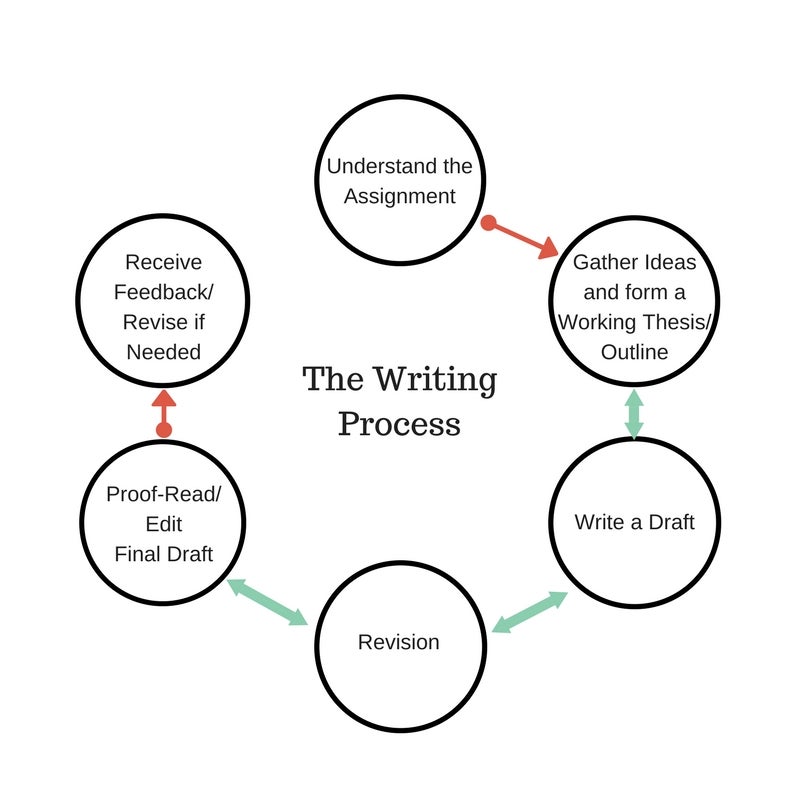


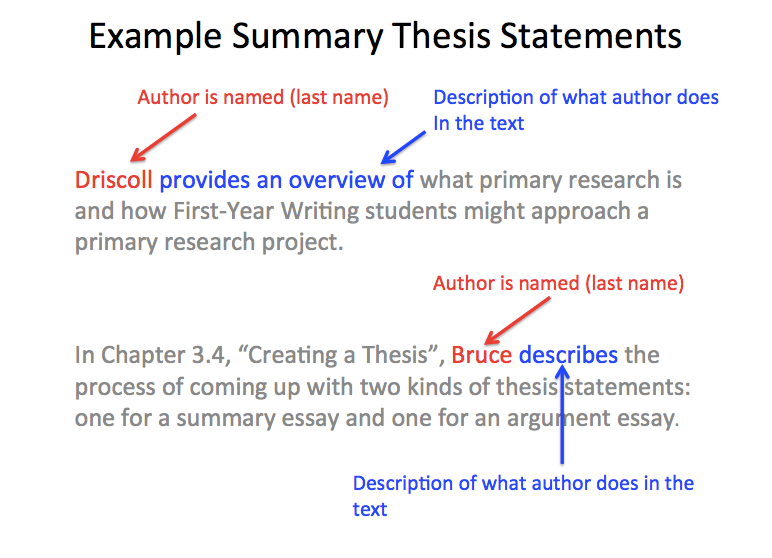
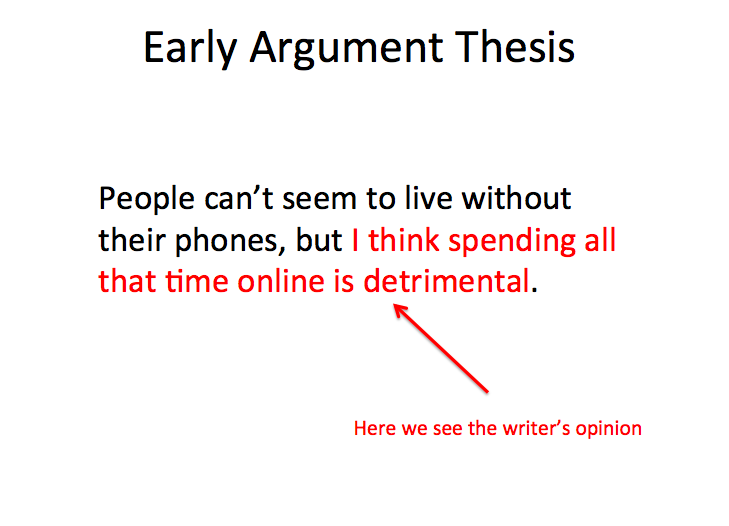
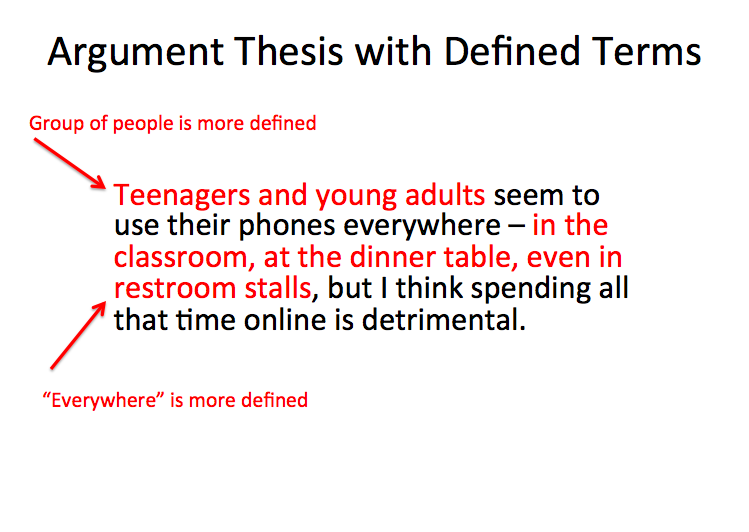
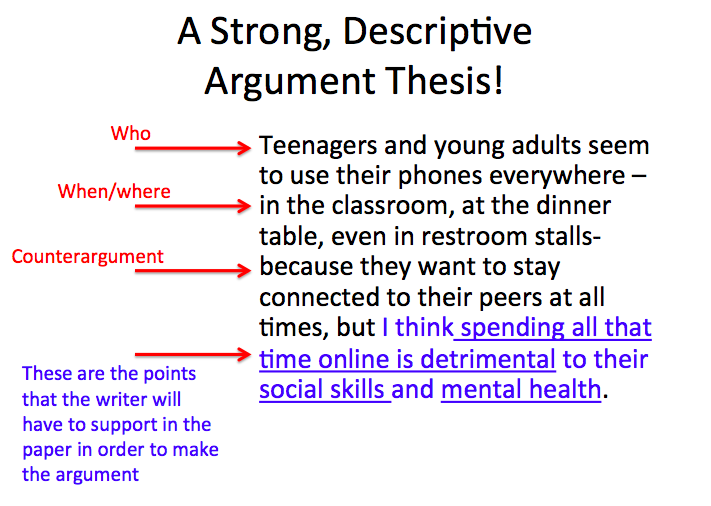


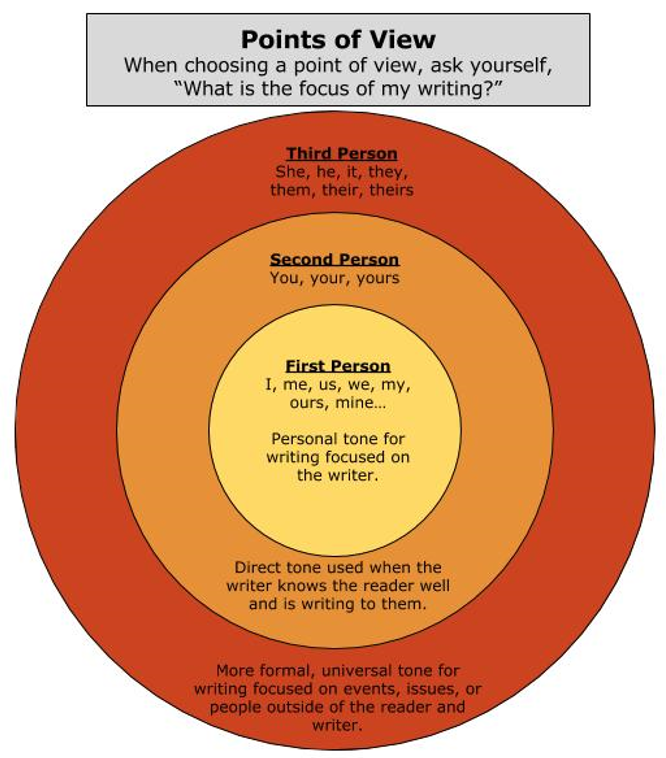





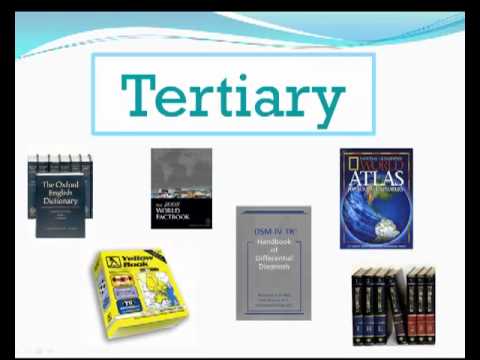
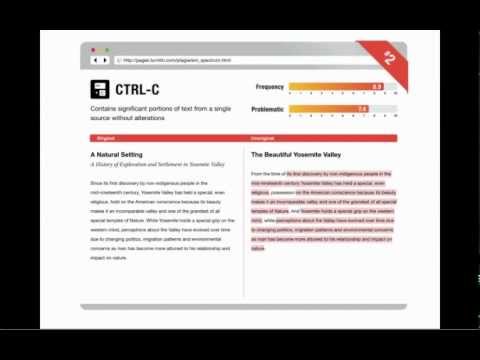
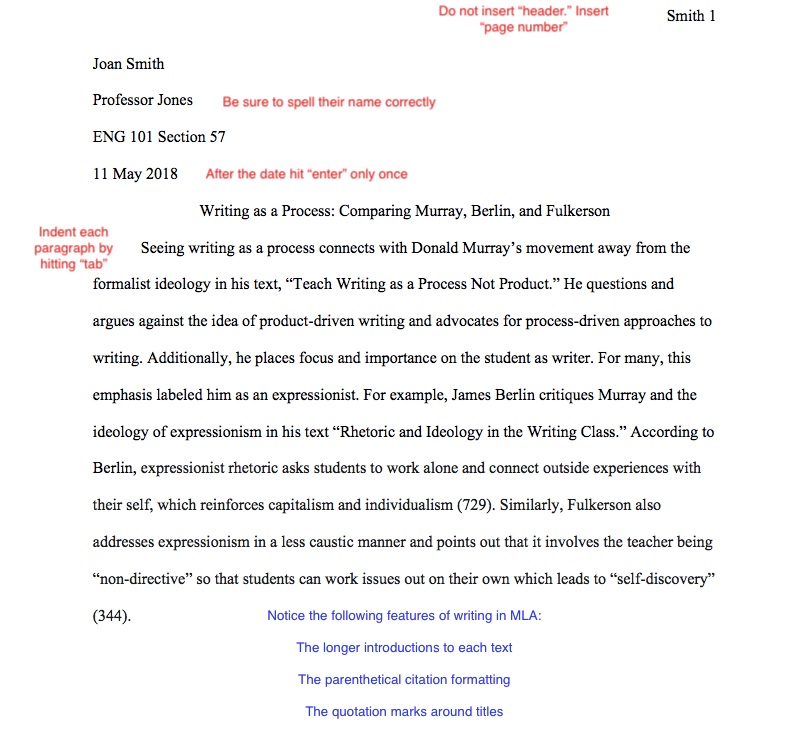
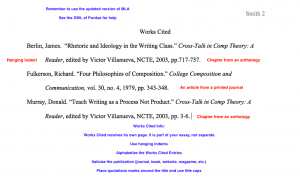
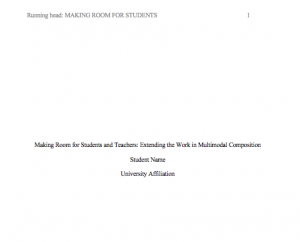
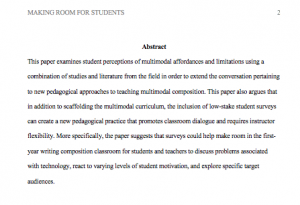
 Level 2 Heading