
An Ohioan’s Guide to State & Local Government by R. Clayton Wukich is licensed under a Creative Commons Attribution 4.0 International License, except where otherwise noted.
An Ohioan’s Guide to State & Local Government by R. Clayton Wukich is licensed under a Creative Commons Attribution 4.0 International License, except where otherwise noted.
Your personal journey is at the heart of this textbook. My goal is to help you become a more informed and active citizen. While this book does not endorse any political ideology, it strongly supports free speech and intellectual diversity. You are free to explore and espouse your political values to engage thoughtfully and constructively in civic life.
Throughout the textbook, you will find text boxes labeled “Foundational Facts”—short blurbs that connect the content to foundational documents and ideas. By “foundational documents,” I mean key texts that shaped our nation and state, such as the U.S. Constitution, the Bill of Rights, and landmark writings like the Federalist Papers, as well as Ohio-specific documents like our state constitution. These texts established principles that continue to influence us today, and I hope you’ll recognize the lasting impact of these ideas on our society and civic values.
Our content is especially relevant to Cleveland State University students because the book includes many examples from Northeast Ohio. Our emphasis on place-based learning means that you’ll gain insights directly relevant to your community or hometown. Throughout the textbook, you’ll find profiles of CSU graduates who have excelled in state and local government, often featured in sections titled “Levin Graduates Lead.”
CSU’s Levin School of Urban Affairs has a decades-long history of preparing people to lead in public service, regardless of party affiliation or political ideology. So, you’ll read about Democrats, Independents, Republicans, and nonpartisan officials who have made a difference in our region. Hopefully, some of you will be motivated to follow in their footsteps—or blaze entirely new trails.
The book builds on what you studied in high school where Ohio’s Learning Standards for Social Studies required you to study the three branches of government, checks and balances, federalism, and citizen rights and responsibilities. Ideally, your schools also encouraged you to get involved in positive, community-related activities. We will expand on this foundation with a focus on state and local government.
The book is organized into four major parts. The first part introduces the fundamental concepts and structures of state and local government, emphasizing their impact on our daily lives. The second part explains the workings of Ohio’s state government, detailing the roles and functions of its three branches. The third part focuses on local government, exploring the different types of local governance and their direct influence on communities. Finally, the fourth part reviews practical tools and strategies for civic engagement, helping you actively participate in shaping the future of your community and state.
The creation of this textbook was a collaborative effort between myself, several reviewers, and the generative AI application ChatGPT. My role included being the author, prompt engineer, editor, and content curator. The technology complemented my subject matter expertise, developed through my education, research, and professional experiences. I used ChatGPT to enhance and refine my outlines and drafts. Its search engine capabilities also informed the book’s case studies, short biographies, and my understanding of government policies and procedures. This fusion of expertise and technology helped create this textbook efficiently and tailor it for you.
Building on essential texts, including the United States Constitution, the Ohio Constitution, and the Ohio Revised Code, this book is also informed by resources like the Ohio Legislative Service Commission’s Guidebook for Ohio Legislators and textbooks such as Ohio Government and Politics by Paul Sracic and William Binning. Foundational theories from political science and public administration underpin much of the text. This combination of resources ensures that the book is both comprehensive and grounded in established scholarship, offering a solid framework for your study of Ohio’s government.
I would like to extend my gratitude to the reviewers who provided their invaluable insights. These reviewers, who come from Democratic, Independent, Republican, and nonpartisan backgrounds, have enriched this textbook with their diverse perspectives and expertise. Their thoughtful suggestions and constructive feedback have significantly enhanced the quality and depth of the content.
Reviewers:
Armond Budish
Caryn Candisky
Dave Greenspan
William Gruber
Earl Leiken
Robert Jaquay
Katura Pleasant was instrumental in this project, providing critiques, suggesting approaches, and finding video content to exemplify key concepts.
CSU faculty such as Leah Hudnall, Meghan Rubado, Stephanie Ryberg-Webster, and Roland Anglin provided valuable suggestions.
Special thanks go to Mandi Goodsett, Heather Caprette, and Diane Kolosionek for their dedication and hard work implementing CSU’s Affordable Learning initiative. Their commitment to tailoring textbooks to the specific needs of our students and reducing the costs of higher education is commendable. More people need to follow their example to make education more accessible and affordable for the people of Ohio.
Part I of this textbook introduces the key concepts and structures of state and local government, focusing on their impact on our everyday lives. The chapters in this section explain why understanding state and local government is important, what government is meant to do, and how it is organized to serve and protect its citizens.
Chapter 1 discusses why we should care about state and local government. It highlights how decisions made at these levels directly affect issues like education, public safety, and job opportunities. Chapter 2 explores the purpose of government and how it is structured in the United States, including the different roles of federal, state, and local governments. In Chapter 3, you will learn about different ways to participate in the political process, including ways to make your opinions heard.
Chapter 4 focuses on the foundations of Ohio’s government, including its history, constitution, and the evolution of its political system. Finally, Chapter 5 examines voter behavior and Ohio’s two-party system, explaining how elections work at the state and local levels and how different factors influence voter decisions.
This introduction sets the stage for the rest of the textbook and gives you the tools you need to engage with your community and government in meaningful ways.
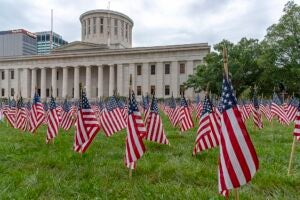
Above: The Ohio Statehouse, located in Columbus, serves as the seat of Ohio’s government, where legislators debate and enact state laws.
You should care about state and local government for four main reasons.
This chapter explains these three reasons in more detail and concludes with information about how to register to vote.
State and local governments may not always be in forefront of your mind, but their decisions directly impact your daily life in ways you might not realize. Understanding how these levels of government affect key issues like economic growth, public safety, and your college tuition rates can help you see why learning about them and staying informed is so important.
Your Job Prospects
Think about the jobs available in your community and the wages they offer. State and local governments are responsible for establishing sustainable tax rates, funding infrastructure like roads, rail, and airports (that support business growth), and subsidizing job training programs that prepare the workforce. For example, if your local government attracts new companies to your area, it can create more job opportunities and stimulate economic growth.
Your Tuition Bill
Speaking of workforce development, state governments subsidize state universities and therefore influence tuition rates. The cost of attending a state university can vary widely depending on the state’s funding priorities and its ability to make universities more efficient and accountable, directly affecting your ability to afford a quality education.
Your Safety
Effective public safety policies can reduce crime rates and make communities safer. State and local governments can invest in police departments, implement community policing, fund mental health services, and support neighborhood watch programs. Additionally, an effective criminal justice system that keeps violent criminals off the streets is key. By focusing on these measures, governments can create a more secure environment for everyone.
Your Environment
Every time you breathe clean air or drink clean water, you benefit from the environmental policies set by your state and local governments. These governments regulate emissions, manage waste disposal, and promote sustainable practices. Local initiatives, such as building metroparks, expanding urban green spaces, or restricting development in flood-prone areas, directly contribute to a healthier and safer environment.
Your Freedom
Beyond job prospects, safety, and the environment, state and local governments also impact your personal freedoms. These governments establish policies on issues that directly affect your rights and day-to-day choices. From setting laws about public assembly to creating regulations that affect personal privacy and how businesses operate, state and local decisions are key for maintaining your freedoms.
For example, if you’re passionate about a particular social issue—such as free speech, gun ownership, or reproductive rights—it’s important to know that many of the laws governing these rights are made at the state or local level. By staying informed and participating in state and local elections, you have the power to influence decisions that protect or expand your personal freedoms. Therefore, understanding state and local governments empowers you to advocate for the rights and freedoms that matter most to you.
State and local governments shape these policies and many others that affect so many aspects of your life. By understanding and engaging with these levels of government, you can help ensure that your community reflects your values and meets your needs. Whether it’s through voting in state and local elections, attending city council meetings, or participating in community initiatives, your involvement is crucial for making your voice heard to help build a better future for yourself and your community.
Another reason you should care about state and local government is simple—you pay for it. Every day, Ohio residents contribute to the work of government through taxes on property, income, and purchases.
According to the Tax Foundation, Ohioans face a combined state and local tax burden equal to about 8.9% of personal income. This means that, on average, Ohio residents pay nearly nine cents of every dollar they earn to state and local governments. That figure includes all types of state and local taxes—property taxes, state and local income taxes, and sales taxes—but does not include federal taxes paid to the IRS. For example, someone earning $50,000 per year would pay roughly $4,450 in total state and local taxes.
Ohio’s average effective property tax rate is about 1.30% of a home’s value, among the higher rates nationwide. These taxes fund schools, roads, police and fire departments, libraries, and many other services that shape everyday life.
Understanding how state and local governments collect, budget, and spend this money helps you see where your dollars go—and how your vote and voice influence the decisions that affect your community.
Knowing key tax terms like income, property, and sales taxes helps you recognize how governments raise money and why tax policy shapes the quality of local services. These definitions give you the language to follow and engage in conversations about how government is funded.
Another reason you should care about state and local government is that you can influence the policies they make. And beyond the laws and regulations government makes, you can also contribute in positive ways to your community. Civic engagement is the broad term for this participation.
Civic engagement means taking part in activities that improve your community or influence public life. It connects individuals to their neighbors, to community organizations, and to government. You can act on your own, such as writing to an elected official, or you can join with others through associations, advocacy groups, or volunteer programs. Civic engagement is important because it strengthens democracy, builds trust between people and institutions, and helps communities respond to challenges.
Some examples are about speaking your mind and influencing government decisions:
Other examples are more about serving the community and working alongside others:
No matter how you participate, civic engagement is about being connected to your community and taking responsibility for its future. Even small actions add up. Whether you vote, volunteer, or donate, your efforts contribute to a stronger community and a healthier democracy.
Caring about state and local government is not only about how it affects you or how you can influence it. It is also about fulfilling your civic responsibility. Living in a democracy comes with rights, but it also comes with duties.
Civic responsibility refers to the duties individuals have to support the well-being of their political community. These duties include voting in elections, following fair laws, serving on juries, and contributing to the common good through community service or other forms of participation. Staying informed about public issues is also part of this responsibility, because informed citizens are better able to hold leaders accountable and make thoughtful decisions.
Benjamin Franklin famously remarked at the close of the Constitutional Convention that the delegates had created “a republic, if you can keep it.” His words remind us that maintaining a democracy requires constant awareness and active participation from its citizens.
When people choose not to participate, decisions are left to a smaller group, and the system becomes weaker.

In the next chapter, we will return to the idea of civic responsibility when discussing the framers of the Constitution, the leaders who wrote and established the U.S. Constitution.
Several believed the government they designed could only succeed if citizens stayed engaged. In other words, the structure of the system alone was not enough. Democracy requires people to take part in order to work as intended.
Throughout this textbook, you will learn about ways you get involved in the political processes you care about. So, before we go any further, let’s start with the basics. Let’s make sure everyone knows how to register to vote.
You must be registered to vote to participate in elections, which allows you to help elect leaders and shape policies that align with your values and interests.
Eligibility to Vote in Ohio
To register to vote in Ohio, you must meet the following criteria:
How to Register
One of the easiest ways to register to vote is online through the Ohio Secretary of State’s website. You will need to provide some personal information, such as your name, address, date of birth, and either your Ohio driver’s license number or the last four digits of your Social Security number.
Here’s the link for more information and to register online: https://olvr.ohiosos.gov/.
Other Registration Methods
In addition to online registration, you can register to vote by:
Mail – Download and complete a voter registration form from the Ohio Secretary of State’s website and mail it to your county Board of Elections.
In Person – Visit your county Board of Elections, any Bureau of Motor Vehicles (BMV) office, or any designated agency providing public assistance or disability programs to register in person.
Registration Deadline
You must register to vote or update your voter registration no later than 30 days before an election.
Keeping Your Registration Updated
Ensure your voter registration is up-to-date, especially if you have moved or changed your name.
You can check your registration status and update your information online through the Ohio Secretary of State’s website: https://voterlookup.ohiosos.gov/.
By taking these steps, you ensure your voice is heard in the democratic process. Remember, your vote matters!
Foundational Facts
The right to vote is guaranteed by the U.S. Constitution, specifically through amendments such as the 15th, 19th, 24th, and 26th, which expanded voting rights over time.
The Ohio Constitution further protects this right at a local level, as outlined in Article V, Section 1, which establishes that every qualified citizen has the right to vote in elections.
From the schools we attend to the roads we travel, state and local governments shape the quality of our communities and the services we rely on every day. They influence our job prospects, protect (or infringe upon) our freedoms, and provide essential public services such as police, fire protection, and education. By learning how state and local governments operate, you can better understand how their decisions impact your life.
Remember, civic engagement is vital for a healthy democracy. Voting in local and state elections allows you to choose leaders who represent your priorities and influence decisions on critical issues like education, healthcare, and infrastructure. Beyond voting, engaging in your community and participating in other civic activities help ensure your voice is heard.
By being informed and active participants in the political process, you can contribute to your community and make a positive impact on the policies that shape your daily life.
Now that we have a better idea about why we should care about government, let’s explore its purpose and how it’s organized in the United States.
Government’s purpose is to establish a framework for order and justice, protect the rights and freedoms of individuals, and promote society’s general welfare. This includes keeping us safe and promoting economic stability. The government operates based on democratic principles, where elected officials create and enforce laws that reflect the will and needs of the people. Through its various branches and levels, the government seeks to balance individual liberties with the common good to foster a safe, fair, and prosperous society.
Maintaining Order & Security
The fundamental role of government in maintaining order and security is essential for a stable society. Governments create and enforce laws to ensure that citizens can live in peace and safety. Police work to prevent and respond to crime, while courts handle legal disputes and ensure justice is served. Additionally, governments maintain military forces to protect the country from external threats. By keeping the peace and protecting citizens’ rights, the government helps create an environment where people can go about their daily lives without fear. This stability is important for the well-being and prosperity of any community.
A critical aspect of maintaining order is upholding the rule of law. The rule of law means that laws are applied equally to everyone, ensuring fairness and justice regardless of a person’s status or power. It prevents abuse of power by ensuring that government officials are also subject to the law. This principle is vital for protecting individual rights and maintaining public trust in the government. When the rule of law is upheld, it ensures that laws are clear, publicized, and stable. This helps to maintain a predictable and orderly society. By enforcing laws fairly and consistently, the government fosters a sense of justice and security, which is fundamental for a functioning democracy.
Protecting Freedom and Liberty
The American system of government is designed to protect and guarantee several fundamental freedoms, often referred to as individual liberties. These freedoms are enshrined in the U.S. Constitution, particularly in the Bill of Rights, which comprises the first ten amendments. These amendments as well as state constitutions outline specific protections and rights that the government cannot infringe upon without due process and valid justification.
Freedom generally refers to the ability to act without constraints or interference. It is the power to make choices and pursue one’s own path. Liberty, on the other hand, is more specific and often relates to the protection of individual rights within a structured society. Liberty emphasizes the legal and institutional protections that safeguard individuals’ ability to exercise their freedoms. Understanding both concepts is essential to grasp the foundations of democratic governance and the protections offered to individuals in a free society.
Civil rights, which are a critical aspect of liberty, refer to the rights of individuals to receive equal treatment and be free from discrimination in various settings, including public institutions and employment. These rights are protected under federal, state, and local laws and are essential for ensuring that all citizens can fully participate in society without facing unfair barriers.
Freedom of Speech and Press – The First Amendment guarantees the freedom of speech and the press, allowing individuals to express their opinions and share information without fear of government censorship. However, this freedom is not absolute; for example, it does not protect speech that incites violence or panic, such as falsely yelling fire in a crowded theater. These limits ensure a balance between free expression and public safety.
Freedom of Religion – The First Amendment also ensures freedom of religion, protecting individuals’ rights to practice any religion or none at all. It prevents the government from establishing an official religion or favoring one religion over another.
Freedom of Assembly and Petition – The First Amendment protects the right to peacefully assemble and petition the government for redress of grievances. This allows people to gather for protests, rallies, and other forms of collective action to express their views and seek changes.
Right to Bear Arms – The Second Amendment guarantees the right to bear arms, originally tied to the necessity of a well-regulated militia for the security of a free state. It allows individuals to own and carry weapons, with some regulations in place to protect public safety.
Protection Against Unreasonable Searches and Seizures – The Fourth Amendment protects individuals from unreasonable searches and seizures by the government. It requires law enforcement to obtain a warrant, based on probable cause, before conducting searches.
Rights of the Accused – The Fifth and Sixth Amendments provide several protections for individuals accused of crimes. These include the right to know what you’re accused of, the right to a fair trial, protection against self-incrimination, the right to legal counsel, and protection against double jeopardy (being tried twice for the same crime).
Protection Against Cruel and Unusual Punishment – The Eighth Amendment prohibits excessive bail, excessive fines, and cruel and unusual punishment. This ensures that punishments are fair and proportionate to the crimes committed.
Right to Vote – The right to vote is a cornerstone of democracy, protected by several constitutional amendments. The Fifteenth Amendment prohibits denying the right to vote based on race, the Nineteenth Amendment guarantees women’s suffrage, and the Twenty-Sixth Amendment lowers the voting age to 18. This right ensures that citizens can participate in the electoral process and have a voice in their government.
These freedoms are guaranteed through a system of checks and balances within the American government, with states like Ohio playing a crucial role in protecting freedom and liberty through laws, regulations, and institutions. The state constitution outlines citizens’ fundamental rights, while the judicial system ensures these rights are upheld. Civic engagement and government participation are promoted, encouraging transparency and accountability. Understanding state government is essential, as Ohio’s legislative, executive, and judicial branches work together to create, implement, and interpret state laws, thereby safeguarding the freedoms and liberties of its people.
Foundational Facts
The Bill of Rights refers to the first ten amendments to the United States Constitution, which guarantee fundamental liberties such as freedom of speech, religion, and the press, as well as protections against governmental abuse. Ohio also has its own Bill of Rights within the state constitution, which provides similar protections for Ohio citizens at the state level.
Promoting Society’s General Welfare
Providing public services and infrastructure is a crucial role of the government. This means making sure people have access to essential services like education, healthcare, and transportation. Governments build and maintain schools, hospitals, roads, bridges, and public transportation systems to help communities run smoothly. They also ensure that clean water, sanitation, and waste management services are available to keep communities healthy and safe. By providing these services, the government helps improve the quality of life for all citizens and supports the overall development and progress of society.
Promoting economic stability and social welfare is another key role of government. Governments work to keep the economy strong and stable by creating a supportive business environment and regulating businesses when needed. They also create programs to help people who are struggling, like unemployment benefits, food assistance, and affordable housing. By making sure the economy is healthy and providing a safety net for those in need, the government helps reduce poverty and inequality.
Representing Citizens
Representing citizens is another fundamental role of government, deeply rooted in democratic values. In a democracy, the government is elected by the people and works on their behalf. This means that citizens have the power to choose their leaders through free and fair elections. By representing everyone, the government ensures that diverse perspectives and needs are considered in decision-making. This inclusivity helps create policies that benefit a wide range of people, promoting fairness and equality. When everyone feels represented, it strengthens social cohesion and trust in the government, leading to a more stable and harmonious society.
Democracy also emphasizes transparency, accountability, and civic engagement. Governments are required to operate openly so that citizens can see and understand how decisions are made. Transparency is the practice of openly and honestly sharing information, actions, and decision-making processes with the public to ensure accountability and trust. Accountability means that government officials are responsible for their actions and must answer to the public. Civic engagement relates to ways citizens get involved in the political process, whether by voting, attending public meetings, or joining civic groups. By upholding these democratic values, the government builds public trust, holds officials accountable to the community, and empowers citizens to actively participate in shaping their society.
When citizens know their voices matter, they are more likely to engage in civic activities and contribute positively to their communities. This active participation not only helps to address local issues more effectively but also strengthens the overall democratic process. By valuing and encouraging citizen involvement, the government can create a more dynamic and responsive political system that better serves the needs of all its people.
Two key government goals—keeping order and protecting personal freedoms—can sometimes clash. Societies need laws and systems to stay safe and stable, but if rules are too strict or power goes unchecked, people’s freedoms might be limited. On the other hand, if people have complete freedom without any rules, it can lead to chaos, harm, and a breakdown of safety and stability in society.
The framers of the Constitution recognized this dilemma and created a system of ordered liberty.
Ordered liberty is the idea that while individual freedoms are protected, some rights may be limited to ensure public safety, social stability, and the protection of others’ rights. It reflects the trade-off between personal autonomy and the need for laws that create a functioning society. This concept highlights that liberty is not absolute but operates within a framework of rules designed to benefit both individuals and the community as a whole.
This principle is central to American government and constitutional law. For example, the freedom of speech is a fundamental right, but it is not unlimited—speech that incites violence or threatens public safety can be restricted. Similarly, zoning laws may limit how private property is used to prevent harm to neighbors or preserve the character of a community. These limitations on absolute freedom are what make ordered liberty different from pure liberty, which would prioritize individual rights without regard to societal consequences.
The framers of the Constitution designed a system of ordered liberty to balance individual freedoms with the collective needs of society. The idea was not make sure certain personal rights were protected while maintaining the stability necessary for a functioning government.
Reference
Morgan, Douglas F, Richard T Green, Craig W Shinn, Robert K Robinson, and Margaret E. Banyan. 2022. Foundations of Public Service. 3rd ed: Routledge.
The United States has three levels of government: federal, state, and local.
While all levels of government play important roles, the federal government has a much broader scope and handles many issues that state and local governments cannot address independently.
It’s important to understand how different levels of government operate within our system of federalism. Federalism is the division of power between the national government and the states. Our federal government was created when the states came together and ratified the Constitution, which applies to the entire nation. The Constitution outlines the powers of the federal government, and federal law is the highest law in the country. This reflects the principle of constitutionalism—the idea that government authority comes from and is limited by a fundamental law. In the United States, all government actions must conform to the Constitution, which both establishes the framework of government and protects individual rights.
However, states are not just parts of the federal government; they are independent entities that retain all powers not specifically given to the federal government by the Constitution, as stated in the Tenth Amendment. In contrast, local governments are subdivisions of the states and operate under the authority granted to them by the state government.
While we focus on the state and local levels throughout this book, knowing the basic structure of American government helps you understand who to turn to when you have issues or questions. It also makes it easier for you to get involved in your community and make informed decisions when voting or participating in civic activities. By knowing how each level of government works, you can better understand how policies and laws affect your daily life.
Foundational Facts
The Federalist Papers are a collection of essays by James Madison, Alexander Hamilton, and John Jay, all of whom played key roles in shaping the U.S. Constitution—particularly Madison, often called the “Father of the Constitution.” The essays offer insights into what the framers intended and the key principles behind America’s system of government. The Federalist Papers help us understand the ideas and debates that shaped how our government is structured and the protections it offers.
In Federalist No. 45, James Madison describes federalism as a system that divides power between the national and state governments, each responsible for different areas of governance. While the federal government addresses national priorities, states like Ohio focus on issues that directly impact residents’ daily lives. This structure allows Ohio to shape policies on matters such as local education standards and public safety.
However, over time, the balance Madison envisioned shifted, as the federal government took a more active role in matters ranging from regulating interstate commerce to protecting civil rights and funding education.
Indigenous Influences
The Iroquois Confederacy, also known as the Haudenosaunee or “People of the Longhouse,” was a powerful alliance of six Native American nations: the Mohawk, Oneida, Onondaga, Cayuga, Seneca, and later, the Tuscarora. It is considered one of the oldest participatory democracies in the world and is cited as an influence on the development of American federalism.
Their system of government, known as the Great Law of Peace, created a way for these different groups to work together while still allowing each nation to govern itself. The Great Law of Peace can be understood as a constitution in a broad sense, though it differs significantly from the written constitutions familiar in Western political traditions. It served as the foundational framework for the governance of the Iroquois Confederacy by providing guidelines for maintaining peace, unity, and collective decision-making among the member nations.
Some historians suggest that this confederacy inspired the framers of the U.S. Constitution, particularly the concept of federalism, where power is shared between a central authority and individual states. In a 1751 letter, Benjamin Franklin admired how the Iroquois united under a single framework and maintained autonomy. He argued that the American colonies could learn from their example.
In the previous section, we referenced James Madison as the “Father of the Constitution.” To understand his thinking, it helps to know the ideas that influenced him.
John Locke’s Two Treatises of Government (1689) argued that government must rest on the consent of the governed, that people have natural rights to life, liberty, and property, and that power should be divided among separate branches. Madison had read this work and worried about tyranny. Tyranny refers to the unfair and oppressive use of power by a government or ruler.
Because of this concern, Madison wanted safeguards that would prevent the abuse of power. Abuse of power happens when leaders use their authority dishonestly, unfairly, or for personal gain instead of serving the public.
To limit this risk, Madison supported the principles of separation of powers and checks and balances.
Together, these safeguards make it harder for tyranny or abuse of power to take hold.
We will explore these ideas further in Chapter 4 – Foundations of Ohio Government.
Along with creating safeguards against tyranny, Madison also recognized the importance of citizens taking an active role in their government.
Again, he was influenced by John Locke, who emphasized that governments derive their legitimacy from the consent of the governed. He also was influenced by Jean-Jacques Rousseau, whose Social Contract (1762) stressed the ideas of popular sovereignty and civic responsibility:
These ideas shaped the design of American government.
Throughout this textbook, we will continue to explore civic responsibility and the role you can play in participating in public life.
Representative Democracy
One of the primary ways Americans fulfill their civic responsibility is through participation in our representative democracy. This is a system of government in which citizens elect representatives to make decisions and pass laws on their behalf.
Representative democracy relies on elected officials to act in the best interests of the people. Ideally, this means that the diverse views and needs of the population are considered in governance. But it also requires citizens to communicate their views and needs to those in office.
Foundational Facts
In Federalist No. 10, James Madison explains how representative democracy helps protect against groups with extreme interests and supports a government that works for everyone’s benefit. By electing representatives, citizens create a government that can balance competing interests and make decisions for the common good. Madison argued that a republic enables “a delegation of the government… to a small number of citizens elected by the rest,” allowing for thoughtful and informed decision-making on behalf of the people. But it only works if people make their voices heard.
Watch this video from Khan Academy to learn more about Madison’s argument:
YouTube URL: https://www.youtube.com/watch?v=afRanGsRlOc
Duration: 9:56
When designing the Constitution, Madison and other framers worried not only about tyranny from a king or dictator but also about the danger of a majority suppressing minority interests. This problem is called the tyranny of the majority. In a pure democracy, the will of the majority could override the rights of smaller groups, leading to unfair or oppressive outcomes.
To guard against this, the Constitution built in protections such as the separation of powers, a bicameral legislature, judicial review, federalism, and the Bill of Rights.
While minority voices are often silenced in practice, these safeguards make it harder for majority rule to permanently override their rights. By slowing down decision making and requiring compromise, the system helps government policies balance a wider range of interests.
Pluralism is the idea that power in a democracy is shared among many groups rather than controlled by a single majority or elite. As a description, pluralism explains how different groups such as business associations, labor unions, advocacy organizations, and civic groups compete to influence government. This competition helps prevent any one group from dominating the political system.
As a value, pluralism reflects the belief that a healthy democracy should provide space for many voices to participate, negotiate, and shape decisions.
Pluralism is closely tied to the First Amendment rights of free speech, assembly, and petition. When groups organize around shared interests, they can make their voices heard through lobbying, campaigns, or public demonstrations.
Foundational Facts
In Federalist No. 10, James Madison warned about the danger of factions. He defined a faction as a group of citizens united by a shared interest that might harm the rights of others or go against the common good. Madison argued that it was impossible to remove factions without also removing liberty, so the best solution was to control their effects.
His answer was a large republic with many competing interests. In such a system, no single faction could dominate because power would be divided among many groups. This vision closely resembles what later scholars, including Robert Dahl, called pluralism: a democracy where multiple groups compete, negotiate, and limit each other’s power.
Robert Dahl was an American political scientist who studied politics in New Haven, Connecticut. In his 1961 book Who Governs, he argued that pluralism best describes how power works in American democracy.
A few key points from Dahl’s findings include:
His study became a classic defense of pluralism and showed that democracy in practice is less about direct majority rule and more about organized groups negotiating outcomes.
Critiques of Pluralism
While Dahl’s research presented pluralism as a fair and competitive system, later scholars pointed out important limits. Not all groups have the same resources or opportunities to organize. Wealthy or well-connected groups may gain easier access to officials, while others face barriers.
For example, in the mid-20th century, Black residents and many ethnic minorities in cities like New Haven were often excluded from meaningful participation in decision making. Discrimination, unequal political representation, and social barriers limited their ability to form powerful organizations or influence policy. Critics argued that pluralism in practice did not always guarantee inclusion for marginalized groups.
Marginalized people and groups are those who face barriers to full participation in society. They may be excluded from political, economic, or social opportunities because of their race, ethnicity, income level, gender, religion, or other characteristics. This exclusion can mean having less access to good jobs, quality education, or representation in government. Being marginalized does not mean being completely without voice or power, but it does mean facing disadvantages that make it harder to shape decisions that affect daily life.
Single-Party Control
Pluralism depends on competition among multiple groups and perspectives. Single-party control occurs when one political party dominates government for an extended period of time, even if other parties are legally allowed to compete. When this happens, the competition that makes pluralism effective can weaken. Debate narrows, accountability declines, and marginalized groups may find it even harder to gain access to decision-making. A pluralist system works best when there is ongoing activity by many parties and interest groups that push leaders to compromise and respond to different viewpoints.
Comparing Tyranny of the Majority and Pluralism
Pluralism and tyranny of the majority highlight different challenges for democracy. Tyranny of the majority warns against the danger of one large group silencing minorities through direct control. Pluralism, in contrast, shows how many groups can compete for influence, but also reveals the danger that some groups—especially those without money or political connections—may still be excluded. Both ideas remind us that democratic systems work best when power is checked, voices are balanced, and all communities have real opportunities to participate.
| Tyranny of the Majority | Pluralism |
| Majority group can use its power to silence or oppress minority groups. | Many groups compete for influence, which prevents domination by a single majority. |
| Problem: Minority rights can be trampled if majority rule goes unchecked. | Problem: Not all groups have equal resources, so some—such racial or ethnic minorities—may still be excluded or marginalized. |
| Emphasizes the risks of unchecked majority rule. | Emphasizes the benefits and limits of group competition in democracy. |
| Raises the question: How do we protect minority rights? | Raises the question: How do we make sure all groups truly have access to decision-making? |
Takeaway: Both concepts help explain how democracy can fail groups of people—either through domination by a majority or through exclusion from pluralist competition. A healthy democracy must address both dangers.
The federal government of the United States is designed to handle national and international issues, ensuring a unified approach to governance across the country. It is organized into three branches: legislative, executive, and judicial.
The legislative branch, known as Congress, holds the power of the purse and is responsible for making laws. The power of the purse refers to Congress’s authority to control government spending and allocate funds. Congress is divided into two parts: the House of Representatives and the Senate. Representatives and senators are elected by the people and work to pass laws that address national concerns such as defense, taxation, and interstate commerce.
The executive branch is headed by the President, who is responsible for enforcing the laws passed by Congress. The President also acts as the commander-in-chief of the armed forces and conducts foreign policy by negotiating treaties and representing the United States in international matters. The executive branch includes various federal agencies and departments, each tasked with specific functions, such as the Department of Education and the Department of Transportation, to implement and manage federal policies and programs.
The judicial branch, led by the Supreme Court, interprets the laws and ensures they are applied fairly. The Supreme Court has the power to review laws and executive actions to determine if they are constitutional. This system of checks and balances among the three branches ensures that no single branch becomes too powerful, maintaining a balance of power that is fundamental to the democratic system of the United States. By understanding how the federal government works, citizens can better grasp how national decisions are made and how these decisions impact their lives.
Foundational Facts
The U.S. Constitution creates the structure of the federal government via its three branches—legislative, executive, and judicial. Articles I, II, and III define each branch’s powers and responsibilities.
This design distributes power and responsibilities across different areas of government to prevent any one branch from becoming too powerful.
This section introduces you to the structure and functions of state government, focusing on its three branches: legislative, executive, and judicial. Together, these branches form the framework of state government.
The legislative branch, composed of the state House of Representatives and the state Senate, controls spending and allocates funds. This gives them considerable power over the state’s priorities and actions. They also make laws covering a wide range of areas, including education, transportation, health, and public safety. For example, the legislature passes laws that determine school funding, establish state tax rates, and regulate public utilities. Through their legislative actions, they shape the daily lives of Ohioans by setting the rules and frameworks within which the state operates.
The executive branch, headed by the governor, is tasked with implementing and enforcing state laws. The governor oversees state agencies and appoints heads of departments such as education, transportation, and health, ensuring that these departments function effectively and efficiently. In times of emergency, such as natural disasters or public health crises, the governor has the authority to issue executive orders to manage and mitigate the situation swiftly. This branch ensures that the laws created by the legislature are put into action and that the state’s operations run smoothly.
The judicial branch interprets state laws and ensures that justice is served. State courts handle civil and criminal cases, as well as appeals from lower courts. The state supreme court, for example, has the power to rule on the constitutionality of state laws, ensuring they align with both the state and U.S. Constitutions. This branch plays a crucial role in maintaining the rule of law and protecting the rights of citizens by providing a mechanism to resolve disputes and review the legality of legislative and executive actions.
Understanding the structure and function of these branches is essential for grasping how state government operates and impacts the lives of its citizens.
Now, what do local governments do?
Cities, townships, and villages are responsible for providing services directly to Ohio residents, such as police and fire protection, building inspection, sanitation, and road maintenance. They can pass ordinances (i.e. local laws) related to zoning (e.g., determining what can be built and where), public safety, noise control, property maintenance, and other matters. These regulations are designed to maintain order, protect public health and safety, and ensure the general welfare of the community. Ordinances are enforced by local authorities and can result in fines or other penalties if violated.
Counties in Ohio manage broader services that span multiple municipalities, such as countywide transportation systems, public health services, and libraries. They are often called the “branch offices” of state government because they carry out state-mandated functions at the local level. For example, counties oversee election administration and play a crucial role in court administration, supporting the operation of common pleas courts, probate courts, and other judicial functions within the county.
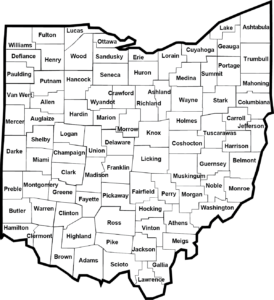
Did you know school districts are a type of local government?
School districts are responsible for the administration and operation of public schools within a specific geographic area. Each school district is governed by an elected board of education, which sets policies, approves budgets, and oversees the district’s superintendent. School districts are tasked with ensuring educational standards, managing school facilities, hiring teachers and staff, and providing transportation for students. They are funded through a combination of local property taxes, state funding, and federal grants.
This semester you will also learn about other types of special districts.
In Ohio, special districts are a type of local government created to provide specific services or programs within an area defined by the state legislature. Unlike general-purpose governments, special districts focus on a single function or a set of related functions. Examples of special districts include library districts, regional water and sewer authorities, and transit and port authorities. Each special district has its own governing body, which is established by state law and varies based on the type of district. These districts can span multiple municipalities or be part of a single local government, allowing them to address specialized needs efficiently.
Reference
Bethel, Alyssa. 2015. Overview of Ohio Local Government. Ohio Legislative Service Commission. Columbus, OH.
In this chapter, we explored the fundamental purposes of government and how it is organized in the United States. The government’s main objectives are to establish order and justice, protect individual rights and freedoms, and promote the general welfare of society. This information empowers you to take the next step in learning about how you can participate in the democratic process.
In this chapter, we’ll explore the basics of politics, the importance of understanding your political values, and the role of the media in shaping your opinions. You’ll also review practical strategies for civic engagement and how to critically evaluate the information you encounter. This knowledge will empower you advocate for your beliefs and contribute to the democratic process.
Politics is the process by which individuals and groups decide on rules, laws, and policies that affect everyone. At its best, the goal of politics is to organize our collective lives in a way that helps us live together peacefully and share access to goods and services we could not secure alone. It involves discussion, debate, compromise, and above all, cooperation.
While politics has often been described as a struggle for power and resources, it does not always have to be framed as a contest with winners and losers. Political scientist Harold D. Lasswell defined politics as “who gets what, when, and how.” This definition highlights the distribution of resources and power, but it does not preclude fairness, balance, or mutual benefit.
Decisions about “who gets what” can be made through competition, but they can also be shaped by compromise and collaboration.
In practice, politics often requires people with different viewpoints to sit down together, find areas of agreement, and work toward solutions that balance competing needs. Power and resources can be shared within communities in ways that allow many voices to be heard and many interests to be met.
Cooperation does not erase conflict, but it creates space to focus on common goals rather than permanent divides.
By examining the workings of state and local government, we see politics as more than a series of struggles. The compromises and cooperative decisions made in city councils and the General Assembly demonstrate how people with diverse perspectives can find common ground and create policies that serve the broader community.
Compromise in Politics
Compromise is often easiest to achieve when elected officials belong to the same political party. Shared values, priorities, and party platforms give them a common starting point for negotiation. This does not mean agreement comes automatically. Differences in region, constituency needs, and personal beliefs still matter, but there is usually more room to work things out.
Between opposing parties, however, compromise is harder to find. Deep differences in ideology, electoral competition, and polarized political climates often make cooperation rare. In today’s politics, we see more examples of gridlock than genuine give and take. Gridlock occurs when opposing sides are unable to reach agreement, which prevents action or decision-making from moving forward.
This textbook will return to this theme again and again. Whether we are examining state budgets, city councils, or nonprofit coalitions, the question of when compromise happens and when it breaks down will be central to understanding how public service decisions are made.
References
Barbour, Christine, and Gerald C. Wright. 2015. Keeping the Republic: Power and Citizenship in American Politics. 7th ed. Thousand Oaks, CA: CQ Press.
Lasswell, Harold D. 1936. Politics: Who Gets What, When, How. New York: Whittlesey House, McGraw-Hill Book Co.
Political values are the basic beliefs and principles that shape how people think about government, politics, and society. They guide opinions on issues, and they influence how individuals vote, engage in civic life, and view public policies.
Let’s learn more about our own personal political values. What do you care about?
Kenneth Janda, another well-known political scientist, outlines three core political values: freedom, order, and equality. These values form the foundation of political ideologies and influence how individuals and societies prioritize policies and governance.
Freedom
Again, freedom refers to the ability of individuals to act and think without undue restriction. It is one of the most central political values in American society because it emphasizes personal liberty and autonomy. People often point to freedom as the reason they participate in politics, protect rights, and debate the limits of government power.
Examples of freedoms include:
Freedom does not mean the absence of all rules, but rather that individuals have wide room to make choices in their personal lives while still living within a society governed by laws. The ongoing challenge in politics is deciding where the line should be drawn between individual liberty and the responsibilities of the community.
Think About It
Which freedoms matter most to you? Reflect on how your personal values connect to the idea of freedom and consider examples from your own life.
Order
Order represents the need for a stable and structured society where laws and regulations maintain public safety and social cohesion. Without order, individuals could not fully enjoy their freedoms, and communities would struggle to function. Government institutions and rules provide the framework that allows people to live together peacefully and predictably.
Examples of order include:
Order does not mean eliminating freedom. Instead, it reflects the idea that some rules are necessary for society to function and for individuals to live safely and fairly alongside one another.
Think About It
How important is order in your life? Consider the rules and institutions you rely on every day, from traffic lights to schools to public safety, and reflect on how they shape your values about order.
Equality
Equality involves the pursuit of fairness and justice, providing that all individuals have equal access to opportunities and resources. It is one of the core values of democracy and has been at the center of many of the nation’s most important social and political struggles. Equality does not mean that everyone will have the same outcomes, but it does mean that people should have the same opportunities and be treated fairly under the law.
Examples of equality include:
Equality often develops through collective action and legal change, as communities and governments respond to demands for fair treatment. Many of the most significant reforms in American history have been aimed at expanding equality and making sure the promise of democracy applies to everyone.
Think About It
What examples of equality matter most to you? Reflect on where you see fairness in your community and where you think more progress is still needed.
Conflicting Values
However, these values can sometimes conflict with each other. Let’s first discuss the conflict between freedom and order. The tension arises because maximizing freedom can lead to disorder, as individuals may act in ways that conflict with others or undermine societal stability. Conversely, maximizing order can infringe on personal freedoms, as strict laws and regulations may limit individual autonomy and rights.
This video explores the extremes of prioritizing either complete freedom or absolute order. It highlights the challenges and consequences of both approaches.
YouTube URL: https://www.youtube.com/watch?v=zL2LMTRoWlA
Duration: 1:53
Reflect on what happens when societies focus solely on individual freedom or rigidly enforce order, and how finding a balance between the two is essential for stability and justice.
Another conflict pits freedom against equality. The tension arises because policies designed to promote equality often require some level of government intervention and redistribution of resources, which can be seen as infringing on individual freedoms. For example, implementing universal healthcare for everyone would require significant taxation, which would infringe on the personal freedom of others to do what they want with their money.
Conversely, maximizing personal freedom can lead to significant inequalities, as individuals with more resources or advantages can leverage them to gain even more benefits, leaving others behind. A simple historical example is the rise of wealthy industrialists during the Gilded Age, sometimes called “robber barons.” They had the freedom to operate with little regulation, which allowed them to amass enormous fortunes while many workers struggled in unsafe jobs with very low pay. Consumers were also affected, as monopolies limited competition and reduced their choices. This led to high prices because companies no longer faced pressure to keep costs low or improve quality when they controlled the market.
By reflecting on these themes and their conflicts, you can begin to explore your own political values, considering which aspects you prioritize and how these preferences shape your views on government and policy.
Reference
Janda, Kenneth, Jeffrey M Berry, and Jerry Goldman. 2012. The Challenge of Democracy. 11th ed. Boston, MA: Wadsworth.
Political socialization is the process through which people develop their political values and beliefs. It begins in childhood and is shaped by many influences, including family, religion, schools, peers, media, and major political events. Where someone lives, their socioeconomic status, and their education also may influence their beliefs.
We will revisit political socialization in more detail in Chapter 5.
Think About It
In the meantime, reflect on what has influenced you. Which people, places, or experiences have shaped your views about government and politics?
Understanding your political values and the issues that matter most to you is a big part of civic engagement. Your political values shape your opinions, influence your decisions, and guide your actions as a citizen. They help you determine what you believe is the best way to organize society and govern communities. Identifying these values can be a reflective and enlightening process.
The Right to Develop Your Own Political Values
In the United States, every citizen has the right to develop their own political values. This right is enshrined in the First Amendment of the U.S. Constitution, which guarantees freedom of speech and the freedom to express one’s beliefs and opinions. The value of open and rigorous debate is central to American democracy, allowing diverse perspectives to be heard and considered. Engaging in discussions about political ideas helps you refine your own views and understand those of others, fostering a more informed and active citizenry.
Finding Your Political Values & Exploring the Issues You Care About
To identify your political values, consider what principles and ideals are most important to you. Do you prioritize individual freedoms or collective responsibilities? How do you view the role of government in addressing economic and social issues? Reflect on your experiences, education, and the influences in your life that have shaped your beliefs. Pay attention to the issues that evoke strong feelings or compel you to act, as these are often tied to your core values.
Think about the issues that you are passionate about. These might include education, healthcare, the environment, economic policy, social justice, or poverty and housing. Understanding which issues matter most to you will help you engage more effectively in political discussions and advocacy. Being informed about these topics enables you to make educated decisions when voting, participating in community activities, or engaging with policymakers.
Questionnaire – Pew Research Center’s Political Typology Quiz
To help you explore your political values and see where you fit in the broader political landscape, take the Pew Research Center’s Political Typology Quiz. This quiz categorizes individuals into one of nine political typology groups based on their responses to various questions about political beliefs and values. The results can provide insight into your political identity and how it compares with others across the United States. This will help inform your experience as you move through this book.
Take the “quiz” to find out which one of our nine political typology groups is your best match, compared with a nationally representative survey of more than 10,000 U.S. adults by Pew Research Center. You may find some of these questions are difficult to answer. That’s OK. In those cases, pick the answer that comes closest to your view, even if it isn’t exactly right.
This exercise is for your personal exploration. It won’t be graded, and the instructor won’t see your results. Use this opportunity to gain a deeper understanding of your political values and how they align with different perspectives within the American political spectrum.
You need reliable information to inform your opinions and decisions about politics. But have you ever thought about where you get the information from?
The problem with much of the information circulating these days is that it can be biased, misleading, or downright false. This misinformation can lead to polarized opinions, mistrust in public institutions, and poor decision-making among citizens. By becoming more critical about your information sources, you can ensure that your views and actions are based on accurate information.
Information literacy in politics is the ability to effectively locate, evaluate, and use political information to make informed decisions, engage in civic discourse, and participate in democratic processes. Let’s explore how you can stay informed.
Understand the difference between fact-based reporting and opinion content. Fact-based reporting aims to present verified information and events as they are, adhering to journalistic standards of objectivity and accuracy. This type of reporting is typically found in the main sections of newspapers and in the news segments of cable news channels. On the other hand, opinion programming on cable news and the editorial section in newspapers provide analysis and viewpoints that reflect the author’s or the network’s perspective. While these can offer valuable insights, they are inherently subjective and should be approached with a critical mind to distinguish between facts, personal opinions, and the goals of the information providers.
To better understand what makes journalism reliable, watch the director of the Ethical Journalism Network describe the core values of ethical journalism:
YouTube URL: https://www.youtube.com/watch?v=uNidQHk5SZs
Duration: 2:54
Diversify your sources. To get a well-rounded view of political issues, you should read news from multiple outlets. This means not just sticking to one newspaper or TV channel but exploring a variety of reputable sources, including newspapers, TV stations, and online platforms. Reading from sources that span the ideological spectrum can provide a more balanced perspective and help you understand different arguments and viewpoints.
Don’t let algorithms force you into an echo chamber. An echo chamber is an environment where a person only encounters information or opinions that reflect and reinforce their own. This can be a negative thing because it limits exposure to diverse perspectives and critical thinking, potentially leading to a skewed or biased understanding of issues. Social media applications use algorithms that show you content similar to what you’ve already engaged with, which creates echo chambers. To counter this, diversify your feed by following a broad range of individuals, organizations, and media outlets to expose yourself to different viewpoints and information.
Prioritize reputable sources. Local newspapers and TV stations are valuable to the extent they adhere to rigorous journalistic standards and implement strong fact-checking processes. They often provide insights into regional issues and politics that the national media fail to cover.
Check for bias and verify information. Always be on the lookout for bias in what you consume. Fact-checking websites like FactCheck.org, PolitiFact, and Snopes can help verify the accuracy of claims and statements made in the news. It’s also wise to cross-reference stories by checking multiple sources to confirm their validity, especially if a story appears in only one outlet or lacks verification.
Whenever possible, read primary sources such as government reports, official statements, and public records. These documents provide direct insights without the filter of media interpretation. Additionally, follow official communications from political figures and institutions through their websites or verified social media accounts for firsthand information.
Always question your information sources. Consider who wrote the article, their potential biases, and what evidence they provide to support their claims. Articles that cite sources, provide data, and link to original documents or studies are generally more reliable.
By following these steps, you can enhance your ability to find accurate information, make informed political decisions, and engage effectively in civic activities. Becoming a critical consumer of information is not just about being well-informed; it’s about being able to discern the quality of the information you consume and understanding its impact on your perspectives and actions.
It’s our responsibility to critically assess the information we consume, whether it comes from journalists, politicians, social media influencers, or other sources. By evaluating these sources, checking for potential biases, and seeking reputable, fact-based reporting, we can avoid falling prey to misinformation and make better-informed decisions that reflect a genuine understanding of the issues at hand.
Content creators are individuals or companies who produce and share various forms of content, such as videos, memes, and other posts, on social media. These creators often build a dedicated following by posting content that resonates with their target audience, which allows them to become influencers within their specific niche or industry. Influencers have the power to affect their followers’ opinions and decisions.
Just because someone has a popular podcast or TikTok account doesn’t mean they care about the facts or promote a nuanced view of a policy problems
Content creators often prioritize popularity, clicks, and revenue over accuracy and in-depth arguments. Negative content—focusing on fear, outrage, or conflict—and polarizing content—emphasizing extreme viewpoints—often outperform positive content. While this content is not always false, it can mislead and manipulate viewers by distorting reality.
Unfortunately, some content creators peddle misinformation and, worse, manufacture disinformation. Misinformation is incorrect or misleading information spread without the intent to deceive, often occurring when people share false information they believe to be true. Disinformation, on the other hand, is deliberately false information spread with the intent to deceive or manipulate. Disinformation is flat-out lying. Both can be harmful, but understanding the intent behind the information can help you better assess and respond to it.
Watch this video from CyberWise, a trusted educational resource on digital literacy, where they provide a clear explanation of what fake news is:
YouTube URL: https://www.youtube.com/watch?v=V4o0B6IDo50
Duration: 3:34
Always approach online content critically, check sources, and be mindful of the impact of the content you engage with. This way, you can make more informed decisions and avoid contributing to the spread of false information.
Remember, just because a friend reposts something doesn’t mean it’s true. It’s important to verify information before believing or sharing it. When you spot content that you’re unsure about, fact-check it on websites like FactCheck.org, PolitiFact, and Snopes. These sites investigate and debunk false or misleading claims, rumors, and hoaxes across various topics, providing evidence-based and contextualized analysis with references to original sources.
Check out Snopes at: https://www.snopes.com/
As you navigate through various news sources, it’s important to be aware of media bias and sensationalism and how they can influence the information you receive.
Media bias refers to the tendency of journalists and news producers to report events and stories in a way that reflects a particular perspective or agenda. This can result in presenting information that is partial, unbalanced, or slanted, potentially influencing public perception and opinion. Media bias can be influenced by various factors, including business models. For example, many cable news channels rely on advertising revenue to sustain their operations. This financial dependency can lead these outlets to frame their coverage in certain ways to attract and retain viewers or readers. As a result, they may prioritize a specific ideology, target content for specific demographics, and reflect the interests of their owners, all of which contribute to biased portrayals of events.
This quest for viewers, subscribers, and clicks can also lead to sensationalist reporting.
Sensationalism involves prioritizing dramatic, shocking, or emotionally charged stories over more substantive and balanced reporting. Infotainment and talking head shows contribute significantly to sensationalism. These programs often feature heated debates between opposing viewpoints rather than providing in-depth, investigative journalism. The goal is to keep viewers watching and increase ratings. However, this format can oversimplify complex issues, create false equivalencies, and prioritize sensationalism over factual reporting.
Sensationalism leads to a distorted view of events and issues by focusing on the most attention-grabbing aspects rather than providing a comprehensive understanding. Be aware of what you’re reading and watching and take it with a grain of salt. Always approach online content critically, check the sources, and be mindful of the impact of the content you engage with. This way, you can make more informed decisions and avoid contributing to the spread of misinformation.
Media Bias/Fact Check (MBFC) is a valuable resource that helps you understand the biases of different news outlets and the reliability of their reporting. MBFC rates news sources based on their bias (left, right, center) and their adherence to factual reporting. These ratings can help you critically assess the information you consume and ensure that you are getting a balanced perspective.
Let’s explore the Media Bias/Fact Check website. Look up the news sources you frequently use and review their ratings. Pay attention to the bias category they fall into and the level of factual reporting they adhere to.
Another tool comes from Ad Fontes Media, a company that evaluates information sources to help advertisers better understand their audiences and consumers assess media reliability and bias. You may have seen their Media Bias Chart shared on social media. Ad Fontes Media ranks news outlets based on political bias and reliability, which provides a resource for understanding how different sources present information. Explore their interactive chart here or check out their static chart below:

By exploring these sites, you’ll gain a better understanding of the potential biases in your news sources and learn how to approach information with a more critical perspective. This practice will help you become a more discerning consumer of news and improve your overall media literacy.
It’s important to note that media bias encompasses more than just political left, right, and center perspectives; it also includes biases related to cultural, social, and economic issues. For example, a news outlet based in a major city might emphasize the benefits of public transit expansion, walkability, and reducing traffic congestion, whereas a rural-focused publication may focus on road maintenance, broadband access, and concerns about urban policies being applied to rural communities. Both perspectives are shaped by location and lived experience rather than a strict left/right divide.
Reporting on nutrition and health trends can vary based on industry perspectives. A wellness-focused publication may promote plant-based diets and organic foods as essential for health, while a food industry-backed source may highlight the affordability and accessibility of processed foods. These biases are shaped by commercial interests rather than just political alignment.
Remember that news outlets, especially for-profit ones, rely on attracting and retaining audiences to generate revenue. This means their editorial decisions are often shaped by the need to appeal to specific viewer or reader preferences. Whether through subscriptions, ad revenue, or sponsored content, media organizations benefit from crafting stories that engage their target audience. While not all bias is intentional or profit-driven, the economic realities of the news industry mean that editorial decisions are frequently influenced by what attracts and maintains an audience. This creates an incentive to frame stories in ways that resonate with specific groups. This practice reinforces certain narratives over others. Again, it’s best practice to diversify your news sources.
By consuming different media sources, you gain access to a range of perspectives and in-depth analysis. Here are some key Ohio-based media sources to consider:
The State of Ohio – A weekly program, produced by Ohio Public Television Stations (Ohio PBS), covers the political and governmental issues impacting the state.
Columbus on the Record – A weekly program aired by WOSU Public Media in Columbus. This show brings together a panel of journalists and experts to analyze local and state government issues, politics, and public policy.
The Ohio Channel – Often referred to as the C-SPAN of Ohio, The Ohio Channel provides direct access to government proceedings like the Ohio General Assembly, Supreme Court sessions, and other significant events.
In Focus: Ohio – An Ohio-specific 30-minute public affairs program. Spectrum News 1 also provides daily Northeast Ohio news.
Major newspapers include: Cleveland.com (aka The Plain Dealer); Dayton Daily News; The Cincinnati Enquirer; The Columbus Dispatch; and The Toledo Blade.
Those newspapers are for-profit entities, though. Other outlets are nonprofits with a clearer public service mission. Signal Cleveland is funded by the philanthropic community of Greater Cleveland. Cleveland’s Ideastream Public Media is also a nonprofit and reports on and aggregates Ohio-related government and politics news. And the City Club of Cleveland regularly broadcasts panel discussions, debates, and other programs.
By engaging with different media sources, students and professionals can stay current on issues and developments in state and local government. This list is not exhaustive, so continue to seek new sources and critically evaluate the information you consume.
Foundational Facts
The First Amendment of the U.S. Constitution protects freedom of the press, allowing journalists to report news and share information without government interference. This freedom is essential for a well-informed public, as it promotes access to diverse viewpoints and holds public officials accountable.
As you find your voice, you should make it heard.
We have already discussed civic engagement. You’ll remember that civic engagement means being involved in your community and the political process. It’s about making your voice heard and working to improve society.
There are many ways to participate in civic life in the United States, and each form of engagement helps strengthen our democracy. Different types of civic engagement include:
To get a better idea of what civic engagement involves, watch this introductory video by Khan Academy:
YouTube URL: https://www.youtube.com/watch?v=387o7cyj40g
Duration: 2:51
This video explains the basics of civic engagement and why it’s important for everyone to participate in their community and government.
Watch this video by Judge Laurel Beatty Blunt on behalf of the Ohio State Bar Association. She explains how you can influence public policy in Ohio:
YouTube URL: https://www.youtube.com/watch?v=02fl0tyQp3c
Duration: 1:19
This resource provides practical steps and insights into the legal process in Ohio, empowering you to make a difference at the state level.
Civic engagement is about improving your community and influencing the decisions that affect your life. By participating in these different ways, you can help shape the future and make a positive impact.
In today’s political climate, polarization has made it harder for people to talk with one another respectfully about important issues. Polarization is the growing gap between the political views of Republicans and Democrats.
Sharp divisions sometimes lead to hostility, and in some very troubling cases, even violence. These trends weaken trust in government and in each other. One way to push back against this problem is by practicing civil discourse.
Civil discourse refers to respectful and constructive communication about political and social issues, even when people disagree. It encourages individuals to express their views thoughtfully and to listen with an open mind. Practicing civil discourse allows communities to address conflicts, find common ground, and develop solutions without hostility or aggression. It also builds trust among citizens and supports effective democratic processes.
How to Practice Civil Discourse
Civil discourse does not mean avoiding disagreement. Instead, it is about approaching differences in a way that strengthens democracy rather than weakens it.
When people stop engaging in civil ways, disagreements can spill over into anger, intimidation, or even violence. Political violence is one of the most serious threats to democracy. It involves the use of physical force or threats by individuals or groups to achieve political goals. Examples include terrorism, assassinations, riots, and violent protests.
Political violence undermines democratic processes by replacing dialogue and debate with fear and force. It silences voices, discourages participation, and disrupts public order. In the long run, it weakens trust in government and threatens the rule of law. No matter the cause or issue, political violence is unacceptable in a democracy.
It is important to recognize that disagreements, even heated ones, can be handled through civil discourse, elections, and the rule of law. Choosing violence not only harms individuals but also erodes the very foundation of democratic society.
Think About It
Why is rejecting political violence essential to democracy?
One way to support democracy and the public good is through your career. A career is the long-term pursuit of work in a particular field or profession, often involving ongoing learning, skill development, and advancement. Unlike a job, which may be short-term or focused on immediate income, a career reflects a person’s broader goals, interests, and commitment to a chosen line of work.
A public service career is work focused on helping people and improving the well-being of a community. It can be in government, nonprofit organizations, or other roles that put the public good ahead of personal profit.
Government jobs are quintessential public service.
These jobs can provide strong salaries and benefits, but money should not be the only factor in your decision. You should also think about whether you have what scholars call a public service motivation. Public service motivation means being drawn to work that benefits others and society. People with this motivation often show three main traits. First, they like to be part of making policies and speaking up for important causes. Second, they feel a responsibility to help others and serve their community or country. Third, they believe public programs matter and want to support them so people’s lives can be better.
If you enjoy solving problems in your community and want your work to improve people’s daily lives, a public service career may be a good fit for you.
There are many opportunities in state and local government. Working in these settings allows you to influence policies and programs that directly affect residents. Careers can be found in local government such as city managers, budget directors, city planners, and in public safety. At the state level, you can find careers such as budget analysts who manage state spending, human resource specialists who oversee hiring and employee development, and policy analysts who study issues and recommend solutions. Plus, there are many more opportunities across a range of other topics, including running for office yourself.
Learn More
Keep in mind that you can also work on major challenges in the nonprofit and private sectors. If you are interested in learning more, check out this public service career textbook and consider enrolling in the CSU course: UST 205 – Public Service Careers.
Reference
Perry, James L., and Lois Recascino Wise. 1990. “The Motivational Bases of Public Service.” Public Administration Review 50 (3): 367–373.
Employees in these roles often earn good, and sometimes excellent, money. In addition to salaries, these jobs provide good benefits, including health insurance, retirement plans, and paid time off.
Many government jobs, particularly in public safety, offer the opportunity to retire after 20 years of service. Other positions, such as those in administration and public works, typically allow for retirement after 30 years of service. These pension plans provide long-term stability and financial security for your retirement.
Working for state and local government can lead to a rewarding and financially secure career, allowing you to make a positive impact while also achieving your personal financial goals.
Government employees enjoy job stability and opportunities for career advancement. The structured environment of state and local government often includes clear career paths, regular performance evaluations, and access to professional development programs. This isn’t always the case in the private sector.
Employees can benefit from training workshops, continuing education opportunities, and mentorship programs designed to help them grow and advance in their careers. Additionally, government positions are less susceptible to economic downturns compared to private sector jobs, offering a sense of security and continuity. This stability and potential for growth make government careers both appealing and sustainable over the long term.
In this chapter, we learned about the basics of politics, understanding our political values, and how media shapes our opinions. Politics is about organizing society and deciding who gets what resources and power. By understanding how these decisions are made, we see why it’s important to make our voices heard. Studying state and local governments helps us understand how power and resources are managed in our communities, which can improve our civic engagement skills.
We also talked about identifying our political values, like freedom, order, and equality. These values guide our actions and decisions as citizens. Knowing what we care about most helps us understand our priorities and how they shape our views on government and policy. This self-awareness makes us better at discussing and advocating for political issues, ensuring our participation in democracy is informed and meaningful.
Lastly, we looked at how media bias and sensationalism can influence our view of reality. By learning to critically evaluate the information we see and understand the motives behind it, we can make better decisions and avoid spreading misinformation. This chapter gives us the tools to navigate the political world, stand up for our beliefs, and take an active role in the democratic process. Your informed civic engagement can make a positive impact on your community and beyond.
This chapter explores Ohio’s history, structure of government, and geography. By learning about these things, you will gain an appreciation for how Ohio’s laws and policies have developed.
Understanding the basics of Ohio’s history will give you important context for studying its government throughout the semester. This background will help you see how historical events and the state’s geography shaped today’s laws and policies.
Watch this video created by Geoff Gibson, a geography enthusiast and YouTube content creator, for an introduction:
YouTube URL: https://www.youtube.com/watch?v=0g09NDTC6q0
Duration: 13:58
In the video, you’ll learn about Ohio’s diverse geography, from the flat, fertile lands of the Lake Erie Plain to the Ohio River, which provides a vital waterway for transportation and commerce. The varied landscape supports different economic activities, and major cities like Cleveland, Columbus, and Cincinnati emerged along transportation routes. As settlements developed, the need for an organized government became evident.
The resulting state represents a cross-section of America, with many population centers.
By exploring Ohio’s history and geography, you will gain a deeper understanding of the factors that have shaped its government and policies. This knowledge will enhance your appreciation of Ohio’s political and social landscape, informing your civic engagement throughout the course.
Here’s another good video that describes how Ohio’s access to rivers and Lake Erie shaped transportation routes, human settlements, and economic development that’s sustained population growth. It covers some of the same ground as the previous video but is worth the watch.
It’s by the YouTube account, GeoLogic:
YouTube URL: https://www.youtube.com/watch?v=eDQUoolZAS4
Duration: 9:40
It also reminds us that Ohio’s population is distributed across multiple cities and towns. Therefore, there isn’t just one region that dominates state politics.
A constitution establishes the basic framework for government. It is the fundamental law of a state or nation, created by the people it governs. Both the federal government and the states have constitutions.
The Ohio Constitution is the state’s fundamental law. It organizes Ohio’s government, defines the powers of state and local institutions, and protects the rights of Ohioans. Unlike ordinary laws, it can only be changed through amendments approved by voters, which makes it a direct expression of public will.
Why the State Constitution Matters
It shapes how Ohio’s government works and defines the rights and responsibilities of both citizens and public officials.
Where to Read It
You can review the full text online at https://codes.ohio.gov/ohio-constitution.
Key Features
How It Relates to the U.S. Constitution
Ohio’s Constitution is modeled after the U.S. Constitution. Like our federal framework, it establishes a system of separated powers among three branches of government, includes checks and balances, and begins with a declaration of individual rights.
Ohio’s Constitution mirrors federal principles such as popular sovereignty, representative democracy, and the rule of law.
Because Ohio operates fully within the American federal system, understanding the U.S. Constitution helps explain how Ohio’s institutions are structured, how authority is divided, and how state and local governments exercise their powers.
Feel free to read through the U.S. Constitution: https://constitutioncenter.org/the-constitution.
Here are the key differences between the U.S. Constitution and the Ohio Constitution:
Bottom line: The U.S. Constitution sets broad national principles, while the Ohio Constitution applies those principles in a more detailed way at the state level.
The Ohio Constitution must follow the rules set by the United States Constitution and federal laws because the U.S. Constitution is the supreme law of the land. This principle, known as the Supremacy Clause, is found in Article VI of the U.S. Constitution. It means that federal laws and the U.S. Constitution take precedence over any conflicting state laws or constitutions. If there is a conflict between a state law or constitution and federal law, the federal law will override the state law.
This provides a unified legal framework across all states, maintaining consistency and protecting citizens’ rights under federal law. Therefore, Ohio’s state government must ensure that its constitution and laws align with federal regulations and constitutional principles.
However, that doesn’t mean the federal government controls every aspect of the state.
The founding fathers believed in a balance of power between the federal government and the states. They wanted a system where both levels of government had their own responsibilities but could also work together to govern effectively. This idea is clearly explained in the Federalist Papers.
Foundational Facts
In Federalist No. 45, James Madison discusses how the federal and state governments would share power. He argues that the powers given to the federal government are “few and defined,” mostly related to national defense, foreign affairs, and regulating commerce between the states. On the other hand, the powers of the states are “numerous and indefinite,” covering issues that directly affect the daily lives of citizens, such as education, public safety, and their local economies.
Madison believed this balance would allow both levels of government to operate effectively within their own spheres, while also providing a system of checks and balances to prevent any one level from becoming too powerful. This relationship between federal and state governments is designed to protect individual freedoms and promote a stable, well-functioning democracy.
Ohio’s path to statehood began as part of the Northwest Territory, established by the Northwest Ordinance of 1787. This ordinance set the framework for governance and the admission of new states to the Union. Ohio became the 17th state in 1803, with its first constitution reflecting the political ideals of the time, emphasizing legislative supremacy and limiting the governor’s power.
The first Ohio Constitution, drafted in 1802, was influenced by the political climate of the time, particularly the dominance of Jeffersonian Republicans who favored a weaker executive branch. Unlike the U.S. Constitution, which established a strong presidency, Ohio’s 1802 Constitution limited the governor’s powers significantly, reflecting a preference for legislative supremacy. This was evident in the governor’s lack of veto power and the two-year term limits imposed on the office. Later, the governor was granted veto power and a four-year term of office.
Watch this video for an overview of Ohio’s path to statehood:
YouTube URL: https://www.youtube.com/watch?v=Snt_FQ0VlUo
Duration: 6:05
As Ohio grew and developed, the limitations of the 1802 Constitution became apparent, particularly with the increasing number of counties and the burden placed on the state supreme court. This led to the adoption of a new constitution in 1851, which addressed these issues by restructuring the judiciary and expanding the role of elected officials. The 1851 Constitution also included a Bill of Rights, closely mirroring the first ten amendments to the U.S. Constitution, and provided mechanisms for future amendments and revisions, allowing the document to evolve over time.
The progressive era of the early 20th century brought further changes to Ohio’s constitution. The 1912 state constitutional convention added new amendments, which allowed for citizens to directly propose and vote on laws and constitutional changes. This shift towards direct democracy reflected broader national trends and demonstrated Ohio’s responsiveness to contemporary political movements.
Overall, Ohio’s history has profoundly shaped its constitution. The state constitution remains a living document capable of adapting to the changing needs and values of its citizens.
Reference
Sracic, Paul A., and William C. Binning. 2015. Ohio Government and Politics. Washington DC: CQ Press. Book available electronically via the CSU library.
In this section, we will explore how the Ohio Constitution lays out the blueprint for the state’s government, as well as its local governments. You’ll learn about the specific roles and responsibilities of the three branches of state government: the legislative, executive, and judicial branches. Understanding how these branches operate will help you grasp the important concepts of separation of powers and checks and balances. Without separation of powers and checks and balances, it would be much more difficult to maintain a balanced and fair government. This knowledge will not only clarify how Ohio’s government functions but also show how it impacts your daily life and community.
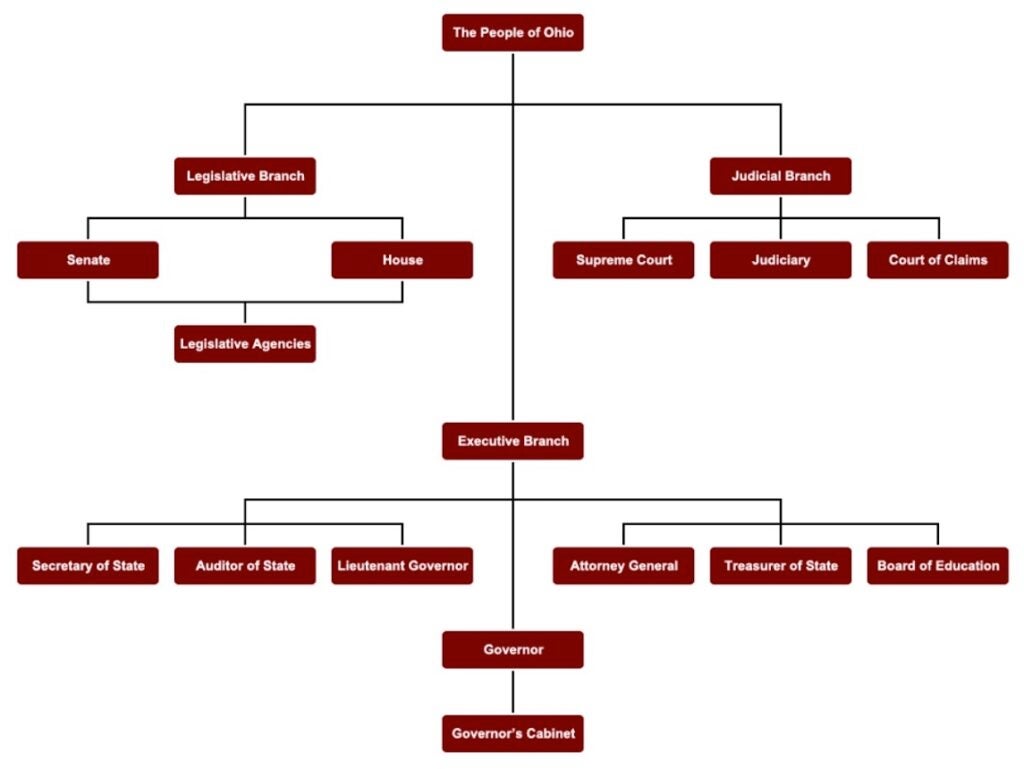
Like the U.S. Constitution, the Ohio Constitution divides political power into three branches of government. This system is called the separation of powers. You may remember this idea from Chapter 2. Each branch has its own responsibilities, and together they help keep government balanced.
The Legislative Branch – Making the Laws
The legislative branch makes the laws. In Ohio, this branch is called the General Assembly. It is a bicameral legislature, which means it has two chambers: the House of Representatives and the Senate. Because the General Assembly decides how money is raised and spent, it is very influential.
The Executive Branch – Carrying Out the Laws
The executive branch is led by the governor. This branch enforces state laws and manages the day-to-day work of government. The governor oversees state agencies and appoints leaders of major departments such as education, transportation, and health.
One important power of the governor is the ability to issue executive orders, which are official directives issued by the governor that manages the operations of state government. Executive orders may be used during emergencies to mobilize resources, coordinate state agencies, or set temporary rules for public safety. They also can be used to reorganize agencies or give instructions on how laws should be carried out. However, they cannot create new laws or spend money that has not been approved by the legislature.
In addition to the governor, Ohio voters also elect other executive officials. These include the attorney general, the secretary of state, the auditor, and the treasurer. Each of these officers has specific duties that you will learn about later in this textbook.
The Judicial Branch – Interpreting the Laws
The judicial branch is made up of the courts. Judges interpret laws and make sure they are applied fairly. Ohio courts hear both civil and criminal cases and also review appeals from lower courts. The Ohio Supreme Court can decide whether a state law follows the state constitution. Ideally, this helps protect individual rights and ensures that the legislature and governor stay within their constitutional limits.
The Only Unicameral State Legislature in the U.S.
Every U.S. state except Nebraska has a bicameral legislature (two chambers, usually called a house or an assembly and a senate. Nebraska is the one exception. In 1937, it adopted a unicameral legislature (a single chamber) after a statewide referendum.
Checks and balances create a system that ensures no single branch of government becomes too powerful by allowing each branch to limit the powers of the others. This system is essential for maintaining a balance of power and protecting citizens’ rights.
When all three branches are controlled by the same political party, they may be less inclined to check and constrain the others’ activities. In a previous chapter, we defined that situation as single-party control of government. However, The Ohio Constitution allows for the public to act as a check against the three branches of governments. Specifically, citizens can initiate referendums in which the public decide whether to pass laws or invalidate laws recently passed by the legislature.
Foundational Facts
The framers of Ohio’s Constitution modeled our system of checks and balances on the U.S. Constitution to prevent any one branch—legislative, executive, or judicial—from becoming too powerful. This principle ensures that each branch can limit the powers of the others. Federalist No. 51, written by James Madison, explains this system, stating that “ambition must be made to counteract ambition,” so that power remains evenly distributed and government serves the public interest.
The Ohio Constitution sets the ground rules for local governments. It spells out what cities, counties, townships, and other local bodies are allowed to do and what limits they face. This creates a common framework for how local governments operate across the state, while still giving communities some room to make their own choices.
Common local governments in Ohio include:
We will also explore the relationship between local governments and the state, and how they work together to serve the public.
The system that we’ve created in the U.S. is complicated. It’ll take some work for you to grasp the different types of local government and the jargon that we use to describe it. Our system of local government isn’t always the simplest or most efficient, but it is the result of adaptation to change over time.
To prepare you and get you in the right frame of mind, watch this seemingly unrelated Saturday Night Live skit. No one said we can’t have fun in this class:
YouTube URL: https://www.youtube.com/watch?v=JYqfVE-fykk
Duration: 4:50
The skit highlights how our systems are often nuanced, path-dependent, and repurposed. Don’t get frustrated as we work our way through the material. You will finish reading this textbook a more informed citizen.
This section is important because it highlights how the Ohio Constitution protects your individual rights. Just like the U.S. Constitution, Ohio’s Bill of Rights ensures that you have freedoms and protections within the state.
While the federal Bill of Rights provides baseline protections applicable to all citizens across the United States, each state, including Ohio, has its own constitution and bill of rights to address specific issues and rights pertinent to its residents. This allows states to offer protections and freedoms that may go beyond those provided by the federal government. Additionally, a state Bill of Rights serves to reaffirm and reinforce federal protections, ensuring that residents’ rights are upheld at both state and federal levels.
Abortion is an explicit right in the Ohio Bill of Rights that is not found in the U.S. Bill of Rights as of 2023. Article I, Section 22of the Ohio Constitution gives people the right “to make and carry out one’s own reproductive decisions.”
Understanding your rights helps you recognize the protections you have and the role of your state and U.S. constitutions in maintaining your rights.
Let’s learn more about your rights. Khan Academy does a good job classifying and describing these personal, political, and economic rights. Watch each video listed below.
Personal Rights of Citizenship
These are rights that allow individuals to decide the best course of action for themselves, ensuring freedom from government interference in their private life, home, mind, and body. They define how an individual should be free from government intrusion.
YouTube URL: https://www.youtube.com/watch?v=AG6SiMEK1tk
Duration: 4:59
Political Rights of Citizenship
These are the rights of citizens to participate in actions associated with governance.
YouTube URL: https://www.youtube.com/watch?v=jCP23_xNf1A
Duration: 3:42
Economic Rights of Citizenship
These are the rights citizens have to control their own property, labor, and working conditions. They encompass the ability to make money and own possessions.
YouTube URL: https://www.youtube.com/watch?v=j_XrGo15iBc
Duration: 4:29
While the state constitution guarantees you certain rights, certain responsibilities and obligations accompany your citizenship. You will recall we explored this notion of civic responsibility in Chapter 2. In this section, we will revisit those ideas as well as identifying the obligations that citizens must obey.
Let’s go back to Khan Academy content and explore our civic responsibilities and obligations in more detail.
Civic Responsibilities
These are activities that citizens “should do” to be good and productive members of society. Examples of responsibilities include voting (and being an informed voter), voicing concerns (e.g., emailing a city department about a broken streetlight), volunteering, and respecting the rights and beliefs of others.
YouTube URL: https://www.youtube.com/watch?v=Tms0TgD_97g
Duration: 2:32
Obligations of Citizenship
These are actions that citizens are required to fulfill. If citizens do not fulfill these actions, they will face punishment by law or legal repercussions. Examples of obligations include obeying the law, serving on juries for citizens over 18, paying taxes, attending school for young citizens, and defending the Constitution and the country when called upon.
YouTube URL: https://www.youtube.com/watch?v=VjPE5JTGjXE
Duration: 4:11
By fulfilling these duties, you contribute to the well-being of your community, state, and country.
One of the best books on the founding of Ohio is David McCullough’s The Pioneers. It tells the story of how a small group of New Englanders carried the ideals of the American Revolution westward into the Ohio Country after the passage of the Northwest Ordinance of 1787. The Northwest Ordinance was a law passed by Congress that created a system for governing and settling the land north of the Ohio River and east of the Mississippi River, an area known as the Northwest Territory. This territory later became the states of Ohio, Indiana, Illinois, Michigan, Wisconsin, and part of Minnesota.
The book centers on the settlement of Marietta, the first permanent American town in what would become Ohio, and follows the people who led the effort.
The story begins with Manasseh Cutler, who lobbied Congress to pass the Northwest Ordinance. He was part of a group of Revolutionary War veterans in Massachusetts who wanted to open western lands for settlement, but they also insisted on setting important rules for the new territory:
Rufus Putnam, a Revolutionary War veteran, then led the Ohio Company of Associates in establishing Marietta. While Manasseh Cutler stayed in New England, his son Ephraim Cutler joined the settlement and later carried the group’s ideals into state politics. He fought to keep slavery out of Ohio’s constitution. Samuel Hildreth recorded the history and natural environment of the new state, which preserved the story for future generations.

Ohio achieved some of the group’s goals, but not all. The promise of freedom of religion became part of the state’s constitution and was generally upheld. The commitment to public education also took root. Ohio established a system of common schools and later became home to a number of state universities, though access was not equal for all citizens at first. The ban on slavery was included in Ohio’s constitution of 1802, making it the first free state carved out of the Northwest Territory. However, Black residents still faced harsh restrictions, including “Black Laws” that limited their rights to vote, serve on juries, or attend public schools.
The call for good faith toward Native peoples was the principle least honored. Although the ordinance promised respect and fair treatment, the reality was a long history of broken treaties, forced removal, and violent conflict. Native communities were displaced as white settlers moved into the Ohio Country, and their rights were largely ignored in practice.
In this way, Ohio reflected both the ideals and the shortcomings of early American democracy: the state advanced freedom, education, and opposition to slavery, but it also fell short of its promises to provide equality and justice for all.
If this history interests you, you should read David McCullough’s book. Watch this interview with the author.
YouTube URL: https://www.youtube.com/watch?v=gySrSoSLLh0
Duration: 17:04
Another important figure in Ohio’s early history is Thomas Worthington, often called the “Father of Ohio Statehood.” Worthington was a leading advocate for Ohio’s statehood and helped to draft the state’s first constitution in 1802. He helped shape provisions that defined Ohio’s political framework and supported the development of public education.
Edward Tiffin, Ohio’s first governor, also made lasting contributions. As the state’s first chief executive, he oversaw the transition from territorial government to statehood and worked to implement the new constitution. Tiffin’s leadership helped establish the foundations of Ohio’s government at a critical moment in its early development.
Portrait of Edward Tiffin
Together, Worthington and Tiffin were central to Ohio’s founding era. Their work in writing the constitution, guiding the state’s admission to the Union, and setting the direction of its first government left a legacy that shaped Ohio’s political and institutional identity.
Ohio’s first constitution, adopted in 1802, prohibited slavery. While racial prejudice still existed, Ohio’s abolitionist movement was influential, and several Ohioans played an active role in the Underground Railroad, which aided enslaved people in their escape to the North. This early commitment to justice distinguished Ohio in the years leading up to the Civil War.
Watch this video from the Ohio Statehouse to learn more about the anti-slavery focus of Ohio’s first constitution:
YouTube URL: https://www.youtube.com/watch?v=BBnDETIf5lg
Duration: 5:32
Committed abolitionists in Ohio played a crucial role in shaping the state’s history and moral character. Charles Osborne founded the first abolitionist newspaper. Figures like John P. Parker, John Rankin, Lucy Stanton, Salmon Portland Case, and Levi Coffin were instrumental in the fight against slavery, providing shelter and assistance to those fleeing bondage. Harriet Beecher Stowe wrote the novel Uncle Tom’s Cabin, which had a tremendous influence on the abolitionist movement. These efforts reflected a broader societal commitment to human rights and equality, which resonated deeply with the state’s citizens.
Watch the following video from the Ohio Statehouse to learn more:
YouTube URL: https://www.youtube.com/watch?v=-sgn7V59gng
Duration: 5:46
During the Civil War, Ohio’s dedication to these principles was evident in the disproportionate number of Union soldiers who hailed from the state. Ohio contributed significantly to the Union Army, with many men enlisting to fight for the abolition of slavery and the preservation of the Union. This strong participation underscored the state’s commitment to the cause of freedom and justice.
Ohio’s long-standing dedication to these values is something we can be proud of. It speaks to a history of moral courage and a willingness to stand up for what is right.
Today, tens of thousands of Ohio families can trace their lineage back to the Civil War and be proud of their ancestors’ contributions to abolition. For example, my great-great-grandfather, Charles Martin, enlisted in the Union Army in 1861 in Akron, and later fought at the Battle of Gettysburg. His story is one of many that highlight the bravery and dedication of Ohioans who fought for the abolition of slavery.
Here’s something for you trivia buffs and sports fans. Ohio’s contribution to abolition continues to resonate in our state’s popular culture. This is evident in the nickname of the Columbus Blue Jackets, the state’s NHL team. The name pays homage to the many Ohioans who served in the Union army during the American Civil War and to the manufacture of many of the uniforms worn by that army in Columbus. This tribute reflects the enduring legacy of Ohio’s commitment to freedom and justice, highlighting how the state’s proud history still influences its identity and cultural expressions today. This last paragraph comes directly from the Encyclopedia Britannica: https://www.britannica.com/topic/Columbus-Blue-Jackets.
Foundational Facts
Ohio’s 1802 Constitution set a stance against slavery. This early commitment positioned Ohio alongside national milestones like the Emancipation Proclamation and the 13th Amendment, which ultimately ended slavery in the United States.
From Ohio’s earliest days, corruption has been a concern for citizens and leaders.
Corruption happens when officials misuse their position for personal gain, such as taking bribes or steering contracts to friends, rather than serving the public interest. This is intentional and self-serving.
Types of Corruption
Throughout history, Ohioans have seen how corruption can damage their state. It weakens trust in government, wastes tax dollars, and makes people feel like the system is rigged in favor of the powerful. When this happens, citizens may lose faith in their leaders and withdraw from civic life.
One of the most significant recent examples is the House Bill 6 scandal, in which several political leaders were involved in a large bribery scheme connected to a $1 billion energy bailout law for the company FirstEnergy. Federal investigators exposed the corruption, and criminal charges were brought against some of those responsible. The case became one of the largest corruption scandals in Ohio’s history.
Watch this news report on the House Bill 6/FirstEnergy bribery scheme.
YouTube URL: https://www.youtube.com/watch?v=x-NwSN65U3E
Duration: 2:21
In response to problems like this, Ohio has built safeguards to limit corruption and promote integrity. These include open meetings laws to make government business visible to the public, requirements for financial disclosures by officials, limits on campaign contributions, and the creation of the Ohio Ethics Commission. Over time, reforms like these have been added whenever scandals reminded Ohioans of the need for transparency.
Courts, journalists, and engaged citizens have also played important roles in uncovering wrongdoing and pushing for reform.
Not All Bad Government Is Corruption
Government can fail the public in different ways, but not every failure is corruption:
Understanding the difference shows that while corruption is serious, other problems like mismanagement, neglect, or incompetence can also damage public trust and government performance.
For those interested in learning more about the Ohio Constitution, there’s an informative lectureby former CSU Law School Dean Steven Steinglass available online. Dean Steinglass also maintains a website titled Ohio Constitution News, which provides ongoing insights and updates.
And for those interested in learning more about the U.S. Constitution, Professor Emeritus David Forte contributed to The Heritage Guide to the Constitution. The Heritage Foundation, a conservative think tank, publishes this guide to provide in-depth explanations of each part of the Constitution from a historical and legal perspective.
By exploring the foundations of Ohio’s government, you gain an understanding of civic engagement and your role in shaping your community. This chapter introduces you to the state’s diverse geography, historical milestones, and the structure of state and local governments. Learning about these elements helps you appreciate how Ohio’s laws and policies have developed over time, highlighting the importance of active participation in the democratic process.
The geography of Ohio, from the Lake Erie Plain to the Appalachian Plateaus, not only defines the state’s physical landscape but also influences its economic activities and development patterns. Understanding these geographical distinctions provides context for the state’s legislative decisions and economic policies. Additionally, studying Ohio’s history, including the Northwest Ordinance and the creation of its constitutions, shows how historical events have shaped the state’s governance. This historical perspective helps you see the significance of civic participation in maintaining and evolving these governance structures.
Finally, the chapter details the structure of Ohio’s state government, emphasizing the separation of powers and checks and balances between the legislative, executive, and judicial branches. This knowledge is important for understanding how state laws are created, implemented, and interpreted. Recognizing the roles and responsibilities of each branch, along with your rights and responsibilities as a citizen, empowers you to engage in various civic activities. Whether it’s voting, staying informed, or participating in community service, your involvement is vital in contributing to the well-being and progress of Ohio’s society.
Elections are formal processes in which citizens vote to choose candidates for public office. Elections connect citizens to government, but they take place within a framework built around party competition and geography.
Like every other state, Ohio’s politics are shaped and constrained by two major parties. A political party is an organized group of people who share political beliefs and goals and work together to influence government by electing candidates and shaping policy. A two-party system refers to a political system where two major parties dominate the electoral process and governance.
By examining the two-party system and voter behavior, we can see why Ohio politics looks the way it does and how individual choices fit into broader patterns across the state. This perspective lays the foundation for later chapters, where we turn to each branch of government and the specific offices that Ohioans elect.
The elephant and donkey are iconic symbols of the two-party system in the United States. The Republican Party adopted the elephant, which represents strength and stability, while the Democratic Party uses the donkey to symbolize resilience and determination. These mascots have become synonymous with their respective parties over time.
Again, a two-party system refers to a political system where two major parties dominate the electoral process and governance. The United States (including Ohio) operates under a two-party system made up of the Republican Party and the Democratic Party. These two parties dominate politics, and for decades in Ohio every winner of statewide or state legislative office, from governor to state representative, has been affiliated with one of them.
The United States has a two-party system mostly because of the way elections are set up. In most races, there is only one winner for each district, known as a single-member district, where only one representative is chosen to serve. In this setup, whoever gets the most votes takes the seat, a rule called winner-take-all. This system makes it hard for smaller parties to succeed. Voters often choose one of the two major parties—the Democrats or Republicans—so their vote has a better chance of helping decide the outcome.
Over time, history and political culture have reinforced this pattern. Rules about ballot access—the requirements candidates and parties must meet to appear on the ballot—along with campaign funding and media attention, also give advantages to the two main parties. As a result, third parties rarely win major offices, even if they influence debates and push new ideas.
In contrast, some countries use proportional representation, a system where seats in a legislature are divided based on the percentage of votes each party receives. This allows smaller parties to gain representation in proportion to their share of the vote, so more than two parties usually hold seats in government. For example, in Germany, if a party wins 15% of the national vote, it receives about 15% of the seats in parliament, giving voters more options beyond just two major parties.
Duverger’s Law
Political scientist Maurice Duverger observed that the type of election system shapes how many political parties a country has. His idea, known as Duverger’s Law, says that:
Duverger’s Law helps explain why Republicans and Democrats dominate U.S. politics.
Party platforms are the set of ideas and policy positions that a political party publicly supports. While individual candidates may differ in emphasis or tone, party platforms help voters understand the general beliefs, priorities, and policy approaches associated with each major party.
In Ohio, the Republican and Democratic parties offer distinct platforms that reflect different views about the role of government, the economy, social issues, and public policy. The sections below outline the core beliefs commonly associated with voting Republican or Democrat in Ohio today.
Republicans in Ohio
Voting Republican in Ohio today generally means supporting a set of beliefs that include:
Republican candidates in Ohio typically campaign on platforms that highlight these values by emphasizing economic freedom, personal responsibility, and traditional social norms.
Democrats in Ohio
Voting Democrat in Ohio generally means supporting a different set of beliefs, including:
Democratic candidates in Ohio usually campaign on platforms that focus on creating a fair and equitable society, with a strong emphasis on social programs and environmental sustainability.
Understanding these core beliefs helps explain the distinct political landscapes shaped by the two major parties in Ohio.
Where Ohio Republicans and Democrats Agree
Although much of the attention goes to the differences between the two parties, there are also areas where Democrats and Republicans in Ohio often find common ground. Both parties generally support efforts to grow the state’s economy and attract new jobs, even if they disagree on the best methods.
They tend to agree on the need to maintain strong infrastructure, such as roads, bridges, and public utilities. At the state level, leaders in both parties usually support policies that enhance Ohio’s competitiveness with other states. This includes workforce development programs, business attraction and retention efforts, and initiatives to strengthen manufacturing.
On many issues that affect local communities, such as public safety and basic education, party leaders frequently agree on the importance of providing reliable services. They may differ in emphasis, but both recognize that residents expect government to keep communities safe and schools functioning.
Voter behavior refers to how individuals act and make decisions during elections. It includes the factors that influence voting, such as political beliefs, demographic characteristics, social influences, party affiliation, and views on candidates and issues. Because Ohio operates under a two-party system, voter behavior is often expressed through support for either Republicans or Democrats, even if individuals consider themselves independents.
Watch this video about how people decide who to support.
YouTube URL: https://www.youtube.com/watch?v=YOkfRnqIkSM
Duration: 10:21
Political scientists, journalists, and campaign professionals often study voter behavior to understand how and why people vote the way they do. They look for patterns that can explain past elections and help predict future outcomes.
One of the most important patterns is turnout, which measures how many eligible voters actually cast ballots. Turnout changes from one election to another. Presidential elections usually attract the most voters, while midterms and off-year contests often see fewer people participate. Special elections, such as those held in August, typically draw the lowest numbers, although turnout can rise when voters see the stakes as especially high.
Analysts also study voter preferences, which refer to the choices or leanings of voters. Preferences can mean favoring one party or candidate over another, consistently supporting a party across elections, or prioritizing certain issues such as the economy, healthcare, or education when deciding how to vote.
Voter behavior also includes how people respond to campaign strategies and media coverage. A television ad, a debate performance, or a news story can all shift public opinion.
Studying these patterns helps explain why elections turn out the way they do.
Political socialization is the process through which individuals acquire their political beliefs, values, and behaviors. This lifelong process is influenced by various factors and agents, shaping how people view politics and participate in the political system.
These factors interact in complex ways to shape an individual’s political beliefs and voting behavior over time. By understanding the process of political socialization, we can better comprehend how people form their political identities and participate in the democratic process.
Reference
Janda, Kenneth, Jeffrey M Berry, and Jerry Goldman. 2012. The Challenge of Democracy. 11th ed. Boston, MA: Wadsworth.
Polling is the process of gathering information about public opinion by surveying a group of people who represent a larger population. Public opinion refers to the collective attitudes, beliefs, and views of a population or specific group on key topics. Polling provides a way to understand how people think and what they prioritize, offering insights into topics like political preferences, social issues, or policy support.
Polling organizations, such as Pew Research Center and Gallup, conduct surveys to learn how different groups think about public issues and politics. They might ask about major policy topics such as climate change, healthcare, or the economy. They also study political characteristics like party affiliation, voting behavior, and trust in government. These surveys collect data from thousands of respondents, often selected to ensure diversity in age, gender, race, geography, and other factors.
The key to polling is random sampling. Instead of asking every eligible voter in Ohio or the United States—a complete census that would be costly and time-consuming—pollsters select a smaller group of people chosen at random to reflect the larger population. Because the sample is random, each person has an equal chance of being selected. This reduces bias and makes the results more reliable.
The math behind polling is straightforward. If you randomly select about 1,000 people from a large population, the results are very likely to be within about 3 percentage points of what you would find if you surveyed everyone. This range is called the margin of error. For example, if a candidate is polling at 52% with a margin of error of ±3%, the true level of support in the full population could be anywhere between 49% and 55%.
Key Polling Terms
Random Sampling – A way of selecting people for a survey where every individual in the population has an equal chance of being chosen. This helps the sample reflect the larger population.
Margin of Error – The range that shows how close the poll’s results are likely to be to the true opinion of the whole population. For example, if a candidate is at 52% with a margin of error of ±3%, their actual support could be between 49% and 55%.
Analysts then use statistical methods to interpret the results, searching for patterns that reveal trends in public opinion. They might compare responses between generations to see how attitudes differ, or track how opinions change over time. By analyzing this data, researchers can identify shifts in values, predict voting behavior, and better understand public priorities.
One recent example shows how polling plays out in Ohio. An Emerson College poll of 1,000 registered voters in August 2025 found Republican Vivek Ramaswamy leading Democrat Amy Acton by 10 points in the 2026 governor’s race. In a matchup with former Congressman Tim Ryan, Ramaswamy’s lead narrowed slightly to 8 points. About 10% of voters remained undecided. This highlights how early polling provides a snapshot rather than a prediction.
Party affiliation (or party identification) refers to how people identify with or lean toward one of the two major political parties. Recent national survey data from 2024-2025 shows clear generational patterns that also help explain voting behavior in Ohio.
Younger Americans, especially those in Gen Z, are more likely to identify as Democrats or lean Democratic. About two-thirds of voters in this group fall into the Democratic camp, while about one-third lean Republican. Voters in their late twenties show a similar pattern, though the gap is slightly narrower. People in their thirties still lean Democratic overall, but the margin is smaller, with Republicans picking up more support.
Gender Gaps in Gen Z Party Affiliation
Recent surveys show a gender gap within Generation Z, but not a partisan majority for either group. Gen Z women are more likely than Gen Z men to identify with or lean toward the Democratic Party, while Gen Z men are more likely than Gen Z women to identify with or lean toward the Republican Party. However, independents remain the largest group among both Gen Z men and women. What factors do you think help explain these gender differences in political identification among Gen Z?
By middle age, the balance is nearly even. Voters in their forties and fifties are about evenly split between the two parties. Among older generations, especially those 60 and above, Republicans hold an advantage. This shift reflects a long-term trend where younger generations begin with stronger ties to the Democratic Party, while older generations lean more Republican.
How Ohio Defines Party Registration
It’s worth noting the difference between party affiliation and party registration.
Party affiliation (or party identification) is how a person sees themselves politically. It’s a survey measure — someone might say “I’m a Democrat,” “I’m a Republican,” or “I’m independent.” It captures personal identity and political leanings, even if it isn’t reflected on official records.
Party registration is an official status recorded by the state when a voter registers. In Ohio, you don’t pick a party when you first register to vote. Instead, your party registration is based on which party’s primary you last voted in. If you haven’t voted in a recent primary, you are considered unaffiliated.
This means someone could identify as a Republican in surveys (party affiliation) but be officially registered as unaffiliated in Ohio if they haven’t voted in a GOP primary. Conversely, someone might identify as an independent but still show up in the state’s voter file as a Democrat because they last pulled a Democratic primary ballot.
Political culture refers to the shared values, attitudes, and beliefs that shape how people view and interact with their government. It’s not about opinions on specific issues—like public opinion—but about the deeper norms and expectations that influence how citizens and leaders behave in a political system.
For example, the political culture in Cleveland or Akron may differ from rural areas of Ohio. In cities like Cleveland and Columbus, people often prioritize issues such as public transit, affordable housing, and economic development because they live in densely populated areas with diverse communities. Residents may also be more likely to support policies that address social justice or environmental sustainability, reflecting urban priorities.
In rural Ohio, however, political culture might emphasize values such as self-reliance, local control, and preserving traditions. Issues such as agriculture, land use, and access to healthcare often take center stage, as these are more relevant to daily life in rural areas. People in these communities may also have different expectations for government involvement, preferring smaller, more limited roles compared to urban residents.
These differences in political culture help explain why priorities, voting patterns, and government policies can vary across regions, even within the same state. Understanding political culture provides insight into why people support certain leaders or policies and how political systems respond to diverse needs.
Understanding voter behavior in Ohio elections requires a close look at the differences between rural, suburban, and urban areas. Each of these regions has unique characteristics that influence how people vote and what issues they care about, which help to explain why Republicans consistently win statewide.
Rural Areas
Rural areas in Ohio are characterized by smaller populations, less diversity, and a greater focus on agriculture and local businesses. These regions comprise approximately 30% of Ohio’s population. Voters in rural areas tend to prioritize issues like farming policies, land use, and local economic development. They often support Republican candidates who advocate for limited government, lower taxes, and traditional values. Rural areas consistently show strong Republican support, significantly impacting statewide elections.
Small Towns and Small Cities
In addition to rural communities, smaller towns and cities such as Ashtabula, Lima, Steubenville, and Warren are increasingly aligning with Republican voting patterns. These areas, while more urbanized than rural communities, share similar economic and social concerns, which often lead them to favor Republican candidates. The growing Republican support in these smaller towns and cities plays a significant role in shaping the political landscape and impacting statewide elections.
Ashtabula, Trumbull, and Mahoning counties are notable examples of areas where voters have shifted strongly toward Republican candidates. Between 2012 and 2020, voter support in these counties shifted by 30%, moving from favoring the Democratic presidential candidate to favoring the Republican candidate. This represents dramatic realignment in voter preferences.
Suburban Areas
Suburban areas, which are the communities surrounding major cities, are home to about 50% of Ohio’s population. These regions include a mix of residents, including middle-class families, professionals, and increasingly diverse populations. Suburban areas are often considered key swing areas in Ohio elections due to this variability in voter preferences. Suburban voters might be concerned with issues such as education quality, property taxes, and local development.
Their political preferences can be more varied, sometimes leaning toward Republican candidates due to concerns about taxes and regulation, but also showing support for Democratic candidates who address social issues and education. However, suburban voters have increasingly voted Republican in recent elections.
Urban Areas
Urban areas in Ohio, like Cleveland, Columbus, and Cincinnati, tend to have higher population densities and are more diverse in terms of race, ethnicity, and socioeconomic status. These areas, which house approximately 20% of Ohio’s population, often prioritize issues such as public transportation, affordable housing, and social services. Urban voters are more likely to support Democratic candidates who advocate for progressive policies on social issues and government intervention in the economy. In recent elections, Democratic support has increased in Columbus and Cincinnati but has actually decreased in Cleveland and Cuyahoga County.
Why It Matters
The rural-suburban-urban dynamic is critical in Ohio elections because it shapes the political landscape. Candidates and political parties must tailor their messages to address the specific concerns of voters in these different regions. Rural areas heavily favor Republicans, while suburban areas can swing between parties, making them crucial battlegrounds. Urban areas often support Democrats, but turnout and engagement can vary, influencing overall election outcomes.
Watch this video from the Toledo-based nonprofit Midstory to learn more about how Ohio transformed from a swing state that elected both Democrats and Republicans to a state that now reliably supports Republican candidates.
YouTube URL: https://www.youtube.com/watch?v=kBuBb6AaKaA
Duration: 3:41
What’s happening in Ohio follows a nationwide trend. Check out this Pew Research Center report.
References
The “Five Ohios” Model
Ohio used to be considered a swing state, and political scientists used the Five Ohios model to explain voter behavior. This model divided the state into five distinct regions, each with its own political tendencies and priorities:
This model was effective in highlighting the diversity within the state and how different regions could swing elections based on varying economic priorities and social issues.
What’s the Swing State?
In American politics, a swing state is a state where both major political parties have similar levels of support among voters. Swing states are highly competitive and can “swing” toward either party, and they are particularly important in determining the outcome of presidential elections. Ohio was once considered a swing state.
The Shift to a Rural-Suburban-Urban Dynamic
In recent years, the Five Ohio’s model has become less effective in explaining statewide political performance as Ohio has solidified as a Republican stronghold. For example, while urban Cincinnati has shifted more towards the Democratic side, the postindustrial Mahoning Valley has moved Republican. Moreover, other blue-collar areas, especially along the Ohio River, have seen a marked shift to Republican support. The new understanding of voter behavior in Ohio is better captured by the rural-suburban-urban dynamic, which focuses on the broader geographic trends that have come to dominate electoral outcomes across the country.
Relevance of the Five Ohio’s Model Today
While the Five Ohio’s model may seem obsolete for predicting statewide political performance, it still offers valuable insights. Different parts of Ohio continue to have distinct economic and social priorities; for example, industrial policy remains crucial in Northeast Ohio, while agricultural policy is vital in Northwest and Southeast Ohio. Understanding these regional differences helps explain why certain issues resonate more in specific areas, influencing campaign strategies and voter turnout.
Over the years, parties such as the Libertarian Party, Green Party, and Constitution Party have sought to influence Ohio’s political discourse and policy debates. These third parties operate outside the two dominant political parties, focusing on specific issues or alternative ideologies not fully addressed by the Democrats or Republicans. They aim to provide voters with additional choices in the political landscape.
The legal hurdles for third parties have been substantial, requiring them to collect a large number of signatures to get on the ballot and to achieve a certain percentage of the vote to maintain their status. In 2006, a federal court ruling made it easier for third parties to access the ballot, leading to a brief period where multiple third parties were represented in Ohio elections. However, subsequent legislation and court rulings have continued to complicate ballot access for these parties.
While third parties rarely win major offices, they can impact elections by drawing votes away from major party candidates and bringing attention to specific issues and perspectives that might otherwise be overlooked.
Reference
Sracic, Paul A., and William C. Binning. 2015. Chapter 9 – Direct Democracy in Ohio in Ohio Government and Politics. Washington DC: CQ Press.
In Ohio, many voters are increasingly identifying as political independents rather than labeling themselves a Republican or Democrat. Being an independent means evaluating candidates and issues based on personal beliefs and values, rather than adhering strictly to a party’s platform. This trend reflects a desire for greater flexibility in political choices and a focus on individual issues over party loyalty.
For your own self-exploration, take the ISideWith political quiz. ISideWith: https://www.isidewith.com/political-quiz
This quiz helps you see how your beliefs align with various political parties in the United States.
You can explore the list of political parties they consider, including major parties like the Republicans and Democrats, as well as minor political parties.
According to its website, ISideWith is independent and is not affiliated with any investors, political parties, or interest groups. It operates without external funding influences, relying on donations and support from users through applications like Patreon to maintain its operations and continue its mission of voter education and engagement.
This information was shared in the first chapter, but let’s again make sure you know how to register to vote.
Registering to vote is a crucial step in participating in the democratic process. It gives you the power to influence decisions that affect your community and country. By voting, you can help elect leaders and shape policies that align with your values and interests.
One of the easiest ways to register to vote is online through the Secretary of State’s website. Click here for more information: https://olvr.ohiosos.gov/.
Remember, you must be a citizen and 18 years old or older.
Now that everybody knows how to register, let’s learn about political culture.
This chapter explored Ohio’s two-party system and the factors that shape voter behavior. We examined the core beliefs of the Republican and Democratic parties in Ohio. Republicans generally advocate for limited government, traditional values, economic conservatism, and Second Amendment rights. In contrast, Democrats emphasize social justice and equality, environmental sustainability, progressive social policies, and healthcare access. These distinct ideological stances play a significant role in shaping policy debates and electoral outcomes in the state.
Reflecting on the section about political socialization can help you understand how your own political beliefs have developed. By examining influences such as family, education, peer groups, and media, you can gain insights into what shapes your views and values. This self-awareness can enhance your civic engagement by allowing you to make more informed decisions, engage in meaningful political discussions, and advocate for issues that matter to you.
To explain Republican dominance in statewide races, we introduced the rural-suburban-urban dynamic model. This model highlights how rural areas, with their smaller populations and traditional values, consistently support Republican candidates. Suburban areas, which are home to a mix of middle-class families and professionals, often swing between parties but have leaned more Republican in recent years due to concerns about taxes and regulation. Urban areas, which are more diverse and densely populated, tend to support Democratic candidates, but their impact is often diluted by the strong Republican support in rural and suburban regions. Understanding this dynamic is key to explaining the current political trends in Ohio.
Part II of this textbook focuses on how state government works, giving an overview of its structure, functions, and the important roles it plays in making laws and policies. The state government is made up of three branches—legislative, executive, and judicial—each with its own responsibilities that work together to keep the government balanced and ensure laws are followed.
The legislative branch, which is discussed in Chapters 6 through 8, is responsible for creating the laws that govern the state. It includes the state House of Representatives and the state Senate, which together form the General Assembly. The process of making laws involves introducing bills, debating them, making changes, and finally passing them to the governor for approval. The legislature also handles the budgeting process, deciding how state funds are spent on various programs and services that affect everyone in the state.
The executive branch, described in Chapters 9 and 10, is led by the governor, who acts as the state’s chief executive officer. The governor is responsible for making sure state laws are enforced and that state agencies run smoothly. Alongside the governor, other elected officials and state agencies work to provide public services such as education, transportation, economic development, and public safety.
The judicial branch, covered in Chapter 11, interprets the laws and ensures that justice is served. This branch includes a system of courts, with the state supreme court being the highest authority. Judges in these courts resolve disputes, ensure laws are applied fairly, and protect individual rights. The judicial branch also acts as a check on the powers of the other branches, making sure that laws and actions by the government comply with the state and federal constitutions.
This part of the textbook also explores career opportunities in state government (Chapter 12) and the process of state elections and campaigning (Chapter 13). These chapters provide insights into the various roles people can pursue within the state government and explain how elections determine who holds these important positions. Through these discussions, this section offers a clear understanding of how state government operates and its crucial role in the larger system of government.
Comprised of the Senate and the House of Representatives, the Ohio General Assembly is responsible for making, changing, and removing state laws. The General Assembly is Ohio’s state legislature. Legislators propose new laws, debate their merits, and vote on them. These laws can impact various aspects of life, from school funding and healthcare policies to transportation and public safety.
In addition to lawmaking, the state legislature oversees the executive branch to ensure laws are enforced correctly and fairly. This legislative oversight is part of our system of checks and balances, preventing any one branch of government from becoming too powerful. Through committees and public meetings, the legislature fosters diverse opinions and supports the democratic process at the state level.
Understanding how the Ohio legislature works is important for your future civic engagement. By knowing the roles and responsibilities of your state senators and representatives, you can better participate in the democratic process. This knowledge will help you advocate for issues that matter to you, engage with lawmakers, and contribute to the creation of laws that benefit your community. Whether you plan to vote, attend public meetings, or even consider a career in public service, understanding the legislative process will help you make informed decisions and be an active, informed citizen.
Foundational Facts
The Ohio Constitution grants the General Assembly significant power over state finances, a responsibility often called the “power of the purse.” Article II, Section 22 of the Ohio Constitution requires that all appropriations of money be made by law. This gives the legislature control over the state budget. This power allows the General Assembly to determine funding priorities that impact essential areas like education, healthcare, and infrastructure.
The Ohio General Assembly, composed of the House of Representatives and Senate, is the state’s legislative branch and serves as the cornerstone of Ohio’s government. Its broad powers and responsibilities are vital to shaping the policies, programs, and governance that affect the lives of all Ohioans. These powers can be grouped into several key areas, including lawmaking, budgeting, taxation, representation, and maintaining checks and balances within the state government.
Foundational Facts
The powers of the Ohio General Assembly derive from Article II ofthe Ohio Constitution, which grants the legislature broad authority to govern and serve the people of Ohio.
Lawmaking Powers
The General Assembly’s lawmaking powers are central to its role. It is responsible for drafting and enacting laws that regulate daily life, address critical issues, and shape the state’s future. These laws cover a wide range of topics, such as public safety, education, healthcare, and business regulation. For example, the legislature establishes school funding formulas, regulates healthcare facilities, and sets standards for businesses operating within Ohio. Additionally, the General Assembly has the authority to propose amendments to the Ohio Constitution. These amendments, once approved by the legislature, are placed on the ballot for voter approval, allowing significant legal changes to reflect the will of Ohio’s citizens.
Budget Creation
Budget creation is another critical responsibility of the General Assembly. Every two years, legislators develop and approve a biennial state budget that allocates resources to meet the needs of Ohioans. The budget is a blueprint for how public funds will be spent on essential services like education, healthcare, public safety, and infrastructure maintenance. For example, the budget provides funding to ensure schools have the resources to educate students, supports law enforcement and emergency services, and maintains the state’s roads and bridges. The budget process reflects the state’s priorities and ensures that resources are managed responsibly to benefit Ohio’s citizens.
Taxing Power
Closely related to budget creation is the General Assembly’s taxing power, which is essential for generating the revenue needed to fund state operations. The legislature establishes tax policies, including income, sales, and property taxes, to provide the funds necessary for programs and services. Taxes are not just tools for revenue generation; they can also influence behavior and promote broader policy goals. For example, taxes on cigarettes are designed to discourage smoking, while tax incentives are often used to attract businesses.
Foundational Facts: What Do We Mean by the Term “Power of the Purse”?
The term “power of the purse” refers to the authority of a legislative body, like the Ohio General Assembly, to control public spending and taxation. This power is fundamental to representative government because it means that elected officials, not unelected leaders, determine how public money is collected and spent. By holding the purse strings, the legislature can shape policies, fund priorities, and serve as a check on the executive branch’s power.
The term “power of the purse” originates from the principles emphasized by the Founding Fathers during the creation of the U.S. Constitution. Alexander Hamilton and James Madison both highlighted the importance of legislative control over finances in the Federalist Papers. In Federalist No. 58, Madison described the power of the purse as “the most complete and effectual weapon with which any constitution can arm the immediate representatives of the people.”
Representation and Advocacy
As representatives of the people, members of the General Assembly play a vital role in advocating for their constituents and ensuring their voices are heard in state government. Legislators address the concerns of their districts by proposing laws and policies that reflect local priorities. For example, a representative from a rural district might advocate for agricultural subsidies, while one from an urban area might focus on affordable housing initiatives. Public engagement is also an essential aspect of the legislature’s work. Through public hearings, town halls, and other forums, citizens have the opportunity to participate in the legislative process, share their opinions, and influence decision-making.
Maintaining Checks and Balances
The General Assembly also has the important responsibility of maintaining checks and balances within Ohio’s government. It reviews and monitors executive branch activities, a power called legislative oversight. The Senate confirms the governor’s appointments to significant positions, such as agency heads and short-term judicial appointments, ideally ensuring that qualified individuals are chosen to serve the state. Additionally, the General Assembly has the power to impeach and remove state officials accused of wrongdoing. The House of Representatives initiates impeachment proceedings, and the Senate conducts the trial, requiring a two-thirds vote to convict and remove the official from office. These mechanisms ensure that no branch of government becomes too powerful or acts outside the bounds of the law.
Impeachment
In Ohio, impeachment is the process outlined in the state constitution for charging certain public officials, such as the governor, other executive officers, or judges, with misconduct while in office. The Ohio House of Representatives has the sole power to impeach, meaning it brings the formal charges, similar to an indictment in criminal court. Impeachment does not itself remove the official from office but begins the process for possible removal.
In 2020, members of the Ohio House introduced articles of impeachment against Governor Mike DeWine over COVID-19 public health orders. The measure did not advance, but it demonstrated how the impeachment process can be initiated.
Removal
Removal occurs after impeachment if the Ohio Senate holds a trial and votes to convict the official by a two-thirds majority. A conviction results in the official being removed from office before their term ends. The Ohio Constitution also allows for other removal methods, such as recall elections for local officials in some cities, or judicial proceedings under state law for officials who neglect their duties, commit misconduct, or become unable to serve.
The powers and functions of the Ohio General Assembly are foundational to the state’s governance. By creating laws, managing the budget, generating revenue, representing citizens, and maintaining checks and balances, the legislature shapes Ohio’s policies and ideally helps state government to operate effectively and responsibly.
The legislative branch at the federal level is called the U.S. Congress, a term established by the United States Constitution, to emphasize its role in representing the entire nation and making federal laws. In contrast, the legislative branch at the state level in Ohio is called the General Assembly, a term rooted in historical tradition dating back to colonial times. Early colonial governments often referred to their legislative bodies as General Assemblies.
This distinction between names underscores the different scopes of authority, with Congress handling national issues and the General Assembly addressing state-specific matters.
The Senate has 33 members called Senators; the House has 99 members called Representatives. One Senator is elected from each Senate district, and one Representative is elected from each House district.
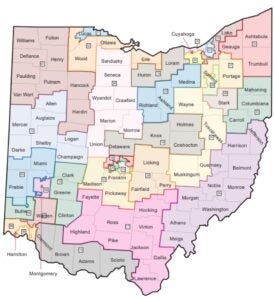

Qualifications for Membership
To hold office as a Senator or Representative, a person must meet certain qualifications. A person must:
A Senator or Representative must take an oath or affirmation to support the United States and Ohio Constitutions and to faithfully discharge the duties of the office.
Foundational Fact
Article II, Section 3 of the Ohio Constitution sets specific qualifications for members of the General Assembly. To serve as a Senator or Representative, an individual must be a qualified voter, reside in their district for at least one year before the election, and be elected to the office. Additionally, upon taking office, legislators must present a certificate of election and take an oath or affirmation to support both the U.S. and Ohio Constitutions, as well as to faithfully discharge their duties.
Legislative Elections and Terms of Office
Elections to the Senate and House of Representatives are held in even-numbered years, marking the start of a new biennium, which is a two-year legislative period. Terms of office begin on January 1 of the odd-numbered year following the election. Senators are elected to four-year terms, with about half elected every two years. Senators from even-numbered districts are up for election at the same time, while Senators from odd-numbered districts are up for election two years later. Representatives are elected to two-year terms, meaning the entire membership of the House is subject to election every two years.
Term Limits
Term limits are restrictions on the number of terms an elected official can serve in a particular office. Under the Ohio Constitution, a person cannot hold the office of Senator for longer than two successive four-year terms. A person cannot hold the office of Representative for longer than four successive two-year terms.
Term limits for Ohio state legislators present both advantages and disadvantages. On the positive side, term limits can promote fresh perspectives and new ideas in the legislature, reduce the potential for entrenched political power, and encourage politicians to focus on their current duties rather than long-term career prospects.
However, they also have notable drawbacks, such as the loss of experienced lawmakers who have developed expertise and relationships crucial for effective governance. Additionally, frequent turnover can lead to a reliance on lobbyists and bureaucrats for institutional knowledge, potentially undermining legislative independence and continuity. Neither lobbyists nor government employees are directly held to account by the voters, whereas legislators are.
While term limits prevent members from serving more than eight consecutive years in either the House or Senate, they can bounce back and forth. For example, Matt Huffmanserved in the House for eight years, then the Senate for eight years, and was then reelected to the House in 2024.
Apportionment of Seats/Districts
Seats in both chambers of the Ohio legislature are apportioned by population. Legislators in the House represent smaller districts with fewer constituents, while senators represent larger districts.
Reference
Ohio Legislative Service Commission. 2023. Chapter 2 – The Legislative Branch in A Guidebook for Ohio Legislators. Columbus, OH, p. 16-18.
As of 2025, Republicans dominate both chambers. In the House, there are 65 Republicans and 34 Democrats. The Ohio Senate consists of 24 Republicans and 9 Democrats.
References
Ohio, like the rest of the United States, operates primarily under a two-party system consisting of the Republican and Democrat parties. We learned about the two-party system in the last chapter, but let’s explore how this system affects the General Assembly. Both the state House and Senate are currently controlled by strong Republican majorities.
Republicans in Ohio
Republicans in the Ohio legislature can be categorized as fiscal conservatives, social conservatives, Trump Republicans, and more moderate Republicans, with Trump Republicans becoming the dominant voice within the party and encompassing both fiscal and social conservatism.
Fiscal Conservatives – These members advocate for limited government intervention in economic matters, emphasizing free-market principles, and supporting lower taxes and reduced government spending. They believe that free-market principles foster economic growth, innovation, and efficiency. Fiscal conservatives prioritize policies that reduce government debt and promote economic stability through restrained fiscal policies.
Social Conservatives – Social conservatism is a key aspect of this group, emphasizing traditional social values and advocating for stability within communities. This includes supporting traditional family roles, opposing abortion, advocating for religious freedom, and promoting law and order. Social conservatives focus on maintaining cultural traditions and often support policies that reflect their moral and ethical beliefs.
Trump Republicans – Trump Republicans, who have become the dominant voice within the party, blend foundational aspects of fiscal and social conservatism. Inspired by President Donald Trump’s “Make America Great Again” movement, they also focus on populist and nationalist policies, often emphasizing strong border security, economic protectionism, and a more confrontational approach to political opponents and policies. Trump Republicans prioritize issues such as opposing transgender inclusion in sports and schools, and they actively campaign against the teaching of critical race theory in educational institutions. They are strong advocates for gun rights and are vocal about their commitment to President Trump’s priorities.
Moderate Republicans – These members support many conservative principles but also recognize the need for practical and sometimes bipartisan solutions. While they advocate for limited government intervention, they may support targeted government programs that address critical needs such as healthcare, education, and infrastructure. Moderate Republicans uphold traditional values and individual responsibility but may also support progressive stances on issues like criminal justice reform or environmental conservation. This balanced approach allows them to appeal to a broader range of voters and work towards practical solutions.
This categorization provides a nuanced understanding of the different priorities within the Ohio Republican Party.
Democrats in Ohio
Democrats in Ohio generally fall into two categories: progressive Democrats and moderate Democrats.
Progressive (or Liberal) Democrats – These members advocate for government policies that promote social justice, economic equality, and environmental sustainability. Social justice initiatives aim to create a fair and equitable society where all individuals have equal access to opportunities, resources, and rights. This includes addressing inequalities related to race, gender, and socioeconomic status.
Progressives often support increased government intervention in the economy to provide public services such as healthcare, education, and social safety nets, which often require tax increases to fund. They prioritize civil rights, LGBTQ+ rights, and women’s rights, including access to reproductive healthcare. Additionally, they emphasize combating climate change, supporting comprehensive immigration reform, expanding voting rights, and advocating for gun control measures.
Moderate Democrats – These members advocate for a more balanced approach to government policies, blending progressive ideals with practical solutions that can gain bipartisan support. While they support social justice and economic equality, they may prefer incremental changes and collaborations across party lines. Moderates often emphasize fiscal responsibility while recognizing the need for public investment in healthcare, education, and infrastructure. They propose more gradual approaches to civil rights and environmental sustainability compared to their progressive counterparts.
In the Ohio General Assembly, party caucuses are groups of legislators from the same political party who meet to discuss and plan their legislative strategies. These caucuses help coordinate the efforts of party members to advance their shared goals and policies.
The majority party is the political party with the most members in either the Ohio House of Representatives or the Ohio Senate. Control of the majority party grants significant power, including leadership positions like Speaker of the House and Senate President. These positions allow the majority party to control what legislation is assigned to committees, which bills are brought to the floor for a vote, and ultimately, which laws are passed. We will learn more about these positions later in this chapter.
The minority party, on the other hand, is the political party with fewer members in either chamber. While the minority party has less formal power, it can still influence legislation through advocacy, proposing amendments, and engaging in public debates.
Republican Caucus
Members of the Republican Party in the Ohio House of Representatives and the Ohio Senate meet regularly to coordinate their legislative agenda. As the majority party in both chambers, the Republican caucus wields significant power over the legislative process. By controlling key leadership roles and committee assignments, the caucus ensures that its legislative priorities, rooted in conservative principles, are advanced. Most key policy decisions are made within the House and Senate Republican caucuses before reaching the floor for a vote.
Democrat Caucus
Members of the Democratic Party in the House and Senate meet as groups to discuss their legislative priorities and strategies. As the minority party in the Ohio General Assembly, Democrats have limited influence over which legislation is considered and passed. Despite these constraints, the Democratic caucus plays a role in providing alternative viewpoints, advocating for progressive policies, and holding the majority party accountable.
Party caucuses are instrumental in organizing party efforts, strategizing on legislation, and maintaining party discipline within the Ohio General Assembly. They enable members to present a unified front on important issues and work towards their legislative goals. However, the majority party’s dominance can lead to partisanship, where strong loyalty to one’s political party hinders collaboration. Polarization—the growing division between political parties—can further reduce cooperation, often resulting in legislative gridlock. Legislative gridlock is a situation in which little or no progress is made on passing laws or addressing important issues due to political stalemates, disagreements, or polarization. We will explore the concepts of partisanship and polarization in greater detail in the next chapter.
The Ohio State Legislature, also known as the General Assembly, consists of two chambers: the House of Representatives and the Senate. Each chamber has a presiding officer who leads and maintains order during legislative sessions. The Speaker of the House is the leader of the House of Representatives, while the President of the Senate leads the Senate. Although these leaders are elected by all members of their respective chambers, they are typically selected by the majority party’s caucus, meaning the party with the most seats usually determines the presiding officer. The Republican Party currently holds supermajorities in both the House and Senate, which allows them to pass certain legislation or override a governor’s veto without needing support from the opposing party.
Powers and responsibilities of these presiding officers include:
The Speaker of the Ohio House is elected at the beginning of each General Assembly session, which occurs every two years, by a majority of House members. The role of Speaker involves guiding the House’s agenda, presiding over sessions, and determining which bills reach the floor for a vote.
The Speaker appoints members to various committees and designates committee chairs for the majority party. This appointment power allows the Speaker to influence the legislative process by deciding who serves any in each role. A legislative committee is a smaller group of legislators within the House or Senate, tasked with reviewing, analyzing, and making recommendations on proposed legislation. These committees focus on specific areas of policy, such as education, health, or finance, and shape and refine bills before they are considered by the full legislative body.
You will learn more about committees later in this chapter. For now, watch this brief report on Speaker Huffman’s update to the House committee structure:
YouTube URL: https://www.youtube.com/watch?v=4uVqJsuUepU
Duration: 1:38
And don’t forget that the Speaker decides which bills receive floor votes, giving the position what is essentially veto power over all proposed legislation.
The current Speaker of the House is Matt Huffman (Republican), who serves as state representative for Ohio’s 78th District, which includes his hometown of Lima.

Speaker of the House Matt Huffman
Speaker Huffman has a unique record of service in the General Assembly. He served as President of the Senate before term limits prevented him from continuing in that role.
In 2024, he successfully ran for state representative and soon was elected Speaker by his peers to start the 2025-2026 legislative session. Prior to his time in the Senate, he had served four terms in the House. Born and raised in Lima, Ohio, Senator Huffman has practiced law for 30 years in his family’s private practice law firm and has represented many small businesses in West Central Ohio. Speaker Huffman began his public service on Lima City Council in 1992, serving until 2006, including seven years as City Council President.
In the Ohio legislature, he has sponsored bills to reform the medical delivery system, eliminate abortion, and enable parents to move their students from public schools to private schools through taxpayer subsidized vouchers.
Speaker Huffman defeated former Speaker Jason Stephens for the position in 2025. News 5 Cleveland aired a story about their race prior to the 2024 general election. Watch it to learn more about how House Speakers are chosen:
YouTube URL: https://www.youtube.com/watch?v=tQ3jUFJ27-8
Duration: 4:02
Much of the final two paragraphs were quoted directly from Speaker Huffman’s official bio: https://ohiohouse.gov/members/matt-huffman/biography.
The President of the Ohio Senate is chosen at the beginning of each General Assembly session, similar to the Speaker of the House. Like the Speaker, the President of the Senate oversees legislative sessions and appoints committee chairs and members for the majority party. And like the speaker, they have de facto veto power over all potential legislation by deciding which bills get floor votes in which do not.
The current President of the Senate is Rob McColley (Republican), who is serving his second term in the Ohio Senate, representing Senate District 1. This district is situated in Northwest Ohio and includes the communities of Bryan, Defiance, Van Wert, and Findley.
President of the Senate Rob McColley
Senator McColley graduated from Napoleon High School in 2003 and then went on to attend The Ohio State University, where he earned a Bachelor of Science in Business Administration with a major in Finance. He then attended the University of Toledo College of Law and graduated with a Juris Doctorate in 2010.
Prior to being appointed to the Senate, he represented the 81st Ohio House District as a State Representative where he also served in House leadership as Assistant Majority Whip. Before being elected State Representative, he served in the Community Improvement Corporation of Henry County, where he oversaw economic development efforts for the county and worked to improve local workforce development efforts between manufacturers and schools in Henry and Williams counties.
The last two paragraphs are quoted directly from the following source: https://ohiosenate.gov/members/rob-mccolley/biography
In the Ohio legislature, the minority Democratic party holds fewer seats than the majority Republican party, which currently has a supermajority in both the House and Senate. This supermajority status significantly weakens the minority party’s ability to provide checks and balances. The leaders of the minority party, known as the Minority Leader in both the House and the Senate, advocate for their party’s policies and work to influence legislation, though their impact is limited. Minority party members serve on committees and attempt to shape bills through negotiations and amendments. Despite their reduced power, their participation is essential for ensuring that diverse viewpoints are considered in the legislative process. However, the supermajority status of the majority party often means that the minority party’s influence is minimal.
Committees are essential to the legislative process, handling the bulk of the work in the Ohio General Assembly. They allow for detailed examination and discussion of proposed legislation. The Ohio General Assembly includes both the House of Representatives and the Senate, each with its own set of committees.
Types of Committees
In both the House and the Senate, committees enable lawmakers to explore specific issues, gather information, and hear from experts and the public. This process ensures that legislation is vetted before it is brought to the floor for a vote. Understanding the committee system is vital for anyone interested in how laws are made and how they can participate in the legislative process.
The Power of the Committee Chair
Committee chairs play an influential role in the legislative process. A committee chair is a legislator who leads a committee and manages its work. Because they control the committee’s agenda and decide which bills receive hearings or votes, chairs can shape which issues move forward—and which stall. Their leadership often reflects the priorities of the chamber’s majority party, which make the position one of the most powerful within the legislature.
We will revisit committees in the next chapter when we illustrate how a bill becomes law and how budgets are adopted.
In the Ohio General Assembly, a representative or senator becomes a member of a particular committee through appointments made by their chamber’s leadership.
While the House Speaker and President of the Senate appoint committee chairs and members for the majority party, in practice, minority leaders appoint membership for their party. By selecting who sits on which committees, leadership can shape their legislative agendas and prioritize bills that align with their party’s goals. This appointment power allows them to place loyal members in key positions, ensuring support for their leadership and policies. It also enables them to reward allies and manage dissent within their ranks, consolidating their control over the legislative process and the overall direction of state policy.
Legislators in Ohio are supported by a staff that helps with research and constituent services. Senators have one legislative aide and one secretary, while House members have one legislative aide. These staff members are based in Columbus and are not used for campaign activities. Committees also have assigned staff to assist with committee-specific business. Understanding this structure helps illustrate how the Ohio General Assembly functions and the roles that various leaders and committees play in shaping state laws and policies.
Legislative staffers are employees who support members of the Ohio General Assembly in carrying out their duties. They assist lawmakers by conducting research, drafting bills, managing communications, and handling constituent services. Their work ensures that legislators have the information and support they need to make informed decisions and effectively serve their constituents. Committee staffers also contribute significantly by providing specialized knowledge and organizational support, which helps committees function smoothly and efficiently.
Note the term constituent services refers to the assistance and support that elected officials and their staff provide to the residents of their district. This service includes helping constituents navigate government agencies, resolve issues with government programs, and access benefits and resources.
How to Become a Legislative Staffer
If you are interested in becoming a legislative staffer, there are various pathways you can take. Internships and fellowships are excellent starting points that provide valuable experience and networking opportunities. Pursuing a degree in political science, public administration, or a related field will also make you a strong candidate. Additionally, getting involved in campus activities related to governance, volunteering in political campaigns, and seeking recommendations from professors can enhance your prospects.
Benefits of Being a Legislative Staffer
Working as a legislative staffer offers numerous benefits. You will gain firsthand experience in the legislative process, develop a deep understanding of public policy, and build a network of professional contacts. This role also hones skills such as research, communication, and problem-solving, which are valuable in various careers. Moreover, the experience of contributing to the creation and implementation of laws can be incredibly rewarding and can open doors to future opportunities in public service, law, and other fields.
Reference
Sracic, Paul A., and William C. Binning. 2015. Chapter 3 – the Ohio Legislature in Ohio Government and Politics. Washington DC: CQ Press, p. 34-40.

Grace Flajnik (Republican), an alumna of the Levin College at Cleveland State University, has carved an early path in public service as a legislative aide at the Ohio House of Representatives. After earning her BA in Political Science from Youngstown State University, Grace furthered her education with a Master of Public Administration (MPA) from the Levin College. Her academic background provided her with a strong foundation in government and public policy. She also had volunteered on political campaigns in the Mahoning Valley.
Following her graduation, Grace secured a sought-after fellowship with the Ohio Legislative Services Commission, which is a great starting point for aspiring legislative aides and other state government employees. Fellows typically develop strong skills in policy analysis and research.
Grace then worked for State Representative Nick Santucci, a Republican from Howland Township in Trumbull County. Currently, Grace works for Rep. Justin Pizzulli, who represents Scioto, Adams, and parts of Brown County. In her role, she wears many hats, from helping constituents with their concerns to analyzing policies and drafting legislation. Grace’s daily tasks include responding to citizens’ questions, preparing reports on legislative issues, and assisting in the creation of new laws.
Here’s then-House Speaker Jason Stephens presenting Grace with the “Employee of the Quarter” award in 2024.
Grace’s journey shows that a combination of relevant education, practical experience through fellowships and political campaigns, and a passion for public service can lead to rewarding positions in the legislature.
Photos from Rep. Santucci’s Instagram account: https://www.instagram.com/p/CoNJhMBN8jI/ and Grace Flajnik’s LinkedIn account.
In addition to lawmaking, Ohio state legislators serve their constituents by overseeing executive branch agencies. For example, a state legislative committee could hold a hearing to review the performance and budget of a particular state agency to ensure the agency is effectively managing its programs and resources. This is an example of checks and balances. The Ohio General Assembly employs additional tools for oversight, including the establishment of permanent oversight committees to monitor the executive branch’s activities. One example is the Correctional Institution Inspection Committee, responsible for inspecting private and state-operated adult prisons and jails operated by the Department of Youth Services.
Legislators also review and have the power to invalidate administrative rules issued by state agencies through the influential Joint Committee on Agency Rule Review (JCARR). Comprising five members each from the House and Senate, JCARR ensures balanced representation by limiting membership to three members from the same political party per body. Although JCARR cannot directly invalidate a rule, it can recommend such action to the General Assembly.
Additional oversight is provided by the Controlling Board and the Sunset Review Committee, which evaluates agencies on a set schedule, potentially terminating those that fail to justify their existence.
Legislative oversight is a critical check and balance against the executive and judicial branches. By monitoring and reviewing the actions of executive agencies, the legislature ensures that these agencies operate within the law and adhere to legislative intent. This oversight prevents the executive branch from overstepping its authority and ensures that public funds are used appropriately.
Additionally, by having the power to review and recommend changes to administrative rules, the legislature can ensure that the judicial branch does not interpret laws in ways that stray from legislative intent. This system of checks and balances helps maintain the separation of powers and ensures that no single branch of government becomes too powerful.
However, oversight generally diminishes when the same party controls each branch. When the legislative, executive, and judicial branches are controlled by the same party, there may be a tendency for legislators to align with their party’s agenda and priorities, leading to less rigorous scrutiny. This can result from a desire to maintain party unity, avoid intra-party conflict, and support the party’s overall goals. Consequently, the legislative branch may be less inclined to critically evaluate and challenge the actions of the other branches, potentially leading to an imbalance of power and reduced accountability.
References
Ohio Legislative Service Commission. 2023. in A Guidebook for Ohio Legislators. Columbus, OH.
Sracic, Paul A., and William C. Binning. 2015. Chapter 3 – the Ohio Legislature in Ohio Government and Politics. Washington DC: CQ Press, p. 32-34.
Under the Ohio Constitution, the seven-member Ohio Redistricting Commission is responsible for dividing Ohio into Senate and House districts every ten years. This coincides with the release of national census data, and the commission redraws district maps to reflect population changes. We call the redrawing process reapportionment. The Commission is composed of the Governor, the Auditor of State, the Secretary of State, a person chosen by the Speaker of the House, a person chosen by the Minority Leader of the House, a person chosen by the President of the Senate, and a person chosen by the Minority Leader of the Senate.
The Commission draws lines dividing the state into 33 Senate and 99 House districts. Given Ohio’s 2020 census population of 11,799,448 people, the ideal population of a state House district is 119,186, while the ideal population of a Senate district is 357,559. The ideal populations are known technically as ratios of representation.
Districts
Find your districts here: https://www.ohiosos.gov/elections/ohio-candidates/district-maps/
In drawing districts, the Commission must follow procedures to keep counties, municipal corporations, and townships together. And the Commission must attempt to create a district plan that (1) is not drawn primarily to favor or disfavor a political party, (2) corresponds closely to the statewide partisan preferences of Ohio voters, and (3) includes compact districts. If a federal court or the Ohio Supreme Court invalidates the redistricting plan, the Commission is required to meet and prepare a new plan.
Reference
Ohio Legislative Service Commission. 2023. Chapter 2 – The Legislative Branch in A Guidebook for Ohio Legislators. Columbus, OH, pp. 19-20.
Gerrymandering is the practice of drawing the boundaries of electoral districts in a way that gives one political party or group an unfair advantage over its opponents. Gerrymandering can significantly impact election outcomes by shaping the political landscape to favor the party in control of the redistricting process, often leading to a lack of fair representation for certain groups.
Gerrymandering, which is when districts are drawn to favor Republicans or Democrats, often leads to general elections where most races aren’t competitive. Paul Scracic, a professor at Youngstown State, points out “Because of gerrymandering there are usually only about two dozen competitive seats in the Ohio House and three to four in the Senate during elections.” (Scracic and Binning 2015, p. 29).
A related problem is that when one party controls most of the seats, politicians have less reason to work together across party lines, leading to increased political conflicts. This can lead to increased political polarization, which we will discuss in more detail later in the chapter.
In the HBO show Last Week Tonight, the host John Oliver critiques the practice of gerrymandering. Warning: there is some vulgarity, and the host tends to lean left (I’d prefer to give you down-the-middle commentators), but the video provides a unique overview of the process.
YouTube URL: https://www.youtube.com/watch?v=A-4dIImaodQ
Duration: 19:34
It’s important to note that both Republican and Democrat-controlled states engage in gerrymandering. For example, Maryland, which is controlled by Democrats, is often cited as one of the worst offenders. However, there are examples of reform, in places such as California, where an independent commission draws district lines to ensure fairer representation. This shows that changes can be made to reduce the negative impact of gerrymandering.
In 2024, Ohio voters rejected Issue 1, a proposed constitutional amendment to create a citizen-led commission for redistricting. This would have replaced the current system. The ballot language, approved by a GOP-controlled board, misleadingly claimed the amendment required gerrymandering, which reformers said misled voters.
Proponents of the measure, including former Republican Ohio Chief Justice Maureen O’Connor, argued it would ensure fairness and transparency but faced significant challenges.
Opponents, including Governor Mike DeWine and President Donald Trump, criticized the proposal as flawed and unaccountable. Despite the defeat, supporters vowed to continue advocating for redistricting reform to end gerrymandering in Ohio.
References
Carr Smyth, Julie. 2024 (Nov 6). Ohio Voters Reject Replacing Troubled Mapmaking System with Citizen-led Redistricting Commission. Associated Press. https://apnews.com/article/election-2024-redistricting-ballot-measure-ohio-af8ae51957bfb3086250f6ed7e2b0646
Sracic, Paul A., and William C. Binning. 2015. Ohio in Ohio Government and Politics. Washington DC: CQ Press.

State Senator Grace Drake (Republican) was a remarkable public servant, known for her commitment to mentoring young leaders. She represented Ohio’s 22nd District from 1984 to 2000, a district that always included her hometown Solon (Cuyahoga County). Drake’s legislative career was characterized by her ability to foster bipartisan cooperation and her focus on improving the lives of her constituents.
During her time in the Ohio Senate, Drake was instrumental in several key initiatives. She chaired the Ohio Women’s Policy and Research Commission, which played a significant role in addressing issues affecting women in the state. Additionally, she co-chaired the Certificate of Need Study Committee and was a member of the Certificate of Need Review Board, where she worked to ensure that healthcare resources were distributed effectively and efficiently across Ohio. Drake also served on the Joint Select Committee on Central Motor Vehicle Registration, helping to streamline and modernize the state’s vehicle registration processes.
Senator Drake chaired Ohio’s Task Force on Regional Competitiveness, where she led efforts to enhance the economic vitality of the state’s regions. Under her leadership, the task force focused on identifying barriers to economic growth and advocated for policies that promoted regional cooperation and innovation. These initiatives included promoting infrastructure improvements, supporting workforce development programs tailored to regional needs, and encouraging partnerships between local governments and businesses to attract new industries. By focusing on these areas, the task force helped make the state more attractive to investors and positioning it for long-term growth and competitiveness.
One of Senator Drake’s most enduring legacies is the creation of the Ohio Center for the Advancement of Women in Public Service at Cleveland State University (CSU). Understanding the importance of empowering women in politics, she established the Center to provide training, networking opportunities, and research on women’s political participation. Through her persistent efforts, she secured funding year after year, ensuring the Center’s continued operation and impact on future generations of women leaders.
Beyond her legislative achievements, Grace Drake was a mentor to countless young people, guiding and inspiring them to pursue careers in public service. The mentoring programs she initiated at CSU have helped many young leaders navigate the complexities of political life. Drake’s legacy lives on through the Center and the mentoring initiatives she championed, reflecting her lifelong dedication to public service and empowering others. Her contributions have left a lasting impact on Ohio and continue to inspire future leaders.
References

Patrick Sweeney (Democrat), another prominent figure in Ohio politics, served in the Ohio House of Representatives from 1967 to 1996 and in the State Senate from 1997 to 1998. Known for his work in education and urban policy, Sweeney was a strong advocate for initiatives that supported urban development and revitalization. After his legislative career, he continued his public service as an administrator at CSU, where he played a significant role in supporting the Levin College of Urban Affairs. His efforts advanced the college’s mission to foster leadership and innovation in urban affairs. Representative Sweeney left a lasting impact on the state’s approach to urban policy and education.
Reference

State Senator Nickie Antonio (Democrat) is a prominent figure in Ohio politics. She represents the 23rd District, which includes parts of Cuyahoga County. She also serves as the state senate’s minority leader, which means she is the highest-ranking member of the Democratic Party in the state senate. This makes her responsible for leading the Democrats’ legislative agenda, strategizing on policy priorities, and coordinating efforts to represent her party’s positions.
She earned her Bachelor’s degree from Cleveland State University and later a master’s degree in Public Administration from the Maxine Goodman Levin School of Urban Affairs at CSU, where she developed her passion for urban planning and community development. It was during the Columbus Seminar course for her MPA program at CSU that she first realized she could be a state senator.
Before her tenure in the Ohio Senate, Antonio served as a state representative and on the Lakewood City Council, where she worked tirelessly to improve the community and address local issues. Her leadership skills and dedication to her constituents earned her a reputation as a proactive and compassionate public servant. As a council member, she focused on economic development, public safety, and social services, making significant contributions to the city’s growth and welfare.
In the Ohio Senate, Antonio has continued to champion progressive causes, advocating for LGBTQ+ rights, healthcare reform, and public education. She has been a vocal supporter of legislation aimed at expanding Medicaid, protecting reproductive rights, and addressing the opioid crisis. Her efforts have been recognized statewide, making her a respected and influential voice in the Ohio General Assembly.
Senator Antonio’s work is driven by her belief in equality and justice for all Ohioans. She continues to advocate for policies that support marginalized communities and improve the quality of life for her constituents. Her background in urban affairs and public administration uniquely positions her to address the complex challenges facing Ohio’s urban areas.
Darnell T. Brewer (Democrat), a Levin School graduate, serves as State Representative for Ohio’s 18th House District. He earned his BA in Urban Studies from the Levin School with a certificate in nonprofit management and then went on to earn a Master of Legal Studies from CSU’s School of Law.
Representative Brewer brings over 15 years of leadership experience in social services and public advocacy to his role in the Ohio House of Representatives.
In the legislature, Representative Brewer works to advance policies that promote affordable housing, quality education, economic development, and public safety reforms. A Cleveland native, he has been deeply involved in initiatives supporting families and youth.
Representative Brewer’s career trajectory highlights the power of public service to drive change.
Watch Representative Brewer celebrate nurses appreciation week:
Duration: 1:00
Reference
https://ohiohouse.gov/members/darnell-t-brewer/biography
Tristan Rader (Democrat) is a state representative who earned his MPA from CSU. Before being elected to the state legislature in 2024, he served on Lakewood City Council, where he introduced initiatives to improve public transportation, support small businesses, and promote community sustainability.
Rader also led a nonprofit dedicated to expanding access to solar energy across Ohio. Under his direction, the organization worked to make solar power more affordable and accessible. They implemented projects ranging from residential systems to large-scale installations.
Reference
Representative Rader’s LinkedIn profile
Dave Greenspan (Republican) is a former Ohio state representative who served from 2017 to 2020. Before his tenure in the state legislature, Greenspan was involved in local government, serving on the Cuyahoga County Council and the city council of Sandy Springs, Georgia. He holds a bachelor’s degree in business and accounting from Troy University and has a background in communications and broadcasting.
During his time as a state representative, Greenspan focused on improving local infrastructure, enhancing public safety, and promoting fiscal responsibility. He successfully sponsored several pieces of legislation, including measures to increase transparency in government operations and initiatives aimed at reducing bureaucratic inefficiencies.
Today, Dave Greenspan continues to serve as Westlake’s city council president and as an advisory committee member for the Levin School. In this role, he contributes his wealth of experience and insights, guiding the development of programs that aim to educate and empower future leaders in public service.
Reference
The Columbus Seminar (UST 473/573) offers Cleveland State University students a unique opportunity to explore state government in action and gain insight into careers in public service. Over Spring Break, students travel to Columbus for a five-day, immersive experience that brings them face-to-face with key figures in Ohio’s government. This field study includes meetings with senior officials from all three branches of government, as well as leaders from independent agencies, the media, and advocacy organizations.
During the Columbus Seminar, students connect with Ohio’s policymakers and gain firsthand knowledge of how state-level decisions impact communities across the state. Cleveland State alum and current State Senator Nickie Antonio credits this course with inspiring her to pursue a career in public office. Participants meet influential alumni like Senator Antonio and Senator Kent Smith (also a Levin alum), visit institutions like the Ohio Supreme Court, and engage with representatives from organizations such as the ACLU, the Buckeye Institute, and the Coalition on Homelessness and Housing.
Photo: Dr. Meghan Rubado and CSU students with Ohio Supreme Court Justices.
Before the field study, students prepare by attending five Friday afternoon classes at the Levin School of Urban Affairs. These sessions cover topics like federalism, state politics, and the policy-making process. Enrolling in the Columbus Seminar provides a rare opportunity for juniors, seniors, and graduate students to earn credit hours while gaining real-world insights. Admission is competitive and requires an application, with a priority deadline of November 15. For students interested in a career in public service, the Columbus Seminar is a steppingstone toward understanding the work of government and the opportunities it holds.
For more information, check out https://levin.csuohio.edu/columbus-seminar/columbus-seminar.
Understanding the structure and functions of the Ohio General Assembly is useful for your future civic engagement. By learning about the roles and responsibilities of state senators and representatives, you gain insights into how laws are made and how legislative decisions impact your community. This knowledge empowers you to advocate for issues that matter to you, engage with lawmakers, and participate in public meetings. Whether you plan to vote, attend public events, or pursue a career in public service, understanding the legislative process will help you become an informed and active citizen.
This chapter provides a foundation for understanding the complexities of the legislative branch, highlighting the importance of committees, legislative staff, and oversight mechanisms. By recognizing how the General Assembly operates and the checks and balances in place, you can better appreciate the democratic process and your role in it. Engaging with your state legislature can lead to meaningful contributions to your community and state, ensuring that your voice is heard in the creation and implementation of laws.
In the next chapter, we will explore how elected officials make laws and set the budget for the state of Ohio. This process is essential for maintaining the state’s operations and services. It’s important for you to know how to make your voice heard to influence policy in a productive way. By understanding the legislative process, you can effectively participate in public hearings, contact your representatives, and engage in advocacy to shape policies that affect your life and community.
This chapter provides an in-depth look at how laws are created and passed in Ohio. It explains the steps and key players involved in transforming ideas into legislation. This chapter is particularly relevant for readers who want to influence public policy or understand how government decisions are made.
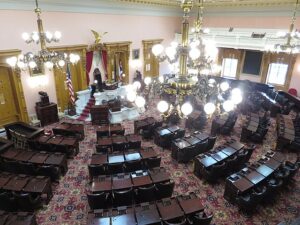
The Ohio House of Representatives chamber, where 99 elected representatives convene to propose, debate, and vote on legislation that shapes the state’s future.
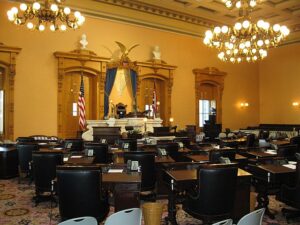
The Ohio Senate chamber, where 33 state senators meet to debate and vote on legislation, a key part of Ohio’s lawmaking process.
The Ohio General Assembly exercises its legislative power primarily through bills and resolutions.
Bills are documents proposed by a member of the General Assembly to create new laws or amend or repeal existing ones. The term “bill” is used from its drafting until it passes both houses and is presented to the Governor. Once approved by the Governor or if the Governor takes no action for ten days, the bill becomes a law.
Here’s an example of a bill:
House Bill 33, introduced in the Ohio General Assembly in 2024, aims to enhance financial literacy education for high school students. This bill mandates that all Ohio high schools include a financial literacy course as a graduation requirement. The goal is to equip students with essential knowledge about managing personal finances, including budgeting, saving, investing, and understanding credit.
Resolutions are formal expressions of the opinions and wishes of the General Assembly and do not require the Governor’s approval. Resolutions do not require the governor’s approval because they are formal expressions of the opinions and wishes of the General Assembly rather than laws. Unlike bills, which create, amend, or repeal laws and require the Governor’s signature to become law, resolutions are used to make declarations, express collective opinions, recognize achievements, or address internal legislative matters. Since resolutions do not have the force of law, they do not necessitate executive approval and are solely within the purview of the legislative branch to adopt.
Resolutions come in three types: joint, concurrent, and simple.
Reference
Ohio Legislative Service Commission. 2023. Chapter 5 – Enacting Legislation in A Guidebook for Ohio Legislators. Columbus, OH p. 47-48.
“I’m Just a Bill” is a famous educational video from the “Schoolhouse Rock!” series. It explains the legislative process at the federal level.
The video personifies a bill and follows its journey from being an idea to becoming a law, identifying steps such as introduction, committee review, debate, and the potential for a presidential veto.
YouTube URL: https://www.youtube.com/watch?v=OgVKvqTItto
Duration: 3:00
A video explaining the federal legislative process is applicable to understanding the state legislature because both processes involve similar steps. Now let’s learn more about how it’s done in Ohio.
The lawmaking process in Ohio involves multiple steps to turn an idea into law:
Note that for most bills, the Ohio Constitution requires a 90-day wait period before the law can be implemented. During this time, citizens can initiate a referendum to overturn an unpopular law. A referendum is a process that allows citizens to vote directly on a specific issue or question placed on the ballot. However, initiating a referendum is difficult and requires considerable resources, including time, money, and organizational effort. We will learn more about this process in Chapter 21.
Foundational Fact
Article II, Section 15 of the Ohio Constitution outlines specific steps for passing a bill in the General Assembly.
Role of Party Caucuses
Party caucuses are influential throughout the legislative process. These are groups of legislators from the same political party who meet to discuss and plan legislative strategies. A closed-door party caucus meeting can influence the progress of a bill significantly. For example, if the caucus collectively decides to oppose a bill, they can effectively put a stop to it, preventing it from advancing.
The Challenges of Passing Legislation
Passing legislation is not easy, as your bill can be waylaid at several steps in the process. When your bill is first assigned to a committee, the committee chair has the authority to deny it a committee vote, effectively killing it. Even if your bill receives a vote, other committee members might reject it, resulting in its demise.
If you’re lucky enough for the committee to approve it, they send it to the full chamber (House or Senate). However, both the Speaker of the House and the President of the Senate have the authority to deny your bill a floor vote. A floor vote is taken by the full membership of the House or Senate. Even if your bill receives a floor vote, it could still fail. If it passes, the other chamber must also pass your bill. If that happens, the final version is sent to the Governor, who could veto it. Finally, even if your bill makes it through that gauntlet, it theoretically could face voter opposition through a citizen-initiated referendum.
You now see how difficult it can be to pass legislation.
The Veto and Legislative Override as Checks and Balances
The principles of checks and balances are fundamental to the Ohio system of governance. They ensure that no single branch of government becomes too powerful, maintaining a balance of power among the legislative, executive, and judicial branches. Checks and balances are used in the lawmaking process, particularly gubernatorial vetoes.
Veto Power
The veto is a constitutional power granted to the executive branch, allowing the governor to reject a bill passed by the legislature. This power serves as a check on the legislative branch, ensuring that laws are carefully considered and preventing hasty or potentially harmful legislation from being enacted without executive review.
Legislative Override
While the governor can check the legislature’s power to some degree, Ohio allows for the legislature to either prevent or overturn a veto if the bill has received a super majority vote in the General Assembly. Let me tell you more.
A legislative override is a process by which the legislature can overturn a veto issued by the governor. In Ohio, this requires a three-fifths (60%) majority vote in both the House and the Senate. This power acts as a counterbalance to the executive veto, ensuring that the legislature can enact laws even if the executive disagrees, provided there is significant support for the legislation.
Reference
Ohio Legislative Service Commission. 2023. Enacting Legislation in A Guidebook for Ohio Legislators. Columbus, OH p. 49-60.
The Ohio Legislative Service Commission (LSC) is a nonpartisan agency that provides research, drafting, and analytical support to the Ohio General Assembly. The LSC plays a key role in the legislative process by assisting legislators and their aides at every step, from developing policy ideas to analyzing proposed laws. It acts as a trusted source of guidance and information while maintaining professionalism and neutrality. LSC key functions include:
Bill Drafting and Amendment Support
The LSC helps legislators turn their ideas into draft legislation, keeping proposals consistent with legal standards and existing statutes. Legislative aides work with the LSC to submit requests for bill drafting or amendments and handle technical adjustments.
Policy and Legal Research
Legislators use the LSC for in-depth research and analysis on policy issues. The agency provides nonpartisan reports, data, and background information to inform legislative decisions. Legislative aides often use these resources to create briefings or prepare talking points for their legislators.
Fiscal Analysis
The LSC prepares fiscal notes and impact statements that explain the financial effects of proposed legislation. Legislators use this information to assess the costs and benefits of policy decisions. Legislative aides review these notes to help their legislators understand budgetary impacts and explain them during debates or hearings.
Procedural and Legal Guidance
The LSC advises legislators on procedural rules and the legal aspects of proposals. Legislative aides request clarification on issues like committee referrals or amendment protocols, relying on the LSC to navigate the legislative process.
Legislative Education and Training
The LSC provides training for new legislators and their staff. These sessions cover the legislative process, tools, and resources to help both legislators and aides perform their roles effectively.
Confidentiality
The LSC treats all bill drafting, research, and other services as confidential. This allows legislators to explore ideas and proposals without outside influence or pressure.
The LSC works closely with legislators and their aides to support every step of the legislative process. Its expertise and resources help shape effective policies and improve the quality of legislative work in Ohio.
This case study uses House Bill 68 to explain Ohio’s legislative process in detail. Known as the “Saving Adolescents from Experimentation (SAFE) Act,” the bill proposed banning gender-affirming care for minors and restricting transgender women and girls from participating on female sports teams in schools and colleges.
The bill was chosen for its complexity. It followed the typical steps of becoming law, including committee review and votes in both chambers, but it also included a rare gubernatorial veto and an even rarer veto override by the General Assembly.
In this case, the governor opposed the bill and vetoed it. However, the General Assembly held another vote and achieved the required three-fifths majority in both the House of Representatives and the Senate to override the veto. Subsequently, the bill became law.
Background
House Bill 68, also known as the “Saving Adolescents from Experimentation (SAFE) Act,” aimed to ban gender-affirming care for minors and restrict transgender women and girls from participating in female sports teams at both K-12 and collegiate levels in Ohio.
Legislative Process
Introduction and Committee Referral
House Approval
Senate Approval
Governor’s Veto
Veto Override
Analysis
The initial House vote of 62-26 was not sufficient to override a gubernatorial veto, as it did not reach the three-fifths majority required. However, during the veto override process, the House achieved the necessary three-fifths majority with a vote of 65-28. The Senate’s vote of 23-9 was sufficient both during the initial passage and the veto override, as it met the three-fifths majority requirement.
This case study exemplifies the legislative process and the checks and balances inherent in the governance system, highlighting how the General Assembly can override a gubernatorial veto when it garners sufficient support.
Timeline Summary
This section demonstrates the legislative power dynamics and the procedural steps involved when the General Assembly overrides a gubernatorial veto, especially when the initial votes do not meet the veto-proof threshold in one chamber but do in the other.
Now that you’ve covered the legislative process in detail, take time to walk through the flow chart below. The goal is to recognize the intricacies of the process.

Source: Ohio Legislative Service Commission. 2023. Chapter 5 – Enacting Legislation in A Guidebook for Ohio Legislators. Columbus, OH p. 66.
If you’re interested in identifying legislation and seeing where it stands in the decision-making process, the Ohio Legislature’s Legislation Search Tool is a valuable resource. Whether you’re tracking a specific policy issue, researching a topic for school, or simply staying informed about changes to Ohio’s laws, understanding how to find and follow legislation can be very useful.
The tool helps you identify both proposed and enacted legislation. Proposed legislation includes bills or resolutions currently under review by the legislature, while enacted legislation refers to those that have completed the process and are now law.
Key Features of the Tool
How to Use the Tool
Why It’s Useful
This tool is useful for anyone interested in Ohio’s legislative process – whether you’re a student, a researcher, or an engaged citizen.
In Ohio, the policymaking process involves several key actors, each playing a role in shaping legislation. Some have formal roles (e.g., legislators and staff); others wield informal influence over the process (e.g., the press and special interests):
By understanding the roles of these various actors, one gains insight into the complexities of the legislative process and the multitude of influences that shape state law in Ohio.
In recent years, lawmaking in Ohio, like in many other states, has been heavily influenced by partisanship and polarization. Understanding these terms can help us grasp why it can sometimes be difficult for lawmakers to pass new laws and policies.
Partisanship refers to strong loyalty to a political party, often leading members of that party to strongly support their party’s policies and candidates while opposing those of the other party. In Ohio, as well as across the United States, partisanship has become more intense, meaning that Democrats and Republicans are more likely to disagree with each other on a wide range of issues. Moreover, with super majorities in the House and Senate and a Republican governor, Republicans do not need Democrat support to pass favored legislation.
Polarization is the growing gap between the political views of Republicans and Democrats. This means that the two parties are moving further apart in their beliefs and policy preferences. For example, Democrats might strongly support environmental regulations and social justice initiatives, while Republicans might emphasize free-market principles and traditional values. As polarization increases, it becomes harder for the two parties to find common ground.
The opposite of polarization is bipartisanship. Bipartisanship is when members of both parties work together to pass laws. This cooperation is essential for effective governance, especially in a divided government where one party controls the legislature, and the other holds the executive office. Bipartisanship requires compromise and a willingness to find solutions that satisfy both parties to some extent.
However, rising partisanship and polarization have made bipartisanship more challenging. This partisanship is partly explained by gerrymandering. When legislative districts are strongly skewed toward either Republicans or Democrats, incumbents are assured of winning the general election. The only real threat to their seat comes from challengers within their own party during the primary. Therefore, they lack a political incentive to work across the aisle in a bipartisan manner. Their incentive is to stay in the good graces of their partisan primary voters.
When lawmakers are unable to agree on policies, it leads to gridlock. Gridlock occurs when there is so much disagreement between the parties that little to no legislation can be passed. This often results in important issues being left unresolved because lawmakers cannot reach a consensus.
Interest groups are organized groups of people who work together to influence government decisions and policies. They represent a wide range of interests such as business, labor, education, the environment, or public safety. Some interest groups focus on advancing the goals of their members such as teachers, farmers, or small businesses, while others advocate for broader causes that affect the public, such as clean air or voting rights.
In Ohio, interest groups help to shape public policy. They provide lawmakers with information, testify at committee hearings, and encourage citizens to contact their elected officials. For example, the Ohio Education Association represents teachers and works to influence education policy and funding, while the Ohio Environmental Council advocates for stronger environmental protections.
Interest groups differ from political parties because they do not nominate candidates for office. Instead, they focus on persuading those already in office or those seeking election to support their issues.
Lobbying refers to the act of influencing government officials, particularly legislators, to enact or modify laws and policies in favor of a particular interest or cause. It often involves direct communication with lawmakers, advocacy efforts, and sometimes organizing grassroots campaigns to support a specific policy position.
Government relations is a broader term that encompasses lobbying but also includes other activities aimed at managing an organization’s relationship with government entities. This can involve monitoring legislative developments, building and maintaining relationships with government officials, providing strategic advice on public policy, and ensuring compliance with government regulations. While lobbying is a key component of government relations, the latter involves a more comprehensive approach to interacting with and influencing government at all levels.
Government relations provides significant value to companies and communities by actively shaping the policies that impact them. For companies, effective government relations can lead to favorable policies, access to government contracts, and a better understanding of regulatory requirements, which can enhance business operations and growth. For local governments, government relations can help secure funding, influence policy decisions that improve local services, and ensure that the voices of residents are heard in governmental decisions, leading to stronger, more resilient communities.
The Advance Higher Education Act was signed into law in 2025. By then, it had became one of the most widely discussed issues in state politics. Because it made headlines, sparked protests, and went through two different General Assemblies, it provides a good case study for understanding how public policy is made. This case gives students a chance to examine how competing interests, lawmakers and different advocacy groups, can shape the legislative process and influence what becomes law.
As you recall, a proposed law is called a bill. If it passes both the House and the Senate and is signed by the governor, it becomes a law, often referred to as an act. In this case, you will read about two bills: Senate Bill 83 (SB 83) and Senate Bill 1 (SB 1), which were debated in different legislative sessions. These bills were early versions of what eventually became the Advance Higher Education Act, the law that was officially passed in 2025. Understanding these two bills will help you see how a policy idea can change over time and what it takes to move from a proposal to an actual law.
Senate Bill 83 & the 135 Ohio General Assembly (2023-24)
Senate Bill 83, also known as the “Ohio Higher Education Enhancement Act,” was a hotly debated in the 135th Ohio General Assembly (2023-24). This bill proposed reforms to higher education, including restricting diversity, equity, and inclusion (DEI) programs at state colleges and universities. The bill aimed to prohibit mandatory diversity training, the use of diversity statements in hiring, and would have required universities to demonstrate intellectual diversity for course approval.
The bill also mandated annual performance evaluations for faculty members and would eliminate their right to engage in labor strikes.
Support and Opposition
Supporters of SB 83, including its sponsor Senator Jerry Cirino and several conservative lawmakers, argued that the bill is necessary to ensure free speech and intellectual diversity on state-owned college campuses. They believed that current DEI programs can stifle diverse viewpoints and create an environment of ideological conformity. Proponents also asserted that the bill would have prevented public funds from being used for what they consider to be biased training and policies.
Opponents, including university faculty, certain student organizations, and civil rights advocates, argued that the bill undermined efforts to create inclusive and equitable educational environments. They contend that DEI programs are essential for addressing historical and systemic inequalities in education. Critics also expressed concerns that the bill’s restrictions could lead to a chilling effect on academic freedom and discourage honest discussions about important social issues.
Legislative Process
SB 83 passed the Ohio Senate in May 2023 and was subsequently revised and passed by a House committee in December 2023. However, the bill faced opposition in the Ohio House, where numerous lawmakers from both parties expressed concerns about its potential impact on education and labor rights. Then House Speaker Jason Stephens refused to give the bill a floor vote and it died in committee.
Remember, the Speaker of the House has the authority to decide which bills reach the House floor for a vote (and which don’t). This means that he can choose to hold up or advance bills based on various factors, including political strategy and legislative priorities. This demonstrates the Speaker’s power and pivotal role in shaping the legislative process.
This case highlights the intense debates and competing interests that can arise in the legislative process, particularly around issues of education, free speech, and equity. It demonstrates how legislative proposals can galvanize various constituency groups, each advocating for their vision of what policies best serve the public interest.
Senate Bill 1 & the 136 Ohio General Assembly (2024-25)
When Ohio’s General Assembly ends its two-year session, any bills that haven’t passed both chambers expire. Because SB 83 (2023) stalled in the House and wasn’t enacted before the session ended in December 2024, it couldn’t carry over as SB 83 into 2025. That’s why the bill’s sponsor, Senator Cirino, had to refile the proposal as a new bill (Senate Bill 1) when the 136th General Assembly convened in early 2025.
The bill was built on the ideas from SB 83 but adds many new mandates. It bans all DEI programs, offices, job titles, trainings, and scholarships; prohibits faculty strikes; requires public posting of course syllabi with instructor credentials; mandates a civic literacy course; demands institutions declare neutrality on controversial topics; and restricts acceptance of donations from China.
Watch this report from WKYC Channel 3:
YouTube URL: https://www.youtube.com/watch?v=zAwzGjISzU0
Duration: 0:37
The Senate quickly advanced the bill. It was first approved by the Senate’s Higher Education Committee, then passed by the full Senate in a floor vote.
In the House, Representative Tom Young of the Miami Valley in Southwest Ohio introduced identical legislation as House Bill 6. Representative Young, who chairs the Workforce and Higher Education Committee, oversaw the bill’s review and approval by committee.
As you recall when a bill is approved by a committee in the House, the Speaker of the House determines whether it will come to the floor for a vote. In the previous session, the Speaker Jason Stephens blocked a floor vote. The new Speaker of House Matt Huffman supported the bill and advanced it to the floor where it received party-line support.
Governor Mike DeWine also supported the bill and signed it into law on March 28, 2025.
Following its enactment, opponents launched a grassroots veto referendum campaign to try to overturn the new law. A veto referendum is a process in Ohio that allows citizens to collect signatures and place a recently passed law on the statewide ballot for voters to decide whether it should take effect or be repealed.
Their goal was to put the issue on the statewide ballot so Ohio voters could decide whether to keep or reject Senate Bill 1. They collected nearly 195,000 petition signatures but fell short of the required 248,100 valid signatures and did not meet the rule that requires signatures from at least 44 of Ohio’s 88 counties.
Under Ohio law, citizens have 90 days after a law is signed to gather enough signatures to pause its implementation and place it on the ballot for a vote. Because the organizers did not meet the required number of signatures by the June 26, 2025 deadline, Senate Bill 1 went into effect without a public vote.
References
https://apnews.com/article/higher-education-ohio-dei-restrictions-faculty-strikes-8b0ab7db08eb712e3350bb241b610f70
https://apnews.com/article/ohio-higher-education-dei-bill-ban-378ca9b2389e182562296872edb5d68e
The press plays a significant role in influencing the lawmaking process in states like Ohio through several mechanisms:
Agenda Setting – The press has the power to shape public discourse by choosing which issues to highlight. When the media focuses on particular topics, it can elevate these issues on the legislative agenda, prompting lawmakers to address them. For example, extensive coverage of the opioid crisis in Ohio has pressured state legislators to prioritize opioid-related policies and funding.
Public Opinion – Media coverage can influence public opinion by framing issues in specific ways. Positive or negative portrayals of policies or legislators can sway public sentiment, which lawmakers often consider when making decisions to align with their constituents’ preferences and ensure reelection.
Watchdog Function – The press serves as a watchdog, holding government officials accountable by investigating and exposing misconduct, corruption, or inefficiency. This scrutiny can lead to public outcry and demand for legislative action or reforms, as seen in instances of corruption uncovered in Ohio’s state government.
Information Dissemination – The media provides vital information to both the public and lawmakers. Detailed reporting on complex issues, legislative proposals, and the potential impact of policies helps inform and educate stakeholders, facilitating more informed decision-making within the legislative process.
Advocacy and Editorials – Newspapers, TV stations, and online media outlets often publish editorials and opinion pieces that advocate for or against specific policies. These can influence lawmakers by presenting arguments, data, and perspectives that may sway their stance on legislative matters.
Campaign Coverage – During election cycles, the press’s coverage of candidates and their platforms can shape the electoral landscape. Lawmakers are likely to respond to issues that receive significant media attention during campaigns to align themselves with voter concerns and secure electoral support.
Overall, the press’s ability to shape public discourse, inform and influence public opinion, and hold government accountable makes it a powerful force in the lawmaking process in Ohio.
The decline of newspapers in both small towns and larger cities has significant implications for the lawmaking process. With fewer reporters monitoring legislators, there is reduced accountability, leading to less scrutiny of their actions. This lack of oversight can result in increased opportunities for corruption and inefficiency, as legislators may feel less pressure to act transparently and responsibly.
Additionally, the decline in newspapers means the public is less informed about their representatives’ activities and decisions. Newspapers play a critical role in keeping communities updated on legislative actions that directly impact their lives. Without this information, public engagement and participation in the democratic process diminish, leading to decreased public pressure on legislators to address specific issues or respond to constituents’ needs. This shift can result in a legislative agenda more influenced by special interest groups or partisan considerations.
Moreover, the reduction in local newspapers affects the coverage of local issues that larger media outlets might overlook. This can lead to policies that do not adequately address the unique needs of smaller communities. The decline also weakens investigative journalism, which relies on dedicated reporters and resources typically found in local newspapers. Fewer in-depth investigations into legislative actions and potential misconduct reduce the overall quality of journalism and public knowledge, eroding civic engagement and weakening democratic institutions.
An illustrative example of this trend is the closure of the Youngstown Vindicator in 2019, which left the city without a major daily newspaper. The loss of the Vindicator had several potential implications:
Information Void – The absence of the Vindicator created an information void in Youngstown, reducing the availability of local news and investigative reporting. Residents lost a crucial source of information about local government, politics, and community issues.
Reduced Accountability for Local Officials – With the closure of the Vindicator, local officials in Youngstown faced less scrutiny from the press, potentially leading to less transparency and accountability in government operations.
Impact on Civic Engagement – The Vindicator’s closure likely contributed to a decline in civic engagement, as residents had fewer resources to stay informed about local issues and participate in the democratic process.
Overall, the decline in newspapers, including those in larger cities like Youngstown, can undermine the lawmaking process by diminishing accountability, reducing public awareness and engagement, and weakening the representation of local issues and diverse perspectives. This can lead to less effective and less democratic governance.

Dr. Meghan Rubado is a nationally recognized expert on the impact of declining small-town print journalism, a field she understands both academically and personally. Before pursuing her PhD in political science, Dr. Rubado worked as a newspaper reporter for The Post-Standardin Syracuse, where she covered local government. Her research now explores how the erosion of small-town newspapers affects civic engagement, government accountability, and community identity. Dr. Rubado’s insights are sought after by policymakers and media professionals.

State Senator Kent Smith (Democrat), a Levin School alum, represents Ohio’s 21st Senate District.
Smith graduated from Miami University in 1988 and earned a Master of Science in Urban Studies from CSU in 2001. His master’s thesis focused on the emerging threat of predatory lending and the subprime market. In 2002, he co-authored the first Predatory Lending Report for Policy Matters Ohio.
Before serving in the Ohio Senate, Senator Kent Smith served in the state house and on the Euclid school board. He served four terms in the Ohio House of Representatives from 2015 to 2022, representing the 8th District. Prior to his tenure in the House, Smith was a dedicated member of the Euclid Board of Education from 2002 to 2013, during which he never missed a meeting.
Senator Smith has a strong record of legislative accomplishments. In 2023, he introduced Senate Bill 50 to enhance 9-1-1 laws and strengthen emergency telecommunicator training, ensuring more effective responses during emergencies.

Senator Smith visiting with Levin School students on April 15, 2024.
An advocate for fairness in utility services, Smith has worked to protect Ohioans from unfair practices by utility companies. He introduced laws to prevent utilities from passing the cost of their political activities onto customers, ensuring bills reflect actual service costs. Additionally, he pushed for laws requiring utility companies to refund customers if they were overcharged and sponsored the Consumer Utility Billing Transparency Act to make bills clearer and easier for customers to understand. These efforts aim to hold utility companies accountable and give Ohio residents more control over their bills.
In addition to these efforts, Senator Smith has supported raising the state minimum wage and expanding protections for utility workers against harassment or threats.
Reference
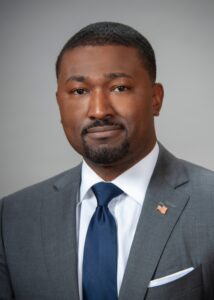
Terrence Upchurch represents Ohio’s 20th House District, which includes portions of Cleveland and surrounding communities. A CSU graduate, he earned his bachelor’s degree in political science and is currently pursuing his law degree at CSU. Upchurch began his public service career working as a special assistant to Cleveland City Council and was elected to the Ohio House of Representatives in 2018. As a legislator, he focuses on economic development, criminal justice reform, and improving educational opportunities.
Reference
https://www.ohiohouse.gov/members/terrence-upchurch/biography
This chapter explores the legislative process in Ohio, focusing on the journey of a bill from its inception to becoming a law. It explains that bills are proposed by members of the Ohio General Assembly and must pass through several stages, including drafting, committee review, debate, and voting in both legislative chambers. If a bill is approved by both the House and the Senate, it is sent to the Governor, who can either sign it into law or veto it. Additionally, the chapter discusses the use of resolutions, which express the opinions and wishes of the General Assembly but do not require the Governor’s approval.
Readers will learn how this knowledge can inform their civic engagement activities. By understanding the legislative process, individuals can better advocate for issues they care about, engage with their representatives, and participate in public hearings. Knowing how laws are made and the roles of different actors in the process empowers citizens to influence policy decisions and hold their government accountable. This chapter equips readers with the tools to actively participate in democracy and drive meaningful change in their communities.
A budget is a financial document that outlines the government’s planned revenues and expenditures for a specific period. Put simply, it is the government’s money plan. It shows how much money is expected to come in (i.e. revenues), how much will be spent, and on what items the money will be spent (i.e. expenditures).
In many ways, budgets are value documents that demonstrate what issues elected officials care enough about to fund.
This chapter illustrates how Ohio’s budgets are created and allocated over a two-year period. Understanding this process will help you with your civic engagement activities, as it reveals how public funds are distributed and how citizens can influence fiscal decisions.
This process underscores the importance of the General Assembly’s power of the purse. Nothing can be included in the budget with the General Assembly approving. Legislative control over financial resources shapes state priorities and impacts public services. At the same time, you’ll learn about the governor’s influence over the process as well.
Revenues & Expenditures
Revenues are the money the government collects. Most of this comes from taxes such as income tax, sales tax, and property tax, but it can also include fees, licenses, and funds from the federal government.
Expenditures are the money the government spends. This includes funding for schools, healthcare, transportation, public safety, and other programs and services that benefit the public.
Together, revenues and expenditures show where the money comes from and where it goes.
Again, a budget is a detailed plan that the government creates each year to manage its money. It shows how much money the government expects to receive and how it plans to spend it. The budget includes:
The budget acts as a guide for how the government will handle its finances over a specific period, usually one year.
An appropriations bill is a type of law that allows the government to spend money. Each appropriations bill sets aside a certain amount of money for specific government activities and programs. These bills are necessary to:
Appropriations bills must be passed by both houses of the legislature and signed by the governor to become law.
In short, while the budget provides the plan, the appropriations bills provide the legal means to make that plan a reality. Multiple appropriations bills are needed to cover all the spending areas outlined in the budget, ensuring that every part of the government gets the money it needs to operate.
The state government creates several distinct budgets every two years to manage its finances effectively. These include the operating budget, capital budget, transportation budget, Bureau of Workers’ Compensation budget, and Industrial Commission budget, each serving different purposes and addressing various aspects of the state’s needs.
Operating Budget
The operating budget covers the day-to-day expenses of running the state government. This includes salaries for state employees, funding for public services like education and healthcare, and maintenance costs for state facilities. Essentially, it deals with recurring expenditures necessary for the state’s regular operations and services provided to the public.
Capital Budget
The capital budget, on the other hand, is used for long-term investments and infrastructure projects. This includes spending on construction, major repairs, and improvements to state buildings, roads, bridges, and other public infrastructure. Capital budget items are typically large, one-time expenses that provide benefits over many years, such as building a new school or upgrading the state’s transportation system.
Transportation Budget
The transportation budget specifically allocates funds for the construction, maintenance, and operation of Ohio’s transportation system, including highways, bridges, and public transit. This budget ensures dedicated funding for critical transportation projects, distinguishing it from the broader capital budget that covers a wider range of infrastructure projects.
By creating separate budgets for operating, capital, and transportation needs, the state can more effectively plan and manage its resources, ensuring that each area receives appropriate funding and attention.
Bureau of Workers’ Compensation Budget
The Bureau of Workers’ Compensation budget is a separate budget that provides for the compensation and medical benefits to workers injured on the job. This budget is distinct because it is funded primarily through administrative assessments charged to employers, rather than the General Revenue Fund, to address the specific financial management needs of workers’ compensation programs.
Industrial Commission Budget
The Industrial Commission budget supports the Industrial Commission of Ohio, which handles appeals for workers’ compensation claims. Like the Bureau of Workers’ Compensation budget, it is typically passed every two years and is funded through assessments on employers. This separation ensures focused financial management for the adjudication and appeals process in the workers’ compensation system.
References
Ohio Legislative Service Commission. 2023. Chapter 8 – The Ohio Budget Process.
The state budget process in Ohio is a systematic procedure that determines how the state allocates its financial resources over a two-year period. This process involves various actors, including state agencies, the Governor, and the General Assembly.
Here are the steps used to create the operating budget:
Preparation by State Agencies
Agencies receive instructions from the Office of Budget and Management (OBM) on how to prepare their budget requests and submit them to OBM for review.
Formulation by the Governor
OBM collaborates with the Governor to develop budget recommendations, which are compiled into the executive budget document (“blue book”).
The blue book contains the governor’s detailed budget proposal, including projected revenues, recommended expenditures, and policy priorities for the upcoming biennium. It also provides background information on the state’s financial condition and explanatory notes that outline why certain programs or services are being emphasized. This document serves as the starting point for legislative debate and amendment.
Submission to the General Assembly
The Governor submits the executive budget to the General Assembly for review and approval.
Legislative Process
The Legislative Service Commission drafts the Governor’s proposed budget into bill form, which is reviewed, amended, and approved by both the House and Senate.
The legislative process involves several key steps. First, the proposed budget is introduced in the House of Representatives, where the House Finance Committee and its subcommittees conduct hearings. They review the budget, propose amendments, and draft a substitute bill incorporating their changes. This bill is then considered and amended by the full committee before being sent to the House floor for a vote.
Once the House passes the budget, it moves to the Senate, where the Senate Finance Committee and its subcommittees conduct a similar review. They may draft their own substitute bills to include desired changes. After thorough review and amendments, the Senate passes its version of the budget bills. Often, the Senate Finance Committee starts its review process while the bill is still under consideration in the House committee to manage the limited time available effectively.
Given that the House and Senate versions of the budget bills typically differ, a conference committee is convened to reconcile these differences. This committee, comprising members from both chambers, works to create a final version of the budget that is acceptable to both the House and the Senate. The committee’s report is then submitted to both chambers for approval.
Governor’s Approval
The approved budget bills are sent to the Governor for signature or veto. The General Assembly can override vetoes with a three-fifths majority vote. The Constitution empowers the Governor to veto any item in an act making an appropriation, but the General Assembly has the power to override a line-item veto by a three-fifths majority vote in each house.
A line-item vetois the power of an executive authority, such as the Governor, to reject specific provisions a budget, without vetoing the entire appropriations bill. The General Assembly has the power to override a line-item veto by a three-fifths majority vote in each house.
Watch WKYC Channel 3 reporter Matt Rascon report on line-item vetoes by Governor Mike DeWine in 2023:
YouTube URL: https://www.youtube.com/watch?v=PrngTJpIip0
Duration: 2:00
Reference
Ohio Legislative Service Commission. 2023. Chapter 8 – The Ohio Budget Process.
The process for the capital budget begins in late summer of odd-numbered years, focusing on long-term infrastructure projects.
Watch this report by NBC4 reporter Natalie Fahmy from Columbus on the legislature’s capital budget processes in 2024:
YouTube URL: https://www.youtube.com/watch?v=gkSpaIppDAQ
Duration: 2:33
Key steps in the capital budget process include:
Throughout this process, various actors try to influence how state funds are allocated and who benefits from them. Different interest groups, such as local governments, nonprofits, businesses, and policy think tanks, lobby to ensure that their priorities are included. These actors provide data, advocate for specific projects, and sometimes collaborate to strengthen their influence. The final budget reflects a compromise between these competing interests, determining how resources are distributed across the state.
Some of this lobbying has the public interest at heart. For example, the Greater Cleveland Funders Collaborative is a coalition of local foundations and philanthropic organizations dedicated to enhancing the health and human services sector in the Greater Cleveland area. This group works together to influence Ohio’s state capital budget process by identifying and endorsing specific projects that address critical community needs. By combining their resources and expertise, the collaborative amplifies the impact of their advocacy efforts, ensuring that these projects receive the attention and consideration of state legislators. Their endorsements, grounded in thorough research and a deep understanding of regional needs, increase the chances of these projects securing state funding, thereby addressing vital local priorities in the state capital budget.
The state government of Ohio relies on several key sources of revenue to fund its operations and services. These sources are essential for supporting public programs, infrastructure, and other important functions in the state.
Sales Tax
A major source of revenue for Ohio’s budget is the sales tax, which applies to most goods and some services sold in the state. This tax is important because it grows with the economy, providing a steady stream of income.
Personal Income Tax
Another major source of revenue is the personal income tax. Ohio’s income tax system is progressive, meaning that people with higher incomes pay higher rates on the amounts above certain thresholds.
For tax year 2024 (returns filed in 2025), Ohio has three brackets:
Recent legislation is phasing in a change so that by tax year 2026, most non-business income will be taxed flatly at 2.75% for income above $26,050, eliminating the higher 3.50% bracket.
Progressive vs. Flat Tax
Progressive Tax – Tax rates increase as income increases. People with higher incomes pay a larger share of their income in taxes compared to those with lower incomes.
Flat Tax – Everyone pays the same tax rate regardless of income level. Higher earners still pay more in total dollars, but the percentage is the same for all.
Federal Funds
Federal funds are a significant part of Ohio’s budget. These funds come from the federal government and are used for specific programs like Medicaid, education, and transportation. Federal contributions are crucial because they help supplement the state’s own revenues and support essential public services.
Check out this graphic showing revenue sources for the state’s transportation budget. The federal government provided the largest source, followed by the state’s motor vehicle fuel tax. Without this funding source, the state wouldn’t be able to maintain our highways at the same level.

Motor Vehicle Fuel Tax
Ohio’s motor vehicle fuel tax is a crucial revenue source for the state’s transportation budget, funding the construction, maintenance, and repair of highways and roads. This tax is applied to the sale of gasoline and diesel fuel, with rates periodically adjusted to meet the growing infrastructure needs. As of July 2019, Ohio increased its fuel tax to 38.5 cents per gallon for gasoline and 47 cents per gallon for diesel. This adjustment was aimed at addressing the funding shortfalls for critical transportation projects across the state, ensuring safe and efficient travel for residents and businesses alike.
Commercial Activity Tax (CAT)
The Commercial Activity Tax (CAT) is a tax on the gross receipts of businesses in Ohio. Unlike a corporate income tax, which is based on profits, the CAT is based on the total receipts of a business. Although it only contributes about 3.5% to the state’s revenues, the CAT is an important part of Ohio’s tax system, especially since Ohio does not have a corporate income tax.
Citizens have several opportunities to influence the Ohio state operating and capital budgets:
Public Hearings
Committees hold public hearings where citizens can testify about specific budget items. For example, during the debate over the Ohio state budget in 2025, numerous public hearings were held where citizens could express their opinions on proposed cuts to public health funding. These hearings provide a platform for direct citizen input, allowing legislators to hear firsthand how budget decisions impact their constituents.
Contacting Legislators
Writing letters, making phone calls, or scheduling meetings with legislators is a common way for citizens to advocate for or against budget items. For example, during the 2025 budget process, many Ohioans contacted their representatives to voice their concerns about proposed reductions in education funding. Personal stories and data shared through these contacts can significantly influence legislators’ perspectives and decisions. Engaging directly with legislators ensures that citizens’ voices are heard in the budgetary decision-making process.
Participating in Public Forums
Public forums hosted by community organizations or local governments offer another venue for discussing the state budget and gathering citizen input. In 2025, several public forums were organized across Ohio to discuss the impact of potential budget cuts on education. These events allowed citizens to voice their concerns, ask questions, and provide suggestions directly to policymakers and other stakeholders.
Engaging with Interest Groups
Joining or supporting advocacy groups that focus on specific budgetary changes can amplify an individual’s voice. For example, environmental advocacy groups in Ohio mobilized members to oppose budget cuts to the Environmental Protection Agency in the 2025 state budget. These groups often have the resources and expertise to mount effective campaigns and lobby on behalf of their members.
Using Social Media
Social media platforms are powerful tools for raising awareness and contacting legislators directly. During the 2025 budget process, Ohioans used X and Facebook to organize virtual town halls and tweet at their legislators using hashtags like #SaveOurSchools to advocate for increased education funding. Social media campaigns can quickly mobilize large numbers of people and bring significant attention to specific budget issues.
Participating in the Electoral Process
Voting for candidates who align with their budget priorities is a fundamental way for citizens to influence the budget process. For example, the 2022 gubernatorial election in Ohio saw debates on budget priorities, with candidates outlining their plans for health care, education, and infrastructure spending. Citizens can impact budget decisions by electing officials who share their views on fiscal policies and priorities.
These various forms of public participation ensure that citizens have multiple avenues to influence the budget process and hold their elected officials accountable for their fiscal decisions.
The state budget process in Ohio involves multiple steps and key players, including state agencies, the governor, and the General Assembly. Initially, state agencies prepare budget requests based on guidelines from the Office of Budget and Management (OBM). These requests are reviewed and formulated into the executive budget by the OBM and the governor. The executive budget is then submitted to the General Assembly, where it undergoes a thorough review process by the House and Senate Finance Committees. Both chambers may propose amendments and pass their versions of the budget, which are reconciled by a conference committee if necessary.
The final budget is then sent to the Governor for approval, who can sign it into law or veto specific items, with the General Assembly holding the power to override such vetoes.
This chapter equips readers with the knowledge needed to engage effectively in the budgeting process. By understanding how the budget is developed and approved, citizens can participate in public hearings, contact their legislators, and use social media to advocate for fiscal policies that reflect their priorities.
The governor is the most visible leader in Ohio state government. As the head of the executive branch, the governor is responsible for carrying out the laws passed by the General Assembly, proposing a budget, and setting priorities for the state.
But the governor does not act alone. Ohio also elects other statewide executive officials such as the attorney general, auditor, and secretary of state, who each influence how government functions.
This chapter begins with a look at the governor’s powers. We then will explore how checks and balances limit executive power and keep it in line with the legislature and courts. Along the way, we will examine case studies of Ohio leaders, including Mike DeWine and George Voinovich.
By the end of this chapter, you should have a clearer understanding of the executive branch in Ohio, who holds power, how they are chosen, and the responsibilities they carry.
The Governor of Ohio is the head of the state’s executive branch, with extensive responsibilities and powers. The Governor oversees the execution of state laws, appoints heads of state agencies and departments, prepares the state budget, and grants pardons and reprieves. The Governor can call special legislative sessions and has the authority to veto legislative bills. The Governor’s office is central to Ohio government and politics, making the Governor the chief policy promoter and advocate in Ohio. The role also includes serving as the head of state, attending official ceremonies, and representing Ohio in various capacities.
The Governor’s formal powers include appointment authority, which allows the Governor to appoint officials to key positions within the state government. This power extends to members of various boards and commissions, often with the advice and consent of the Senate. The Governor also plays a major role in budget-making by presenting a biennial budget to the General Assembly. This becomes the basis for legislative deliberations. Additionally, the Governor has strong veto power, including a line-item veto over budgets, which can be used to strike specific provisions in appropriation bills.
Another critical aspect of the Governor’s role is the power to call out the Ohio National Guard during emergencies, such as natural disasters or civil disturbances. This authority highlights the Governor’s role as the chief of security and safety for the state. Furthermore, the Governor has the power of clemency, which includes granting pardons and commuting sentences. This power is significant in cases where the Governor believes justice necessitates such actions.
Overall, the Governor’s position is multifaceted and encompasses a wide range of responsibilities that impact various aspects of state governance. The Governor is limited by Ohio law to serving only two terms in office.
Foundational Facts
Under Article III of the Ohio Constitution, the Governor holds the highest executive authority in the state. This includes enforcing state laws, appointing officials (with Senate approval), preparing the state budget, and wielding veto power over legislation. The Governor also has the power to call special legislative sessions and mobilize the Ohio National Guard in emergencies. These powers, outlined in Ohio’s Constitution, position the Governor as a central figure in state government.
References
Ohio Legislative Service Commission. 2023. Chapter 10 – The Executive Branch in A Guidebook for Ohio Legislators. Columbus OH.
Sracic, Paul A. and William C. Binning. 2015. Chapter 4 – The Ohio Executive Branch in Ohio Government and Politics. Washington DC: CQ Press.
Mike DeWine (Republican), born January 5, 1947, is the 70th Governor of Ohio, serving since 2019. A Republican, he was Ohio’s Attorney General from 2011 to 2019 and served in Congress, both in the U.S. House (1983-1991) and Senate (1995-2007). DeWine, from Yellow Springs, Ohio, graduated from Miami University and earned his law degree from Ohio Northern University. He began his career as an assistant prosecutor and then county prosecutor for Greene County. DeWine also served as Ohio’s lieutenant governor under George Voinovich. Elected to the U.S. Senate in 1994, he served until 2006.
Governor Mike DeWine has achieved several significant accomplishments during his tenure. One of his major achievements is securing the $20 billion Intel Semiconductor Factory project, which is expected to bring over 20,000 jobs to Ohio, marking the largest single private sector investment in the state’s history.
Governor DeWine has also made substantial investments in law enforcement and mental health services. He allocated over $274 million to support law enforcement resources and crime prevention efforts. His administration has invested $1.2 billion in student wellness and mental health programs, aiming to address these issues early and comprehensively
He was reelected in 2022, defeating former Dayton Mayor Nan Whaley by a large margin.
Much of the text in the above bio is quoted directly from the following source: https://en.wikipedia.org/wiki/Mike_DeWine
Let’s revisit the concept of checks and balances because to get things done the governor must navigate both the legislative and judicial branches.
As you recall, the Ohio Constitution divides the state government into three branches: legislative, executive, and judicial. This division of power is crucial as it grants specific powers to each branch and establishes a system of checks and balances.
The purpose of checks and balances is to ensure that no single branch can control too much power, maintaining a separation of powers. Here are some examples of how the different branches in Ohio work together:
Source (modified): https://bensguide.gpo.gov/j-check-balance
Foundational Facts
Remember, the Ohio Constitution, drawing from the U.S. Constitution, divides power among the legislative, executive, and judicial branches. It also creates checks and balances to prevent any one branch from becoming too powerful.
Concentrated power in a single branch can lead to abuses, unchecked authority, and a lack of accountability to the people. Federalist No. 51 underscores this, as James Madison argued that each branch should have “the necessary constitutional means and personal motives to resist encroachments” from the others. Ideally, this arrangement maintains a balanced and fair government.
Getting elected as the governor of Ohio involves several steps, including meeting eligibility requirements, running a campaign, winning a primary election, and then winning the general election.
First, to be eligible to run for governor in Ohio, a person must be at least 18 years old and a resident of Ohio. They must also be a U.S. citizen. That’s it. Those are the only legal requirements. Once they meet these basic requirements, they need to declare their candidacy, which involves filing the necessary paperwork with the Ohio Secretary of State and paying any required fees. This makes their intention to run for governor official.
Running a campaign is a significant part of getting elected. The candidate needs to gain support from voters, which often involves creating a campaign team, raising funds, and developing a campaign strategy. This includes making public appearances, participating in debates, and advertising their policies and plans for the state. For example, Mike DeWine, who is the current governor of Ohio, campaigned on issues like improving education, increasing job opportunities, and enhancing public safety.
The election process begins with the primary election, where candidates from the same political party compete against each other to become the party’s nominee. The winners of the primary elections from each party then face off in the general election. In Ohio, the general election is held in November during even-numbered years. To win, a candidate must receive the most votes from the citizens of Ohio. Once elected, the new governor takes an oath of office and begins serving a four-year term, during which they will work on implementing their policies and managing the state’s executive branch.
Over the last few decades, Ohio governors have commonly shared several characteristics, notably a strong background in law and politics, with many having previously served in roles such as state attorney general or U.S. congressman. These governors have predominantly been white males, reflecting a lack of gender and racial diversity in the state’s highest executive office. This trend underscores broader patterns of political representation where minority groups and women have historically been underrepresented in high-ranking political positions.
Term Limits
In Ohio, the governor, lieutenant governor, attorney general, secretary of state, treasurer of state, and auditor of state are each limited to serving two successive four-year terms. “Successive” means the terms must be back-to-back. Once an official has served two consecutive terms, they must wait at least four years before they can run for that same office again. However, they are allowed to run for a different office without waiting, which is why some statewide officials continue their political careers by seeking another executive or legislative position.
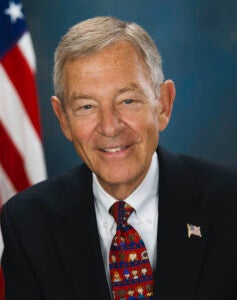
George Voinovich (Republican) was Governor from 1991 to 1998.
First as mayor of Cleveland, he was credited with restoring financial health to Cleveland after the city went into default under his mayoral predecessor. A plainspoken man with a disarming grin and support from the city’s business establishment, he helped ignite the downtown building boom of the 1980s that would give Cleveland the moniker “Comeback City.”
Watch this interview from the Teaching Cleveland project in 2014:
YouTube URL: https://www.youtube.com/watch?v=ihpqx3pLVgI
Duration: 10:20
As governor, he balanced another difficult set of books by making choices that pleased neither his critics on the left – for cuts in child day care and flat spending on school busing for desegregation – and on the right, for advocating tax increases.
He was an overwhelmingly popular governor, with job approval ratings between 60 percent and 70 percent. He managed to maintain an aura of control during a deadly prison riot at Lucasville in 1993 by not grandstanding for the cameras, and won reelection in 1994 with a stunning 72 percent of the vote.
When he moved into the governor’s mansion, the state was facing massive debt; by the time he left, it had nearly $1 billion in its “rainy day” fund and the Ohio Turnpike was undergoing a major expansion. His mantra was “Work harder and smarter and do more with less,” and he held budget growth to its lowest in three decades.
Following his two terms in Columbus, he was elected to the U.S. Senate where he served from 1999 to 2011.
Voinovich was born to parents of Serbian and Slovenian heritage in Cleveland’s Collinwood neighborhood, a working-class enclave with deep ethnic roots. A devout Catholic who attended Mass several times a week, Voinovich said he used prayer to help guide him in difficult or painful decisions. His goal, he had said, was “to witness and to make people feel good.”
After retiring from the U.S. Senate, George Voinovich joined CSU as a senior fellow in the Maxine Goodman Levin College of Urban Affairs. In this role, he served as a key advisor for CSU’s efforts to engage and support the broader Cleveland community, and he played an active part in developing major new community service initiatives at the university.
While at CSU, he authored the book Empowering the Public-Private Partnership: The Future of America’s Local Government, which draws on his success in revitalizing parts of Cleveland in the 1980s.
Much of the text in the above bio is quoted directly from Senator Voinovich’s obituary. See below for more details:
Cleveland Plain Dealer. 2016. “George Voinovich, Former Cleveland Mayor, Ohio Governor and U.S. Senator, Dies.” Jun. 16. https://www.cleveland.com/metro/2016/06/george_voinovich.html.
Additional Reference
Cleveland State University. 2016. CSU Mourns the Passing of George Voinovich. https://www.csuohio.edu/news/csu-mourns-passing-george-voinovich
The lieutenant governor of Ohio supports the governor and assumes the role if the governor is unable to serve. Often overseeing specific policy areas or initiatives, the lieutenant governor’s responsibilities are shaped by the governor’s directives. This role involves significant administrative duties and coordination with state agencies to implement the governor’s agenda.
Reference
Sracic, Paul A. and William C. Binning. 2015. Chapter 4 – The Ohio Executive Branch in Ohio Government and Politics. Washington DC: CQ Press
In January 2025, Governor Mike DeWine nominated then-Lieutenant Governor Jon Husted to fill the U.S. Senate seat vacated by J.D. Vance. Husted, who had been elected twice as Lieutenant Governor as DeWine’s running mate, assumed his new role in Washington, D.C.
To fill the vacancy, Governor DeWine appointed Jim Tressel as Lieutenant Governor. Tressel has had a distinguished career spanning athletics and higher education. Best known for his tenure as head coach of the Ohio State Buckeyes football team from 2001 to 2011, he led the program to a national championship in 2002 and multiple Big Ten titles. After his coaching career, he transitioned into academic leadership, serving as an administrator at the University of Akron before becoming president of Youngstown State University from 2014 to 2023.
While Governor DeWine had the authority to nominate Tressel to fill the Husted vacancy, the selection required confirmation by both the State House and Senate. Watch this news report by WBNS 10TV to learn more:
YouTube URL: https://www.youtube.com/watch?v=X7nlPoMurxo
Duration: 2:34
If you want to go more in depth, watch this longer segment from Columbus on the Record, a public affairs show from WOSU Public Media.
YouTube URL: https://www.youtube.com/watch?v=JFUl7szdy0A
Duration: 26:46
While the United States federal government allows the president to appoint the attorney general and other high-profile positions, the framers of the Ohio state constitution opted for a different approach by making these key executive positions elected rather than appointed. This decision ensures greater accountability and representation of the public’s interests, as Ohioans have direct control over who holds significant offices such as attorney general, secretary of state, auditor, and treasurer.
By electing these officials, the power is distributed more evenly, preventing the governor from consolidating too much authority. This system provides a built-in check and balance within the executive branch, fostering a more balanced and democratic governance structure. The history of Ohio’s executive branch demonstrates that independently elected officials can serve as effective checks on the Governor’s power, promoting transparency and accountability in state government.
Foundational Facts
Sections 1 and 2 of Article III in the Ohio Constitution mandate that key executive positions—such as attorney general, secretary of state, auditor, and treasurer—be filled through elections rather than appointments by the governor. This approach ensures that these officials are more directly accountable to Ohio voters rather than being appointed by the governor.
References
Ohio Legislative Service Commission. 2023. Chapter 10 – The Executive Branch in A Guidebook for Ohio Legislators. Columbus OH.
Sracic, Paul A. and William C. Binning. 2015. Chapter 4 – The Ohio Executive Branch in Ohio Government and Politics. Washington DC: CQ Press.
The attorney general is the chief legal officer of Ohio and represents the state in legal matters. The office provides legal advice to state agencies and officials, defends the state in court, and enforces both civil and criminal laws. This means the attorney general can take action in cases involving financial or consumer disputes (civil law) as well as cases that involve breaking the law and possible punishment (criminal law).
While the attorney general does not usually prosecute routine criminal cases, the office may step in when asked by a county prosecutor, when there is a conflict of interest, or in specialized cases such as organized crime, public corruption, or environmental violations.
The attorney general also oversees law enforcement initiatives and consumer protection programs, including investigating fraud and protecting Ohioans from unfair business practices. In addition, the office supervises the Bureau of Criminal Investigation (BCI), which supports local law enforcement with forensic science, criminal investigations, and specialized
Reference
Sracic, Paul A. and William C. Binning. 2015. Chapter 4 – The Ohio Executive Branch in Ohio Government and Politics. Washington DC: CQ Press.
The current attorney general is Dave Yost (Republican). He graduated from Ohio State University with a Bachelor of Arts degree in journalism. He earned a Juris Doctor from the Capital University Law School. After earning his bachelor’s degree, Yost became a journalist with the Columbus Citizen-Journal.
Yost later served in senior positions within the administration of Columbus Mayor Buck Rinehart and Governor George Voinovich.
Dave Yost was appointed Delaware County Auditor in 1999 and became the Delaware County Prosecutor in 2003. He was elected Ohio’s 32nd state auditor in 2010 after an earlier bid for the Republican nomination for Ohio attorney general. In January 2017, Yost announced his candidacy for Ohio Attorney General, a position he won in 2018 by defeating Democrat Steve Dettelbach. Yost was re-elected in 2022, defeating Democratic candidate Jeffrey Crossman.
The text in the above bio is quoted directly from the following source: https://en.wikipedia.org/wiki/Dave_Yost

Did you know former CSU Law School Dean Lee Fisher (Democrat) was the 44thOhio Attorney General? He served from 1991 to 1995. Dean Fisher also served one term as the Lieutenant Governor, two terms as a State Senator, and one term in the House of Representatives. Lee Fisher is now the President of Baldwin Wallace University.
The auditor of state ensures the financial accountability of Ohio’s state and local governments. A key part of this work is conducting financial audits, which are reviews of government accounts to make sure public money is spent legally and properly.
The auditor also performs performance audits, often at the request of state leaders, to evaluate whether agencies are operating efficiently and using resources wisely. In addition, the auditor provides technical assistance to local governments and can impose fiscal oversight on communities or agencies that fail to meet financial standards.
Reference
Sracic, Paul A. and William C. Binning. 2015. Chapter 4 – The Ohio Executive Branch in Ohio Government and Politics. Washington DC: CQ Press.
The current Auditor of State is Keith Faber (Republican). He has been State Auditor of Ohio since 2019. He was formerly a member of the Ohio House of Representatives (2001-2007), elected from the 84th district, and then a member of the Ohio State Senate (2007-2016), elected from the 12th District. He was president of the Ohio Senate from 2013 to 2016.
The text in the above bio is quoted directly from the following source: https://en.wikipedia.org/wiki/Keith_Faber
The secretary of state is Ohio’s chief elections officer, responsible for overseeing voter registration, election processes, and maintaining election-related records. This office also handles business filings and public records, ensuring that companies and individuals are authorized to operate in Ohio. The secretary of state plays a crucial role in administering election laws and is involved in the apportionment process for legislative districts.
Reference
Sracic, Paul A. and William C. Binning. 2015. Chapter 4 – The Ohio Executive Branch in Ohio Government and Politics. Washington DC: CQ Press.
The current secretary of state is Frank LaRose (Republican). He has served as the 51st Secretary of State of Ohio since January 2019. He was a Republican member of the Ohio State Senate for two terms from January 2011 to January 2019. He was a Republican candidate for the U.S. Senate in the 2024 election, challenging incumbent Senator Sherrod Brown. He lost to Bernie Moreno in the primary.
LaRose graduated from Copley High School. He subsequently enlisted in the United States Army in 1998, serving in the 101st Airborne Division and later the U.S. Special Forces as a green beret. He received the Bronze Star for his service in Iraq. He has said that his military service influenced his desire to protect elections and voters’ rights.
He graduated from Ohio State University with a Bachelor of Science degree in consumer affairs and a minor in business administration.
LaRose ran for Ohio Senate in 2010 and defeated the Democratic nominee, Summit County Councilman Frank Comunale in the 27th District, a Democratic-leaning district, by 56.5% to 43.5%. LaRose won re-election to his seat in 2014 with 67.7% of the vote.
The text in the above bio is quoted directly from the following source: https://en.wikipedia.org/wiki/Frank_LaRose
The treasurer of state is Ohio’s chief financial officer and manages the state’s money on a daily basis. The office collects tax revenues, deposits them into state accounts, and oversees how those funds are invested. The treasurer is also responsible for managing the state’s debt by issuing bonds and tracking repayment.
In addition, the office provides financing tools to local governments and runs programs that teach financial literacy to Ohio residents.
Robert C. Sprague has served as Ohio’s 49th treasurer of state since January 14, 2019. As treasurer, he manages the state’s investment and debt portfolios, oversees the daily cash flow of state funds, and acts as custodian of certain funds and investment assets outside the state treasury.
Before becoming treasurer, Sprague represented Ohio’s 83rd district in the state House of Representatives. He also served as auditor and treasurer of his hometown, Findlay, where he worked on improving credit ratings and reducing debt burdens.
Sprague holds a Bachelor of Science degree in mechanical engineering from Duke University and an MBA from the University of North Carolina, Chapel Hill. He is a member of the Republican Party, and his current term runs through January 2027.
Now let’s talk about some key people who serve in the Governor’s cabinet, which consists of appointed officials who lead various state agencies.
Understanding the key appointed positions in the Governor’s cabinet is important because these roles directly impact how state policies and services are executed. With 50,000 people working for the state of Ohio, learning about a few key positions in the Governor’s cabinet is the first step to better understanding this large bureaucracy. Here are some notable positions:
By learning about these positions, you get a clear picture of how the state government operates and how these roles directly impact our daily lives and community services. There are many other people in the Governor’s cabinet who represent many other state agencies. In the next module, we will learn much more about these various state agencies.

Tim Cosgrove is a CSU alumnus and a current CSU trustee who has made a significant impact on public affairs and government relations throughout his career.
Early in his career, Cosgrove served as a key staff member for Governor George Voinovich. In this role, he became a trusted advisor and was referred to as the governor’s right hand in Columbus. As the director of policy and legislation, Cosgrove helped to shape state laws and policies. His responsibilities included analyzing important issues, advising the governor on potential outcomes, and developing strategies that guided the state’s legislative and administrative actions to meet the needs of Ohio residents.
Success in this position required Cosgrove to have strong negotiation and communication skills to effectively work with the legislature, ensure proposals were practical and actionable, and collaborate with experts from various government agencies. Managing the policy portfolio for the entire state also meant overseeing a wide range of complex issues and making strategic decisions that affected millions of people.
Originally from Collinwood, Cosgrove majored in political science at CSU and also attended law school here. Previously a partner at Squire Patton Boggs, a global law firm known for its public policy and government relations expertise, he now leads his own firm, Cosgrove Jonhenry LLC.
As a trustee at CSU, Cosgrove’s leadership has been vital in strengthening the university’s connections with the broader community and enhancing its role as a key institution in Northeast Ohio.
What is a Board of Trustees?
A public state university like Cleveland State has a board of trustees to oversee its operations, set strategic directions, and ensure it fulfills its mission to serve students and the community. Trustees, appointed by the governor, are responsible for making key decisions on issues such as budgeting, academic programs, and campus development, while ensuring accountability and transparency in the university’s governance.
References
This chapter has provided an overview of the key executive roles in Ohio’s state government, highlighting the extensive responsibilities of the governor and other statewide elected officials. By understanding the governor’s powers, such as veto authority and budget preparation, and the collaborative dynamics with the General Assembly, you can better appreciate how state policies are formed and implemented. This knowledge is crucial for anyone looking to engage in civic activities, as it provides insight into the processes that shape public policy and governance.
Engaging in civic activities means being informed about the roles and responsibilities of those in power and how their decisions impact your community. For example, knowing how the governor can influence education funding or public safety initiatives allows you to advocate effectively for issues that matter to you. Additionally, understanding the checks and balances system helps you recognize the importance of each branch of government and how they work together to maintain accountability and transparency.
As you move forward, consider how you can apply this knowledge to participate in local government meetings, support or challenge legislation, and even run for office. By staying informed and involved, you contribute to the democratic process and help ensure that government actions reflect the needs and interests of your community.
This chapter looks at the work of state agencies in Ohio and why they matter.
Agencies are government organizations created to carry out specific tasks or responsibilities.
State agencies are part of the executive branch and are responsible for putting laws into action and providing services that affect people’s daily lives. Agencies such as the Ohio Department of Transportation, which maintains highways, and the Ohio Department of Health, which responds to public health issues, are designed to contribute to the well-being of communities across the state.
These agencies are instrumental in translating legislative intent into actionable programs and services. Legislative intent refers to the purpose or goal lawmakers had in mind when they passed a law. Since laws are often written in broad terms, it is up to agencies to fill in the details by creating regulations, designing programs, and enforcing rules that carry out the goals set by the legislature.
Click here to scroll through a complete list of state agencies.
In this chapter, you will see how agencies carry out their responsibilities, from writing rules to monitoring compliance and educating the public. They provide expertise that helps leaders make decisions and ensure that government programs reach the people they are meant to serve.
This chapter also considers how agencies interact with the public. Learning this will help you understand how you can more effectively engagement with these agencies.
Foundational Facts
While the Ohio Constitution establishes the executive branch broadly, the specific creation, structure, and responsibilities of agencies like the Ohio Department of Transportation and the Ohio Department of Health are detailed in the Ohio Revised Code, specifically in Title I. The Ohio Revised Code is a collection of laws enacted by the General Assembly that govern the state. This legislative approach allows the General Assembly to establish, modify, and regulate state agencies based on Ohio’s evolving needs.
When we talk about state agencies, we are also talking about the larger field of public administration. At its core, public administration is a field of study and practice focused on how government gets things done and the people who make it work.
Public administration can be understood in several ways: as the activity of carrying out government policies, as a profession made up of people committed to public service, and as an academic discipline studied at universities like CSU.
This section introduces each of these perspectives.
Public Administration as an Activity
In this context, public administration is the work of carrying out government policies and programs. It involves managing people, money, and resources to serve the public and put laws into action.
Employees of state agencies practice public administration every day. Their responsibilities include developing regulations, overseeing compliance, delivering services, and communicating with the public. In these ways, they help make government decisions real and meaningful in people’s lives.
Understanding public administration as an activity helps set the stage for thinking about the people who do this work as professionals.
Public Administration as a Profession
Public administration is more than a set of government activities. It is also a profession made up of people who dedicate their careers to public service. Like other professions, it is grounded in specialized education, ethical responsibilities, and professional standards.
A profession is a type of work that requires specialized education, training, and standards of practice. Professions often have ethical responsibilities and are supported by professional associations. Examples include accounting, civil engineering, and, in this case, public administration.
Public administrators work in many roles: they might manage agencies, design and enforce regulations, or advise elected officials. What unites them is a commitment to serving the public interest.
The profession is supported by university programs that prepare students for public service careers, as well as by professional associations such as the American Society for Public Administration (ASPA).
Thinking of public administration as a profession naturally leads to the question of how people are educated and trained for these roles, which brings us to public administration as an academic discipline.
Public Administration as an Academic Discipline
Public administration is both a profession and an academic field. It looks at how government agencies operate, how policies are carried out, and how resources are managed to serve the public. Studying public administration prepares students to understand government institutions and to work in roles that improve community life.
Interested in this path? CSU offers several options:
Taken together, these three perspectives show why public administration is important for understanding state agencies. State agencies bring all of these perspectives together, which makes public administration something that is not only studied but also practiced across Ohio.
References
Greene, Jeffrey D. 2005. Public Administration in the New Century: A Concise Introduction. Wadsworth/Thomson Learning.
Henry, Nicholas. 2013. Public Administration and Public Affairs. 12th ed. Pearson.
Kettl, Donald F. 2021. The Politics of the Administrative Process. 8th ed. CQ Press.
Rosenbloom, David H., Robert S. Kravchuk, and Richard M. Clerkin. 2021. Public Administration: Understanding Management, Politics, and Law in the Public Sector. 9th ed. McGraw-Hill Education.
Waldo, Dwight. 1984. The Administrative State: A Study of the Political Theory of American Public Administration. Holmes & Meier.
State agencies perform a variety of important functions that ensure effective governance and public welfare.
It’s important to understand the multifaceted roles state agencies play in ensuring effective governance and public welfare. Keep reading to learn more.
State agencies in Ohio play a significant role as service providers, implementing policies and delivering essential public goods and services to residents. These agencies are tasked with various responsibilities aimed at improving the quality of life for Ohioans. They administer programs and services across numerous sectors, including transportation, health, and public safety.
One prominent example of a state agency as a service provider is the Ohio Department of Transportation (ODOT). ODOT is responsible for the planning, construction, and maintenance of the state’s transportation infrastructure, including highways, bridges, and public transit systems. By managing these critical infrastructures, ODOT ensures safe and efficient travel for residents and supports economic development by facilitating the movement of goods and services. ODOT works in collaboration with local governments, such as county engineers, to carry out road and bridge projects that often involve federal funds. This cooperative effort helps maintain and improve Ohio’s transportation network, enhancing connectivity within the state and beyond.
Additionally, the Ohio Department of Health (ODH) exemplifies the role of state agencies in providing vital public services. ODH oversees public health initiatives, including disease prevention, health education, and the regulation of healthcare facilities. The department’s efforts are crucial in managing public health crises such as the COVID-19 pandemic, where it coordinated testing, vaccination, and public awareness campaigns to mitigate the virus’s spread. ODH’s work ensures that health standards are met across the state, promoting the well-being of Ohio’s residents through proactive and reactive health measures.
State agencies also provide targeted services to specific populations. For example, the Ohio Department of Aging offers programs and services designed to support the elderly. This includes home care services, nutritional programs, and initiatives to prevent elder abuse. By addressing the unique needs of older adults, the department helps them maintain their independence and quality of life. Similarly, the Ohio Department of Veterans Services focuses on assisting veterans with benefits, healthcare, and employment opportunities, ensuring that those who have served the country receive the support and resources they need.
In summary, Ohio’s state agencies are essential service providers, implementing policies and delivering a wide range of public goods and services. They work across various sectors to ensure the safety, health, and well-being of Ohio’s residents, demonstrating the critical role of the executive branch in state governance.
References
Ohio Legislative Service Commission. 2023. Chapter 10 – The Executive Branch in A Guidebook for Ohio Legislators. Columbus, OH.
Sracic, Paul A., and William C. Binning. 2015. Chapter 4 – The Ohio Executive Branch in Ohio Government and Politics. Washington, DC: CQ Press.
Did you know that government agencies can make laws? They are called regulations, which are rules or directives created by a government agency that have the force of law. Agencies design these regulations to enforce legislation and guide the behavior of individuals, businesses, and organizations. For example, in Ohio, the Environmental Protection Agency (EPA) issues regulations to limit air and water pollution to protect public health.
Regulations must be specific to an agency’s mandate, and agencies can only create them if specifically empowered by the legislature through enabling legislation.
These rules are created to protect public health, ensure fair business practices, and maintain environmental standards. For example, regulations can limit pollution, set safety standards for products, and prevent financial fraud. Without regulations, there would be fewer safeguards against harmful practices, which could lead to greater risks and inequalities in society.
Agencies are allowed to create regulations because they have specialized knowledge and expertise in specific areas that the legislature may not have.
While the legislature passes broad laws, it delegates the authority to create detailed regulations to agencies that can focus on the specifics. For example, the Ohio State Board of Pharmacy can create detailed rules about the distribution of prescription drugs because it has the specialized knowledge to ensure these drugs are handled safely and ethically. This system allows for more precise and effective governance, as agencies can respond quickly to new challenges and changes in their fields.
When an agency drafts a regulation, it typically follows a structured process that includes research, drafting, and public input. First, the agency identifies the need for a new rule or a change to an existing one. It then drafts the regulation, often with input from experts and stakeholders. After that, the draft regulation is published for public comment, allowing individuals and organizations to provide feedback. The agency reviews these comments and may make changes before finalizing the regulation. In Ohio, you can find a list of state regulations in the Ohio Administrative Code, which is available online and contains all the rules established by state agencies. This allows the public to stay informed about the regulations that affect them.
Foundational Facts
The Ohio Administrative Code (OAC) is the official compilation of rules and regulations adopted by state agencies to implement and enforce the laws passed by the Ohio General Assembly. While the legislature creates laws that set the framework, state agencies develop detailed rules within the OAC to specify how those laws are applied in real-life situations.
For example, the Ohio Department of Education uses the OAC to outline specific requirements for teacher certification, and the Ohio Department of Health establishes public health standards, such as food safety regulations, through its rules.
The OAC plays a role in Ohio’s governance by (a) providing a clear set of guidelines for businesses, organizations, and individuals to follow, (b) promoting compliance and (c) protecting public interests. Understanding the OAC can help you navigate the regulatory environment and participate in the rule-making process.
Critiques and Challenges of Government Regulations
Regulations are sometimes criticized for their potential to overreach and create what some call red tape that stifles innovation, burdens businesses, and slows economic growth.
We can define red tape as excessive or overly complex regulations, procedures, or bureaucratic requirements that can create delays, inefficiencies, and frustrations in completing tasks or accessing services. Critics argue that excessive regulations can make compliance costly and time-consuming, particularly for small businesses that may lack the resources to navigate complex rules.
Too many regulations can make government less efficient and less able to handle new problems quickly. For example, strict environmental rules might delay important projects like building bridges or roads, or make it more expensive for industries to adjust to new requirements.
Additionally, opponents of expansive regulatory frameworks warn that unchecked rule-making authority can erode public trust, as it may appear that unelected officials are wielding too much power without sufficient oversight or accountability. These concerns fuel ongoing debates about finding the right balance between necessary regulation and economic and individual freedoms.
Checks & Balances
In Ohio, there are provisions that allow the legislature to review and potentially reject administrative rules and regulations proposed by executive agencies. The Joint Committee on Agency Rule Review (JCARR) is a legislative body that reviews proposed rules from state agencies to ensure they comply with legislative intent and statutory authority. While JCARR does not have the power to unilaterally veto rules, it can recommend invalidation to the General Assembly, which can then take action to prevent the rule from taking effect. This process provides a check on executive agencies and maintains legislative oversight over administrative rulemaking.
Judges in Ohio can invalidate agency-issued regulations. This happens through judicial review, where courts check if the rules follow the law and constitution. If someone challenges a rule in court, judges will determine whether the agency had the authority to create the rule, followed proper procedures, and if the rule is reasonable. If the court finds any problems, it can strike down the regulation. This process ensures that administrative agencies do not exceed their powers and stay within legal boundaries, adding an extra layer of oversight beyond the legislative review by JCARR and the General Assembly.
State agencies play an important role as compliance monitors and enforcers, ensuring that laws and regulations are followed and implemented as intended. Their responsibilities involve a range of activities aimed at achieving compliance with established guidelines and laws. These activities include monitoring, inspecting, and taking corrective actions to ensure adherence to policies. By performing these functions, state agencies help maintain public safety, fairness, and order in various sectors of society.
A key function of state agencies in this role is monitoring compliance. This involves regularly checking and assessing whether the entities subject to the policy are following the rules. Activities such as inspections, audits, and reviews are common practices used by agencies to monitor compliance. For example, the Ohio Environmental Protection Agency (EPA) conducts regular inspections to ensure that businesses and organizations comply with environmental regulations, such as those governing air and water quality. These inspections help identify non-compliance and take necessary actions to rectify any issues.
Additionally, state agencies are responsible for enforcement actions, which include taking necessary steps against those who violate policies. This may involve issuing fines, sanctions, or other penalties, and in some cases, initiating legal proceedings to ensure compliance. For example, the Ohio State Board of Pharmacy can impose fines on pharmacies that fail to adhere to drug distribution regulations, ensuring that dangerous drugs are handled safely and ethically.
Furthermore, state agencies provide education and guidance to help those affected by policies understand and comply with them. This might include offering workshops, publications, and direct assistance to ensure that individuals and organizations are aware of their obligations and how to meet them. Finally, state agencies are accountable for their enforcement activities, keeping records of compliance efforts, reporting on enforcement actions, and being answerable to higher authorities or the public for their outcomes. This transparency and accountability are crucial for maintaining public trust and ensuring the effectiveness of regulations.
By performing these roles, state agencies ensure that the policies and laws enacted by the legislature are effectively implemented and adhered to, thereby safeguarding public interests and promoting orderly conduct across various sectors.
State agencies play a vital role as advisors and researchers, contributing valuable insights that inform policy decisions and legislative actions. These agencies conduct extensive research, gather data, analyze trends, and issue reports that provide expert advice to the legislature, executive branch, and the public. For example, departments of health undertake studies on public health trends and devise strategies for disease prevention. Their research helps shape public health policies and initiatives aimed at improving community health outcomes. Similarly, the Ohio Environmental Protection Agency (EPA) monitors ecological trends, assessing the impact of various factors on natural resources, which in turn guides environmental legislation and conservation efforts.
In addition to their advisory and research functions, state agencies are also key educators and public information officers. They have a responsibility to educate the public and stakeholders about laws, regulations, and available services. This is achieved through public awareness campaigns, training programs, and the publication of informational materials. For example, health departments regularly inform the public about health risks and preventive measures through campaigns on issues such as vaccinations, healthy living, and disease prevention. The Ohio EPA conducts similar outreach to raise awareness about pollution, recycling, and conservation practices, ensuring that residents are informed about how to protect their environment and comply with state regulations.
By fulfilling these roles, state agencies ensure that the public is well-informed and that policies are based on accurate, up-to-date information. They serve as a bridge between the government and the public, facilitating communication and understanding. This dual function of advising policymakers and educating the public helps create a more informed citizenry and a more responsive and effective government. Through their research and educational efforts, state agencies contribute to the overall well-being of society, ensuring that policies are not only well-informed but also widely understood and supported.
Bureaucracy refers to the system of administration and organization used to manage large institutions, including government agencies. It means having a chain of command, set responsibilities, and different offices or units within the same organization, all guided by rules that help government agencies put policies into action.
In Ohio, state agencies such as the Ohio Department of Health and the Ohio Department of Transportation operate within a bureaucratic framework to manage public health initiatives and infrastructure projects, respectively.
However, the term “bureaucracy” often carries a negative connotation, suggesting inefficiency, red tape, and a lack of responsiveness to public needs.
Despite these criticisms, bureaucracy remains central to how government functions and how services are delivered to the public.
Government employees work within this system every day. Many focus on making it more effective by finding ways to be efficient, transparent, and responsive. Their efforts show that bureaucracy is not only about rules and procedures but also about serving the public and building trust between agencies and the communities they support.
In this video, you’ll explore both the frustrations and benefits of bureaucracy. As the presenter zooms in on the federal government later on, remember that the same ideas apply to state and local agencies too.
YouTube URL: https://www.youtube.com/watch?v=3IQJX7UJLN4
Duration: 10:46
A labor union is an organized group of workers who come together to protect and advance their shared interests—such as wages, benefits, and working conditions—through collective action and negotiation. In state government, unions represent many public employees, including correctional officers, administrative staff, highway workers, state troopers, and others who help deliver public services every day.
Labor unions interact with state government primarily through collective bargaining, which is the formal process of negotiation between representatives of employees and representatives of the employer (in this case, the state). Collective bargaining establishes the terms and conditions of employment—such as pay rates, health insurance, vacation time, work hours, and grievance procedures—and typically results in a legally binding collective bargaining agreement. These agreements define employee rights, management responsibilities, and the procedures used to resolve workplace disputes.
In Ohio, the Ohio Civil Service Employees Association (OCSEA) represents more than 27,000 state workers and negotiates with the Office of Collective Bargaining within the Department of Administrative Services. Other unions represent specific groups of state employees, such as the Ohio State Troopers Association (OSTA) and bargaining units for correctional officers, youth services employees, and other specialized fields.
The scope of collective bargaining rights and the influence of unions vary among states. Some states allow negotiations over both wages and working conditions, while others limit bargaining topics or prohibit public employee strikes. Despite these differences, labor relations remain an important part of managing the public workforce.
In public management, the way government employees view and interact with the public can vary significantly, reflecting different roles that the public may assume. These roles include viewing the public as customers, partners, and citizens. Each perspective shapes the interaction between government employees and the public, influencing the effectiveness and nature of public service delivery.
When government employees view the public as customers, they focus on providing efficient and high-quality services. This customer-centric approach emphasizes responsiveness and satisfaction. For example, the Ohio Department of Taxation may adopt a customer service mindset by offering online tax filing systems and assistance tools. This approach streamlines the process for taxpayers and treats citizens like customers in the private sector, aiming to meet their specific needs quickly and effectively.
Viewing the public as partners involves collaboration between the public and government to achieve common goals. This perspective recognizes that the public can contribute to the production and delivery of services. A practical example is the implementation of neighborhood watch programs where local residents work alongside law enforcement to enhance community safety. By partnering with the public, government agencies can leverage local knowledge and resources, leading to more effective and sustainable outcomes.
The role of the public as citizens highlights the importance of civic engagement and participatory governance. In this view, government employees engage citizens in decision-making processes, ensuring that their voices are heard and considered. An example of this is a state legislative committee organizing town hall meetings to discuss proposed changes to certain laws. By involving citizens in these discussions, government employees can foster a sense of ownership and trust in government decisions, leading to more democratic and accepted outcomes.
Each of these roles—customer, partner, and citizen—offers unique benefits and challenges for government employees. Viewing the public as customers can enhance service delivery efficiency but may overlook the importance of public input. Partnering with the public can improve service outcomes but requires effective collaboration and communication. Engaging citizens in governance can lead to more democratic decision-making but may involve complex and time-consuming processes.
In summary, effective public management involves recognizing and balancing these different roles. Government employees must be adaptable, understanding when to treat the public as customers needing efficient service, as partners in service delivery, and as citizens engaged in governance. This multifaceted approach can lead to more responsive, collaborative, and democratic public administration, ultimately benefiting the community as a whole.
Implications for the People
As Customers – Citizens should expect efficient and high-quality services from government agencies, similar to customer service in the private sector. They can provide feedback to improve service delivery and hold agencies accountable for meeting their needs.
As Partners – Citizens can engage in collaborative efforts with government agencies, contributing their knowledge and resources to enhance service delivery. This partnership can lead to more effective solutions and a greater sense of community involvement.
As Citizens – Active participation in governance, such as attending town hall meetings or providing input on policy decisions, allows citizens to influence government actions and ensure their voices are heard. This engagement fosters democratic decision-making and builds trust in government institutions.
Reference
Thomas, John Clayton. 2013. “Citizen, Customer, Partner: Rethinking the Place of the Public in Public Management.” Public Administration Review 73 (6):786-796.
In this chapter, we explored the various roles that state agencies play in Ohio’s government and the critical functions they perform to ensure effective governance and public welfare. From maintaining infrastructure and providing healthcare services to enforcing regulations and educating the public, state agencies are fundamental to the state’s operation. Understanding the multifaceted roles of these agencies helps us appreciate the complexity and importance of public administration.
One of the key themes of this chapter is the importance of civic engagement. We learned how government employees view the public as customers, partners, and citizens, and how these perspectives shape their interactions with the public. By recognizing the public’s role in governance, state agencies can create more responsive and democratic policies. This understanding is important for anyone looking to make a difference in public service.
We also examined specific examples of how state agencies work with the public. The Ohio Department of Transportation (ODOT) and the Ohio Department of Health (ODH) provide clear illustrations of how state agencies deliver essential services and respond to public needs. These examples highlight the practical application of public service and demonstrate how collaborative efforts between the government and the public can lead to better outcomes for communities.
The judicial branch settles legal disputes, interprets laws, and protects the rights guaranteed in the Ohio Constitution. By giving people a system to resolve conflicts, it helps maintain order and safeguard individual freedoms.
In this chapter, you’ll learn how Ohio’s judicial system is organized and what each court does. You’ll study mayor’s courts, municipal and county courts, courts of common pleas, courts of appeals, and the Supreme Court of Ohio. You’ll see how each court operates, the kinds of cases they hear, and how they administer justice.
This chapter also explains how judges are selected, the ethical standards they follow, and how state courts differ from federal courts.
Understanding the judicial branch matters for your role as a citizen. Knowing how the courts work helps you navigate legal processes, stand up for your rights, and take part in civic duties like jury service. It also prepares you to think critically about issues such as judicial independence and legal reforms. Court decisions affect daily life, and by learning about them, you’ll be better equipped to take part in discussions and actions that shape a fairer society.
Finally, while this chapter focuses on Ohio’s courts, you will also learn how the federal court system fits into the bigger picture. You’ll see which matters fall under federal jurisdiction and which are handled by state courts.
Foundational Facts
Article IV of the Ohio Constitution establishes the judicial branch to interpret and apply laws and protect individual rights. The judicial branch is charged with acting as a neutral arbiter to make sure laws are enforced fairly and consistently across the state.
The Ohio Revised Code provides detailed guidance on the structure, jurisdiction, and procedures for Ohio’s courts, including rules for criminal sentencing, civil cases, and family law matters. This structure, which ranges from local Mayor’s Courts to the Supreme Court of Ohio, provides a system for resolving conflicts and maintaining social order. The Ohio Revised Code also sets ethical standards for judges to promote fair, consistent, and transparent legal processes throughout the state.
The Ohio judicial system exists to maintain order in the state and to promote justice. Its main purpose is to interpret and apply the law fairly and consistently. Judges review the facts of each case, determine how the law applies, and issue rulings or judgments. For example, if someone is accused of theft, the court examines the evidence, applies the law, and decides whether the person is guilty and what the penalty should be.
Justice
In the legal system, justice means treating people fairly under the law. It involves making sure that laws are applied consistently, that individuals’ rights are protected, and that court outcomes are based on evidence and the law rather than bias or favoritism. For example, justice means that guilty people are punished, while innocent people are protected from wrongful conviction and unfair penalties.
Justice is closely tied to the rule of law, the idea that no one is above the law and that legal rules apply equally to everyone.
Courts uphold justice through due process. Due process is the legal principle that the government must respect a person’s rights and follow fair procedures before taking away life, liberty, or property. These procedures include giving notice of charges, providing an opportunity to be heard, and ensuring an impartial trial.
Due process is guaranteed by both the U.S. Constitution and the Ohio Constitution, and it helps protect individuals from unfair treatment by those in power.
Ohio has several levels of courts, from local mayor’s courts to the Supreme Court of Ohio. Different courts handle cases according to their seriousness. A minor traffic violation may be resolved in a mayor’s court, while a major constitutional question could be decided by the Supreme Court.
The system also provides for appeals, allowing higher courts to review decisions made in lower courts. If a person believes a legal mistake occurred in their trial, they can appeal to a higher court, which may overturn or modify the earlier decision. This process limits the power of individual courts or judges and promotes consistency in how laws are applied across the state.
The judicial system also checks the powers of the legislative and executive branches. This power, called judicial review, allows courts to decide whether laws or government actions follow the Ohio and U.S. Constitutions. Judicial review helps maintain a balance of power and protects the principles of democracy and the rule of law.
Watch this video from the Cuyahoga County Common Pleas Court to learn more:
YouTube URL: https://www.youtube.com/watch?v=jlnfr1o7vNc
Duration: 3:51
Reference
Ohio Legislative Service Commission. 2023. Chapter 11 – The Judicial Branch in A Guidebook for Ohio Legislators. Columbus OH.
The Ohio judicial system is a well-organized network of courts designed to interpret and apply the law within the state. It includes different courts like the Supreme Court of Ohio, Courts of Appeals, Courts of Common Pleas, Municipal and County Courts, and the unique Mayor’s Courts.
Watch the following video to better understand how these courts operate. The last two minutes of the video will introduce the federal courts:
YouTube URL: https://www.youtube.com/watch?v=uW4UmB_jrVk
Duration: 5:22
The graphic below visually depicts the hierarchy of the state court system and the different roles each court plays. Subsequent sections in this chapter will expound on these different entities.

This system works alongside the federal judicial system, sharing responsibilities while focusing on the specific legal needs of Ohio’s citizens. Note the graphic is from the Ohio Legislative Service Commission (2023), p. 130.
References
Ohio Legislative Service Commission. 2023. Chapter 11 – The Judicial Branch in A Guidebook for Ohio Legislators. Columbus OH.
Sracic, Paul A., and William C. Binning. 2015. Chapter 5 – Courts in Ohio in Ohio Government and Politics. Washington DC: CQ Press.
Before we identify the different courts that operate at the state and local levels in Ohio, let’s differentiate civil versus criminal law.
Civil law deals with disputes between individuals or organizations, where one party believes they have been wronged by the other. In civil cases, the person bringing the lawsuit is called the plaintiff, and the person being sued is the defendant. The goal is usually to obtain compensation or another remedy for the harm done. For example, if someone slips and falls in a store due to a wet floor, they might sue the store for medical expenses and other damages.
Criminal law, on the other hand, involves actions considered offenses against society. In criminal cases, the government prosecutes individuals or organizations accused of committing crimes. These crimes can range from minor offenses, such as traffic violations, to serious crimes, such as robbery or murder. The government, represented by a prosecutor, seeks to punish the wrongdoer to deter future crimes and maintain public order. For instance, if someone is caught stealing from a store, they could be charged with theft and face penalties like fines or imprisonment if found guilty.
While civil cases often result in the losing party paying damages, criminal cases can lead to more severe penalties, including jail time. Understanding these differences helps clarify how various legal issues are addressed and resolved in the legal system.
Foundational Facts
The Ohio Revised Code’s Title 29 defines crimes, penalties, and sentencing guidelines, ensuring consistent application of criminal law.
Mayor’s Courts are local courts found in some Ohio cities but not all. These courts handle minor cases like traffic violations and local ordinance issues. Unlike other courts, the mayor can be the judge, and they don’t have to be a lawyer, but they must get some legal training. Mayor’s Courts are not courts of record, meaning they don’t keep a full transcript of proceedings, but they must report their activities to the Ohio Supreme Court. If someone wants to appeal a decision from a Mayor’s Court, they can go to the Municipal or County Court.
Case Example
In a Mayor’s Court, a typical case might involve a local resident who was cited for running a stop sign in a residential neighborhood. The resident challenges the citation, so the mayor or an appointed magistrate would hear the case, determine whether the traffic violation occurred, and decide the appropriate penalty, such as a fine.
The Sometimes Unfair Financial Burden of Fines and Fees
Fines are monetary penalties imposed by a court as punishment for violating the law. They can be given for various offenses, including traffic violations, misdemeanors, and other minor infractions. The amount of the fine depends on the severity of the offense and local laws. Fines are meant to deter future violations and generate revenue for the government.
Many Ohio mayor’s courts depend on money from fines and fees to operate. This can lead to a conflict of interest, where the courts issue more fines and fees to make money. It also raises concerns about fairness.
For example, small traffic violations can result in large fines. If people can’t pay these fines, they face additional penalties like license suspensions and even jail time. This can trap them in a cycle of debt and legal problems, worsening their financial situation.
Supporters of fines and fees argue that these penalties are necessary to enforce traffic laws and other ordinances, ensuring public safety and compliance. They believe that fines act as a deterrent, discouraging people from breaking the law. Additionally, supporters might point out that fines and fees provide essential funding for the court system and other public services, helping to maintain infrastructure and community programs.
However, while fines and fees can promote compliance, they disproportionately impact low-income individuals, creating a cycle of debt and legal troubles that can be difficult to escape. Alternative approaches, such as income-based fines or community service, could potentially achieve the same goals of compliance and safety without unfairly burdening the poor.
Watch New 5 Cleveland’s Joe Pagonakis report on an ACLU critique of Bratenhahl ticketing practices:
YouTube URL: https://www.youtube.com/watch?v=-uWoYlxXipw
Duration: 3:23
Note: The American Civil Liberties Union (ACLU) is a nonprofit organization that works to protect and promote individual rights and freedoms in the United States. Though it aims to be nonpartisan, its activities and positions on issues like civil liberties and human rights often align with more liberal viewpoints.
This isn’t just a problem in Ohio. If you want to learn more, read this opinion piece about St. Louis County, Missouri.
Reference
Sracic, Paul A., and William C. Binning. 2015. Chapter 5 – Courts in Ohio in Ohio Government and Politics. Washington DC: CQ Press p. 81-83.
Municipal and county courts in Ohio were established by state law to hear cases such as traffic violations, misdemeanors, evictions, and civil disputes where the amount in controversy is less than $15,000. There are 130 municipal courts and 35 county courts in Ohio, and they are often referred to as the “workhorses” of the state judicial system due to their high volume of cases.
Municipal courts typically have jurisdiction over one or more municipalities or even entire counties, depending on the local population and geographical needs. County courts, on the other hand, serve areas not covered by municipal courts. Judges in these courts can be full-time or part-time in municipal courts, while county court judges are part-time. These courts help to maintain local order and provide accessible justice for everyday legal issues.
These courts also conduct preliminary hearings for felony cases before they are moved to common pleas courts, which have jurisdiction to handle these cases. By conducting preliminary hearings, municipal courts ensure that there is sufficient evidence to proceed with felony charges, protecting defendants’ rights by preventing them from facing unwarranted prosecution.
The administration and funding of these courts are primarily the responsibility of local governments. This means that cities or counties allocate the necessary resources to maintain court operations, including paying for judges’ salaries, staff, and facilities. Although the state provides regulatory oversight and ensures that the courts adhere to standardized procedures, local governments bear the financial burden of their day-to-day functioning.
Housing courts specifically in Cleveland and Toledo were established by the Ohio General Assembly address cases related to housing and property issues. These specialized courts handle disputes such as landlord-tenant conflicts, building code violations, eviction cases, and other matters affecting the quality of housing and neighborhood stability. The creation of these courts was driven by the need to focus judicial attention on the unique challenges of urban housing and the goal is to resolve cases impacting public health, safety, and the well-being of communities.
Case Example
In an municipal or county court, you might hear cases involving traffic violations, such as a driver facing charges for speeding or running a red light. For example, a driver cited for driving 20 miles per hour over the speed limit could have their case heard in Municipal Court, where the judge would determine the appropriate fine or penalties based on the evidence presented.
References
Ohio Legislative Service Commission. 2023. Chapter 11 – The Judicial Branch in A Guidebook for Ohio Legislators. Columbus OH p. 128-130.
Sracic, Paul A., and William C. Binning. 2015. Chapter 5 – Courts in Ohio in Ohio Government and Politics. Washington DC: CQ Press p. 82-84.
The Courts of Common Pleas are an important part of Ohio’s judicial system, serving as the primary trial courts for felony legal matters. Each of Ohio’s 88 counties has its own Court of Common Pleas, which is divided into several specialized divisions: General, Domestic Relations, Juvenile, and Probate.
These courts are established by the Ohio Constitution and have broad jurisdiction, meaning they can hear a wide variety of cases. Judges in the Courts of Common Pleas are elected to six-year terms and must be experienced lawyers who reside in the counties they serve. This structure ensures that the judges are familiar with local issues and can make informed decisions that reflect the needs and values of their communities.
Watch this video to differentiate civil from criminal cases and then review the specialized divisions of the court:
YouTube URL: https://www.youtube.com/watch?v=qGo72EakJu0
Duration: 7:18
Case Example
In the General Division of the Court of Common Pleas, a typical case might involve a person charged with burglary. The court would conduct a trial, hear evidence from the prosecution and defense, and if the defendant is found guilty, the judge would determine the appropriate sentence, which could include prison time.
Foundational Facts
The structure and jurisdiction of Ohio’s Common Pleas Courts are outlined in Title 23 of the Ohio Revised Code. These courts handle a range of cases, including civil, criminal, family, and probate matters, serving as the primary trial courts across Ohio’s counties.
Why Probate Judges Select Metroparks Board Members
Metroparks in Ohio are county-based park systems designed to preserve natural landscapes and provide recreational opportunities for the public. Each is governed by a three-member board of park commissioners. County probate judges have the unique responsibility of appointing those governing boards.
This practice dates to the early 20th century when the state legislature established the system to ensure that park management remained fair and impartial. By having probate judges, who are trusted and neutral legal officials, select the commissioners, the goal was to keep the board free from political influence and focused solely on preserving and improving the parks for public enjoyment.
The probate judges’ role in appointing the Metroparks Board helps maintain transparency and accountability in park operations. Since judges are seen as objective and knowledgeable, their appointments are generally trusted to prioritize the community’s best interests. This system helps ensure that the commissioners are dedicated to their roles and committed to the long-term sustainability and accessibility of the Metroparks, which are valuable resources for recreation, conservation, and education in Ohio.
If you’d like to read more about these park boards, click on the following links:
Reference
Ohio Legislative Service Commission. 2023. Chapter 11 – The Judicial Branch in A Guidebook for Ohio Legislators. Columbus OH p. 126-127.
The Courts of Appeals in Ohio serve as intermediate appellate courts, which means they review decisions made by lower courts to ensure the law was applied correctly. Ohio is divided into twelve appellate districts, and each district has its own Court of Appeals. These courts hear cases from the Courts of Common Pleas, Municipal Courts, and County Courts. When someone loses a case in one of these lower courts and believes there was a legal error, they can appeal to the Court of Appeals. A panel of three judges reviews each case, examining the records from the lower court and considering written and oral arguments from both sides.
The Courts of Appeals have the authority to affirm, reverse, or modify the decisions of lower courts. They also have original jurisdiction over certain special types of cases, such as those involving writs of habeas corpus and mandamus. Judges on the Courts of Appeals are elected to six-year terms and must have practiced law for at least six years before taking office. These courts play a vital role in ensuring fairness and consistency in the application of the law across Ohio.

Case Example
In a Court of Appeals, a case might involve a defendant appealing their conviction from a lower court on the grounds of a legal error made during the trial. The appellate judges would review the trial court record, consider the legal arguments from both sides, and decide whether to uphold the conviction, reverse it, or remand the case for a new trial.
Reference
Sracic, Paul A., and William C. Binning. 2015. Chapter 5 – Courts in Ohio in Ohio Government and Politics. Washington DC: CQ Press p. 84-85.

The Supreme Court of Ohio is the highest court in the state’s judicial system and serves as the court of last resort. This means that it is the final authority on interpreting Ohio law and the state constitution. Established by the Ohio Constitution, the Supreme Court is composed of a Chief Justice and six Associate Justices. These justices are elected to six-year terms by the voters of Ohio and must have practiced law for at least six years before they can serve on the court. The Supreme Court hears cases that involve significant legal questions, especially those related to the Ohio Constitution, as well as appeals in death penalty cases and cases where there have been conflicting decisions in the lower courts.
The Supreme Court’s primary function is to review decisions made by the lower courts, such as the Courts of Appeals, to ensure that the law has been correctly interpreted and applied. When a case is brought before the Supreme Court, the justices review the records from the lower courts and consider written and oral arguments from both sides. The court has the discretion to choose which cases it will hear, except in certain situations where it is required to take the case, such as death penalty appeals or cases involving constitutional questions.
Case Example
In the Supreme Court of Ohio, a case might involve a significant question about the constitutionality of a state law. For example, if a new law affecting voting rights is challenged, the Supreme Court would review the case to determine whether the law complies with the Ohio Constitution, making a final and binding decision.
Administrative Roles
In addition to its appellate responsibilities, the Supreme Court of Ohio has several important administrative roles. It oversees the practice of law in the state, including the admission of new attorneys and the discipline of lawyers who violate professional rules. The court also has the authority to make rules governing the procedures and operations of all other courts in Ohio, ensuring a uniform and efficient judicial system. By fulfilling these duties, the Supreme Court plays a crucial role in maintaining the integrity and consistency of Ohio’s legal system.
Foundational Facts
The Ohio Supreme Court, established under Article IV of the Ohio Constitution, serves as the highest court in the state. It has final authority on interpreting Ohio law and the state constitution. The court also oversees lower courts and regulates the practice of law in Ohio, playing a key role in maintaining judicial standards statewide.
References
Ohio Legislative Service Commission. 2023. Chapter 11 – The Judicial Branch in A Guidebook for Ohio Legislators. Columbus OH p. 123.
Sracic, Paul A., and William C. Binning. 2015. Chapter 5 – Courts in Ohio in Ohio Government and Politics. Washington DC: CQ Press p. 85-86.
Chief Justice Sharon L. Kennedy serves as the head of the Ohio Supreme Court and has made significant contributions to the state’s judicial system through her extensive legal career. She began her professional journey as a police officer in Hamilton, Ohio, which provided her with a unique perspective on the law enforcement side of the justice system. Later, she earned her law degree from the University of Cincinnati College of Law and transitioned into private practice, where she developed a strong foundation in legal principles and advocacy.
As a judge on the Butler County Court of Common Pleas, Chief Justice Kennedy gained recognition for her work in developing specialized docket programs, such as a felony non-support court to address parental support issues, and a drug court aimed at rehabilitation over incarceration. Elected to the Ohio Supreme Court in 2012, she has focused on improving the efficiency and accessibility of the judicial system. She has been a strong advocate for the modernization of court processes, including the implementation of electronic filing systems to streamline case management. Her leadership has been instrumental in promoting judicial education and professional development for judges across Ohio. Chief Justice Kennedy’s efforts have enhanced the administration of justice in Ohio, making the legal system more responsive and effective for its citizens.
Jurisdiction means the authority a court has to hear and decide a case. A court’s jurisdiction depends on the type of case and where it happens. For example, a local court might handle a speeding ticket, while only the Supreme Court of Ohio can decide certain constitutional questions about Ohio law.
Ohio’s state courts handle most legal matters. These include criminal cases like theft or assault, civil disputes such as contract disagreements or property issues, and family matters like divorce or child custody. State courts also hear cases involving the Ohio Constitution and state laws.
The federal courts deal with cases that involve the U.S. Constitution, federal laws passed by Congress, disputes between people from different states when large sums of money are involved, and cases where the United States government is a party. Federal courts also hear cases involving treaties, international issues, or disputes that cross state lines.
State vs. Federal Courts
| State Courts (Ohio) | Federal Courts |
| Handle most legal matters in daily life | Handle cases involving U.S. laws and the Constitution |
| Criminal cases such as theft, assault, or murder | Cases involving the U.S. Constitution or federal laws passed by Congress |
| Civil disputes such as contracts, property, or personal injury | Disputes between people from different states involving large sums of money |
| Family law issues such as divorce, adoption, or child custody | Cases where the U.S. government is a party |
| Cases based on the Ohio Constitution or state laws | Cases involving treaties, international issues, or disputes crossing state lines |
In short, state courts focus on Ohio laws and most day-to-day legal matters, while federal courts handle issues that involve national laws or the U.S. Constitution. Some cases can be heard in both systems, but jurisdiction determines which court has the legal authority to decide.
In Ohio, judges are selected through a process that combines both elections and appointments. Judges at all levels, from the Municipal Courts to the Supreme Court, are elected by the public to six-year terms. Relatively recent changes in Ohio law (2021) require party affiliations to be listed on the ballot for candidates running for the Ohio Supreme Court and the state’s appellate courts. Candidates for these positions participate in partisan primary elections, and their party affiliations are listed on both the primary and general election ballots. For Municipal Courts and Courts of Common Pleas, candidates run in partisan primaries but appear on the general election ballot without party affiliation, aiming to promote judicial impartiality during the general election.
When a vacancy occurs between elections, the Governor has the authority to appoint a judge to fill the position until the next election.
In several states, judges are appointed rather than elected. For example, in California, judges of the Supreme Court and Courts of Appeal are appointed by the Governor and then confirmed by the Commission on Judicial Appointments. In New York, the Governor appoints judges to the Court of Appeals, the state’s highest court, with the advice and consent of the state Senate.
One advantage of appointing judges is that it can help ensure that only highly qualified candidates are selected, reducing the influence of political campaigns and fundraising. However, a drawback is that it may limit the public’s ability to have a direct say in who serves as a judge, potentially leading to a lack of accountability. Overall, appointed judges can promote a more merit-based selection process, but they may also seem less connected to the voters’ preferences.
References
Ohio Legislative Service Commission. 2023. Chapter 11 – The Judicial Branch in A Guidebook for Ohio Legislators. Columbus OH p. 127-129.
Sracic, Paul A., and William C. Binning. 2015. Chapter 5 – Courts in Ohio in Ohio Government and Politics. Washington DC: CQ Press p. 86-87.
Judicial independence means judges make decisions based only on the law and the facts, without being influenced by politics, public opinion, or outside pressures. This principle is essential for protecting the integrity of the judicial system and building public trust.
In practice, though, independence can be difficult to achieve. In Ohio, judges are elected through a political process. Campaigns for office can create pressure to rule in ways that appeal to voters or financial supporters instead of focusing solely on the law. This can be especially challenging for judges who plan to run for reelection.
In states where judges are appointed, political influence can still shape the process. Governors who appoint judges may be influenced by ideology, policy goals, or pressure from interest groups. This shows that complete independence is difficult no matter how judges are chosen. Both elected and appointed systems create potential challenges to impartiality.
Judicial accountability means judges are responsible for their conduct and can face disciplinary action if they violate ethical standards. Oversight bodies, such as judicial conduct boards, investigate complaints and enforce rules when necessary.
To maintain fairness, judges must follow a strict code of conduct. A code of conduct is a set of rules that guide how people should act. The Ohio Code of Judicial Conduct has these four official Canons:
Examples from the Ohio Code of Judicial Conduct
Avoiding Impropriety (Canon 1)
Scenario: A judge is invited to an expensive dinner paid for by a local law firm that often appears in her courtroom. If she accepts, it might look like favoritism. The Code says judges must avoid even the appearance of impropriety.
Impartiality in Court (Canon 2)
Scenario: A judge is presiding over a case where one party is wealthy and represented by a well-known law firm, while the other party cannot afford a lawyer. The judge must apply the same rules to both sides and avoid giving special treatment to the side with more resources. Canon 2 requires impartiality so that justice is not influenced by money, power, or social standing.
Recusal (Canon 2, Rule 2.11)
Scenario: A judge is assigned a case where one of the lawyers is their cousin. To avoid a conflict of interest, the judge must recuse (step aside) so another judge can hear the case.
Extrajudicial Activities (Canon 3)
Scenario: A judge volunteers on weekends at a nonprofit that helps families in need. This is allowed, but the judge cannot use their judicial position to raise money for the nonprofit, since that could look like they are pressuring people to donate.
Limits on Political Activity (Canon 4)
Scenario: While running for reelection, a judge is asked to speak at a rally for a candidate running for governor. The Code prohibits judges from endorsing political candidates to protect the independence of the courts.
Ethical standards are reinforced through ongoing training. In Ohio, judges are required to participate in continuing legal education to stay up to date on changes in the law and to strengthen their commitment to ethical principles. By following these rules and engaging in regular training, judges protect the integrity of the courts and support public confidence in the justice system.
Key Terms in Judicial Ethics
Code of Conduct – A set of rules requiring judges to act with integrity, impartiality, and fairness, both in court and in their personal lives.
Judicial Independence – Judges make decisions based only on the law and facts, free from political or outside pressure.
Judicial Accountability – Judges are responsible for their conduct and can face discipline for violating ethical rules.
Recusal – When a judge steps aside from a case to avoid a conflict of interest or the appearance of bias.
References
Ohio Legislative Service Commission. 2023. Chapter 11 – The Judicial Branch in A Guidebook for Ohio Legislators. Columbus OH p. 127-129.
Sracic, Paul A., and William C. Binning. 2015. Chapter 5 – Courts in Ohio in Ohio Government and Politics. Washington DC: CQ Press p. 86-87.
Judicial restraint and judicial activism are two different ways judges can interpret the law. Judicial restraint focuses on sticking closely to the original intent of the Constitution and laws, avoiding personal opinions, and deferring to the legislative and executive branches. It values stability, respect for precedent, and a limited role for judges in the democratic process.
But judicial activism supports a broader interpretation of the law, considering current values and societal needs. This approach allows judges to address social issues and promote justice, even if it means overturning precedent or challenging other branches of government. Judicial activists play a more active role in shaping public policy and protecting individual rights.
Judge4Yourself.com is a non-partisan resource that provides ratings for judicial candidates in Cuyahoga County, Ohio. It aims to help voters make informed decisions by offering detailed evaluations based on criteria such as integrity, knowledge, experience, and impartiality. The ratings are created by six cooperating bar associations with input from experienced lawyers.
However, the site has faced criticism and accusations of bias. Both Democratic and Republican candidates have complained about the ratings process, with some suggesting that it is unfair or inconsistent. For example, the Cuyahoga County Democratic Party recently decided not to participate in the review process, citing concerns over declining ratings for candidates with increasing legal experience. Despite these criticisms, the coalition behind Judge4Yourself has expressed its commitment to a fair and transparent process, continually working to improve the evaluation criteria and ensure experienced lawyers are involved in the reviews (Signal Cleveland).
For further information, you can visit Judge4Yourself.com.
Reference
Naymik, Mark. 2024. Cuyahoga Democrats Boycotting Judge4yourself. Signal Cleveland.
The criminal justice system is the network of people and organizations that deal with crime and law enforcement. Its purpose is to keep communities safe, hold people accountable when they break the law, and protect the rights of the accused.
The system begins with law enforcement officers, who investigate crimes and arrest suspects. Prosecutors decide what charges to bring and present evidence in court, while defense attorneys represent the accused and make sure their rights are protected. Judges oversee trials, apply the law, and make rulings based on the evidence.
If someone is found guilty, the corrections system carries out the sentence. This can include prison, probation, or parole. Corrections officers and probation or parole officers also work on rehabilitation, which helps people return to society after serving their sentences.
Understanding how Ohio’s courts operate will give you a better picture of this larger system. Courts are where many of the most important parts of criminal justice take place—trials, sentencing, and appeals. By learning about the courts, you’ll see how justice is carried out and how rights are protected in practice.
Opportunities for change within the judicial system help to address the unintended effects, biases, and errors that can arise when judges uphold existing laws. While judges are bound to enforce the laws written by the legislature, these laws can sometimes have consequences that were not anticipated or intended. For example, certain laws might disproportionately impact specific communities or fail to adapt to new societal challenges. Recognizing these issues, society has the opportunity to learn from past experiences and develop new strategies that are more just and effective.
The legislative branch plays a key role in this process by crafting and amending laws. When evidence shows that current laws are not achieving their intended goals or are causing harm, the legislature has the authority and responsibility to make necessary changes. A notable example is the War on Drugs, which has led to widespread criticism for its role in mass incarceration for nonviolent crimes and its disproportionate impact on minority communities.
Watch the following TedTalk from former Ohio State law professor Michelle Alexander:
YouTube URL: https://www.youtube.com/watch?v=SQ6H-Mz6hgw
Duration: 23:39
In response to these criticisms, there has been a growing movement to reform drug laws by implementing treatment and rehabilitation for nonviolent offenders rather than only punitive measures. Even people who disagree with Professor Alexander’s premise of systemic racial bias have sought related reforms.
President Trump’s justice reform initiative, known as the First Step Act, is an example of bipartisan efforts to address flaws in the criminal justice system. This legislation, supported by a diverse coalition of lawmakers from across the political spectrum, aimed to reduce recidivism, improve prison conditions, and offer second chances to nonviolent offenders. Recidivism refers to the tendency of a person who has been previously convicted of a crime to reoffend or engage in similar criminal behavior after serving their sentence or undergoing intervention. It is often measured by whether an individual is rearrested, reconvicted, or reincarcerated within a specified period after their release.
The passage of the First Step Act demonstrates that criminal justice reform is a bipartisan issue, with broad agreement that the system must evolve to better serve justice and fairness.
Watch a Trump administration official promote the initiative on Fox News:
YouTube URL: https://www.youtube.com/watch?v=DX1hZ9hzOOQ
Duration: 5:52
This commitment to reform, shared by both parties, highlights the potential for meaningful change when lawmakers work together to address systemic problems.
Finally, watch Oklahoma Governor Kevin Stitt talk about the toll of mass incarceration in his state:
YouTube URL: https://www.youtube.com/watch?v=Y4wLoMp9RfM
Duration: 6:30
In 2018, Justice Melody J. Stewart was elected to the Ohio Supreme Court, becoming the first African American woman to serve in this capacity. Her election was a historic achievement, reflecting her exceptional qualifications and dedication to the legal profession. She served in that role from 2019 to 2025.
Prior to this, Justice Stewart served on the Eighth District Court of Appeals for over a decade, where she authored hundreds of opinions, shaping Ohio law. During her tenure, she was known for her meticulous legal reasoning and commitment to justice. In academia, she held leadership roles as the administrator for health law programs and served as a faculty member at the University of Toledo College of Law, where she taught legal ethics and professional responsibility.
Justice Stewart’s contributions have been recognized with numerous awards, including the Nettie Cronise Lutes Award (named after the first woman licensed to practice law in the state) from the Ohio State Bar Association, underscoring her impact on the Ohio judiciary. She is an alumna of Cleveland State University’s College of Law and earned a PhD from Case Western Reserve University.
References
This chapter provided an in-depth look at the judicial branch of Ohio’s state government, highlighting its essential role in maintaining justice, upholding the rule of law, and protecting individual rights. We began by examining the purposes of the Ohio judicial system, which include interpreting laws, resolving disputes, and serving as a check on the legislative and executive branches. By ensuring that laws are applied fairly and consistently, the judicial branch helps to maintain a balanced government and protect the principles of democracy.
The chapter detailed the structure of Ohio’s judicial system, from local Mayor’s Courts to the Supreme Court of Ohio. Each court has specific functions and handles different types of cases, contributing to a well-organized and efficient judicial process. The Mayor’s Courts handle minor offenses like traffic violations, while Municipal and County Courts deal with misdemeanors and civil disputes. The Courts of Common Pleas, divided into specialized divisions such as General, Domestic Relations, Juvenile, and Probate, handle more serious cases. The Courts of Appeals review decisions from lower courts, and the Supreme Court of Ohio serves as the highest court, making final decisions on significant legal issues.
Understanding these different courts and their functions is crucial for recognizing how justice is administered in Ohio. The chapter also covered the judicial selection process and ethical considerations, emphasizing the importance of judicial independence and integrity. Judges in Ohio are elected, ensuring they are accountable to the public, while also adhering to strict ethical guidelines to maintain impartiality and public trust. This balance between accountability and independence is vital for a fair judicial system.
The knowledge gained from this chapter is not only informative but also empowering for your future civic engagement activities. Being informed about the judicial system enhances your ability to participate in civic duties such as jury service, voting in judicial elections, and advocating for legal reforms. Understanding the judicial process allows you to better navigate legal situations and protect your rights. Moreover, this awareness fosters a deeper appreciation for the role of the judiciary in maintaining social order and justice, encouraging active participation in discussions and actions that shape the legal landscape.
By understanding the intricacies of Ohio’s judicial branch, you are better equipped to engage in meaningful civic activities and contribute to a just society. Whether you are pursuing a career in law, public service, or simply striving to be an informed citizen, the insights gained from this chapter provide a strong foundation for your civic responsibilities. Your knowledge of the judicial system will enable you to advocate effectively for fair legal practices and ensure that justice is upheld in your community.
For students considering careers in state government, this chapter showcases available opportunities.
Ohio’s state government operates through a wide range of agencies that deliver services, regulate industries, and support communities. Each offers distinct career opportunities for people interested in public service.
Department of Administrative Services (DAS)
Mission & Role: Provides centralized services to state agencies, including procurement, human resources, IT, and facilities management.
Public Service Opportunities: Organizational management, procurement, technology support, HR, and facilities administration.
Department of Agriculture (ODA)
Mission & Role: Oversees food safety, farming standards, plant and animal health, and even amusement ride inspections.
Public Service Opportunities: Food inspection, agricultural policy, consumer protection, and environmental compliance.
Department of Children & Youth (DCY)
Mission & Role: Coordinates services for Ohio’s children, youth, and families, including early childhood programs, foster care, and adoption.
Public Service Opportunities: Child welfare, program administration, case management, policy development, and family support services.
Department of Commerce
Mission & Role: Regulates businesses, financial institutions, and markets. Its Division of Unclaimed Funds helps Ohioans reclaim lost or forgotten assets.
Public Service Opportunities: Regulatory enforcement, consumer outreach, financial services, and licensing oversight.
Department of Development (ODOD)
Mission & Role: Promotes economic growth and community development through workforce initiatives, business support, and housing programs.
Public Service Opportunities: Economic development, grant administration, housing programs, and business outreach.
Department of Education & Workforce (DEW)
Mission & Role: Oversees Ohio’s public schools, curriculum standards, and assessments, while also connecting education to workforce development.
Public Service Opportunities: Policy analysis, curriculum development, workforce alignment, and data systems.
Department of Health (ODH)
Mission & Role: Protects and improves public health through disease prevention, emergency preparedness, health inspections, and community health initiatives.
Public Service Opportunities: Epidemiology, health education, emergency management, regulatory enforcement, and program coordination.
Department of Job and Family Services (ODJFS)
Mission & Role: Administers programs such as unemployment insurance, Medicaid, food assistance, child support, and workforce development.
Public Service Opportunities: Social services, benefits administration, workforce programs, and policy implementation.
Department of Natural Resources (ODNR)
Mission & Role: Manages parks, forests, waterways, wildlife, and oversees mineral resources, dam safety, and recreational programs.
Public Service Opportunities: Conservation, environmental planning, outdoor recreation, and regulatory roles.
Department of Public Safety (ODPS)
Mission & Role: Promotes safety through emergency response coordination, homeland security, licensing, and oversight of the Ohio State Highway Patrol.
Public Service Opportunities: Law enforcement, emergency management, highway safety, homeland security, and licensing.
Department of Rehabilitation and Correction (ODRC)
Mission & Role: Oversees Ohio’s prison system and rehabilitation programs for inmates.
Public Service Opportunities: Correctional management, rehabilitation services, parole supervision, and facility operations.
Department of Transportation (ODOT)
Mission & Role: Maintains Ohio’s highway system and supports public transit, aviation, and other transportation infrastructure.
Public Service Opportunities: Civil engineering, project management, transportation planning, and operations management.
Environmental Protection Agency (Ohio EPA)
Mission & Role: Enforces state and federal environmental laws, regulates pollution control, and manages emergency environmental response.
Public Service Opportunities: Environmental regulation, compliance, water and air quality analysis, and emergency response.
Ohio State Highway Patrol (OSHP) (Division of Public Safety)
Mission & Role: Enforces traffic laws, investigates crashes, and provides emergency and investigative support services.
Public Service Opportunities: Troopers, investigators, aviation support, and public safety communications.
State Agencies
Find links to all state agencies here.
Not all state employees need to move to Columbus. While Columbus is the state capital and home to many state government offices, Ohio has a decentralized approach to state employment, with job opportunities spread across the state. Let’s explore opportunities in Northeast Ohio.
State Jobs in Northeast Ohio
State jobs outside Columbus allow residents to serve our state while benefiting from stable government employment.
Applying for a job in state government is a structured and straightforward process that begins with researching available positions on the Ohio Department of Administrative Services website. This site provides a list of current job openings, including detailed descriptions and qualification requirements. You can search for jobs by keyword, skill, location, and organization.
When you find a position that matches your skills and interests, prepare your application carefully. Update your resume to highlight relevant experiences and skills and write a tailored cover letter that explains your interest in the role and how your background makes you a strong candidate. Pay close attention to the application instructions and deadlines to ensure you submit all required documents on time.
Additionally, consider reaching out for informational interviews or networking with current state employees to gain insights into the application process and the work environment.

Dr. Roberta Steinbacher is a renowned professor emerita at Cleveland State University, where she founded the Levin College of Urban Affairs and designed its first undergraduate programs.
Over her career, she empowered thousands of students to pursue careers in public service, providing opportunities previously unavailable to many students. For example, Dr. Steinbacher created the Push to Achievement Program, a collaboration between CSU and the Cuyahoga County Department of Human Services Welfare Division. This initiative enabled 130 women receiving public assistance to earn a four-year degree.
She also created the AAPLE program to recognize students’ prior learning and expedite their degree completion.
Beyond her academic contributions, Dr. Steinbacher was a distinguished practitioner. She served in Governor Richard Celeste’s cabinet from 1983 to 1988 as the Executive Director of the Ohio Department of Human Services. In this role, she oversaw various state social service programs and initiatives, addressing critical issues related to public assistance, child welfare, and social services. Her tenure in the department underscored her deep commitment to public service and social equity, and her work continues to inspire students and professionals dedicated to improving the welfare of Ohio’s residents.
Remember, if you choose to pursue one of our undergraduate majors, you’ll benefit from the expertise of a distinguished leader in the field who dedicated herself to CSU. When you walk into the Urban Building’s atrium, look up, and you’ll see it’s named after her. As a senior, you can also earn a full ride through the Campbell-Steinbacher Fellowship program, which she and another founding professor, Dr. Thomas Campbell, personally endowed.

Professor Steinbacher with Professor Sy Murray at the Levin School’s 2024 homecoming party.
If you’re interested in a career in the judicial branch, becoming a judge, clerk, or another key role can be a rewarding path. Judges start their careers as lawyers and gain experience in various legal settings before being appointed or elected to the bench. This journey requires dedication and a strong understanding of the law, making law school a crucial step.
After obtaining a law degree and passing the bar exam, aspiring judges usually work as attorneys for several years. They might specialize in areas such as criminal law, civil litigation, or family law. This practical experience is vital as it provides a deep understanding of legal procedures and helps build a reputation in the legal community.
Many future judges also serve as clerks for more experienced judges, learning the intricacies of court operations and decision-making processes. The combination of legal practice and clerkship experience equips aspiring judges with the skills and knowledge necessary for judicial roles.
For those who prefer not to attend law school, there are still opportunities within the judicial system. Positions such as court clerks, bailiffs, and court reporters play important roles in the administration of justice. Court clerks manage the flow of cases and maintain court records, while bailiffs ensure courtroom security and order. Court reporters transcribe court proceedings to create accurate records for future reference.
Additionally, there are roles like legal assistants and paralegals who support lawyers and judges by conducting research, organizing files, and preparing legal documents. These positions typically require an associate’s degree or certification in paralegal studies.
Another important point is that if you see yourself pursuing a law career and want to stay in Cuyahoga County, most Court of Common Pleas judges, prosecutors, and public defenders earned their law degrees at CSU’s Law School. The network and connections are strong. You’re in a good place here.
For students considering careers in state government, this chapter has highlighted the diverse opportunities available. Careers in state government are not only fulfilling but also essential for maintaining the well-being and safety of our communities. From a civic engagement perspective, you learned more about state agencies and what they do.
In earlier sections, you learned about Ohio’s two-party system, patterns of voter behavior, how people develop their political values, and the role of polling as a way to measure public opinion. Building on that foundation, this chapter turns to the structure and practice of elections and campaigning in Ohio today.
Elections are formal processes in which citizens vote to choose candidates for public office. In Ohio, elections follow specific rules and are administered by a range of officials and bodies. Currently, the Republican Party controls all statewide executive offices and majorities in both chambers of the General Assembly, which is the backdrop for elections and campaigns in Ohio.
This chapter explains how elections are conducted, who is responsible for overseeing them, and the rules that guide these processes. It also looks at political campaigns and how candidates attempt to win elections. A political campaign is an organized effort by a candidate to influence an election. Most campaigns are focused on winning office, but some are run to highlight specific issues, build public visibility, or lay the groundwork for future races.
Campaigns involve raising money, reaching out to voters, building support through volunteers and endorsements, and persuading citizens to cast their ballots.
By learning about these elements together, you will gain a clearer understanding of how elections work in Ohio and the forces that influence their outcomes.
In Ohio, elections for state offices are held on a regular schedule, with different offices up for election in different years:
Gubernatorial Elections
The Governor of Ohio is elected every four years, with the next election scheduled for 2026. Gubernatorial elections are held in midterm election years, which are the years when there are no presidential elections (e.g., 2022, 2018, 2014).
State Legislative Elections
Ohio House of Representatives – All 99 seats in the Ohio House of Representatives are up for election every two years during even-numbered years (e.g., 2022, 2024, 2026).
Ohio Senate – The Ohio Senate has 33 seats, with half of the seats up for election every two years. Each senator serves a four-year term, so half of the districts are elected in presidential election years (e.g., 2024, 2028) and the other half in midterm election years (e.g., 2026, 2030).
Statewide Executive Offices
Other statewide executive offices, including the lieutenant governor, attorney general, secretary of state, treasurer, and auditor, are elected every four years, coinciding with the gubernatorial elections (e.g., 2022, 2026).
Judicial Elections
Ohio Supreme Court – Justices on the Ohio Supreme Court serve six-year terms. Elections are staggered, with some justices elected in presidential election years and others in midterm election years.
Ohio Courts of Appeals and Common Pleas Courts – Judges in these courts also serve six-year terms, with elections held in both presidential and midterm election years depending on the specific court and district.
Reference
There are two types of elections for these positions:
Primary elections determine the candidates who will represent each political party in the general election. Ohio uses a semi-open primary system where voters must declare their party affiliation at the polling place to receive the corresponding party’s ballot. This system allows for some flexibility while still maintaining party control over the nomination process. Primary elections set the stage for the general election.
General elections in Ohio are held on the first Tuesday after the first Monday in November. These elections determine who will hold public office, including statewide executives, legislators, judges, and many local officials. Voters also decide ballot issues, such as constitutional amendments, local levies, or referenda. While turnout is highest during presidential election years, Ohioans also vote in odd-numbered years for local offices and issues. You’ll learn more about ballot issues and local government elections in subsequent chapters. This chapter focuses on state elections.
Ohio runs elections through a partnership between state and local officials. Voters can cast a ballot on Election Day, take part in early in-person voting, or use absentee voting.
Early in-person voting is a method of voting that allows registered voters to cast their ballots at designated locations before election day. In Ohio, early in-person voting typically begins several weeks prior to the election and includes evening and weekend hours. This gives voters added flexibility and convenience.
Absentee voting allows a voter to request a ballot ahead of time, fill it out at home, and return it by mail or drop-off.
Watch this video from the secretary of state about how counties administer absentee voting:
YouTube URL: https://www.youtube.com/watch?v=PDuIHQIJNC8
Duration: 3:09
The Ohio Secretary of State is the state’s chief elections officer. This office makes sure elections follow state and federal laws, provides guidance to local officials, keeps the statewide voter registration system, certifies results, and oversees campaign finance reporting.
At the local level, each of Ohio’s 88 county boards of elections—bipartisan offices made up of appointed members and professional staff—manage elections in their communities. A board of elections is responsible for registering voters, hiring and training poll workers, setting up polling places, and counting ballots. Poll workers are temporary staff, often community volunteers, who run polling places on Election Day. They check in voters, issue ballots, answer questions, and help keep the process organized and secure. Boards also run early voting centers and handle absentee ballots.
Watch this news report to learn more about the role poll workers play during elections:
YouTube URL: https://www.youtube.com/watch?v=C7YcIezpLN8
Duration: 1:53
State and county officials work together to keep elections secure, from maintaining accurate databases to using cybersecurity tools that protect election systems. Election observers, appointed by political parties or independent groups, may also be present to monitor voting and add transparency.
Elections in Ohio depend on this shared system of responsibilities. Understanding how it works helps voters see the effort involved in making sure ballots are cast and counted fairly.
The goal of this section is to better understand how Ohio’s election system works and how it compares to other options used in the United States and around the world. Election rules matter because they shape who gets elected and what kinds of voices are represented.
Ohio, like most states, uses the winner-take-all system, also called first-past-the-post. In this model, the candidate with the most votes in a district wins the seat, even if they don’t get more than half of the votes. This approach is simple and easy for voters to understand, and it often supports a two-party system that provides stable government. But it also has downsides. The system can produce disproportional results, where the number of seats won does not match the overall share of votes.
For example, in Ohio’s 2024 U.S. House elections, Republican candidates received 56% of the statewide vote but won 10 of the 15 congressional seats (about 67%). Smaller parties rarely win seats, and votes for losing candidates don’t result in representation, which leaves some voters feeling unheard.
Political scientists call this problem disproportional representation, which means the share of seats a party wins does not match the share of votes it receives. In systems like winner-take-all, the party with slightly more votes can end up with a much larger share of seats, while other voices are underrepresented.
Ohio’s 2024 U.S. House Elections
Other places have chosen different systems. Some address these issues. For example:
Election systems differ in important ways. By comparing Ohio’s approach with others, we can see how the rules influence the types of candidates who win and the degree to which voter preferences are reflected in government.
Summary of Election Systems
A political campaign is an organized effort by a candidate to influence an election. Most campaigns are focused on winning office, but some are run to highlight specific issues, build public visibility, or lay the groundwork for future races.
Campaigns involve raising money, reaching out to voters, building support through volunteers and endorsements, and persuading citizens to cast their ballots.
In Ohio, campaigns use a variety of strategies to reach voters and build support. These strategies can include targeting certain groups of voters, organizing grassroots efforts, and investing in media and advertising. Campaigns must decide how to use their time and resources to connect with the people whose votes they need to win.
This section looks at how campaigns operate in Ohio, from voter targeting and ground game efforts to the role of media, direct mail, and messaging. By understanding these strategies, you will see how campaigns influence elections and shape the choices voters face at the ballot box.
Targeting Voters
Campaign strategies often begin with targeting specific voter demographics. Ohio’s diverse population and geography means that different regions have distinct political leanings and issues that matter to their residents. Campaigns typically analyze voter data to identify key swing areas, such as suburban voters in Central Ohio or working-class voters in Northeast Ohio. Understanding these demographics allows campaigns to tailor their messages and resources effectively. For example, urban areas like Cleveland and Columbus may focus on social justice and economic issues, while rural areas might prioritize agricultural policies and Second Amendment rights. This targeted approach helps campaigns appeal to specific voters whose support they need to win.
Ground Game & Grassroots Mobilization
A ground game refers to the on-the-ground efforts a campaign uses to connect directly with voters. This often involves volunteers and staff going door to door, making phone calls, and organizing community events. Grassroots mobilization is valuable in Ohio because personal interactions can influence voter turnout and build support. A major part of this work are get out the vote (or GOTV) efforts, which focus on encouraging supporters to cast their ballots early or on election day.
Campaigns may set up local offices in important regions to coordinate these efforts and identify supporters. While candidates can sometimes win without a strong ground game—for example, if they have significant name recognition, strong party backing, or major funding—grassroots efforts remain an important tool for building enthusiasm and motivating people to vote.
Media & Advertising
Media and advertising are a big part of campaign strategies. Given the state’s many media markets, successful campaigns invest heavily in television, radio, and digital ads to reach a broad audience. These ads are crafted to address local issues and resonate with regional values. For example, in Southwest Ohio, campaigns might emphasize conservative values and economic growth, while in Northeast Ohio, they might focus on healthcare and job creation. Social media has also become a vital tool for campaigns, allowing them to engage with voters directly, share updates, and counter misinformation. .
Direct mail in a political campaign refers to physical mail, such as postcards, flyers, or letters, sent directly to voters’ homes to communicate a candidate’s message. It remains an effective tool in elections because it allows campaigns to target specific voter groups with tailored messages, such as highlighting a candidate’s stance on issues that matter to certain demographics or urging supporters to vote early. Direct mail is particularly effective at reaching older voters, who are more likely to read physical mail, and at creating a tangible connection to the campaign. It also reinforces name recognition and can serve as a reminder to vote, making it a key part of mobilization efforts.
Messaging strategies in state political campaigns are generally chosen to reach voters effectively based on the campaign’s goals and the political context.
Effective use of media and advertising helps campaigns shape the narrative, highlight their candidates’ strengths, and respond to their opponents’ attacks, making it a crucial element of winning elections in Ohio.
Pros & Cons of Attack Ads
Negative or attack ads can be powerful tools in a campaign. They highlight an opponent’s flaws, which helps draw a contrast between candidates and sometimes sway undecided voters. The goal is often to strip support from the targeted candidate, drive down their favorability ratings, and cast doubt in people’s minds about that candidate’s ability to lead.
At the same time, these ads carry risks. If voters see them as too personal or unfair, the strategy can backfire. This can damage the candidate who launched the ad as much as the opponent. They can also increase cynicism about politics by focusing more on tearing others down than building up ideas or solutions.
In the 2022 Ohio gubernatorial race, Governor Mike DeWine’s campaign ran this negative ad targeting Nan Whaley. The ad focused on her record and criticisms of her past decisions, which is a standard use of attack messaging. As you watch it, notice how it frames Whaley in a negative light rather than promoting DeWine’s strengths.
YouTube URL: https://www.youtube.com/watch?v=H8AfAWkbZ_0
Duration: 0:30
Running a campaign takes more than just a candidate. It requires a team of staff and volunteers who carry out the daily work of reaching voters, raising money, organizing events, and keeping the operation on track. Campaigns vary in size depending on the office and the resources available. A statewide campaign for governor might employ dozens of staff, while a state rep campaign might rely almost entirely on volunteers.
A campaign staffer is anyone employed by a political campaign to handle its daily operations. Staffers can range from senior managers who set strategy to entry-level assistants who help with outreach, fundraising, and logistics. Unlike volunteers, staffers are paid employees.
Senior campaign positions often include:
Not every campaign has all these roles, but these positions are common in larger races.
Volunteers are also very important. They knock on doors, make phone calls, staff campaign offices, distribute yard signs, and help with events. Some volunteers specialize in digital outreach, such as texting voters or posting content on social media. Campaigns often depend on volunteers to expand their reach and connect directly.
For students and community members, volunteering on a campaign can be an entry point into politics. It provides firsthand experience with how campaigns operate and can lead to future opportunities in public service or political careers.
Entry-Level Campaign Jobs
Many people begin their political careers by taking on junior staffer roles. These positions provide a chance to learn how campaigns operate day to day:
These jobs can be demanding, but they give young staffers direct exposure to campaigns, sometimes opening doors to more senior positions in politics or government.
Campaigns also give people a chance to build friendships and connections that last beyond election season. Many staffers use those relationships to figure out what to do next, whether that means working in government, staying involved in future campaigns, applying to law school, or moving into advocacy work. The people you meet on a campaign often help you see new possibilities and open doors you might not have considered.
In addition to staff and volunteers, many candidates hire outside consultants to provide specialized expertise. Consultants are professionals who work for multiple campaigns rather than being employed by just one. They often bring technical skills, experience, and resources that a campaign cannot provide on its own.
Common types of consultants include:
Consultants can be expensive, which means they are more common in statewide or congressional campaigns than in local races. Still, even smaller campaigns may hire a consultant for specific needs, such as designing a website or running a targeted mailing.
The 2022 Ohio gubernatorial campaign was a high-profile race that featured competitive primaries and a decisive general election.
In the Republican primary, incumbent Governor Mike DeWine faced challenges from more conservative candidates, including Jim Renacci, a former U.S. Representative. Despite criticism from within his party for his handling of COVID-19 policies, DeWine secured the Republican nomination with a commanding lead, thanks to his strong statewide network and moderate appeal.
On the Democratic side, former Dayton Mayor Nan Whaley and Cincinnati Mayor John Cranley competed for the nomination. Whaley won the primary and became the first woman in Ohio’s history to lead a major party’s gubernatorial ticket. Her campaign focused on economic justice, abortion rights, and combating corruption in state government.
Watch this news report from WLWT in Cincinnati to learn how the candidates initially framed their general election campaign messages.
YouTube URL: http://www.youtube.com/watch?v=uLg9i-elwHY
Duration: 2:41
In the general election, Governor DeWine won decisively, earning over 62% of the vote. His strong performance resulted from several factors, including his bipartisan appeal, widespread name recognition, and a record of economic growth and job creation. DeWine highlighted his leadership during the pandemic and focused on how he balanced public health measures with economic stability.
DeWine also benefited from running in a state that had shifted increasingly Republican over the past decade, as well as from a midterm election environment where an unpopular Democratic president hurt his opponent’s chances.
Whaley struggled to gain momentum, facing challenges from Ohio’s Republican-leaning electorate and a significant financial disadvantage compared to DeWine’s well-funded campaign.
Watch this election night news coverage from NBC4 in Columbus to gain insight into the results and the atmosphere of the evening.
YouTube URL: http://www.youtube.com/watch?v=Ot7Fx_29gks
Duration: 3:15
The 2022 Ohio gubernatorial race highlights the dynamics of modern state elections, including the impact of party divisions, campaign messaging, and shifting voter demographics. It also underscores Governor DeWine’s ability to navigate a polarized political landscape and secure broad support in a state trending toward Republican dominance.
Fun Fact
The term gubernatorial comes from the Latin word gubernator, which means governor or steersman. It relates to the act of governing or steering. Over time, the term evolved in English to specifically describe things related to a governor, such as a gubernatorial election, which is an election to choose a state’s governor. While it might sound formal or unusual, it simply reflects the historical roots of the English language borrowing heavily from Latin.
Campaign fundraising is the process of collecting money to support a political campaign. It is a central part of elections in Ohio. Candidates need money to pay for advertising, staff, travel, events, and other costs that come with running for office. Fundraising gives candidates the resources to communicate their message, build name recognition, and connect with voters.
Donors are individuals, organizations, or groups who give money to political campaigns. Donations can range from small contributions made online to large checks written by wealthy individuals or special interest groups. Candidates often spend hours calling potential donors in a practice known as “dialing for dollars.”
Some campaigns rely on bundlers—well-connected supporters who gather donations from many people in their networks and deliver them to the campaign as a group. Bundling allows campaigns to receive large sums of money while staying within individual contribution limits.
Campaigns employ fundraisers, whose job is to bring in money and help the campaign meet its financial goals. Fundraisers plan events such as dinners, galas, and rallies, build relationships with donors, and manage online giving platforms.
Small-dollar donors are individuals who give relatively modest amounts of money to political campaigns, often through online platforms. In recent years, campaigns have increasingly relied on these contributions—sometimes called grassroots donations—to show broad support from everyday voters. While each donation may only be $5, $10, or $25, the total can add up quickly when thousands of people contribute. This trend has made campaigns less dependent on large donors and has given more voters a sense of ownership in the political process.
In addition to individual donors, candidates for state office in Ohio also raise money from party organizations and from political action committees (PACs). A PAC is a group formed to raise and spend money on elections. PACs in Ohio often represent business associations, labor unions, or issue-based organizations. They can contribute directly to state candidates, but they must follow contribution limits set by Ohio law.
Another important player in Ohio politics is the use of dark money groups. These are nonprofit organizations, often organized under section 501(c)(4) of the federal tax code, that can spend money on state elections and ballot issues without fully disclosing their donors. Their activity makes it harder for voters to know who is behind certain ads or political efforts.
By understanding how campaign fundraising works, Ohio voters can better recognize the influences behind campaigns. Informed voters are in a stronger position to hold candidates accountable and push for reforms that increase transparency and fairness in the electoral process.
Case Study – House Bill 6 and Dark Money in Ohio
In 2019, the Ohio General Assembly passed House Bill 6, a law that provided a financial bailout for two nuclear power plants owned by FirstEnergy and its affiliates. Later investigations revealed that more than $60 million in dark money had been funneled through a nonprofit group to influence the bill’s passage.
Because dark money groups are not required to disclose their donors, voters could not see who was funding the ads and lobbying efforts in favor of the law. Federal prosecutors later described this scheme as one of the largest bribery and money-laundering scandals in Ohio history.
This case shows how dark money can shape state policy while limiting transparency. It also demonstrates why campaign finance reform and disclosure rules remain major issues in Ohio politics.
Campaign finance laws are the rules that govern how money is raised and spent in political campaigns. These laws are designed to promote transparency, reduce corruption, and make elections fairer by showing the public who is funding candidates and limiting the influence of money in politics.
In Ohio, campaign finance laws set contribution limits and require candidates to disclose where their money comes from. For example, individuals can currently give up to $15,499.69 to a statewide candidate during each election period. Political action committees (PACs) and party committees are allowed to give larger amounts. These rules help prevent wealthy donors from having too much influence and give voters insight into who is supporting a campaign.
The Ohio Elections Commission enforces these laws. It investigates complaints, handles violations, and can issue penalties.
Candidates, political parties, and organizations must follow Ohio’s campaign finance laws to take part in elections within the rules.
Both the Republican and Democratic parties in Ohio are organized at the state and county levels. Each party has a state central committee, which oversees party operations and makes strategic decisions. These committees are made up of members elected from each of Ohio’s state senate districts.
County party organizations are active in local politics through recruiting candidates, organizing campaign events, and encouraging voter turnout. They also have the authority to fill vacancies in local elected offices when they occur.
At the state level, party organizations are heavily involved in campaign fundraising. They may raise money to support their candidates and can provide resources, advice, and logistical help during elections. While party conventions no longer play a major role in nominating candidates, state parties continue to be part of the campaign process in Ohio.
The party caucuses in the Ohio General Assembly have campaign committees known as Legislative Campaign Funds (LCFs). These funds are auxiliary organizations of the state political parties and are associated with the General Assembly. The four LCFs in Ohio are:
These committees play a role in recruiting competitive candidates for legislative seats and then fundraising for them. They help with strategizing and getting their current party members the necessary resources to conduct effective campaigns. LCFs coordinate efforts to recruit candidates, organize campaign activities, and disseminate partisan messaging, thereby strengthening the overall campaign infrastructure for their party. Through these structured efforts, LCFs support their candidates and contribute to the success of their campaigns.
Reference
If you’ve ever thought about making a difference in your community, running for office in Ohio is a great way to get involved. Whether you’re interested in state or local government, the process to get on the ballot and run for office can be straightforward if you follow the right steps. Here’s a guide to help you understand what’s required and how you can take the first steps toward becoming a candidate.
First, it’s important to know the basic requirements for running for office in Ohio. These can vary depending on the office you are seeking. Generally, you need to meet the following criteria:
Once you’ve confirmed that you meet the basic requirements, the next step is to file your candidacy. This involves several key steps:
In addition to filing for candidacy, you will need to comply with campaign finance laws. When you file your candidacy, you will receive materials about campaign finance compliance and reporting requirements. This includes keeping track of donations and expenditures and filing regular reports with the Ohio Secretary of State’s office. Make sure to review the campaign finance rules and reporting deadlines to stay in compliance.
Running for office is a significant way to contribute to your community and participate in the democratic process. It requires commitment, but it can be incredibly rewarding. By following these steps and staying informed about the requirements and deadlines, you can take the first steps toward making a difference in Ohio’s government.
For more detailed information, consult the Ohio Secretary of State’s website and review the 2024 Ohio Candidate Requirement Guide for the most up-to-date guidelines and forms.
Reference
Ohio Secretary of State. 2024. Ohio Candidate Requirement Guide Columbus, OH.
This chapter has provided a detailed look into Ohio’s elections and the campaign strategies used by candidates.
Understanding campaign strategies is crucial for anyone interested in political engagement. Campaigns in Ohio target specific voter demographics, employ grassroots mobilization, and invest in media and advertising to reach a broad audience. Effective campaigns analyze voter data, organize local efforts, and tailor messages to resonate with regional values. Knowing these strategies can help you recognize how campaigns work and the ways in which they seek to influence voters.
This knowledge equips you to be an informed and active participant in Ohio’s political process. Whether you’re voting, volunteering for a campaign, or considering running for office, understanding the political landscape and campaign strategies can help you make a difference. By engaging in civic activities, you can contribute to shaping policies and electing leaders who represent your values and interests.
Part III focuses on local government, exploring the various forms it takes and the roles it plays in our communities. Local governments are closest to the people and have a direct impact on our daily lives, from the services we rely on to the schools our children attend.
Chapter 14 provides an overview of the different types of local governments in Ohio, including counties, cities, villages, and townships. Each of these entities has its own structure and responsibilities, which are shaped by state laws and the needs of the communities they serve. Chapter 15 zooms in on mayors and councils, highlighting their roles in local governance and how they work together (or sometimes at odds with each other) to make decisions that affect their municipalities.
Chapter 16 discusses school districts, which are a unique form of local government responsible for managing public education. These districts play a crucial role in shaping the future of communities by overseeing schools, setting educational policies, and ensuring students receive a quality education. Chapter 17 introduces other special districts, which are created to provide specific services like water supply, public transportation, or fire protection.
In Chapter 18, you’ll learn about intergovernmental relationships, where different levels of government—federal, state, and local—interact and collaborate to address issues that cross jurisdictional boundaries. Chapter 19 goes further by exploring how local governments partner with nonprofit organizations to deliver services and improve community well-being. These collaborative efforts are essential for addressing complex social issues and enhancing the quality of life in local areas.
Chapter 20 examines the relationship between local governments and the private sector, highlighting how they work together to drive economic development, create jobs, and provide essential services. This chapter also discusses the challenges and benefits of public-private partnerships. Finally, Chapters 21 and 22 explore career opportunities in local government and the electoral processes that shape local leadership. These chapters provide insight into the many ways individuals can contribute to their communities through public service and civic engagement.
Overall, this part of the textbook offers a detailed look at the structure, functions, and importance of local government, providing you with the knowledge you need to understand and participate in the governance of your community.
Local government is where most people experience government most directly. It is where decisions about roads, parks, police, schools, and services happen close to home. In this chapter, we explore the structure of some specific types of local government in Ohio, including counties, cities, villages, and townships and the services they provide.
You will see how these governments are organized and funded.
Throughout this chapter, we connect these ideas to real people working in local government today, including several Levin School alumni who hold leadership positions in Northeast Ohio. As you read, think about how these systems of government affect your daily life and how you can participate in shaping the future of your community.
Foundational Facts
The framers of the U.S. Constitution believed that local matters, such as public safety, health, and infrastructure, are best managed by state and local governments rather than the federal government.
Federalist No. 17 by Alexander Hamilton noted that people will naturally feel more connected to their local governments, which directly impact their daily lives. By leaving local governance to the states and the people, the framers empowered citizens to influence the decisions that shape their everyday experiences.
A county is an administrative division within a state tasked with providing various local government services and implementing state laws. In many states, including Ohio, counties are one of the main ways government services reach people in their communities.
Below is a list of key services offered by county governments.
Counties are sometimes referred to as “branch offices” of state government because they serve as the local administrative arms that implement and enforce state laws and policies. This designation reflects the essential role counties play in carrying out state functions at the local level, such as maintaining public records, administering elections, providing public health services, and overseeing the justice system. Therefore, counties are a critical link between state authorities and the local population.
The County Seat
In Ohio, a county seat serves as the administrative hub for the county, functioning like the capital of the county. Cleveland is the county seat of Cuyahoga County; Chardon is the county seat of Geauga County; Painesville is the county seat of Lake County; Akron is the county seat of Summit County; Elyria is the county seat of Lorain County; Medina is the county seat of Medina County; and Ravenna is the county seat of Portage County.
This is where the offices of the county commissioners are typically located, often in a county administration building. Commissioners manage key administrative responsibilities, including budgets, infrastructure projects, and policy decisions for the county. The county seat is also home to the courthouse, which handles judicial matters such as legal proceedings and public records.
Geauga County Courthouse – Located in Chardon, Ohio, this historic courthouse stands as the center of judicial and administrative activities for Geauga County.
Services Not Provided by the County
Metroparks and community colleges are often associated with counties but are not directly administered by them. Each Metropark is governed by a board of park commissioners appointed by the county probate judge. The board then oversees the hiring of professionals to run the system.
Likewise, community college districts in Ohio are specific geographical areas established to provide accessible higher education and vocational training to residents within the district. Some are associated with a particular county, like Cuyahoga Community College (Tri-C), while others serve multiple counties. For example, the Lakeland Community College District includes Lake County and parts of Geauga and Cuyahoga counties.
These districts are typically governed by a board of trustees, appointed by the Governor and confirmed by the State Senate. They are supported by local taxes, state funding, and student tuition, ensuring that community colleges can offer a wide range of academic programs, workforce development, and continuing education opportunities.
Reference
Bethel, Alyssa. 2015. Overview of Ohio Local Government. Ohio Legislative Service Commission. Columbus, OH.
In Ohio, county governments operate under different forms, each with its own structure and method of governance. The county commissioner is the most prominent form; 86 out of 88 counties use this model. Only two, Cuyahoga and Summit Counties, use the county executive/council form.
Let’s use Lake County and Cuyahoga County to describe how the two models work.
County Commissioner Form (such as Lake, Lorain, Geauga, and Medina Counties)
Most counties use the traditional county commissioner form of government. This form is characterized by a board of county commissioners, typically consisting of three members elected at-large by the county’s voters. The commissioners serve both executive and legislative roles, making decisions collectively about the administration and policies of the county.
A board of commissioners oversees several county departments, approves the budget, and sets policies. Each commissioner may be assigned administrative responsibilities, such as overseeing departments or projects. This collective decision-making process aims to ensure that a diversity of perspectives informs the governance of the county.
In this form, several other positions are elected. Like the commissioners, a sheriff, prosecutor, treasurer, clerk of courts, auditor, recorder, engineer, and coroner are elected every four years.
County Executive/Council Form (Cuyahoga and Summit Counties)
Cuyahoga County, Ohio’s most populous county, operates under a county executive/council form of government. This structure, adopted in 2010 to enhance efficiency and accountability, features an elected county executive who serves as the chief executive officer and oversees the administration of county government.
The county executive has significant authority over the county’s operations, including appointing department heads, preparing the budget, and implementing policies. All countywide positions are appointed by and report to the county executive. Additionally, Cuyahoga and Summit Counties operate under a home rule charter, granting them more flexibility and powers than county commissioners.
The legislative functions are carried out by an elected county council, consisting of representatives from various districts within the county. The council enacts ordinances, approves the budget, and oversees the executive’s actions. This separation of executive and legislative powers aims to provide a system of checks and balances within the county government.
Key Differences
The primary difference between these two forms lies in the separation of powers and the distribution of responsibilities. In the executive/council form, the executive and legislative roles are clearly divided between the county executive and the county council, promoting a system of checks and balances. Conversely, in the commissioner form, the board of commissioners combines both executive and legislative functions, leading to a more centralized decision-making process. Understanding these forms helps to appreciate how different counties tailor their governance structures to meet their unique needs and challenges.
Elected Officials
County Commissioner – An elected official who serves on the governing board of a county, responsible for both policymaking and the administration of county government. Again, 86 of 88 Ohio counties use the county commissioner form of government.
County Executive – The chief executive officer of a county government (Cuyahoga or Summit), responsible for the administration of county services and the implementation of policies set by the county council.
County Councilmember – An elected official who serves on a county council (in Cuyahoga or Summit counties). County councilmembers make laws, set policy, review and approve the county budget, and provide oversight of county operations on behalf of the residents they represent.
Reference
Bethel, Alyssa. 2015. Overview of Ohio Local Government. Ohio Legislative Service Commission. Columbus, OH.
In the “Counties Work” game by iCivics, you’ll take on the role of a county official tasked with keeping citizens happy by evaluating their requests, finding solutions through county departments, maintaining a balanced budget, and ensuring public safety during crises.
This game mirrors the real-world responsibilities of county governments. As you navigate the game, you’ll experience how counties provide essential services like law enforcement, public health, and infrastructure maintenance, and how officials must engage with residents and direct them to available resources.
Try to play for at least 15 minutes. Plan to use the first two or three minutes to learn how to play by trial and error. You’ll get the hang of it quickly, even if it seems clunky early on.
Click here to play.
P.S. The game is free. You don’t have to sign up for an account to play. The organization iCivics is dedicated to nonpartisan civics education.
The Ohio Revised Code lays out the rules by which local governments operate. You are not required to read those statutes; I just want you to know they exist and the state controls much about local government.
Again, the Ohio Revised Code is a collection of all permanent laws enacted by the Ohio General Assembly, organized by subject matter into titles, chapters, and sections. It serves as the primary source of state law in Ohio, detailing the statutes and regulations that govern various aspects of life in the state.
Localities (e.g., Cities, Villages & Townships)
In Ohio, localities include cities, villages, and townships, each serving unique roles in managing community needs.
Cities are larger municipalities with populations over 5,000 and provide a wide range of services like police, fire protection, and utilities.
Villages are smaller, with populations under 5,000, offering similar services but on a smaller scale.
Townships, often found in rural areas, are the most basic form of local government, focusing on services like road maintenance, zoning, and sometimes fire and police services. These different forms of local government help ensure that communities, whether large or small, have the appropriate resources and governance to meet their residents’ needs.
Foundational Facts
The Ohio Revised Code specifies the powers and responsibilities of local governments. Titles 3, 5, and 7 of the Ohio Revised Code outline the authority and duties of each local entity: Title 3 governs counties, Title 5 covers townships, and Title 7 addresses municipal corporations such as cities and villages.
Reference
Bethel, Alyssa. 2015. Overview of Ohio Local Government. Ohio Legislative Service Commission. Columbus, OH.
In Ohio, cities, villages, and townships each provide various services to their residents, reflecting their size and resources.
As larger municipalities, cities offer a comprehensive range of services. These include full-time police and fire departments, emergency medical services, and advanced public health facilities. Cities manage local infrastructure, including road construction and maintenance. Public works departments are responsible for the construction, maintenance, and management of the city’s infrastructure and public facilities, including roads, bridges, water and sewer systems, public buildings, and parks.
Many cities also offer extensive water, sewer, and public utility services, as well as a wide array of recreational facilities, parks, libraries, and community centers. Economic development initiatives and zoning regulations help manage urban growth and attract businesses.
Land use planning is related term. It is the process of regulating the use of land to determine who can do what with specific spaces in a locality. It involves deciding what spaces are used for housing, industry, agriculture, recreation, and conservation.
Cities may also provide specialized services like public housing programs, senior services, and arts and cultural programs to support diverse community needs.
Villages, being smaller than cities, offer similar services but on a reduced scale. They typically maintain local roads, provide basic police and fire protection, and manage water and sewer services. Villages often focus on maintaining parks and recreational facilities and may operate small libraries and community centers. They handle zoning and land use planning but usually do not have the extensive economic development programs seen in cities. The scope of services in villages is designed to meet the needs of smaller populations while ensuring a high quality of life for residents.
Townships provide essential services, particularly in rural and less densely populated areas. Their primary responsibilities include road maintenance, zoning, and land use regulation. Townships often rely on county or regional services for law enforcement and may establish volunteer fire departments or contract with nearby municipalities for fire and emergency medical services. They manage local waste collection, cemeteries, and parks. Due to their smaller budgets and resources, townships focus on providing basic services and maintaining local infrastructure, ensuring that residents have access to necessary amenities without the breadth of services offered by larger municipalities.
Below is a list of common public goods and services that city, village, and township governments provide:
This range of services provided by city, village, and township governments ensures that residents across Ohio have access to essential public goods and services. By tailoring their offerings to the specific needs and resources of their communities, these local governments help maintain the basic infrastructure and public safety required for daily life.
References
Bethel, Alyssa. 2015. Overview of Ohio Local Government. Ohio Legislative Service Commission. Columbus, OH.
U.S. Census Bureau. 2024. Census of Governments’ Individual State Descriptions. Washington, DC.
Ohio cities and villages can be governed using two main models: the mayor/council model and the council/manager model.
In the mayor/council model, the mayor is an elected official who serves as the chief executive officer of the city. The mayor oversees the daily operations of the city, implements policies, and often has veto power over council decisions. The city council, also elected, acts as the legislative body, passing laws, approving budgets, and representing the interests of the residents. This model emphasizes a strong leadership role for the mayor, who is directly accountable to the voters for the city’s administration.
In contrast, the council/manager model separates political leadership from administrative management. The city (or village) council, elected by the residents, functions as the legislative body and is responsible for making policies for the city. The council then hires a professional city manager to execute these policies and handle the day-to-day operations. The city manager is an appointed official who serves at the pleasure of the council and is theoretically selected based on professional qualifications rather than political affiliation. This model aims to provide efficient and effective management through professional expertise, while the elected council focuses on policy and representation.
Both models can help local governments be responsive to their residents’ needs, but they differ in the distribution of executive powers and the role of professional management in the governance process.
Watch a video produced by the International City/County Management Association, an organization that advocates for the council/manager model:
YouTube URL: http://www.youtube.com/watch?v=sP54bvzocRs
Duration: 2:22
Conversely, proponents of a strong mayor system argue that it ensures clear accountability by placing executive authority in a single elected leader who is directly responsible to the voters. They also emphasize that this structure allows for more decisive leadership and streamlined decision-making, particularly in addressing urgent issues or implementing citywide initiatives efficiently.
Reference
Bethel, Alyssa. 2015. Overview of Ohio Local Government. Ohio Legislative Service Commission. Columbus, OH.
In Ohio, the local government equivalent of a constitution is called a home rule charter. This document outlines the organization, powers, functions, and essential procedures of the local government, similar to how a constitution establishes the structure of government, sets the rules for its operation, and provides a framework for making laws and policies.
However, not all local governments in Ohio have charters. While home rule governments generally serve populations larger than 5,000 residents, not every community of this size has home rule status. According to the Ohio Revised Code, a community must first adopt a charter to exercise home rule powers. Voters must approve the charter, and any subsequent changes can only be made through amendments also approved by voters.
Home rule governments have the flexibility to create their own rules and regulations. If their charter permits, they can establish their own structure and procedures for operating the government. For example, a community may establish a council-manager form of government, or they may prefer the strong-mayor model. They also have the authority to enact laws applicable to all residents and entities in the community, provided those laws do not conflict with state or federal laws. This flexibility allows them to tailor their operations to better meet the needs of their communities.
Local governments without charters must follow the specific standardized laws set out in the Ohio Revised Code. These laws provide a detailed framework that outlines what local governments can and cannot do. This standard set of rules ensures consistency and uniformity across these local governments but also means they have less flexibility compared to those with charters.
For example, a city with a charter can decide how its government is structured, choose its own form of government (such as a mayor-council or council-manager system), and create local laws that address specific community needs. Conversely, a locality without a charter must adhere strictly to the state laws that dictate how they operate and what powers they have.
Foundational Facts
Established in the Ohio Constitution, Article XVIII, Sections 3 and 7, home rule gives these local governments the power to exercise “all powers of local self-government” and adopt their own charters, as long as they do not conflict with state laws.
Reference
Ohio Revised Code: https://codes.ohio.gov/ohio-revised-code
Community groups play a vital role in local government and urban politics. Local interest group politics often differ from state and national-level politics. In urban areas, community groups are typically more diverse and include neighborhood associations, community development corporations, and local business coalitions. These groups focus on specific local issues such as zoning, public safety, and community development.
Urban interest groups in Ohio include a wide range of organizations, from neighborhood associations and houses of worship to community development corporations and local business coalitions. These groups work on specific issues relevant to their communities, such as improving public safety, enhancing local infrastructure, and supporting economic development. For example, neighborhood associations may advocate for better lighting and road maintenance, while business coalitions might focus on policies that support local commerce and attract new businesses.
Churches also serve as community hubs that receive attention from elected officials and drive policy change in many urban areas. Additionally, branches of national groups like the NAACP and the Urban League are influential in local politics.
The barriers to entry for local interest groups are generally lower than for national groups, allowing a wider range of organizations to participate in the political process. Local policymakers are often more accessible to interest groups, and the competition for their attention is less intense than at the national level. This accessibility allows interest groups to have a more direct and immediate impact on local policy decisions. Grassroots mobilization, public campaigns, and direct lobbying are common tactics used by urban interest groups to influence local government.
Community groups have a direct impact on local policy decisions by working closely with city council members and other local officials. For example, in Cleveland, neighborhood associations and community groups often collaborate with city council members to address issues like housing, infrastructure, and public safety. These groups can influence decisions on real estate development projects, ensuring that the interests of local residents are considered in the planning process.
References
Berry, Jeffrey M. 2012. “Urban Interest Groups.” In The Oxford Handbook of American Political Parties and Interest Groups, edited by L. Sandy Maisel and Jeffrey M. Berry, 502-515. Oxford University Press.
Sracic, Paul A., and William C. Binning. 2015. Chapter 9 – Direct Democracy in Ohio in Ohio Government and Politics. Washington, DC: CQ Press.
Townships in Ohio are governed by a board of township trustees and a township fiscal officer, all of whom are elected by the residents.
A board of township trustees is the governing body of a township in Ohio. Consisting of three elected members, the board is responsible for overseeing the administration of township services and regulations, including road maintenance, zoning, fire protection, and other local services. Trustees are elected to four-year terms, with elections staggered to ensure continuity. The board holds regular public meetings to make decisions on township matters, set budgets, and address community concerns.
The township fiscal officer is also elected and is responsible for maintaining the township’s financial records, handling budgeting, accounting, and financial reporting. This officer plays a crucial role in ensuring fiscal transparency and accountability. Although independent of the township trustees, the fiscal officer collaborates with them to manage township finances effectively. Elected to a four-year term, the fiscal officer must complete required continuing education to stay informed about financial management practices and legal requirements. This role serves a function similar to that of a treasurer or finance director in other local governments.
Townships may adopt limited home rule, which grants them additional authority to pass local regulations and manage public works projects such as water and sewer systems. However, even with limited home rule, townships have fewer powers compared to cities and villages and must often rely on county governments for certain services.
Additionally, townships are required to hire a township administrator who handles much of the administrative work, assisting the trustees in managing the day-to-day operations of the township. The governance structure of townships emphasizes local control and community involvement, with elected officials directly accountable to the residents they serve. This setup allows for governance that is closely aligned with the specific needs and preferences of the township’s population.
Reference
Bethel, Alyssa. 2015. Overview of Ohio Local Government. Ohio Legislative Service Commission. Columbus, OH.
Local governments, including municipalities and counties, are structured to provide a wide range of public goods and services to their residents. These governments create various departments, each responsible for specific functions such as public safety, public health, infrastructure, and social services. The goal is to ensure that residents have access to essential services that enhance their quality of life and maintain public order.
In cities, for example, departments are often led by appointed officials or department heads who are experts in their respective fields. For example, the police department is typically headed by a police chief, while the fire department is led by a fire chief. Public works departments handle infrastructure projects, including road maintenance and water services, and are managed by a public works director. Health departments, managed by health commissioners, oversee public health initiatives such as disease prevention and health education. Other departments may include parks and recreation, which manage public parks and recreational facilities, and economic development, which focuses on attracting businesses and supporting local economies.
Counties have similar structures but often serve larger geographic areas and more diverse populations. They also manage additional functions that cities might not, such as court systems and county jails. Departments in counties are led by elected officials or appointed directors. For example, the county sheriff oversees law enforcement and jail operations, while the county coroner handles investigations into unexplained deaths. The county auditor manages financial oversight and property assessments, and the county engineer is responsible for road and bridge maintenance.
Key Terms
Department – An organizational unit that carries out specific services or functions for the community, such as police, fire, public works, or parks and recreation
Office – An office is typically a smaller administrative unit that provides support, oversight, or specialized services within or alongside departments. For example, human resources might be classified as an office in your municipality.
To ensure responsive and effective government, a variety of jobs and positions are needed within these departments. Key positions include:
These positions, among others, are essential for the effective functioning of local government, ensuring that services are delivered efficiently and that the needs of the community are met.
Local governments in Ohio need money to provide services like public safety, road maintenance, parks, and waste collection. Counties, cities, villages, and townships raise this money—known as revenue—from several main sources.
Property Tax
A property tax is collected by local governments—such as counties, cities, villages, and school districts—based on the assessed value of land and buildings. Property taxes are a major source of funding for schools, safety services, and local infrastructure. In most communities, this is the single largest source of local revenue.
Sales Tax
A sales tax is added to the price of goods and certain services at the time of purchase. In Ohio, both the state and counties collect sales taxes to raise revenue for government operations and public programs. When you buy something at a store, part of the total you pay goes to support county and state government services.
Income Tax
An income tax is a tax on the money people earn from wages, salaries, or other sources of income. Not every local government collects this tax in Ohio, but in cities and villages that do, it provides an important stream of revenue for general operations.
Other Sources of Revenue
Counties, cities, villages, and townships also receive money from the state and federal governments through grants and shared revenues. These funds often support roads, social services, and other programs that benefit local residents.
Local governments can also collect fees for services—such as water, sewer, and waste collection—as well as fines for traffic violations or other infractions.
Together, these sources allow Ohio’s local governments to maintain public services and invest in future development.
Residents of Ohio have many ways to engage in local government and influence policymaking. Public participation refers to how individuals and groups take part in government decision-making by sharing ideas, raising concerns, and contributing input on public issues. Through activities such as attending public meetings, serving on advisory committees, or participating in local political parties, residents can shape their communities and influence local decisions.
Attend Public Meetings
One way to participate is by attending public meetings, such as city council sessions and hearings on specific issues. These meetings typically include time for public comments. Public comments refer to the portion of a city council or other local government meeting where residents are invited to speak directly to elected officials. During this time, members of the public can share opinions, raise concerns, ask questions, or provide input on issues affecting the community. Public comment periods are usually governed by clear rules, such as time limits for each speaker and guidelines about topics or respectful conduct. This process allows residents to participate in local decision-making and gives council members an opportunity to hear directly from the people they represent.
Join a Community Group
Another way to get involved is by joining or forming community groups. These are typically place-based organizations that focus on neighborhood engagement, service projects, and strengthening local connections. While some may engage in advocacy, their primary mission is often community building, service provision, or cultural programming rather than direct policy change. Examples include neighborhood associations, block clubs, and community development corporations (CDCs), which we will explore further in a later chapter.
For example, West Park Kamm’s Neighborhood Development focuses on economic development, housing stabilization, and community events in the Kamm’s Corners area. Other community development corporations, such as Slavic Village Development and Burten, Bell, Carr Development, Inc., work to revitalize neighborhoods through housing initiatives, small business support, and public space improvements.
By joining a community group, you gain greater access to local elected officials because these groups often serve as conduits between residents and government leaders. Many community groups have established relationships with city council members, county officials, and state representatives, allowing them to bring resident concerns directly to decision-makers. Additionally, these groups often host public meetings, forums, and networking events where officials engage with constituents, making it easier for residents to voice concerns, propose solutions, and stay informed on local policy decisions.
Join an Advocacy Group
You could also get involved by joining an advocacy group. These organizations work to raise awareness about specific issues and influence public policy through grassroots organizing, lobbying, and public campaigns.
Here are some examples in Northeast Ohio that represent a range of perspectives across the political spectrum:
Advocacy groups amplify individual voices by organizing collective action, allowing residents to mobilize support, influence decision-makers, and drive policy change. By joining or forming an advocacy group, you can help organize events, campaigns, and petitions to raise awareness and push for reforms. These groups also provide resources and networks that strengthen communication with local government officials and the media, increasing the impact of their efforts.
Get Involved with Your Local Political Party
Joining your county political party as a committee member is another effective way to get involved. A county party is the local branch of a political party that operates at the county level, organizing political activities, supporting candidates, and mobilizing voters within its jurisdiction. County parties are typically affiliated with state and national party organizations and can play a role in candidate recruitment, grassroots organizing, fundraising, and election efforts. They also coordinate local party committees, host events, and provide resources for political engagement, such as voter outreach and issue advocacy. Examples include the Cuyahoga County Democratic Party and the Cuyahoga County Republican Party.
In larger cities, participating in ward clubs can also be beneficial. Ward clubs, like those in Cleveland, are local political organizations typically aligned with a specific party. These clubs mobilize voters, endorse candidates, and engage in grassroots campaigning efforts. They might organize community events, voter registration drives, and informational meetings to discuss local issues and political strategies. For example, the Cleveland Ward 17 Democratic Club focuses on voter engagement, community education, and supporting Democratic candidates across all levels of government. Getting involved in a county party or ward club allows residents to connect with elected officials, gain political experience, and influence local decision-making.
Serve on a City or County Advisory Committee
Residents can also apply to serve on city or county advisory committees, which provide community input on specific programs, policies, and development plans. These committees give residents a direct voice in local decision-making and help ensure that government actions reflect community needs and priorities. Advisory committees are typically composed of appointed volunteers with an interest or expertise in a particular issue area.
Examples of advisory committees and boards:
Serving on an advisory committee is a great way for residents to influence local policies, work with government officials, and bring new perspectives to important decisions. It also provides valuable experience in public service and policymaking. Many cities and counties regularly seek volunteers for these committees, with openings posted on their websites. By joining, residents can help shape their community’s future and ensure their voices are heard in local government.
Vote, Run for Office or Just Call Your Elected Officials
Participating in local elections—both by voting and running for office—is one of the most direct ways to influence government. Voting gives residents the power to choose representatives who align with their values and priorities, shaping policies that affect their daily lives. Those who want to take a more active role in decision-making can run for local office, such as city council, school board, or county positions, to directly impact their community’s future.
Another way to engage with local government is by communicating directly with elected officials. Residents can email, call, or use social media to share concerns, provide input on proposed legislation, and request meetings to discuss important issues. Establishing relationships with local officials helps residents stay informed about policy developments and ensures their voices are heard in decision-making processes.
Thick vs. Thin Participation
Public administration scholar Tina Nabatchi distinguishes between thin and thick forms of civic participation. Thin participation includes activities that are brief, limited in interaction, and require relatively little time or commitment from participants. Examples include voting, signing a petition, completing a survey, or speaking during public comment at a council meeting. These activities allow many people to participate, but they often provide limited opportunities for dialogue, learning, or influence over outcomes.
Thick participation, by contrast, involves deeper engagement. It brings people together for sustained interaction, discussion, and problem-solving. Examples include advisory boards, citizen committees, deliberative forums, participatory budgeting, or long-term community planning processes. Thick participation requires more time and effort, but it gives participants greater opportunities to learn, build relationships, and shape decisions collaboratively.
Public comment periods often feel thin to many people because they are one-directional and tightly constrained. Speakers usually have only a few minutes, cannot engage in back-and-forth discussion, and may not receive a response from elected officials. As a result, participants may feel unheard or unsure whether their input matters. While public comments are an important way to place concerns on the public record, they are often most effective when paired with thicker forms of participation that allow for dialogue and shared problem-solving.
Also, don’t be like these guys:
YouTube URL: https://www.youtube.com/watch?v=tN9Dj5tkXAE
Duration: 2:20
Local government fragmentation refers to the distribution of power across many small local governments within a given area. In Northeast Ohio, this fragmentation is evident, with numerous cities, villages, townships, special districts, and school districts operating independently. This region alone has 485 separate local governments, including 146 cities and villages, 112 townships, 113 special districts, and 114 school districts. The sheer number of these local entities means that decision-making power is dispersed among many different bodies, each responsible for specific services and policies within their jurisdiction.
One of the primary benefits of having so many local governments is that it allows for greater representation and responsiveness to the specific needs of smaller communities. Residents can choose to live in communities that best match their preferences for services and taxation levels, a concept known as “voting with your feet.” This competition among local governments can lead to more efficient and tailored services, as each entity strives to attract and retain residents by meeting their unique needs. Additionally, fragmentation can foster innovation and new ideas, as multiple governments can experiment with different approaches to common problems, potentially leading to better overall solutions.
However, this fragmentation also comes with significant costs. The existence of numerous local governments can lead to redundancies and inefficiencies. For example, having multiple human resources or public works departments within a single county can result in unnecessary duplication of efforts and resources. This can be costly and may lead to inconsistencies in service delivery across neighboring areas. Another example has to do with fire departments. Two fire departments might be a mile apart, but they both buy the same kind of ladder truck or other equipment. Ladder trucks are seldom used but cost up to $1.4 million each.
Fragmentation can exacerbate inequalities between affluent and poorer communities, as wealthier areas can afford better services, leaving disadvantaged regions with fewer resources. This can also contribute to suburban sprawl, as local governments may prioritize developing open spaces for economic gain rather than preserving them, weakening the urban core and spreading resources thinly across a wider area.
Suburban sprawl is the uncontrolled expansion of suburban areas into the surrounding countryside, characterized by low-density residential and commercial development. Suburban sprawl often leads to increased reliance on automobiles, loss of open spaces and farmland, and greater environmental impacts. It typically results in extended infrastructure needs, such as roads and utilities, and can contribute to longer commutes, traffic congestion, and decreased community cohesion.
In addition, a group of researchers in St. Louis identified several specific downsides to local government fragmentation that are also relevant to Northeast Ohio:
While the fragmented system of local government in Northeast Ohio allows for tailored and responsive services to specific community needs, it also brings challenges of inefficiency, redundancy, and inequality. The debate over whether to maintain this system or move towards a more consolidated approach is ongoing, with strong arguments on both sides. Ultimately, the goal remains to balance effective local governance with the efficient use of resources to serve all residents equitably.
References
Downs, Anthony. 1994. New Visions for Metropolitan America. Washington, DC: Brookings Institution.
Krouse, Peter. 2019. “St. Louis Tried to Merge Its Way to a More Prosperous Future But Couldn’t Pull It Off.” Cleveland Plain Dealer, May 19.
Tiebout, Charles M. 1956. “A Pure Theory of Local Expenditures.” The Journal of Political Economy, 64(5):416-424.
The U.S. Census of Governments
Regionalism refers to efforts by neighboring local governments within a metropolitan area or region to work together on shared issues such as transportation, housing, land use, and economic development. Regionalism can take many forms, ranging from informal cooperation to full political consolidation. The goal is to improve efficiency, coordination, and equity in how services are delivered across communities.
One type of regionalism is consolidation, in which several smaller local governments combine into a single, larger government. Researchers such as Anthony Downs have argued that consolidation can reduce inefficiencies and inequalities caused by fragmented local government structures. In theory, fewer and larger local governments can eliminate redundant services and improve resource management. For example, instead of maintaining 50 separate HR or public works departments within one county, three or four regional departments could serve the same area more efficiently.
Examples of successful consolidation include Nashville and Louisville, where city and county governments merged to form unified metropolitan governments. These efforts have led to more coordinated planning and service delivery.
Other forms of regionalism are less formal. Some communities use interlocal cooperation, where local governments share services or coordinate on specific issues—such as joint fire protection districts, regional SWAT teams, joint purchasing agreements, or shared budget offices. This type of regionalism allows each municipality to retain its independence while gaining the benefits of collaboration.
Regionalism can also promote greater equity. When local governments collaborate or consolidate, resources can be distributed more evenly between affluent and lower-income areas. Wealthier communities often have more resources, while others struggle to fund basic services. Regional cooperation can help reduce these disparities and create more balanced opportunities for residents across an entire region.
However, this transfer of money and resources from one community to another also presents a significant political obstacle to regional cooperation. Communities are often reluctant to support initiatives that redirect their tax dollars to benefit other jurisdictions. Many residents and local leaders fear losing control over how their revenues are spent, particularly if they believe their community is being asked to subsidize services in another.
As a result, even when regionalism promises greater efficiency and fairness, it can be difficult to gain public or political support, especially for consolidation.
Regional Organizations in Northeast Ohio
To address regional challenges, specialized organizations have been created to plan, manage, and deliver services that benefit multiple communities.
The Northeast Ohio Areawide Coordinating Agency (NOACA) coordinates regional planning for transportation, air quality, and water quality across Cuyahoga, Geauga, Lake, Lorain, and Medina counties. It brings together local governments to make decisions about infrastructure investments and environmental policies that affect the entire region. NOACA is one example of a regional organization designed to address issues that extend beyond city and county boundaries.
In a subsequent chapter, you’ll learn about other regional or “special purpose” organizations called special districts—such as the Northeast Ohio Regional Sewer District and the Greater Cleveland Regional Transit Authority (RTA)—which manage essential services that serve multiple communities within the region.

Chris Ronayne (Democrat) is the current County Executive of Cuyahoga County, bringing a wealth of experience in urban planning and community development to the role. He is a proud graduate of the Maxine Goodman Levin College of Urban Affairs at Cleveland State University, where he earned his degree in Urban Planning and Development. This education laid the foundation for his career, equipping him with the knowledge and skills to address the complex challenges faced by urban communities.
Before becoming County Executive, Ronayne served as the President of University Circle Inc., a nonprofit organization dedicated to the development and promotion of Cleveland’s cultural hub. In this role, he spearheaded numerous initiatives to enhance the area’s economic growth, transportation, and community engagement. His leadership helped transform University Circle into a vibrant, thriving district that attracts visitors and residents alike.
As County Executive, Chris Ronayne focuses on improving public services, economic development, and infrastructure within Cuyahoga County. He is committed to creating a more equitable and sustainable community for all residents. Under his leadership, the county has embarked on various projects aimed at reducing poverty, increasing access to education, and fostering job growth.
Ronayne’s background in urban planning and development informs his approach to governance. He believes in the power of thoughtful planning and collaboration to drive positive change. His vision for Cuyahoga County includes enhancing public transportation, expanding affordable housing, and supporting local businesses.
Some of the text in the above bio is quoted directly from the following source: https://cuyahogacounty.gov/executive/about-us

John Plecnik (Republican) is a law professor at CSU and serves as a Lake County Commissioner. He earned his law degree from Duke University and an LL.M. in Taxation from New York University. At CSU’s College of Law, Plecnik teaches courses in tax law, tax procedure, and wealth transfer tax. His academic contributions are recognized internationally, and he has been honored with awards such as the Golden Apple Award from CSU’s Young Alumni Council.
In addition to his academic career, Plecnik has made significant contributions to public service as a Lake County Commissioner. Sworn in as the 79th Commissioner in 2021, he plays a key role in setting the budget and administrative policy for the county government. As commissioner, Plecnik focuses on fiscal responsibility, economic development, and improving public services. He has worked on initiatives to attract businesses to Lake County, enhance public safety, and ensure efficient use of taxpayer dollars.
His background in law and public policy equips him to address complex issues and serve the community effectively, supporting his dual roles with expertise.
Reference

Armond Budish (Democrat) served as the Cuyahoga County Executive from 2015 to 2022. He earned his law degree from New York University School of Law and began his professional journey as a lawyer, specializing in elder law and estate planning. His work in this field led to the publication of several books and articles, establishing him as an authority on issues affecting seniors.
Before his tenure as County Executive, Budish served in the Ohio House of Representatives from 2007 to 2014. He was elected Speaker of the House and served in that role from 2009 to 2011. In this leadership position, he focused on legislative initiatives aimed at economic development, education reform, and healthcare improvement.
After leaving office, Armond Budish continued his commitment to public service and education by affiliating with the Levin College of Public Affairs and Education at Cleveland State University. At CSU, he works with faculty and students pursuing careers in public service.
Reference

Erik Janas joined Cuyahoga County in mid-September 2023 as chief of staff to county executive Chris Ronayne. A chief of staff is a senior advisor and key executive within an organization, often responsible for managing the day-to-day operations of a leader’s office, such as a mayor, county executive, or governor.
Erik returned to Northeast Ohio after serving as deputy county administrator for Franklin County. In Franklin County, Janas managed a $2 billion all-funds budget and a workforce of approximately 6,500, supervised critical service departments, and directed government affairs across multiple levels of government.
His career spans nearly three decades in local government. Janas has held roles with the City of Columbus (as regional & government affairs advisor to the mayor), the City of Cleveland (departments of development, finance, and the mayor’s office), and began his public service in Cuyahoga County’s health & human services.
Janas holds a BA in economics from the University of Dayton and an MPA from the Levin College of Urban Affairs at Cleveland State University. He also has a public sector leadership certificate from Cornell University and is a credentialed manager through the ICMA.

Katherine Gallagher serves as the Deputy Chief of Staff for Operations and Community Innovation in Cuyahoga County, where she oversees the fiscal department, human resources, IT, and innovation and development. A joint JD/MPA graduate from Cleveland State University, Katherine brings a strong foundation in law and public administration to her role, driving efficiency and progress across essential county operations. Prior to her current position, she was the Mayor of Brooklyn, Ohio, where she demonstrated her commitment to community-centered leadership. Katie’s career exemplifies the dedication to innovation and service that the Levin School instills in its graduates.
Watch Katherine talk about her experiences in this alumni testimonial video:
YouTube URL: https://www.youtube.com/watch?v=KW0o3HJtZSc
Duration: 2:11
In this chapter, we’ve explored the various forms of local government in Ohio, including counties, cities, villages, and townships. We’ve learned about the services they provide, how they are structured, and how they are governed. Understanding these different local government units helps us appreciate the roles they play in our daily lives and the community at large.
By examining the services provided by counties, such as law enforcement, public health, and social services, we can see how these essential functions keep our communities safe and healthy. The differences between city, village, and township services highlight how each locality tailors its offerings to meet the specific needs of its residents. This knowledge is crucial for understanding how local policies and decisions directly affect our daily experiences and well-being.
We also discussed the different governance models, such as the mayor/council and council/manager systems, and how they impact local decision-making. Learning about the influence of interest groups on city policies and the challenges and benefits of fragmented local government versus regionalism provides a broader perspective on the complexities of local governance. These insights can help us become more informed and engaged citizens.
As you move forward, you can apply what you’ve learned in this chapter to your civic engagement activities. Whether it’s attending public meetings, joining community groups, or simply staying informed about local government actions, your participation can make a difference. Understanding the structure and function of local governments equips you with the knowledge to advocate for positive changes in your community and ensure your voice is heard.
Cities are complex organizations, and their leaders have to balance competing priorities every day. At the center of city government are the mayor and city council—the elected officials who make decisions that directly shape how a community functions. From setting budgets and passing local laws to addressing residents’ concerns, these officials are often the most visible and accessible part of government.
In this chapter, we’ll look closely at the roles of mayors and councils and how they work together to govern a city. You’ll learn what mayors actually do, how their responsibilities vary depending on the form of government, and why their leadership still matters in modern America. We’ll also explore the structure and purpose of city councils, how council districts are organized, and what happens during a typical council meeting.
Along the way, we’ll highlight key figures such as former Cleveland Mayor Carl Stokes, the first Black mayor of a major U.S. city, and Levin alumni who have served as mayors and senior city officials.
By the end of this chapter, you should have a clearer sense of how city governments operate, how power is shared and negotiated between the mayor and council, and how you can engage with these institutions as an informed citizen or future public servant.
Mayors serve as the chief executives of their cities, and they oversee various departments such as the fire department and public works. They engage with elected councils and serve as leaders in their communities.
Watch this video from Simple Civics, a series created to explain key concepts in local government in an accessible way. In this episode, Dr. Teri Jett discusses the role of a mayor and the responsibilities they hold in leading a city:
YouTube URL: https://www.youtube.com/watch?v=B-fyGGC3uaM
Duration: 3:13
The mayor’s role is to implement policies, oversee city operations, and ensure that municipal services are effectively delivered. They work closely with the city council to develop budgets, address community needs, and create strategic plans for the future. The mayor represents the city in various capacities, from local events to meetings with state and federal officials. They often will advocate for resources and support.
In larger Ohio cities, mayors often have substantial resources to manage their duties. These mayors receive a salary and have access to a team of staff who assist with administration, communications, and policy development. Larger cities also have more complex infrastructures and services, requiring mayors to be adept at handling issues related to public safety, economic development, and urban planning. They lead various departments and stakeholders to address the diverse and dynamic needs of their urban populations.
In smaller Ohio communities and villages, the role of the mayor can differ significantly. Mayors in these areas may volunteer their time or receive a modest stipend, reflecting the limited financial resources of their municipalities. Without extensive staff support, these mayors often take a hands-on approach, directly engaging with residents and managing day-to-day operations.
Despite the challenges, mayors in smaller communities are deeply committed to their roles, working tirelessly to improve the quality of life for their constituents and address local concerns. This variation in resources and responsibilities highlights the diverse ways Ohio mayors serve their communities, yet all share the common goal of effective and dedicated leadership.
Mayors matter now more than ever. Whether leading a big city or a small town, they are often the public face of local government—the people residents look to when problems need solving. Mayors deal directly with the everyday issues that affect quality of life: public safety, infrastructure, housing, and jobs. Their decisions can determine whether a city thrives or struggles.
In large cities, mayors manage complex operations and serve diverse populations. They’re responsible for delivering basic services, balancing budgets, and setting priorities that keep cities moving forward. Many also represent their cities on national and international stages, working with other urban leaders to share ideas and address shared challenges like climate change, economic inequality, and public health.
Political theorist Benjamin Barber described this growing network of collaboration in If Mayors Ruled the World, arguing that cities—and the mayors who lead them—are uniquely positioned to take practical action where national governments often stall.
In smaller communities, the mayor’s role can look a bit different but is no less important. These leaders often know many residents personally and respond directly to local concerns. They work to strengthen neighborhoods, support small businesses, and maintain essential services such as roads, water, and waste management. Their leadership helps create a sense of belonging and shared purpose that holds communities together.
Across the country, mayors bring government closer to the people. They turn policy ideas into real-world results, tackle problems head-on, and build the partnerships needed for cities and towns to grow.
Reference
Barber, Benjamin R. 2013. If Mayors Ruled the World: Dysfunctional Nations, Rising Cities. Yale University Press.
Carl Stokes made history in 1967 when he became the first African American mayor of a major U.S. city, Cleveland, Ohio.
His election was a significant milestone in American political history, symbolizing a profound shift in the nation’s racial dynamics and political landscape during a time of intense social upheaval and civil rights struggles. Stokes’ victory was not only a triumph for African Americans but also a testament to the possibility of political change and progress in urban America.
Stokes’ election represented a beacon of hope and a source of inspiration for African American communities nationwide. It demonstrated that African Americans could achieve high political office and wield significant influence in shaping public policy and governance. His administration was characterized by a commitment to addressing urban problems and promoting racial equality. Stokes focused on revitalizing Cleveland’s economy, improving public services, and fostering better relationships between the police force and the African American community, which had been strained by years of mistrust and discrimination.
One of Stokes’ notable achievements was the implementation of the “Cleveland: Now!” program, an ambitious urban revitalization initiative aimed at addressing the city’s economic and social challenges. The program sought to attract investments, create jobs, and improve housing and infrastructure in Cleveland’s neglected neighborhoods. Although the program faced numerous challenges and criticisms, it marked a significant effort to tackle urban decay and promote economic development in a major American city.
Carl Stokes’ legacy extends beyond his tenure as mayor. His groundbreaking election paved the way for future generations of African American politicians and leaders. His leadership and vision continue to serve as an enduring symbol of the potential for progress and equality in American politics. Stokes’ impact on Cleveland and American society remains a powerful reminder of the importance of diversity and inclusion in political leadership.
Watch this video to learn more. In it, Leon Bibb from News 5 Cleveland discusses the significance of Mayor Stokes accomplishments:
YouTube URL: https://www.youtube.com/watch?v=RrP6wKGTNAw
Duration: 5:39
City councils are at the heart of local democracy in Ohio. In most cities and villages that use the mayor-council form of government, the mayor serves as the executive, while the council acts as the legislative branch. Councilmembers make the laws, approve the budget, and represent the interests of residents. They also work with the mayor and city departments to make sure public needs are met—whether that means funding police and fire services, maintaining roads and parks, or supporting neighborhood development.
In larger cities, councils tend to have more professional support. Councilmembers are usually paid for their service and may have staff to help with policy research, communication, and constituent outreach. These resources allow councils to operate through committees focused on specific areas such as finance, safety, or public works. This structure helps city governments handle complex issues efficiently and make informed decisions that affect thousands of residents.
In smaller towns and villages, the setup often looks different. Councilmembers may volunteer their time, receive little or no pay, and have limited staff assistance. Many hold full-time jobs outside of public service but still dedicate themselves to improving their communities. They might spend evenings discussing zoning changes, local infrastructure repairs, or organizing community events.
No matter the size of the city or the level of resources, Ohio’s city councils share the same purpose: to represent their communities and make thoughtful decisions to keep local government responsive and effective.
The Council-Manager Form of Government
Some Ohio communities use the council-manager form of government, which you read about in a previous chapter. In this system, the city council is still the legislative body, but instead of a mayor running day-to-day operations, the council hires a professional city manager. The manager oversees departments, prepares the budget, and carries out council policies.
This approach is designed to bring professional administration into local government—similar to how a CEO manages a company under a board of directors. The mayor’s role in this structure is often more limited or ceremonial, while the city manager provides consistent leadership regardless of election cycles.
Constituent services are a significant part of a city council member’s responsibilities. This involves addressing the needs and concerns of the residents in their district. City council members spend much of their time answering phone calls, responding to emails, and meeting with constituents to listen to their issues and provide assistance. They help connect residents with necessary resources, such as public services, community programs, and local government departments.
Watch this short video from 23 ABC News KERO-TV in Bakersfield, CA, where the reporter explains the duties and responsibilities of a city council member. It provides a quick overview of how council members serve their communities and make important decisions:
YouTube URL: https://www.youtube.com/watch?v=vK-wEZFG_-0
Duration: 1:13
In addition to constituent services, city council members play a big role in policymaking by proposing, debating, and passing local laws and regulations that shape the direction of the city. They are also responsible for overseeing the city’s budget, approving expenditures, and ensuring that taxpayer dollars are used effectively. Council members provide oversight of city agencies and departments to ensure accountability and transparency in local government operations.
This next video by the City of Minneapolis outlines the key responsibilities of a city council member. It offers insight into the daily tasks and long-term goals of council members in Minneapolis, highlighting their role in shaping city policies and serving their constituents:
YouTube URL: https://www.youtube.com/watch?v=JjZRiqa9iS4
Duration: 2:11
These videos provide insights into the roles and responsibilities of city council members. By understanding the duties of council members in different states, students can better appreciate the varied yet essential work these local officials do.
City council districts can be organized in different ways to represent the residents of a city. Some cities use single-member districts (often called wards in Ohio), where each council member represents a specific area or neighborhood. This setup can give neighborhoods a strong voice and make it easier for residents to reach their representative. The downside is that ward representatives may focus heavily on competing neighborhood interests, sometimes at the expense of broader citywide concerns.
Cleveland’s city council is comprised of just single-member districts.
Other cities such as Cincinnati, Columbus, and Dayton use at-large districts, where council members are elected by the entire city. This approach can encourage members to think about what is best for the whole community. However, at-large systems may overlook the needs of certain neighborhoods, especially those with fewer resources or less political influence.
Some cities use a mixed-member council system, also called a hybrid system. In this model, some council members are elected from single-member districts while others are elected at-large. The goal is to balance strong neighborhood representation with a wider citywide perspective. While this system can offer the best of both approaches, it may also create tension when ward members focus on local issues and at-large members emphasize citywide goals.
Akron, Toledo, and Youngstown use a mixed-member council system.
Each type of district system has trade-offs, and the choice affects how residents experience representation and how well they feel their needs are met.
City council meetings serve as the primary venue for elected officials to make decisions on behalf of the community. These meetings are typically open to the public, which provides transparency and an opportunity for residents to observe or participate in the decision-making process.
A typical city council meeting begins with a call to order, led by the council president or mayor, followed by the pledge of allegiance. Afterward, the council moves to approve the agenda, ensuring all items for discussion are agreed upon. Minutes from the previous meeting are usually reviewed and approved to maintain an accurate public record of council activities.
The main portion of the meeting often includes public comment periods, where residents can voice their opinions or concerns about issues affecting the community. Some councils may require individuals to sign up in advance to speak, while others allow for open comment. These sessions provide valuable input to council members and demonstrate the importance of civic engagement.
City council meetings also include the review and discussion of ordinances, resolutions, and motions. You’ll remember that ordinances are local laws that address zoning, public safety, or other municipal issues. Resolutions are often used to express the council’s stance on broader topics or to approve specific actions, such as contracts or agreements. Each ordinance is typically introduced, discussed, and sometimes voted on during the meeting. In some cases, an ordinance may require multiple readings or public hearings before a final vote.
Throughout the meeting, reports from committees, city departments, or the mayor may be presented. These updates help council members stay informed about ongoing projects, financial matters, and other administrative activities. The council may also discuss budgets, approve expenditures, or make appointments to local boards and commissions.
Finally, the meeting concludes with new business or open discussions, where council members address emerging topics or raise concerns for future consideration. The meeting is then adjourned, and the public record is updated to reflect all actions taken.
Note that the city clerk plays a key role in organizing city council meetings. The clerk works behind the scenes to ensure the meeting runs smoothly and adheres to legal and procedural requirements. Responsibilities often include preparing the agenda in collaboration with council members, maintaining official records such as meeting minutes, and distributing materials to council members and the public. The clerk may also handle logistics, such as scheduling the meeting, setting up the meeting space, and ensuring that public notices about the meeting are issued as required by law.
Many cities stream their council meetings. Feel free to watch to learn more. Examples include:
Cleveland City Council YouTube Channel – https://www.youtube.com/@ClevelandCityCouncil
City of Mentor YouTube Channel – https://www.youtube.com/user/cityofmentor
Sunshine laws, sometimes referred to as open meetings laws, are designed to make local government more transparent by requiring meetings of elected officials and governing bodies to be open to the public. These laws promote accountability by allowing residents to observe decision-making processes and see their representatives in action. Transparency allows public scrutiny of government actions, which ideally fosters trust between officials and the communities they serve.
In local government, transparency is particularly important because decisions at this level often have a direct and immediate impact on residents’ daily lives. Open meetings laws mandate public access to council deliberations, requiring advance notice of meetings, publication of agendas, and opportunities for community input. This framework helps prevent secretive decision-making and builds a culture of fairness and openness. It also allows residents to stay informed and participate actively in shaping policies that affect their neighborhoods.
A lack of transparency can lead to corruption, favoritism, or decisions that fail to reflect the community’s needs. Sunshine laws act as a safeguard against these issues by making government actions visible and accessible. They reinforce the principle that local officials are accountable to the public and that their actions must withstand scrutiny. By creating an open forum for discussion and decision-making, these laws strengthen public trust and encourage civic engagement.
Foundational Facts
In Ohio, open meetings laws are established at the state level. These laws are outlined in the Ohio Revised Code, primarily under Section 121.22. This law applies to all public bodies in the state, including city councils, boards of education, and other local government entities. The state legislature is responsible for enacting and amending these laws to ensure they reflect current standards of transparency and accountability.
These laws are often called “sunshine laws” because they metaphorically bring government actions “into the light,” making them visible and accessible to the public. The term “sunshine” symbolizes transparency and openness, with the idea that public scrutiny acts as a disinfectant to prevent corruption and misconduct.
The phrase is thought to have gained popularity following a 1913 quote by U.S. Supreme Court Justice Louis Brandeis: “Sunlight is said to be the best of disinfectants; electric light the most efficient policeman.”
A city budget is a plan that details how a city will spend its money over a year. It includes how much money the city expects to earn and how it will be used for things like public services, roads, and other community needs. The budget helps ensure the city manages its finances responsibly and meets the needs of its residents.
The budget process for a city government with a mayor-council system involves several steps and key players.
Watch this short video from the New York City Council that explains the city’s budget process. While it uses some technical terms, it gives a good overview of the steps involved in creating and approving the city’s budget. Although New York City is huge, cities in Ohio, whether big or small, implement a similar basic process:
YouTube URL: https://www.youtube.com/watch?v=wp8osuI2Rbo
Duration: 1:06
In summary, a city budget is a detailed financial plan for how a city will earn and spend money over a year, focusing on public services, infrastructure, and community needs. The budgeting process in a mayor-council system involves the mayor creating a proposed budget, which the city council reviews, adjusts, and approves, ensuring financial responsibility and addressing community priorities.
Jane Campbell (Democrat), Cleveland’s first female mayor, served from 2002 to 2006 and is an alumna of the Maxine Goodman Levin College of Urban Affairs at Cleveland State University. Her tenure as mayor was marked by her focus on economic revitalization and public safety, two critical issues for the city at the time. Campbell’s leadership was instrumental in initiating several key projects that aimed to improve the quality of life for Cleveland residents and boost the local economy.
One of Campbell’s notable accomplishments was the establishment of the Cleveland Industrial Retention Initiative (CIRI). This program aimed to support and retain local businesses, recognizing the vital role they play in the city’s economic stability. By providing resources and assistance to existing businesses, CIRI helped to safeguard jobs and foster a more robust industrial sector in Cleveland. This initiative demonstrated Campbell’s proactive approach to economic development and her commitment to sustaining the city’s industrial base.
Additionally, Campbell played a pivotal role in securing federal funding for the Euclid Corridor Transportation Project, a major thoroughfare in Cleveland. This ambitious project aimed to transform Cleveland’s Euclid Avenue by improving public transit and stimulating economic development along the corridor. The project included the creation of a bus rapid transit system, which enhanced accessibility and connectivity for residents. This initiative not only improved public transportation but also spurred investment and development in the area, contributing to the revitalization of one of Cleveland’s key thoroughfares.
Jane Campbell’s tenure as mayor was characterized by her strategic vision and dedication to addressing the city’s challenges. Her efforts in economic revitalization and public transit development left a lasting impact on Cleveland, showcasing her leadership and commitment to public service. As an alumna of the Levin College of Urban Affairs, her accomplishments reflect the college’s mission of preparing leaders who drive positive change in their communities. Ironically, she was defeated by another Levin College CSU alumnus, Frank Jackson, who would go on to serve four terms as mayor.

Frank Jackson (Democrat), an alumnus of Cleveland State University’s Maxine Goodman Levin College of Urban Affairs, served as the Mayor of Cleveland from 2006 to 2022, making him the longest-serving mayor in the city’s history.
A crown jewel of the Jackson administration was the Opportunity Corridor and his Neighborhood Transformation Initiative. The Opportunity Corridor is a major road project that aimed to connect the interstate highways with the University Circle area, promoting economic development and improving transportation access. Alongside this, Mayor Jackson’s Neighborhood Transformation Initiative focused on revitalizing Cleveland’s neighborhoods by investing in housing, infrastructure, and community services. These efforts were designed to create jobs, improve living conditions, and bring new opportunities to residents.
Under Mayor Jackson’s leadership, Cleveland also saw economic growth and urban development. He was instrumental in the resurgence of downtown Cleveland, supporting projects such as the development of the Flats East Bank and the renovation of Public Square. These projects not only revitalized key areas of the city but also attracted new businesses, tourists, and residents, contributing to Cleveland’s economic success.
Mayor Jackson implemented numerous initiatives to enhance police-community relations, reduce crime, and ensure that all Clevelanders felt safe in their neighborhoods. His efforts included the expansion of community policing programs, the establishment of the Office of Professional Standards, and the implementation of the Consent Decree with the U.S. Department of Justice to reform the Cleveland Division of Police.
Mayor Jackson also worked with the state legislature to implement city control over the school district through what was known as the Cleveland Plan for Transforming Schools. This comprehensive education reform initiative, launched in 2012, aimed to improve the quality of education in Cleveland’s public schools through enhanced accountability, expanded school choice, and increased support for teachers and administrators. He empowered principals with more administrative control over their schools.
While the plan initially led to improvements in student performance and higher graduation rates, its impact was tempered by several factors. Over the 12 years since the legislation passed, Ohio shifted its high school graduation requirements, expanded access to private school vouchers, and changed the state report card for districts from a letter scale to a star system. Additionally, the global pandemic severely disrupted the progress measured from the Cleveland Plan, making it difficult to sustain the earlier gains. Despite these challenges, the Cleveland Plan represented a significant effort to reform and improve the city’s education system.
Bradford Davy, a Levin College graduate, serves as Cleveland Mayor Justin Bibb’s chief of staff. Again, a chief of staff is a senior advisor and key executive within an organization, often responsible for managing the day-to-day operations of a leader’s office, such as a mayor or governor.
Davy’s role with the City of Cleveland requires a blend of managerial acumen and policy expertise, as he coordinates with department heads, advises the mayor on critical issues, and helps prioritize initiatives that drive Cleveland’s progress. His leadership helps to translate Mayor Bibb’s vision into actionable strategies that serve Cleveland’s neighborhoods, advance economic opportunity, and foster resilient communities.
Davy’s experience includes a background in community engagement and organizational strategy, making him a trusted advocate for Cleveland residents. Prior to serving as chief of staff, he was the city’s chief strategy officer, where he oversaw key initiatives to strengthen economic mobility and address systemic disparities.
Davy joined the Bibb administration after working for The Fund for Our Economic Future, which promotes job creation, job preparation, and job access in Northeast Ohio.
References

Did you know accounting professor Dr. Craig Foltin (Republican) served as the mayor of Lorain from 2000 to 2007? Before joining Cleveland State University as an accounting professor, he had a political career. During his tenure as mayor, Foltin focused on the city’s economy, improving public safety, and enhancing the quality of life for Lorain’s residents. His leadership in local government provided him with practical experience, which he now shares with his students at CSU, enriching their learning with real-world insights and applications.
Reference
In this chapter, we explored the roles of mayors and city councils in local government. We examined how mayors serve as the chief executives of their cities, overseeing various departments and implementing policies that ensure the smooth operation of city services. Mayors work closely with city councils, which act as the legislative bodies responsible for passing laws, approving budgets, and representing the interests of the community. This partnership is vital for effective governance, as both entities collaborate to address community needs and plan for the future.
We also looked at the differences in mayoral roles in various-sized cities, particularly in Ohio. In larger cities, mayors typically have more resources, including paid staff, to help manage the complex needs of urban populations. They deal with issues such as public safety, economic development, and urban planning. In contrast, mayors in smaller communities may volunteer their time or receive modest compensation, often taking a hands-on approach to daily operations. Despite these differences, all mayors share the common goal of improving their communities and addressing local concerns.
City councils play an important role in local government by acting as the legislative arm. They pass laws, approve budgets, and ensure that the needs of their constituents are met. City councils in larger cities often have more resources, including paid staff and specialized committees, to address complex issues. In smaller communities, council members may volunteer their time, balancing their duties with other jobs. Regardless of the size of the community, city councils are essential for maintaining effective and responsive local governance.
Understanding the functions of mayors and city councils can greatly inform your future civic engagement activities. By knowing how these local government roles work, you can better participate in community meetings, advocate for policies that matter to you, and hold your local officials accountable. This knowledge empowers you to be an informed and active citizen, capable of influencing decisions that impact your daily life and the well-being of your community.
Ultimately, this chapter highlights the significant impact that local government has on our lives. Mayors and city councils shape the future of our cities by addressing current challenges and planning for sustainable growth. As you continue to engage with your local government, remember that your involvement can lead to meaningful changes. By staying informed and participating in civic activities, you contribute to the health and vitality of your community, making it a great place to live for everyone.
In this chapter, you will learn about school districts, which are a form of local government. School districts are local governments responsible for administering public schools in a specific area. Ohio has 611 different school districts.
The chapter provides insight into the critical responsibilities of school districts in offering educational services and maintaining quality education across the state. By exploring how school districts are managed, the chapter identifies the roles of key officials like board members, superintendents, and treasurers. It also highlights the distinct functions of different types of school districts.
Foundational Facts
The right to a public education is enshrined in the Ohio Constitution, Article VI. Ohio’s school districts are primarily governed under Title 33 of the Ohio Revised Code. Each school district operates under the leadership of a board of education, elected by the community, along with key officials such as superintendents and treasurers. Ideally, these leaders work to ensure that their districts meet state standards while addressing local educational needs.
The framers of the U.S. Constitution did not include a specific mandate for public education at the federal level because they believed education was primarily a state and local responsibility. This perspective aligned with their emphasis on federalism, where powers not explicitly given to the federal government were left to the states.
Early American leaders like Thomas Jefferson, however, strongly advocated for public education, viewing it as essential to an informed citizenry capable of participating in democratic governance.
In the 19th century, states increasingly recognized the value of public education and began establishing statewide systems. By the time Ohio adopted its constitution, it included Article VI, which requires a “thorough and efficient system of common schools.”
School districts in Ohio provide a wide range of educational services that form the foundation of public education and contribute to the well-being of their communities. From kindergarten through 12th grade, these districts exist to provide students a comprehensive education designed to prepare them for future success. Core subjects like reading, writing, math, science, and social studies are taught at every grade level, while advanced topics such as literature, algebra, biology, and history are introduced as students progress.
One of the primary responsibilities of school districts is to implement and maintain curricula that meet state and federal standards. This includes designing programs that align with Ohio’s learning objectives while tailoring educational services to the needs of local communities.
A curriculum is the set of courses, lessons, and learning objectives that outline what students are expected to learn at each grade level. Districts also administer state and federal assessments to measure student progress and ensure that schools are staffed with qualified educators who deliver high-quality instruction.
In addition to academics, school districts provide support services that address students’ overall well-being. These services include counseling, health services, and nutritional programs, which help students thrive both academically and personally. Districts also manage special education programs for students with disabilities to make sure all learners have access to the resources and accommodations they need.
Beyond the classroom, school districts offer extracurricular activities such as sports, arts, and clubs, which support students’ social and emotional development. Transportation services are another critical function, ensuring that students can safely travel to and from school. Maintaining school facilities and managing budgets are also key responsibilities, as districts must allocate resources effectively to meet the diverse needs of their communities.
Through these comprehensive educational services, Ohio’s school districts not only prepare students for their futures but also strengthen their communities.
Reference
Bethel, Alyssa. 2015. Overview of Ohio Local Government. Ohio Legislative Service Commission. Columbus OH.
A board of education is the elected governing body of a school district. It sets policies, adopts budgets, hires the superintendent and treasurer, and provides oversight for district operations. Board members are elected in nonpartisan local elections and serve staggered four-year terms, giving residents a direct voice in how their schools are managed.
In addition to school board members, other key officials are essential to the effective operation of school districts:
Teachers contribute to school district administration as well. Teachers are on the front lines of education, implementing the curriculum and interacting directly with students.
Teachers’ Unions & Collective Bargaining
Labor Union: A labor union is an organized group of workers who come together to protect and advance their shared interests—such as wages, benefits, and working conditions—through collective action and negotiation.
Teachers’ Unions: Teachers’ unions represent educators within a school district. They negotiate contracts with administrators through a process called collective bargaining, which establishes pay, benefits, and workplace policies. Beyond negotiating contracts, teachers’ unions often participate in broader education policy discussions by lobbying lawmakers and engaging with school boards to influence decisions that affect public education.
Reference
Bethel, Alyssa. 2015. Overview of Ohio Local Government. Ohio Legislative Service Commission. Columbus OH.
In Ohio, the Cleveland Metropolitan School District is the primary example of a mayor-controlled school district. Since 1998, the mayor of Cleveland has had the authority to appoint a seven-member school board. This model of governance is intended to enhance accountability and streamline decision-making within the school district. Other cities in Ohio do not typically follow this model, relying instead on elected school boards for governance.
School districts in Ohio are local government entities responsible for providing public education to students within their geographic boundaries. They operate independently of other local government structures such as municipalities or counties but often overlap with these jurisdictions.
School districts are governed by elected boards of education and are funded through a combination of state aid, local property taxes, and federal funds. Their primary function is to manage and control public schools, ensuring that students receive a quality education in accordance with state and federal guidelines.
There are currently 611 individual school districts in the state of Ohio operating 3,599 schools.
Classifications of Ohio School Districts
Reference
Bethel, Alyssa. 2015. Overview of Ohio Local Government. Ohio Legislative Service Commission. Columbus OH.
The operations of local school districts in Ohio are influenced by various governmental bodies, each influencing education policy and administration. The General Assembly, Ohio’s state legislature, has significant influence through its power to pass laws that affect education. They create laws that determine funding, set educational standards, and mandate statewide programs. The legislature’s decisions on budget allocations directly impact the resources available to local school districts, which influence everything from teacher salaries to classroom supplies.
Foundational Facts
The State of Ohio establishes its public school curriculum requirements through the Ohio Revised Code (ORC). For example, Section 3313.60 of the ORC mandates that local boards of education include subjects such as language arts, geography, history, government, mathematics, science, health education, physical education, fine arts, and first aid in their curricula. These requirements provide the foundation for preparing Ohio’s students for academic and personal success.
Section 3313.60 of the ORC is a law passed by the General Assembly. Laws like this are enacted by the legislature and signed by the governor. They establish broad requirements and mandates, such as the inclusion of specific subjects in public school curricula.
The governor of Ohio also has a substantial impact on local school districts. As the chief executive officer of the state, the governor can propose education budgets, suggest new educational initiatives, and sign or veto education-related legislation passed by the General Assembly. Additionally, the governor appoints eight members to the Ohio State Board of Education, which allows for influence over the board’s policies and decisions. The governor’s vision for education can shape the priorities and direction of education policy in the state.
The Ohio State Board of Education, created by the General Assembly through enabling legislation, is empowered to serve as a policymaking body of sorts. The board sets standards for curriculum, graduation requirements, and teacher qualifications. While they do not create laws, their policies significantly impact the daily operations of local school districts. The board works closely with the Ohio Department of Education to make sure that schools adhere to these standards, influencing the quality of education and ensuring consistency and accountability across the state.
The Ohio Department of Education (ODE) administers the policies set by the Ohio State Board of Education and ensures that local school districts comply with state and federal regulations. The ODE provides guidance, resources, and oversight to local districts, helping them implement state standards and improve educational outcomes. The department is also responsible for collecting data on school performance, which it uses to monitor and evaluate the effectiveness of local districts and schools.
The courts also can shape the operations of local school districts. Legal decisions can impact various aspects of education, including school funding, student rights, and employment practices. For example, court rulings on cases related to school finance have prompted changes in how the state allocates funding to promote a more equitable distribution of resources. The judiciary ensures that the laws and policies governing education comply with constitutional requirements, protecting the rights of students, teachers, tax payers, and school districts.
School funding in Ohio relies on a combination of local property taxes, state aid, and federal funds. The state’s funding formula is intended to make sure each district receives a basic level of funding to meet the educational needs of its students. However, this system faces significant challenges, particularly regarding equity and adequacy across different districts.
Ohio has a long-standing tradition of providing universal, free public education, rooted in its early state constitutions. This commitment ensures that all children, regardless of their background, have access to quality education.
To learn more about the historical context and evolution of this principle, watch the following video from the Ohio Statehouse education project:
YouTube URL: https://www.youtube.com/watch?v=lRWn5q1Cwws
Duration: 3:57
State funding is distributed through a formula considering student enrollment, local property wealth, and specific student needs such as special education and English language learners. This aims to supplement districts with lower property wealth, ensuring a more equitable distribution of resources. Local property taxes, a major revenue source, lead to disparities between wealthy and less wealthy districts, as those with higher property values can generate more funding.
Federal funds, although a smaller portion of school budgets, come through programs like Title I for low-income students and Individuals with Disabilities Education Act (IDEA) funding.
In Ohio, school districts are required to pass a levy to increase local taxes for additional funding. A levy is a request for voters to approve a property tax increase. Remember that a property tax is a tax collected by local governments—such as counties, cities, villages, and school districts—based on the assessed value of land and buildings. Property tax revenue is a primary source of funding for school districts.
In some other states, school districts can increase property taxes unilaterally without voter approval. That is not the case in Ohio. The levy process begins with the school board deciding to place a levy on the ballot. This decision is usually based on financial needs such as building repairs, educational programs, operating expenses, or other needs. Once the board approves the levy proposal, it must be submitted to the county board of elections by a specified deadline to appear on the ballot for voter approval.
You remember that county boards of elections are bipartisan offices composed of appointed members and professional staff. They manage elections by maintaining voter registration records, preparing ballots, assigning and staffing polling locations, and counting votes to ensure fair and accurate election administration in their communities..
Watch this 2024 video from News 5 Cleveland about a proposed levy in Medina:
YouTube URL: https://www.youtube.com/watch?v=faEwR8pW6T4
Duration: 3:24
Here’s a shorter video from Columbus. In it, an NBC4 reporter describes two levies on the November ballot:
YouTube URL: https://www.youtube.com/watch?v=faPiG0UQR0I
Duration: 2:52
The reporter mentioned the term mill levy. A mill is a unit used to express property tax rates. One mill equals one dollar of tax for every $1,000 of a property’s assessed value. An assessed property value is the dollar value assigned to a property by a local government for tax purposes. Property taxes, including those from mill levies, are based on this assessed value rather than the property’s market value.
If voters in the Columbus school district pass a 3-mill levy, it means homeowners will pay an additional $3 for every $1,000 of their property’s assessed value.
Calculating how much a mill levy will cost a particular homeowner can be a bit complicated, so let’s break it down step by step.
If a home is assessed at $200,000, we first convert this value into units of $1,000. So, $200,000 divided by $1,000 equals 200 units. Next, we multiply these 200 units by the mill rate of 3. This calculation results in $600. Therefore, if the 3-mill levy passes, the homeowner with a $200,000 assessed property would need to pay an additional $600 in property taxes.
For the levy to pass, it must receive a majority vote from the community during an election. There are different types of levies, such as operating levies for day-to-day expenses and bond levies for capital improvements.
If the levy passes, the approved tax increase will be implemented to generate the necessary funds for the school district. If it fails, the school board may need to make budget cuts or consider alternative funding options.
Watch this video to learn how the Centerville school district outside Dayton decided to move forward after voters rejected a levy:
YouTube URL: https://www.youtube.com/watch?v=faPiG0UQR0I
Duration: 2:52
The inequity of school funding in Ohio is a significant issue, with the reliance on local property taxes resulting in stark differences in funding between wealthy and poorer districts. Wealthier districts can afford better facilities, more extracurricular activities, and higher teacher salaries. The Ohio Supreme Court has ruled multiple times, notably in the DeRolph v. State of Ohio (1997) case, that the state’s school funding system is unconstitutional, as it fails to provide a “thorough and efficient system of common schools” as required by the Ohio Constitution.
Despite these rulings, substantial reforms have been slow to implement, leaving disparities in place. The DeRolph ruling was based on the Court’s conclusion that overreliance on the property tax caused significant disparities between wealthy and poorer districts. At the time, Governor Voinovich proposed an increase in the state sales tax to address this problem but it was sent to the voters of the state for approval and was rejected. The legislature’s failure to comply with the court’s rulings represents a breakdown in Ohio’s system of checks and balances.
This news report from 2011 describes how Ohio funds public schools affects the student experience in Parma:
YouTube URL: https://www.youtube.com/watch?v=fVVS_2ItwWE
Duration: 3:25
The issue of school funding inequity is widespread across the United States, not just in Ohio. Variations in funding levels are largely driven by local property taxes, leading to significant disparities in educational resources available to students in different regions. Many states rely heavily on local property taxes to fund schools, creating a system where educational opportunities are tied to the wealth of the local community.
State funding formulas are intended to balance these disparities but often fall short. States vary widely in their contributions to education, and the effectiveness of their funding formulas can differ greatly. Federal contributions to education are relatively small and often targeted toward specific programs, which do not necessarily address broader inequities in the overall funding system.
Wealthy and poor school districts in Ohio differ significantly in terms of governance and resources.
Typically located in affluent suburban areas, wealthy districts benefit from higher property tax revenues, leading to greater funding and resources. They often have well-maintained facilities, smaller class sizes, and a wide range of programs and services, including advanced placement courses, extracurricular activities, and support services. The governance structures in wealthy districts tend to be robust, with well-resourced boards of education that can focus on enhancing educational quality and innovation. These districts, however, may face challenges related to maintaining equity among their diverse student populations.
Often found in urban and rural areas, poorer districts struggle with limited funding due to lower property tax revenues. They face significant challenges, such as aging infrastructure, higher student-to-teacher ratios, and fewer academic and extracurricular programs. Governance in poorer districts can be more complex, dealing with higher rates of poverty and the need for additional support services to address students’ basic needs. These districts rely more heavily on state funding, which can be inconsistent, leading to potential budget shortfalls and resource constraints. Understanding these differences highlights the significant disparities in educational opportunities and outcomes between wealthy and poor school districts.
Why Urban Schools Face Resource Constraints
Urban school districts often have fewer financial resources than suburban districts, in part because of depopulation and long-term economic shifts. Cleveland is a clear example: the city’s population declined from a peak of 914,808 in 1950 to about 356,000 today. During this period, many predominantly White families moved to the suburbs. The loss of residents reduced the local tax base, making it harder to fund public services, including schools.
Depopulation is the process by which residents move away from a community, leading to a decline in its population.
Another significant factor is redlining, a discriminatory practice in which banks and government policies in the mid-20th century denied mortgages and financial services to residents of certain neighborhoods—often predominantly Black communities. As a result, many Black families could not move to the suburbs and were also denied opportunities to purchase homes in the city. This limited homeownership and wealth-building, leaving many urban areas with lower property values.
Over time, these disparities have been reinforced by underinvestment in urban areas, particularly those affected by deindustrialization, as industries relocated or closed. The loss of jobs and economic activity further eroded the tax base. Together, these factors created a cycle of disinvestment, in which businesses close or relocate, banks refuse to lend, and governments reduce services—resulting in economic decline and deteriorating infrastructure.
Disinvestment continues to affect cities like Cleveland today, which creates financial challenges for school districts.
Funding Inequities in Rural Education
Rural school districts often face financial challenges tied to depopulation, the gradual loss of residents from small towns and rural areas. Many rural communities have seen their populations decline as younger generations move to cities or suburban regions in search of jobs, education, and other opportunities. At the same time, industries that once anchored rural economies—such as manufacturing, mining, and agriculture—have become more automated or relocated elsewhere.
For example, towns in southeastern Ohio that once relied on coal mining have struggled to replace those lost jobs. Moreover, the decline of family-owned farms has also played a role, as larger agribusiness operations require fewer workers and contribute less to the social and economic life of small towns.
As people leave, the local tax base shrinks, and schools are affected.
Lower property values and smaller populations mean that rural districts collect less from local property taxes, their main source of school funding. Geographic isolation also increases costs for transportation, technology, and specialized programs, while state and federal funding formulas often fail to fully account for these added expenses.
Rural districts also may struggle to attract and retain teachers because of lower salaries, limited professional opportunities, and fewer community amenities. As populations continue to decline, student enrollment drops as well—further reducing school funding and forcing difficult decisions about consolidation and services.
If you want to learn more about the challenges faced by people living in poverty in Ohio, consider watching the PBS documentary Growing Up Poor in America. This film explores the issue of poverty and focuses on its impact on children and families, particularly during the 2020 COVID-19 shutdowns.
YouTube URL: https://www.youtube.com/watch?v=qAxQltlGodA
Duration: 53:17
You don’t have to watch the entire documentary.
The consequences of inequitable school funding are profound and far-reaching. Schools in wealthier areas can afford better facilities, more advanced technology, smaller class sizes, and higher salaries to attract and retain quality teachers. In contrast, underfunded schools struggle to provide basic educational resources, leading to overcrowded classrooms, outdated textbooks, and insufficient technology and support services.
These resource disparities directly impact students’ educational experiences and outcomes. Students in underfunded schools are less likely to have access to advanced coursework, extracurricular activities, and other enrichment opportunities, which can negatively impact their academic achievement and future opportunities. The long-term effects include lower graduation rates, reduced college enrollment, and limited career prospects, perpetuating cycles of poverty and inequality.
Efforts to address these inequities include changes to state funding formulas, increased state aid to low-income districts, and legal challenges to existing funding systems. However, achieving a more equitable education system requires sustained commitment and comprehensive reform at both the state and national levels.
Child poverty refers to the condition in which children live in households with income levels that fall below the poverty line, which limits their access to basic necessities like food, housing, healthcare, and education. This situation creates significant barriers to their physical, emotional, and intellectual development, perpetuating cycles of poverty for future generations.
School Funding Alone Won’t Solve the Problem
While adequate school funding is essential to ensure access to quality teachers, up-to-date materials, and enriching extracurricular programs, it cannot address the full scope of challenges that children in poverty face. Issues like food insecurity, unstable housing, and limited access to healthcare all contribute to poor educational outcomes, regardless of the quality of the school system. Children who arrive at school hungry, sick, or emotionally distressed are less able to focus on learning, making even the best-funded schools insufficient on their own to bridge these gaps.
The root causes of child poverty extend beyond the classroom and require holistic, community-wide solutions. Schools can be vital hubs for addressing these challenges, but they must be supported by broader interventions to address the systemic and individual barriers that children in poverty encounter daily.
The Responsibilities of Parents & Families
Parents and family members shape a child’s opportunities and environment. Their responsibilities include providing a stable and secure home, prioritizing education by encouraging attendance and engagement, and modeling positive behaviors such as resilience, healthy habits, and a strong work ethic. Securing stable employment is also an important responsibility because it provides financial security and demonstrates the value of hard work.
Personal responsibility is the idea that individuals are accountable for their actions, decisions, and well-being, including fulfilling obligations to themselves, their families, and society. It emphasizes self-reliance, accountability, and making choices that contribute positively to one’s life and community.
Fathers who are absent, uninvolved, or fail to pay child support can significantly increase the likelihood of child poverty. Child support payments are a critical source of income for many single-parent households, and their absence often leads to severe financial strain. According to the U.S. Census Bureau, custodial parents who receive child support typically have higher household incomes, which allow them to better provide for essentials like food, housing, and healthcare. When fathers do not pay child support, it directly reduces the resources available to children and increases their risk of living in poverty.
While parents have the responsibility to provide for their children, they cannot always do it alone. Terrible things can happen that disrupt even the most stable families—job loss, illness or housing instability can push parents and children into difficult situations. In these moments, community and government programs can help families recover. Families can be proactive and advocate for their children by connecting with community resources and seeking help when needed.
If you want to learn more about Ohioans living in poverty, consider watching the PBS documentary Growing Up Poor in America. This film explores the devastating effects of child poverty in different parts of Ohio, particularly during the 2020 COVID-19 shutdowns.
YouTube URL: https://www.youtube.com/watch?v=qAxQltlGodA
Duration: 53:17
You don’t have to watch entire documentary.
Community & Government Interventions
Reducing child poverty often involves creating jobs and raising wages so parents can better support their families. This includes encouraging businesses to invest in areas with fewer opportunities and offering job training programs to help workers qualify for higher-paying careers. Tax policies that allow families to keep more of their earnings can also make a significant difference.
Government programs play an important role as well by providing essentials like food, healthcare, and affordable housing—programs collectively known as the social safety net. This support helps families meet their basic needs and creates a more stable environment for their children.
Early childhood programs, including universal pre-K, affordable childcare, and Head Start, give young children a strong foundation for success while helping parents balance work and family responsibilities. Schools can also serve as hubs for support by providing wraparound services like healthcare, mental health counseling, and social services, ensuring that children and families can access resources conveniently and effectively. Together, these programs create the infrastructure necessary to support families and break the cycle of poverty.
Faith-based and other nonprofit organizations play an important role in reducing child poverty by providing both direct support and long-term solutions. They help meet basic needs like food and housing while also offering programs that support education and personal growth. For example, many nonprofits run after-school programs that give children a safe place to learn and grow by offering enrichment activities that might otherwise be out of reach for low-income families. These organizations often step in where government programs fall short.
While no single solution can eradicate child poverty, a collaborative approach that combines improved school funding, robust community and government interventions, and active family engagement is key to helping children.
Charter schools are publicly funded schools that operate independently of the traditional public school system. They are established through a charter, or contract, with a state or local authorizing agency, such as a school district, university, or nonprofit organization. This charter outlines the school’s mission, goals, and accountability requirements. Unlike traditional public schools, charter schools have greater flexibility in their curriculum, teaching methods, and management, which ideally allows them to innovate and tailor educational approaches to meet the needs of their students.
The concept of charter schools was created to provide more educational choices for families and to encourage innovation in teaching and learning. The idea is that by giving schools more freedom to experiment with different educational methods, they can find new and effective ways to improve student achievement.
Charter schools can be started by teachers, parents, nonprofit organizations, or private equity firms looking to make money. While many charter schools are nonprofit, some are operated by for-profit organizations. This arrangement can be problematic because a for-profit organization’s primary goal is to generate profit for its shareholders or owners. This profit motive can sometimes conflict with the educational goals of providing high-quality education. For example, a for-profit entity might prioritize cost-cutting measures that negatively affect the quality of education, such as hiring less experienced teachers or reducing educational resources.
Charter schools are publicly funded based on student enrollment, often through a system where funding follows the student. This means that each student brings a certain amount of funding with them in the form of vouchers or other types of public education funding. In Ohio, for example, the funding comes from a combination of state and local tax revenues that would otherwise be allocated to the student’s home school district. These funds are redirected to the charter school the student attends and are used to cover the school’s operating costs, such as teacher salaries, classroom materials, and building maintenance. Federal grants may also provide additional funding for specific programs or initiatives.
Investing public money into the charter school system has its pros and cons. On the positive side, charter schools can innovate and use flexible teaching methods that might be more effective than traditional approaches. They provide families with more options to find a school that best fits their child’s needs and must meet specific performance goals to remain open, which can drive them to improve student outcomes. On the downside, this can divert funds away from traditional public schools, potentially weakening the overall public education system. The quality of charter schools can vary widely; some perform exceptionally well, while others do not meet basic educational standards. There is also a risk that charter schools might not serve all students equally, particularly those with special needs or from disadvantaged backgrounds.
Investing more public money into charter schools is a complex issue with potential benefits and drawbacks. It requires careful consideration of how to balance innovation and choice with ensuring all students have access to high-quality education.
Running for a school board in Ohio is a great way to get involved in your community and make a difference in local education. To be eligible, you must be a U.S. citizen, at least 18 years old, and a resident of both Ohio and your specific school district for at least 30 days before the election. You also need to be a registered voter in your school district.
To get started, you’ll need to file a petition with your county board of elections. This petition must be filed by 4 p.m. on the 90th day before the November general election. The number of signatures required varies depending on the size of your district. For example, a candidate in a city district with a population under 20,000 needs 25 valid signatures, while a district with a population of 100,000 or more requires 300 valid signatures. There is also a small filing fee. Once your petition is filed, you can start campaigning to gather support from your community.
Serving on a school board is a vital form of civic engagement. School board members help shape the educational policies and priorities of their district, directly impacting the quality of education for students. By running for a school board position, you can advocate for the needs and interests of students, teachers, and parents, ensuring that the community’s voice is heard in the decision-making process.
Moreover, school board service provides an opportunity to address important issues such as budget allocations, curriculum standards, and school safety. It also involves working collaboratively with other board members and district officials to make decisions that benefit the entire school community. Engaging in this type of public service not only helps improve local schools but also strengthens the community by fostering a culture of involvement and accountability.
If the idea of running for school board interests you, watch this video. In it, an official from the Ohio School Boards Association outlines the roles and responsibilities of a school board member:
YouTube URL: https://www.youtube.com/watch?v=fHQVCFt49bg
Duration: 6:12
For more information on running for a school board in Ohio, you can visit the Ohio School Boards Association website: https://www.ohioschoolboards.org/running-school-board.
Reference
Ohio School Boards Association. 2024. Running for a School Board.
Serving on a school board isn’t always fun. It can be very challenging due to the hostile and partisan politics often involved. School board members frequently face intense criticism and backlash from both the public and other board members. Disagreements about educational policies, budgets, and curriculum can lead to heated debates and personal attacks. This hostile environment can make it difficult for members to work together effectively, impacting the board’s ability to make decisions that benefit students and the community.
In recent years, the politicization of school boards has intensified, with national political issues influencing local education decisions. Board members may find themselves caught in the crossfire of broader political battles, leading to increased stress and conflict. The pressure from partisan groups and the community can be overwhelming, discouraging individuals from running for or continuing in these important roles. This hostile atmosphere can detract from the primary focus of school boards, which is to provide quality education for students.
Watch this news report about a harassing letter a Worthington school board member received:
YouTube URL: https://www.youtube.com/watch?v=f10mL54I0_o
Duration: 1:48
Perhaps you don’t want to run office, but instead lead as a superintendent or principal.
The Center for Educational Leadership (CEL) at Cleveland State University’s Levin College has been instrumental in developing leadership capacity across the region. The CEL has prepared many individuals for leadership roles such as superintendents and principals in school districts through its various licensure programs.
For example, the CEL at Cleveland State University offers a Superintendent Licensure Program and a Principal Licensure Program, both of which have successfully graduated many cohorts. These programs focus on building leadership skills and ensuring that graduates are equipped to handle the complexities of leading school districts. Many of these graduates have gone on to lead school districts facing significant challenges and those that are thriving in the region.
Furthermore, the Levin College’s focus on practical, real-world training and professional development has resulted in a strong network of alumni who are well-prepared for leadership positions in education. This network includes individuals who are actively contributing to educational policy and administration, ensuring that the knowledge and skills gained from Levin College are applied to improve the educational landscape in Northeast Ohio.
If this work interests you, find more information here: https://levin.csuohio.edu/casal/cel.
Teaching is a wonderful, indispensable public service.
To become a K-12 teacher in Ohio, you need to earn a bachelor’s degree in education or a related field from an accredited college or university. During your degree program, you must complete a student teaching internship to gain hands-on experience in a classroom. After graduating, you need to pass the Ohio Assessments for Educators (OAE) exams, which test your knowledge of teaching practices and the subject you plan to teach. Once you pass these exams, you can apply for a teaching license from the Ohio Department of Education. Continuous professional development and maintaining your certification through additional coursework and training are also essential steps in your teaching career.
Learn more at: https://levin.csuohio.edu/te

For recent graduates interested in government budgeting and financial management, Ohio’s public sector offers numerous opportunities, particularly in school district finance. Managing public funds effectively is essential to ensuring that schools can serve students and communities efficiently.
Dante Colaluca, Assistant Treasurer for the Bedford City School District and a graduate of CSU’s MPA program, is part of this critical financial management field. In Ohio, school district treasurers and their teams oversee the fiscal health of public schools, ensuring compliance with state regulations, managing budgets, and handling financial reporting.
Treasurers are responsible for payroll, purchasing, and financial planning, working closely with superintendents and school boards to align district resources with educational priorities. By providing sound financial oversight, they help schools operate smoothly and remain accountable to taxpayers. Colaluca’s work in school finance demonstrates the vital role of financial professionals in supporting public education.
Before this role, he served as an accounting specialist at the Educational Service Center (ESC) of the Western Reserve, gaining valuable experience in school finance operations. The ESC is a regional service agency in Ohio that provides support to local school districts. ESCs in Ohio offer a range of services, including financial management assistance, professional development for educators, special education support, curriculum planning, and administrative consulting. The ESC of the Western Reserve serves districts in Northeast Ohio, including those in Lake and Geauga counties.
This chapter emphasizes the role school districts play in educating Ohio’s youth. Ohio has 611 school districts operating 3,599 schools, funded through a mix of state aid, local property taxes, and federal funds.
School districts in Ohio are primarily governed by boards of education, which set policies, adopt budgets, and oversee general administration. These boards are typically composed of five members elected by residents during nonpartisan general elections. Superintendents and treasurers play roles in the daily management and financial oversight of the districts, respectively. Principals are responsible for the administration of individual schools, focusing on curriculum implementation, staff management, and creating a safe learning environment. And teachers and other support staff deliver vital programming.
Understanding the operations of school districts is essential for informed civic engagement. Readers can use this knowledge to actively participate in local education policymaking, whether by running for a school board position, supporting educational initiatives, or advocating for equitable funding. By getting involved, individuals can help shape the educational landscape, ensuring that all students have access to quality education and contributing to the strength and development of their communities.
This chapter examines various special districts in Ohio, such as library districts, park districts (Metroparks), regional water and sewer districts, and transit authorities. You will learn about the unique purposes these special districts serve, their governance structures, and how they are funded. The chapter discusses the benefits of having specialized entities focus on specific functions, such as wastewater treatment or public transportation, and the challenges that arise from having multiple overlapping jurisdictions.
Foundational Facts
In addition to counties, cities, villages, and townships, Ohio has special district governments created under the Ohio Revised Code to serve specific functions across multiple jurisdictions. These districts—such as those for water, fire, and parks—are authorized by Ohio Revised Code provisions like Title 61, Chapter 6119 for regional water and sewer districts and Title 15, Chapter 1545 for park districts.
Special districts operate independently, with their own governing boards, and are funded through taxes or fees, allowing them to address specialized needs and enhance public services in Ohio communities.
Traditional local governments, such as counties and cities, are general-purpose entities responsible for a broad range of public services and governance functions within their geographic boundaries. These include law enforcement, public health, zoning, infrastructure maintenance, and other essential community services. They operate with elected officials and have a degree of autonomy to create ordinances, levy taxes, and make decisions tailored to the needs of their constituents.
Special districts in Ohio, on the other hand, are single-purpose governmental units created to perform specific functions that are not adequately addressed by traditional local governments. These districts are established by state law to provide particular services within defined geographic areas and are governed by their own boards, which may be elected or appointed depending on the district’s enabling legislation.
Special districts include entities such as library districts, park districts, regional water and sewer districts, and transit authorities. Each type of special district focuses on delivering specific services such as water supply, public transportation, fire protection, or library services. Unlike general-purpose local governments, special districts do not have broad legislative or regulatory powers. Instead, they are limited to the functions and responsibilities explicitly granted to them by the state.
A notable characteristic of special districts is their ability to span multiple jurisdictions, including crossing city, township, and county lines. This allows them to achieve efficiency and economies of scale by pooling resources and serving larger populations beyond the constraints of individual local government boundaries. By concentrating on a single function, special districts can deliver services more effectively and efficiently than general-purpose governments, which have to divide their attention among many responsibilities.
Special districts are funded through various means, including property taxes, special assessments, user fees, and sometimes state and federal grants. This funding mechanism allows them to provide targeted services efficiently but can also lead to challenges in coordination with other local government entities.
In summary, while traditional local governments in Ohio manage a wide array of public services and governance functions with a broad mandate, special districts are created to address specific needs within the community, operating independently within their narrowly defined scope of authority. Their ability to span multiple jurisdictions enhances their efficiency and effectiveness in delivering specialized services.
Reference
Bethel, Alyssa. 2015. Overview of Ohio Local Government. Ohio Legislative Service Commission. Columbus OH.
Prominent special districts operating in Northeast Ohio include:
This video, produced by NEORSD, provides an introduction to how the sewer system works and explains its role in public health and environmental protection:
YouTube URL: https://www.youtube.com/watch?v=KdsjL3G-iNc
Duration: 8:14
Other special districts include:
These special districts provide specific services and address regional needs that go beyond the capacities of traditional local governments in Northeast Ohio.
Special districts, which (again) are single-purpose entities created to provide specific services, offer various advantages and disadvantages.
Positive aspects include:
Potential negative aspects of special districts include:
Overall, while special districts can provide highly effective and specialized services, they also introduce challenges related to coordination, accountability, and complexity within the broader framework of local governance.
Now let’s watch the “Special Districts” episode from Last Week Tonight with John Oliver:
YouTube URL: https://www.youtube.com/watch?v=3saU5racsGE
Duration: 15:20
While the show contains some vulgar humor, its high production quality and well-researched examples provide a valuable look into the significant but often overlooked impact of special districts. The episode focuses on the downsides of special districts and highlights that most of us are unaware of their existence.
Still, Northeast Ohio is fortunate to be home to several excellent and impactful special districts that operate in the best interests of the people they serve.

Dr. Floun’say Caver, an alumnus of the Levin College, is the Chief Operating Officer of the Greater Cleveland Regional Transit Authority (RTA), where he plays a pivotal role in overseeing the day-to-day operations of Cleveland’s public transportation system. With a strong background in urban planning and public administration, Dr. Caver brings a wealth of knowledge and experience to his position. He is dedicated to improving transit services and ensuring that they meet the needs of the community, focusing on efficiency, safety, and sustainability.
Under Dr. Caver’s leadership, the RTA has seen significant advancements in service delivery and customer satisfaction. He has been instrumental in implementing new technologies and innovative solutions to enhance the transit experience for riders. His commitment to excellence is evident in the numerous projects he has spearheaded, aimed at modernizing the transit infrastructure and expanding accessibility. Dr. Caver’s strategic vision has helped the RTA navigate challenges and seize opportunities, making public transit a more viable option for Cleveland residents.
Beyond his professional achievements, Dr. Caver is also an active member of the community. He frequently engages with local organizations and stakeholders to promote public transportation and advocate for its benefits. His efforts have not only improved the quality of transit services but have also strengthened community ties and fostered greater public involvement in transit planning. Dr. Caver’s leadership at the RTA exemplifies his dedication to public service and his commitment to making a positive impact on the Greater Cleveland area. He earned his PhD in Public Administration from the University of Texas at Dallas, further solidifying his expertise.
Reference

Sean E. McDermott, an alumnus of Cleveland State University’s Levin College, serves as the Chief Planning and Design Officer for Cleveland Metroparks. Since joining the Metroparks in December 2013, McDermott has been instrumental in overseeing and transforming the park system’s 23,000 acres of parkland, which includes 300 miles of trails, eight golf courses, eight lakefront parks, and the Cleveland Metroparks Zoo.
His leadership and vision have significantly enhanced the accessibility and enjoyment of these natural spaces for residents and visitors alike.
Under McDermott’s guidance, several major projects have been successfully completed, contributing to the revitalization of Cleveland’s lakefront and park areas. Notable achievements include the construction of a new beach house at Edgewater Park (and the park’s cleanup), the installation of a pedestrian bridge over Euclid Creek connecting Villa Angela and Wildwood parks, and the restoration of the pier at Euclid Beach Park. These projects have not only improved the aesthetics and functionality of the parks but have also strengthened community ties and provided new recreational opportunities. McDermott’s dedication to long-term planning and sustainable development ensures that Cleveland Metroparks will continue to thrive for generations to come.
Beyond his professional responsibilities, McDermott actively engages with the community through his involvement with LakewoodAlive and the New Village Corp. His commitment to community development and affordable housing projects further demonstrates his dedication to improving the quality of life for Northeast Ohio residents.
Reference
https://www.crainscleveland.com/awards/sean-e-mcdermott-forty-2018
In conclusion, this chapter on special districts in Ohio emphasizes how these single-purpose governmental units address specific community needs that traditional local governments may not cover adequately. By focusing on distinct functions such as public transportation, wastewater treatment, park management, and library services, special districts provide specialized expertise and efficient service delivery. Their ability to span multiple jurisdictions allows them to pool resources and serve larger populations, enhancing their effectiveness. However, this specialization also brings challenges, including potential fragmentation of governance, lack of accountability, and funding disparities.
Understanding the structure and function of special districts can significantly inform future civic engagement activities. By recognizing the unique contributions and limitations of these entities, individuals can better advocate for efficient and equitable service delivery in their communities. Engaging with special districts, whether through attending public meetings, participating in advisory boards, or supporting funding initiatives, empowers citizens to influence decisions that directly impact their quality of life. Furthermore, this knowledge encourages informed voting and community participation, ensuring that these districts operate transparently and effectively, ultimately contributing to a well-coordinated and responsive local government system.
This chapter explains how federal, state, and local governments in the United States share power and work together. You’ll learn about federalism and how responsibilities are divided between the federal and state governments. We’ll also explore the relationship between state and local governments, including the Dillon Rule and Home Rule, which determine how much control local governments have.
Understanding these connections helps explain how public policies are created and put into action. These relationships affects things like funding decisions and how governments team up to solve regional problems. Knowing how these relationships work gives you a better understanding of how government functions in everyday life.
Federalism is a system of government where power is divided between a central national government and regional units such as states. This division allows both the national and state governments to have independent authority over their citizens. In the United States, federalism means that not all decisions are made by one central government; instead, multiple levels of government share responsibilities.
The organization of the federal system in the U.S. is complex, with one federal government, fifty state governments, and nearly 90,000 local governments, including counties, municipalities, townships, special districts, and school districts. This structure enables different levels of government to perform distinct functions and serve their communities effectively.
Federalism in the U.S. has evolved over time. Initially, the federal system was characterized by distinct separations of power between federal and state governments. However, over time, the roles and responsibilities of these governments have become more intertwined, leading to a more cooperative approach. Modern federalism often emphasizes collaboration across different levels of government and specific policy areas.
One important aspect of this evolution is devolution, the process of shifting policy responsibilities from the national government to state and local governments. For example, the federal government has devolved responsibility for welfare programs to the states through block grants. This funding mechanism, which you will learn more about later in this chapter, provides federal funds and considerable discretion to states in exchange for pursuing certain policy goals. Education policy has also been decentralized, giving states more control over standards and accountability measures.
Not all policies that the federal government shifts to state and local governments come with financial resources. Unfunded mandates are requirements imposed by the federal government on state and local governments (or state requirements imposed on local governments), to perform certain actions or comply with specific regulations without providing corresponding funding to cover the associated costs. An example of an unfunded mandate is the Americans with Disabilities Act (ADA), which requires public facilities to be accessible to people with disabilities without providing federal funding to cover the necessary modifications. Moreover, Ohio places unfunded mandates on local governments, from criminal justice to environmental regulations.
Understanding federalism is valuable because it affects how laws are made and implemented in the U.S. It shapes the interactions between different levels of government and impacts how public services are delivered.
A key component of federalism is the relationships that exist between governments.
Intergovernmental relations (IGR) in the United States refer to the interactions and collaborative efforts among different levels of government: federal, state, and local. These relationships are essential for the effective governance and administration of public policies and programs. The concept encompasses both vertical relationships (between different levels of government) and horizontal relationships (among governments at the same level).
Vertical IGR involves the relationships between federal, state, and local governments. These relationships often include activities such as seeking information, funding, administering programs, and seeking technical assistance and regulatory relief. For example, local governments frequently interact with state and federal agencies to secure grants and technical support for various initiatives. Grants categorized as categorical, block, formula, and project grants play a significant role in these interactions by providing necessary funding for specific purposes.
Horizontal IGR refers to the cooperation and collaboration among local governments. This type of relationship is crucial for addressing regional issues that cross jurisdictional boundaries, such as transportation, environmental management, and emergency services. Horizontal activities often include interjurisdictional agreements, contracts, and partnerships which enable local governments to pool resources and expertise to tackle common challenges.
Understanding IGR helps to appreciate the collaborative nature of American governance and the importance of both vertical and horizontal cooperation among government units.
Reference
McGuire, Michael. 2004. Chapter 7 – Relating to Other Organizations in The Effective Local Government Manager, edited by Charldean Newell, 181-207. Washington D.C.: ICMA.
Many intergovernmental relations involve money transfers, often with the federal government providing aid to state and local governments or the state transferring funds to local governments.
Grants are funds provided by one level of government to another. When a federal or state agency offers a grant to a local government, it represents a form of intergovernmental relations, with funds moving from one government to another. These financial transfers are crucial for local governments to implement various programs and services they might otherwise be unable to afford.
There are two main types of grants: block grants and categorical grants. Block grants are awarded for general purposes, giving the recipient considerable discretion in how to spend the money. For example, the Local Law Enforcement Block Grants (LLEBG) Program allows communities to develop their own responses to local crime and drug problems, providing the flexibility to address specific needs within their jurisdictions effectively.
Categorical grants, on the other hand, must be spent on specific purposes according to set rules or projects. One type of categorical grant is a formula grant, distributed according to a set of rules that specify eligibility and funding amounts. For instance, the federal government provides formula grants under the Violence Against Women Act, requiring states and territories to allocate funds to law enforcement, prosecution, courts, and victim services according to specific percentages.
Another type of categorical grant is a project grant, awarded based on competitive applications to perform specific tasks or functions. An example is FEMA’s Assistance to Firefighters Grant Program, which funds fire departments based on the merit of their applications to improve operations and safety measures. These grants ensure funds are used for well-defined purposes and often lead to significant improvements in public services and infrastructure.
Watch this short FEMA video from 2013 about their grants program:
YouTube URL: https://www.youtube.com/watch?v=dSgy1pVHlkI
Duration: 3:31
This video offers an overview of FEMA’s Assistance to Firefighters Grant Program, which “is designed to enhance the ability of the fire service to protect the public and emergency personnel. The program helps meet the human resource, material, and programmatic needs of fire departments across the country.”
Note: The Federal Emergency Management Agency (FEMA) is a federal agency that operates within the Department of Homeland Security.
Reference
Kettl, Donald F. 2012. The Politics of the Administrative Process. 5th ed. Washington D.C.: CQ Press.
The relationship between state and local governments in the United States is defined by two key concepts: the Dillon Rule and Home Rule.
The Dillon Rule, created by Judge John Forrest Dillon in the late 1800s, says that local governments only have the powers that the state government gives them. This means that state governments have more control, and local governments have to follow state laws very closely. This ruling by an Iowa Supreme Court Justice has been used for a long time as a legal guideline to show how state and local governments should work together. While the states have the main control, they should also give local governments some freedom to manage their own communities.
To give local governments more say over their affairs, states can grant them Home Rule status. This concept allows municipalities to create charters that enable them to manage their own affairs independently, if their actions do not conflict with state laws. Home Rule is designed to provide local governments with the flexibility to address local issues more effectively. For example, Ohio’s Constitution permits municipalities to adopt Home Rule charters, granting them the power to exercise local self-government and enforce local regulations that are not inconsistent with general state laws.
The application of Home Rule in Ohio has led to significant local government reforms, particularly in response to corruption scandals. For example, Cuyahoga County adopted a Home Rule charter in 2010 to address corruption and improve government efficiency. This charter established a new form of government with an elected county executive and council, replacing the previous system that was prone to corruption and inefficiency. Similarly, Summit County adopted a Home Rule charter in the 1970s following a major scandal, demonstrating how Home Rule can be used to enhance accountability and governance at the local level.
While Home Rule empowers some local governments to tailor their policies to better serve their communities, make no mistake that the state has the final say.
Marijuana, minimum wage, and plastic bags: states across the country have intervened on these issues and more. Watch the following video from Ballotpedia’s Elizabeth Moore to learn how states preempt local authority:
YouTube URL: https://www.youtube.com/watch?v=KebxRqQTTps
Duration: 2:54
Again, state preemption occurs when state law overrides or limits the authority of local governments to regulate certain activities by prohibiting local ordinances. This principle is rooted in the idea that local governments derive their powers from the state and must comply with state laws and constitutions. Remember, state officials can preempt local government ordinances based on their political preferences. They have that authority.
Foundational Facts
The relationship between state and local governments in Ohio is shaped by the Dillon Rule and Home Rule. The Dillon Rule, developed in the late 1800s, holds that local governments have only the powers explicitly granted to them by the state.
In contrast, Ohio’s Home Rule Amendment, adopted in 1912 and outlined in Article XVIII of the Ohio Constitution, allows municipalities to create charters and manage their own affairs as long as their actions don’t conflict with state law. This flexibility empowers Ohio’s cities and villages to address local issues directly, but the state still retains ultimate authority, particularly through state preemption, which can override local ordinances on issues like minimum wage and marijuana regulation.
Watch this video about local governments across the United States. The presenter talks about the Dillon Rule and Home Rule and provides several examples of preemption.
YouTube URL: https://www.youtube.com/watch?v=8fcglnOoQg8
Duration: 9:04
Reference
Sracic, Paul A., and William C. Binning. 2015. Chapter 9 – Direct Democracy in Ohio in Ohio Government and Politics. Washington DC: CQ Press.
Interlocal cooperation is the practice where local governments work together to achieve common policy or administrative goals. These cooperative efforts can take many forms, ranging from informal “handshake” agreements to formal written contracts. Local governments might share resources, personnel, or even services.
One of the primary reasons for interlocal cooperation is cost savings. By pooling resources, local governments can reduce expenses and improve service efficiency and effectiveness. This cooperation can lead to decreased property tax burdens for residents, service standardization, improved responsiveness, and the reduction of duplicative services.
Formal Cooperation Agreement
Service contracts involve formal agreements between governments to provide or receive services. For example, a local government might help a neighboring city with a specific task, or they might pay another local government to handle services like waste disposal or street repair. This arrangement, known as contracting out, occurs when a government hires another entity—either another government or a private organization—to perform a service instead of providing it directly. Contracting out allows governments to save costs and access specialized expertise.
Interlocal contracts also might involve shared staffing or physical resources–such as heavy equipment–as well. In Cuyahoga County, nearly all local governments collaborate through some form of interlocal contracting. For example, mutual aid agreements allow local governments to share resources and support each other during emergencies. Mutual aid agreements are formal arrangements between agencies to provide assistance and share resources during emergencies or disasters. These agreements allow local governments to support one another with personnel, equipment, or services when local resources are overwhelmed.
Organizations That Facilitate Cooperation
Local governments sometimes form regional organizations to coordinate and cooperate on a larger scale. For example, a council of governments (COG) is a voluntary association of local governments, such as cities, counties, townships, or villages, that collaborate to address regional issues and provide shared services. COGs operate as administrative organizations and are not a separate level of government. Members pool resources and expertise to solve problems that extend beyond individual jurisdictions. In Northeast Ohio, the Regional Income Tax Agency (RITA), operates as a COG that assists over 300 municipalities with income tax collection and administration. By centralizing tax services, RITA helps its members reduce administrative costs and improve compliance.
Metropolitan planning organizations (MPOs) are regional entities designated by federal law to coordinate transportation planning and funding in metropolitan areas with populations of 50,000 or more. MPOs bring together representatives from local governments, state transportation agencies, and other stakeholders to develop long-range transportation plans and prioritize projects that align with regional goals.
The Northeast Ohio Areawide Coordinating Agency (NOACA) serves as the MPO for Cuyahoga, Geauga, Lake, Lorain, and Medina counties. Its members include representatives from local governments within these counties, regional transit authorities, and state agencies. Specifically, membership consists of elected officials (such as county commissioners and mayors) and appointed officials who work collaboratively to guide regional transportation and environmental planning.
Less Formal Cooperation
Collaboration groups and policy networks are more informal but equally important. Collaboration groups facilitate program coordination and joint action among local governments. These are essentially working groups that coordinate action.
In this 12-minute video, Chief Anthony Ayers from the Capital Heights, MD police department talks about a working group he created to solve problems by using resources from multiple agencies:
YouTube URL: https://www.youtube.com/watch?v=N3UoSDEczi4&t=1104s
Duration: 12:36
Start watching the video at the 18:24 mark (that’s exactly where the link above will take you) and continue until about the 31:00-minute mark.
This is a great example of a collaboration group, which involves both departments within the city (intra-local cooperation) and those from other areas (interlocal cooperation).
Policy networks, in contrast, are more informal and involve ongoing communication and idea-sharing among a diverse range of stakeholders, including government officials, nonprofits, private organizations, and community leaders. These networks help local governments stay informed about best practices, explore innovative solutions, and build relationships that support long-term collaboration on common challenges.
In real life, a policy network might involve the Cleveland mayor collaborating with counterparts in cities like Akron, Columbus, Detroit or Pittsburgh to identify best practices for public transit or tackling urban redevelopment. This network could also include regional stakeholders, such as nonprofit leaders, business representatives, and state officials, who contribute expertise and ideas. By sharing strategies, lessons learned, and innovative solutions, these groups work together to develop policies that benefit their communities.
In conclusion, interlocal cooperation is essential for efficient and effective local governance in the United States. It allows local governments to share resources, reduce costs, and improve services for their residents. By understanding and engaging in various forms of interlocal cooperation, local governments can address common challenges and enhance the quality of life in their communities.
Reference
The Northeast Ohio Areawide Coordinating Agency (NOACA) is the federally designated metropolitan planning organization (MPO) for Greater Cleveland. As the region’s MPO, NOACA is responsible for coordinating all federally required transportation planning across Cuyahoga, Geauga, Lake, Lorain, and Medina counties. Federal law requires MPOs to decide which proposed highway, transit, bikeway, and pedestrian projects receive federal transportation funding, and NOACA fills that role for Northeast Ohio.
NOACA represents officials from state, county, city, village, and township governments throughout the five-county region. The agency leads regional work in transportation planning, economic development, air quality, and water quality. By coordinating with ODOT, transit agencies, and local governments, NOACA develops long-range plans and short-term funding programs that support safe, efficient, and environmentally responsible travel.
The agency plays a major role in regional decision-making. Its Board of Directors—48 elected and appointed officials—sets priorities and determines how federal transportation dollars are allocated in the region. This process brings local governments together to plan projects with regional significance and ensures that community perspectives are part of the decision-making process.
NOACA’s vision is to strengthen regional cohesion, maintain existing infrastructure, and build a sustainable multimodal transportation system that supports economic activity and quality of life. Adopted in 2014, this vision guides the agency’s strategic planning and everyday operations.
The region NOACA serves is large and diverse: five counties, 61 cities, 45 villages, and 58 townships spread across 2,000 square miles and home to about 2.1 million residents. Recent initiatives highlight the agency’s broad impact. NOACA is installing electric vehicle charging stations across the region to improve access and support equity in emerging transportation technologies. It contributed funding to the Irishtown Bend Stabilization Project along the Cuyahoga River, helping secure the hillside and pave the way for a 23-acre park. Through its Transportation Improvement Program, NOACA funds upgrades to highways, bridges, transit systems, bikeways, and pedestrian networks. The agency also helped lead VibrantNEO 2040, a federally funded long-term planning framework for Northeast Ohio’s future development.
NOACA’s work reflects the role of Regional Intergovernmental Organizations (RIGOs), a concept described by Dr. David Miller and Dr. Jen Nelles in Discovering American Regionalism. RIGOs help coordinate across local jurisdictions in regions that lack formal regional governments. They do not hold direct governing authority, but they can influence regional policy by facilitating collaboration, sharing information, and aligning local priorities. NOACA fits this model by bringing local governments together to address issues that cross community boundaries and require regional solutions.
References
Miller, David Young, and Jen Nelles. 2018. Discovering American Regionalism: An Introduction to Regional Intergovernmental Organizations. Routledge.
Engaging with the Northeast Ohio Areawide Coordinating Agency (NOACA) is a way for citizens to actively participate in shaping the region’s transportation and environmental policies. One of the most direct ways to get involved is by attending a NOACA Board meeting. These meetings are open to the public and provide an opportunity for residents to comment on agenda-relevant issues. Meeting details, including time, place, and agenda, are posted on NOACA’s calendar usually a week before the meeting. Arriving a few minutes early to sign in ensures you can participate in the public comment period.
Another effective way to engage with NOACA is by providing feedback on projects. NOACA offers a “Comment on Projects” link on their homepage where citizens can share their thoughts on projects under consideration for funding. Additionally, when major planning and policy documents are being drafted, NOACA announces public comment periods on social media and in the “News and Announcements” section of their website. This is a crucial way for residents to influence important planning documents and policies.
Following NOACA on social media platforms such as Facebook, X, and LinkedIn is another valuable way to stay informed and engaged. NOACA uses these platforms to share updates about the agency’s activities, publicize meetings and opportunities for public involvement, and solicit feedback on current plans and documents. By engaging with NOACA on social media, citizens can stay updated and participate in ongoing discussions about regional transportation and environmental issues.
Citizens can also engage with NOACA by emailing the agency directly through the “Contact Us” link on their website. Signing up for NOACA’s E-newsletter, NOACA Connection, is another excellent way to receive regular updates about the agency’s projects, meetings, and public involvement opportunities. This ensures that you stay informed about the latest developments and opportunities to get involved.
Lastly, talking to your locally elected officials who serve on NOACA’s board is a powerful way to influence decision-making. The board includes mayors, county commissioners, city council members, and other elected representatives who are responsible for making key decisions for NOACA. By communicating your views and concerns to these officials, you can have a direct impact on the policies and projects that affect your community. Engaging with these representatives ensures that your voice is heard in the regional planning process.
Engaging with NOACA through these various channels empowers citizens to contribute to the planning and development of their region. Active participation in board meetings, providing feedback on projects, staying informed through social media and newsletters, and communicating with elected officials are all effective ways to ensure that your views and interests are represented in NOACA’s work.
Reference
https://www.noaca.org/about/about-noaca/how-to-interact-with-noaca

Grace Gallucci, a Levin College graduate, is the Executive Director of the Northeast Ohio Areawide Coordinating Agency (NOACA), a special district responsible for transportation planning and infrastructure development across a five-county region in Northeast Ohio. With over 25 years of experience in transportation finance and planning, Gallucci has led NOACA in its mission to improve regional mobility, enhance environmental sustainability, and support economic growth.
Before joining NOACA, Gallucci gained valuable experience in strategic planning, finance, and project implementation through key positions at the Chicago Transit Authority and the Regional Transportation Authority of Northeastern Illinois. Her expertise has been essential in guiding NOACA’s efforts to develop comprehensive transportation plans that address the diverse needs of the region’s communities.
Gallucci is recognized for her collaborative leadership, working closely with local governments, community leaders, and stakeholders to ensure that transportation projects are equitable and accessible. Under her direction, NOACA has made significant strides in public transit, roadways, and bike paths, contributing to a more connected and sustainable Northeast Ohio.
In addition to her role at NOACA, Gallucci is an affiliated faculty member at Northwestern University’s McCormick School of Engineering, where she shares her expertise with the next generation of transportation professionals. Her contributions to the field have earned her national recognition, establishing her as a leading figure in transportation planning and public administration.
Reference
https://www.mccormick.northwestern.edu/research-faculty/directory/affiliated/gallucci-grace.html
CSU alumnus and U.S. Congressman Max Miller (Republican) worked for President Donald Trump’s campaign in 2016 and later in his administration as a special assistant to the president. Simultaneously, he served in the Marine Corps Reserves until 2019.
Returning to Northeast Ohio, Miller settled in Rocky River and was elected to the U.S. House of Representatives in 2022.
Members of Congress can support local governments and state agencies in different ways.
For example, Congressman Miller supports local governments by assisting them with grant applications to various federal agencies. His office helps navigate the often complex and competitive grant application process, ensuring that local governments can secure the necessary funding for vital projects. By offering guidance on application procedures, providing letters of support, and leveraging his connections in Washington, DC, Congressman Miller increases the chances of success for grant applications that fund infrastructure improvements, public safety initiatives, and other local government projects.
On the House Committee on Agriculture, Congressman Miller’s advocates for rural development initiatives that directly benefit Ohio’s local governments. By promoting policies that enhance broadband infrastructure and support rural economies, Miller can help local governments attract new businesses and improve services for their residents. Additionally, his committee membership helps secure federal funding for agricultural projects, providing resources to responsible state agencies.
References
Marcia L. Fudge, a CSU law school alum, served as the U.S. Secretary of Housing and Urban Development (HUD) from 2021 to 2024. A dedicated public servant, Fudge (a Democrat) has a long history of leadership, including her tenure as mayor of Warrensville Heights and as a U.S. Representative for Ohio’s 11th Congressional District. Known for her advocacy on issues such as affordable housing, economic development, and social equity, Fudge brought her wealth of experience and commitment to public service to the national stage as HUD Secretary.
As HUD Secretary, Fudge was a member of the President’s Cabinet. HUD manages a wide array of programs focused on public housing, homelessness prevention, and community development. With an annual budget exceeding $60 billion and a workforce of approximately 8,000 employees.
Regarding intergovernmental relations, HUD partners with state and local governments to address housing and urban development needs. Through programs like Community Development Block Grants, HOME Investment Partnerships, and Public Housing Assistance, HUD provides funding and technical support to state and local agencies. These partnerships enable governments, nonprofits, and private organizations to develop affordable housing and attempt to revitalize communities.
Community Development Block Grants (CDBG) are a key federal funding program managed by HUD to support projects in cities and counties, including Cleveland, Ohio. These grants provide local governments with flexible funding, meaning the money can be used for a wide range of purposes as long as it aligns with the program’s goals. Local governments can decide how to use the funds to meet their community’s specific needs, such as improving affordable housing, creating jobs, or upgrading public facilities like parks and roads. In Cleveland, CDBG funds might be used to repair homes in underserved neighborhoods, help small businesses grow, or enhance public spaces to strengthen community connections.
The Cleveland Browns have proposed building a new 65,000+ seat domed stadium in the suburb of Brook Park, about 14 miles from their current lakefront stadium in downtown Cleveland. This ambitious project is estimated to cost around $2.4 billion and is planned as part of a 176-acre mixed-use “stadium district” development near Cleveland Hopkins International Airport.
In a notable act of intergovernmental collaboration, the Ohio General Assembly and Governor Mike DeWine approved $600 million in state funding to support the Browns’ plan, an amount directly set aside from Ohio’s unclaimed funds reserves (unused funds from dormant accounts and uncashed checks) rather than the general tax revenues. State leaders touted this as a creative way to help finance the stadium without tapping regular taxpayer dollars, framing it as an investment in Ohio’s quality of life and economy.
In addition, the City of Brook Park sought approximately $71 million through an Ohio Department of Transportation program to fund new highway ramps and road improvements around the proposed site, showing how local governments petition the state for infrastructure grants to support major projects. Brook Park Mayor Edward Orcutt has championed the project, calling it “a once-in-a-lifetime opportunity” to transform the city’s economy and position it as a regional destination.
Watch Fox8’s report announcing state funding for the stadium:
URL: https://fox8.com/video/browns-dome-deal-done-new-stadium-ready-by-2029/10854845/
Duration: 3:07
Notably, the region’s metropolitan planning agency, NOACA, has withheld their initial support for Brook Park’s transportation funding request. They cite that the stadium project wasn’t yet in the area’s long-range plan and needed further traffic study. This indicates that even cooperative efforts must go through planning reviews in intergovernmental bodies.
Local Opposition and Legal Challenges
Despite the state’s and Brook Park’s enthusiasm, leaders in the City of Cleveland and Cuyahoga County quickly voiced strong opposition. This shows us that intergovernmental relations can involve conflict as well as cooperation.
Cleveland officials were alarmed at the prospect of losing the Browns (a major regional asset) to a suburb. Mayor Justin Bibb argued that moving the team would “divert economic activity from downtown, create a competing entertainment district, and disrupt the momentum of our lakefront redevelopment.” The City of Cleveland even filed a lawsuit in early 2025 to block the relocation, invoking Ohio’s existing “Modell Law.” This state law (enacted after the Browns’ 1990s relocation saga) was meant to prevent sports teams from leaving an Ohio city if public funds have been used for their facilities, unless certain conditions like advance notice or a chance for locals to buy the team are met. In essence, Cleveland’s leaders argued the Browns, benefitting from city funds, could not simply exit the city without permission.
However, the Ohio legislature responded through the budget bill by amending the Modell Law to explicitly apply only when a team moves out of state, clearing the path for the Browns to relocate within Ohio. This unilateral state action exemplifies tension in state-local relations: a state-level decision overriding a city’s legal tool for self-preservation.
Cuyahoga County leaders likewise opposed the stadium plan, primarily out of concern for regional impacts and financing. County Executive Chris Ronayne (who also chairs the NOACA board) labeled the proposal a “bad idea” and a potential “boondoggle.” He noted that many fans and residents did not want the team to move from downtown. He raised practical concerns that a stadium next to Ohio’s busiest airport could worsen traffic congestion on shared highways and even pose safety or logistical issues for air travel and shipping. In fact, county officials formally requested detailed reviews by ODOT and the Federal Aviation Administration, underscoring how multiple levels of government (local, state, and federal) become involved when large projects have transportation and safety implications.
Watch report on the Cuyahoga County Executive’s concerns about traffic around the airport and his letters to the Ohio Department of Transportation and the Federal Aviation Administration:
YouTubeURL: https://www.youtube.com/watch?v=tqBw-rW-xAU
Duration: 2:44
Furthermore, Ronayne made it clear the county would not commit local funding or bonds toward the Browns’ project. He balked at any expectation that Cuyahoga County help finance another $600 million in stadium costs on top of the state’s contribution. This rift between Brook Park’s development ambitions and broader county priorities illustrates intergovernmental competition: one municipality’s gain can be seen as another’s loss (the City of Cleveland).
Intergovernmental Relations in Action
The Browns’ new stadium saga is an example of Ohio’s intergovernmental relations at work.
On one hand, it shows cooperation through fiscal support and grants: the state government stepped in to assist a local community (Brook Park) with a massive economic development project by reallocating state-held funds and potentially funding infrastructure upgrades. This kind of state-to-local financial assistance, essentially a large grant or subsidy, is a form of intergovernmental interaction often designed to spur regional growth or keep a valued institution (like an NFL team) in-state.
On the other hand, the case also highlights conflict and negotiation in intergovernmental affairs. Different jurisdictions have clashing interests, in this case the suburb hosting the new development versus the central city aiming to retain it.
This case the complex layers of intergovernmental relations in Ohio. It involves state lawmakers, multiple city governments, county authorities, regional planning agencies, and even courts, all interacting over issues of funding and development. The case shows both the positive aspects of intergovernmental relations (such as funding partnerships) and the inevitable tensions when governmental units have competing goals. Ultimately, intergovernmental relations encompass not just the flow of grants and resources but also negotiation, compromise, and sometimes conflict between different levels of government.
References
https://www.cbssports.com/nfl/news/funding-plan-for-new-cleveland-browns-stadium-is-unconstitutional-and-unlawful-lawsuit-claims/
https://www.enr.com/articles/60987-ohio-sets-aside-600m-for-cleveland-browns-24b-stadium-plan
https://www.news5cleveland.com/news/local-news/ronayne-asks-odot-faa-to-weigh-in-on-traffic-safety-impacts-of-proposed-browns-stadium
This chapter provides an in-depth look at American federalism and intergovernmental relationships, explaining how power is divided and shared among federal, state, and local governments. Understanding intergovernmental relations is essential for comprehending the full picture of American governance. This type of cooperation is crucial for addressing problems that cross jurisdictional boundaries. By learning about these different models and relationships, readers can better understand the framework within which public policies are developed and implemented.
The chapter also discusses the Dillon Rule and Home Rule, two key concepts that define the relationship between state and local governments. The Dillon Rule limits local governments to powers explicitly granted by the state, while Home Rule provides local governments with greater autonomy to manage their own affairs. However, it’s important to note that state’s retain control over what local government can and cannot do.
Nonprofit organizations are groups that work to benefit the public without aiming to make a profit. Unlike businesses that exist to earn money for their owners, nonprofits use their funds to further their missions, which often include helping people, protecting the environment, improving communities or promoting education. These organizations can take many forms, including charities, foundations, and service providers.
In this chapter, you will explore how local governments and nonprofit organizations collaborate to address community needs. Key examples, such as the various community development corporations (CDCs) in Northeast Ohio, will illustrate effective collaborations in action. Additionally, you will discover how philanthropic foundations support local government initiatives. By the end of this chapter, you will understand how these partnerships build stronger, more resilient communities. Community resilience refers to the ability of a community to withstand and recover from adverse events, such as economic downturns, social disruptions, pandemics, and other disasters.
While local governments are public entities responsible for providing essential services such as policing, education, and infrastructure maintenance, nonprofit organizations often fill gaps in these services or provide additional support. Local governments are funded by taxpayers and are accountable to elected officials, whereas nonprofits rely on donations, grants, and volunteers and are typically run by professional staff and governed by a board of directors. Both play crucial roles in maintaining and improving community well-being, but they operate in different ways.
Local governments in Northeast Ohio, like those in many other places, rely heavily on nonprofits to provide services that the government may not be able to offer on its own. Nonprofits often:
Nonprofits also advocate for community needs and help to implement local government policies and initiatives. This collaboration promotes a more comprehensive approach to addressing community challenges.
Local governments often support nonprofits by providing funding through grants and partnering on community projects. They may also coordinate services to avoid duplication of efforts and ensure resources are used efficiently. For example, a city government might work with a local nonprofit to run after-school programs, providing space and logistical support while the nonprofit delivers the programs and services.
The Greater Cleveland Food Bank
One prominent example in Northeast Ohio is the Greater Cleveland Food Bank, which works tirelessly to ensure that everyone in the community has access to nutritious food. As the largest hunger relief organization in the region, the Greater Cleveland Food Bank distributes millions of meals annually to individuals and families in need. They achieve this by partnering with a vast network of neighborhood-based nonprofits, including food pantries, shelters, and community meal programs. Some of their key partners include the Hunger Network of Greater Cleveland, the Salvation Army, and the Cleveland Metropolitan School District. By collaborating with these and other organizations, the Greater Cleveland Food Bank effectively extends its reach, providing essential food assistance and resources to those who need it most.
A faith-based organization is a nonprofit group affiliated with or inspired by religious beliefs and values. These organizations often focus on providing social services and community support, guided by their spiritual mission. In Northeast Ohio, faith-based organizations play a significant role in addressing community needs, particularly in areas like homelessness, hunger, and addiction recovery.
Faith-based services are incredibly diverse, reflecting the wide range of religions, denominations, and ideological perspectives that guide them. From Christian organizations to Jewish, Muslim, and other religious institutions, faith-based services are united by a common mission to serve their communities, though their approaches can vary greatly.
One prominent example is The City Mission, a Christian nonprofit dedicated to serving the homeless population in Cleveland. Founded in 1910, The City Mission provides emergency shelter, meals, and comprehensive programs designed to help individuals and families regain stability and self-sufficiency. A key initiative of The City Mission is Laura’s Home, a residential program specifically for women and children experiencing homelessness. Laura’s Home offers shelter, life skills training, education, and spiritual support, empowering residents to rebuild their lives.
These faith-based organizations often work directly with local governments to enhance their impact. For example, The City Mission collaborates with the City of Cleveland to provide shelter and resources for the homeless population. During extreme weather conditions, The City Mission works with the city to offer additional emergency shelter beds and coordinate transportation for those in need. Laura’s Home partners with local government agencies to ensure that women and children have access to essential services such as healthcare, education, and job training.
Learn more about the City Mission by watching this WKYC interview from 2021:
Duration: 6:08
Other examples of faith-based organizations in the region include Catholic Charities, which partners with county and city governments across Northeast Ohio to deliver a wide range of social services, including mental health counseling, senior services, and food assistance programs. They also work with local governments to administer housing assistance programs, helping to prevent homelessness and stabilize families. Similarly, the Salvation Army coordinates closely with local governments during emergencies and disasters. They work with city officials to set up emergency shelters, distribute food and supplies, and provide long-term recovery assistance to affected residents.
The West Side Catholic Center in Cleveland is a related organization that supports individuals and families experiencing poverty, homelessness, and other crises. They offer a range of services that address immediate needs and support long-term stability. Their services include a drop-in center, which provides meals, clothing, and showers for those in need; emergency shelter and transitional housing programs designed to help families and individuals move toward permanent housing; and a Women and Children’s Shelter that provides safe, temporary accommodation.
Additionally, the West Side Catholic Center offers employment readiness and financial literacy programs to empower clients to achieve self-sufficiency, as well as case management services to guide them through personal and systemic challenges. They often communicate and coordinate with city officials. By meeting both basic and more complex needs, the organization helps to a stronger, more resilient community.
Other key organizations include Lutheran Metropolitan Ministry, which focuses on helping marginalized populations, and Jewish Family Services, which provides counseling, employment services, and support to families in the region. These institutions have evolved alongside the community, addressing the changing needs of the population while maintaining their core mission of service.
These collaborations between faith-based organizations and local governments help amplify their efforts, combining the strengths of both sectors to address complex social challenges and improve community outcomes.
Philanthropy is the act of promoting the welfare of others, typically through the donation of money, resources, or time to support causes and initiatives that address social, cultural, health, and environmental issues. Philanthropy can be practiced by individuals, corporations, and other organizations, and it encompasses a wide range of activities, from funding research and education to providing disaster relief and supporting the arts.
Foundations are philanthropic organizations that provide funding and support for various charitable activities and projects. They can be established by wealthy individuals, families, corporations, or community groups that pool their money together, each with unique focus areas and funding priorities. Unlike for-profit businesses, their primary goal is to advance the public good through grants, donations, and other financial contributions to nonprofit organizations, research institutions, and community initiatives.
Local governments often engage with foundations to advance projects and pursue goals that require additional funding and expertise. These partnerships can be vital in areas such as public health, education, community development, and environmental sustainability. For example, a city government might collaborate with a local foundation to fund and implement a new public park, ensuring that the project has the necessary resources and community support. Foundations can provide grants, technical assistance, and strategic guidance, allowing local governments to undertake projects that might be beyond their financial capabilities.
Moreover, foundations can help local governments pursue long-term goals by funding innovative pilot programs and research initiatives. This allows governments to test new approaches and gather data before committing public resources on a larger scale. By leveraging the financial resources and specialized knowledge of foundations, local governments can enhance their capacity to address complex community challenges and drive meaningful change. This collaboration not only brings additional resources to public projects but also fosters a sense of shared responsibility and partnership in improving community well-being.
Cleveland is a foundation-rich city, home to dozens of grant-making institutions, including community, private, family, and corporate foundations, all dedicated to serving Cuyahoga County. These foundations play a crucial role in funding a wide array of initiatives aimed at improving the community’s quality of life. Among them, the Cleveland Foundation and the George Gund Foundation stand out for their significant impact and enduring commitment to the region. The following subsections will explore the history, mission, and contributions of these two prominent foundations.
The Cleveland Foundation
The Cleveland Foundation, established in 1914, is a prominent example of a philanthropic organization in Northeast Ohio and is recognized as the first community foundation in the United States. As a leader in innovative philanthropy, the Cleveland Foundation provides funding and support for a wide range of community initiatives, including education, economic development, public health, and the arts.
One notable project supported by the foundation is the revitalization of the Greater University Circle neighborhoods, which includes initiatives to improve housing, support local businesses, and enhance public transportation. Through its grantmaking, the Cleveland Foundation has made significant contributions to the revitalization of Cleveland’s neighborhoods, the enhancement of public spaces, and the promotion of social equity, solidifying its role as a pivotal force in advancing the public good.
A program you can take advantage of is the Cleveland Foundation’s Public Service Fellowship program, which frequently has more Levin School alumni than graduates from other universities. This program prepares recent college graduates to lead through a comprehensive 12-month, full-time paid placement at a selected public sector agency or a nonprofit partner in Cleveland, providing meaningful career-related work experience. The fellowship offers a $44,000 salary with health benefits and a $1,000 signing bonus. Participants engage in professional development sessions administered by Cleveland Foundation staff and professionals with expertise in their fields. This includes first-hand opportunities to network and connect with a diverse array of senior leaders, organizations, and community members. Click here to learn more.
The George Gund Foundation
The George Gund Foundation, established in 1952, is a key philanthropic organization in Northeast Ohio dedicated to supporting community development and enhancing the quality of life for residents. The foundation focuses on areas such as education, economic development, the environment, arts and culture, and human services. Through its strategic grantmaking and initiatives, the Gund Foundation has played a significant role in addressing critical issues within the region.
One notable project supported by the foundation is the redevelopment of Public Square in downtown Cleveland. This initiative transformed the area into a vibrant, accessible public space that fosters community engagement and urban revitalization. By funding innovative projects and partnerships, the foundation helps to foster sustainable development, promote social justice, and improve the overall well-being of the community.

Katura Pleasant is an MPA alum, focused on education equality and advocacy. As a Cleveland Foundation Fellow, she was placed with the Cuyahoga County Health and Human Services, gaining valuable experience in public service.
Katura is committed to helping kids. She volunteered with True2U, a mentoring program that helps students in the Cleveland Metropolitan School District find their strengths and explore career paths. Her work as an AmeriCorps reading tutor helped students to improve their reading skills and gain confidence.
Katura’s goal is to advocate for those who don’t have a voice. Her experiences at Levin School and in various community programs highlight her commitment to making a positive impact. She is a shining example of how Levin School students can lead and serve their communities.

Katura and friends at the Levin School’s 2024 homecoming party.
Community development is the process of improving the quality of life for people within a community by addressing various social, economic, and environmental issues. This often involves creating sustainable solutions that enhance the overall well-being of residents and foster a sense of community.
Community development corporations (CDCs) are nonprofit organizations dedicated to this mission. They are essential because local governments—despite their efforts—often face limitations in resources, funding, and manpower. CDCs fill these gaps by focusing on specific neighborhood needs, leveraging community engagement, and attracting private investments for projects that might otherwise be overlooked.
CDCs can be especially important in large cities. Compared to large municipal governments, nonprofit CDCs typically work in neighborhoods and, ideally, can build much stronger connections to neighborhood residents, businesses, and institutions.
Their impact can be significant. By focusing on affordable housing, economic development, public space improvements, and social services, these organizations help create vibrant, thriving neighborhoods. Their work enhances residents’ quality of life and contributes to the economic and social health of the region.
Key CDCs in Cleveland
In Cleveland, several CDCs are making significant impacts on local neighborhoods:
Check out the entire list of Cleveland CDCs here.
CDCs in Akron and Youngstown
Community development efforts extend beyond Cleveland – with notable examples in Akron and Youngstown:

Joy Johnson earned an MPA and a certificate in nonprofit management from CSU’s Levin College of Urban Affairs.
She serves as the executive director of Burten, Bell, Carr Development, Inc., a CDC where she leads efforts to revitalize underserved communities in Cleveland’s Central and Kinsman neighborhoods, along with Buckeye-Shaker and Buckeye Woodhill through real estate development and supportive social services.
Johnson previously worked as the organization’s associate director for six years before stepping into her current role in 2020. A native of Cleveland, she serves on several boards and committees including the Ohio CDC Association and the Greater Cleveland Human Services Chamber of Commerce.

Monserrat Monterrubio Ruiz, a Levin College alumnus, currently serves as the economic development director at Metro West Community Development Organization. With a background in architecture and urban planning, Monserrat’s work focuses on creating inclusive and sustainable economic development strategies. Her journey at Metro West began as a small business coordinator, where she supported local businesses. Her exceptional skills and dedication led to her appointment as interim director, and eventually, as the permanent economic development director.
Watch Monserrat introduce herself and describe her work:
YouTube URL: https://www.youtube.com/watch?v=HI_smZ5Rvt4
Duration: 0:40
Cleveland Neighborhood Progress (CNP) is a crucial component of the community development ecosystem in Cleveland. It is an umbrella organization that supports a network of CDCs and other community organizations—helping them to collaborate, share resources, and amplify their impact. CNP provides funding, technical assistance, and strategic planning support to enhance the effectiveness of CDCs.
Cleveland’s CDC system has long been seen as a national model, thanks in part to Cleveland Neighborhood Progress and their regranting program. The regranting program is a way to fund smaller, community-based organizations. Cleveland Neighborhood Progress gets large grants from major foundations or the government and then redistributes these funds to local groups, like CDCs. This method helps target resources more effectively, allowing local organizations to address their community’s specific needs with development projects and initiatives. In Cleveland, the regranting program has helped local CDCs with neighborhood improvements, including housing repairs, economic growth, and community services, leading to sustainable community development.
One example of how the regranting process works in Cleveland involves the Cleveland Foundation, Cleveland Neighborhood Progress, and a local CDC.
First, the Cleveland Foundation awards a large grant to Cleveland Neighborhood Progress, an organization specializing in community development. Professionals at Cleveland Neighborhood Progress, who are experts in identifying effective community programs, assess various initiatives across the city. They select the best programs based on their potential impact and alignment with community needs.
For example, they might identify a housing rehabilitation program proposed by a specific CDC, like the Northwest Neighborhoods CDC. Cleveland Neighborhood Progress then allocates a portion of the grant money to the Detroit Shoreway CDC to fund this specific program. As a result, the Northwest Neighborhoods CDC can implement their housing rehabilitation project, improving housing conditions and supporting economic development in their neighborhoods.
Affordable housing refers to housing that is reasonably priced, so people with low to moderate incomes can afford it without spending too much of their earnings. In the United States, housing is generally considered affordable if it costs no more than 30 percent of a household’s income, including utilities. For example, a family earning $40,000 a year should spend no more than $12,000 annually, or about $1,000 a month, on housing costs.
Households that spend more than 30 percent of their income on housing are considered cost-burdened. Families that are cost-burdened often have less money left for other needs such as food, healthcare, and transportation.
Cost-Burdened – Refers to households that spend more than 30 percent of their income on housing, including rent or mortgage payments and utilities.
Many communities lack enough quality affordable housing, which makes it hard for families to find safe and stable places to live. Creating affordable housing is important because it ensures that people have access to a decent home, which is essential for their well-being, stability, and overall quality of life.
Watch this video on the lack of affordable housing in Northeast Ohio communities. Specifically, Maple Heights Mayor Annette Blackwell and CSU Professor Ronnie Dunn talk about how housing instability negatively affect children.
YouTube URL: https://www.youtube.com/watch?v=NUuo6cvSaI8
Duration: 2:02
Local governments and community development corporations (CDCs) often join forces to address the critical need for affordable housing in their communities. This partnership leverages the strengths and resources of both entities to create sustainable and impactful housing solutions. Here’s a step-by-step look at how such a collaboration can unfold:
Initiating the Project
A CDC identifies a need for affordable housing in a specific neighborhood and proposes a development project. The CDC might plan to build new housing units or rehabilitate existing buildings to provide more affordable options. Recognizing the potential benefits, local government officials agree to collaborate on the project. They will then hire architects, contractors, and maybe a general manager. Some CDCs need more help, so they partner with developers.
A real estate developer is a professional or company involved in the planning, financing, construction, and management of real estate projects. Developers often take the initial risk by purchasing land and developing it into a profitable venture, working through various stages such as securing financing, obtaining necessary permits, and overseeing the construction process. They play a crucial role in shaping the built environment and contributing to community growth and development. But sometimes they need government and CDC support to initiate projects.
Zoning Adjustments
One of the first steps involves adjusting zoning regulations to accommodate the new housing development. Zoning refers to the division of a city or municipality into designated areas for different purposes, such as residential, commercial, industrial, and recreational. The local government works with the CDC to change the zoning of the targeted area, if needed, ensuring that it is suitable for residential development. This might involve changing the designation from industrial or commercial use to residential use, making it legally permissible to build housing units.
Providing Tax Incentives
To make the project financially viable, local governments can offer various tax incentives. These might include:
Federal, state, and local governments provide other tax incentives such as:
These incentives can significantly reduce the financial burden on the developer, making it easier to move the project forward. Many affordable housing developments use multiple sources of public tax incentives to make projects work.
Infrastructure Support
Local governments can also provide crucial infrastructure support to enhance the project’s success. This support might include repaving streets, building new sidewalks, upgrading water and sewer lines, and ensuring adequate street lighting and public transportation access. These improvements not only support the new housing development but also benefit the existing community by improving overall infrastructure.
Streamlining the Permitting Process
Permitting is the official process of obtaining authorization from the local government for construction and development activities. Local governments can streamline this process for CDC projects by simplifying application procedures, reducing fees, and expediting review times. By minimizing bureaucratic obstacles, local governments help ensure that housing projects move forward more quickly and efficiently, allowing residents to access new affordable housing options sooner.
Ongoing Collaboration and Support
Throughout the development process, local governments and CDCs maintain close communication and collaboration. Regular meetings, progress reports, and joint problem-solving sessions help address any issues that arise and keep the project on track. This ongoing partnership ensures that both entities are aligned and working towards the common goal of providing affordable housing.
This case study illustrates how local governments and CDCs can effectively partner to create affordable housing. By adjusting zoning regulations, providing tax incentives, offering infrastructure support, and streamlining the permitting process, local governments can significantly enhance the capacity of CDCs to develop and deliver much-needed housing solutions. This collaborative approach not only addresses the immediate need for affordable housing but also contributes to the long-term stability and vitality of the community.
It’s also important to note that nonprofits like Cleveland’s Habitat for Humanity and Laura’s Home fund, build, and refurbish affordable housing for families. Both organizations are led by Levin College graduates. And both work with local governments and CDCs.

Tania Manesse, a Levin College graduate, is the CEO of the Cleveland Neighborhood Partnership, the key organization you’ve already learned about. Tania began her career in the private sector before deciding to further her education. She went back to school and earned her graduate degree at the Levin College of Urban Affairs.
After completing her degree, Tania took on the role of economic development director in Shaker Heights, Ohio, where she successfully spearheaded the Van Aken District redevelopment project, transforming it into a vibrant mixed-use area. Her success in Shaker Heights led her to a similar position with the city of Cleveland, where she played a crucial role in the Flats East Bank project, revitalizing the waterfront and attracting new businesses and residents.
Now, as the CEO of the Cleveland Neighborhood Partnership, Tania uses her extensive experience in both government and nonprofit sectors to initiate positive change. She collaborates with local community development corporations (CDCs) to revitalize neighborhoods, support small businesses, and create affordable housing. Her leadership ensures that resources are used effectively to improve the quality of life for Cleveland residents.
Tania’s journey from the private sector to leading a major nonprofit organization highlights her dedication to community development. Her work not only strengthens neighborhoods but also inspires others to pursue careers that make a difference.

Dr. Roland V. Anglin, a professor and former Dean of the Levin College of Public Affairs and Education, stands out as a nationally recognized expert in economic and community development. Known for his commitment to creating social and economic opportunities for marginalized communities, Dr. Anglin combines scholarly research with practical strategies to promote community-based approaches and advocate for inclusive public policies.
His expertise benefits CSU students, particularly those interested in careers focused on community and economic development, as his work highlights the impact that local initiatives can have on addressing systemic inequalities.

Timothy L. Tramble, Sr., a Levin College alumnus, is the President and CEO of the Saint Luke’s Foundation, an organization dedicated to advancing health equity in the Saint Luke’s neighborhoods and across Cuyahoga County. Since taking on this role in June 2020, Tramble has focused on addressing the critical health disparities faced by the communities Saint Luke’s serves.
Prior to his current position, Tramble was a highly regarded leader in community development, having made a significant impact as the head of Burten, Bell, Carr Development, Inc. (BBC). During his tenure at BBC, he oversaw multimillion-dollar real estate development projects in some of Cleveland’s most underserved neighborhoods. His innovative approach led to the founding of WOVU 95.9 FM Community Radio Station and the creation of BoxSpot, a micro-enterprise development initiative, among other successful community revitalization efforts.
Tim’s career began with roles at the Cleveland Department of Public Health and as an environmental planner for CT Consultants, where he facilitated comprehensive water management system assessments. His academic background includes an MPA and a graduate certificate in nonprofit management, along with a Bachelor’s degree in environmental science from Central State University. Additionally, Tramble is certified as an Economic Development Finance Professional by the National Development Council.
Linda Uveges, a distinguished Levin College alumna, serves as the CEO of The City Mission, a nonprofit organization dedicated to helping individuals and families experiencing homelessness in Cleveland. Under her leadership, The City Mission has expanded its reach and impact, providing critical services such as emergency shelter, rehabilitation programs, and pathways to self-sufficiency. Uveges’s compassionate leadership and strategic vision have been instrumental in advancing the organization’s mission to restore hope and transform lives.
Before becoming CEO, Uveges served in various roles at The City Mission, including Chief Operating Officer, where she played a key role in developing programs and services that address the root causes of homelessness. Her commitment to the community and her ability to inspire change have made her a respected leader in the nonprofit sector.
You’ve already watched an interview with Uveges. Now watch this short CSU promotional video in which she talks about her work and how her CSU degrees (BA and Master’s in nonprofit management) prepared her for leadership:
YouTube URL: https://www.youtube.com/watch?v=Ud4gJfIARVc
Duration: 2:27
Linda’s work has earned her recognition as one of Crain’s Cleveland Business’ Notable Women in Nonprofits in 2019, highlighting her significant contributions to improving the lives of those in need.
John Litten, a Cleveland State University MPA alumnus, is the CEO of Greater Cleveland Habitat for Humanity, where he leads efforts to provide affordable housing and strengthen communities. In addition to his work with Habitat for Humanity, John has served as a city council member for Lakewood and held the position of council president. His leadership in both nonprofit housing and local government reflects his commitment to public service and improving the lives of residents. Drawing on his experience and education, John continues to make a significant impact on housing and community development in Northeast Ohio.
Watch this video to learn how Habitat is expediting the building process by installing modular homes:
YouTube URL: https://www.youtube.com/watch?v=LUjKbRp4EB8
Duration: 2:17

Matt Zone, a Levin College graduate, has spent his career dedicated to enhancing communities across Northeast Ohio through strategic urban planning, environmental stewardship, and public engagement. Currently, he oversees the Western Reserve Land Conservancy’s Thriving Communities program, a transformative initiative focused on revitalizing vacant, unsafe, and unproductive properties. Through this program, Matt collaborates with local governments and community organizations across Ohio to convert abandoned spaces into assets that foster economic growth, create green spaces, and build safer, more vibrant neighborhoods. The Western Reserve Land Conservancy plays a critical role in land preservation, conservation, and community development, making it a key partner for municipalities striving to strengthen their environmental and economic foundations.
Before joining the Land Conservancy, Matt served as a Cleveland City Councilman for over two decades, representing the diverse Ward 15, which includes neighborhoods like Cudell, Detroit Shoreway, Edgewater, and Ohio City. Known for his collaborative approach, he worked closely with city government and local residents to advance landmark projects such as the Gordon Square Arts District, improve infrastructure around Battery Park, and enhance connectivity to Edgewater Park. His efforts in placemaking have contributed to the vibrancy and cultural richness of these neighborhoods, setting a standard for community-centered development.
Matt’s leadership extends nationally and regionally. As the 2017 President of the National League of Cities, he represented the interests of over 19,000 cities, towns, and villages, advocating for policies that support resilient, thriving urban communities. He has also held prominent roles as President of the Northeast Ohio City Council Association (NOCCA) and as a founding member of the Great Lakes Energy Development Task Force, which seeks to advance offshore wind generation on Lake Erie. In addition, Matt serves on the boards of Vibrant NEO 2040, the Black Environmental Leaders Association, Cleveland Neighborhood Progress, the Neighborhood Veterans Association, and the Italian American Museum of Cleveland.
Born and raised in Cleveland, Matt learned the importance of hard work and civic responsibility early on. A proud graduate of Cleveland State University, Matt continues to invest his time and talents in Northeast Ohio. He is married to Michelle, and they have a son who serves as a Cleveland Police detective. Matt’s work reflects his unwavering commitment to social equity, environmental sustainability, and community growth, creating a legacy of positive impact across the region.
Reference
Rosemary Mudry, a dedicated Levin College alumna, is the Executive Director of the Cleveland Public Market Corporation (CPMC), the nonprofit organization managing Cleveland’s historic West Side Market. In this role, Rosemary leads efforts to transform the West Side Market into the nation’s premier public market, ensuring it meets the evolving needs of merchants, customers, and the surrounding community. CPMC’s mission under her leadership is to preserve the city’s rich public market tradition while enhancing the accessibility, equity, and diversity of the local food system.
Watch her discuss her plans on Fox 8 News:
URL: https://fox8.com/news/clevelands-west-side-market-gearing-up-for-significant-changes/
Duration: 2:17
Before her work at CPMC, Rosemary served as the Executive Director of West Park Kamm’s Neighborhood Development, where she was responsible for the strategic and operational activities of the community development corporation (CDC) serving over 25,000 residents on Cleveland’s west side. Her earlier roles include Director of Neighborhood Development at Old Brooklyn Community Development Corporation and working with Ohio City Inc.’s Near West Recreation program, where she began her community development career.
Inaddition to her professional work, Rosemary is actively involved in her community as the Secretary of the Board for Summer on the Cuyahoga and as Vice President of the Laurel School Alumnae Association. She holds a Master’s Degree in Urban Planning, Design, and Development from Cleveland State University and a B.A. in Latin American Studies and Political Science from Oberlin College.
Reference

The Levin School of Urban Affairs is named in honor of Maxine Goodman Levin, a visionary Cleveland philanthropist and real estate developer whose work has left an impact on urban renewal and historic preservation in Cleveland. In 1989, Cleveland State University renamed its College of Urban Affairs after her in recognition of her generous endowment and dedication to urban progress.
Mrs. Levin’s contributions to urban affairs include establishing the Albert A. Levin Chair of Urban Studies and Public Service at CSU in 1969, the first endowed chair in the nation to integrate teaching with public service focused on urban issues. Beyond her support for higher education, Levin was instrumental in founding the Cleveland Landmarks Commission and the Cleveland Restoration Society.
The Cleveland Landmarks Commission, a government agency within the city’s planning department, helps to identify and preserve Cleveland’s historic buildings, sites, and districts. The Cleveland Restoration Society, a nonprofit organization, complements this effort by providing advocacy, technical assistance, and educational resources to protect and revitalize Northeast Ohio’s historic resources. Levin’s involvement in these initiatives reflects her commitment to preserving Cleveland’s rich architectural and cultural heritage while promoting economic revitalization.
So, what did her advocacy accomplish? The Cleveland Landmarks Commission has been instrumental in preserving Cleveland’s historic landmarks. One example is the Broadway Avenue Historic District. This district features significant architectural treasures such as the Our Lady of Lourdes Church and School, which reflect the cultural and historical heritage of the community.

Photo: Our Lady of Lourdes Church and School
Saving buildings like these is important because they serve as tangible links to the city’s past. Preserved landmarks also contribute to community pride, attract tourism, and support economic revitalization by encouraging investment in historically significant areas. Through its work, the Commission ensures that Cleveland’s architectural and cultural history is not lost to future generations.
Through her philanthropic efforts and advocacy, Maxine Goodman Levin not only strengthened Cleveland’s nonprofit sector but also empowered civic organizations to address critical community challenges. Her legacy continues to inspire the Levin School’s mission to advance vibrant and sustainable communities.
References
This chapter explores the collaboration between local governments and nonprofit organizations. It differentiates the roles of nonprofits and local governments, but it also highlights how they complement each other in providing services and addressing community needs. Key examples, such as the Greater Cleveland Food Bank and various community development corporations, illustrate effective partnerships that enhance community well-being. The chapter also discusses the role of philanthropic foundations such as the Cleveland Foundation in supporting local government initiatives.
By learning about different nonprofits, foundations, and community development corporations, you can find organizations that match your interests and values. Whether you are passionate about providing food to those in need, supporting local arts, or developing affordable housing, there are numerous ways for you to get involved. This knowledge allows you to seek out volunteer opportunities, internships, or even careers that align with your personal goals and contribute to the well-being of your community.
When you understand how local governments and nonprofits work together, you can better appreciate the importance of partnerships in community development. Engaging in collaborative networks helps ensure that community initiatives are more coordinated and successful, ultimately leading to stronger, more resilient neighborhoods.
Understanding the relationship between state and local government and the private sector is crucial because collaboration between the two can achieve significant social benefits. The private sector includes all for-profit businesses that are not owned or operated by the government. This sector ranges from large corporations to small businesses. Large corporations are big companies with many employees and significant resources, while small businesses are independently owned and operated, often with fewer employees and more localized operations. Knowing how these entities interact with the government helps us see how public policies affect business environments and community development. This chapter will explore the following topics: taxes, regulations, procurement, contracting out, and public-private partnerships. Keep reading to learn more.
Taxes are money that people and businesses must pay to the government. The government uses this money to provide public services and build things like roads, schools, and parks. There are different general types of taxes:
These taxes are important because they help fund essential services like education, healthcare, and public safety.
Taxes affect businesses in many ways. High taxes can make it harder for businesses to make a profit. Sometimes, governments offer tax breaks or lower tax rates to encourage businesses to open in their area. These incentives can attract new companies, create jobs, and boost the local economy.
In addition, taxes are a way for businesses to contribute to public goods and services that directly benefit them. For example, taxes help pay for infrastructure such as roads and bridges, which businesses rely on to transport goods and services. Taxes also fund job training programs that create a skilled workforce, which is essential for businesses to grow and innovate. By contributing to these public services, businesses help create a better environment for their operations and the community as a whole.
Different Types of State and Local Taxes for Businesses
State and local governments in Ohio rely on a variety of taxes to generate revenue, many of which directly impact businesses, both large and small. You’ll remember these terms from previous chapters on state and local government revenue sources.
These taxes shape the business environment in Ohio. Understanding how each tax impacts different types of businesses helps companies plan their finances, comply with regulations, and take advantage of any available tax incentives.
Regulations are rules set by the government to control how things are done. These rules are meant to protect people, the environment, and ensure fair practices. You’ll remember the term from previous chapters. Examples of regulations include:
While regulations are often necessary, they can also impact how businesses operate. Some regulations require businesses to spend money on new equipment or change how they do things, which can be costly. However, regulations can also lead to benefits like a cleaner environment and safer workplaces, which are good for everyone in the long run.
State and local governments must find a balance between collecting enough taxes to fund services and not overburdening businesses and residents. Similarly, they need to create regulations that protect the public without making it too difficult for businesses to succeed. Finding this balance helps create a strong and healthy community.
One way governments can achieve this balance is by carefully analyzing the impact of their tax policies and regulations. For example, they can conduct cost-benefit analyses to understand the economic implications of new taxes or regulations. By doing this, they can make informed decisions that consider both the need for revenue and the potential burden on businesses and residents.
Governments can also engage in dialogue with businesses and community members to understand their needs and concerns. This collaborative approach allows for the creation of policies that are more likely to be accepted and supported by the community. For example, a city council might organize a series of roundtable discussions with local business owners to better understand the implications of proposed policy changes.
Additionally, governments can implement targeted tax incentives and regulatory exemptions for specific sectors that are vital to the local economy. For example, offering tax breaks to small businesses or startups can encourage entrepreneurship and job creation. Similarly, providing regulatory flexibility for industries like renewable energy can promote innovation and environmental sustainability.
Finally, governments can focus on creating a stable and predictable tax and regulatory environment. When businesses know what to expect, they can plan and invest with greater confidence. This stability encourages long-term economic growth and attracts new businesses to the area.
Procurement
Procurement refers to the process by which government entities acquire the goods and services they need from the private sector. This includes everything from office supplies and construction materials to professional services like consulting and IT support. For example, a school district might procure new computers for its elementary schools or hire a private construction company to build a new gymnasium.
Government agencies employ professionals who know how to manage these purchases and projects. Ideally, these personnel follow best practices to ensure that everything is done ethically, efficiently, and effectively. They use competitive bidding to find the best deals and make sure all contracts follow the rules. The goal is for the government to get high-quality products and services at a relatively low cost and receive them on time.
Contracting Out Public Services
Many local governments have shifted from providing public services in-house to contracting these services out to for-profit companies. For example, cities used to handle sanitation services internally, owning the trucks, employing the sanitation workers, and sometimes even owning the landfills. This approach was often expensive and inefficient. Today, most local governments contract with for-profit companies to pick up the trash. These companies bring specialized expertise, equipment, and economies of scale that local governments might lack, making the process more streamlined and cost-effective.
Contracting out public services comes with both advantages and disadvantages. On the positive side, it can lead to cost savings, improved efficiency, and access to specialized skills and technologies. For-profit companies may provide services more efficiently due to their expertise and experience. However, there are also potential downsides. Contracting out can sometimes lead to issues if the private company cuts corners to save costs, resulting in reduced service quality. Therefore, local governments must carefully weigh these pros and cons when deciding whether to contract out public services.
Public-Private Partnerships (PPPs) are collaborations where the government and private companies work together to complete projects or provide services that benefit the public. These partnerships are important because they combine the strengths of both sectors. The government offers oversight and ensures that public needs are met, while private companies bring in efficiency, innovation, and funding.
PPPs offer several benefits for both public and private sectors. For the public sector, governments can complete projects without having to fully fund them, which saves taxpayers money. These partnerships also help deliver projects faster and more efficiently. For the private sector, companies get opportunities to invest in large projects, gain profits, and build their reputations. They also get a chance to work on important community projects that they might not be able to do alone.
One example of a successful PPP in Ohio is the Ohio River Bridges Project. This project aimed to improve transportation infrastructure by building new bridges and updating existing ones over the Ohio River. The state government provided oversight and some funding, while private contractors handled the construction and management of the bridges. As a result, the project improved transportation infrastructure, reduced traffic congestion, and boosted economic activity in the region.
Another notable example is the Cleveland Flats East Bank Project. We already learned about this project in the last chapter because Levin alum Tania Manesse spearheaded it. The project focused on transforming a little-used area into a vibrant, mixed-use community with residential, commercial, and entertainment spaces. The City of Cleveland, private developers, local businesses, and community organizations all played a role in the project’s success by investing funds, providing expertise, and supporting community engagement. The project led to increased property values, job creation, and an enhanced social life, attracting new businesses and residents and contributing to the overall growth and revitalization of Cleveland.
These case studies demonstrate how effective PPPs can be in achieving large-scale projects that benefit both the community and the economy. By working together, the public and private sectors can accomplish more than they could alone, leading to stronger and more vibrant communities.

Jason Russell, a Levin College alumnus, leads at the intersection between the public and private sectors. Currently, he is part of Bedrock, a leading real estate development firm. Prior to his role at Bedrock, Jason served as the Neighborhood General Manager for the Van Aken District in Shaker Heights. In this position, he managed a vibrant mixed-use development and was instrumental in transforming it into a dynamic community hub.
Jason also served as a City Councilman At-Large for South Euclid. During his tenure, he chaired the city’s planning commission. His dual experience in both public and private sectors highlights his deep commitment to fostering urban growth and improving community living standards.
To gain more insights into Jason’s career, watch his feature in this testimonial video. It’s a promotion for the Levin School’s Master of Urban Planning and Development program, framed like a commercial, but in it, Jason describes his journey. It’s worth watching:
YouTube URL: https://www.youtube.com/watch?v=YqwPXav-ZOw
Duration: 2:05
Historic preservation is the practice of protecting, conserving, and managing buildings, landscapes, and objects with historical, cultural, or architectural significance. This effort aims to maintain the authenticity and integrity of these resources so that future generations can appreciate and learn from them. Historic preservation can include activities like restoring a building to its original state, adapting historic structures for modern use while keeping their significant features, and documenting historic sites for research and education.
In Ohio and Cleveland, government agencies work closely with for-profit companies and nonprofit organizations to preserve historic places. Agencies like the Ohio History Connection and the Cleveland Landmarks Commission provide grants, tax credits, and technical support to help fund preservation projects. Nonprofits such as the Cleveland Restoration Society and Heritage Ohio advocate for preservation, offer educational programs, and assist communities with their projects. For-profit companies, like architectural firms and cultural resource management firms, provide the expertise needed to restore and adapt historic buildings. This collaboration ensures that Ohio’s and Cleveland’s rich history is preserved and accessible to the public.
A great example of historic preservation in Cleveland, Ohio is the restoration of the West Side Market. This iconic public market, which opened in 1912, is not only a hub for fresh produce, meats, and other local goods but also chairs the architectural landmark. The Westside market features a beautiful clock tower, intricate tile work, and a stunning interior design that reflects its early 20th century origins.

Efforts to preserve and restore the West Side Market have ensured that it remains a vibrant part of Cleveland’s community. The market underwent significant renovations in the early 2000s to update its infrastructure while maintaining its historic charm. These preservation efforts have helped keep the market functional and relevant, allowing it to continue serving as a cultural and economic asset for the city.
Historic preservation often involves public-private partnerships, where government agencies, private companies, and nonprofit organizations work together to protect and restore historic sites. These partnerships leverage the strengths and resources of each sector to achieve preservation goals that might be unattainable for any single entity. In Ohio and Cleveland, these collaborations have led to the successful restoration and adaptive reuse of several historic buildings and districts.
Governments commit resources, especially when historic preservation projects support broader urban revitalization efforts. Urban revitalization is the process of improving and renewing urban areas that have experienced decline or neglect. This often involves renovating or replacing outdated infrastructure, buildings, and public spaces to attract residents, businesses, and visitors. Urban revitalization aims to enhance the economic, social, and cultural vibrancy of a city, making it more livable and appealing. The process can include efforts like historic preservation, new construction, improving public transportation, and increasing access to parks and community services.
One notable example of a public-private partnership in Cleveland is the adaptive reuse of the former Ameritrust Tower. Once a vacant office building, it has been transformed into The Nine, a high-end hotel and residential complex. This project involved collaboration between private developers and public agencies to revitalize the structure, preserve its historic features, and create a vibrant new use for the building. Similarly, the restoration of Playhouse Square, though primarily a public-nonprofit collaboration, also demonstrates how different sectors can come together to preserve and rejuvenate historic spaces for contemporary use.
The Warehouse District in Cleveland is another example of historic preservation driven by the private sector. This area, once filled with vacant and deteriorating buildings, has been revitalized through the efforts of private developers who saw the potential in these historic structures. The transformation of buildings on Euclid Avenue, such as the Schofield/Kimpton Hotel, the Cleveland Athletic Club, and the entire E. 4th Street, showcases how private investment can lead to the preservation and adaptive reuse of historic buildings, turning them into modern amenities while retaining their historical charm. These projects highlight the vital role of public-private partnerships in preserving the rich architectural heritage of Ohio and Cleveland.
One potential pitfall of urban revitalization and historic preservation can be gentrification. Gentrification is the process where an area’s building stock is improved and attracts wealthier residents, often leading to the displacement of long-time, lower-income residents because prices and property taxes increase. This can be negative because it forces people out of their homes and communities, increasing inequality. To avoid gentrification, developers and city planners should include affordable housing in their projects and make sure that community engagement allows the voices and needs of all community stakeholders to influence projects.

Dr. Stephanie Ryberg-Webster is a CSU professor and an expert in historic preservation. Her research explores the connections between historic preservation and urban development, focusing on topics such as preservation in older cities, rehabilitation tax credits, and social inclusion in preservation efforts. Her book, Preserving the Vanishing City, examines the history of historic preservation in Cleveland during the 1970s and early 1980s, a time of significant urban decline. Students interested in learning more about historic preservation are encouraged to reach out to Dr. Ryberg-Webster directly.
In this chapter, you learned about the relationship between state and local government and the private sector. We explored how taxes, regulations, and public-private partnerships (PPPs) shape the interaction between government and for-profit businesses. Understanding these elements helps you see how businesses contribute to public services and how regulations aim to ensure safety and fairness. We also examined case studies that showed how successful PPPs can lead to significant community benefits, such as improved infrastructure and economic growth.
By understanding the relationship between government and the private sector, you can better appreciate the complexities of public policies and their impact on your community. This knowledge can inform your future civic engagement activities, such as participating in local government meetings, advocating for balanced regulations, or supporting public-private initiatives that benefit your community. By being active in your community, you may feel a greater sense of agency and fulfillment.
Local government is where public service meets everyday life. In this chapter, you’ll explore the range of careers that keep local governments running. While some people serve their communities as elected officials—like mayors, county executives, council members, or county commissioners—most local government work is done by professionals who are hired, not elected. These include city managers, urban planners, finance directors, and public works administrators who keep essential services operating and help communities plan for the future.
Local government careers offer variety, responsibility, and purpose. The work involves solving real problems—whether maintaining roads, managing parks, or guiding new development. You’ll learn about the education and skills needed for these roles and hear from professionals who build their careers serving local communities. The chapter also emphasizes the role of ethics in public service, since integrity and accountability are essential to maintaining public trust.
Understanding how local government careers work will also make you a more informed citizen. Knowing who does what—and how decisions get made—helps you engage more effectively in your own community. Whether you choose a career in local government or simply want to be a more active resident, this knowledge will give you a clearer sense of how communities function and how you can make a difference.
Local government work is about impact at the closest level to the people. By the end of this chapter, you’ll see that serving your community can take many forms—through professional roles, civic involvement, or both—all grounded in the values of ethics, service, and good governance.
A career in local government management offers a rewarding path for those passionate about public service. These professionals are crucial in managing the services that affect the health, safety, and welfare of a community. Whether resolving significant community issues or assisting residents with their queries, local government managers find professional satisfaction in making tangible differences in their communities. They come from diverse backgrounds but share a dedication to their profession and the people they serve, ensuring vital services like emergency response, water management, refuse collection, and more are effectively provided.
Local government managers hold various titles, such as city manager, county administrator, or chief administrative officer. Regardless of the title, their core responsibility is to deliver public services efficiently. These professionals bring technical knowledge, academic training, and management expertise to their roles, ensuring that community needs are met effectively.
The daily duties of a local government manager are diverse and dynamic. They oversee teams of department heads, supervisors, and support staff, ensuring the smooth operation of local government services. Their responsibilities include preparing annual budgets, hiring personnel, and implementing policies set by elected officials. Managers must also address community-specific challenges, such as crime, homelessness, or infrastructure issues, and work closely with legislators and citizens to plan for the community’s future.
Get a better idea about what it’s like to work in local government by watching the following:
YouTube URL: https://www.youtube.com/watch?v=tTW8VyPpC2U
Duration: 5:57
To prepare for a career in local government management, aspiring professionals typically pursue degrees in political science, public administration, or business. Advanced degrees, such as a master’s in public administration, are recommended.
Practical experience through internships or entry-level positions, such as administrative assistants or budget analysts, serve as steppingstones. The career path can lead to roles like assistant manager or department head, providing essential experience for top management positions. Local government managers must possess strong communication, budgeting, and strategic planning skills, along with a dedication to ethical standards and public service.
In summary, a career in local government management is ideal for those who seek to make a positive impact on their communities. It offers diverse responsibilities, the opportunity to solve complex problems, and the chance to work with like-minded professionals dedicated to public service. As the field evolves and older professionals retire, new opportunities will arise for the next generation of local government leaders, making it a promising and fulfilling career choice.
Reference
ICMA. 2020. “Careers in Local Government Management.” Next Generation of Managers.
For students interested in pursuing careers in local government, the International City/County Management Association (ICMA) and the Ohio City/County Management Association (OCMA) are excellent resources. ICMA is a global organization that provides professional development, resources, and support for local government professionals. It offers a wealth of information on best practices, emerging trends, and career development opportunities. Students can benefit from ICMA’s comprehensive career guides, which provide personalized plans to help navigate the complexities of local government careers. Additionally, ICMA hosts annual conferences where students can learn from experts, attend workshops, and network with professionals from around the world.
OCMA focuses specifically on the needs of local government professionals in Ohio. It offers similar resources and support tailored to the state’s unique challenges and opportunities. By joining OCMA, students can access valuable information on local government practices in Ohio, attend state-specific conferences, and network with local professionals. Both ICMA and OCMA provide students with opportunities to connect with mentors, find internships, and gain practical experience. Engaging with these organizations can significantly enhance a student’s understanding of local government and help them build a strong foundation for a successful career.
Tanisha Briley’s career in city management is a testament to her commitment to public service. A CSU alum, Briley has distinguished herself nationally in the field of local government management. Her journey began with a solid educational foundation, earning her BA in economics from Ohio State and her MPA from the Levin School, which equipped her with the knowledge and skills essential for a successful career in public administration. At CSU, Professor Sy Murray, who himself was a city manager in places like Cincinnati and San Diego, helped her identify different career opportunities and pathways.
After completing her MPA, Briley worked as the assistant city administrator for Davenport, Iowa where she was responsible for managing complex projects and initiatives that directly impacted the quality of life for residents. These experiences not only provided her with an understanding of the operational aspects of city management but also highlighted her ability to solve multifaceted challenges.
Briley’s significant career milestone came when she was appointed as the City Manager of Cleveland Heights, Ohio. In this role, she was responsible for overseeing all city operations, including managing the budget, implementing policies set by the city council, and ensuring the delivery of essential services to residents. Her tenure in Cleveland Heights was marked by a series of achievements, including enhancing community engagement, promoting economic development, and improving municipal services. Briley’s leadership style, characterized by transparency, collaboration, and a proactive approach to problem-solving, earned her the respect of both her colleagues and the community.
In November 2019, Cleveland Heights residents voted to change the city’s government structure from a council/manager model to a mayor/council model, marking a significant shift in its governance. The new structure took effect in January 2022, with the city’s first elected mayor assuming office to lead the administration and collaborate with the council on policy-making and strategic priorities.
In the council/manager model, a city manager serves as the chief executive, appointed by the council to oversee all city operations. In contrast, under the mayor/council system, a chief administrative officer assists the elected mayor by managing day-to-day operations and implementing the mayor’s policies. For Briley, this change meant she would need to either transition into a chief administrative officer role or seek another city manager position elsewhere.
In 2020, Briley was appointed as the city manager of Gaithersburg, Maryland. Moving to a larger city presented new challenges and opportunities, but Briley’s extensive experience and proven track record made her well-suited for this role. In Gaithersburg, she continued to demonstrate her commitment to public service by focusing on sustainable development, fostering a vibrant and inclusive community, and maintaining high standards of municipal governance. Her ability to navigate the complexities of city management in a larger urban setting further solidified her reputation as a capable and visionary leader.
Regional Governance Trends: Mayor/Council vs. Council/Manager Models
Northeast Ohio municipalities predominantly use the mayor/council model of government, where an elected mayor serves as the chief executive and works alongside an elected city council responsible for legislative functions. In contrast, there are more city manager opportunities in Southern Ohio and in southern and western states, where the council/manager model is more prevalent. This model relies on a professionally appointed city manager to oversee day-to-day operations, offering a different approach to governance that emphasizes administrative expertise and minimizes the political aspects of executive leadership.
Throughout her career, Briley has also contributed to the academic and professional development of future public administrators. As an adjunct professor at Levin College, she shared her practical insights and experiences with students, inspiring them to pursue careers in public service. Her involvement in academia underscores her dedication to mentoring the next generation of city managers and public administrators.
Listen to her on the GovLove podcast as she discusses her experiences and insights as a city manager:
GovLove URL: https://elgl.org/podcast-the-first-100-days-as-a-new-city-manager-with-tanisha-briley-gaithersburg-md/
Duration: 49:48
In this episode, she shares her journey, challenges, and achievements in her role as the city manager for Gaithersburg, MD. The conversation provides a firsthand account of what it takes to succeed in local government, offering valuable lessons and advice for aspiring public service professionals. Through her story, you will gain a deeper understanding of the day-to-day responsibilities and strategic thinking involved in managing a city.
City Manager
A city manager is the chief executive in a council/manager form of government, appointed by the city council to oversee the administration of the municipality. This professional role emphasizes expertise in public administration and ensures that city operations align with the policies set by the council. The city manager’s responsibilities typically include:
The city manager acts as the primary administrative leader, and they maintain a nonpartisan approach to governance by focusing on professional management practices. City managers often serve as the key point of accountability for the council and residents. This helps to make sure that government operations remain efficient, effective, and transparent. The role may vary based on the city’s size, priorities, and unique challenges.
Reference
National Academy of Public Administration

Professionals in Northeast Ohio, like Robert Fowler, demonstrate how individuals can apply their expertise across various administrative structures. Fowler, a Levin College alumnus, has navigated roles in both council/manager and mayor/council systems, showcasing the versatility and adaptability required to excel in local government leadership.
His career spans diverse positions such as assistant city manager in Mentor, administrative officer in Norton, director of public safety in Lorain, director of administration in Wooster, and village administrator in Carrollton. These roles have enabled him to work under both city manager-led and mayor-led governance structures, leveraging his expertise in municipal operations, finance, grant writing, and public safety. For example, his achievements in Norton—securing over $10 million in grant funding—highlight his ability to implement strategic initiatives, while his time as Lorain’s director of public safety demonstrates his capacity to operate as a department head within a mayor/council framework.
Department Heads
A department head in local government is a senior official responsible for managing a specific municipal department or agency. They oversee daily operations, develop and implement policies, manage budgets, and ensure the department meets the needs of the community. Department heads typically report to the city manager, mayor, or another senior official, depending on the local government’s structure, and they play a key role in delivering public services effectively and efficiently.
Examples of department heads in local government include:
These roles are vital to the functioning of a city or municipality, as each department contributes to the well-being and quality of life of residents.
As assistant city manager of Mentor, Ohio, Fowler plays a key role in supporting the city manager in overseeing the city’s administration and operations.
Assistant City Managers
An assistant city manager is a senior administrator in local government who supports the city manager in overseeing the day-to-day operations of the municipality. This role bridges the gap between the city manager and department heads, ensuring that policies and initiatives are effectively implemented across city departments. Key responsibilities of an assistant city manager typically include:
Assistant city managers play a role in maintaining smooth municipal operations by providing leadership, problem-solving, and support to both the city manager and city staff. This position requires a broad skill set, including expertise in municipal governance, strategic planning, and public administration, to meet the diverse needs of the community.
Fowler’s professional service, including his tenure as president of the Ohio City/County Management Association (OCMA), underscores how professionals in Northeast Ohio can bridge governance models while advancing the values of ethical leadership and professional development. His career exemplifies the fluidity with which skilled public administrators can transition between models, applying their knowledge and leadership to improve communities across governance structures. Like Tanisha Briley, Fowler studied under Professor Sy Murray.
Reference

Both Tanisha Briley and Robert Fowler learned from one of the best. Professor Sylvester Murray is professor emeritus at Cleveland State University, where he maintains office hours and brings a wealth of experience from his illustrious career as a city manager and a leader in public administration. He has served as the president of both the American Society for Public Administration (ASPA) and the International City/County Management Association (ICMA), underscoring his significant influence on the field.
Professor Sylvester Murray has served as City Manager of Ann Arbor, MI; Cincinnati, OH; Inkster, MI; and San Diego, CA. Read Professor Murray explain how he got involved in city management:
In my senior year, [a professor] came to me and asked what I wanted to do with my life. I told him my ambition was to become a lawyer so that I could go back to Miami, become the mayor, and do things for my people.
He said, “Are you aware that Miami operates with a council-manager form of government?” I said, “No. So what?” And he said, “Well, the mayor doesn’t do things in Miami. That’s a person called a city manager.”
He went on to say, “The advantage of being the city manager is that people select you based on whether you are qualified to be city manager. The mayor has to convince people that he is qualified.
“If you really want to go back and run the city of Miami, you need to go into city management.” And that’s how I got into the profession.
Professor Murray didn’t look back. His insights and teachings have profoundly impacted students and professionals alike, fostering the next generation of public service leaders. Levin School students still have the opportunity to meet with Professor Murray and accompany him to ICMA and related state conferences. Contact your professor if you’d like to meet with Professor Murray or explore careers in city management.

Professor Murray with students at the Levin School’s 2024 homecoming party.
Reference
https://icma.org/articles/pm-magazine/remarkable-management-life
A career in urban planning involves creating and improving cities, towns, and neighborhoods. Urban planners work on many types of projects, like building houses, shops, and parks. They make sure that new developments are good for the community and the environment. Urban planners consider things like how land is used, how people will get around, and what services are needed. They often work with architects, engineers, government officials, and the public to make sure their plans are balanced and effective.
What Planners Do
Urban planners create detailed plans that guide how areas will develop over time. These plans cover zoning laws, where buildings can go, housing needs, and ways to boost the economy. They also do research and analyze data to make sure their decisions are based on facts. Involving the public is a big part of their job. Planners gather opinions from community members through surveys, public meetings, and working with local groups to make sure everyone’s voice is heard.
Some planners are generalists and work in public-sector planning departments. These planners work on comprehensive citywide plans, zoning, land use, neighborhood improvement, and other area plans like parks and recreation planning or lakefront improvement. Other planners work in specialized areas. For example, planners might work in a Department of Community Development on affordable housing and community improvement. Others might work in a Department of Economic Development, focusing on projects meant to boost local tax revenue and improve the local economy.
You can also find planners in entities like Departments of Building and Housing or special offices of the mayor like sustainability or urban analytics.
Career Paths
How can you pursue these jobs? Undergraduate education in things like community planning, political science, and sociology is a good start. Graduate education in urban planning is normally recommended. Planners take coursework in things like community engagement, land use, urban design, data analytics, and geographic information systems (GIS). Many planning classes have an applied focus to give students insight into the real world of city planning practice.
To get a sense of the types of applied projects advanced planning students complete, check out these links from recent CSU student projects: Revising Our Waterfront Line and Balancing Broadway.
Feel free to check out other resources from the American Planning Association (here), the Ohio Chapter of the APA (here), and the Cleveland Section (here).

Urban planners help tackle big issues like climate change, growing populations, and spreading cities. They come up with ways to make cities more resilient and sustainable, promoting practices that are good for the environment and people. For example, they might plan for more parks, better public transportation, and energy-saving buildings. By focusing on smart growth, urban planners create communities that are ready for the future. A career in urban planning is exciting and important, giving professionals the chance to shape the places where people live and work.
Joyce Pan Huang, an alum of the Levin College of Urban Affairs, has made significant strides in the field of urban planning and development. Currently serving as the Director of City Planning for the City of Cleveland, Huang’s career is marked by her dedication to creating vibrant, sustainable, and inclusive urban environments. Her educational background at Levin provided her with a robust foundation in urban affairs, preparing her to tackle complex planning challenges and drive meaningful change in her community.
Before her appointment as the Director of City Planning, Huang made a notable impact as the Vice President of Community Development at MidTown Cleveland Inc. In this role, she was instrumental in spearheading numerous development projects that revitalized the MidTown area, fostering economic growth and enhancing the quality of life for residents. Her work involved close collaboration with community stakeholders, businesses, and government entities, reflecting her ability to build consensus and drive forward-thinking urban initiatives.
In January 2022, Cleveland Mayor Justin Bibb recognized Huang’s exceptional contributions to urban planning and appointed her as the city’s new planning director. In this role, Huang is responsible for overseeing the city’s planning strategies, including land use, zoning, and urban design. Her vision for Cleveland includes promoting equity, sustainability, and innovation in city planning. Huang’s leadership is pivotal in guiding Cleveland’s growth and development, ensuring that the city evolves in a way that benefits all its residents.
Reference
Litt, Steven. 2022. “Cleveland Mayor Justin Bibb Taps Joyce Huang of MidTown Cleveland Inc. to Become New City Planning Director.” Cleveland Plain Dealer, Jan 20.

As the Cleveland City Planner during the 1960s, Professor Norman Krumholz confronted the problems of poverty, racism, widespread unemployment, neighborhood decline, and high crime rates. To address these problems, Krumholz introduced an innovative approach to city planning, coined “equity planning”.
He moved away from traditional corporate-focused urban renewal projects to prioritizing the needs of residents, such as affordable housing, public transportation, and quality urban education. “It is not enough for cities to be beautiful and efficient,” he wrote. “They could, and should, be just and fair as well, and planners should work toward human betterment.”
We can define the term equity planning as a city planning approach focused on ensuring that resources, opportunities, and benefits are distributed fairly across all communities.
Professor Krumholz’s emphasis on equity planning resonated with city planners across the country, fostering a new generation of public service leaders. He went on to teach for 40 years at Levin College at CSU. His influence is particularly evident in his protégé, Chris Ronayne, who currently serves as County Executive of Cuyahoga County. Ronayne recalls Krumholz’s advice: “Get out of the cube and apply yourself because a planner’s place isn’t at a desk. It’s in the community.” Krumholz’s legacy continues through his students and the foundational principles he established in Cleveland.
If you’d like to learn more about the planning professor, contact your professor or Dr. Beth Nagy. Also, check out the school’s BA in community planning and Master of Urban Planning and Development program.
For more information, feel free to read Professor Krumholz’s bio in the Encyclopedia of Cleveland History.
While city managers and planning directors often receive the spotlight, there are numerous other rewarding careers in local government that play crucial roles in serving the community. One such area is budget and finance. Professionals in this field manage the financial health of the municipality, ensuring that public funds are used efficiently and transparently. They develop budgets, conduct financial analyses, and oversee expenditures, helping the city allocate resources to various departments and projects effectively. By maintaining fiscal responsibility, these professionals ensure that the city’s operations run smoothly and sustainably.
Civil engineering and public works also offer significant opportunities for meaningful careers in local government. Civil engineers and public works staff design, build, and maintain the infrastructure that residents rely on daily, such as roads, bridges, water systems, and public buildings. Their work ensures that the physical framework of the community is safe, functional, and capable of supporting growth and development. In addition to technical expertise, these professionals often collaborate with other departments, contractors, and the public to execute projects that enhance the quality of life in the community.
Another essential role in local government is housing inspection and code enforcement. Housing inspectors ensure that residential and commercial properties meet safety and health standards, protecting residents from hazards and ensuring the quality of the housing stock. By conducting regular inspections and enforcing building codes, these professionals play a key role in maintaining the integrity and safety of the community’s living and working spaces.
Project management is also a critical field within local government. Project managers oversee various initiatives, coordinating between departments and ensuring that projects are completed on time and within budget. Their work spans a wide range of areas, from infrastructure projects to community programs, making them indispensable to the successful implementation of local government initiatives.
Public safety professionals, such as police officers, firefighters, and emergency medical technicians, provide critical services that keep the community safe. These individuals respond to emergencies, enforce laws, and provide medical assistance, ensuring the safety and well-being of residents. Each of these roles, though different in function, contributes to the effective governance and overall health of the community, demonstrating that there are many paths to making a positive impact in local government.
Local government offers many rewarding career paths beyond the roles of city manager or chief administrative officer (CAO). ICMA’s career guides provide personalized plans to help you achieve your professional goals, addressing challenges such as workforce changes, technological advancements, ethical dilemmas, and staff development needs. Whether you’re a student, intern, department head, mid-management staff, retired, veteran, or part of SheLeadsGov, there’s a guide for you. Learn more by exploring this ICMA resource: https://icma.org/career-guides.
In chapter 3, we identified the financial benefits associated with working for the government.
Working for local government offers good salaries, strong benefits such as health insurance and retirement plans, and the opportunity for early retirement after 20 to 30 years of service, depending on the role. Local government jobs provide long-term financial security, job stability, and opportunities for career advancement through structured career paths and professional development programs. These positions are less vulnerable to economic downturns than private sector jobs, making them a stable and rewarding career choice.
As you explore your career options in public service, it’s crucial to ask yourself: Are you committed to upholding the ethical standards expected of a public servant? Are you prepared to navigate the complex ethical dilemmas that may arise?
Ethics in public administration involves the moral principles and standards that guide the actions of those working in government. These principles are fundamental to ensuring that public servants act with integrity, transparency, and accountability, always prioritizing the public’s best interests. Ethical behavior builds trust between government officials and the communities they serve. When this trust is compromised, public support and cooperation weaken, hindering the effective functioning of government.
Learn more by reading ICMA’s code of ethics.
Reference
Svara, James. 2022. The Ethics Primer for Public Administrators in Government and Nonprofit Organizations. 3rd ed: Jones & Bartlett.
Public administrators often face various ethical challenges that require careful navigation to maintain integrity and public trust.
One common ethical problem is conflicts of interest. A conflict of interest occurs when a public official’s personal interests could improperly influence their professional decisions. This can include financial interests, relationships, or other personal considerations. It is essential for public administrators to avoid not only actual conflicts of interest but also the appearance of such conflicts. By doing so, they ensure that their decisions are made solely based on the public good, thereby maintaining public trust.
Another significant ethical issue in public administration is the misuse of public resources. This involves using government funds, equipment, or supplies for personal gain or unauthorized purposes. Examples include falsifying timesheets, using government vehicles for personal errands, or using office supplies for private projects. Misuse of public resources undermines the efficiency and integrity of public institutions. Public administrators must be vigilant in using resources responsibly and ensure that all actions are transparent and accountable to prevent abuse.
Lack of transparency is another major ethical challenge that can damage public trust. This issue arises when public officials do not provide clear, accessible information about their decision-making processes. Without transparency, the public cannot hold officials accountable for their actions, leading to suspicion and loss of confidence in government operations. Public administrators should strive to make their processes as open and transparent as possible, ensuring that their decisions are well-documented and available for public scrutiny.
Issues like pay-to-play and favoritism further complicate ethical governance. Pay-to-play involves situations where individuals or organizations make contributions to public officials in exchange for favorable treatment or access to decision-makers. Favoritism occurs when officials give preferential treatment to friends, family, or certain groups over others, regardless of merit. These practices erode public confidence and create an unfair environment. Public administrators must avoid any behavior that could be perceived as biased or corrupt and uphold fairness and impartiality in all their dealings.
Reference
Emerson, Sandra, Royce Menkus, and Kathy Van Ness. 2010. The Public Administrator’s Companion: A Practical Guide. Washington, DC: CQ Press.
Two majors are particularly relevant here: Public Policy and Management and Community Planning. Both are designed to prepare students to be problem solvers for communities.
The Public Policy and Management major introduces students to the world of public service. Its interdisciplinary approach allows students to understand public service from various perspectives and across different levels of government, with an emphasis on local government.
Our Community Planning major provides a strong foundation in urban geography, political systems, and social matters, covering topics such as urban planning, community engagement, data analysis, Geographic Information Systems (GIS), sustainability, and public management. Students are equipped with the knowledge and skills needed to address and solve various community issues, preparing them for a wide range of career opportunities in the public, private, and nonprofit sectors.
Graduates of these majors are well-positioned to pursue well-paid, meaningful careers in local government.
Additional Information
Talk to your professor to learn more!
In this chapter, we explored the wide array of career opportunities available in local government, focusing primarily on city management and urban planning. We highlighted the vital roles these professionals play in ensuring the effective delivery of services, from emergency response and infrastructure maintenance to community development and economic planning. By understanding the responsibilities and challenges faced by city managers and urban planners, readers gain insight into the essential functions that keep our communities running smoothly and sustainably, emphasizing the need for ethical decision-making in these roles.
We also identified other rewarding career paths within local government, such as budget and finance, civil engineering, public works, housing inspection, project management, and public safety. Each of these roles contributes significantly to the well-being and governance of our communities. Professionals in these fields work behind the scenes to ensure fiscal responsibility, maintain infrastructure, enforce safety standards, manage projects, and provide critical services that keep the community safe and thriving. Ethics are crucial in all these positions, ensuring trust and integrity in public service.
Engaging with organizations like the International City/County Management Association (ICMA) and the Ohio City/County Management Association (OCMA) can further enhance one’s understanding and involvement in local government. These organizations offer resources, career guides, conferences, and networking opportunities that are invaluable for both aspiring and current public service professionals. By participating in these networks, individuals can stay informed about best practices, emerging trends, and career development opportunities in local government, all while upholding ethical standards.
What you have learned in this chapter can significantly inform your future civic engagement activities. Understanding the various roles within local government allows you to appreciate the complexities and importance of effective governance. This knowledge empowers you to participate more actively and responsibly in your community, whether by pursuing a career in public service, volunteering for local initiatives, or advocating for policies and projects that enhance the quality of life for all residents. By being informed and engaged, and adhering to ethical principles, you can contribute to creating a more vibrant, equitable, and well-managed community.
Local elections determine key community leaders such as mayors, council members, township trustees, county commissioners, and school board members. These officials make important decisions that affect daily life and local policies. This chapter provides an overview of the different types of local government positions, the nature of partisan versus nonpartisan elections, and the timing and cycles of these elections.
Local government elections choose leaders like mayors, council members, trustees, commissioners, and school board members. These people make important decisions about our communities.
Types of Local Government Positions
Partisan vs. Nonpartisan Elections
In Ohio, some local government elections are partisan, meaning that candidates run as members of political parties such as the Democrats or Republicans. For example, elections for county offices like County Commissioners, Sheriffs, Prosecutors, Treasurers, Auditors, Clerks of Courts, Recorders, Engineers, and Coroners are partisan. In these elections, voters are aware of each candidate’s party affiliation, which can influence their voting decisions.
On the other hand, many local government elections in Ohio are nonpartisan, where candidates do not run under a party label. School board elections are nonpartisan, allowing voters to focus on the candidates’ ideas and plans for the school district rather than their political party affiliation.
Cities, villages, and townships vary in their approach. Some use partisan elections, while others use nonpartisan elections. The specific approach can depend on the local government’s charter or the options afforded to them by the Ohio Revised Code.
Election Cycles and Timing
Local elections happen at different times. Some positions are elected every four years, while others might be elected every two years. The timing depends on the rules of each community.
County offices such as commissioners, sheriffs, prosecutors, treasurers, clerks of courts, auditors, recorders, engineers, and coroners are generally elected every four years. Commissioners often appear on the ballot during midterm and presidential election years, while other county offices align with gubernatorial elections.
City elections, including mayors and city council members, vary in their cycles, with mayoral elections typically occurring every four years and city council terms varying between two and four years depending on the city’s charter. Village offices, such as mayors and council members, follow similar cycles, with elections often held during off-year elections.
Township elections, which include trustees and fiscal officers, are typically held every four years during odd-numbered years.
School board members, serving primarily four-year terms, are elected during odd-numbered years, with many districts implementing staggered terms to maintain continuity.
Understanding these timelines helps voters stay informed about when they can expect various local government offices to appear on the ballot, ensuring active participation in local elections and governance.
In Ohio, candidates for many local government positions, including partisan offices, typically run in both primary and general elections. For partisan positions like County Commissioners, Sheriffs, Prosecutors, Treasurers, Auditors, Clerks of Courts, Recorders, Engineers, and Coroners, candidates participate in primary elections to secure their party’s nomination. These primary elections are held in spring, where candidates from the same political party compete. The winners of the primary elections then advance to the general election in the fall, where they compete against candidates from other parties.
For nonpartisan positions, such as school board members, township trustees, and some city and village officials, there are usually no primary elections. Instead, all candidates appear directly on the ballot in the general election. However, some municipalities may have different rules based on their charters or specific regulations, so it is always important to check with the local board of elections for specific procedures.
For example, Cleveland and Cincinnati employ a two-round system for mayoral elections. In this system, if no candidate receives a majority of the votes in the primary election, the top two candidates advance to a general election runoff. This ensures that the elected mayor has broader support among the electorate.
Local government elections in Ohio are administered by county boards of elections. These boards are responsible for overseeing all aspects of the election process within their respective counties. This includes voter registration, maintaining voter rolls, verifying candidate petitions, preparing ballots, managing polling places, and ensuring the accurate counting of votes.
Each county board of elections operates under the guidance and regulations set forth by the Ohio Secretary of State, who provides uniform standards and procedures to ensure fair and consistent elections across the state. The boards are composed of an equal number of members from the two major political parties, ensuring bipartisan oversight of the election process.
Running for city council can vary greatly depending on the scale of your election. If you’re running for a position in a large city like Cleveland, which is a paid, full-time role with thousands of voters, your resource requirements will be more intensive compared to running in a smaller village.
Getting Started
To begin, ensure you meet all the eligibility requirements such as age and residency. These criteria can be confirmed with your local board of elections. Next, you need to file for candidacy. This involves obtaining and submitting a nominating petition with the required number of signatures from registered voters in your district. Make sure all paperwork is accurately completed and submitted by the deadline to avoid disqualification.
Campaign Preparation
Research the key issues affecting your community and develop a clear campaign platform that outlines your positions and proposed solutions. Budgeting and fundraising are crucial parts of your campaign preparation. Estimate your campaign expenses and establish a budget. Fundraise through donations, events, and other legal means to support your campaign activities. Effective fundraising will ensure you have the resources needed to run a successful campaign.
Campaign Strategies and Tactics
Develop a detailed campaign plan that includes your goals, timeline, and budget. Key campaign activities include door-to-door canvassing, phone banking, direct mail, and digital outreach. Grassroots mobilization and community engagement are vital to building support and connecting with voters on a personal level.
Fundraising & Campaign Finance
Identify various sources of campaign funding, such as individual donations, political action committees (PACs), and public financing. Ensure you understand and comply with all legal requirements and reporting standards for campaign finance at the local level. Effective fundraising and careful management of campaign finances are crucial to maintaining a viable campaign.
Building Your Campaign
Assemble a dedicated campaign team, including a manager, volunteers, and advisors, to help with strategy, outreach, and day-to-day operations. Engage with voters through door-to-door canvassing, phone banking, and attending community events. Utilize social media and digital marketing to reach a broader audience and keep your constituents informed about your campaign and platform.
Media & Communication
Develop relationships with local media to increase your visibility. Prepare press releases, hold press conferences, and participate in interviews. These activities will help you get your message out to a wider audience. Additionally, participate in debates and public forums. These events are opportunities to present your platform and address voter concerns. Prepare thoroughly to articulate your ideas clearly and confidently.
Voter Outreach & Engagement
Identify and target key voter demographics to tailor your outreach efforts. Develop strategies to increase voter turnout and participation in local elections. Utilize volunteer networks and community organizations to mobilize voters and spread your message effectively.
Election Day & Beyond
Ensure your team is ready for election day operations, including monitoring polling stations and encouraging voter turnout. If you win the election, prepare for the transition into office by understanding your new responsibilities and starting to implement your platform. If you do not win, consider ways to stay involved in the community and plan for future opportunities to serve.
Running for city council requires dedication and organization. By following these steps, you can build a competitive campaign.
Now, let’s explore campaigning on a larger scale. Watch Street Fight, an Academy Award-nominated documentary that tells the story of a young unknown challenger named Cory Booker as he takes on the head of a powerful political machine in Newark, New Jersey. This film provides a behind-the-scenes look at the gritty and often brutal world of local politics.
The documentary is not just about an election; it is an exploration of bare-knuckle politics in America. You’ll see Booker, who later became a U.S. Senator and a prominent national political figure, in his early days as he faces significant challenges.
You haven’t watched a video this long for class before. It represents a significant portion of this week’s course material, so take your time to watch the entire film. It’s worth it:
Curry, Marshall. 2005. Street Fight.
YouTube URL: https://www.youtube.com/watch?v=cZi_q9fwQfg
Duration: 81:46
As you watch this documentary, pay attention to the strategies, challenges, and interpersonal dynamics that unfold. Consider how these elements reflect broader themes in this course, like politics, how cities are organized, and public service.
Local elections in Ohio cover a range of positions including mayors, council members, trustees, commissioners, and school board members, each with distinct election cycles and partisan or nonpartisan classifications. Candidates for these roles participate in primary and general elections, with specific rules varying by municipality. County boards of elections administer these elections, ensuring fairness and consistency. Running for city council involves strategic planning, fundraising, voter outreach, and media engagement. This chapter aims to provide a comprehensive understanding of the local election process and the essentials of running a successful campaign.
Throughout the textbook, we’ve explored various ways to get involved in state and local government. Part IV offers practical guidance on civic engagement and brings together the ideas you’ve learned to help you make your voice heard in meaningful ways.
Chapter 23 begins by teaching you how to navigate Ohio’s governing documents, such as the state constitution, laws, and regulations. Understanding these documents is valuable for anyone looking to engage with government, as they lay the foundation for how the state operates and how decisions are made. This chapter will equip you with the knowledge needed to understand the legal framework that governs Ohio and how you can interact with it to advocate for change.
Chapter 24 focuses on direct democracy in Ohio, a tool that allows citizens to participate directly in the legislative process. This chapter explains the mechanisms of initiatives, referendums, and recalls, providing a clear understanding of how you can propose new laws, challenge existing ones, or even remove elected officials from office. Direct democracy gives Ohioans a hands-on way to influence government decisions and policies.
Finally, Chapter 25 serves as a summary of how to make your voice heard in the civic arena. It ties together the concepts and strategies discussed throughout the textbook, emphasizing the importance of active participation in the democratic process. Whether through voting, attending public meetings, or engaging in community activism, this chapter reinforces the idea that your involvement is key to shaping the future of your community and state.
This part of the textbook is designed to be a practical guide, providing you with the knowledge and strategies you need to be an informed and effective participant in Ohio’s civic life. By the end of this section, you will be well-equipped to navigate the complexities of government and take an active role in shaping the policies that impact your life.
Understanding the key documents that shape our government is valuable for every citizen. In this chapter, we’ll examine the U.S. Constitution, the Ohio Constitution, the Ohio Revised Code, and municipal charters. These documents form the foundation of our government at the national, state, and local levels, and you’ve encountered aspects of them throughout this textbook (recall Foundational Facts).
Familiarity with these documents provides you with the tools to navigate the government system, understand your rights and responsibilities, and engage more effectively in the democratic process. By knowing these foundational texts, you can make informed choices about policies, advocate for your beliefs, and influence government actions. Ultimately, this knowledge empowers you to take an active role in shaping the future of your community and state.
Historical Context and Importance
The United States Constitution, written in 1787 and ratified in 1788, serves as the supreme law of the land. It was created to establish a national government that balanced the need for a strong central authority with the protection of individual freedoms. The Constitution lays the groundwork for how our federal government operates and sets the standard for laws in the United States. Its importance cannot be overstated, as it influences every aspect of American life, including the governance of states like Ohio.
Structure and Key Principles
The Constitution is divided into several key parts:
Understanding these parts of the Constitution is useful because they influence how state and local governments are organized and how they function. For example, the separation of powers established in the Constitution is mirrored in Ohio’s government, with similar branches and checks and balances.
The U.S. Constitutions’ Impact on State and Local Government
The U.S. Constitution not only governs the federal government but also significantly impacts state and local governments. Here’s how:
For more details on how the U.S. Constitution influences state and local governance, you’re encouraged to review the document yourself. Familiarizing yourself with it will help you better understand how the rules of our democracy apply to you.
Foundational Facts
You can learn more about the Constitution and the intent of its framers by reading the Federalist Papers. The authors—Alexander Hamilton, James Madison, and John Jay—wrote these essays to convince people to support the ratification of the U.S. Constitution. They argued for a strong but balanced government structure, highlighting principles like federalism, checks and balances, and separation of powers, which continue to shape both federal and state governments.
Meanwhile, the Anti-Federalist Papers presented concerns that the Constitution might concentrate too much power at the national level, potentially infringing on individual and state rights. This debate ultimately led to the addition of the Bill of Rights.
Historical Context and Development
The Ohio Constitution has a rich history dating back to the early 19th century. Ohio became a state in 1803, and its first constitution was crafted with a strong emphasis on legislative power and limited executive authority, reflecting the political ideals of the time. This original constitution, known as the Constitution of 1802, laid the foundation for state governance but soon showed its limitations as Ohio grew.
By 1851, Ohio had experienced significant population growth and economic development, which led to the need for a more modern and functional constitution. The Constitution of 1851 was adopted to address these issues, introducing a more balanced system of government, expanding the judicial system, and enhancing the rights of Ohioans. This version of the constitution also made it easier for the document to be amended, allowing it to evolve with the needs of the state.
The Ohio Constitution has continued to evolve, with amendments and revisions reflecting the changing political, social, and economic landscape of the state. Key amendments, such as those introduced during the Progressive Era, have expanded citizen participation in government through initiatives like the referendum and initiative processes.
Structure and Key Provisions
The Ohio Constitution is organized into several key sections that outline the structure and powers of state government, as well as the rights of its citizens:
Understanding the Ohio Constitution is a key to empowering citizens. By knowing your rights and the structure of your state government, you can better advocate for your interests, challenge injustices, and participate effectively in the democratic process. For example, knowing how the amendment process works allows you to engage in efforts to change or improve the Constitution, whether by supporting initiatives that align with your values or by opposing those that do not.
Moreover, the Ohio Constitution provides a framework for understanding your responsibilities as a citizen, such as voting, jury duty, and participating in public debates. By engaging with this document, you are not just a passive observer of government but an active participant in shaping the future of your state.
For a deeper understanding, you are encouraged to read the Ohio Constitution yourself and explore its provisions in detail. This knowledge will help you navigate the legal and political landscape of Ohio, making you a more informed and empowered citizen.
Overview of the Ohio Revised Code (ORC)
The Ohio Revised Code (ORC) is the collection of all the laws that govern the state of Ohio. It covers everything from criminal justice and public health to education and transportation. These laws are written and passed by the Ohio General Assembly, and they apply to everyone in the state. The ORC is organized into different sections called “titles,” each focusing on a specific area of law. For example, there are titles dedicated to criminal offenses, local government, and family law. The ORC is the foundation of state law, guiding how public and private actions are regulated across Ohio.
Navigating the ORC
Navigating the Ohio Revised Code might seem overwhelming at first, but with a little guidance, you can easily find the laws that affect you. Here are some tips:
When you look up a specific law, you might find that it includes a section with summaries or annotations. For example, if you’re looking at the section on traffic laws, you might find an annotation that explains what the term “reckless operation” means in simpler terms. Instead of just reading the legal definition, the annotation might clarify that “reckless operation” refers to driving in a way that puts others at risk, such as speeding through a residential area or swerving between lanes without signaling.
These annotations are often written in plain language and provide examples or explanations that make it easier to understand the law. So, if you’re not used to reading legal text, these summaries and annotations can be helpful in breaking complex terms and concepts into something more accessible.
By understanding how to navigate the ORC, you can quickly find the information you need, whether you’re looking up your rights as a voter or understanding your obligations under criminal law.
Legal Literacy
Legal literacy is an important skill for every citizen. It is the ability to understand and effectively navigate the laws and legal systems that govern society. Legal literacy includes knowing how to access legal information, interpret legal documents such as statutes, regulations, and court rulings, and understanding one’s rights and responsibilities under the law. This knowledge empowers individuals to make informed decisions, protect their rights, and participate more fully in the legal and civic processes. Relatedly, knowing how to access and interpret the Ohio Revised Code empowers you in several ways:
Legal literacy isn’t just about knowing the law—it’s about using that knowledge to make informed choices and participate actively in the democratic process. By familiarizing yourself with the Ohio Revised Code, you equip yourself with the tools needed to navigate the legal landscape of Ohio confidently.
The ORC provides a comprehensive framework for how local governments—such as cities, villages, townships, and counties—are supposed to operate within the state. It outlines the powers and responsibilities of these local governments, ensuring that they function effectively and within the boundaries of state law.
Defining Local Government Authority
The ORC clearly defines the authority granted to different types of local governments. For example, it specifies what powers a city council has in passing local ordinances, how a mayor can enforce these ordinances, and the role of county commissioners in managing county-wide services like public health and transportation. By establishing these roles, the ORC ensures that local governments have the tools they need to address the specific needs of their communities.
Organizing Local Government Structure
The ORC also dictates the structure of local governments. It describes how local governments should be organized, including the election and duties of local officials, such as mayors, council members, and township trustees. For example, the ORC might detail how a city council is elected, how long members serve, and how often meetings must be held. This organization helps maintain consistency in governance across the state, ensuring that all local governments operate under a similar set of rules.
Regulating Local Ordinances and Resolutions
One of the key roles of local governments is to pass ordinances (local laws) and resolutions that address the needs of their communities. The ORC provides guidelines on how these ordinances and resolutions should be drafted, passed, and enforced. It also outlines limits on what local governments can regulate. For example, while a city might have the power to set zoning laws or noise ordinances, it must do so within the constraints set by state law.
Ensuring Compliance with State Laws
Local governments in Ohio must operate within the framework established by the ORC, which ensures that their actions comply with state laws. This means that while local governments have the authority to govern on many issues, they cannot create laws or policies that conflict with state laws. For example, a city cannot pass an ordinance that contradicts state laws on public health or criminal justice.
Providing for Citizen Involvement
The ORC also includes provisions that encourage citizen involvement in local government. It might outline the processes for holding public hearings, allowing citizens to voice their opinions on proposed ordinances, or for initiating referendums to challenge local laws. By setting these guidelines, the ORC ensures that local governments remain accountable to the people they serve.
What are Home Rule Charters?
Not every local government in Ohio operates under a home rule charter. In fact, only those municipalities that have chosen to adopt one can enjoy the flexibility and autonomy that a home rule charter provides. As discussed earlier in the textbook, home rule charters allow local governments to manage their own affairs, provided their actions do not conflict with state laws. These charters serve as the local equivalent of a constitution, outlining the structure, powers, and functions of a city’s government. However, for those local governments without a home rule charter, the Ohio Revised Code dictates how they must operate, leaving them with less flexibility to tailor their governance to local needs.
Variations and Examples
One of the most significant aspects of home rule charters is that they can vary widely from one municipality to another. This variation allows each community to structure its government in a way that best meets its unique needs. For example, a city with a home rule charter might opt for a strong mayor system, where the mayor has significant executive power, while another might prefer a council-manager system, where a professional city manager oversees daily operations. These differences can impact everything from how local laws are created to how public services are delivered. For example, Cleveland’s home rule charter allows for a mayor-council form of government, whereas Mentor’s charter establishes a city manager-council system.
Empowerment through Local Governance
Understanding your community’s home rule charter is a powerful tool for civic engagement. By becoming familiar with the charter, you can better understand how decisions are made in your city or town, who holds power, and how you can influence local policies. This knowledge enables you to:
By familiarizing yourself with your community’s home rule charter, you empower yourself to be an active participant in local governance. This knowledge gives you the tools to influence policies, engage with your local government, and help shape the future of your community.
The ability to amend governing documents is a crucial aspect of our democratic system, allowing citizens to adapt and refine the laws that govern them. Each document—the U.S. Constitution, the Ohio Constitution, the Ohio Revised Code, and municipal charters—has its own process for amendments, and historical examples illustrate how these processes have been used to bring about significant changes.
U.S. Constitution
Amending the U.S. Constitution is a challenging process, reflecting the importance of changes to the nation’s foundational laws. An amendment can be proposed either by a two-thirds vote in both the House of Representatives and the Senate or by a constitutional convention called for by two-thirds of state legislatures. Once proposed, the amendment must be ratified by three-fourths of the state legislatures or by conventions in three-fourths of the states. For example, the 19th Amendment, ratified in 1920, which granted women the right to vote, was the result of decades of advocacy and is a powerful example of how the amendment process can lead to significant societal change.
Ohio Constitution
The Ohio Constitution can be amended in several ways. An amendment can be proposed by a three-fifths majority in both houses of the Ohio General Assembly or by a petition signed by a certain number of Ohio voters. Proposed amendments are then put to a statewide vote, where they must be approved by a majority of voters. A historical example is the 1912 amendments, which introduced the initiative and referendum processes, allowing Ohioans to propose and vote on laws directly. This change greatly increased public participation in state governance.
Ohio Revised Code (ORC)
The ORC can be amended through the legislative process. A bill proposing changes to the ORC can be introduced by a member of the Ohio General Assembly, debated, and, if approved by both houses and signed by the governor, becomes law. Citizens can influence these changes through lobbying, public comment, and by voting for representatives who support their views.
Municipal Charters
Amending a home rule charter is typically done through a local process. A city council may propose amendments, or citizens can initiate the process by gathering signatures on a petition. The proposed amendments are then usually voted on by the local electorate. For example, many cities in Ohio have used this process to adopt the council-manager form of government, which has been credited with making local government more professional and efficient.
Empowerment through Civic Action
Understanding the amendment process empowers you to take an active role in shaping the laws that govern your life. These documents are not static; they are living entities that can and should evolve to meet the changing needs of society. By participating in the amendment process, whether through voting, advocacy, or even proposing changes, you become a vital part of the democratic system. This engagement allows you to help shape the future of your community, your state, and your nation, ensuring that the government reflects the will and values of the people it serves.
Ohio has a rich history of civic engagement, where citizens have successfully influenced government policies through a deep understanding of the governing documents. Here are a few examples:
In 2006, Ohio voters approved an amendment to the state constitution that raised the minimum wage and indexed it to inflation. This change was the result of a successful petition drive led by advocacy groups who understood the amendment process and how to present their case effectively to the public and lawmakers.
After significant public pressure and advocacy, Ohio expanded early voting options in 2012 in response to concerns about access and voter turnout. Advocacy groups utilized their understanding of the Ohio Revised Code and constitutional protections to lobby for changes that made voting more accessible to all Ohioans.
The renovation of Public Square in downtown Cleveland in 2016 was a major civic project driven by local advocacy and public engagement. Citizens participated in public hearings and lobbied local officials to ensure that the redesign met the needs of the community while respecting historical preservation guidelines set out in the city’s home rule charter.
These examples demonstrate how a solid understanding of governing documents can empower citizens to take effective action. By translating knowledge into civic engagement, you can help shape the policies and laws that govern your life, ensuring that they reflect the needs and values of your community.
Throughout this chapter, we’ve explored the foundational documents that shape our government: the U.S. Constitution, the Ohio Constitution, the Ohio Revised Code, and home rule charters. Understanding these documents is crucial for every citizen, as they outline your rights, responsibilities, and the structure of the government that serves you. By familiarizing yourself with these documents, you gain the knowledge needed to navigate the legal and political systems, advocate for your rights, and influence the policies that affect your life. Whether it’s understanding the amendment process, navigating local government structures, or engaging in civic actions like petitioning or voting, these documents empower you to be an active and informed participant in your community.
Now that you’ve learned these primary documents, it’s time to apply that knowledge. Civic engagement isn’t just about knowing your rights—it’s about using that knowledge to make a difference. Whether you’re voting in the next election, attending a city council meeting, or advocating for a cause you believe in, the information you’ve learned in this chapter will help you navigate these processes with confidence.
Start by exploring how these documents affect your daily life and your community. Consider ways you can get involved, from supporting local initiatives to influencing state legislation. Remember, these documents are living entities that evolve with the needs and values of society. Your voice and actions are crucial in shaping the future of your community, state, and nation. Don’t hesitate to step up, engage with your local government, and be a part of the change you want to see.
Let’s expand our earlier definition of an election. Elections are formal processes in which citizens vote to choose candidates for public office or decide on specific policies and issues. By voting for a candidate, you’re choosing who to elect to office to make decisions on your behalf. When you vote on a ballot initiative or in a referendum, you’re making the policy decision yourself. That’s called direct democracy, a system where citizens have the power to make decisions on laws and policies directly.
In this chapter, you will learn about the mechanisms of direct democracy in Ohio. You’ll learn about the ways citizens can influence government actions through referendums, ballot initiatives, and recalls. By understanding these processes, you will gain insight into how decisions are made directly by the people rather than elected representatives.
The knowledge you gain from this chapter has significant implications for your future civic engagement activities. By learning about direct democracy, you can become more active in shaping your community and state. Whether it’s participating in a referendum to overturn an unpopular law, proposing a new ballot initiative to address a pressing issue, or organizing a recall to hold an official accountable, you will have the tools to make your voice heard and drive change.
As you engage with the content of this chapter, think about how you can apply this knowledge to advocate for the issues you care about and contribute to the betterment of your community.
Understanding Indirect Democracy
Throughout the semester, we’ve predominantly discussed examples of indirect democracy. Indirect democracy, also known as representative democracy, is a system where citizens elect representatives to make decisions on their behalf. These elected officials debate and pass laws, create policies, and govern according to the wishes of their constituents, supporters, and campaign contributors.
In Ohio, for example, voters elect members of the Ohio General Assembly, which includes the Ohio House of Representatives and the Ohio Senate. These representatives create and pass state laws, such as those related to education, transportation, and healthcare. Similarly, at the local level, Ohioans elect city council members and mayors who make decisions about local policies and ordinances.
Understanding Direct Democracy
In contrast, direct democracy is a system where citizens have the power to make decisions on laws and policies directly. Instead of electing representatives to make these decisions, people vote on specific issues themselves. Tools like referendums, ballot initiatives, and recalls are examples of direct democracy.
In Ohio, direct democracy allows citizens to:
For example, the 2023 abortion constitutional amendment was decided through an initiative where voters directly chose whether to amend the state constitution to include abortion rights. Similarly, the 2011 Senate Bill 5 referendum allowed Ohioans to reject a law that limited collective bargaining rights for public employees.
Referendums in Ohio
Understanding Referendums
A referendum is a process that allows the people of Ohio to reject any law passed by the General Assembly, except laws that deal with taxes, state expenses, or emergencies. According to the Ohio Legislative Service Commission, a referendum petition can be filed within 90 days after the Governor has filed the law with the Secretary of State. If the petition is validated by the Secretary of State, the law is then put to a vote by the people.
Referendums are an important tool for direct democracy. They give Ohio citizens the power to overturn laws they disagree with, ensuring that the public has a direct say in the laws that govern them. This process acts as a check on the decisions made by elected officials.
The Referendum Process
The process of starting a referendum in Ohio involves several steps. First, a group of citizens must file a petition with the Secretary of State within 90 days of the law’s passage. The petition must be signed by a number of voters equal to six percent of the votes cast for the office of Governor in the last election. Additionally, the signatures must come from at least 44 of Ohio’s 88 counties, with each county providing signatures equal to three percent of the votes cast for the office of Governor in that county.
Once the petition is filed, the Secretary of State checks the signatures. If the petition is valid, the law is put on hold until a statewide vote. During the next general election, voters can vote “yes” to approve the law or “no” to reject it. If most voters reject the law, it does not go into effect.
Remember, the Ohio Constitution provides citizens with this option. It represents a check against the three branches of government and is the only way people who disagree with a law can immediately prevent it from taking effect.
Case Study: Senate Bill 5 (Issue 2) Referendum (2011)
A well-known example of a referendum in Ohio is the case of Senate Bill 5 in 2011. Senate Bill 5 was a controversial law that limited the collective bargaining rights of public employees such as teachers and firefighters. Many people in Ohio disagreed with this law and wanted it overturned.
Opponents of Senate Bill 5 quickly organized a petition to put the law to a referendum. They gathered more than a million signatures, far exceeding the required number. The Secretary of State validated the petition, and the law was put on hold until the next general election.
During the election, the people of Ohio voted on Issue 2, which asked if they wanted to approve or reject Senate Bill 5. The majority of voters, about 61%, voted “no,” rejecting the law. As a result, Senate Bill 5 did not go into effect, demonstrating the power of the referendum process in Ohio.
Referendums like the one for Senate Bill 5 show how Ohioans can directly influence their state laws. By understanding and participating in the referendum process, citizens can ensure that their voices are heard and their opinions matter in the state’s legislative process.
References
Ohio Legislative Service Commission. 2023. Legislative Glossary in A Guidebook for Ohio Legislators. Columbus, OH.
Sracic, Paul A., and William C. Binning. 2015. Chapter 9 – Direct Democracy in Ohio in Ohio Government and Politics. Washington, DC: CQ Press.
Understanding Ballot Initiatives
A ballot initiative is a process that allows the people of Ohio to propose new laws or constitutional amendments without needing the approval of the General Assembly. According to the Ohio Legislative Service Commission, an initiative petition must meet certain legal requirements, such as having the minimum number of signatures. If the petition is valid, the issue is then submitted to the voters for their approval or rejection.
Initiatives are an important part of direct democracy. They give Ohio citizens the power to create laws and amend the constitution directly, bypassing the state legislature. This process allows the public to address issues that they feel are not being adequately handled by their elected representatives.
The Initiative Process
Starting a ballot initiative in Ohio involves several key steps. First, a group of citizens must draft a proposed law or constitutional amendment. They must then file the proposed text with the Ohio Attorney General and collect signatures from registered voters. The total number of signatures required is equal to 6 percent of the votes cast for the office of Governor in the last election. Additionally, the signatures must come from at least 44 of Ohio’s 88 counties, with each county providing signatures equal to five percent of the votes cast for the office of Governor in that county.
Initiating a referendum is difficult and requires significant resources. In the last gubernatorial election, 4,201,368 people turned out to vote. Therefore, you would need at least 252,082 signatures. Almost all successful referendums employ companies who specialize in signature gathering.
Once the signatures are collected, the petition is submitted to the Secretary of State for verification. If the petition is deemed valid, the proposed law or amendment is placed on the ballot for a statewide vote. During the next general election, voters have the opportunity to vote “yes” to approve the measure or “no” to reject it. If the majority of voters approve the measure, it becomes law or an amendment to the constitution.
Case Study: The 2009 Casino Gambling Amendment
A well-known example of a ballot initiative in Ohio is the 2009 Casino Gambling Amendment. This initiative proposed allowing casino gambling in specific Ohio cities, including Cleveland, Cincinnati, Columbus, and Toledo.
Supporters of the initiative drafted the proposed amendment and began collecting signatures. They gathered enough signatures to meet the legal requirements and submitted the petition to the Secretary of State, who validated it. The proposed amendment was then placed on the ballot for the 2009 general election.
During the election, the people of Ohio voted on the Casino Gambling Amendment. The majority of voters, about 53%, voted “yes,” approving the amendment. As a result, casino gambling was legalized in the specified cities, demonstrating the power of the initiative process in Ohio.
Recent Example: 2023 Abortion Constitutional Amendment
Another recent example is the 2023 Abortion Constitutional Amendment. This ballot initiative aimed to enshrine abortion rights in the Ohio Constitution. Supporters gathered the necessary signatures and successfully placed the measure on the ballot. The majority of Ohio voters approved the amendment, reflecting the ongoing debate on reproductive rights and the ability of citizens to directly influence significant legal changes.
Learn more by watching the following report from NBC4 Columbus:
YouTube URL: http://www.youtube.com/watch?v=c06_Dm-vSFE
Duration: 4:22
Initiatives like this show how Ohioans can directly propose and enact laws or constitutional amendments. By understanding and participating in the initiative process, citizens can ensure that their voices are heard and that important issues are addressed, even if the state legislature does not act on them.
References
Ohio Legislative Service Commission. 2023. Legislative Glossary in A Guidebook for Ohio Legislators. Columbus, OH.
Sracic, Paul A., and William C. Binning. 2015. Chapter 9 – Direct Democracy in Ohio in Ohio Government and Politics. Washington, DC: CQ Press.
In Ohio, citizens have the power to challenge a new law through a process called a veto referendum. This process allows voters to decide whether a recently passed law should take effect or be repealed. It is a form of direct democracy that gives the public a say in the legislative process.
Here’s how it works: after the governor signs a new law, Ohioans have 90 days to organize a petition drive. To qualify for the ballot, they must collect a specific number of valid signatures from registered voters—equal to 6% of the total votes cast in the most recent governor’s election. These signatures must also come from at least 44 of the state’s 88 counties, making it a statewide effort.
If enough valid signatures are submitted, the law is put on hold. It does not go into effect unless and until a majority of voters approve it in the next statewide election. If the majority votes “no,” the law is repealed. If the majority votes “yes,” the law goes into full effect.
The veto referendum is an important example of how everyday citizens can influence public policy in Ohio, especially when they believe lawmakers have passed a law that does not reflect the will of the people.
A recall is a process that allows the people to remove an elected official from office before the end of their term through a direct vote. This power is not available at the state level in Ohio, meaning state officials such as the Governor or members of the General Assembly cannot be recalled. However, some local governments in Ohio have provisions in their charters that allow for the recall of local officials.
Recalls are an important tool for direct democracy, providing citizens with a mechanism to hold their elected officials accountable. If an official is not performing their duties to the satisfaction of the electorate or is involved in misconduct, voters can initiate a recall to remove the official from office.
The process of initiating a recall at the local level in Ohio varies depending on the specific provisions outlined in the municipal charter. Generally, the steps include filing a petition, collecting signatures, verifying the petition, and holding a recall election.
Case Study: Dennis Kucinich Recall Attempt as Mayor of Cleveland (1978)
A notable example of a recall attempt in Ohio is the case of Dennis Kucinich, who was the Mayor of Cleveland in 1978. During his term, Kucinich faced significant opposition due to his controversial policies and leadership style. Opponents organized a recall petition, gathering the required number of signatures to initiate a recall election.
The recall election was held in August 1978. Despite the strong opposition, Kucinich narrowly survived the recall, with 60% of the voters choosing to keep him in office. This case demonstrates the recall process in action and highlights the challenges and complexities involved in successfully removing an official from office.
Recent Local Recall Efforts
While recalls of state officials are not permitted in Ohio, there have been various local recall efforts in recent years. These efforts often arise from contentious local issues or perceived misconduct by local officials. For example, in recent years, there have been recall efforts in smaller Ohio cities and towns, focusing on mayors and city council members who were believed to be underperforming or engaged in controversial decisions.
Recalls provide a way for citizens to directly hold their elected officials accountable, but they can also be disruptive, distracting cities from their work. By understanding and participating in the recall process, voters can ensure that their local government reflects their needs and values. When voting in a recall election, it is important for voters to carefully judge the matter, as the recall may or may not be warranted.
References
Ohio Legislative Service Commission. 2023. Legislative Glossary in A Guidebook for Ohio Legislators. Columbus, OH.
Sracic, Paul A., and William C. Binning. 2015. Chapter 9 – Direct Democracy in Ohio in Ohio Government and Politics. Washington, DC: CQ Press.
While direct democracy through mechanisms such as referendums, initiatives, and recalls empowers citizens to have a direct impact on their government, it also faces several challenges and criticisms. These issues can affect the effectiveness and fairness of the process.
Complexity of Issues
One of the main challenges of direct democracy is the complexity of the issues presented to voters. Many policy matters require a deep understanding of technical, legal, and economic details, which can be difficult for the average voter to fully grasp. This complexity can lead to oversimplification in campaign messaging, where important nuances are lost and voters may make decisions based on incomplete or misleading information.
Voter Fatigue
Another significant challenge is voter fatigue. With frequent elections and numerous measures on the ballot, voters can become overwhelmed and disengaged. This fatigue can result in lower voter turnout and less thoughtful decision-making, as voters may not take the time to research and understand each issue fully. The overwhelming number of decisions to be made can lead to a decrease in the overall quality of democratic participation.
Influence of Money
The influence of money in politics is a critical concern in direct democracy. Well-funded interest groups and individuals can dominate the discourse by spending large amounts of money on advertising and campaigning. This financial influence can skew the results in favor of those with the resources to mount extensive campaigns, potentially drowning out the voices of ordinary citizens and grassroots movements. The 2009 Casino Gambling Amendment, for example, saw significant spending from casino interests, which influenced its passage.
Majority Rule vs. Minority Rights
Direct democracy operates on the principle of majority rule, which can sometimes threaten the rights of minority groups. When policies are decided by a simple majority vote, there is a risk that the interests of minority populations will be overlooked or actively harmed. This potential for the “tyranny of the majority” is a fundamental criticism of direct democracy, as it may not provide adequate protections for vulnerable groups within society.
Administrative and Logistical Issues
Administering direct democracy processes, such as verifying petition signatures and organizing special elections, can be resource-intensive and logistically challenging. Local governments may face significant costs and administrative burdens in managing these processes. Ensuring the integrity and accuracy of the signature verification process, for example, requires substantial effort and oversight.
Potential for Misuse
There is also a potential for the misuse of direct democracy mechanisms. For example, recalls can be used as a political tool by opponents to disrupt governance or to challenge officials for reasons other than misconduct or poor performance. This potential for strategic misuse can undermine the stability and effectiveness of government operations.
While direct democracy provides powerful tools for citizens to influence their government, it also faces several significant challenges and criticisms. The complexity of issues, voter fatigue, financial influence, risks to minority rights, administrative burdens, and potential for misuse all present obstacles to the effective functioning of direct democracy. Addressing these challenges requires careful consideration and potential reforms to ensure that direct democracy processes remain fair, inclusive, and truly representative of the will of the people. By understanding and mitigating these issues, Ohio can continue to uphold the principles of direct democracy while improving its implementation and impact.
Dark Money and Its Impact on Referendums
Dark money refers to political spending by nonprofit organizations that are not required to disclose their donors. This lack of transparency allows special interest groups to fund campaigns, including those for referendums, without revealing who is behind them. This can lead to deception and manipulation of the political system for private gain. An example of this in Ohio is the corrupt campaign to subsidize nuclear power plants, known as House Bill 6. In this case, dark money funded a multimillion-dollar effort to pass a bill that provided substantial financial support to two failing nuclear power plants. The campaign used deceptive advertising and other tactics to mislead voters and legislators about the true nature of the bill, ultimately leading to a federal investigation and multiple indictments for bribery and corruption. This example illustrates how dark money can undermine the democratic process, allowing hidden interests to manipulate policy decisions without public accountability.
Direct democracy will continue to play a significant role in Ohio’s political landscape, allowing citizens to directly participate in the legislative process. As technology evolves and information becomes more accessible, the potential for civic engagement through referendums, initiatives, and recalls is likely to increase. This is valuable because it allows the people to serve as a check against the three branches of government. However, it can also be disruptive when special interests manipulate the system for their gain or foreign adversaries try to influence the process. By understanding and utilizing these tools, Ohioans can ensure their voices are heard and their concerns addressed.
Reference
Sracic, Paul A., and William C. Binning. 2015. Chapter 9 – Direct Democracy in Ohio in Ohio Government and Politics. Washington, DC: CQ Press.
As an Ohio citizen, you have the power to influence state laws and policies through direct democracy. By participating in the initiative process, you can bring attention to important issues, mobilize your community, and effect meaningful change. This form of civic engagement not only empowers individuals but also strengthens democracy by ensuring that the government reflects the will of the people.
Imagine you, as an Ohio citizen, are passionate about environmental conservation and believe that the state should implement stricter regulations on plastic use. You decide to propose a new law through the initiative process. Here’s a step-by-step guide to successfully implementing your initiative. Let’s be honest upfront, though: this process is very difficult and will cost a lot of time, money, and other resources.
Research and Drafting Your Proposal
Start by identifying the issue you want to address. Conduct thorough research on the environmental impact of plastic use in Ohio. Gather data, consult experts, and review existing laws to understand the current situation and what changes are necessary. Next, draft your proposal. Write a clear and concise proposal for the new law, outlining specific regulations such as banning single-use plastics or imposing fines for noncompliance.
You should make sure there’s a penalty for violating the law, otherwise it’s toothless. The last redistricting law passed through referendum in Ohio lacked effective enforcement mechanisms. This led to the fact that the political majority on the Ohio Redistricting Commission kept producing legislative maps that ignored orders from the Ohio Supreme Court and violated the intent of the initiative petition approved by voters requiring a process that led to fair and proportionate redistricting.
Filing the Proposal
Once your proposal is ready, submit it to the Ohio Attorney General’s office. The Attorney General will review the proposal to ensure it is legally sound and clear. Be prepared to make any necessary revisions based on feedback from the Attorney General to improve the proposal and address any legal issues.
Gathering Signatures
To get your initiative on the ballot, you’ll need to gather signatures. Start by forming a committee of volunteers to help with the signature collection process. You need to collect signatures from registered voters equal to six percent of the votes cast for the office of Governor in the last election. Make sure you gather signatures from at least 44 of Ohio’s 88 counties, with each county providing signatures equal to five percent of the votes cast for the office of Governor in that county.
Remember, you will need at least 252,082 signatures, and it will cost you. Almost all successful referendums employ signature collection companies.
Submitting the Petition
Once you have collected the required number of signatures, submit the petition to the Secretary of State for verification. Be prepared to address any challenges or discrepancies in the signature verification process to ensure your petition is accepted and your initiative moves forward.
Campaigning and Getting Out Your Vote
Now it’s time to launch a campaign to raise awareness about your initiative. Use social media, public events, and local media to educate the public about the importance of the new law. Engage with community leaders, environmental groups, and other stakeholders to build broad support. Encourage your supporters to vote during the next general election. Organize voter registration drives and provide information on how and where to vote. Monitor the election process to ensure everything runs smoothly and fairly.
Celebrating Success or Analyzing Defeat
If your initiative passes, celebrate the achievement and begin working on its implementation. If it fails, take the time to analyze the reasons behind the defeat and consider future efforts to address the issue. Use the experience to refine your approach and possibly try again in the future.
References
Ohio Legislative Service Commission. 2023. Legislative Glossary in A Guidebook for Ohio Legislators. Columbus, OH.
Sracic, Paul A., and William C. Binning. 2015. Chapter 9 – Direct Democracy in Ohio in Ohio Government and Politics. Washington, DC: CQ Press.
In this chapter, you have explored the mechanisms of direct democracy in Ohio, including referendums, initiatives, and recalls. These tools empower citizens to directly influence laws and government actions. Referendums allow citizens to reject laws passed by the legislature if the referendum is approved or to effectively approve the law if the referendum is defeated, giving them a direct say in the legislative process. Initiatives enable citizens to propose new laws or constitutional amendments, allowing them to address issues that may not be adequately handled by their elected representatives. Recalls provide a way for voters to remove local elected officials from office before the end of their term, ensuring accountability and responsiveness in government.
Understanding these processes equips you with the knowledge needed to participate actively in Ohio’s democratic system. By engaging in referendums, you can challenge or support laws that impact your community, ensuring that legislation reflects the will of the people. Initiatives allow you to bring attention to important issues and drive legislative changes directly. Recalls offer a mechanism to address poor performance or misconduct by local officials, maintaining the integrity of local governance. These tools collectively enhance your ability to effect meaningful change and hold your government accountable.
The chapter also highlighted notable case studies that illustrate the power of direct democracy. For example, the 2011 Senate Bill 5 referendum demonstrated how citizens overturned a law limiting collective bargaining rights for public employees. The 2023 abortion constitutional amendment showed how an initiative can lead to significant legal changes by enshrining abortion rights in the state constitution. These examples underscore the impact that informed and active citizens can have on the legislative process and policy outcomes.
As you reflect on what you’ve learned, consider how you can apply this knowledge to your future civic engagement activities. By participating in referendums, initiatives, and recalls, you can ensure that your voice is heard and that your community’s needs are addressed. Whether advocating for new policies, challenging unjust laws, or holding officials accountable, your involvement is crucial to maintaining a vibrant and responsive democratic system. Embrace the power of direct democracy to shape the future of your state and contribute to the betterment of society.
Civic engagement is a cornerstone for a healthy democracy. It involves actively participating in your community and government to make a positive impact. Throughout this book, we’ve focused on how you can get involved, make your voice heard, and contribute to your community through public service. This chapter summarizes the key points and provides practical steps for becoming an engaged citizen.
Voting is one of the most important ways to participate in civic life. Voting in local, state, and national elections allows you to choose leaders who represent your values and priorities. Registering to vote is easy, and finding your polling location is just a click away. By staying informed about candidates and issues, you can make decisions that align with your beliefs and have a direct impact on your community.
Public participation in the legislative process is another vital aspect of civic engagement. Understanding how laws are made in Ohio gives you the tools to influence policy. You can get involved by attending public hearings, contacting your representatives, and participating in advocacy efforts. For example, you might analyze a piece of legislation that aims to enhance financial literacy education for high school students. By following its journey through the legislative process, you can identify opportunities for public input and advocacy.
Volunteering and community service are powerful forms of civic engagement. By giving your time to help others, you can address local needs and improve the quality of life in your community. Identify volunteer opportunities that match your interests and skills and get involved in projects that make a tangible difference. Personal stories of civic engagement and volunteerism highlight the positive impact you can have.
Developing an election engagement plan is a proactive way to participate in the democratic process. Research candidates and issues thoroughly to make informed decisions. Plan how and where you will vote and encourage your peers to do the same. Engaging others in the election process helps build a more informed and active electorate.
Reflecting on your civic engagement experiences is essential for personal growth. Writing reflective essays allows you to synthesize your learning and consider how your values, beliefs, and understanding of civic engagement have evolved. Reflect on challenges you faced, how you overcame them, and the impact of your actions. Continuous learning and active participation are crucial for making a lasting difference.
Exploring careers in government is a rewarding way to contribute to your community. Public service careers offer competitive salaries, excellent benefits, and the opportunity to make a difference. Whether you are interested in administration, public safety, or public works, there are many paths to explore. Research the job’s salary, benefits, typical responsibilities, and the process of obtaining such a position, including how to apply for state and local government jobs or how to run for office.
Chapter 1 – Why Care About State & Local Government?
Understanding state and local governments is crucial because their decisions impact daily life, from education to infrastructure. Learning how these governments function helps readers appreciate the importance of staying informed and participating in civic matters, which can improve community well-being. By being engaged, readers can influence policies that affect job prospects, healthcare, safety, and more, making their involvement vital for shaping a better future.
Chapter 2 – Purpose of Government & How It’s Organized
The purpose of government is to establish order, protect rights, and promote general welfare. By understanding how the government is organized and operates, readers can see the balance between maintaining order and protecting freedoms. This knowledge helps them grasp how policies affect their lives and empowers them to engage effectively in civic activities, ensuring their voices contribute to a fair and prosperous society.
Chapter 3 – Finding Your Voice & Making It Heard
Politics involves organizing society and distributing resources and power. Understanding your personal political values and how media might inform your opinions prepares you to navigate the political system effectively. By identifying values and engaging critically with information, you can advocate for your beliefs and participate in the democratic process, ensuring your contributions are informed and meaningful.
Chapter 4 – Foundations of Ohio Government
The chapter details the history, geography, and constitutional development of Ohio, emphasizing the balance of power between the state and federal governments. It explores how historical events have shaped the state’s governance and the significance of the state constitution in ensuring checks and balances. Understanding these foundations empowers citizens to actively participate in civic activities, such as voting and community service, and contributes to the progress of Ohio’s society.
Chapter 5 – Voter Behavior & Ohio’s Two-Party System
This chapter explains the dynamics of voter behavior and the two-party system in Ohio. It examines the factors influencing voting patterns, the core ideologies of the Democratic and Republican parties, and the impact of social influences on political beliefs. By understanding these elements, readers gain insights into the electoral outcomes and the political landscape of Ohio.
Chapter 6 – The Legislative Branch
The chapter provides an overview of the Ohio General Assembly’s structure and functions. It highlights the legislative process, the roles of the Senate and House of Representatives, and the importance of legislative oversight. This knowledge is crucial for understanding how state laws are made and how citizens can engage in the legislative process to influence policy decisions and hold the government accountable.
Chapter 7 – Lawmaking Process
This chapter outlines the steps involved in the lawmaking process in Ohio, from bill introduction to enactment. It emphasizes the roles of various actors, including legislators, committees, and the Governor. Understanding this process equips citizens with the tools to advocate for issues they care about and engage more effectively in democracy.
Chapter 8 – Budgeting Process
The budgeting process chapter explains how Ohio’s budgets are created and allocated over a two-year period. It distinguishes between the operating budget and the capital budget, highlighting the importance of legislative control over financial resources. This knowledge helps citizens understand how public funds are distributed and how they can influence fiscal decisions through civic engagement.
Chapter 9 – The Governor & Other Executives
This chapter explores the roles and responsibilities of Ohio’s key executive officials, including the Governor. It details the Governor’s powers, such as veto authority and budget preparation, and the collaborative dynamics with the General Assembly. Understanding these roles helps citizens advocate for change, participate in community meetings, and hold public officials accountable.
Chapter 10 – State Agencies
The chapter examines the functions and operations of state agencies in Ohio. It highlights their role in implementing laws, delivering public services, and engaging with the public. Examples like the Ohio Department of Transportation and the Ohio Department of Health illustrate how state agencies contribute to effective governance and public welfare.
Chapter 11 – The Judicial Branch
The judicial branch chapter provides an in-depth look at Ohio’s judicial system, covering the structure and functions of various courts. It explains the judicial selection process, ethical considerations, and the differences between state and federal court jurisdictions. This knowledge empowers citizens to navigate legal processes, advocate for their rights, and participate in civic duties like jury service.
Chapter 12 – Career Options in State Government
This chapter highlights the diverse career opportunities available in state government, emphasizing the rewarding nature of public service. It discusses various roles, such as those in public health, transportation, and environmental protection, and how a foundation in public service education can prepare students for successful careers in these fields.
Chapter 13 – State Elections & Campaigning
This chapter offers a detailed look into Ohio’s state elections and campaign strategies. It covers the various state government positions, the electoral processes, and the critical elements of campaigning, such as fundraising and voter outreach. The chapter explains the importance of understanding election cycles, the role of political parties, and the strategies employed to engage voters. This knowledge equips citizens to participate actively in the political process, whether voting, volunteering for a campaign, or running for state office. By understanding these elements, citizens can make informed decisions that influence the governance of Ohio.
Chapter 14 – Counties, Cities, Villages & Townships
The chapter focuses on the services provided by counties, cities, villages, and townships in Ohio. It explains their organizational structures and governance models, highlighting the impact of local governance on daily life. This knowledge enables citizens to better appreciate local government functions and participate actively in community decision-making processes.
Chapter 15 – A Focus on Mayors & Councils
This chapter explores the roles and responsibilities of mayors and city councils in local government. It provides insights into how these leaders work together to make policies, manage budgets, and represent the community. Understanding these roles helps citizens become more involved in local government and effectively influence decisions affecting their communities.
Chapter 16 – School Districts
This chapter provides a comprehensive understanding of the operations of school districts in Ohio. It discusses the roles of key officials like board members, superintendents, and treasurers, and the distinct functions of different types of school districts. Understanding school district governance helps citizens engage more effectively in educational policy discussions and advocate for quality education.
Chapter 17 – Other Special Districts
This chapter examines the role of special districts in Ohio, such as library districts and transit authorities. It highlights their unique purposes, governance structures, and funding mechanisms. Understanding special districts helps citizens advocate for efficient and equitable service delivery and participate in decision-making processes affecting their quality of life.
Chapter 18 – Intergovernmental Relationships
This chapter discusses the intergovernmental relationships within the United States, focusing on federalism and the division of powers among federal, state, and local governments. It explains the concepts of the Dillon Rule and Home Rule and their implications for state and local governance. Understanding these relationships is essential for comprehending public policy creation and implementation.
Chapter 19 – Collaborative Efforts Between Local Governments & Nonprofits
In this chapter, readers learned how local governments and nonprofit organizations collaborate to provide essential services and address community needs, enhancing overall community well-being. By understanding the distinct roles of nonprofits, local governments, and philanthropic foundations, readers can appreciate the importance of partnerships in driving positive change. This knowledge empowers readers to seek out volunteer opportunities, internships, or careers that align with their values and contribute to their communities.
Chapter 20 – The Relationship Between Government and the Private Sector
In this chapter, you learned about the relationship between state and local governments and the private sector. On the one hand, governments impose taxes to fund public services and enforce regulations to ensure safety, but on the other hand, excessive taxes and regulations can inhibit healthy economic growth. It’s key to find a balance. We also explored public-private partnerships and learned about examples of the government and businesses working together directly to improve communities. You can use this knowledge to engage in local government, advocate for fair policies, and support community projects that are important to you.
Chapter 22 – Local Elections & Campaigning
The chapter outlines the process and importance of local elections in Ohio. It describes the various local government positions, the differences between partisan and nonpartisan elections, and the timing of these elections. This knowledge equips citizens to participate actively in local governance, whether by voting, volunteering, or running for office.
Chapter 19 – Career Options in Local Government
The chapter explores career opportunities in local government, emphasizing the importance of ethics in public service. It discusses roles in city management, urban planning, and other areas, highlighting the skills and education needed to succeed. This knowledge inspires citizens to consider careers in public service and engage more effectively with local government.
Chapter 23 – Navigating Ohio’s Governing Documents
This chapter emphasizes the importance of understanding foundational documents like the U.S. Constitution, the Ohio Constitution, the Ohio Revised Code, and home rule charters. By developing legal literacy and applying the knowledge gained from these documents, you can actively participate in government processes, protect your rights, and influence policies, becoming a more engaged and effective citizen who helps shape the future of your community.
Chapter 24 – Direct Democracy in Ohio
The chapter explores the mechanisms of direct democracy in Ohio, such as referendums, initiatives, and recalls. It explains how citizens can influence government actions directly, bypassing elected representatives. This knowledge empowers citizens to participate actively in shaping their communities and state through direct democratic processes.
Chapter 25 – Civic Engagement (A Summary)
The final chapter summarizes the key points from the book, emphasizing the importance of civic engagement in a healthy democracy. It provides practical steps for becoming an engaged citizen, such as voting, participating in the legislative process, volunteering, and reflecting on civic experiences. The chapter aims to inspire citizens to actively contribute to their communities and the democratic process.
By applying the knowledge gained from each chapter, readers can actively participate in shaping their communities and promoting effective governance.
As you reach the end of this textbook, we invite you to consider taking your passion for public service to the next level by exploring the academic programs offered by our school. Our programs are ranked fourth in the country for urban policy and 12th in local government management by U.S. News & World Report.
Our undergraduate majors are designed to prepare you for meaningful careers that make a difference in your community and beyond. You can choose from a variety of Bachelor of Arts degrees, including:
For those interested in graduate degrees, we offer two highly regarded graduate programs:
If you’re interested in learning more about these programs and how they can help you achieve your career goals, don’t hesitate to contact your professor for more information. We look forward to helping you take the next step toward a rewarding career in public service.
CSU’s Office of Civic Engagement (OCE) is another resource for students looking to make a difference both on campus and in the community. The OCE promotes active citizen engagement as a core value, encouraging students to participate in various programs and initiatives that foster a sense of civic duty and community involvement.
One of the primary ways students can get involved is through service-learning opportunities like Viking Corps and the America Reads program. These initiatives place students in meaningful roles within the community, such as tutoring at local schools and libraries, helping them develop critical soft skills and build their professional networks. The OCE also offers the Democracy Fellowship Program, which partners with organizations like Campus Vote Project to provide students with hands-on experience in promoting voter engagement and education.
The OCE organizes numerous events and activities throughout the year, including voter registration drives and community service projects. For example, the office collaborated with the CSU Men’s Basketball Team to volunteer at the Greater Cleveland Food Bank, repacking food for families in need. They also host the Kindland Summit, which brings together community leaders to discuss and promote kindness and generosity within the community.
Students interested in civic engagement can find a variety of ways to get involved, from participating in local government meetings to joining campus organizations like the CSU League of Women Voters or the Student Socialist Society. The Office of Civic Engagement provides the tools and opportunities for students to become active, informed citizens, making a positive impact on their community and beyond.
For more information, visit the Office of Civic Engagement website and explore the many ways you can get involved and make a difference at CSU and in the city of Cleveland.
In conclusion, civic engagement is about being an active participant in your community and government. Voting, participating in the legislative process, engaging with state agencies, exploring public service careers, volunteering, developing election plans, and reflecting on your experiences all contribute to a healthier democracy. By staying involved and making your voice heard, you can make a positive impact and help shape the future of your community. Remember, your participation matters, and your actions can lead to meaningful change.
Abuse of Power – When someone in authority uses their position dishonestly, unfairly, or for personal gain instead of serving the public.
Accountability – The obligation of public officials to answer for their actions, to justify them, and to suffer punishment in the case of misconduct.
Advocacy Group – An organization that works to raise awareness about specific issues and influence public policy through grassroots organizing, lobbying, and public campaigns. These groups mobilize supporters, engage with policymakers, and promote policy changes on local, state, or national levels.
Affordable Housing – Refers to housing that is reasonably priced, so people with low to moderate incomes can afford it without spending too much of their earnings. In the United States, housing is generally considered affordable if it costs no more than 30 percent of a household’s income, including utilities. See also cost-burdened.
Agencies – Government organizations created to carry out specific tasks or responsibilities. These include providing services and creating and enforcing regulations. See also federal agencies and state agencies.
Apportionment – The process by which legislative seats are distributed among districts based on population. This ensures that representation in the legislature is reflective of the population distribution.
At-Large Districts (City Council) – Council members are elected by the entire voting population of the city, rather than specific geographic areas.
Attorney General – The chief legal officer of Ohio, representing the state in legal matters and providing legal advice to state agencies and officials.
Auditor of State – Ensures the financial accountability of Ohio’s state and local governments by conducting financial and performance audits.
Ballot Access – The requirements and procedures that candidates and parties must follow to appear on voters’ ballots.
Ballot Initiative – A ballot initiative is a process that allows citizens to propose new laws or amendments to the state constitution by collecting a required number of signatures to place the measure on the ballot for a public vote.
Bicameral Legislature – A lawmaking body that has two separate chambers, usually a lower house and an upper house, which must both agree on a bill before it becomes law.
Bill of Rights – Refers to the first ten amendments to the United States Constitution, which guarantee fundamental liberties such as freedom of speech, religion, and the press, as well as protections against governmental abuse. Ohio also has its own Bill of Rights within the state constitution, which provides similar protections for Ohio citizens at the state level.
Bills – Documents proposed by a member of the General Assembly to create new laws or amend or repeal existing ones. The term “bill” is used from its drafting until it passes both houses and is presented to the Governor. Once approved by the Governor or if the Governor takes no action for ten days, the bill becomes a law.
Bipartisanship – Cooperation and compromise between members of different political parties to achieve common legislative goals.
Board of Education – Elected officials responsible for overseeing the administration of public schools within a school district.
Boards of Elections – Bipartisan offices within county government composed of appointed members and professional staff. They manage elections by maintaining voter registration records, preparing ballots, assigning and staffing polling locations, and counting votes to ensure fair and accurate election administration in their communities.
Board of Township Trustees – The governing body of an Ohio township, consisting of three elected members responsible for overseeing local services, regulations, and budgets. See also township trustee.
Bribery – Offering, giving, receiving, or soliciting something of value in exchange for influencing the actions of a public official. See also corruption.
Budget – A financial document that outlines the government’s planned revenues and expenditures for a specific period. Key components include projected tax revenues, spending priorities, and any planned borrowing or debt management strategies. See also capital budget and operating budget.
Bureaucracy – System of administration characterized by hierarchical structure, standardized procedures, and a set of rules and regulations designed to ensure consistency and efficiency in managing large government agencies.
Campaign Finance Laws – Regulations that govern the raising and spending of money in political campaigns to promote transparency, reduce corruption, and ensure fairness in the electoral process.
Campaign Fundraising – The process by which political candidates collect money from individuals and other sources to fund their election campaigns, covering expenses such as advertising, staff salaries, and events.
Capital Budget – A financial plan for long-term investments in physical assets such as buildings, roads, and infrastructure. See also budget and operating budget.
Career – A long-term pursuit of work in a particular field or profession, often involving ongoing learning, skill development, and advancement. Unlike a job, which may be short-term or focused on immediate income, a career reflects a person’s broader goals, interests, and commitment to a chosen line of work.
Charter School – Publicly funded school that operates independently of the traditional public school system under a charter or contract with a state or local authorizer such as a school district. These schools are funded through state and local tax revenues, with funding typically allocated based on student enrollment.
Child Poverty – A condition where children live in families with incomes too low to meet basic needs such as food, housing, healthcare, and education, which affects their overall well-being and development.
Civic Engagement – Participation in activities that improve your community or influence public life, such as voting, volunteering, attending meetings, or joining community groups.
Civic Responsibility – The duties individuals have to support the well-being of their political community, such as voting, following fair laws, serving on juries, and contributing to the common good.
Civil Discourse – Respectful and constructive communication about political and social issues, where individuals express their views thoughtfully, listen to others with an open mind, and seek to understand differing perspectives. Civil discourse helps address conflicts, find common ground, and develop solutions without aggression or hostility.
Civil Rights – The rights of individuals to receive equal treatment and be free from discrimination in various settings, including public institutions and employment, as guaranteed by the U.S. Constitution and laws, and protected at both the federal and state levels.
City – A municipal corporation in Ohio typically with 5,000 or more residents.
City Council – A legislative body in a city government responsible for making laws, setting policies, and overseeing the city’s budget and administration. It is typically composed of elected representatives who serve to address the needs and interests of the city’s residents and ensure the efficient and effective delivery of municipal services.
City Council Meeting – Formal gathering of a city’s elected legislative body to discuss, deliberate, and make decisions on local government matters.
City Manager – A professional responsible for the administration of a city’s government, implementing policies set by the elected city council.
City Planning – The process of designing and regulating the use of spaces within a locality. It involves land use planning, zoning, and transportation to manage the growth, development, and sometimes decline of communities.
City or County Advisory Committees – Volunteer-based groups appointed by local governments to provide input, recommendations, and community perspectives on specific policies, programs, or issues. These committees help guide decision-making in areas such as zoning, planning, and public safety.
Civil Law – Civil law deals with disputes between people or organizations, usually involving money or other remedies.
Charter School – A publicly funded school that operates independently of the traditional public school system. Charter schools can be initiated by teachers, parents, nonprofit organizations, or for-profit entities.
Chief Justice of the State Supreme Court – The head of the highest court in Ohio, responsible for overseeing the administration of justice in the state.
Chief of Staff – The top aide and senior advisor to a mayor or governor, responsible for managing the executive office, overseeing staff and operations, coordinating policy initiatives, and ensuring the effective implementation of the leader’s priorities.
Checks and Balances – A system where each branch of government can limit the powers of the others, which helps prevent the abuse of power.
Committee Chair – The legislator who leads a committee and manages its work. The chair sets the committee’s agenda, schedules hearings, presides over meetings, and often influences which bills move forward for consideration by the full legislature. See also legislative committee.
Committee Vote – A vote taken by the members of a specific legislative committee to decide whether a proposed bill should advance to the full legislative body for further consideration and potential passage.
Community Development – The process of improving the quality of life for people within a community by addressing various social, economic, and environmental issues.
Community Development Block Grants – A federal program administered by HUD that provides flexible funding to local governments for projects that address housing, economic development, and infrastructure needs, particularly in low- and moderate-income communities.
Community Development Corporation (CDC) – A nonprofit organization dedicated to improving the quality of life in a specific community by addressing social, economic, and environmental issues. CDCs work on projects such as developing affordable housing, supporting local businesses, and enhancing public spaces to foster sustainable and vibrant communities.
Community Group – Place-based organization that focus on neighborhood engagement, service projects, and strengthening local connections. A community group may organize events, address local concerns, and foster civic involvement, often working to improve quality of life within a specific area.
Community Resilience – Refers to the ability of a community to withstand and recover from adverse events, such as natural disasters, economic downturns, and social disruptions.
Concurrent Resolutions – Resolutions that need approval from both houses but are not filed with the Secretary of State. They are used for actions required by the Ohio Constitution or statutes, such as disapproving proposed Supreme Court rules or handling joint procedural matters.
Conference Committee – A temporary panel composed of members from both the House and Senate, established to reconcile differences in legislation that has passed both chambers in different forms.
Conservatism – An ideology that prioritizes limited government intervention in economic matters, traditional social values, and personal responsibility. See conservative and social conservatism.
Conservative – A person who supports limited government, traditional social values, and personal responsibility.
Constituent Services – Assistance provided by elected officials and their staff to residents in their district, including answering questions, addressing concerns, and connecting them with resources and services.
Constitution – The fundamental principles and laws established to govern a state or nation. The U.S. Constitution is the supreme law of the land, and each state, including Ohio, has its own constitution.
Constitutionalism – The principle that government authority is derived from and limited by a body of fundamental law. In the United States, the Constitution establishes the framework of government, grants powers, protects individual rights, and requires that all government actions conform to the rule of law.
Contracting Out – Occurs when a government hires another entity—either another government or a private organization—to perform a service instead of providing it directly. Contracting out allows governments to save costs and access specialized expertise.
Corruption – The misuse of public office or authority for personal gain, which undermines trust in government and harms the public good. Examples include bribery, embezzlement, nepotism, kickbacks, patronage, and other forms of dishonest or unethical behavior.
Cost-Burdened – Refers to households that spend more than 30 percent of their income on housing, including rent or mortgage payments and utilities. Families that are cost-burdened often have less money left for other needs such as food, healthcare, and transportation. See also affordable housing.
Council of Governments (or COG) – A voluntary association of local governments, such as cities, counties, townships, or villages, that collaborate to address regional issues and provide shared services. COGs operate as administrative organizations and are not a separate level of government.
Counties – Administrative divisions within a state tasked with providing various local government services and implementing state laws. Services include law enforcement, public health, social services, infrastructure maintenance, and more.
County Commissioner – An elected official who serves on the governing board of a county, responsible for both policymaking and the administration of county government. Again, 86 of 88 Ohio counties use the county commissioner form of government..
County Commissioner Form of Government – A form of county government where three elected commissioners collectively act as the legislative and executive authority, each overseeing specific departments such as public safety, public works, and finance. This system is used in all Ohio counties except Cuyahoga and Summit.
County Council – The elected legislative body in counties with a county executive-council form of government, responsible for making laws, setting policies, and passing the county budget.
County Councilmember – An elected official who serves on a county council (in in Cuyahoga or Summit counties). County councilmembers make laws, set policy, review and approve the county budget, and provide oversight of county operations on behalf of the residents they represent..
County Executive-Council Form of Government – A form of government used in Cuyahoga and Summit counties where executive functions are carried out by an elected county executive, and the legislative functions are handled by an elected county council.
County Executive – The chief executive officer of a county government (Cuyahoga or Summit), responsible for the administration of county services and the implementation of policies set by the county council..
County Party – The local branch of a political party that operates at the county level, organizing political activities, supporting candidates, and mobilizing voters within its jurisdiction.
County Seat – The administrative center of a county, typically housing key government offices such as the county commissioners and the county courthouse. The county seat serves as the hub for both administrative and judicial functions within the county.
Courts of Appeals – Intermediate appellate courts in Ohio that review decisions made by lower courts to ensure the law was applied correctly.
Courts of Common Pleas – Primary trial courts in Ohio handling serious legal matters, including major civil and criminal cases, family law, and probate matters.
Criminal Justice – The system of practices and institutions for enforcing laws, ensuring public safety, and administering justice.
Criminal Law – Criminal law deals with crimes against society, where the government prosecutes individuals or organizations and seeks penalties such as fines or imprisonment.
Curriculum– Set of courses, lessons, and learning objectives that outline what students are expected to learn at each grade level.
Dark Money – Refers to political spending by nonprofit organizations that are not required to disclose their donors.
Dillon Rule – A principle that local governments only have powers expressly granted to them by the state government, ensuring uniformity and state oversight of local governance.
Direct Democracy – A system where citizens have the power to make decisions on laws and policies directly. Tools such as referendums, initiatives, and recalls are examples of direct democracy.
Direct Mail – In a political campaign, direct mail refers to physical mail, such as postcards, flyers, or letters, sent directly to voters’ homes to convey a candidate’s message and engage with specific audiences.
Disinformation – Deliberately false or misleading information spread with the intention to deceive or manipulate public opinion.
Elections – Formal processes in which citizens vote to choose candidates for public office or decide on specific policies and issues.
Embezzlement – The theft or misuse of public funds or property by a person who is trusted to manage them. See also corruption.
Equality – The state of being equal, especially in status, rights, and opportunities.
Equity Planning – A city planning approach focused on ensuring that resources, opportunities, and benefits are distributed fairly across all communities within a jurisdiction. Initially developed by Norman Krumholz while he served as Cleveland’s city planner.
Executive Branch – Headed by the governor, this branch implements and enforces state laws. It includes the governor, lieutenant governor, and other elected executive officials.
Executive Order – An official directive issued by the governor that manages the operations of state government. Executive orders may be used during emergencies to mobilize resources, coordinate state agencies, or set temporary rules for public safety. They also can be used to reorganize agencies or give instructions on how laws should be carried out. However, they cannot create new laws or spend money that has not been approved by the legislature..
Fact-Checking Website – An online platform that investigates and verifies the accuracy of claims, statements, and information, providing evidence-based analysis and context to help the public discern truth from misinformation and disinformation.
Faction – A group of citizens united by shared interests or goals that may conflict with the rights of others or the broader common good. James Madison used this term in Federalist No. 10 to explain the dangers of groups that could dominate government. He argued that the best way to limit the harm caused by factions was to have a large republic with many competing interests so that no single faction could control decision making.
Faith-Based Organization – A nonprofit group affiliated with or inspired by religious beliefs and values. These organizations typically focus on providing social services, humanitarian aid, and community support, guided by their spiritual mission.
Federal Agencies – Government organizations within the executive branch of the United States that carry out federal laws. Functions include providing services and creating and enforcing regulations. Examples include the Environmental Protection Agency (EPA), the Centers for Disease Control and Prevention (CDC), and the Federal Bureau of Investigation (FBI).
Federal Government – The federal government of the United States is the national governing body, composed of the executive, legislative, and judicial branches, responsible for regulating nationwide affairs, enacting federal laws, and overseeing defense, foreign policy, and other national interests.
Federalism – The distribution of power between a central government and regional governments. In the U.S., this refers to the relationship between the federal government and the states.
Federalist Papers – A collection of 85 essays written by James Madison, Alexander Hamilton, and John Jay in 1787-1788 to support the ratification of the U.S. Constitution. These essays argue for a strong federal government and explain the principles behind the Constitution’s design, including federalism, checks and balances, and separation of powers. Written in response to the Anti-Federalist Papers, which expressed concerns over centralized power.
Fines – Monetary penalties imposed by a court as punishment for an offense or violation of the law.
Floor Vote – A vote taken by the full membership of the State House or Senate on a proposed bill or resolution to determine its final approval or rejection.
Foundations – Philanthropic organizations that provide funding and support for various charitable activities and projects.
Framers of the Constitution – The leaders who wrote and established the U.S. Constitution and designed our system of government.
Freedom and Liberty – Freedom refers to the ability to act without constraints or interference, while liberty emphasizes the protection of individual rights within a structured society.
General Elections – Elections held to choose public officials from among the candidates nominated by political parties or running as independents.
General Welfare – The well-being of the public at large, often considered a primary goal of government policy.
General Assembly – The legislative body of the State of Ohio, consisting of the Ohio House of Representatives and the Ohio Senate, responsible for enacting state laws and passing the state budget.
Gentrification – The process where an area’s building stock is improved and attracts wealthier residents, often leading to the displacement of long-time, lower-income residents because prices and property taxes increase.
Gerrymandering – The practice of drawing the boundaries of electoral districts to give one political party or group an unfair advantage over its opponents.
Get Out the Vote (GOTV) – refers to efforts by political campaigns, parties, and advocacy groups to encourage eligible voters to participate in elections. These efforts often include door-to-door canvassing, phone banking, transportation assistance, and reminders to ensure high voter turnout.
Government Relations – A practice that involves managing an organization’s interactions with government entities, including lobbying, monitoring legislative developments, and building relationships with government officials.
Governor – The head of the state’s executive branch, responsible for implementing state laws and overseeing the operation of the state executive branch.
Grant – A sum of money provided by one level of government to another. Block grants are awarded for general purposes with considerable flexibility in spending, while categorical grants are designated for specific purposes with detailed rules and restrictions.
Great Law of Peace – The oral constitution of the Iroquois Confederacy, which established a framework for governance, unity, and conflict resolution among its six member nations through principles of peace, consensus, and collective decision-making.
Gridlock – A situation where legislative progress is halted due to severe disagreement and inability to reach a consensus between political parties.
Historic Preservation – The process of identifying, protecting, and maintaining buildings, objects, landscapes, or other artifacts of historical significance.
Home Rule – The power granted to local governments by the state to govern themselves with limited state interference, allowing them to tailor policies and governance structures to better serve their communities.
Home Rule Charter – A formal document that outlines the organization, powers, functions, and essential procedures of a home rule local local government.
Impeachment – In Ohio, impeachment is the formal process by which the House of Representatives brings charges against a state official, such as the governor or a judge, for misconduct while in office. See also removal.
Independent – A political designation for individuals who do not align with any specific political party, often focusing on issues rather than party affiliation.
Information Literacy – The ability to identify, locate, evaluate, and effectively use information.
Interest Group – Organized group of people who work together to influence government decisions and policies.
Intergovernmental Relations – Interactions and collaborative efforts among different levels of government—federal, state, and local. This concept includes both vertical relationships (between different levels of government) and horizontal relationships (among governments at the same level). See also interlocal cooperation.
Interlocal Cooperation – Refers to collaborative arrangements between two or more local governments to address common issues and provide public services more efficiently. These partnerships can involve sharing resources, coordinating policies, and jointly funding projects to achieve mutual benefits and improve service delivery.
Iroquois Confederacy (Haudenosaunee) – A historic alliance of six Native American nations—the Mohawk, Oneida, Onondaga, Cayuga, Seneca, and Tuscarora—centered in the northeastern United States. Founded before European contact, the Confederacy operated under the Great Law of Peace, a system of governance which emphasized collective decision-making, unity, and the sovereignty of each member nation. It is considered one of the oldest participatory democracies in the world and is often cited as an influence on the development of American federalism.
Joint Resolutions – Resolutions used in the General Assembly for significant actions such as ratifying amendments to the U.S. Constitution or proposing amendments to the Ohio Constitution. They require approval from both houses and must be filed with the Secretary of State after approval.
Judicial Activism – Occurs when judges make decisions based on their personal views or policy considerations rather than adhering strictly to precedent and established law.
Judicial Branch – This branch interprets state laws and ensures justice is served. State courts handle civil and criminal cases, as well as appeals from lower courts. The state supreme court, for example, can rule on the constitutionality of state laws.
Judicial Independence – The principle that judges should make decisions based solely on the law and facts, free from political pressures or external influences.
Judicial Restraint – The philosophy that judges should interpret the Constitution and laws based on the original intent of the framers or the clear meaning of the text.
Judicial Review – The power of courts to decide whether laws or executive actions comply with the constitution. If a court finds a law or action unconstitutional, it can be invalidated.
Kickbacks – Payments made to public officials in return for awarding government contracts or steering public money toward certain projects. See also bribery and corruption.
Land Use Planning – The process of regulating the use of land to determine who can do what with specific spaces in a locality. It involves deciding what spaces are used for housing, industry, agriculture, recreation, and conservation, often reflecting the priorities and interests of the people making the decisions.
Law – A rule established by a governing authority that mandates or prohibits certain actions and is enforced by penalties for noncompliance.
Legal Literacy – The ability to understand and effectively navigate the laws and legal systems that govern society. Legal literacy includes knowing how to access legal information, interpret legal documents such as statutes, regulations, and court rulings, and understanding one’s rights and responsibilities under the law.
Legislative Branch – Comprising the state house of representatives and state senate, the legislative branch creates state laws on various issues such as education, transportation, health, and public safety.
Legislative Committee – A specialized group within a legislature organized by topic or policy area, such as education or transportation. Committees review proposed laws, gather information through hearings or expert testimony, and decide whether to recommend the bill for consideration by the full legislative body. They also oversee how existing laws and programs are implemented. See also legislative oversight.
Legislative Gridlock – A situation in which little or no progress is made on passing laws or addressing important issues due to political stalemates, disagreements, or polarization. Legislative gridlock typically occurs when opposing parties or factions are unable to reach a compromise, often resulting in delays, inaction, or the failure to advance critical policies or legislation. This can happen when the majority party cannot secure enough support to pass legislation, or when the minority party uses procedural tools to block or delay action.
Legislative Override – The power of the legislature to pass a law even after the governor has vetoed it. In Ohio, the General Assembly can override a veto if three-fifths of the members in both the House of Representatives and the Senate vote in favor of the bill.
Legislative Oversight – The review and monitoring of agencies, programs, and activities by the General Assembly. Legislative oversight is an example of checks and balances. The practice provides the General Assembly a check against the executive branch. And ideally ensures the executive branch is operating within the law and according to legislative intent.
Legislative Service Commission (LSC) – A nonpartisan state agency that provides research, drafting, and analytical support to the Ohio General Assembly.
Legislative Staff (or Legislative Aide) – Individuals who assist legislators in researching issues, drafting bills, and managing legislative activities.
Legislative Override – Process by which the legislature can overturn a veto issued by the governor.
Levy – A request for voters to approve a property tax increase to raise funds for specific purposes such as school operations, capital improvements, or other public services. Levies can be for a fixed term or permanent, and they directly affect property tax rates.
Liberal – A person who supports social equality and government intervention in the economy. See also progressive.
Liberalism – An ideology advocating for government intervention to achieve social equality, support progressive social policies, and protect individual rights. Note the difference between this type of modern liberalism and classical liberalism, which emphasizes limited government and free markets to protect individual freedoms.
Lieutenant Governor – The second-highest executive officer in Ohio, who acts as governor in the governor’s absence and often has specific duties assigned by the governor or state law.
Line-Item Veto – The power of the Governor to reject specific provisions in a budget without vetoing the entire appropriations bill.
Lobbyist – An individual or group that seeks to influence lawmakers and government officials on specific legislation or policy decisions, often representing the interests of a particular organization, industry, or advocacy group.
Lobbying – The act of influencing government officials, particularly legislators, to enact, modify, or oppose specific laws and policies on behalf of a particular interest or cause.
Local Government – Local government in Ohio refers to municipal and county entities that govern local affairs, provide essential services, and implement policies tailored to their communities’ needs. These functions include zoning regulations, local law enforcement, public schooling, public transportation, and maintaining infrastructure such as roads and parks.
Majority Party – The political party with the most members in either the state house or senate. The majority party controls leadership positions, such as the Speaker of the House or Senate President, as well as committee chair assignments and the legislative agenda.
Margin of Error – A polling term that indicates the range that shows how close a poll’s results are likely to be to the actual opinion of the whole population. For example, if a candidate is at 52% with a margin of error of ±3%, their actual support could be between 49% and 55%. See also polling.
Marginalized People and Groups – People and communities who face barriers to full participation in society. They may be excluded from political, economic, or social opportunities because of race, ethnicity, income, gender, religion, or other characteristics, which can limit their influence in decision making.
Master of Public Administration (MPA) – A graduate degree that prepares students for leadership and management roles in government and nonprofit organizations. The program focuses on developing skills in policy analysis, budgeting, human resources, and organizational management to improve how public services are delivered.
Mass Incarceration – The extensive use of imprisonment, particularly in the United States, where a significantly high number of people are incarcerated.
Mayor – The elected head of a city, town, or other municipality, responsible for overseeing local government operations and implementing policies set by the municipal council.
Mayor-Council Form of Government – A structure of municipal governance where the mayor, elected by the people, serves as the chief executive officer, and the city council acts as the legislative body.
Media Bias – The perceived or real bias of journalists and news producers within the mass media, in the selection of events and stories that are reported and how they are covered.
Metropolitan Planning Organizations (MPOs) – Regional entities designated by federal law to coordinate transportation planning and funding in metropolitan areas with populations of 50,000 or more. The Northeast Ohio Areawide Coordinating Agency (NOACA) serves as the MPO for Cuyahoga, Geauga, Lake, Lorain, and Medina counties.
Minority Leader – Elected leader of the minority party in the state house or senate. This individual is responsible for setting the legislative agenda and strategy for their party, leading caucus meetings, negotiating with the majority party, and serving as the primary voice for the minority party in legislative debates and public communications.
Minority Party – The political party with fewer members in either the state house or senate. The minority party’s role includes serving as the opposition to the majority party, offering alternative policies, holding the majority accountable, and representing its constituents’ interests.
Misinformation – False or inaccurate information spread without the intention to deceive.
Mixed-Member Proportional Election System – An electoral system that combines elements of first-past-the-post and proportional representation to allocate seats in the legislature.
Municipal and County Courts – Local courts that handle certain criminal offenses, traffic violations, and civil cases involving smaller amounts of money.
Mutual Aid Agreement – Formal arrangement between agencies to provide assistance and share resources during emergencies or disasters. These agreements allow entities to support one another with personnel, equipment, or services when local resources are overwhelmed.
Nepotism – Favoring family members or friends by giving them jobs, contracts, or benefits in government regardless of merit. See also corruption.
Nonpartisan Elections – Elections in which candidates do not run with any party label.
Nonprofit Organizations – A group that works to benefit the public without aiming to make a profit. Unlike for-profit businesses, which seek to earn money for their owners, and government agencies, which are funded by taxpayers to provide public services, nonprofits use their funds to further their mission and address unmet community needs.
Ohio Administrative Code – The official compilation of rules and regulations adopted by state agencies to implement and enforce the laws passed by the Ohio General Assembly.
Ohio Revised Code – The codified collection of all the statutes and laws enacted by the Ohio General Assembly. It provides the legal framework for the state, covering a wide range of areas including criminal law, civil law, administrative procedures, and government operations. It also lays out the rules by which local governments operate.
Operating Budget – Covers the recurring, day-to-day expenses necessary for the state’s regular operations and public services, including salaries, education, and healthcare. See also budget and capital budget.
Ordinance – Law or regulation enacted by a local government.
Order – A state of peace and security, maintained by laws and policies ensuring public safety and societal stability.
Ordered Liberty – The idea that individual freedoms are protected, but some rights may be limited to ensure public safety, social stability, and the protection of others’ rights. It reflects the trade-off between personal autonomy and the need for laws that maintain order in a functioning society.
Partisanship – Strong loyalty to a political party, often leading members to prioritize party goals over collaboration with the other party.
Partisan Elections – Candidates run as members of political parties, like Republicans or Democrats. Voters know which party each candidate represents.
Party Affiliation – Refers to how people identify with or lean toward one of the two major political parties. Also referred to as party identification. See also party registration.
Party Caucus – A meeting of members of a specific political party (Republican or Democrat) in the House or Senate to discuss strategies, set agendas, and make decisions on legislative matters.
Party Registration – An official status recorded by the state when a voter registers. In Ohio, you don’t pick a party when you first register to vote. Instead, your party registration is based on which party’s primary you last voted in. If you haven’t voted in a recent primary, you are considered unaffiliated. See also party affiliation.
Patronage – The practice of giving government jobs, contracts, or favors to political supporters as a reward for their loyalty rather than their qualifications. See also corruption.
Personal Income Tax – A tax levied on individuals’ earnings, crucial for state revenue and some local governments.
Personal Responsibility – The idea that individuals are accountable for their actions, decisions, and well-being, including fulfilling obligations to themselves, their families, and society. It emphasizes self-reliance, accountability, and making choices that contribute positively to one’s life and community.
Philanthropy – The act of promoting the welfare of others, typically through the donation of money, resources, or time to support causes and initiatives that address social, cultural, health, and environmental issues.
Pluralism – The idea that power in a democracy is shared among many groups rather than controlled by a single majority or elite. As a description, pluralism explains how different groups such as business associations, labor unions, advocacy organizations, and civic groups compete to influence government. As a value, pluralism reflects the belief that a healthy democracy should provide space for many voices to participate, negotiate, and shape decisions.
Polarization – The growing division and extreme differences in opinions and beliefs between political parties, making it harder for them to agree on issues.
Policy Network – An informal group of stakeholders, which can include government officials, nonprofits, private organizations, and community leaders, who share ideas to address shared challenges and develop innovative solutions.
Politics – The process by which individuals and groups make decisions about public policies, laws, and governance.
Political Action Committee (PAC) – An organization that collects and distributes campaign funds to candidates and political parties to influence elections and policy decisions.
Political Advertisements – Media used by political candidates and parties to influence voters.
Political Culture – The set of attitudes, beliefs, and sentiments that shape political behavior within a particular region or state.
Political Socialization – The process through which individuals acquire their political beliefs, values, and behaviors.
Political Values – The basic beliefs and principles that shape how people think about government, politics, and society.
Political Violence – The use of physical force or intimidation by individuals or groups to achieve political objectives. This can include acts such as terrorism, assassinations, riots, and violent protests, all of which are unacceptable in American society.
Politics – The process by which decisions are made in government, involving the negotiation, debate, and power dynamics among different groups and individuals.
Polling – A method of gathering information about people’s opinions, beliefs, or behaviors by surveying a representative sample of a larger population. Polling is often used to understand public attitudes on political, social, and economic issues.
Popular Sovereignty – The principle that the ultimate source of political power rests with the people. Government exists and operates only with the consent of the governed, and citizens have the right to shape or change their government through elections, participation, and constitutional processes.
Power of the Purse – The authority of the legislature to raise and spend public money. In Ohio, the General Assembly exercises this power by creating the state budget, deciding how tax dollars are collected, and determining which programs and services receive funding.
Preemption – Occurs when state government overrides or limits the authority of local governments by prohibiting ordinances that conflict with its own policies or preferences.
President of the Senate – The presiding officer of a senate, typically the lieutenant governor or a senator elected by the members of the senate.
Principal – The lead administrator of a school, responsible for overseeing daily operations, academic programs, and staff management.
Procurement – The process by which government entities acquire goods and services from the private sector to meet their operational needs.
Progressive – A person who supports social reform, economic equality, and environmental sustainability through government action. See also liberal and liberalism.
Proportional Representation – An election system where political parties win seats in a legislature based on the percentage of votes they receive, which allow more than two parties to gain representation.
Proposed Legislation – Bills or resolutions that are currently under consideration by the legislature. Unlike enacted legislation, proposed legislation has not yet completed the legislative process or become law.
Prosecutor – A legal representative of the prosecution in criminal trials. In Ohio, county prosecutors handle felony cases, while city prosecutors handle misdemeanor cases.
Public Administration – A field of study and practice focused on how government gets things done and the people who make it work. Public administration can be understood as an activity of government, as a profession, and as an academic discipline.
Public Administration (as an Activity or Process of Government) – The work of carrying out government policies and programs, including managing people, money, and resources to put laws into action.
Public Administration (as a Profession) – A career field made up of people who manage government and nonprofit organizations. It emphasizes the training, standards, and ethical responsibilities of public administrators, and the ways they are trained to do this work responsibly.
Public Administration (as an Academic Discipline) – An area of study that examines how governments and nonprofit organizations are managed and how policies are put into practice. It combines theory and practice to prepare students for careers in public service.
Public Hearings – Meetings held by legislative or administrative bodies to allow public input on proposed actions or policies.
Public Opinion – The collective attitudes, beliefs, and views of a population or a specific group on particular topics, often measured through surveys and polls. Public opinion can influence policy decisions, political campaigns, and social trends.
Public Participation – The process through which individuals and groups contribute to decision-making and governance.
Public Policy – The actions adopted or proposed by a government to address public problems and achieve specific goals.
Public-Private Partnerships (PPPs) – Collaborations where the government and private companies work together on projects that benefit the community.
Public Service Career – A public service career is work focused on helping people and improving the well-being of a community. It can be in government, nonprofit organizations, or other roles that put the public good ahead of personal profit.
Public Service Motivation – Means being drawn to work that benefits others and society.
Public Works – Refers to the department responsible for the construction, maintenance, and management of a locality’s infrastructure and public facilities. This includes roads, bridges, water and sewer systems, public buildings, and parks, ensuring these essential services and structures are safe, efficient, and functional for the community.
Random Sampling – A way of selecting people for a survey where every individual in the population has an equal chance of being chosen. This helps the sample reflect the larger population. See also polling.
Ranked-Choice Voting – An electoral system in which voters rank candidates by preference on their ballots.
Recidivism – The tendency of a person who has been convicted of a crime to reoffend or return to criminal behavior after serving their sentence.
Real Estate Developer – A professional or company involved in the planning, financing, construction, and management of real estate projects.
Red Tape – Excessive or overly complex regulations, procedures, or bureaucratic requirements that can create delays, inefficiencies, and frustrations in completing tasks or accessing services. For example, red tape might involve lengthy paperwork or approvals needed to start a business or complete a government project.
Redlining – A discriminatory practice used by banks, governments, and insurance companies in the mid-20th century to deny loans, mortgages, or other financial services to individuals based on their race or the racial composition of their neighborhoods. Named after the red lines drawn on maps to mark areas deemed “high risk” for investment—often predominantly Black or minority communities—redlining limited economic opportunities, contributed to wealth disparities, and reinforced racial segregation in housing and education.
Referendums – Processes by which citizens can approve or reject laws passed by the legislature.
Regionalism – The practice of coordinating policies and actions across multiple local governments within a region to address common issues and challenges.
Regulation – A rule or directive created by a government agency that has the force of law, designed to implement, interpret, or enforce legislation and guide the behavior of individuals, businesses, and organizations. For example, in Ohio, the Environmental Protection Agency (EPA) issues regulations to limit air and water pollution to protect public health.
Removal – Removal is when a state official is taken out of office before the end of their term, usually after conviction by the Ohio Senate in an impeachment trial. Local officials can be removed by recall election. See also impeachment.
Representative Democracy – A system of government in which citizens elect representatives to make decisions and pass laws on their behalf. Representative democracy relies on regular elections, active civic participation, and accountability mechanisms to maintain a responsive and legitimate government.
Resolutions – Formal expressions of the opinions and wishes of the General Assembly and do not require the governor’s approval.
Responsiveness – The ability of a government to respond to the needs and concerns of its citizens.
Rule of Law – Principle that ensures everyone, including government officials and private citizens, follows the same laws. These laws are clear, public, and applied equally to all. It ensures fairness, protects individual rights, and helps maintain order in society.
Rules and Reference Committees – Legislative committees responsible for the rules governing the procedures of the legislative body and referencing bills to appropriate committees.
Sales Tax – A major source of revenue for Ohio’s budget, applied to most goods and some services sold in the state. Also a revenue source for some local governments.
School Districts – Local government entities responsible for administering public schools in a specific area.
Secretary of State – An elected official responsible for overseeing elections, maintaining public records, and handling business registrations in Ohio.
Sensationalism – The use of exciting or shocking stories or language at the expense of accuracy, to provoke public interest or excitement.
Separation of Powers – The principle that government authority is divided among three branches (legislative, executive, and judicial) so that no single branch holds all power.
Simple Resolutions – Resolutions that only require approval from the house in which they are introduced and typically address organizational matters, appointments, and commendations specific to that house.
Single-Member District – An election system where each district chooses only one representative to a legislative body. The candidate with the most votes wins the seat.
Single-Member Districts (City Council) – Each council member represents a specific geographic area or district within the city, with residents of that district voting for their representative.
Single-Party Control – A situation where one political party dominates government for a long period of time, even though other parties are legally allowed to compete. This dominance can weaken competition and reduce accountability.
Social Conservatism – A political ideology that emphasizes traditional social values, often advocating for limited changes to societal norms and institutions. See also conservative, conservatism, and social values.
Social Justice – The pursuit of a fair and equitable society by addressing inequalities and ensuring equal access to opportunities, resources, and rights for all individuals.
Social Safety Net – Government programs and community services designed to provide financial assistance and resources, such as food, housing, healthcare, and unemployment support, to individuals and families facing economic hardship or instability.
Social Values – The principles and beliefs that guide individuals’ views on societal issues, including family structure, marriage, religion, and morality.
Speaker of the House – The presiding officer of the House of Representatives, responsible for leading the House, managing House business, and representing the majority party.
Special Districts – Local government units created to perform specific functions, such as water supply, transportation, or fire protection.
Standing Committee – A permanent committee established in a legislature, usually focusing on a specific area of policy, such as finance or education.
State Agency – Government organizations within a state’s executive branch that carry out state laws. Functions include providing services and creating and enforcing regulations. Examples include the Ohio Department of Transportation (ODOT) and the Ohio Department of Health..
State Government – State government in the United States is the organization through which political authority is exercised at the state level, consisting of the executive, legislative, and judicial branches that create and enforce laws, policies, and programs within the state’s boundaries.
State Representatives – Members of the Ohio House of Representatives, elected from House districts for two-year terms.
State Senators – Members of the Ohio Senate, elected from Senate districts for four-year terms.
Suburban Sprawl – The expansion of suburban areas into the surrounding countryside, characterized by low-density residential and commercial development.
Sunshine Laws – Laws designed to promote transparency and accountability in government by requiring certain meetings, records, votes, and deliberations of public bodies to be open and accessible to the public.
Superintendent – The chief executive officer of a school district, responsible for implementing education policies and managing the day-to-day operations of the district.
Supremacy Clause – Provision in Article VI of the U.S. Constitution stating that the Constitution, federal laws, and treaties made under its authority are the supreme law of the land. It establishes that federal law takes precedence over state laws and constitutions when conflicts arise
Supreme Court of Ohio – The highest court in Ohio, which has the final authority on interpretations of the Ohio Constitution and state laws.
Swing State – A state where both major political parties have similar levels of support among voters, making it a key battleground in elections. Swing states are highly competitive and can “swing” toward either party. They are particularly crucial in determining the outcome of presidential elections. Ohio was once considered a swing state.
Taxing Power – The authority of a government to impose taxes to raise revenue for public purposes.
Term Limits – Restrictions on the number of terms an elected official can serve in a particular office.
Third Party – A third party is a political party that competes with the two dominant parties in the U.S. two-party system, but typically has less influence and fewer chances of winning significant elections.
Township – A type of local government in Ohio, governed by elected trustees who may manage services such as road maintenance, zoning, and fire protection.
Township Fiscal Officer – An elected official responsible for managing the financial affairs of an Ohio township. The fiscal officer maintains accurate records of all township accounts, processes payroll, oversees budgets, and ensures compliance with state and federal financial regulations.
Township Trustee – An elected official responsible for governing a township as part of a board of trustees. They set budgets, create policies, and oversee service delivery operations. See also board of township trustees.
Transparency – The principle that public officials should provide clear, accessible information about their decision-making processes, ensuring public accountability.
Treasurer – The chief financial officer of an Ohio public school district, responsible for overseeing the district’s finances, ensuring compliance with state and federal financial regulations, and maintaining accurate financial records. The treasurer manages budgeting, payroll, purchasing, accounts payable and receivable, and financial reporting.
Turnout – The percentage of eligible voters who actually cast ballots in an election.
Two-Party System – Refers to the political system where two major parties dominate the electoral process and governance.
Tyranny – The unfair and oppressive use of power by a government or ruler.
Tyranny of the Majority – A situation in which the will of a majority group oppresses or suppresses the rights and interests of minority groups. The U.S. Constitution includes safeguards, such as separation of powers, federalism, and the Bill of Rights, to limit and/or prevent this problem.
Urban Revitalization – The process of improving and renewing urban areas that have experienced decline or neglect.
Veto – A constitutional power granted to the executive branch allowing the governor to reject a bill passed by the legislature.
Veto Referendum – A process in Ohio that allows citizens to collect signatures and place a recently passed law on the statewide ballot for voters to decide whether it should take effect or be repealed.
Veto Override – The process by which the legislature can enact laws even if the executive disagrees, provided there is significant support for the legislation. In Ohio, this requires a three-fifths (60%) majority vote in both the House and the Senate.
Villages – Smaller municipalities with populations typically under 5,000, offering services similar to cities but on a smaller scale.
Voting – The act of expressing a choice or preference in an election or decision-making process.
Voter Behavior – Refers to how individuals act and make decisions during elections.
Voter Preferences – The political choices or leanings of voters, such as support for a party, candidate, or specific issue.
Ward Clubs – Local political organizations, typically aligned with a specific political party in larger cities, that engage in voter mobilization, candidate endorsements, and grassroots campaigning within a designated ward or neighborhood.
Winner-Take-All – A rule in elections where the candidate who gets the most votes wins the entire contest, and all other candidates receive nothing..
Zoning – Process by which local governments regulate land use and development to designate specific areas for residential, commercial, industrial, and other purposes.

Clayton Wukich is an associate professor of public administration and the interim director of the Maxine Goodman Levin School of Urban Affairs at Cleveland State University. He is a military veteran who served in Afghanistan.
He earned his PhD from the University of Pittsburgh and has professional experience at the federal, state, and local levels of government. His current research centers on emergency management, and he serves as a co-principal investigator on a National Science Foundation-funded project investigating the 2023 East Palestine train derailment.
For this open textbook project, Clayton contributed as author, prompt engineer, and editor.