
Main Body
Early Settlement of Puerto Rico (Casey Smith)
csmith28
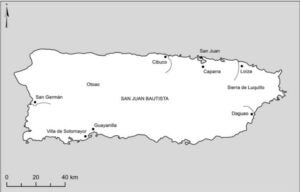
On November 19, 1493, Christopher Columbus discovered Puerto Rico (naming it San Juan Bautista) during his 2nd voyage after a group of Taíno women and children guided Columbus to the island where he remained for two days.[1] However, it wasn’t until 1505 when the Spanish first settled the island. Vicente Yáñez Pinzón, captain of San Juan Bautista, sent a few conquistadores to the island with cattle, goats, and sheep.[2] On August 12, 1508, Juan Ponce de León discovered San Juan Bay and gave the area the name Puerto Rico. Thus, de León became the first governor of the island and with 42 men started the main colonization of the island when he created the settlement of Caparra.[3]
Puerto Rico’s early economy largely focused on mining gold, which largely depended on the encomienda system. In this system the conquistadores would provide benefits to the indigenous people who would provide labor in exchange. However, disease devastated the Taíno/Carib population and there was a labor shortage. In 1510, the first black slaves were brought to the island to help fill the labor shortage.[4] The importation of slaves also gave rise to the Hato economy in Puerto Rico. Early Spanish colonizers (hateros) were given land by the Spanish Crown as a gift where they raised cattle on large open-range ranches, other livestock, foodstuffs, and crops like tobacco. Hateros often claimed land beyond what they were granted-this led to conflict among settlers.[5]
In 1510, Taíno Chief Urayoán tested the belief the Spanish were immortal when he ordered his men to drown a Spanish man named Diego Salcedo, which they succeeded in doing. In 1511, a Taíno uprising erupted, marking the start of widespread resistance to the Spanish. The uprising lasted until 1513 and around 200 Spanish settlers were killed in the rebellion.[6]
In 1521, the main settlement of Caparra moved to present-day San Juan. Then, in 1523, sugar was first planted when Tomás de Castellón established an ingenio (sugar mill) where 100 Africans provided the labor.[7] In the same year, the Casa de Contratación and Council of the Indies restricted commercial traffic from the West Indies to Seville and Cádiz; this also meant colonies had to buy European goods at fixed prices.[8] Altogether, the trade ability for the settlers of Puerto Rico was limited and the economy of Puerto Rico suffered as a result. Furthermore, in 1525, the flotilla commenced. The flotilla was a fleet of Spanish ships that travelled together to dissuade pirate/privateer attacks to protect Spanish goods and wealth. The flotilla set out twice a year, this seriously harmed Puerto Rico as it led to shortages in necessary materials.[9] These factors aided in the expansion of illegal trade with pirates as the inhabitants of Puerto Rico could get access to goods and trade with the pirates. In 1528, Puerto Rico suffered its first pirate invasion when 60 French corsairs invaded and plundered San Germán. Defense became an important focus of the island from this point onwards.[10]
In the 1530s, many people left the island for other parts of New Spain due to news of mineral riches being made elsewhere. Hence, the mining sector of the economy significantly declined.[11] In April 1539, construction began on El Morro, a fort in San Juan.[12]
In 1543, the Council of the Indies ordered the emancipation of the Amerindians on the island.[13] However, sugar cultivation expanded in the 1550s and by 1556, 10 new ingenios were built.[14] Additionally, from 1550 to 1600, cattle was the most profitable item in the Puerto Rican economy for most people as sugar also provided an income for a minority of the island. It was also at this time that the number of ships that visited the island declined.[15]
In 1564, the appointment of Francisco de Bahamonde as governor of the island began an era where military governors ran the island. These figures also largely focused on the defenses of the island. It also led to the militarization of the political system.[16]
In 1582, situado began. The situado was a subsidy from Mexico that paid for the garrison in San Juan and helped fund infrastructure. The government of Puerto Rico relied heavily on the situado to pay for defenses, troops, and other things necessary to facilitate everyday life on the island.[17] However, the situado often came late and the island suffered.
In November 1595, Sir Francis Drake attacked San Juan with a flotilla after hearing a damaged galleon with gold and other treasure took refuge on Puerto Rico. However, Drake couldn’t defeat the defenses of El Morro and failed to enter the port. On November 24, Drake left the island.[18] In June 1598, Sir George Clifford, Earl of Cumberland, attacked the island. Clifford gained a Spanish surrender of El Morro and looted 150 tons of sugar, but had to withdraw at the end of August due to topical heat and disease severely affecting his troops.[19]
Puerto Rico wasn’t heavily settled until 1508 despite being discovered in 1493. In a region that had the possibility to gain wealth, Puerto Rico seemed promising at first. In the early days of settlement, the Spanish settlers focused on mining the island for precious materials whereas other Spanish settlers focused on agriculture. The inhabitants of the island turned to exploiting the Taíno/Carib population to gain wealth. However, in 1510, the Taíno/Carib peoples rebelled unsuccessfully against the Spanish. Slaves also helped fuel the ingenios and hatos on the island. By the 1530s, the mining industry had declined and agriculture prevailed on the island. However, by the 1550s, the flotilla meant less key resources were available to sustain the island and the number of ships stopping at Puerto Rico declined as it was deemed a small colony that didn’t have much value with agriculture dominating the island. Hence, many resorted to trading with pirates for key resources. Trouble further arose in the 1580s and 1590s. The situado made conditions worse as situado often arrived late and meant a lack of funds for the inhabitants of the island. Then, in the 1590s, invasion threatened the island. Hence, Puerto Rico was a struggling and vulnerable island by 1600.
- Lisa Pierce Flores, The History of Puerto Rico (Santa Barbara, California: Greenwood Press, 2010), 19. ↵
- Pierce Flores, The History of Puerto Rico, 21; David Martin Stark, Slave Families and the Hato Economy in Puerto Rico (Gainesville, Floridia: University Press of Florida, 2015), 20. ↵
- Pierce Flores, The History of Puerto Rico, 21. ↵
- Stark, Slave Families and the Hato Economy, 21. ↵
- Stark, Slave Families and the Hato Economy, 19-20. ↵
- Karen F. Anderson- Córdova, Surviving Spanish Conquest: Indian Fight, Flight, and Cultural Transformation in Hispaniola and Puerto Rico (Tuscaloosa, Alabama: University of Alabama Press, 2017), 48; Fernando Picó, History of Puerto Rico: A Panorama of Its People (Princeton, New Jersey: Markus Wiener Publishers, 2006), 37-38; Pierce Flores, The History of Puerto Rico, 22. ↵
- Stark, Slave Families and the Hato Economy, 21. ↵
- Picó, History of Puerto Rico, 68. ↵
- Pierce Flores, The History of Puerto Rico, 41. ↵
- Picó, History of Puerto Rico, 45. ↵
- Stark, Slave Families and the Hato Economy, 20-21. ↵
- “History of San Juan,” National Parks Service, accessed November 24, 2025, https://www.nps.gov/saju/learn/historyculture/history.htm. ↵
- Pierce Flores, The History of Puerto Rico, 49. ↵
- Stark, Slave Families and the Hato Economy, 21-22. ↵
- Picó, History of Puerto Rico, 57. ↵
- Ibid., 48. ↵
- Stark, Slave Families and the Hato Economy, 26-27. ↵
- Pierce Flores, The History of Puerto Rico, 46. ↵
- Picó, History of Puerto Rico, 84; Pierce Flores, The History of Puerto Rico, 46; Stark, Slave Families and the Hato Economy, 24. ↵