
Public Service Careers by Clayton Wukich, Ph.D. is licensed under a Creative Commons Attribution 4.0 International License, except where otherwise noted.
Public Service Careers by Clayton Wukich, Ph.D. is licensed under a Creative Commons Attribution 4.0 International License, except where otherwise noted.
This textbook supports my public service careers course, where students explore different career options. While public service is often tied to government, we also look at opportunities in nonprofits and in businesses that create public good. I do not impose my own interests or values. Instead, students are encouraged to discover what matters most to them.
Career preparation should be part of the college experience from start to finish and embedded across the curriculum, whether a student is studying social science, engineering, computer science, the humanities, or any other field. This book is designed to help students become public service job ready—or at least to point them in the right direction—and to encourage them to think about the future of work and how they can prepare for it.
This is very much a work in progress, and suggestions are welcomed.
I used the generative AI applications ChatGPT and NotebookLM in several ways to facilitate this project. My role included being the author, prompt engineer, editor, and content curator. The technology complemented my subject matter expertise, which I have developed through my education, research, and professional experiences. I used generative AI to enhance and refine outlines and drafts, and its search capabilities informed the book’s case studies and short biographies.
Special thanks go to Mandi Goodsett, Heather Caprette, and Diane Kolosionek for their dedication and hard work implementing CSU’s Affordable Learning initiative. Their commitment to tailoring textbooks to the specific needs of our students and reducing the costs of higher education is commendable. More people should follow their example to make education more accessible and affordable.
I have created two other texts: The Ohioans’ Guide to State and Local Government and The Van Aken District, which examines real estate development from a local government perspective.
Over the last academic year, they’ve saved my students a combined $13,000 in textbook costs.
There is no single “perfect” answer to what you should do with your life, and that’s okay. Choosing a career in public service doesn’t require having everything figured out from the start. Instead of waiting for certainty, focus on exploring as you gain experience.
Watch this presentation by Stanford professors Bill Burnett and Dave Evans about designing your life:
YouTube URL: https://www.youtube.com/watch?v=1Na-gjMv2Y4
Duration: 15:39
This is the advice they give:
They also wrote a book called Designing Your Life. In it, they apply a creative problem-solving approach (design thinking) to career planning. Instead of trying to “figure it all out” in advance, they encourage prototyping different career paths by testing ideas in small, low-risk ways.
Key takeaways from the book include:
In this textbook and our public service careers class, I try to embrace the “design your life” approach by guiding you through exploration, reflection, and real-world engagement with practitioners. Rather than presenting a single formula for success, I introduce a variety of career paths. The textbook encourages self-assessment and provides practical steps for gaining experience. You’ll learn how to get curious, talk to people, and try things.
The first four chapters form the foundation of this textbook. Together, these chapters are designed to help you understand what public service means and how you can start positioning yourself for success.
The next section begins with a refresher on how government is structured in the United States. Chapter 5 explains the three levels of government and the role of bureaucracy in carrying out work. Chapter 6 describes how local governments are organized in Northeast Ohio. Then the remaining chapters focus on specific local government careers.
Next, the textbook turns to the nonprofit sector. Students are introduced to how the sector is organized and the wide range of services it provides. The chapters highlight opportunities across areas such as health and human services, community development, arts and culture, and philanthropy.
Why Start with Local Governments & Nonprofits?
Starting with local government and then nonprofits in Northeast Ohio is intentional because readers explore public and nonprofit opportunities in our region first before moving on to state, federal, and international contexts. Taken together, the local government and nonprofit chapters give students a strong sense of who does what when it comes to civic problem solving. We refer to this system of people and organizations working to address challenges in our communities as the Northeast Ohio civic ecosystem.
In the next section, readers learn about opportunities at the state and federal level. Many of these jobs are based in Northeast Ohio, so you do not have to leave the region to pursue a career in state or federal service.
The next section identifies private sector opportunities. Readers see how businesses contribute to the public good through environmental sustainability, corporate social responsibility, and social entrepreneurship. These chapters highlight how careers in the private sector can align with public service values and offer pathways for those who want to improve communities while working outside of government or nonprofits.
In the next section, readers explore ways to serve abroad through the military, the foreign service, or international nongovernmental organizations. This brings the focus back to careers in government and the nonprofit sector, but in an international context.
Finally, the textbook concludes with a focus on volunteerism, philanthropy, and civic engagement. The goal is to show that there are meaningful ways to serve even if you do not choose public service as a career. These activities are an important part of the Northeast Ohio civic ecosystem and demonstrate how individuals can contribute to solving community problems in many different ways.
Public service is work done to meet the needs of a community or society, rather than to benefit an individual or private business. It focuses on serving the common good. Public service can be carried out by government agencies, nonprofits, or even private organizations that work for the benefit of the public.
In government, this might include city planners working to design safer streets or firefighters rescuing residents from a structure fire.
In the nonprofit sector, it could be a housing organization building affordable homes or a food bank distributing meals to families.
In the private sector, it might involve a company systemically reducing their pollution levels, or a social enterprise launching a business that reinvests some profits back into the community.
Each of these examples serves the public good by addressing shared needs.
What’s the difference between the public, nonprofit, and private sectors?
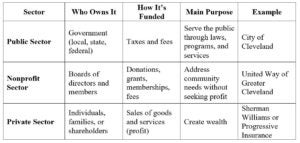
Each sector creates public value, which means producing benefits that improve life for people and communities.
If you’re thinking about a career in public service, it helps to understand what sets it apart. Public service means putting the needs of your community ahead of personal gain. It’s about doing work that improves people’s lives and strengthens the places we live.
A public service career is work done with the goal of helping others and improving the well-being of a community. People in these careers focus on addressing public problems, meeting shared needs, and creating benefits that reach beyond individual interests. Public service careers exist in government, nonprofit organizations, and private companies that put community needs first.
These careers span many fields. Some people work in public safety, such as firefighters or emergency medical technicians. Others serve in education, public health, environmental protection, social work, or urban planning. What connects these roles is a dedication to the public good rather than profit alone.
People enter public service for different reasons. Some are motivated by the chance to make a difference. Others value the stability and purpose the work provides. Whatever the motivation, public service careers strengthen communities and improve quality of life.
A job is work you do mainly to earn money, often without a long-term plan for advancement in that field. It may be short-term, part-time, or something you do while preparing for other opportunities. A career is a series of connected jobs in the same field or line of work that build on each other over time. Careers usually involve setting long-term goals, developing skills, and gaining experience to grow in your chosen profession.
For example, someone might take a job as a clerk in a city office to earn income. If that person continues working in government, moves into new roles with more responsibility, and builds expertise in public administration, they are building a career in public service.
A public service career is different from a regular job in the private sector because the main goal is not to make a profit. In the private sector, the focus is usually on generating income for the business and its owners or shareholders. Success is often measured in financial terms, such as revenue, profit margins, or return on investment.
In public service, the priority is to create benefits for the community, even if those efforts do not produce a financial gain. A city planner, for example, is judged by how well they improve neighborhoods, not by how much money the city makes. While public service organizations must still manage their budgets responsibly, their success is measured by the public value they create, such as safer streets or healthier residents.
Public service careers can be a strong choice for people who want to improve their communities and help others. Many in these careers share something called public service motivation, which researchers define as a person’s desire to serve the public and help others through work that is grounded in public institutions (Perry and Wise 1990). In simpler terms, it is a deep interest in work that benefits the public and makes life better for others, even when there is no personal reward. People with this motivation might want to influence important decisions, feel a responsibility to their community, or care strongly about meeting public needs.
Your own values, experiences, and interests can help you decide if this path fits you. Some people are shaped by role models who volunteered or worked to improve life around them. Others are influenced by school experiences, faith traditions, or training that teaches responsibility to others. If you find meaning in solving problems that affect many people and you are drawn to efforts that make communities healthier, safer, or more equitable, public service work may feel like a natural fit.
According to polling data, many Millennial and Gen Z-aged people show interest in solving public problems. A 2025 Deloitte survey found that about 40% of respondents said they value a job that lets them make a difference in the world. A large majority (Millennials 92%) and (Gen Z 89%) say that having a sense of purpose is very or somewhat important to their job satisfaction and overall well-being.
If you share that outlook, a public service career can provide ways to act on your values.
Identify What Interests You
First, check out the O*NET Interest Profiler from the U.S. Department of Labor. It’s a research-based assessment that matches students’ interests to the six Holland Codes (RIASEC: Realistic, Investigative, Artistic, Social, Enterprising, Conventional). These codes are a widely used framework in career counseling that groups people by work styles and environments where they tend to do well. With your results, you can immediately explore careers, salary ranges, and required education.
How it works:
Next, the Roadtrip Nation website is tool that helps you discover career paths that resonate with you, not someone else’s expectations. It begins with selecting what you’re passionate about. You can choose topics such as technology, design, government, music, nonprofits, sports, education. And it identifies different possibilities. It’s not perfect and it’s not about just public service, so use it generally. Know that their public service options are limited, but it’s worth trying.
How it works:
References
Perry, James L. 1997. “Antecedents of Public Service Motivation.” Journal of Public Administration Research and Theory 7 (2):181-197. doi: 10.1093/oxfordjournals.jpart.a024345.
Perry, James L., and Lois Recascino Wise. 1990. “The Motivational Bases of Public Service.” Public Administration Review 50 (3):367-373. doi: 10.2307/976618.
Like any career path, public service work comes with benefits and challenges. People often choose it because of the chance to make a meaningful difference. Many find satisfaction in knowing their efforts improve the quality of life for others.
Public service careers can offer a sense of purpose and personal fulfillment. Personal fulfillment is the sense of satisfaction and contentment that individuals experience when they engage in work or activities that align with their values, purpose, and passions. This fulfillment often results from contributing to the well-being of others or achieving personal goals. For many public servants, the knowledge that their work has a positive impact on others provides deep emotional and psychological rewards, which make the challenges and sacrifices of public service worthwhile.
In many cases, government and nonprofit positions provide good benefits, such as health insurance, retirement plans, and paid leave. Job stability can also be stronger than in some parts of the private sector, especially in certain government roles.
On the other hand, public service jobs sometimes come with lower pay compared to similar positions in the private sector. Limited budgets can mean fewer resources for projects, which can make it harder to achieve goals. Decision-making processes may be slower due to rules, regulations, and layers of approval. Some positions also require navigating political pressures or responding to public criticism.
Burnout, which is a state of physical, emotional, and mental exhaustion caused by prolonged stress, can also be a challenge in public service careers. Heavy workloads and the emotional toll of addressing complex social problems can leave employees feeling exhausted or discouraged. When staffing is short or resources are limited, the pressure to do more with less can intensify. Over time, this strain may affect job satisfaction and performance, making it important for public service professionals to find ways to manage stress and maintain a healthy work-life balance.
For many people, the pros outweigh the cons because the work aligns with their values and provides a sense of accomplishment that goes beyond a paycheck. Understanding both sides can help you decide whether a public service career matches your personal and professional priorities.
Public service careers have traditionally been seen as stable, especially in government and established nonprofit organizations. However, under the Trump administration, federal agencies have faced budget cuts, staff layoff, and hiring freezes. Many nonprofits that employ public service professionals have also experienced funding cuts, often tied to changes in federal grants or donations from the private sector. These reductions can lead to layoffs, program closures, and heavier workloads for those who remain. This has disrupted the long-standing perception of stability in these fields.
Watch this PBS NewsHour report on federal workforce firings.
YouTube URL: https://www.youtube.com/watch?v=-j32jCPmJUE
Duration: 5:26
At the same time, demographic and workforce trends are creating new opportunities in other areas of public service. The silver tsunami, a wave of retirements as older workers leave the workforce, and the effects of the “great resignation” have opened positions in many state and local government agencies.
In some places, these vacancies have been difficult to fill, which creates strong demand for qualified professionals. For those interested in public service, this means there are still many career options available, especially in fields such as public safety, health services, planning, and administration at the state and local levels.
In recent years, the growth of social enterprises and civic technology firms in the private sector has created new career paths for people interested in public service outside of traditional government roles.
Social enterprises use business strategies to address social and environmental challenges, reinvesting profits into their mission rather than maximizing shareholder returns. Civic tech firms develop tools and platforms that improve how communities access information, engage with government, or solve local problems. These organizations offer opportunities for professionals to create meaningful change while working in flexible, private sector environments.
Public service doesn’t have to be a career; it can also be a fulfilling part of your personal life. This distinction is often made between a vocation and an avocation. A vocation is a profession or career, something you do for a living and where your primary focus is often on your job. In contrast, an avocation is an activity pursued outside of your main profession, usually for enjoyment or personal satisfaction. Volunteerism, civic engagement, and philanthropy often fall into this category of avocation, where individuals contribute to the public good, even if it’s not their primary job.
Volunteerism means offering your time and effort without pay to help a cause or organization. This could be tutoring students, serving meals at a shelter, or helping with a community cleanup. Volunteers often support the work of nonprofits, schools, and local governments.
Watch this video about how former President Jimmy Carter started volunteering for Habitat for Humanity:
YouTube URL: https://www.youtube.com/watch?v=q3MvPi62vTk
Duration: 2:35
Note: Just watch to the 2:35 minute mark.
Civic engagement is taking part in activities that address public concerns or shape how the community is run. This can include voting, attending town hall meetings, joining neighborhood associations, or participating in advocacy campaigns. Civic engagement helps ensure that community voices are heard in decision-making.
Advocacy is a critical aspect of civic engagement. It involves promoting a cause or policy to influence public opinion or government decisions. Advocates work to bring about change by raising awareness, lobbying legislators, and organizing campaigns. Whether advocating for freedom, individual rights, environmental protection, social justice, or public health, individuals can use their voices to drive important societal changes. Advocacy empowers individuals to stand up for what they believe in and to work toward a more just and equitable society.
Philanthropy involves giving money or other resources to support causes, organizations, or projects that benefit the public. Philanthropy can range from small individual donations to large gifts from foundations. These contributions often fund programs, research, or services that improve quality of life.
Together, these activities show that you do not need to work in a public service career to make a positive impact.
To be competitive in the job market and to succeed at work, students need to build skills that complement classroom learning. Employers value professionalism, clear communication, and the ability to adapt in different settings.
CSU supports students through the Office of Career Development & Exploration. You can email careers@csuohio.edu to make an appointment or self-schedule through the office’s website.
Services include:
Taking advantage of these resources early and often will make you more prepared for internships, job searches, and advancement after graduation.
When to Use Career Services
Career development is ongoing. You don’t need to wait until senior year to get started.
An internship is a short-term, supervised work experience that lets students apply what they learn in the classroom in a professional setting. Internships help students gain practical skills, explore career paths, and make connections that may lead to future opportunities.
When considering an internship, students should focus on whether the work matches their interests and offers meaningful responsibilities. It is also important to ask how the experience will help build skills and move career goals forward.
At the Levin School, some majors require an internship for students who do not already have substantial work experience. These experiences are intended to link coursework with real-world practice. More information is available on the Levin School’s internship website: https://levin.csuohio.edu/lssc/student-internships.
Students interested in Levin School-related internships should contact:
Jennifer L DiAngelo – j.diangelo@csuohio.edu.
She will help you identify available opportunities and walk you through the process.
Tips for Making the Most of Your Internship
This chapter introduced what it means to work in public service and why a public service perspective matters. At its core, public service is about putting the needs of the community ahead of personal gain and working to solve problems that affect people’s daily lives. It is more than a job. It is a commitment to improving the well-being of others. That commitment can take many forms, from a full-time career to volunteer work.
Public service can be personally rewarding. It offers the chance to connect your skills and values with work that has a real impact. It can also be overwhelming and lead to real burnout.
As you continue through this course and learn about different career paths, keep in mind that public service is rooted in the drive to make a positive difference in the world around you.
As you explore this textbook and think about your career path, remember that your work is only one part of who you are. Harvard Professor Arthur Brooks explains why defining yourself solely by your career can be a mistake. Watch his discussion here:
YouTube URL: https://www.youtube.com/watch?v=L5lsYI0Q8zw
Duration: 6:29
Public service has a long and complex history, evolving significantly across different cultures and eras. Understanding this history helps you appreciate how this concept has evolved and shaped societies and governments around the world.
It also helps us see how different this idea is from systems that prioritize self-interest, power, and personal gain. Public service is fundamentally differentways of thinking that focus only on benefiting oneself, gaining power, or achieving personal goals. Public service is about putting the needs of the community or society first, while those other systems prioritize individual or selfish interests.
During the Middle Ages, particularly in Europe, the concept of public service was largely shaped by the feudal system. Lords and nobles were responsible for protecting their vassals and managing the lands they owned. While this was a form of public service, it was often limited to the upper classes and was more about maintaining power than serving the broader community.
A significant turning point in the history of public service during this period was the signing of the Magna Carta in 1215 in England. The Magna Carta, also known as the Great Charter, was signed by King John of England. King John was compelled to sign this document by a group of rebellious barons who were dissatisfied with his heavy-handed rule and excessive taxation. The barons, who were powerful landowners, gathered their forces and confronted the king at Runnymede, forcing him to agree to their demands to avoid a full-scale rebellion.
The Magna Carta established the principle that the king and his government were not above the law. It introduced the idea that rulers had a duty to serve the people and respect their rights. By limiting the absolute power of the monarchy and ensuring accountability, the Magna Carta laid the groundwork for modern democratic governance and public service.
Despite the promise of the Magna Carta, the opposite of public service continued to be prevalent, as many rulers and leaders remained focused on maintaining their own power and wealth. However, the Magna Carta’s influence persisted, gradually inspiring further developments in the accountability and responsibility of leaders to their people. This document is often seen as a foundational moment in the development of constitutional governance, where the power of rulers is checked by the law, ensuring that public service is aligned more closely with the needs and rights of the people.
The Enlightenment was an intellectual movement in the 17th and 18th centuries that emphasized reason, individualism, and the pursuit of knowledge, challenging traditional authority and laying the groundwork for modern democratic and philosophical thought. It brought about significant changes in the way people thought about government and public service. Philosophers such as John Locke and Jean-Jacques Rousseau argued that governments should exist to serve the people and protect their rights. This period saw the rise of ideas like democracy, individual rights, and the social contract, which laid the foundation for modern public service.
At the same time, the Enlightenment also exposed the dangers of absolute power and the neglect of public service. The French Revolution, for example, was a direct response to the monarchy’s failure to serve the public, leading to widespread poverty and unrest.
Some scholars, such as David Graeber and David Wengrow in The Dawn of Everything, argue that Enlightenment thinkers were influenced by Indigenous intellectuals from North America. They document that Europeans engaged in debates and exchanges with Indigenous figures, who criticized European systems of hierarchy and emphasized values like equality, freedom, and communal living. Reports of these exchanges made their way back to Europe, and these ideas challenged the notion of blind obedience to self-interested monarchs. They reinforced the belief that people could govern themselves in more equitable ways.
Indigenous societies are communities or groups of people who are the original inhabitants of a specific geographic area and have distinct cultural traditions, languages, and social structures. Indigenous societies often maintain a connection to their ancestral lands and ecosystems, and their cultural practices are shaped by this relationship. Examples include the Iroquois Confederacy (also known as the Haudenosaunee) in North America, the Māori in New Zealand, and the Aboriginal peoples in Australia. These societies often have unique governance systems, philosophies, and ways of life that have been passed down through generations.
For many Indigenous societies, public service is rooted in the values of community, interconnectedness, and stewardship. Rather than being seen as a formal job or career path, public service often reflects cultural traditions and responsibilities that prioritize the well-being of the community over individual gain. In these societies, the concept of serving others is not separate from daily life. It is embedded in the roles and practices that sustain the group as a whole.
Leadership in Indigenous communities often emphasizes consensus-building and collective decision-making. Leaders are seen not as rulers but as caretakers, responsible for maintaining harmony and protecting resources for future generations. For example, many Indigenous cultures have traditions of planning and decision-making that consider the impact on “seven generations” into the future. This long-term perspective highlights a profound commitment to stewardship and sustainability, which are essential components of their view of public service.
Additionally, public service in Indigenous contexts often includes honoring and preserving cultural traditions. Elders, for example, are respected as keepers of knowledge and play a crucial role in educating younger generations. Sharing traditional stories, teaching skills, and preserving language are all forms of public service that sustain the identity and cohesion of the community.
By understanding Indigenous perspectives on public service, we gain a broader appreciation for the diverse ways people contribute to the public good. These traditions remind us that public service is not just about formal roles in government or organizations. It can also be a way of life, guided by shared values and a sense of responsibility to others and the earth.
Indigenous philosophies may have played a role in shaping the United States Constitution, particularly through the influence of the Iroquois Confederacy (Haudenosaunee). The Iroquois Confederacy was a political alliance of six Native American nations governed by the Great Law of Peace, which emphasized shared decision making and checks and balances.
Founding leaders such as Benjamin Franklin and Thomas Jefferson were familiar with this system and drew inspiration from it. Principles such as federalism—where power is divided between central and regional governments reflect the structure of the Iroquois Confederacy. The Confederacy’s use of deliberation and consensus also influenced the American ideals of debate and cooperation in government.
The American Revolution was a pivotal moment in the history of public service, as it sought to establish a government that served the people rather than a distant monarchy. The Revolution was driven by the colonists’ desire for self-governance and their belief that the British government was failing to uphold their rights and interests.
Following the Revolution, the United States Constitution was drafted and ratified, which created a new framework for public service. The Constitution conveys the fundamental principles and laws established to govern a state or nation. It established a government based on the principles of democracy, the rule of law, and the separation of powers. These principles were designed to ensure that public servants were accountable to the people and that no single branch of government could dominate or abuse power.
James Madison, often referred to as the “Father of the Constitution,” was a key architect of this framework. Madison was deeply concerned about the dangers of tyranny, which refers to the oppressive and unjust use of power by a government or ruler. To prevent such a concentration of power, he advocated for the separation of powers by dividing the government into the legislative, executive, and judicial branches. Each branch was given distinct responsibilities and the ability to check the others. This created a system of checks and balances that would prevent any one branch from becoming too powerful.
Madison’s insights were influenced by his studies of political theory and history, particularly his understanding of past governments where the lack of such safeguards had led to the abuse of power. Abuse of power is when someone in a position of authority uses that authority in a way that is dishonest, unfair, or self-serving, rather than for the benefit of the people.
Madison’s notes, letters, and essays—especially those in The Federalist Papers—showed that he was influenced by several philosophical works, including John Locke’s Two Treatises of Government (1689). Locke’s writings argued that legitimate government is based on the consent of the governed, that people have natural rights to life, liberty, and property, and that power should be limited through the separation of powers. These ideas shaped how Madison and the other framers’ thought about representative government. Another influential work was Jean-Jacques Rousseau’s The Social Contract (1762), which emphasized civic responsibility. Civic responsibility refers to the duties individuals have to participate in and support the health of their political community—things such as voting, obeying just laws, serving on juries, or contributing to the common good.
The inclusion of these principles in the Constitution ensured that the new American government would be more responsive to the needs of its citizens. The Constitution and its amendments promoted a form of public service rooted in accountability, transparency, and the protection of rights. Madison’s work laid the foundation for a government that not only served the people but also empowered them to have a direct role in their governance.
Of course, it’s important to acknowledge that the early American democracy, as established by the Constitution, was deeply flawed in its inclusivity. Black Americans were enslaved, denied their rights, and stripped of their freedom. Slavery was a brutal institution that stood in stark contrast to the democratic ideals of liberty and equality that the Constitution purported to uphold. In addition to slavery, other groups, including women, Indigenous peoples, and non-property-owning white men, were also excluded from participating in this early democracy.
However, the principles of equality and justice enshrined in the Constitution, though initially limited in their application, provided a foundation upon which future generations could build. Over the course of American history, access to democratic participation has expanded significantly, gradually extending rights and freedoms to Black Americans, women, and other marginalized groups. This ongoing struggle for inclusion and equality reflects the evolving nature of American democracy, demonstrating the capacity for growth and progress within the framework established by the Constitution.
In the 19th and 20th centuries, public service became more institutionalized with the development of professional public administration practices. Governments began to establish bureaucracies—organized systems of administration consisting of various departments and agencies responsible for implementing laws and policies—and civil services, which are bodies of government employees hired based on merit to perform public duties.
Key milestones during this period include the creation of the civil service system in the United Kingdom with the Northcote-Trevelyan Report of 1854, which recommended hiring civil servants based on merit rather than patronage. Patronage refers to the practice of appointing individuals to government positions based on their political connections or loyalty rather than their qualifications or ability. This system often led to inefficiency and corruption because unqualified individuals were given positions of power and influence, which prioritized personal gain over the public good. You’ll learn more about corruption in the next section.
The Pendleton Act in the United States in 1883 was another critical step in establishing a merit-based system for federal employment, moving away from the patronage system.
The Pendleton Act was passed to address widespread corruption and inefficiency in the federal government caused by the spoils system. The assassination of President James A. Garfield in 1881 by a disgruntled office seeker highlighted the dangers of this system and increased public demand for reform.
Ohio Facts
President James A. Garfield, the 20th president of the United States, was born in Moreland Hills, Ohio and later made his home in Mentor, Ohio. His house in Mentor is now a National Historic Site that you can visit.
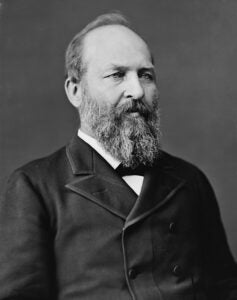
Before becoming president, he served as a Civil War general and a member of Congress, where he was known for his strong speeches and dedication to civil rights. His presidency was tragically cut short when he was assassinated in 1881, just months after taking office.
These reforms in the United Kingdom and the United States were partly a response to the failures of previous systems that prioritized personal gain over the public good. As governments became more complex and the needs of citizens more diverse, it became clear that a professional, merit-based approach to public service was essential for maintaining trust and ensuring the effective delivery of services.
These developments were partly a response to the failures of previous systems that prioritized personal gain over the public good. As governments became more complex and the needs of citizens more diverse, it became clear that a professional, merit-based approach to public service was essential for maintaining trust and ensuring the effective delivery of services. The problem was there were other problems to solve, namely corruption.
In the early 20th century, the rise of the Progressive Movement in the United States and similar movements elsewhere brought about significant reforms aimed at reducing corruption and increasing accountability in public service. Corruption refers to the abuse of power by government officials for personal gain, which can include bribery, embezzlement, nepotism, and other forms of dishonest or unethical behavior.
Check out this video that describes the corruption of the era:
YouTube URL: https://www.youtube.com/watch?v=Spgdy3HkcSs
Duration: 13:50
Corruption in government has far-reaching negative effects. It erodes public trust in government institutions, as citizens lose confidence in their leaders and the belief that their government acts in the public’s best interest. This erosion of trust weakens the social contract between the government and its people, making it more difficult for public institutions to function effectively.
Types of Corruption
Corruption leads to inefficiency and waste within government. Public resources that should be used for essential services, infrastructure, and social programs are often misallocated or diverted for personal gain. As a result, public projects are delayed or compromised, and critical services are underfunded or poorly delivered. Furthermore, corruption exacerbates social and economic inequalities. It often benefits a small, powerful elite at the expense of the broader population, leaving marginalized and vulnerable groups without access to the resources and opportunities they need. This not only deepens inequality but also undermines social cohesion and the overall well-being of society.
The people in Progressive Movement sought to address these issues by implementing significant reforms aimed at reducing corruption and increasing transparency and accountability in public service. One of the key achievements of this movement was the establishment of merit-based hiring practices through the civil service system, which aimed to professionalize public administration and reduce the influence of political patronage. By focusing on merit rather than political connections, these reforms helped to create a more efficient and effective public service, better equipped to meet the needs of citizens.
In addition to civil service reforms, the Progressive Era also saw the creation of independent oversight bodies and regulatory agencies designed to hold government officials accountable for their actions. The establishment of the Federal Trade Commission (FTC) in 1914, for example, was intended to prevent unfair business practices and promote consumer protection, reflecting a growing commitment to public service ideals within the government. Anti-corruption initiatives during this period also gained momentum, with efforts to expose and prosecute corrupt public officials. Muckraking journalists played a crucial role in raising public awareness and prompting reforms by investigating and publicizing corruption in government and business.
These early 20th-century reforms laid the foundation for modern efforts to combat corruption and promote accountability in public service. In the years that followed, additional measures were introduced to further enhance transparency and integrity in government. The development of ethics codes, transparency laws, and freedom of information laws in many countries has made it easier for the public to access government records, increasing transparency and holding public officials accountable. The establishment of independent watchdog agencies and anti-corruption commissions has further strengthened efforts to ensure that public servants adhere to the highest standards of integrity, helping to protect the public good and maintain trust in government institutions.
The history of public service is a story of evolving ideas about leadership, responsibility, and the role of government in society.
Public service values are the core beliefs and principles that guide how organizations work to meet the needs of the people they serve.
When people think about government, they often picture laws, budgets, and agencies. But behind all of these are the values that guide how public servants make decisions and interact with the communities they serve. These values are the foundation of public service. They help explain why two officials might approach the same problem in different ways, or why difficult trade-offs are made when resources are limited.
Everyday examples bring this home. A police chief setting priorities for neighborhood patrols, a public works director deciding how to allocate limited resources, or a mayor weighing competing priorities in the city budget are all guided by values.
These values do not operate in isolation. They sometimes complement one another and sometimes conflict. A program that is efficient might not be equitable, or a policy that is transparent might take longer to implement. Public servants constantly balance these tensions in order to serve the public good.
This chapter introduces the key values that shape public service. To make them easier to follow, they are presented in four broad categories:
For each value, you will see a short definition, a description of why it matters, and a few real-world examples. Think of these as a toolkit. By the end of the chapter, you will be able to recognize how these values appear in everyday government work and understand why they matter for building stronger, more responsive institutions.
These values are the guardrails of democracy. They keep government power legitimate by making sure decisions are made openly, fairly, and within the boundaries of law. They include principles such as the rule of law, accountability, transparency, fairness, ethics, and respect for plural voices.
In a democracy, these values reflect the principles that give government its legitimacy. Legitimacy means the public recognizes government authority as rightful because it is grounded in consent and adherence to shared rules. Fairness, accountability, and transparency are not only administrative goals but expressions of democratic ideals, which show that power is exercised openly and in service of the people.
These values are often described as institutional safeguards. Institutional safeguards are the rules, practices, and standards that prevent the abuse of power and make government actions predictable, consistent, and justifiable to the public. They protect individual rights, limit arbitrary decision-making, and create the conditions for citizens to trust and accept government authority.
When public servants ground their choices in these values, they build trust between citizens and government. In this way, the practice of public service becomes a direct extension of democratic life.
The following sections introduce several of the most important values. Each is explained in simple terms with examples that show what it looks like in practice.
Commitment to the Rule of Law Means Following Established Rules and Procedures
Definition: Commitment to the rule of law means that public officials and institutions act according to established laws and legal processes rather than personal preference or political pressure.
Description: The rule of law is a foundation of democracy because it places government under the same laws that apply to everyone else. It protects rights, limits arbitrary power, and creates consistency in how decisions are made. A central part of this principle is due process, which means that people are entitled to fair and regular procedures before government decisions affect their rights, property, or opportunities. Public servants show this commitment by applying laws fairly, respecting due process, and keeping their actions within the boundaries of legal authority. Even when rules slow down decision-making or require unpopular choices, adherence to the rule of law strengthens legitimacy by showing that government actions are lawful and predictable.
Examples:
What Is Due Process?
Definition: Due process is the guarantee that government must follow fair and established procedures before taking actions that affect a person’s rights, property, or opportunities.
Why It Matters: Due process protects individuals from arbitrary decisions. It means people have the right to be heard, to know the rules and charges against them, and to receive decisions based on evidence and law rather than favoritism or political influence. By following due process, public officials uphold fairness, strengthen trust, and reinforce the legitimacy of government.
Everyday Examples:
Accountability Means Being Answerable for Your Actions
Definition: Accountability means being answerable for your actions. It is the obligation of public servants to act in ways that are lawful and ethical.
Description: Accountability means public servants must be able to explain and justify their decisions and actions. It extends beyond delivering services to also include promoting civic participation and helping different organizations and groups work toward shared goals. Effective accountability often involves clear performance measures, regular reporting, and opportunities for public review or feedback.
Examples:
How Public Officials Are Held to Account
In democratic systems, voters can hold elected officials accountable through regular elections. Appointed officials and career public servants are often evaluated by supervisors, ethics commissions, inspector general offices, and judicial review. Financial and performance audits verify that resources are used appropriately, while transparency laws require disclosure of records and decisions. Public hearings and comment periods give residents opportunities to question decisions and influence outcomes.
For example, a state legislature might summon an agency director to explain why a program is over budget, or a city council could call for an independent investigation into police conduct. In both cases, the process serves to ensure that public power is exercised responsibly and in the public interest.
Transparency Means Making Information Open and Accessible
Definition: The practice of making information about government decisions, processes, and performance openly available and accessible to the public in a timely and understandable way.
Description: Transparency allows residents, journalists, advocacy groups, and other stakeholders to see how decisions are made and how public resources are used. It supports accountability by making it harder for misconduct, waste, or favoritism to go unnoticed. While transparency does not guarantee agreement with decisions, it helps build credibility by showing that actions are based on clear rules and documented reasoning. True transparency goes beyond simply posting documents. It involves presenting information in a way that people can find, use, and understand.
Example:
Ethics Means Acting with Integrity and Responsibility
Definition: Ethics are the shared principles and standards that guide how individuals and organizations in public service should act. Ethics is not only about choosing between right and wrong in a simple sense. It is about applying professional codes, democratic values, and community expectations to make decisions that serve the public interest.
Description: Ethics is a central part of democratic public administration. It goes beyond avoiding misconduct and includes fulfilling positive responsibilities to the public. Professional groups provide detailed codes of ethics. A code of ethics is a written set of principles that outlines the standards of behavior expected from members of a profession or organization. It provides guidance on how to act responsibly. In public service, codes of ethics set expectations for advancing the public interest, promoting fairness, and maintaining integrity in decisionmaking.
Ethics functions both as a democratic safeguard, because it protects the legitimacy of government, and as a professional standard, because public servants are expected to follow clear codes of conduct in their daily work.
Here are some relevant codes of ethics:
Examples of ethical behavior:
Deliberation & Pluralism Mean Valuing Debate and Multiple Voices
Definition: Deliberation is the practice of open discussion where different viewpoints are considered before decisions are made. Pluralism is the recognition that diverse groups, interests, and perspectives should have a place in democratic governance.
Description: Democracies rely on more than majority rule. They depend on discussion, compromise, and respect for a variety of voices in order to arrive at decisions that reflect the public interest. Deliberation creates space for reasoned debate, while pluralism acknowledges that no single group should dominate the process. Together, they help produce policies that are better informed and more legitimate. Public servants support these ideals by creating opportunities for dialogue, weighing competing perspectives, and seeking common ground even when disagreement remains.
Examples:
In Conclusion
Other democratic ideals, such as citizen participation, inclusiveness, social equity, and trust, are also essential to sustaining legitimacy in government. These values emphasize not only how institutions are held accountable but also how people engage in shaping decisions and how resources are shared across society. They are explored in later sections of this chapter, where their role in strengthening relationships between government and the public becomes clearer.
References
Bozeman, Barry, and Michael M Crow. 2021. Public Values Leadership: Striving to Achieve Democratic Ideals. John Hopkins University Press.
Denhardt, Janet V, and Robert B Denhardt. 2015. The New Public Service: Serving, Not Steering. Routledge.
Svara, James H. 2022. The Ethics Primer for Public Administrators in Government and Nonprofit Organizations. 3rd ed: Jones & Bartlett.
Alongside democratic safeguards, public service also rests on professional values that shape how work is carried out. These values reflect the ethos of public servants—the attitudes and orientations that guide their decisions and daily practice. They include altruism, pragmatism, and recognition that all sectors can contribute to the public good.
Some values, such as ethics, bridge both categories. Ethics protects the legitimacy of government as a democratic safeguard, but it is also enforced through professional codes of conduct that guide public servants in their work.
Altruism Is About Putting Others First
Definition: Altruism means putting the needs and well-being of others ahead of one’s own interests.
Description: In public service, altruism reflects a commitment to act in ways that benefit the community, especially when there is no personal gain. This can involve making decisions that prioritize fairness, safety, or quality of life for the public, even if those choices require more time, resources, or personal effort. Altruism helps build trust between the public and government by showing that public servants are motivated by a genuine desire to serve others rather than by personal or political advantage.
Examples:
Pragmatism Means Focusing on What Works
Definition: A way of thinking that focuses on practical results and real-world impacts instead of rigid beliefs or theories. It avoids strict, inflexible rules and overly formal approaches, placing more value on what can be observed, tested, and used to make the most of opportunities.
Description: Pragmatism represents a can-do approach by prioritizing what works to solve pressing social problems. Achieving public values often requires pragmatic approaches rather than rigid ideological ones. It involves learning from success, adapting, accommodating multiple views, and building support through dialogue and discussion, even if full consensus is not reached. Pragmatism recognizes that public values often compete with private values and may require compromise.
Examples:
Cross-Sector Public Value Means All Sectors Can Create Public Good
Definition: The principle that no single sector—public, private, or nonprofit—owns public values, and they can be achieved by organizations in any sector, either alone or through partnerships.
Description: This value challenges the belief that government is only a last resort for solving problems. It recognizes that all sectors can both advance and hinder public values. It also encourages setting aside stereotypes about sector roles and instead adopting flexible approaches to create public good. Bozeman and Crow (2021) refer to this as sector agnosticism.
Examples:
References
Bozeman, Barry, and Michael M Crow. 2021. Public Values Leadership: Striving to Achieve Democratic Ideals. John Hopkins University Press.
Denhardt, Janet V, and Robert B Denhardt. 2015. The New Public Service: Serving, Not Steering. Routledge.
These values represent the technical backbone of public administration. Concepts such as economy, efficiency, effectiveness, standardization, and social equity form the benchmarks that administrators use to judge performance and balance trade-offs in daily decisionmaking.
In 2011, Kristen Norman-Major wrote an article called “Balancing the Four Es” to describe key values in public administration: economy, efficiency, effectiveness, and equity. She explains what each value means, how we can measure them, and why it matters for government work. Her article looks at how these values connect to each other and why public administration students should learn about all four throughout their education.
This section clarifies Norman-Major’s concept of equity. Standardization is added to represent the idea of treating everyone the same way. And social equity is added to explain how some administrators value creating fair or expanded access to opportunity and outcomes for people who have fewer means or groups who have been historically underrepresented.
Some of these values conflict with each other. For example, it is difficult to promote social equity if you prioritize economy above all other values.
Economy Means Using Resources Carefully
Definition: The careful use of resources, specifically spending the least necessary to provide an agreed-upon level of public services.
Description: Economy is often the most closely examined value in public administration, especially when budgets are tight. It focuses on using taxpayer money wisely to deliver the best possible value. Because it deals with measurable factors like expenditures and cost savings, economy can be evaluated in clear, objective ways.
Examples:
Economy & Fiscal Responsibility
Economy means using public money carefully. It focuses on spending only what is needed to deliver services. Fiscal responsibility goes further. It means managing public funds wisely to keep budgets balanced, reduce waste, and plan for the future.
Being fiscally responsible can include cutting spending, delaying projects, or choosing lower-cost alternatives when resources are limited. A city council might fund only the most urgent capital projects during a budget shortfall.
Some leaders follow a fiscally conservative approach. Fiscal conservatism means limiting government spending, lowering taxes, and reduced public debt. Others support targeted investments that may cost more upfront but produce long-term public benefits. Most public officials weigh both perspectives based on local needs and political realities. Others tax and spend more freely, but cities, in particular, need to be wary of this approach.
In 1981, political scientist Paul Peterson published the book City Limits. He argued that cities are not the best level of government to carry out redistributive policies that benefit disadvantaged groups. Citing New York City’s near-bankruptcy in the 1970s, he claimed that cities are more focused on delivering core services and encouraging economic development than on shifting resources between populations.
Efficiency Means Getting the Most Out of Resources
Definition: Achieving the most, the best, or the most preferable public services for available resources, or maximizing total value from the use of scarce resources.
Description: Often thought of in terms of process efficiencies, this value aims to minimize wasted effort or expense. While sometimes stereotyped as lacking in the public sector, most governments strive for it. However, some argue it is conceptually weak and difficult to contextualize for practical application.
Examples:
What’s the Difference Between Economy and Efficiency?
Efficiency and economy are related but not the same.
Economy is about spending as little as possible to achieve a certain level of public service. It focuses on minimizing the cost of inputs. For example, getting the lowest price on road repair materials or buying office supplies in bulk.
Efficiency is about getting the most value from the resources you have. It focuses on how well resources are used to produce outputs. For example, organizing road repair crews so the same amount of material and labor fixes more miles of roadway in less time.
In short, economy is about cost control, while efficiency is about getting the most value from the resources you have. A government can be economical without being efficient (spending little but producing poor results) or efficient without being economical (producing great results but at a high cost). Responsible public administrators aim for both.
Effectiveness Means Reaching Intended Goals
Definition: Programs and services achieving the goals they were designed to meet.
Description: Effectiveness measures whether the intended results of a program or service are actually reached. It is often straightforward to measure using tools such as tracking outputs, program evaluations, pre- and post-tests, and benchmarking. However, challenges can arise when goals are not clearly defined or when the desired outcomes are less tangible and harder to quantify.
Examples:
What’s the Difference Between Efficiency and Effectiveness?
They sound similar because both focus on results, but efficiency and effectiveness are different in what they measure.
Efficiency looks at how well resources (time, money, labor) are used to produce services. It is about the relationship between inputs and outputs. It’s about doing things in the least wasteful way.
Effectiveness looks at whether the service or program achieves its intended goals or outcomes. It is about the relationship between outputs and desired results. It’s about doing the right things to reach objectives.
Examples:
In other words:
Standardization Means Applying Rules the Same Way for Everyone
Definition: Standardization is the practice of using the same rules and procedures for all people. It focuses on consistency and impartial decision making.
Description: In public service, standardization means people can expect predictable treatment. Decisions follow established processes rather than personal preference or special favors. Standardization supports public trust because the community can see that criteria are clear, requirements are explained, and decisions are made openly. It reflects the idea that similar situations should receive similar treatment.
Examples:
Social Equity Means Fair Access to Opportunity and Outcomes
Definition: Social equity is the just distribution of public services and the implementation of public policy so that all people have a fair chance to meet basic standards of well-being (National Academy of Public Administration, n.d.).
Key Takeaway: Social Equity Is a Value
Social equity is not a neutral fact. It is a normative value—a belief about what is fair and just in society. Because people hold different values, equity is often debated in politics and public administration. Some view equity as essential for ensuring everyone has a fair chance, while others oppose government intervention. Understanding these debates is central to understanding public service.
Description: In everyday conversation, equity is sometimes confused with fairness, or treating everyone the same. In public service, however, fairness and equity are related but not identical.
Some services are universal and provided equally to everyone. Others are targeted to address historic or structural disadvantages. The goal is not identical treatment, but just outcomes that expand opportunity and strengthen democracy.
Examples:
The Politics of Social Equity
Social equity is a contested value in American public service. It reflects beliefs about what is fair and just in society, but those beliefs vary widely. Some see equity as essential for expanding opportunity and correcting the effects of past discrimination. Others argue government should not intervene, or that interventions are unfair to those who do not benefit directly. Because of this, social equity is both an ethical commitment and a political flashpoint.
One way social equity plays out in practice is through distributive and redistributive policies. Distributive policies provide broad benefits, like new parks or road projects, that most communities can enjoy. They are usually less controversial but may do little to close deeper gaps unless directed toward disadvantaged areas. Redistributive policies, on the other hand, shift resources from one group to another—such as through progressive taxes, food assistance, or student aid. These can reduce inequities but often spark political conflict because some groups see themselves as losing while others gain.
Inequities based on race, gender, and other factors illustrate why redistributive policies are often proposed. For example, Black infants in the United States face higher mortality rates than white infants, and women earn less on average than men. Supporters of equity-focused policies argue these measures reduce structural disadvantages; critics counter that they distort fairness, expand government’s role too far, or impose heavy costs. These competing perspectives feed ongoing political debates over what government should or should not do to promote equity.
Professional associations have also weighed in. Groups such as the American Society for Public Administration (ASPA) and the American Institute of Certified Planners (AICP) have updated their codes of ethics to include explicit commitments to social equity.
Recent years have highlighted tensions between political leadership and professional ethics around equity. For example, President Trump issued executive orders eliminating many federal diversity, equity, and inclusion (DEI) programs, while at the same time professional associations like ASPA and AICP reinforced equity as a core ethical value. By doing so, they frame equity not just as a political choice but as part of professional responsibility. Moreover, in some states and localities, laws now restrict or forbid equity initiatives, while in others, leaders expand them.
Conversation Starter: Policy vs. Professional Ethics
What should public servants do when their legal duty under federal, state, or local policy conflicts with their professional code of ethics? How much discretion should they exercise in carrying out policies that touch on equity? Should they simply follow the law, or also consider broader commitments to fairness?
How would you navigate this tension if you were in public service?
References
Gooden, Susan T. 2015. Race and Social Equity: A Nervous Area of Government. Routledge.
Lowi, Theodore J. 1972. “Four Systems of Policy, Politics, and Choice.” Public Administration Review 32 (4):298-310. doi: 10.2307/974990.
National Academy of Public Administration (NAPA) Standing Panel on Social Equity in Governance (n.d). www.napawash.org/aa_social_equity/index.htm
Norman-Major, Kristen. 2011. “Balancing the Four Es; or Can We Achieve Equity for Social Equity in Public Administration?” Journal of Public Affairs Education 17 (2):233-252. doi: 10.1080/15236803.2011.12001640.
Peterson, Paul E. 1981. City Limits. University of Chicago Press.
Schuck, Peter H. 2003. Diversity in America: Keeping Government at a Safe Distance. Harvard University Press.
Leadership and relational values describe how public officials, organizations, and communities work together to achieve shared goals. These values focus less on internal operations and more on relationships that sustain legitimacy and trust.
Relational values reinforce one another. Trust grows when government is responsive, inclusive, and empathetic. Vision helps people see a shared direction, but it becomes more credible when communities are engaged in shaping it. Citizen engagement and inclusiveness give people meaningful roles in decision-making, while responsiveness shows that their voices matter. Flexible leadership and empathy allow public servants to adapt to changing needs and understand the lived experiences of those they serve. Together, these values strengthen the bonds between institutions and the public.
Trust Means Confidence in the Reliability and Good Faith of Others
Definition: A core element in public service relationships that is necessary for cooperation and for achieving shared public goals.
Description: Trust is often the starting point for effective leadership and public value management. It helps institutions work together and include a broad range of voices. Trust does not require personal closeness but grows when people believe their goals align and see consistent follow-through. Building trust means demonstrating results rather than only making promises and, when possible, earning recognition from credible outside sources.
Examples:
Challenges to Trust
Trust can weaken when public organizations do not follow through on commitments or when their actions seem disconnected from stated goals. A single high-profile failure, such as a major project running far over budget or a public safety response breaking down in a crisis, can overshadow years of competent performance.
In other situations, trust erodes gradually when residents feel excluded from decision-making or believe information is being withheld. Disputes over fairness, concerns about how resources are used, and perceptions that certain groups receive preferential treatment can deepen public skepticism. Once damaged, trust is difficult to restore.
Recovery often requires more than a change in message or leadership. It may demand visible improvements in performance, open communication channels, and sustained outreach to demonstrate that past problems have been addressed.
Vision Means Having a Clear Picture of Where to Go
Definition: A clear and inspiring idea of the public values a community or organization seeks to achieve. It should be easy to understand, go beyond the interests of any one person, and be supported through collective input.
Description: Vision is especially important in the early stages of a public values–focused effort. Because public values can be broad and sometimes vague, a strong vision helps turn them into specific goals. It shows possible paths from the problem to the solution and motivates ongoing cooperation among people and groups with different perspectives or interests.
Examples:
Citizen Engagement Means Involving the Public in Decisions
Definition: The process of involving and working with the public to define problems, develop alternatives, implement solutions, and shape shared goals. It is an “active, bidirectional act of participation, involvement, and unification of forces between two (or more) parties” (Vigoda 2002, p. 527).
Description: Citizen engagement reflects democratic norms and the belief that the public should help shape the policies and services that affect their lives. Public managers may relate to the public in different ways depending on the situation.
Sometimes residents act as customers, seeking services for personal benefit. In these cases, managers must ensure quality service, timely responses, and respectful treatment. For example, a city clerk’s office that helps residents obtain permits or licenses can improve service by offering clear instructions online and providing prompt follow-up.
In other situations, the public becomes a partner in delivering services or meeting community goals. Their active participation is necessary for success. A neighborhood watch program, for instance, depends on residents sharing information with local police to deter crime.
Finally, residents take on the role of citizens when they help set policy direction and shape government decisions. This can include town hall meetings where residents and city officials work together on plans for new parks or infrastructure. In these settings, collaboration can lead to better-informed decisions, broader community support, and stronger trust between the public and government.
Inclusiveness Means Making Sure All Voices Are Heard
Definition: Actively involving participants from a wide range of cultural, economic, regional, and political backgrounds, and making sure minority viewpoints are heard and considered.
Description: Inclusiveness is closely linked to pluralism. It emphasizes that public value belongs to all citizens, not just those in the majority or with the most influence. In a democracy, this means creating space for diverse perspectives and giving them a genuine role in decision-making. While this can make the process slower or more complex, it helps decisions hold up over time because they reflect a broader range of experiences and interests.
Examples:
Responsiveness Means Acting Quickly and Accurately
Definition: The timeliness and accuracy with which a public agency or service provider responds to a request for action or information from the public.
Description: Responsiveness refers to how quickly and accurately public agencies address requests from the public. It is closely tied to public trust and is often viewed as a measure of effective service. Timely, accurate responses can improve confidence in government and strengthen performance.
Examples:
Flexible Leadership Means Adapting to the Situation
Definition: A leadership approach that recognizes different situations call for different skills, talents, and even leaders. Roles or styles may shift as circumstances change.
Description: This approach challenges the idea that one “heroic” leader can succeed in every context. Instead, it focuses on adapting leadership styles to meet the needs of the moment and relying on the strengths of a team. It values planning for leadership transitions and drawing on the experience of past leaders. Examples of leadership roles in this model include visionaries, coalition builders, negotiators, peacemakers, implementation leaders, conservers, and innovators who replace outdated practices (Bozeman and Crow 2021).
Examples:
Empathy Means Understanding Other People’s Experiences
Definition: The capacity to understand and share the feelings, experiences, and perspectives of others, especially during direct interactions.
Description: Empathy plays a key role in advancing social equity. It means noticing emotional cues, understanding another person’s situation from their point of view, and expressing that understanding in a meaningful way (Norman-Major 2022).
Examples:
References
Bozeman, Barry, and Michael M Crow. 2021. Public Values Leadership: Striving to Achieve Democratic Ideals. John Hopkins University Press.
Denhardt, Janet V, and Robert B Denhardt. 2015. The New Public Service: Serving, Not Steering. Routledge.
Norman-Major, Kristen. 2022. “How Many Es? What Must Public Administrators Consider in Providing for the Public Good?” Public Integrity 24 (3):342-352. doi: 10.1080/10999922.2021.1967010.
Thomas, John Clayton. 2012. Citizen, Customer, Partner: Engaging the Public in Public Management. M.E. Sharpe.
Vigoda, Eran. 2002. “From Responsiveness to Collaboration: Governance, Citizens, and the Next Generation of Public Administration.” Public Administration Review 62 (5):527-540. doi: doi:10.1111/1540-6210.00235.
This chapter explored the core values that guide public service and how they shape decisions, policies, and daily work. Together, these principles provide a framework for making choices, balancing competing priorities, and building stronger, more responsive institutions. Let’s summarize these concepts in the order they appeared:
Democratic Values that Provide Institutional Safeguards
Professional Values
Administrative Values
Leadership and Relational Values
Together, these values do more than guide decisions; they sustain the legitimacy of government itself. By practicing them, public servants build trust with the people they serve and reinforce the democratic foundations that make government authority both rightful and effective.
Building a career in public service is not something you do alone. The people you meet along the way, including classmates, alumni, mentors, and professionals in the field, can help you grow and discover opportunities. That’s what this chapter is about.
Networking is the process of building and maintaining professional relationships to exchange information and create opportunities for collaboration and career growth.
It involves more than swapping business cards or connecting on LinkedIn. It is about having real conversations and learning from the experiences of others. These relationships can lead to mentorship, professional guidance, and opportunities that are rarely found through a job posting alone.
For someone pursuing a public service career, a strong network can provide insight into how agencies and organizations operate. It can also connect you with mentors who are willing to share lessons from their own experiences. In many cases, networking leads to partnerships and collaborations that strengthen both your career and the community you serve.
Each semester brings new opportunities to meet people through guest speakers, site visits, internships, and volunteer work. Over time, these connections can become a source of support, guidance, and encouragement that extends well beyond graduation.
Networking can feel uncomfortable at first, especially for introverts, but it does not require being aggressive or meeting everyone in the room. Meaningful progress often comes from smaller conversations, one-on-one meetings, and steady relationship-building.
A strong networking strategy starts with knowing where you want to go. Identify your short-term career goals, such as landing an internship or developing a skill, and your long-term goals, such as securing a leadership role or working in a specific field. With those targets in mind, decide how and with whom you will build relationships.
Avoid common mistakes that can weaken your network. Focusing only on high-profile people while ignoring peers and others in your field can leave you with a narrow, less supportive network.
While most people you meet through networking are respectful and professional, you may encounter someone who makes you uncomfortable or crosses a line. Trust your instincts. You are under no obligation to follow up, meet, or maintain contact with anyone who behaves inappropriately.
If someone makes an unwanted advance or says something that feels off, end the conversation and move on. You can say you need to catch another session, meet a friend, or take a call. If the behavior happens in a setting connected to the Levin School or Cleveland State, let a faculty member or event organizer know so they can address it.
Your safety and comfort come first. Networking should help you grow, not put you in situations that feel wrong.
When you introduce yourself as a student—especially from a well-regarded program like the Levin School—you tap into a unique window of opportunity. Professionals, civic leaders, and alumni are often far more willing to meet with students than with working professionals they don’t know. Why?
It’s Non-Transactional
Students are seen as learners, not job-seekers. A request for advice or perspective feels different from a direct request for a job.
People Like to Give Back
Many alumni remember the challenges of starting out and want to help the next generation. Meeting with a student gives them a chance to “pay it forward.”
It’s Flattering
Being asked to share career insights signals that their work is valued and respected.
The Time Factor
Students typically have more flexibility to meet during business hours, making scheduling easier.
How to Make the Most of This Advantage:
This advantage fades quickly after graduation, so use it while you’re in school. You might be surprised by how many doors open simply because you’re still a student.
Class activities can provide opportunities to build professional relationships, and you can start with your classmates.
Alumni often tell me that their former classmates have become their most valuable professional contacts. They call each other for advice and talk openly about pressures they cannot discuss with coworkers. Sometimes those conversations are about solving problems, and other times they are simply a chance to blow off steam with someone who understands the work.
The takeaway is simple: treat your classmates with respect. Many will become leaders in their fields, and staying in touch can benefit you both personally and professionally.
Good instructors will also create opportunities for you to connect with practitioners in the field.

Director Lydia Mihalik from the Ohio Department of Development visits with first year MPA and MUPD students in October 2024. Special thanks to CSU Government Affairs Director Caryn Candisky for making that event possible.
When a guest speaker visits, take a few minutes beforehand to learn about their work and think of questions that matter to you. This preparation makes it easier to start a real conversation.
After the session, send a short message on LinkedIn or by email to thank them for their time and share one thing you learned. Don’t use AI. Be authentic. Small gestures like this help you open the door for future conversations.
Side Note
I have heard stories from HR officials who interview candidates and then receive a follow-up message that is clearly written by AI. Instead of making a good impression, the message has the opposite effect. The lesson here is simple: your follow-up should sound like you. Authenticity matters more than perceived polish.
Site visits are about meeting professionals where they work. In my classes, you’ll see me asking people we meet: what’s your job title and what do you do? This is good way to lay the foundation for a conversation.
Introduce yourself to the hosts and others you meet, even briefly. Make notes about what they share, and use those details when you follow up later. Mentioning something specific from your conversation shows that you were listening.
Professor Nisha Mistry and senior seminar students met with Cleveland City Council members at City Hall in fall 2024.
Class projects also can be a reason to connect with community leaders or practitioners. If your project relates to their work, reach out to ask for their insights or feedback. You’ll definitely have class projects in your senior seminar course as an undergraduate and your planning and MPA capstone courses as a graduate student. Take advantage of these opportunities to network.
Levin School events are a great way to connect with people who care about public service. The annual Norman Krumholz Seminar, coordinated by Dr. Beth Nagy, brings together students, faculty, alumni, and community leaders to discuss important issues in urban planning and public policy.
Alumni events, such as our 2024 homecoming party, give you a chance to meet graduates working in the field and learn what they’re doing now.
If you want a sense of what these gatherings feel like, watch this short video from the party to get sense of what these events look like.
YouTube URL: https://www.youtube.com/watch?v=W_GoxLjyopA
Duration: 0:55
When you attend these, talk to people. Ask them about their work or what brought them to the event. If you make a good connection, follow up afterward on LinkedIn or email.
You should also ask your professors to introduce you to their former students or people they know. These events can be the start of relationships that help you throughout your career, but only if you take the first step.
Throughout this textbook, you’ll read about people who graduated from CSU’s Levin School of Urban Affairs and their public service work. I call those sections “Levin Graduates Lead.”
If you’d like to learn about some alumni now, feel free to click on my LinkedIn post from May 2025.
In it, I curate 15+ YouTube videos with alumni talking about their work, from city planner Phil Kidd getting to know Cleveland by running every Cleveland street to nonprofit executive Linda Uveges reflecting on her experience at the School.

Quinton Green, a U.S. Army veteran who served in Afghanistan, is the real estate transactions manager at Cleveland Neighborhood Progress and a licensed realtor. With more than a decade of experience in real estate, he has built his career around urban planning and development, affordable housing, and neighborhood and economic development. He is committed to creating and preserving quality housing options for residents in Cleveland and beyond.
Quinton earned his BA in criminology from CSU and is about to graduate from CSU’s Master of Urban Planning and Development program.
Watch this News 5 Cleveland story about Quinton’s redevelopment project in Cleveland’s Mount Pleasant neighborhood. This is a great example of how a private sector project advances public service values.
YouTube URL: https://www.youtube.com/watch?v=KXuZ0RW0eYg
Duration: 2:22
Some of great networking opportunities happen outside of class. In this section, I’ll write about professional associations, their conferences, volunteer experiences, and a little bit on using LinkedIn.
Professional Associations
Joining professional associations is one way to start. Groups like the American Society for Public Administration (ASPA), International City/County Management Association (ICMA), and American Planning Association (APA) offer student memberships at reduced or no cost. ICMA membership is free for students and you get access to their database of members and other resources.
Here are some professional associations to know about:
Conferences
Conferences also will help you network. The Ohio City/County Management Association (OCMA) waives conference fees for students. Moreover, the Levin School often helps cover travel and registration for these events.
Being in these rooms matters. You meet people doing the work you want to do, hear what challenges they are facing, and begin to see yourself as a peer in the profession.

Here’s a photo of students at an OCMA conference in Columbus. I was there when they took this photo, I just refused to wear a silly hat.
How to Approach People at a Conference
Walking into a professional conference can feel overwhelming, but most people there expect and welcome conversation. Here are some ways to start:
Be genuine. You do not need to meet everyone in the room. A few meaningful conversations can be more valuable than a long list of contacts you never speak to again.
Volunteer Experiences
Getting involved in the community is another way to build your network. Public meetings, volunteer events, and civic forums give you the chance to learn how decisions are made and to connect with people active in local issues.
Sometimes CSU will create these experiences for you. For example, in my public service careers class, I’ll schedule an afternoon of service event and embed it in our volunteerism curriculum. This year, we’ll be volunteering for a few hours at the Greater Cleveland Food Bank.
Maintaining a LinkedIn presence can also connect you to opportunities. Alumni and local leaders post about programs, jobs, and events. For example, Levin MPA alum Stephanie Molnar, who runs the Cleveland Foundation’s fellowship program, shared an event this summer that brought students and community leaders together. See her post here. You absolutely could have taken the initiative to attend.
Following and engaging with posts like this can keep you in the loop and open doors you might not find otherwise.
Finally, reach out to Professor Jeffrey Bowen about networking. He’s a professional and can give you great advice.
A strong LinkedIn profile helps you stand out and makes it easier for people to connect with you. Start by setting up your profile or making sure the one you already have is current. Include your education, work experience, and skills so visitors get a clear picture of who you are and what you can do.
LinkedIn is more than a place to store your resume. Joining relevant groups, following relevant organizations, and connecting with alumni can help you discover opportunities and expand your network over time.
Quick LinkedIn Wins
You can make a noticeable improvement to your LinkedIn profile in under an hour by doing the following:
These small steps help you present yourself as an active, engaged member of the public service community and make it easier for others to see your potential.
On my own LinkedIn, I post about Levin School events, programs, and accomplishments. Over the last year, I have made a point to celebrate my own successes more as well as student and alumni achievements. And I’m developing my voice to say things that matter to me. When I announced my new case study on real estate redevelopment, I also used the post to emphasize the role real estate development should play in the Levin School’s curriculum. Here’s a link to that post.
My posts are professional and help me strengthen relationships within my network. I often include visuals because they attract more impressions and get more reactions. I usually use Canva to create them, but you don’t need get that specific.
If you want, you can post about what we’re learning from guest speakers, site visits, and other events. Thoughtful posts and comments show that you are engaged. Remember that employers often review LinkedIn profiles when screening candidates, so what you post and react to should reflect the professional image you want to project. Avoid extreme political statements or personal content that does not fit the public service brand you are building. Jacob Ott from CSU’s Office of Career Development and Exploration recently emphasized this point.
LinkedIn Is Weird
LinkedIn is distinct from other social media because its primary purpose is all about professional networking and finding job.
Watch this video from the Good Work YouTube channel.
YouTube URL: https://www.youtube.com/watch?v=IMfBS4mBfBQ
Duration: 5:47
They point out that a lot of people find LinkedIn weird or cringe because the LinkedIn algorithm tends encourages bragging and expert-sounding content. This creates a performative feel, where people are not presenting their true selves.
The last video critiqued LinkedIn’s bragging tone. I also want to take a moment to talk about the use of AI-generated content, which can be another way to come across as disingenuous. I see it more and more on LinkedIn. I sometimes use AI to copyedit my work or smooth out transitions, but I do not rely on it to generate my core ideas. I want my posts to reflect my own thinking.
AI Slop
I am sharing an episode of Last Week Tonight with John Oliver about AI slop. You don’t have to watch the whole thing, but I want you to be aware of the concept. While the video focuses more on visuals than written content, the point still applies. Both AI-generated writing and images can feel impersonal or even disorienting. The takeaway is simple: keep your LinkedIn presence authentic.
YouTube URL: https://www.youtube.com/watch?v=TWpg1RmzAbc
Duration: 29:04
A mentor is an experienced person who provides advice and encouragement to someone who is less experienced. Mentoring is the process of building that relationship. At its best, mentoring is about listening, sharing experiences, and helping someone navigate both challenges and opportunities.
There are many ways to find a mentor. Some students are matched through formal programs, while others connect with mentors by reaching out to alumni, supervisors, or professionals they meet at events. Faculty can also serve as mentors, and classmates can sometimes fill that role informally as you move forward together in your careers.
CSU Student Mentoring Program
The Levin School offers a structured mentoring program through the Center for Public and Nonprofit Management. Students are paired with alumni and local professionals who can provide career advice on monthly basis throughout the academic year. Learn more here: https://levin.csuohio.edu/cpnm/student-mentoring.
Rob Ziol and Kat Hollo run the program and do an outstanding job.
The benefits of mentoring are clear. Mentors can help you set realistic career goals and give you honest feedback about your progress. They introduce you to professional networks, and they can show you how to handle challenges and make decisions with integrity. A good mentor provides encouragement when you need it and pushes you to stretch when you are ready for more responsibility.
Build a Network of Mentors
In today’s fast-changing work environment, it is unrealistic to expect one mentor to provide everything you need. Different mentors bring different strengths. One may help you navigate the day-to-day of your first job, another may offer perspective on leadership, and yet another may open doors to opportunities you would not have found on your own.
Building a network of mentors allows you to draw on a wider range of knowledge. It also prepares you for future leadership roles by showing you how others with different backgrounds and experiences approach their work. Creating and cultivating this network is one of the most effective ways to keep learning and growing over the course of your career.
How to Approach a Potential Mentor
Reaching out to someone you admire can feel intimidating, but most professionals are open to helping students. Here are a few ways to start the conversation:
The key is to be genuine and professional. Many mentoring relationships begin with one short meeting or a single email exchange.
Remember, you do not have to this on your own. Talk to Rob Ziol or Kat Hollo about the mentoring program.

Rob Ziol, a Levin MPA alum, is the director of CSU’s Center for Public and Nonprofit Management. He is committed to creating opportunities for students to connect with professionals and prepare for their careers.
Rob oversees a nationally recognized professional development program that trains public and nonprofit employees throughout Ohio. He uses those connections to help CSU students find mentors and explore job opportunities. Together with Kat Hollo, he runs CSU’s mentoring program, which matches students with alumni and civic leaders for a formal year-long experience.
Kat Hollo, a Levin alum and current MPA student, serves as assistant director of CSU’s Center for Public and Nonprofit Management.
Kat co-leads CSU’s mentoring program with Rob Ziol. She pairs students with mentors and creates and curates formal programming for their year-long experiences. Through her leadership, so many students have built lasting relationships that have opened doors to career opportunities.
Her work reflects Levin’s mission to connect students with real-world experiences.

State Senator Grace Drake was a remarkable public servant, known for her commitment to mentoring young leaders.
She represented Ohio’s 22nd District from 1984 to 2000, a district that always included her hometown Solon in Cuyahoga County. Drake’s legislative career was characterized by her ability to foster bipartisan cooperation and her focus on improving the lives of her constituents.
Beyond her legislative achievements, Senator Drake created CSU’s mentoring program. Her legacy here lives on through this program and her work continues to empower future leaders.
References
As a student, you have unique access to other students, mentors, alumni, and professionals who are often willing to share their experiences with you. By taking advantage of your opportunities, you can begin developing a network that will last well beyond graduation.
Before we learn about local government specifically, let’s do a refresher on how government is organized in the United States.
The organization of government serves a critical purpose: to ensure that power is distributed, responsibilities are clearly defined, and citizens’ rights are protected. Understanding how government is structured at different levels—federal, state, and local—will help you grasp how public policies are created and implemented, and the career opportunities you have.
The structure of government in the United States is based on the principle of federalism, which distributes power between a central government and regional governments. In practice, this means authority is divided between the federal government and the states. Local governments operate within this system under the authority of the states. Ideally, these levels work together to serve the public. In reality, their interactions are often marked by disagreement, competition, and negotiation.
Federal Government
The federal government has authority over issues that affect the entire nation. It is responsible for matters such as national defense, foreign relations, and economic activity that crosses state borders. The U.S. Constitution provides this authority and includes the Supremacy Clause, which establishes that federal law overrides conflicting state laws. Despite this, states often argue that federal policies go too far, and disputes between the two levels of government frequently end up in court or in political standoffs.
State Government
Each state operates under its own constitution, which serves as its fundamental law. States manage education, transportation, and public safety, along with other areas important to residents’ daily lives. For example, states run public schools, oversee state highways, and maintain emergency services. States value their autonomy, but they must also follow federal requirements, which can create tension when state policies differ from federal priorities.
Branches of Government
At each level—federal, state, and local—government is further divided into branches. The legislative branch makes laws, the executive branch carries out those laws, and the judicial branch interprets them. This structure is meant to prevent the concentration of power and to provide balance. While the system is designed to work smoothly, political differences and competing priorities often create delays, disputes, and complex negotiations across these branches.
Separation of Powers & Checks and Balances
The U.S. system of government divides authority into three branches: legislative, executive, and judicial. This is called separation of powers. Each branch has unique responsibilities and limits on what it can do.
To keep any branch from becoming too powerful, the Constitution also created checks and balances. This means each branch has the ability to limit the others. For example, the president can veto a bill, but Congress can override that veto, and courts can strike down laws that violate the Constitution. These safeguards were built to maintain balance, though in practice political conflict sometimes weakens their effectiveness.
Local Government
Local governments are closest to the people. They include counties, cities, townships, and special districts. Local governments manage zoning, utilities, policing, fire protection, and community health services. Their authority is defined by state constitutions and state law. Local governments often face challenges because they depend on state resources and are limited in how they can raise funds. When state leaders impose rules without financial support, local officials may struggle to meet community needs.
If you would like to learn more about state and local government, feel free to skim through my other textbook.
When you pursue a career in public service, there’s a good chance you’ll work within the bureaucracy. Bureaucracy is the organized system of government agencies that carry out laws and deliver public services. It provides structure and consistency so that policies created by elected officials are applied fairly across society. Without bureaucracy, government programs would be chaotic and uneven.
Bureaucracy sometimes has a negative reputation, often linked to red tape or inefficiency. But it is important to remember that bureaucracy is designed to promote fairness, accountability, and order in government. It ensures that services such as public health, transportation, and education reach the people who need them.
Government agencies are at the heart of bureaucracy.
An agency is a government organization created to carry out specific tasks or responsibilities. Agencies put laws into action by creating regulations, designing programs, and enforcing rules. For example, when Congress passes a law to reduce air pollution, the Environmental Protection Agency sets emission standards, monitors compliance, and enforces penalties for violations. At the local level, departments often serve the same function as an agency.
The people who make agencies run are called civil servants—career professionals hired for their expertise and merit. As a civil servant, you would be on the front lines of public service. Your role might involve writing regulations, delivering programs, or monitoring compliance.
In each case, your work would help translate legislative intent—the goals lawmakers had in mind when passing a law—into real-world outcomes that affect citizens’ daily lives.
In this video, you’ll explore both the frustrations and benefits of bureaucracy.
YouTube URL: https://www.youtube.com/watch?v=3IQJX7UJLN4
Duration: 10:46
At its core, public administration is a field of study and practice focused on how government gets things done and the people who make it work.
Public administration can be understood in several ways: as the activity of carrying out government policies, as a profession made up of people committed to public service, and as an academic discipline studied at universities like CSU.
This section introduces each of these perspectives.
Public Administration as an Activity
In this context, public administration is the work of carrying out government policies and programs. It involves managing people, money, and resources to serve the public and put laws into action.
Employees of state agencies practice public administration every day. Their responsibilities include developing regulations, overseeing compliance, delivering services, and communicating with the public. In these ways, they help make government decisions real and meaningful in people’s lives.
Understanding public administration as an activity helps set the stage for thinking about the people who do this work as professionals.
Public Administration as a Profession
Public administration is more than a set of government activities. It is also a profession made up of people who dedicate their careers to public service. Like other professions, it is grounded in specialized education, ethical responsibilities, and professional standards.
A profession is a type of work that requires specialized education, training, and standards of practice. Professions often have ethical responsibilities and are supported by professional associations. Examples include accounting, civil engineering, and, in this case, public administration.
Public administrators work in many roles: they might manage agencies, design and enforce regulations, or advise elected officials. What unites them is a commitment to serving the public interest.
The profession is supported by university programs that prepare students for public service careers, as well as by professional associations such as the American Society for Public Administration (ASPA).
Thinking of public administration as a profession naturally leads to the question of how people are educated and trained for these roles, which brings us to public administration as an academic discipline.
Public Administration as an Academic Discipline
Public administration is both a profession and an academic field. It looks at how government agencies operate, how policies are carried out, and how resources are managed to serve the public. Studying public administration prepares students to understand government institutions and to work in roles that improve community life.
Interested in this path? CSU offers several options:
Taken together, these three perspectives show why public administration is important for understanding careers in government.
References
Greene, Jeffrey D. 2005. Public Administration in the New Century: A Concise Introduction. Wadsworth/Thomson Learning.
Henry, Nicholas. 2013. Public Administration and Public Affairs. 12th ed. Pearson.
Kettl, Donald F. 2021. The Politics of the Administrative Process. 8th ed. CQ Press.
Rosenbloom, David H., Robert S. Kravchuk, and Richard M. Clerkin. 2021. Public Administration: Understanding Management, Politics, and Law in the Public Sector. 9th ed. McGraw-Hill Education.
Waldo, Dwight. 1984. The Administrative State: A Study of the Political Theory of American Public Administration. Holmes & Meier.
Government organization provides the framework, but it is through bureaucracy and public administration that policies take effect in daily life. Agencies turn laws into programs and services, and civil servants carry out the work that keeps communities functioning. For students considering public service, understanding these structures is more than a lesson in civics. It is preparation for a career path.
Local governments deliver essential services and ensuring the well-being of communities. In Ohio, local government structures such as counties, cities, villages, and townships have specific responsibilities, from maintaining infrastructure and public safety to managing public health and social services. Understanding how these local entities function and the services they provide is relevant to anyone interested in public service careers because these roles provide essential services.
A county is an administrative division within a state tasked with providing various local government services and implementing state laws. Counties serve as the primary unit of local government in many states, including Ohio, where they play a critical role in delivering public services to residents.
Below is a list of key services offered by county governments, each playing a crucial role in maintaining public safety, health, infrastructure, and more.
Metroparks and community colleges are often associated with counties but are not directly administered by them. Each Metropark is governed by a board of park commissioners appointed by the county probate judge. The board then oversees the hiring of professionals to run the system.
Likewise, community college districts in Ohio are specific geographical areas established to provide accessible higher education and vocational training to residents within the district. Some are associated with a particular county, like Cuyahoga Community College (Tri-C), while others serve multiple counties. For example, the Lakeland Community College District includes Lake County and parts of Geauga and Cuyahoga counties.
These districts are typically governed by a board of trustees, appointed by the Governor and confirmed by the State Senate. They are supported by local taxes, state funding, and student tuition, ensuring that community colleges can offer a wide range of academic programs, workforce development, and continuing education opportunities.
References
Bethel, Alyssa. 2015. Overview of Ohio Local Government. Ohio Legislative Service Commission. Columbus, OH.
In Ohio, county governments operate under different forms, each with its own structure and method of governance. The county commissioner is the most prominent form; 86 out of 88 counties use this model. Only two, Cuyahoga and Summit Counties, use the county executive/council form.
Let’s use Lake County and Cuyahoga County to describe how the two models work.
County Commissioner Form (Lake County)
Lake County uses the traditional county commissioner form of government, which is the most common form in Ohio. This form is characterized by a board of county commissioners, typically consisting of three members elected at-large by the county’s voters. The commissioners serve both executive and legislative roles, making decisions collectively about the administration and policies of the county.
The board of commissioners oversees several county departments, approves the budget, and sets policies. Each commissioner may be assigned specific administrative responsibilities, such as overseeing particular departments or projects. This collective decision-making process aims to ensure that a diversity of perspectives informs the governance of the county.
In this form, several other positions are elected. Like the commissioners, a sheriff, prosecutor, treasurer, clerk of courts, auditor, recorder, engineer, and coroner are elected every four years.
County Executive/Council Form (Cuyahoga County)
Cuyahoga County, Ohio’s most populous county, operates under a county executive/council form of government. This structure, adopted in 2010 to enhance efficiency and accountability, features an elected county executive who serves as the chief executive officer and oversees the administration of county government.
The county executive has significant authority over the county’s operations, including appointing department heads, preparing the budget, and implementing policies. All countywide positions are appointed by and report to the county executive. Additionally, Cuyahoga and Summit Counties operate under a home rule charter, granting them more flexibility and powers than county commissioners.
The legislative functions are carried out by an elected county council, consisting of representatives from various districts within the county. The council enacts ordinances, approves the budget, and oversees the executive’s actions. This separation of executive and legislative powers aims to provide a system of checks and balances within the county government. The council members work closely with the county executive to ensure that local government services meet the needs of the residents efficiently and effectively.
Key Differences
The primary difference between these two forms lies in the separation of powers and the distribution of responsibilities. In Cuyahoga County’s executive/council form, the executive and legislative roles are clearly divided between the county executive and the county council, promoting a system of checks and balances. Conversely, in Lake County’s commissioner form, the board of commissioners combines both executive and legislative functions, leading to a more centralized decision-making process.
Additionally, the executive/council form tends to be adopted by larger, more urban counties that require a more complex administrative structure, whereas the commissioner form remains prevalent in smaller, more rural counties where a simpler governance model is sufficient. Understanding these forms helps to appreciate how different counties tailor their governance structures to meet their unique needs and challenges.
Reference
Bethel, Alyssa. 2015. Overview of Ohio Local Government. Ohio Legislative Service Commission. Columbus, OH.
In the “Counties Work” game by iCivics, you’ll take on the role of a county official tasked with keeping citizens happy by evaluating their requests, finding solutions through county departments, maintaining a balanced budget, and ensuring public safety during crises.
This game mirrors the real-world responsibilities of county governments. As you navigate the game, you’ll experience how counties provide essential services like law enforcement, public health, and infrastructure maintenance, and how officials must engage with residents and direct them to available resources.
Try to play for at least 15 minutes. Plan to use the first two or three minutes to learn how to play by trial and error. You’ll get the hang of it quickly, even if it seems clunky early on.
Click here to play.
P.S. The game is free. You don’t have to sign up for an account to play. The organization iCivics is dedicated to nonpartisan civics education.
The Ohio Revised Code lays out the rules by which local governments operate. You are not required to read those statutes; I just want you to know they exist and the state controls much about local government.
For the record, the Ohio Revised Code is a collection of all permanent laws enacted by the Ohio General Assembly, organized by subject matter into titles, chapters, and sections. It serves as the primary source of state law in Ohio, detailing the statutes and regulations that govern various aspects of life in the state.
In Ohio, localities include cities, villages, and townships, each serving unique roles in managing community needs.
Cities are larger municipalities with populations over 5,000 and provide a wide range of services like police, fire protection, and utilities.
Villages are smaller, with populations under 5,000, offering similar services but on a smaller scale.
Townships, often found in rural areas, are the most basic form of local government, focusing on services like road maintenance, zoning, and sometimes fire and police services. These different forms of local government help ensure that communities, whether large or small, have the appropriate resources and governance to meet their residents’ needs.
Reference
Bethel, Alyssa. 2015. Overview of Ohio Local Government. Ohio Legislative Service Commission. Columbus, OH.
In Ohio, cities, villages, and townships each provide various services to their residents, reflecting their size and resources.
As larger municipalities, cities offer a comprehensive range of services. These include full-time police and fire departments, emergency medical services, and advanced public health facilities. Cities manage local infrastructure, including road construction and maintenance. Public works departments are responsible for the construction, maintenance, and management of the city’s infrastructure and public facilities, including roads, bridges, water and sewer systems, public buildings, and parks.
Many cities also offer extensive water and sewer services, as well as a wide array of recreational facilities, parks, libraries, and community centers. Economic development initiatives and zoning regulations help manage urban growth and attract businesses.
Land use planning is related term. It is the process of regulating the use of land to determine who can do what with specific spaces in a locality. It involves deciding what spaces are used for housing, industry, agriculture, recreation, and conservation.
Cities may also provide specialized services like public housing programs, senior services, and arts and cultural programs to support diverse community needs.
Villages, being smaller than cities, offer similar services but on a reduced scale. They typically maintain local roads, provide basic police and fire protection, and manage water and sewer services. Villages often focus on maintaining parks and recreational facilities and may operate small libraries and community centers. They handle zoning and land use planning but usually do not have the extensive economic development programs seen in cities. The scope of services in villages is designed to meet the needs of smaller populations while ensuring a high quality of life for residents.
Townships provide essential services, particularly in rural and less densely populated areas. Their primary responsibilities include road maintenance, zoning, and land use regulation. Townships often rely on county or regional services for law enforcement and may establish volunteer fire departments or contract with nearby municipalities for fire and emergency medical services. They manage local waste collection, cemeteries, and parks. Due to their smaller budgets and resources, townships focus on providing basic services and maintaining local infrastructure, ensuring that residents have access to necessary amenities without the breadth of services offered by larger municipalities.
Below is a list of common public goods and services that city, village, and township governments provide:
This range of services provided by city, village, and township governments ensures that residents across Ohio have access to essential public goods and services. By tailoring their offerings to the specific needs and resources of their communities, these local governments help maintain the basic infrastructure and public safety required for daily life.
References
Bethel, Alyssa. 2015. Overview of Ohio Local Government. Ohio Legislative Service Commission. Columbus, OH.
U.S. Census Bureau. 2024. Census of Governments’ Individual State Descriptions. Washington, DC.
Ohio cities and villages can be governed using two main models: the mayor/council model and the council/manager model.
In the mayor/council model, the mayor is an elected official who serves as the chief executive officer of the city. The mayor oversees the daily operations of the city, implements policies, and often has veto power over council decisions. The city council, also elected, acts as the legislative body, passing laws, approving budgets, and representing the interests of the residents. This model emphasizes a strong leadership role for the mayor, who is directly accountable to the voters for the city’s administration.
In contrast, the council/manager model separates political leadership from administrative management. The city (or village) council, elected by the residents, functions as the legislative body and is responsible for making policies for the city. The council then hires a professional city manager to execute these policies and handle the day-to-day operations. The city manager is an appointed official who serves at the pleasure of the council and is theoretically selected based on professional qualifications rather than political affiliation. This model aims to provide efficient and effective management through professional expertise, while the elected council focuses on policy and representation.
Both models can be used to ensure that local governments are responsive to their residents’ needs, but they differ in the distribution of executive powers and the role of professional management in the governance process.
Watch a video produced by the International City/County Management Association, an organization that advocates for the council/manager model:
YouTube URL: http://www.youtube.com/watch?v=sP54bvzocRs
Duration: 2:22
Reference
Bethel, Alyssa. 2015. Overview of Ohio Local Government. Ohio Legislative Service Commission. Columbus, OH.
Townships in Ohio are governed by a board of township trustees and a township fiscal officer, all of whom are elected by the residents.
A board of township trustees is the governing body of a township in Ohio. Consisting of three elected members, the board is responsible for overseeing the administration of township services and regulations, including road maintenance, zoning, fire protection, and other local services. Trustees are elected to four-year terms, with elections staggered to ensure continuity. The board holds regular public meetings to make decisions on township matters, set budgets, and address community concerns.
The township fiscal officer is also elected and is responsible for maintaining the township’s financial records, handling budgeting, accounting, and financial reporting. This officer plays a crucial role in ensuring fiscal transparency and accountability.
Townships may adopt limited home rule, which grants them additional authority to pass local regulations and manage public works projects such as water and sewer systems. However, even with limited home rule, townships have fewer powers compared to cities and villages and must often rely on county governments for certain services.
Additionally, townships are required to hire a township administrator who handles much of the administrative work, assisting the trustees in managing the day-to-day operations of the township. The governance structure of townships emphasizes local control and community involvement, with elected officials directly accountable to the residents they serve. This setup allows for governance that is closely aligned with the specific needs and preferences of the township’s population.
Reference
Bethel, Alyssa. 2015. Overview of Ohio Local Government. Ohio Legislative Service Commission. Columbus, OH.
Local governments, including municipalities and counties, are structured to provide a wide range of public goods and services to their residents. These governments create various departments, each responsible for specific functions such as public safety, public health, infrastructure, and social services. The goal is to ensure that residents have access to essential services that enhance their quality of life and maintain public order.
In cities, for example, departments are often led by appointed officials or department heads who are experts in their respective fields. For example, the police department is typically headed by a police chief, while the fire department is led by a fire chief. Public works departments handle infrastructure projects, including road maintenance and water services, and are managed by a public works director. Other departments may include parks and recreation, which manage public parks and recreational facilities, and economic development, which focuses on attracting businesses and supporting local economies.
Counties have similar structures but often serve larger geographic areas and more diverse populations. They also manage additional functions that cities might not, such as court systems and county jails. Departments in counties are led by elected officials or appointed directors. For example, the county sheriff oversees law enforcement and jail operations, while the county coroner handles investigations into unexplained deaths. The county auditor manages financial oversight and property assessments, and the county engineer is responsible for road and bridge maintenance.
To ensure responsive and effective government, a variety of jobs and positions are needed within these departments. Key positions include:
These positions, among others, are essential for the effective functioning of local government, ensuring that services are delivered efficiently and that the needs of the community are met.
Chris Ronayne (Democrat) is the current County Executive of Cuyahoga County, bringing a wealth of experience in urban planning and community development to the role. He is a proud graduate of the Maxine Goodman Levin College of Urban Affairs at Cleveland State University, where he earned his degree in Urban Planning and Development. This education laid the foundation for his career, equipping him with the knowledge and skills to address the complex challenges faced by urban communities.
Before becoming County Executive, Ronayne served as the President of University Circle Inc., a nonprofit organization dedicated to the development and promotion of Cleveland’s cultural hub. In this role, he spearheaded numerous initiatives to enhance the area’s economic growth, transportation, and community engagement. His leadership helped transform University Circle into a vibrant, thriving district that attracts visitors and residents alike.
As County Executive, Chris Ronayne focuses on improving public services, economic development, and infrastructure within Cuyahoga County. He is committed to creating a more equitable and sustainable community for all residents. Under his leadership, the county has embarked on various projects aimed at reducing poverty, increasing access to education, and fostering job growth.
Ronayne’s background in urban planning and development informs his approach to governance. He believes in the power of thoughtful planning and collaboration to drive positive change. His vision for Cuyahoga County includes enhancing public transportation, expanding affordable housing, and supporting local businesses.
John Plecnik (Republican) is a law professor at CSU and serves as a Lake County Commissioner. He earned his law degree from Duke University and an LL.M. in Taxation from New York University. At CSU’s College of Law, Plecnik teaches courses in tax law, tax procedure, and wealth transfer tax. His academic contributions are recognized internationally, and he has been honored with awards such as the Golden Apple Award from CSU’s Young Alumni Council.
In addition to his academic career, Plecnik has made significant contributions to public service as a Lake County Commissioner. Sworn in as the 79th Commissioner in 2021, he plays a key role in setting the budget and administrative policy for the county government. As commissioner, Plecnik focuses on fiscal responsibility, economic development, and improving public services. He has worked on initiatives to attract businesses to Lake County, enhance public safety, and ensure efficient use of taxpayer dollars.
His background in law and public policy equips him to address complex issues and serve the community effectively, supporting his dual roles with expertise.
Reference
Armond Budish (Democrat) served as the Cuyahoga County Executive from 2015 to 2022. He earned his law degree from New York University School of Law and began his professional journey as a lawyer, specializing in elder law and estate planning. His work in this field led to the publication of several books and articles, establishing him as an authority on issues affecting seniors.
Before his tenure as County Executive, Budish served in the Ohio House of Representatives from 2007 to 2014. He was elected Speaker of the House and served in that role from 2009 to 2011. In this leadership position, he focused on legislative initiatives aimed at economic development, education reform, and healthcare improvement.
After leaving office, Armond Budish continued his commitment to public service and education by affiliating with the Levin College of Urban Affairs at Cleveland State University. At CSU, he works with faculty and students pursuing careers in public service.
Reference
This chapter explores the various forms of local government in Ohio, including counties, cities, villages, and townships, and the services they provide. It highlights the different governance structures, such as the county commissioner form and the executive/council model, and the critical roles these entities play in delivering public services. The chapter also emphasizes the importance of local government in maintaining public safety, infrastructure, and public health, providing a comprehensive overview of how local governments operate to serve their communities. Understanding these structures and services is essential for those pursuing careers in public service, as it provides a foundation for contributing to local government.
While some people build careers by running for and holding elected offices, such as mayors or county commissioners, these positions are just one part of the local government landscape. This chapter focuses on roles where you don’t have to run for office to lead.
A local government manager is an appointed professional responsible for the overall performance and daily operations of a local government, implementing policies and delivering public services efficiently. They are essential to the smooth operation of counties, cities, villages, and townships.
Local government managers work behind the scenes to provide the necessary services to their residents. These managers, who might have titles such as city manager, county administrator, township administrator, or chief administrative officer (CAO), are responsible for making sure the policies set by elected officials are put into action. They oversee various departments and make sure that public services, such emergency services, public works, and waste collection, are delivered effectively. In Northeast Ohio, this means ensuring that communities are well-maintained, safe, and responsive to the needs of citizens.
The local government management profession began in the early 20th century as part of a reform movement aimed at making local government more efficient and less corrupt. Initially, many managers came from engineering backgrounds, focusing on infrastructure. Today, managers come from a variety of academic backgrounds, including public administration and business. Regardless of their background, they ideally should all share a commitment to public service.
This chapter will guide you through the skills and education needed to succeed in these roles, using real-life examples and insights from experts. You’ll also learn about the importance of ethics in public service, a key factor in building a successful and impactful career in local government.
Get a better idea about what it’s like to work in local government by watching the following video. Although it was created by the Illinois City/County Management Association, it still provides a helpful overview of the various opportunities you can expect to find in Ohio:
YouTube URL: https://www.youtube.com/watch?v=tTW8VyPpC2U
Duration: 5:57
While pursuing elected local office can be an impactful way to serve your community, it comes with challenges and considerations. Local elected positions vary widely in responsibilities and compensation. For example, a county commissioner in Ohio earns a salary of $99,000 per year, which provides financial stability. On the other hand, some roles, such as small-town council members, may be unpaid or provide only modest stipends, making them more like volunteer positions. Additionally, elected officials are accountable to the voters, which means their ability to serve is tied to the community’s support in elections. This reliance on voter approval brings a lack of stability, as continued service depends on the outcome of each election.
This chapter, however, focuses on appointed local government positions rather than elected ones. Appointed roles, such as chief administrative officers, city managers, and department heads such as finance directors and public works directors, are typically filled based on qualifications, expertise, and performance, rather than election campaigns. These professionals lead the day-to-day operations of local government. While running for office and serving as an elected leader requires different skills, appointed positions often emphasize technical knowledge, administrative abilities, and long-term planning to ensure effective local governance. Whether elected or appointed, both paths offer valuable ways to make a difference in your community, but they require distinct approaches and preparation.
Reference
A career in local government management provides an opportunity to make a real difference in your community. These managers tackle issues that affect people’s daily lives, from providing clean water to planning for community development. Local government managers can see the direct impact of their work. For example, a manager might oversee a project that improves transportation or creates new recreational spaces.
In Northeast Ohio, communities vary widely in their challenges and opportunities. Some communities are focused on revitalization, working to recover from economic decline and population loss. In these areas, local government managers might focus on attracting new businesses, upgrading aging infrastructure, addressing poverty, or implementing programs to reduce crime and improve public safety. These efforts often involve collaborating with community organizations, law enforcement, and residents to restore vitality and create a safer, more equitable environment.
Community revitalization refers to the process of improving and renewing areas within a community that have experienced economic, social, or physical decline. The goal is to foster sustainable growth and enhance the quality of life for all residents.
Ohio’s urban, suburban, and rural areas each face unique challenges tied to economic and population decline. Urban areas often grapple with aging infrastructure, vacant properties, concentrated poverty, and higher crime rates, which require coordinated efforts to revitalize neighborhoods and provide essential services. Suburban communities, while historically seen as more stable, are increasingly dealing with issues like shrinking tax bases, aging housing stock, and growing economic disparities as some suburbs experience population loss or shifts in demographics.
Northeast Ohio First Suburbs Consortium
The Northeast Ohio First Suburbs Consortium is a regional collaboration of communities working to strengthen Cleveland’s first-ring suburbs—municipalities that directly border the central city and were developed during the mid-20th century. These suburbs, including Lakewood, Cleveland Heights, Parma, and Shaker Heights, often face unique challenges such as aging infrastructure, shifting demographics, and housing stock maintenance. The consortium advocates for policies and resources to address these issues and support sustainable growth in these historically vibrant communities.
Meanwhile, rural areas face challenges such as declining industries, limited access to healthcare and broadband, and outmigration, particularly among younger residents seeking opportunities elsewhere. Each of these contexts—urban, suburban, and rural—requires tailored approaches to address the specific needs and obstacles of the community.
Other communities in the region are experiencing growth, where managers face different challenges, such as managing increased demand for housing, public services, and transportation systems. Working in a revitalizing community often requires creative problem-solving and resilience in the face of limited resources, while managing in a growing community might demand strategic planning to balance expansion with sustainability. These contrasting conditions demonstrate the variety and complexity of careers in local government management and the importance of tailoring solutions to meet the unique needs of each community.
Mentor, Ohio as an Example of Growth
Mentor, Ohio, is a prime example of a growing community in Northeast Ohio, where local government managers must balance expansion with sustainability. The city has experienced increased demand for housing, public services, and infrastructure to support its growing population and expanding business base. This growth highlights the importance of proactive and adaptive management to maintain a high quality of life in thriving communities.

Jeri Chaikin, a CSU alum, served as the chief administrative officer (CAO) for the City of Shaker Heights, Ohio from 2001 until 2025. As CAO, Jeri worked closely with the mayor and city council on strategic initiatives, budgeting, and administrative operations.
She oversaw the daily management of 13 city departments, reviewed operating and capital budgets, and approved key personnel decisions, expenditures, and facility use. Additionally, in her role as clerk of council, she ensured smooth legislative processes by managing agendas and materials for council and committee meetings.
Jeri’s career in public service spanned decades, including her tenure as director of the Euclid Corridor Project at the Greater Cleveland Regional Transit Authority from 1999 to 2001. Prior to that, she served as county administrator for Cuyahoga County for 19 years, leading administrative operations.
Jeri holds both a bachelor’s degree in political science and a Master of Public Administration (MPA) from Cleveland State University. Her remarkable career reflects her dedication to effective governance.
Read this article from Cleveland.com to learn how the Shaker Heights celebrated her during her last city council meeting as CAO.
Chief Administrative Officers
A chief administrative officer (CAO) for a city is a senior executive responsible for overseeing the day-to-day operations of the municipal government. The CAO typically works closely with the mayor and city council to implement policies, manage budgets, and ensure the efficient delivery of city services. Their responsibilities often include:
The CAO acts as the city’s chief operating officer to make sure that the local government functions effectively and that public resources are managed responsibly. Depending on the city’s structure, the role may vary slightly in scope and authority.
Tanisha Briley’s career in city management is a testament to her commitment to public service. A CSU alum, Briley has distinguished herself nationally in the field of local government management. Her journey began with a solid educational foundation, earning her BA in economics from Ohio State and her MPA from the Levin School, which equipped her with the knowledge and skills essential for a successful career in public administration. At CSU, Professor Sy Murray, who himself was a city manager in places like Cincinnati and San Diego, helped her identify different career opportunities and pathways.
After completing her MPA, Briley worked as the assistant city administrator for Davenport, Iowa where she was responsible for managing complex projects and initiatives that directly impacted the quality of life for residents. These experiences not only provided her with an understanding of the operational aspects of city management but also highlighted her ability to solve multifaceted challenges.
Briley’s significant career milestone came when she was appointed as the City Manager of Cleveland Heights, Ohio. In this role, she was responsible for overseeing all city operations, including managing the budget, implementing policies set by the city council, and ensuring the delivery of essential services to residents. Her tenure in Cleveland Heights was marked by a series of achievements, including enhancing community engagement, promoting economic development, and improving municipal services. Briley’s leadership style, characterized by transparency, collaboration, and a proactive approach to problem-solving, earned her the respect of both her colleagues and the community.
In November 2019, Cleveland Heights residents voted to change the city’s government structure from a council/manager model to a mayor/council model, marking a significant shift in its governance. The new structure took effect in January 2022, with the city’s first elected mayor assuming office to lead the administration and collaborate with the council on policy-making and strategic priorities.
In the council/manager model, a city manager serves as the chief executive, appointed by the council to oversee all city operations. In contrast, under the mayor/council system, a chief administrative officer assists the elected mayor by managing day-to-day operations and implementing the mayor’s policies. For Briley, this change meant she would need to either transition into a chief administrative officer role or seek another city manager position elsewhere.
In 2020, Briley was appointed as the city manager of Gaithersburg, Maryland. Moving to a larger city presented new challenges and opportunities, but Briley’s extensive experience and proven track record made her well-suited for this role. In Gaithersburg, she continued to demonstrate her commitment to public service by focusing on sustainable development, fostering a vibrant and inclusive community, and maintaining high standards of municipal governance. Her ability to navigate the complexities of city management in a larger urban setting further solidified her reputation as a capable and visionary leader.
Regional Governance Trends: Mayor/Council vs. Council/Manager Models
Northeast Ohio municipalities predominantly use the mayor/council model of government, where an elected mayor serves as the chief executive and works alongside an elected city council responsible for legislative functions. In contrast, there are more city manager opportunities in Southern Ohio and in southern and western states, where the council/manager model is more prevalent. This model relies on a professionally appointed city manager to oversee day-to-day operations, offering a different approach to governance that emphasizes administrative expertise and minimizes the political aspects of executive leadership.
Throughout her career, Briley has also contributed to the academic and professional development of future public administrators. As an adjunct professor at Levin College, she shared her practical insights and experiences with students, inspiring them to pursue careers in public service. Her involvement in academia underscores her dedication to mentoring the next generation of city managers and public administrators.
Listen to her on the GovLove podcast as she discusses her experiences and insights as a city manager:
GovLove URL: https://elgl.org/podcast-the-first-100-days-as-a-new-city-manager-with-tanisha-briley-gaithersburg-md/
Duration: 49:48
In this episode, she shares her journey, challenges, and achievements in her role as the city manager for Gaithersburg, MD. The conversation provides a firsthand account of what it takes to succeed in local government, offering valuable lessons and advice for aspiring public service professionals. Through her story, you will gain a deeper understanding of the day-to-day responsibilities and strategic thinking involved in managing a city.
City Manager
A city manager is the chief executive in a council/manager form of government, appointed by the city council to oversee the administration of the municipality. This professional role emphasizes expertise in public administration and ensures that city operations align with the policies set by the council. The city manager’s responsibilities typically include:
The city manager acts as the primary administrative leader, and they maintain a nonpartisan approach to governance by focusing on professional management practices. City managers often serve as the key point of accountability for the council and residents. This helps to make sure that government operations remain efficient, effective, and transparent. The role may vary based on the city’s size, priorities, and unique challenges.
Reference
National Academy of Public Administration

Professionals in Northeast Ohio, like Robert Fowler, demonstrate how individuals can apply their expertise across various administrative structures. Fowler, a Levin College alumnus, has navigated roles in both council/manager and mayor/council systems, showcasing the versatility and adaptability required to excel in local government leadership.
His career spans diverse positions such as assistant city manager in Mentor, administrative officer in Norton, director of public safety in Lorain, director of administration in Wooster, and village administrator in Carrollton. These roles have enabled him to work under both city manager-led and mayor-led governance structures, leveraging his expertise in municipal operations, finance, grant writing, and public safety. For example, his achievements in Norton—securing over $10 million in grant funding—highlight his ability to implement strategic initiatives, while his time as Lorain’s director of public safety demonstrates his capacity to operate as a department head within a mayor/council framework.
Department Heads
A department head in local government is a senior official responsible for managing a specific municipal department or agency. They oversee daily operations, develop and implement policies, manage budgets, and ensure the department meets the needs of the community. Department heads typically report to the city manager, mayor, or another senior official, depending on the local government’s structure, and they play a key role in delivering public services effectively and efficiently.
Examples of department heads in local government include:
These roles are vital to the functioning of a city or municipality, as each department contributes to the well-being and quality of life of residents.
As assistant city manager of Mentor, Ohio, Fowler plays a key role in supporting the city manager in overseeing the city’s administration and operations.
Assistant City Managers
An assistant city manager is a senior administrator in local government who supports the city manager in overseeing the day-to-day operations of the municipality. This role bridges the gap between the city manager and department heads, ensuring that policies and initiatives are effectively implemented across city departments. Key responsibilities of an assistant city manager typically include:
Assistant city managers play a role in maintaining smooth municipal operations by providing leadership, problem-solving, and support to both the city manager and city staff. This position requires a broad skill set, including expertise in municipal governance, strategic planning, and public administration, to meet the diverse needs of the community.
Fowler’s professional service, including his tenure as president of the Ohio City/County Management Association (OCMA), underscores how professionals in Northeast Ohio can bridge governance models while advancing the values of ethical leadership and professional development. His career exemplifies the fluidity with which skilled public administrators can transition between models, applying their knowledge and leadership to improve communities across governance structures. Like Tanisha Briley, Fowler studied under Professor Sy Murray.
Reference

Both Tanisha Briley and Robert Fowler learned from one of the best. Professor Sylvester Murray is professor emeritus at Cleveland State University, where he still maintains office hours and brings a wealth of experience from his illustrious career as a city manager and a leader in public administration. He has served as the president of both the American Society for Public Administration (ASPA) and the International City/County Management Association (ICMA), underscoring his significant influence on the field.
Professor Sylvester Murray has served as City Manager of Ann Arbor, MI; Cincinnati, OH; and San Diego, CA.
Read Professor Murray explain how he got involved in city management:
In my senior year of college, [a professor] came to me and asked what I wanted to do with my life. I told him my ambition was to become a lawyer so that I could go back to Miami, become the mayor, and do things for my people.
He said, “Are you aware that Miami operates with a council-manager form of government?” I said, “No. So what?” And he said, “Well, the mayor doesn’t do things in Miami. That’s a person called a city manager.”
He went on to say, “The advantage of being the city manager is that people select you based on whether you are qualified to be city manager. The mayor has to convince voters that he is qualified. If you really want to go back and run the city of Miami, you need to go into city management.”
And that’s how I got into the profession.
Professor Murray didn’t look back. His insights and teachings have profoundly impacted students and professionals alike, fostering the next generation of public service leaders. Levin School students still can meet with Professor Murray during CSU office hours and accompany him to ICMA and related state conferences. Contact your professor if you’d like to meet with Professor Murray.
Reference
To succeed in local government management, a combination of education, skills, and personal attributes is essential. A bachelor’s degree in fields such as political science, public administration, or business is often a starting point. However, an advanced degree, like a master’s degree in public administration (MPA), is useful and can increase a candidate’s competitiveness.
Coursework that prepares individuals for this field includes public budgeting, conflict resolution, public policy, organizational behavior, accounting, microeconomics, statistics, planning, and program evaluation. It is also helpful to have experience in leadership and public speaking. It’s worth noting that while an MPA is recommended, it is not always required, and some may enter the field with a bachelor’s degree and transition smoothly into a career in local government with management, financial, or analytical backgrounds. However, the value of a CSU MPA lies in its ability to help you develop managerial skills early while providing opportunities to network with practitioners across the region.
Networking is the process of building and maintaining professional relationships to exchange information, gain insights, and create opportunities for career development and collaboration. Networking early in a career is especially valuable because it helps you build professional relationships and uncover mentorship opportunities that can guide their career development. It also increases access to job opportunities and establishes your reputation within the field, which is especially beneficial in local government, where strong regional connections often lead to career growth and impactful partnerships. All Levin School students are strongly encouraged to participate in our mentoring program.
Relevant CSU Degree Programs
Relevant CSU degree programs are housed in the Levin School of Urban Affairs and include our BA in public policy & management and our MPA program.
Key skills for local government managers include strong communication abilities, both written and verbal, along with budgeting and financial analysis skills. They also need to be effective leaders, with strong strategic planning and problem-solving skills. Technology literacy is also increasingly important, especially as communities upgrade their IT systems. Local government managers must be able to engage with various individuals in public safety, public works, and economic development to guide their communities toward common goals.
Additionally, they are expected to understand and address specific problems that face the community, such as crime, homelessness, or deteriorating infrastructure, while also dealing with federal and state mandates and fluctuations in the economy.
Personal attributes are equally vital for success in local government management. Integrity is considered the most essential quality, as managers must implement policies fairly and equitably, regardless of their personal convictions. Self-confidence, dedication, and a strong commitment to public service are also crucial. Managers must be able to lead effectively, make sound judgments, and work well under stress and tight deadlines. They also need to be dedicated to improving the quality of life for their community.
Other important attributes include an appreciation for creativity and a strong moral compass. Furthermore, they must be adept at media relations and be self-motivated. They must also be able to listen well, tell stories, and be innovative. A manager must also be committed to providing fair and equitable services to all citizens within the community.
In summary, a career in local government management requires a mix of formal education, practical skills, and strong personal character. Aspiring managers benefit from degrees in relevant fields, the development of strong managerial and communication skills, and a commitment to public service and ethical behavior.
Reference
People who aspire to local government management often start their careers in entry-level positions that provide exposure to the workings of municipal or county operations and help build essential skills. Common entry-level roles and starting salaries include:
These positions provide foundational experience in budgeting, planning, administration, and policy, which equips individuals with the skills needed to advance into management roles. Additionally, internships or fellowships designed for recent graduates are excellent entry points into the field.
Applying for These Jobs
The application process for local government management positions is often structured and involves specific steps to ensure fairness and merit-based hiring. Candidates typically need to submit a resume and cover letter, participate in interviews, and, in some cases, pass a civil service exam. Understanding the unique aspects of this process can help applicants navigate it successfully.
Civil Service Systems – Many cities and counties use civil service systems to maintain merit-based hiring practices. These systems often include job classifications that outline the qualifications and responsibilities for each position, as well as standardized exams to assess candidates’ knowledge and skills. Applicants who pass the exams are placed on eligibility lists, which hiring managers use to fill open positions.
Preference for Internal Candidates – Many local governments prioritize promoting internal candidates, making it common for management positions to be filled by individuals who have worked their way up within the organization. For external applicants, gaining experience through internships or entry-level positions in the same locality can improve their chances of advancing in the hiring process.
Online Applications and Job Alerts – Most cities and counties post job opportunities on their official websites. These portals often allow candidates to create profiles, upload documents, and sign up for job alerts tailored to their interests. Websites like GovernmentJobs.com or the International City/County Management Association (ICMA) also list openings for local government positions nationwide, providing broader access to opportunities.
Applicants should carefully review job descriptions and requirements to ensure they meet all qualifications. Tailoring resumes and cover letters to highlight relevant skills and experience, as well as preparing thoroughly for interviews, can help candidates stand out in this competitive field.
An internship is a short-term professional experience that allows students or recent graduates to gain hands-on exposure to their field of interest while developing practical skills. Internships are a stepping stone for students pursuing careers in local government management, as they provide opportunities to work directly within government agencies, develop networks, and learn about day-to-day operations.
For Levin School majors, internships are strongly encouraged as a way to gain real-world experience and enhance their résumés. Students should contact Jennifer DiAngelo at j.diangelo@csuohio.edu for more information about internship opportunities. It is also advisable to seek out paid internships whenever possible, as these roles often demonstrate a higher level of organizational investment and provide both financial support and valuable experience.
One example is the Greater Cleveland Regional Transit Authority (RTA) Management Development Program, which focuses on cultivating public managers. This program provides fellows with the chance to rotate through various departments within the RTA, such as operations, planning, and finance. Participants learn about public transportation management and are mentored by senior leaders, which prepares them for future leadership roles in the organization or other local government agencies.
Tariq Mohammed, Levin MPA alum, is a prime example of how the Greater Cleveland RTA’s Management Development Program empowers future leaders in public transit. After earning a spot in this competitive program, Tariq spent over two years rotating through key departments, gaining hands-on experience in operations, planning, and finance while being mentored by senior RTA leaders.
His work in the program prepared him for increasingly complex responsibilities, leading to his current role as Business Operations Administrator. In this position, he applies the skills developed during his fellowship to support the agency’s strategic and operational initiatives. Tariq’s career path demonstrates how structured development programs like RTA’s can provide a direct pathway to leadership roles in public service.
Another outstanding opportunity is the Cleveland Foundation Fellowship Program, which places recent graduates with public and nonprofit agencies in Northeast Ohio, including local governments. Fellows work on significant projects, such as community development initiatives, policy analysis, or strategic planning efforts. This program allows participants to make meaningful contributions to their host organizations while gaining an understanding of how local governments operate and collaborate with other sectors to address community needs.
Katura Pleasant, a Levin MPA alum, leveraged the Cleveland Foundation’s Public Service Fellowship to launch her career in local government. Through this prestigious program, she was placed with Cuyahoga Job and Family Services (CJFS), where she worked on initiatives that provide vital social services to residents. Her experience at CJFS allowed her to develop expertise in public benefits administration, workforce programs, and community outreach, while gaining firsthand insight into the complexities of county government operations.
Luke Ols was accepted into the fellowship program immediately after earning his undergraduate degree from the Levin School. At the Cuyahoga County Planning Commission, he works on projects that support sustainable development and community growth across the county. He assists local governments with land use planning, transportation strategies, and economic development initiatives. As he pursues a master’s degree in urban planning and development at Cleveland State, Luke continues to develop the skills and experience needed for future leadership roles in shaping the region’s growth and development.
Elizabeth Katavich was also accepted into the program after completing her undergraduate degree at the Levin School. As a fellow with Cuyahoga County, she worked across multiple sectors, including housing, transportation, public works, and sustainability, assisting with policy analysis and service delivery improvements. Her work focused on critical issues such as affordable housing, workforce development, and strategies to address homelessness. The fellowship provided her with hands-on experience in local government operations and cross-departmental collaboration. Now serving as the Lead Advocacy Coordinator at the LGBT Community Center of Greater Cleveland, Elizabeth continues to apply her knowledge and skills to serve others.
Their trajectories highlight how programs like the Cleveland Foundation Fellowship serve as a springboard for emerging leaders.
For those willing to explore opportunities across the country, the International City/County Management Association (ICMA) Local Government Management Fellowship Program is an excellent choice. This competitive program pairs fellows with host governments in various locations nationwide, offering immersive, full-time placements for recent graduates in public administration, public policy, or related fields. Fellows gain direct exposure to local government management, often working closely with city or county managers on high-impact projects. The ICMA program requires flexibility and a willingness to relocate but provides unmatched experience and networking opportunities in the field of local government.
Christian Lamielle, a Levin MPA alum, secured a coveted spot in the highly competitive ICMA Fellowship Program in 2021. As a fellow in Sedgwick County, Kansas, he worked directly with senior government officials and gained hands-on experience in local government operations, policy implementation, and data analysis. His fellowship projects included producing data visualizations for the Criminal Justice Coordinating Council, managing county social media platforms, and coordinating advisory board meetings.
Leveraging the experience gained through this prestigious program, Christian advanced within Sedgwick County Government, first as a Grant Analyst and now as an Operations Manager, where he oversees election office facilities, budget administration, and human resources functions. His rapid career progression underscores the value of the ICMA Fellowship as a launching pad for future leaders in local government.
These fellowship programs are invaluable for building the skills, knowledge, and connections needed to advance. Whether staying local in Northeast Ohio or exploring opportunities nationwide, these programs provide a foundation for success.
A professional association is a group of people who work in the same field and come together to support each other and improve their profession. These organizations help members connect with others in their field, learn new skills, stay updated on industry trends, and follow ethical standards. They also speak up for the profession to make sure it’s valued and understood.
For students interested in pursuing careers in local government, a few professional associations provide excellent resources.
International City/County Management Association
ICMA is a global organization that provides professional development, resources, and support for local government professionals. It offers a wealth of information on best practices, emerging trends, and career development opportunities. Students can benefit from ICMA’s career guides, which provide personalized plans to help navigate the complexities of local government careers. Additionally, ICMA hosts annual conferences where students can learn from experts, attend workshops, and network with professionals from around the world.
The Ohio City/County Management Association
OCMA focuses specifically on the needs of local government professionals in Ohio. It offers similar resources and support tailored to the state’s unique challenges and opportunities. By joining OCMA, students can access valuable information on local government practices in Ohio, attend state-specific conferences, and network with local professionals.
Both ICMA and OCMA provide students with opportunities to connect with mentors, find internships, and gain practical experience. Engaging with these organizations can significantly enhance a student’s understanding of local government and help them build a strong foundation for a successful career. You should let your professor if you’re interested in attending an ICMA or OCMA conference.
Engaging Local Government Leaders (ELGL)
ELGL is a group that encourages young people to pursue careers in local government. ELGL promotes innovative ideas, provides resources, and fosters a supportive network to attract and retain talented professionals in the field.
ELGL produces the GovLove Podcast, which explores topics related to local government and public service. It covers a wide range of topics, from city planning and budgeting to equity, sustainability, and leadership, offering valuable insights for both seasoned professionals and those curious about a career in local government.
It’s a great resource for anyone interested in how local governments work and the people making a difference in their communities. You’ve already listened to Tanisha Briley’s interview, so you might as well subscribe and make it part of your regular listening routine!
Compensation and benefits are key considerations when exploring a career in local government. While salaries can vary depending on the size of the community, the specific role, and the region, many local government positions offer competitive pay along with a range of valuable benefits.
Typical Salary Ranges:
Local government positions typically come with strong benefits packages. Health insurance is a standard offering, often covering medical, dental, and vision care. Many local government employees also enjoy access to pension plans, which provide financial security in retirement. These pensions are often more generous than those found in the private sector, with defined benefit plans that guarantee a certain income upon retirement. Additionally, retirement plans such as 401(k) or 457(b) options are available, with some employers matching contributions.
Working in local government offers several additional perks that make these careers attractive. Job security is a significant benefit, as government positions are generally more stable than those in the private sector, especially during economic downturns. Many roles also offer flexible working hours, particularly in administrative positions, which can help employees balance work and personal life. Furthermore, local governments often provide ample opportunities for professional development, including training programs, conferences, and educational reimbursement, helping employees advance in their careers.
Overall, careers in local government not only offer competitive salaries and strong benefits but also provide job stability, work-life balance, and opportunities for growth, making them appealing options for those committed to public service.
While city and county leaders often get the spotlight, there are numerous other rewarding careers in local government that play crucial roles in serving the community.
One such area is budget and finance. Professionals in this field manage the financial health of the municipality, ensuring that public funds are used efficiently and transparently. They develop budgets, conduct financial analyses, and oversee expenditures, helping the city allocate resources to various departments and projects effectively. By maintaining fiscal responsibility, these professionals ensure that the city’s operations run smoothly and sustainably.
Civil engineering and public works also offer significant opportunities for meaningful careers in local government. Civil engineers and public works staff design, build, and maintain the infrastructure that residents rely on daily, such as roads, bridges, water systems, and public buildings. Their work ensures that the physical framework of the community is safe, functional, and capable of supporting growth and development. In addition to technical expertise, these professionals often collaborate with other departments, contractors, and the public to execute projects that enhance the quality of life in the community.
Another essential role in local government is housing inspection and code enforcement. Housing inspectors ensure that residential and commercial properties meet safety and health standards, protecting residents from hazards and ensuring the quality of the housing stock. By conducting regular inspections and enforcing building codes, these professionals play a key role in maintaining the integrity and safety of the community’s living and working spaces.
Project management is also a critical field within local government. Project managers oversee various initiatives, coordinating between departments and ensuring that projects are completed on time and within budget. Their work spans a wide range of areas, from infrastructure projects to community programs, making them indispensable to the successful implementation of local government initiatives.
Public safety professionals, such as police officers, firefighters, and emergency medical technicians, provide critical services that keep the community safe. These individuals respond to emergencies, enforce laws, and provide medical assistance, ensuring the safety and well-being of residents. Each of these roles, though different in function, contributes to the effective governance and overall health of the community, demonstrating that there are many paths to making a positive impact in local government.
Local government offers many rewarding career paths beyond the roles of city manager or chief administrative officer (CAO). ICMA’s career guides provide ideas to help you achieve your professional goals. Whether you’re a student, intern, department head, mid-management staff, retired, veteran, or interested in SheLeadsGov, there’s a guide for you. Learn more by exploring this ICMA resource: https://icma.org/career-guides.
A career in local government management offers a mix of benefits and challenges. On the positive side, it provides a opportunity to make a difference in the community. Local government managers directly influence the quality of life for residents by improving services, infrastructure, and public programs. The work is also varied and challenging, with no two days being the same, which keeps the role engaging and dynamic. Job security is another advantage, as local government positions are generally stable even during economic downturns.
Additionally, these roles typically come with competitive salaries and comprehensive benefits, including healthcare and retirement plans. Professional development opportunities are also abundant, which allows managers to attend conferences, pursue certifications, and advance their careers.
However, the profession has its challenges. Local government management often involves high-pressure situations, tight deadlines, and the need to navigate public scrutiny. For example, during the COVID-19 pandemic, local government managers in Northeast Ohio and beyond faced intense pressure to implement public health measures while addressing concerns from businesses and residents.
Long hours are common, as evening meetings with elected officials and community members are a regular part of the job. A notable example comes from Lakewood, Ohio, where local leaders spent months attending public forums to address community concerns during the controversial closure of Lakewood Hospital ten years ago.
Political conflict is another drawback, as managers must work effectively with elected officials who may have differing priorities or agendas. For example, in Cleveland Heights, the transition from a city manager to a mayor-led government highlighted tensions between professional management and elected officials’ competing visions for the city’s future.
Finally, the constant feedback from the public can be demanding. Local officials regularly face public scrutiny over decisions. Despite these challenges, many professionals find the rewards of serving their communities far outweigh the difficulties, as they play a crucial role in shaping the future of their cities and towns.
Reference
As you explore your options, consider this important question: Can you live up to the ethical standards expected of a public servant? Can you do it everyday, day in and day out.
Ethics in this profession refers to the moral standards that guide the behavior of individuals working in government. Ethical behavior is essential because it fosters trust between local government managers and the citizens they serve. Without trust, public support and cooperation diminish, making it difficult for governments to function effectively.
Public administrators often face various ethical challenges that require careful navigation to maintain integrity.
One common ethical problem is conflicts of interest. A conflict of interest occurs when a public official’s personal interests could improperly influence their professional decisions. This can include financial interests, relationships, or other personal considerations. It is essential for public administrators to avoid not only actual conflicts of interest but also the appearance of such conflicts. By doing so, they ensure that their decisions are made solely based on the public good, thereby maintaining public trust.
Conflict of Interest: A Cleveland Case
An illustrative example of a conflict of interest in Northeast Ohio involves former Cleveland City Councilman Joe Cimperman. Between 2002 and 2016, Cimperman participated in council votes that awarded city contracts to ParkWorks and LAND Studio, organizations where his wife was employed. This involvement led to charges by the Ohio Ethics Commission, as state law prohibits public officials from authorizing contracts in which they or their family members have a vested interest. Cimperman did not contest the charges in 2018, resulting in a $10,000 fine and community service. This case underscores the importance for public administrators to avoid both actual and perceived conflicts of interest to maintain public trust.
Reference
Another significant ethical issue is the misuse of public resources. This involves using government funds, equipment, or supplies for personal gain or unauthorized purposes. Examples include falsifying timesheets, using government vehicles for personal errands, or using office supplies for private projects. Misuse of public resources undermines the efficiency and integrity of public institutions. Local government managers must be vigilant in using resources responsibly and ensure that all actions are transparent and accountable to prevent abuse.
Lack of transparency is another major ethical challenge that can damage public trust. This issue arises when public officials do not provide clear, accessible information about their decision-making processes. Without transparency, the public cannot hold officials accountable for their actions, leading to suspicion and loss of confidence in government operations. Public administrators should strive to make their processes as open and transparent as possible, ensuring that their decisions are well-documented and available for public scrutiny.
Issues like pay-to-play and favoritism further complicate ethical governance. Pay-to-play involves situations where individuals or organizations make contributions to public officials in exchange for favorable treatment or access to decision-makers. Favoritism occurs when officials give preferential treatment to friends, family, or certain groups over others, regardless of merit. These practices erode public confidence and create an unfair environment. Public administrators must avoid any behavior that could be perceived as biased or corrupt and uphold fairness and impartiality in all their dealings.
Corruption refers to the abuse of entrusted power or public office for personal gain. It involves unethical actions by public officials, such as accepting bribes, manipulating decisions, or misusing their position to benefit themselves or others. Corruption undermines public trust, damages the effectiveness of government institutions, and disrupts fair processes. It can take various forms, including bribery, embezzlement, nepotism, and the misuse of public resources.
An illustrative example of corruption involves former Cuyahoga County Commissioner Jimmy Dimora, who was at the center of a massive scandal. In 2012, Dimora was convicted on more than 30 counts, including bribery, racketeering, and conspiracy. Prosecutors presented evidence showing that Dimora accepted bribes in the form of cash, home renovations, lavish trips, and other perks from contractors and vendors seeking county contracts. In return, Dimora used his influence to steer contracts to those who provided the bribes, which undermined the integrity of the public bidding process.
Additionally, he directed county employees to perform personal tasks for him, further abusing his position of power and diminishing public confidence in local government. This is an example of the misuse of public resources.
Despite the severity of his crimes, President Joe Biden commuted Dimora’s sentence in December 2024, which meant Dimora was released from prison. Dimora had been serving a 28-year federal prison sentence, one of the most severe penalties for public corruption in Ohio’s history. Dimora’s case is a reminder of the consequences of ethical breaches in public service and the importance of transparency and accountability to prevent corruption.
References
The future of local government careers is being shaped by several emerging trends and technologies that are transforming how public services are delivered.
Smart Cities
Smart cities are urban areas that use advanced technologies, such as sensors, Internet of Things (IoT) devices, and data analytics, to improve the efficiency of city operations and enhance the quality of life for residents. These cities integrate technology into infrastructure and services to address challenges such as traffic congestion, pot holes, snow removal, energy consumption, and public safety.
For example, smart traffic systems use technology to monitor and manage traffic in real time. This means sensors and cameras are placed at intersections and along roads to track how many cars are on the road, how fast they’re moving, and where congestion is building up. Using this information, traffic lights can adjust automatically to improve the flow of vehicles, reducing wait times and easing traffic jams. It’s like having a system that constantly watches the roads and makes on-the-spot decisions to keep cars moving as smoothly as possible.
Smart cities use advanced technologies to address common infrastructure challenges like potholes and snow removal more effectively. For potholes, sensors embedded in roads or data collected from vehicles can detect damage as it forms, while apps allow residents to report potholes directly with GPS coordinates and photos. This real-time data helps cities prioritize repairs efficiently. AI-powered systems can also analyze road conditions and predict where potholes are likely to form based on factors like traffic volume and weather, which enable proactive maintenance to prevent them altogether. Some cities are even exploring automated repair technologies, such as robots, to fill potholes quickly and at lower costs.
For snow removal, GPS-enabled snowplows allow city managers and residents to monitor in real time which streets have been cleared, ensuring resources are deployed efficiently. IoT weather sensors installed on roads can detect snowfall and ice accumulation, allowing for proactive deployment of plows and salt trucks. AI-based route optimization ensures that snowplows cover streets faster and more efficiently, while smart salt spreading systems use data to apply the right amount of de-icing material, reducing waste and environmental impact. By leveraging these technologies, smart cities can maintain safer, more reliable roadways during winter storms and throughout the year, improving services for residents while saving time and money.
Both Cleveland and Akron are taking steps to use smart city technology to improve energy efficiency and sustainability. In Cleveland, the city monitors energy use through EnergyCAP, a centralized system that tracks municipal energy consumption and costs to identify areas for improvement. Cleveland is also part of the Cleveland 2030 District, a collaborative effort to reduce energy use, water consumption, and carbon emissions by 50% in key areas like downtown by 2030. Additionally, the city offers a renewable energy aggregation program, providing residents with 100% clean energy options. Akron, meanwhile, is participating in a regional clean energy initiative aimed at ensuring equitable access to renewable energy projects across 25 Northeast Ohio cities. However, a recent report highlights Akron’s significant room for growth in sustainability efforts. These efforts showcase how both cities are integrating technology to manage energy use and promote environmental sustainability.
Cleveland’s gunshot detection system is another example. The gunshot detection system, a network of acoustic sensors strategically placed throughout the city, detects and locates gunfire in real time, allowing law enforcement to respond more quickly and effectively to incidents. This technology not only enhances public safety but also provides valuable data on gun violence trends, helping local leaders address broader public safety challenges. These innovations aim to make cities more efficient, sustainable, and responsive to residents’ needs.
For local government managers, the rise of smart cities means they must develop a strong understanding of how advanced technologies like sensors and data analytics can be applied to improve city operations. Managers will need to oversee the integration and maintenance of these systems, interpret data to inform decision-making, and ensure that resources are allocated efficiently. They must also address challenges such as data privacy, cybersecurity, and equitable access to technology to make sure that smart city initiatives benefit all residents. Additionally, managers will need to collaborate with technology vendors, train staff to work with new systems, and effectively communicate the value of these innovations to residents and elected officials. In this evolving landscape, adaptability, technical fluency, and a commitment to transparency will be essential for success.
The Growing Importance of Cybersecurity in Local Government
Cybersecurity refers to the practice of protecting digital systems, networks, and data from unauthorized access, attacks, and damage. It is a critical aspect of the future of local government. Public agencies increasingly rely on digital technologies to deliver services, manage data, and engage with residents, making them prime targets for cyberattacks. Local governments collect and store sensitive information, such as personal identification, financial data, and public records, which must be safeguarded from threats like ransomware attacks, data breaches, and phishing schemes. Such incidents can disrupt essential operations, compromise public trust, and result in significant financial losses.
To address these risks, local governments must invest in robust cybersecurity measures, including advanced encryption, secure networks, regular vulnerability assessments, and staff training on best practices. Additionally, implementing incident response plans and collaborating with state and federal agencies can help municipalities prepare for and recover from cyber threats. As digital tools continue to shape the delivery of public services, cybersecurity will remain a cornerstone of protecting both residents and the integrity of local government operations.
Cleveland’s 2024 Ransomware Attack
In June 2024, the City of Cleveland experienced a significant ransomware attack, a type of cyberattack where hackers infiltrate a computer system, encrypt critical data, and demand payment (a ransom) in exchange for unlocking the information. This attack forced the closure of City Hall for several days and disrupted various municipal services. While essential functions like emergency response, waste collection, and utilities remained operational, many administrative processes were temporarily halted. The cyberattack, attributed to a Russian-affiliated ransomware group, demonstrated the increasing vulnerability of local governments to digital threats. The city collaborated with the FBI and the Ohio National Guard’s Cyber Reserve Unit to contain the threat and restore systems. This incident highlights the need for robust cybersecurity measures to protect public infrastructure and maintain citizen trust.
Reference
The Role of Artificial Intelligence in Local Government
The use of artificial intelligence (AI)—a branch of computer science that enables machines to perform tasks that typically require human intelligence, such as learning, problem-solving, and decision-making—is revolutionizing how local government managers respond to the needs of their residents. AI tools can streamline processes, improve service delivery, and provide faster solutions to community concerns. For example, chatbots can assist residents with common inquiries, such as permitting or scheduling, while freeing up staff to handle more complex issues. AI-powered data analytics can also predict who might need services and when by identifying trends, such as seasonal spikes in housing assistance or healthcare needs, enabling governments to allocate resources more effectively. This predictive capability allows local governments to proactively address issues before they become emergencies, enhancing both efficiency and resident satisfaction.
As AI becomes more integrated into public administration, it offers an opportunity to create more equitable and transparent systems. By analyzing large datasets, AI can highlight underserved populations and identify disparities, helping local governments target interventions where they are most needed. However, these advancements require public managers to understand AI’s limitations and ethical implications, ensuring that its implementation is fair, secure, and aligned with public values. The ability to harness AI responsibly will be a critical skill for local government professionals in the years ahead. Leaders will need to be fluent enough in AI technologies to make informed judgment calls and mitigate potential downsides.
While AI offers significant potential for improving local government management, it also comes with challenges. One major concern is bias in algorithms, which can lead to inequitable outcomes if the data used to train AI systems reflects existing societal inequalities. For example, predictive tools for allocating resources could unintentionally overlook certain populations if the underlying data is incomplete or biased.
Another challenge is privacy and data security. As AI systems rely on large datasets, local governments must handle sensitive information responsibly. A breach in cybersecurity or improper use of personal data can erode public trust and create legal and ethical issues.
Cost and resource barriers also pose significant challenges, particularly for smaller municipalities with limited budgets. Implementing AI systems often requires substantial upfront investments, ongoing maintenance, and skilled personnel to manage the technology. This can create a digital divide where wealthier governments benefit from advanced technology while smaller or rural communities struggle to keep up.
Finally, overreliance on technology may diminish the human element in public service. AI cannot replicate the empathy, judgment, and nuanced understanding that human decision-makers bring to complex situations. There is a risk that public managers might rely too heavily on AI, sidelining community input and reducing transparency in decision-making processes.
To mitigate these risks, local governments must adopt AI thoughtfully, with a focus on fairness, inclusivity, and accountability. By doing so, they can ensure that this powerful technology serves all residents equitably and enhances public trust in government institutions.
Shifting Values, Conflict, and Changing Expectations for Service
Demographic shifts and evolving societal expectations are transforming the landscape of local government careers, often bringing both new demands and heightened tensions. As communities become more diverse, public services increasingly need to reflect the differing needs and values of a wide range of populations. However, efforts to address these shifts, such as diversity, equity, and inclusion (DEI) initiatives, have become highly politicized in many areas. In communities where opposition to DEI is strong, such efforts can become flashpoints for conflict, with residents and elected officials divided over what role local governments should play in addressing inequities. This polarization illustrates how issues that were not as politically charged a decade ago are now central to contentious debates about the role of government.
At the same time, public trust in government institutions has eroded, making it more challenging for local officials to navigate these debates effectively. Misinformation, political polarization, and skepticism about the intentions of government programs contribute to an environment where even routine public services can become controversial. For example, discussions about public health measures, school curriculums, or resource allocation—once seen as administrative or technical matters—are now often framed through partisan lenses, intensifying divisions within communities.
Generational differences also add complexity. Younger residents often prioritize issues like sustainability, equity, and transparency, expecting their governments to take active roles in addressing climate change, economic inequality, and social justice. In contrast, some older or more traditional residents may view these priorities as misplaced or ideologically driven, further fueling tensions. The result is a landscape where local government professionals must balance competing expectations while navigating heightened scrutiny and conflict over decisions that were previously seen as less controversial.
This politicization of public service delivery reflects broader national trends but plays out in deeply personal ways at the local level, where governments interact most directly with residents. For professionals in the field, understanding and managing these dynamics is becoming an increasingly critical part of the job.
Looking ahead, the roles within local government are likely to evolve to meet these new demands. We might see the emergence of specialized positions focused on sustainability, digital infrastructure, and community engagement. There may also be a growing need for professionals who can navigate the intersection of technology and public policy, ensuring that innovations benefit all members of the community. As the profession continues to evolve, those who are adaptable, forward-thinking, and committed to public service will find themselves at the forefront of these exciting developments.
Again, one major is particularly relevant here: public policy & management.
The major introduces students to the world of public service. Its interdisciplinary approach allows students to understand public service from various perspectives and across different levels of government, with an emphasis on local government.
And don’t forget to check out the MPA program as well.
Additional Information
Contact: 216-687-3884
Or talk to your professor!
As you consider a career in local government, it’s important to reflect on how well this path aligns with your personal interests, values, and long-term goals. Working in local government can be incredibly rewarding, offering the chance to make a meaningful difference in your community. However, it’s essential to evaluate whether this profession truly fits with who you are and what you want out of your career.
Local government professionals often face significant challenges, such as high levels of stress, risk, and public scrutiny. Whether you’re managing a city, the pressure to meet the needs of your community while navigating complex issues can be intense. Public service roles often require making difficult decisions that can be met with criticism or resistance, which can be emotionally taxing.
As you reflect on these potential challenges, consider whether you have the resilience and dedication to sustain a career in this field. Ask yourself if you’re passionate about serving others, even when the work gets tough. Are you motivated by the idea of creating positive change, despite the obstacles you might face? It’s also important to think about how you handle stress and whether you’re prepared for the level of public accountability that comes with many local government roles.
Ultimately, a career in local government can be fulfilling for those who are committed to public service and can navigate its demands. By honestly assessing your alignment with the profession, you can determine if it’s the right path for you and whether you’re equipped to thrive in this challenging yet rewarding field.
Not everyone who is passionate about local government and public service will choose to pursue it as a full-time career, and that’s perfectly okay. There are many ways to support the important work that local governments do without committing to a career in the field. Whether you’re interested in making a difference in your community or simply want to stay engaged with local issues, there are several meaningful avenues for involvement through volunteerism, advocacy, and philanthropy.
Volunteerism is one of the most direct ways to contribute to your community and support local government efforts. In many places, city council positions are voluntary, meaning council members often serve without pay. This can be a significant way to give back, as you directly influence local decisions and help shape the future of your community. Additionally, many local governments have various boards and commissions that residents can be appointed to. These positions allow you to contribute your expertise or passion in areas like zoning, parks, public safety, or arts and culture, all without needing to commit to a full-time career in government.
Beyond serving on councils or boards, local governments rely on volunteers for a wide range of services, from assisting in public libraries and parks to participating in community clean-up events. Volunteering not only allows you to give back but also offers valuable insights into how local government operates and the challenges it faces.
Advocacy is another powerful way to support local government initiatives. You can advocate for issues you care about by attending city council meetings, writing letters to local officials, or organizing community campaigns around specific causes. Whether it’s pushing for environmental sustainability, affordable housing, or public safety improvements, your voice can help shape the policies and decisions that impact your community.
Philanthropy offers yet another way to make a difference. If you’re in a position to do so, donating to local nonprofits, community organizations, or specific government projects can have a significant impact. Philanthropic efforts can support everything from social services and education to arts and cultural programs that enrich the community.
By engaging in volunteerism, advocacy, or philanthropy, you can play a crucial role in supporting the work of local governments, even if you choose not to pursue a career in the field. These actions not only help strengthen your community but also allow you to stay connected to the issues that matter most to you, contributing to the public good in meaningful and fulfilling ways.
In this chapter, we explored the wide array of career opportunities available in local government management. We highlighted the vital roles these professionals play in ensuring the effective delivery of services. By understanding the responsibilities and challenges faced by local government managers, readers gain insight into the essential functions that keep our communities running smoothly and sustainably.
City planning is the process of designing and organizing urban spaces, including cities, towns, and other developed areas.
City planners shape the places where people live, work, and spend their time. They guide how communities grow by deciding the best ways to use land, build infrastructure, and develop housing, businesses, and public spaces. Their job is to balance economic growth, environmental protection, and community needs to create well-functioning and attractive cities. Planners work with local governments, businesses, and residents to set policies that determine where new buildings can be constructed, how roads and transportation systems should be designed, and how to preserve parks and historic areas.
A big part of city planning involves zoning laws, which regulate what types of buildings and activities can exist in different areas. For example, planners help decide where homes, offices, factories, and shopping centers should be located so that cities remain organized and efficient.
Planners also work on long-term plans that address issues like traffic congestion and affordable housing. In many cases, they lead public meetings to gather input from residents and make sure future development reflects the needs of the community.
City planners also make communities more sustainable and prepared for the future. They help cities plan for things like green spaces, bike lanes, and public transportation, making urban areas more livable and reducing pollution. In places with a lot of growth, they manage how land is used to prevent overcrowding, while in struggling areas, they work on revitalization efforts to bring investment and jobs. They identify flood areas and work to mitigate future flooding. Whether it’s designing a new park, improving a neighborhood, or preparing for disasters, city planners work behind the scenes to make cities better for everyone.
Watch CSU alum Nathen Causman explain the role of city planners and the impact of their work. Now with the City of San Diego, Nathen’s work highlights how CSU planning grads succeed in communities nationwide. Whether you choose to advance your career in Northeast Ohio or explore opportunities across the country, a planning degree can take you far:
YouTube URL: https://www.youtube.com/watch?v=YgpBl3Jpn4s
Duration: 1:51
City planning has a long history, dating back to ancient civilizations like those in Mesopotamia and Rome, where early cities were organized for defense, trade, and public gatherings. Over time, the approach to city planning has evolved significantly. In the past, the focus was primarily on the physical layout of cities, such as road systems and building placements. However, as cities grew larger and more complex, the field of city planning began to include social, economic, and environmental considerations.
In the 20th century, city planning shifted from just functional design to more inclusive and sustainable approaches. One significant change was the introduction of equity planning, which aims to address the needs of all community members, especially those who are often marginalized. This approach seeks to create more just and fair cities by considering the social impacts of urban development and working so all residents benefit from city planning efforts. This evolution reflects the growing understanding that city planning is not just about buildings and roads but also about improving the quality of life for everyone in the community.
Zoning and land-use planning are two important tools that shape how cities and communities grow. Zoning is a system of rules that local governments use to control what can be built in different areas. It determines where homes, businesses, factories, and parks can be located to keep cities organized and functional. For example, zoning laws might prevent a factory from being built in a quiet residential neighborhood or require that a new shopping center includes enough parking and green space. These rules help cities manage growth, reduce conflicts between different land uses, and protect property values.
Land-use planning is a broader process that guides how land in a city or region should be used over time. Instead of focusing only on what is allowed today, land-use planning looks at the long-term needs of a community. City planners create comprehensive plans that outline where new housing, roads, schools, and businesses should be built in the coming years. These plans consider factors like population growth, economic development, environmental protection, and public services. While zoning laws enforce specific regulations, land-use planning helps set the vision for a community’s future and can lead to changes in zoning rules when needed.
Learn more by watching this video:
YouTube URL: https://www.youtube.com/watch?v=qQ7MP2e7Bqk
Duration: 11:02
Notice how a Supreme Court case involving the City of Euclid gave cities the right to zone.
Together, zoning and land-use planning help create safe, efficient, and attractive communities. Without them, cities might face problems like overcrowding, traffic congestion, and environmental damage. By carefully planning how land is used and enforcing zoning laws, local governments can ensure that cities grow in a way that supports businesses, preserves neighborhoods, and improves the overall quality of life for residents.
Effective city planning improves the quality of life for people living in urban areas. Through thoughtful planning, cities can develop in ways that are sustainable and beneficial for residents. For example, city planners work to create affordable housing options, ideally to make sure people of all income levels have access to safe and comfortable homes. They also design public transportation systems that make it easier for people to travel to work, school, and other essential places without relying on cars.
City planners are responsible for creating green spaces such as parks and community gardens, which provide residents with places to relax, exercise, and enjoy nature. By focusing on these areas, city planning helps create healthier and more connected communities.
Robert Moses was one of the most influential city planners in American history, remembered for the sheer scale of his accomplishments. Over several decades in New York, he directed massive building projects that reshaped the city’s landscape, including highways, bridges, parks, and large-scale urban renewal efforts. Urban renewal refers to government-led programs to redevelop areas of a city, often by clearing older neighborhoods to make way for new housing, roads, and public facilities.
Moses never held elected office but accumulated power through a series of appointed positions, which gave him unusual control over planning agencies. His work modernized New York’s infrastructure and expanded recreation spaces, though critics contend that many of his projects displaced residents, weakened transit options, and reinforced segregation. His career demonstrates both the ambition and the controversy that can accompany public service in city planning.
Jane Jacobs was a significant figure in modern urban planning. She was an activist who led opposition to Robert Moses’ plan to destroy Washington Square Park in her New York City neighborhood to build two roads through it.

Photo: Washington Square Park in New York City
Jacobs is best known for her book The Life and Death of Great American Cities. In it, she argued that cities work best when they grow at a human scale. She valued walkable streets, mixed-use development where homes, shops, and workplaces exist side by side, and lively neighborhoods built on community life. Jacobs believed planning should come from the bottom up, shaped by the people who live in a place rather than imposed by distant officials. Her ideas shifted city planning toward preserving neighborhood character and supporting vibrant communities that serve residents’ everyday needs..
This video introduces you to Jane Jacobs, her famous book The Death and Life of Great American Cities, her conflict with New York’s impactful planner Robert Moses, and her own impact on the field.
YouTube URL: https://www.youtube.com/watch?v=gaBjXN84MnA
Duration: 11:51
Norm Krumholz introduced the concept of equity planning, which focuses on ensuring that city planning processes address the needs of underrepresented and disadvantaged communities. Krumholz believed that urban planning should be used as a tool to promote social justice and reduce inequality. During his time as the Director of City Planning in Cleveland, Krumholz implemented policies that prioritized the needs of low-income residents, ensuring that they had a voice in the planning process. His work in Cleveland serves as a powerful example of how equity planning can be used to create more just and inclusive cities, where all residents have access to the resources and opportunities they need to thrive.

Above: Norm Krumholz later taught as a professor at Cleveland State University.
Brent Toderian is a leading urban planner known for his innovative approaches to city planning, sometimes called Vancouverism. He was very much influenced by Jane Jacobs. Based in Vancouver, Canada, Toderian has significantly influenced the city’s development, particularly in areas such as walkable communities and mixed-use development. Mixed-use development is a planning approach that combines different types of land uses—such as housing, retail, offices, and public spaces—within the same area or even the same building. The goal is to create lively neighborhoods where people can live, work, shop, and gather in close proximity, reducing the need for long commutes and encouraging walkability. Through his consultancy, Toderian UrbanWorks, he continues to guide cities worldwide in developing vibrant, resilient, and people-centered urban environments. His work serves as a modern example of how city planning can improve the quality of life for urban residents.

Joyce Pan Huang, a Levin alum, has made big strides in the field of urban planning and development.
In January 2022, Cleveland Mayor Justin Bibb recognized Huang’s exceptional contributions to urban planning and appointed her as the city’s planning director. In this role, Huang was responsible for overseeing the city’s planning strategies, including land use, zoning, and urban design. Her vision for Cleveland included promoting equity, sustainability, and innovation in city planning.
Late in 2024, she took on the role of chief impact officer for the Cleveland Foundation. In this role, Huang leads efforts to create a unified vision for the Foundation to become a catalyst for transformative change in Cleveland.
Before her leadership positions with the City and the Cleveland Foundation, Huang made a notable impact as the vice president of community development at MidTown Cleveland Inc. In this role, she was instrumental in spearheading numerous development projects that revitalized the MidTown area, fostering economic growth and enhancing the quality of life for residents. Her work involved close collaboration with community stakeholders, businesses, and government entities.
References
Litt, Steven. 2022. “Cleveland Mayor Justin Bibb Taps Joyce Huang of MidTown Cleveland Inc. to Become New City Planning Director.” Cleveland Plain Dealer, Jan 20.
Educational Background
To become a city planner, a strong educational foundation is essential. Most city planners hold degrees in fields such as urban planning, architecture, or public administration. These programs provide the knowledge and tools needed to understand how cities function and how to improve them. A degree in Urban Planning, for instance, teaches students about land use, transportation systems, and environmental planning. An Architecture degree focuses more on the design and structure of buildings and spaces, while a degree in public administration covers the management and policy-making aspects of city planning.
In addition to a degree, many city planners pursue certifications to enhance their qualifications. One of the most recognized certifications is the American Institute of Certified Planners (AICP) certification. This credential demonstrates that a planner has met high standards in education, experience, and ethics in the planning profession.
Key Skills
City planners need a combination of technical and soft skills to succeed in their roles. On the technical side, skills like spatial analysis are critical. This involves understanding and interpreting maps, geographic data, and land use patterns to make informed decisions about how to develop urban areas. City planners also engage with communities to understand their needs and preferences, making community engagement a vital skill. Policy analysis is another important skill, as planners must evaluate and develop policies that guide the growth and development of cities. Sustainability is increasingly important in city planning, requiring planners to consider the long-term environmental impacts of their decisions.
In addition to these technical skills, city planners must have strong soft skills. Effective communication is key, as planners must clearly convey complex ideas to different audiences, including government officials, community members, and developers. Negotiation skills are also important when balancing the needs and interests of various stakeholders. Problem-solving is another essential skill, as city planners often face challenges that require creative and practical solutions to ensure that urban areas are functional, sustainable, and equitable.
For city planners, developing strong community engagement skills is essential. Community engagement is the process of actively involving residents in the decision-making process for their neighborhoods and cities. It means not only gathering public feedback on proposed ideas but also fostering open, deliberative conversations about the community’s vision for the future. City planners can engage the public through various methods, such as town hall meetings, surveys, focus groups, and workshops. More importantly, they can create spaces where residents feel heard and valued, ensuring that the development plans reflect the community’s needs, desires, and aspirations. By prioritizing community engagement, city planners can build trust and develop plans that are more inclusive and responsive to the people they serve.
Pros
A career in city planning offers several rewarding benefits. One of the most significant is the opportunity to make a real, tangible impact on communities. City planners play a key role in shaping the places where people live, work, and play, which can lead to a deep sense of accomplishment. There is also a lot of creativity involved in designing urban spaces. Planners get to think about how to arrange buildings, parks, roads, and public spaces in ways that make cities more livable and enjoyable. Additionally, there is a strong sense of job satisfaction that comes from knowing your work helps improve public welfare, making cities more sustainable, accessible, and equitable for everyone.
Cons
Despite the rewards, city planning also comes with its share of challenges. One major challenge is navigating the political landscape. City planners often work with government officials, developers, and community groups, each with their own interests and priorities. Balancing these competing interests can be difficult, as planners must find solutions that satisfy everyone involved.
Another challenge is managing the stress that comes with long-term projects. City planning projects can take years to complete, and the pressure to meet deadlines while maintaining quality can be intense. Finally, city planners often work under public scrutiny. Their decisions can be highly visible and subject to criticism, which requires thick skin and a commitment to doing what is best for the community, even when it is not the most popular choice.
City planners are guided by several key ethical principles that ensure their work is fair, transparent, and in the public’s best interest. Fairness means treating all community members equally and considering the needs of diverse groups when making decisions. Transparency involves being open and honest about the planning process, sharing information with the public, and making decisions in a way that is clear and understandable. Public participation is also a crucial ethical standard, as it emphasizes the importance of involving community members in the planning process and ensuring their voices are heard. By adhering to these principles, city planners help build trust and create plans that truly benefit the community.
City planners often face ethical dilemmas that test their commitment to equity. Gentrification is one example, where new development raises property values but can displace long-time, lower-income residents who can no longer afford to stay. Displacement refers to situations where people are forced to move from their homes because of rising costs or direct redevelopment, often leaving them with few alternatives.
Another challenge is conflict of interest, which occurs when a planner’s personal, financial, or professional interests interfere with their ability to make fair and objective decisions. For example, a conflict exists if a planner responsible for reviewing a zoning change also owns property that would increase in value if the project is approved. These dilemmas call for careful judgment and a focus on solutions that protect vulnerable residents while ensuring fair and transparent decision-making.
Additional Resources
For city planners, adhering to ethical standards is not just a guideline but a professional responsibility. The AICP Code of Ethics and Professional Conduct is the ethical framework provided by the American Institute of Certified Planners (AICP), the professional institute within the American Planning Association (APA). The AICP sets the standards for certified planners, guiding them to promote fairness, transparency, and public participation in their work. This code also helps planners navigate complex ethical dilemmas they may face in their careers.
Salary Ranges
City planners’ salaries can vary based on their experience, location, and specific role. For those starting in the field, entry-level positions typically offer salaries ranging from $45,000 to $60,000 per year. As planners gain experience and take on more responsibilities, they can move into mid-level positions with salaries between $60,000 and $85,000 annually. Senior management roles, such as planning directors or department heads, often command higher salaries, ranging from $85,000 to $120,000 or more, depending on the size of the city and the complexity of the projects they oversee.
Benefits
In addition to competitive salaries, city planners often enjoy several valuable benefits. Job security is a significant perk, particularly in public sector roles, where there is typically less volatility compared to the private sector. Planners working in public service may also qualify for Public Service Loan Forgiveness (PSLF), which can help reduce the burden of student loans. Flexible working hours are another benefit, allowing planners to balance their professional and personal lives more effectively. Moreover, there are ample opportunities for professional development, including attending conferences, obtaining certifications, and participating in continuing education programs, all of which can help planners advance in their careers.
Professional Development
City planners have many opportunities for professional development that can help them advance in their careers. Continuing education is key, and planners can take courses or earn certifications that enhance their skills and knowledge. For example, obtaining the AICP (American Institute of Certified Planners) certification can boost your credentials. Attending planning conferences, such as the APA (American Planning Association) National Planning Conference, is another great way to stay current on industry trends, network with other professionals, and learn about new tools and techniques in the field.
Personal Fulfillment
One of the most rewarding aspects of a career in city planning is the personal fulfillment that comes from making a positive impact on communities. Successfully completing projects that improve neighborhoods, such as developing parks, creating affordable housing, or enhancing public transportation, can bring a deep sense of satisfaction. Knowing that your work contributes to building sustainable, livable cities adds to the personal and professional fulfillment that many city planners experience.
Leadership Opportunities
As city planners gain experience, there are many pathways to leadership roles within the profession. With the right combination of skills and experience, planners can advance to positions such as planning director, where they oversee the planning process for an entire city or region. Some may also choose to become city managers, taking on broader responsibilities in urban governance. Others might become consultants, offering their expertise to multiple cities and regions on a variety of urban development projects. These leadership roles not only come with greater responsibility but also provide the opportunity to influence the future direction of urban development on a larger scale.
The field of city planning is undergoing a transformation, driven by several emerging trends that are redefining how cities are designed and managed. These trends not only reflect the growing importance of technology and sustainability in urban planning but also highlight the innovative approaches that cities around the world are taking to address the challenges of the 21st century.
Smart Cities
Smart cities are urban areas that use digital technology, data, and connected infrastructure to improve how a city operates and serves its residents. This can include things like traffic sensors that ease congestion, smart meters that manage energy use, apps that help people access public services, and data systems that allow governments to make faster, more informed decisions. The goal of a smart city is to make urban life more efficient, sustainable, and responsive to the needs of the community.
For example, in Barcelona, the city has implemented a network of smart sensors that monitor everything from traffic flow to air quality. These sensors provide real-time data that city planners use to optimize traffic signals, reduce congestion, and improve public transportation systems. Another example is Singapore, which has become a global leader in smart city initiatives. Singapore’s Smart Nation initiative includes projects like autonomous vehicles, smart homes, and digital infrastructure that connect all aspects of urban life, making the city more responsive and livable.
Sustainable Urbanization
As concerns about climate change and environmental degradation grow, sustainable urbanization has become a key focus for city planners. This trend involves creating cities that are not only environmentally friendly but also resilient to the impacts of climate change. One notable example is Copenhagen, which aims to become carbon-neutral by 2025. The city has invested heavily in green infrastructure, such as bike lanes, renewable energy, and sustainable public transportation. Another example is Curitiba, Brazil, which has gained international recognition for its innovative approach to sustainable urban development. Curitiba’s integrated public transport system, combined with extensive green spaces and recycling programs, has made it a model for cities around the world looking to balance growth with environmental stewardship.
Integration of Technology in Urban Planning
The integration of advanced technology in urban planning is another trend that is reshaping the profession. Geographic Information Systems (GIS) and other data-driven tools are becoming essential in helping planners analyze spatial data, predict urban growth patterns, and make informed decisions about land use and infrastructure. For instance, in Los Angeles, planners use GIS to map out areas at risk of natural disasters, such as wildfires and earthquakes, allowing them to design more resilient communities. Additionally, cities like Boston are using AI to manage urban planning processes more efficiently. Boston’s CityScore initiative uses data analytics to track the city’s performance in real-time, helping planners identify areas that need improvement and allocate resources more effectively.
Resilient City Design
Another trend closely related to sustainability is the concept of resilient city design. Cities are increasingly focused on designing infrastructure that can withstand and recover from environmental and economic shocks. For example, New York City has implemented the “Rebuild by Design” initiative in response to the devastating effects of Hurricane Sandy. This initiative focuses on creating resilient waterfronts and upgrading infrastructure to protect the city from future storms and rising sea levels. Similarly, Rotterdam in the Netherlands has developed a comprehensive water management system that includes innovative solutions like water plazas, which temporarily store excess rainwater during storms, and floating structures that adapt to changing water levels.
Community-Centered Development
Alongside these technological and environmental trends, there is also a growing emphasis on community-centered development. This approach prioritizes the needs and voices of residents in the planning process. In cities like Portland, Oregon, community engagement is a core part of the planning process, with planners actively involving residents in discussions about land use, transportation, and housing policies. This participatory approach not only helps ensure that development reflects the desires of the community but also builds trust between residents and city officials.
These emerging trends illustrate how city planning is becoming more dynamic, inclusive, and technologically advanced. As cities continue to grow and face new challenges, the ability to harness these trends will be crucial for creating urban environments that are sustainable, resilient, and responsive to the needs of all residents.
Opportunities and Threats
As city planners look to the future, they must navigate both opportunities and challenges. Climate change is a significant threat, requiring planners to design cities that can withstand extreme weather and reduce carbon emissions. Population growth is another factor, as cities must accommodate more residents while maintaining quality of life. Economic shifts, such as changes in job markets and housing demand, also present challenges that planners must address. However, these challenges also offer opportunities for innovation, as planners develop new strategies to create resilient, adaptable, and sustainable urban environments.
The role of city planners is likely to continue evolving in response to these trends. Future city planners may need to develop skills in areas like data analytics, environmental science, and public engagement to meet the demands of increasingly complex urban challenges. The ability to work across disciplines, incorporating insights from technology, sociology, and economics, will become even more important. As cities grow and change, planners who can think creatively and work collaboratively will be in high demand, leading the way in designing the cities of tomorrow.
Is City Planning Right for You?
Choosing a career in city planning is a significant decision that requires careful consideration of your interests, values, and long-term goals. If you are passionate about shaping the environments where people live, work, and play, and if you enjoy solving complex problems that impact entire communities, city planning might be a good fit for you. Reflect on what drives you—do you have a strong desire to make a difference in the way cities grow and function? Are you interested in sustainability, social equity, or innovative design? If these align with your values, city planning could offer a fulfilling and impactful career path.
Challenges and Rewards
While city planning can be deeply rewarding, it also comes with its share of challenges. Planners often work under public scrutiny, making decisions that affect many people, which can lead to criticism and pressure. Additionally, city planning projects can take years to develop and implement, requiring patience and a long-term commitment to see your vision come to life. It’s important to consider whether you have the resilience and dedication needed to navigate these challenges. However, if you can maintain your focus on the positive impact your work can have on communities and the satisfaction that comes from creating sustainable and livable cities, the rewards can far outweigh the challenges.
Even if you’re not able to commit to a full-time career in city planning, there are still meaningful ways to support the field. Volunteering with local community groups or organizations focused on urban development is one way to contribute. These groups often work on projects like improving public spaces, advocating for affordable housing, or promoting sustainable practices.
In Cleveland, community development corporations (CDCs) are a prime example of local community groups involved in urban planning and development. These organizations work at the neighborhood level to address housing, economic development, and community engagement.
One prominent example is Detroit Shoreway Community Development Organization (DSCDO). This CDC focuses on revitalizing the Detroit Shoreway neighborhood through initiatives like affordable housing development, historic preservation, and creating vibrant public spaces. DSCDO also advocates for sustainable practices and works to ensure that development benefits all residents, particularly those who are most vulnerable.
Another example is Slavic Village Development, which has been instrumental in revitalizing the Slavic Village neighborhood. They focus on improving housing conditions, supporting local businesses, and creating community spaces, all while involving residents in the planning and decision-making process.
By volunteering with or supporting organizations like these, individuals can make a significant impact on their community’s development, even if they are not professional city planners.
Advocacy is another powerful tool—by attending public meetings, participating in planning discussions, and voicing your opinions on urban issues, you can help shape the future of your community. Additionally, philanthropy offers an avenue for support; donating to nonprofits and initiatives that focus on urban planning and development can help fund important projects that make cities more livable and inclusive. These actions allow you to have an impact on city planning, even if it’s not your full-time profession.
This chapter covered the essential aspects of a career in city planning, including the roles and responsibilities of city planners, the positive impact their work can have on communities, the ethical standards they must uphold, and the challenges they may face. We also explored the qualifications needed to enter the field, the opportunities for career growth, and the emerging trends shaping the future of the profession. Finally, we discussed ways to support city planning efforts, even if it’s not your full-time career.
As you reflect on the information presented, consider whether a career in city planning aligns with your values and long-term goals. Think about the impact you want to have on your community and the kind of work that excites you. Whether you choose to pursue city planning as a profession or support it in other ways, understanding your motivations and aspirations is key to making informed decisions about your future.
Public safety refers to the protection and well-being of the public through the prevention and response to emergencies, crime, and disasters. It involves various services, including law enforcement, fire services, and emergency medical services, working together to maintain order, prevent harm, and respond to incidents that threaten the safety and security of individuals and communities. Public safety professionals work to create a safe environment where people can live, work, and enjoy their daily activities without fear of harm or danger.
Public safety management involves overseeing and coordinating the work of law enforcement, fire services, and emergency medical services (EMS) to protect the community. Public safety managers ensure that these agencies work together effectively to respond to emergencies, prevent crime, and promote public safety. They are responsible for developing policies, managing resources, and implementing strategies that keep people safe. Their role is crucial in planning for emergencies, maintaining public order, and ensuring that first responders have the support they need to perform their duties.
Law enforcement is a profession focused on upholding laws and ensuring public safety. This service delivery area includes police officers, detectives, and administrative staff who work to maintain public order and prevent crime. Police officers are often the first responders to emergencies, traffic incidents, and reports of criminal activity. They patrol neighborhoods, investigate crimes, and engage with the community to build trust and prevent crime. Detectives handle more complex investigations, such as homicides, fraud, or organized crime, gathering evidence and interviewing witnesses to solve cases. Administrative roles within police departments, such as records clerks and crime analysts, provide essential support by managing information, analyzing data, and ensuring that officers have the resources they need to perform their duties effectively.
The fire service is dedicated to protecting life and property from fire and other hazards. This profession includes firefighters, fire chiefs, and fire inspectors who respond to a wide range of emergencies. Firefighters are trained to extinguish fires, provide medical assistance, and rescue individuals from dangerous situations. They also engage in community education, teaching fire safety and prevention techniques to reduce the risk of fires. Fire chiefs oversee the overall operations of the fire department, including strategic planning, budget management, and personnel decisions. Fire inspectors conduct safety inspections in buildings, enforce fire codes, and investigate the causes of fires to help prevent future incidents.
Emergency medical services—or EMS—provide urgent medical care to individuals experiencing sudden health emergencies. This service delivery area includes paramedics, emergency medical technicians (EMTs), and EMS supervisors who are trained to deliver life-saving medical treatments. EMTs and paramedics respond to 911 calls, assess patients’ conditions, and provide care on the scene or while transporting patients to hospitals. Paramedics have advanced training that allows them to perform more complex medical procedures, such as administering medications or using specialized medical equipment. EMS supervisors manage the operations of EMS teams, coordinate responses to large-scale emergencies, and ensure that all personnel receive proper training and equipment.
Understanding the history of law enforcement, the fire service, and emergency medical services gives you an idea about how these professions have evolved to address changing societal needs. It also helps us appreciate the development of best practices and policies that shape current public safety strategies and improve community outcomes.
The origins of modern law enforcement date back to the early 19th century, with the establishment of formal police departments in cities like London and Boston. Initially, police officers focused primarily on maintaining public order and responding to crime. Over time, the role of law enforcement expanded to include crime prevention, community engagement, and specialized investigations. Today, police departments use advanced technology, data analysis, and community policing strategies to address complex issues such as cybercrime, terrorism, and social unrest. These changes reflect a shift from reactive policing to a more proactive and community-oriented approach.
Organized fire services have a long history, with roots in ancient Rome, where citizens were recruited to fight fires. In the United States, volunteer fire brigades were established in the 18th century, and the first professional fire department was created in Cincinnati in 1853. Originally, firefighters focused on responding to fires and rescuing people and property. As cities grew, so did the complexity of their role. Today, fire services handle a wide range of emergencies, including hazardous material spills, natural disasters, and medical emergencies. Fire prevention and public education have also become big components of their work, which are intended to reduce the number of fires and other emergencies before they occur.
The formal development of EMS as a distinct public safety service began in the mid-20th century. Before this, medical emergencies were often handled by police officers or funeral home staff who provided transportation to hospitals. In the 1960s, the need for trained medical responders became clear, leading to the creation of EMT and paramedic programs. These roles were designed to provide advanced medical care before reaching the hospital, significantly improving patient outcomes. Today, EMS personnel are highly trained in a variety of medical procedures and are equipped to handle complex health emergencies, including heart attacks, strokes, and traumatic injuries. Their role has expanded to include public health initiatives, such as responding to the opioid crisis and providing community health education.
Each area of public safety has evolved significantly, adapting to new technologies, changing societal expectations, and emerging threats. Law enforcement now focuses more on building community trust and using data to predict and prevent crime. The fire service has expanded beyond firefighting to become an all-hazards response force. EMS has grown into a sophisticated medical emergency system, vital to the healthcare continuum. Together, these sectors continue to adapt and collaborate to meet the contemporary challenges of keeping communities safe.
Contributions to Public Safety: Public safety management plays a crucial role in protecting communities by reducing crime, saving lives, and providing essential support during emergencies. Effective coordination among law enforcement, fire services, and EMS ensures a comprehensive response to various threats and challenges. This collaboration not only addresses immediate dangers but also fosters long-term safety and resilience within communities.
Law Enforcement
Community policing programs are a prime example of how law enforcement can make a positive impact on society. These programs emphasize building strong relationships between police officers and the communities they serve. For instance, initiatives like neighborhood watch programs and youth outreach efforts have been shown to reduce crime rates by encouraging community members to collaborate with law enforcement. In Camden, New Jersey, a shift to community policing led to a significant decrease in violent crime and an increase in public trust, illustrating how a proactive and community-centered approach can transform public safety outcomes.
Fire Service
Fire prevention and safety education programs are essential components of the fire service’s contribution to public safety. These programs, which often include school visits, smoke alarm installation initiatives, and community workshops, educate the public about fire risks and safety practices. For example, the “Remembering When” program, developed by the National Fire Protection Association, targets older adults, teaching them how to prevent fires and falls. This program has been credited with reducing fire-related injuries and fatalities among seniors, demonstrating the impact of proactive fire safety education.
Emergency Medical Services (EMS)
A successful emergency response that showcases the coordination among public safety agencies occurred during Hurricane Harvey in 2017. EMS teams worked closely with law enforcement and fire services to evacuate residents, provide medical care, and transport people to safety. In one notable case, EMS personnel helped deliver a baby while en route to a hospital, coordinating with fire services to clear a path through flooded streets and with law enforcement to ensure safe passage. This example highlights how integrated response efforts can save lives and provide crucial support during emergencies.
Overall, effective public safety management not only addresses immediate dangers but also strengthens communities by fostering collaboration, enhancing trust, and promoting long-term resilience. Through coordinated efforts in law enforcement, fire prevention, and emergency medical care, public safety agencies contribute significantly to the well-being of society.

Calvin D. Williams is a distinguished law enforcement professional and former Chief of the Cleveland Police. A Levin School alum, Williams’ career spans over 30 years, starting as a patrol officer and rising through the ranks to become Cleveland’s Chief of Police in 2014.
During his tenure, Chief Williams implemented community policing initiatives aimed at building trust between the police and the community. He was instrumental in reforming the department to comply with a federal consent decree, which focused on improving use-of-force policies and accountability measures. Williams is known for his dedication to making Cleveland a safer place and for his commitment to fostering positive relationships between law enforcement and the residents they serve. His career reflects the impact of strong leadership and a deep commitment to public service.
Williams is currently serving as the Police Chief of Richmond Heights, Ohio. He took on this role in March 2023, over a year after stepping down from Cleveland Police. He brings decades of experience in law enforcement to his new position, continuing his commitment to public safety in a neighboring community.
Educational and Training Requirements
Aspiring police officers must complete training at a police academy, where they learn about criminal law, patrol procedures, and firearms use. Many also pursue degrees in criminal justice to gain a deeper understanding of the legal system and law enforcement strategies.
Firefighters undergo rigorous training at fire academies, focusing on fire suppression, rescue techniques, and hazardous materials handling. Certifications in specialized areas, like handling hazardous materials or advanced rescue operations, are often required.
Emergency Medical Services personnel must achieve certification at various levels, such as EMT or Paramedic. Ongoing training is essential to keep up with medical advancements and maintain proficiency in life-saving techniques.
Soft Skills and Personal Attributes
Strong communication, empathy, critical thinking, and resilience are crucial across all public safety professions. Each service delivery area also requires specific skills:
These skills and attributes help public safety professionals navigate the challenges of their roles while effectively serving the community.
Watch the following WKYC Channel 3 news report in which CSU Professor Ronnie Dunn describes the benefits of law enforcement earning their college degrees:
YouTube URL: http://www.youtube.com/watch?v=ACGV9lP8cvo
Duration: 2:48
The discussion includes the potential impact on minority recruitment and whether requiring college degrees, like in many European countries do, could improve officer performance and reduce misconduct.
Pros
Careers in public safety offer job security, as there is a constant demand for trained professionals in law enforcement, fire service, and emergency medical services. These roles often come with community respect, as public safety workers are seen as protectors and first responders. Additionally, there are clear opportunities for advancement, such as moving into specialized units or leadership positions.
Public safety careers often offer competitive pay and comprehensive benefits, including health insurance and retirement plans. Many positions allow professionals to retire with a full pension after just 20 or 25 years of service, providing financial security at a relatively early age. A pension is a retirement benefit that provides regular income payments to an employee after they retire, based on their years of service and salary. This combination of good compensation and long-term benefits makes these careers attractive options for those looking to make a positive impact while securing their financial future.
The ability to make a tangible difference—saving lives, solving crimes, or educating the public on safety—creates a strong sense of purpose. Many in these fields describe their work as a calling, finding fulfillment in the trust placed in them by the communities they serve. The camaraderie among public safety professionals further enhances job satisfaction, as teamwork and shared experiences build strong bonds within police departments, firehouses, and EMS teams.
Cons
Public safety professions come with high stress due to the unpredictable and sometimes dangerous nature of the work. There is also a risk of physical injury, particularly in law enforcement and fire service. Shift work, which includes nights, weekends, and holidays, can disrupt work-life balance and lead to burnout.
High-profile incidents involving police misconduct have led to widespread criticism and strained relationships between officers and the public. This environment of distrust makes it harder for law enforcement to build positive community relations, which are essential for effective policing. Officers often face hostility and skepticism, which can impact their morale and complicate efforts to engage in proactive, community-based policing strategies.
Police officers tend to have poorer health outcomes compared to many other professions. The physical and psychological demands of law enforcement contribute to elevated risks of stress-related illnesses, cardiovascular disease, and mental health challenges. Studies have shown that officers experience higher rates of hypertension, obesity, and sleep disorders due to irregular work hours, high-stress situations, and exposure to traumatic events.
Additionally, police work is associated with an increased risk of mental health issues such as depression, anxiety, and post-traumatic stress. The cumulative stress of responding to emergencies, violent incidents, and public scrutiny—especially in the wake of controversial events—can lead to burnout and emotional exhaustion. Many officers hesitate to seek mental health support due to stigma within the profession, further exacerbating these issues.
Police aren’t the only ones with poorer health outcomes. Firefighters have a significantly higher risk of developing certain types of cancer compared to the general population.
According to research by the CDC and the National Institute for Occupational Safety and Health (NIOSH), firefighters have a 9% higher risk of being diagnosed with cancer and a 14% higher risk of dying from cancer than non-firefighters. Some specific types of cancer show even greater risk increases; for example, firefighters have twice the risk of developing mesothelioma and a significantly higher risk for cancers such as testicular cancer (over two times greater risk), non-Hodgkin’s lymphoma, and multiple myeloma. This increased risk is due to their frequent exposure to hazardous substances such as smoke, chemicals, and carcinogens during fires.
EMS work is demanding, both physically and mentally. EMTs and paramedics face high stress from life-and-death situations, traumatic injuries, and emotionally charged emergencies, which can lead to burnout and post-traumatic stress. The job is physically taxing, requiring heavy lifting and long hours, which contribute to chronic pain and fatigue. Exposure to infectious diseases, hazardous materials, and violent incidents increases health and safety risks. Additionally, EMS workers often earn lower salaries compared to other public safety professionals, despite the critical nature of their work, and face limited career advancement opportunities unless they pursue further education or transition into specialized roles.
Ethical standards in law enforcement are crucial to maintaining public trust and ensuring justice. One of the most significant ethical issues in this profession is the use of force. Officers must make split-second decisions about when and how to use force, and misuse can lead to serious consequences, including loss of life and community unrest. Upholding ethical standards requires ongoing training, clear policies, and accountability measures to prevent excessive or inappropriate use of force. Additionally, fostering strong community relations is essential, as officers are expected to serve all community members impartially and with respect.
Ethical considerations in the fire service often revolve around resource allocation and safety. Fire departments must make difficult decisions about where to allocate limited resources, such as personnel and equipment, especially during large-scale emergencies or disasters. Ensuring that all communities receive adequate protection and that firefighters have the necessary resources to perform their duties safely is a significant ethical responsibility. Ethical leadership also involves promoting a culture of safety within the department to prevent injuries and fatalities among firefighters.
In EMS, ethical standards are primarily focused on patient care and confidentiality. EMS professionals must navigate complex situations where they provide medical care while respecting patients’ rights and privacy. Ethical dilemmas can arise when patients refuse care, in end-of-life situations, or when EMS personnel need to balance their duty to protect life with the need to respect patient autonomy. Maintaining confidentiality and ensuring informed consent are key ethical obligations in this field.
Examples
Ethical dilemmas occur frequently in public safety professions, and professionals must navigate them carefully to uphold their ethical obligations. For example, in law enforcement, officers may face situations where the use of force seems necessary, but excessive force could violate ethical and legal standards. The 2020 case involving the death of George Floyd sparked widespread discussions about police ethics and accountability, highlighting the need for reform and better training.
In the fire service, ethical dilemmas may arise when deciding which areas to prioritize during large-scale emergencies. During the California wildfires, fire departments had to make tough choices about which communities to protect based on available resources, leading to ethical debates about fairness and equity.
In EMS, professionals may encounter situations where patients refuse life-saving treatment. For example, an EMT responding to a patient experiencing a severe asthma attack must respect the patient’s right to refuse treatment while balancing the duty to save lives. Such situations require careful consideration of ethical principles and effective communication to navigate successfully.
Understanding and upholding ethical standards is vital for public safety professionals, as their actions have a profound impact on individuals and communities.
Typical Entry-Level Positions
For those starting a career in public safety, common entry-level positions include Police Officer, Firefighter, and Emergency Medical Technician (EMT). These roles provide the foundation for learning essential skills, such as emergency response, public interaction, and teamwork. Police officers begin their careers by completing a police academy program, where they are trained in areas like criminal law, self-defense, and community policing. Firefighters typically start by completing fire academy training, which covers fire suppression, rescue techniques, and safety protocols. EMTs complete certification programs that teach them how to respond to medical emergencies, perform life-saving procedures, and safely transport patients to medical facilities.
Career Advancement
There are many paths for career advancement in public safety. In law enforcement, officers can progress to specialized roles like Detective, which involves conducting complex investigations. With experience and further training, they can also become supervisors or rise to leadership positions such as Chief of Police, where they oversee an entire department. In the fire service, firefighters can advance to roles such as Fire Captain or Battalion Chief, eventually reaching the rank of Fire Chief, where they are responsible for managing all aspects of the fire department. For EMS professionals, career paths may lead to positions like Paramedic Supervisor or EMS Director, roles that involve overseeing operations and personnel within an emergency medical services organization.
Transitioning Between Roles
Public safety professionals have the flexibility to move between different sectors or transition into administrative roles. For example, a police officer might shift to a role in emergency management, where their skills in crisis response and public coordination are valuable. Firefighters and EMTs often transition into roles that focus on training and education, using their hands-on experience to teach new recruits. Additionally, some public safety professionals choose to move into policy or administrative positions, where they can influence public safety practices at a higher level. This mobility allows individuals to pursue diverse career opportunities within the field while continuing to contribute to community safety and well-being.
Typical Salary Ranges
Public safety professions offer varying salary ranges depending on the role and level of experience. Entry-level police officers, firefighters, and EMTs generally start with annual salaries between $40,000 and $55,000. As professionals gain experience and move into leadership roles such as Police Chief, Fire Chief, or EMS Director, salaries can increase significantly, often reaching $90,000 to $150,000 or more per year. In larger cities or specialized units, compensation may be even higher, reflecting the added responsibilities and demands of the positions.
Benefits
Public safety careers typically come with strong benefits packages. These often include comprehensive health insurance, covering medical, dental, and vision care. Retirement plans are another key benefit, with many professionals eligible for pensions that provide a steady income after retirement. Disability coverage is also common, offering financial protection in case of work-related injuries or health issues.
Perks
Public safety roles offer additional perks beyond the standard benefits. Job stability is a significant advantage, as there is a constant need for skilled personnel in these fields. Again, many positions offer pension plans, allowing individuals to retire with full benefits after 20 to 25 years of service. Opportunities for professional development are also plentiful, including specialized training, certifications, and leadership programs, which help professionals advance their careers and improve their skills. These factors make public safety careers not only financially rewarding but also fulfilling in terms of personal and professional growth.
Guidance on Application
Applying for positions in law enforcement, fire service, or emergency medical services (EMS) requires meeting specific qualifications, which vary by profession. Many departments will hire candidates and then pay for them to attend the required training academies. For example, police departments often sponsor new recruits to complete their police academy training, which covers criminal law, procedures, and physical conditioning. Similarly, fire departments may sponsor candidates through fire academy training, where they learn essential firefighting techniques and safety protocols. EMS agencies often cover the cost of certification for EMTs and paramedics. This support helps ensure that departments attract and retain qualified candidates who are prepared for the demands of the job.
Selection Process
The selection process typically includes several steps. Candidates usually start with a written exam that assesses their knowledge and reasoning skills. This is followed by a physical agility test to evaluate their fitness level and ability to handle the physical aspects of the job. A thorough background check is conducted to ensure candidates have a clean record and are of good character. Finally, the interview stage often includes panel interviews where candidates are evaluated on their communication skills, judgment, and readiness for the role. Some departments may also require psychological evaluations and medical examinations as part of the selection process.
Preparation Tips
To improve your chances of success, start by building a strong resume that highlights any relevant experience, such as volunteer work, internships, or previous employment in public safety or related fields. Include any certifications or specialized training you have completed. For the interview, practice responding to common questions and scenarios you may encounter in the job. Maintaining good physical fitness is also crucial, as many departments use physical agility tests as a significant part of the selection process. Staying in shape with a routine that includes cardio, strength training, and flexibility exercises can help you perform well. Knowing that many departments invest in their recruits by paying for required training can also be a motivating factor as you pursue a career in public safety.
Let’s learn more about how to navigate the hiring process for these jobs.
In these video, you’ll hear advice about how to navigate the police hiring process:
YouTube URL: http://www.youtube.com/watch?v=MLKL5zAOhsw
Duration: 13:38
YouTube URL: http://www.youtube.com/watch?v=mzCL-g6ThUA
Duration: 10:01
Finally, in this video, Shelli Rae Varela shares her story about passing the physical fitness portion of the firefighters’ exam. Such tests used to emphasize only certain aspects of physical strength (push-ups, pull-ups, dragging weights, etc.) over the actual elements of physical fitness required for the job and the ability to learn how to perform required tasks. Tests have since changed.
Listen to firefighter Shelli Rae Varela talk about passing the firefighting physical fitness exam:
YouTube URL: http://www.youtube.com/watch?v=nApOVdlaZRE
Duration: 15:50
In Ohio, public safety professionals, such as police officers, firefighters, and EMS personnel, can transfer between municipalities while maintaining their retirement benefits through the Ohio Police & Fire Pension Fund (OP&F) or the Ohio Public Employees Retirement System (OPERS). When they move from one public employer to another, their service credits and contributions are preserved, allowing them to continue accumulating pension benefits without starting over. This portability ensures that their years of service, whether in different cities or counties, are recognized, and they remain eligible for retirement benefits based on their total length of service. This system provides flexibility for public safety professionals to seek new opportunities while securing their financial future. This means you won’t be stuck in one location for your entire career. You’ll have flexibility.
Public safety professionals have numerous opportunities for growth through certifications, specialized training, and continuing education. For example, law enforcement officers can earn certifications in areas like criminal investigation or crisis intervention. Firefighters may pursue specialized training in handling hazardous materials or technical rescue operations. EMS personnel can advance by becoming certified as paramedics or through courses in advanced life support. Continuing education is essential for staying up-to-date with the latest techniques and technologies, ensuring professionals provide the highest level of service to their communities.
Pathways to leadership roles are available across all public safety professions. Individuals can move into supervisory positions, such as sergeant or lieutenant in law enforcement, or battalion chief in the fire service. EMS professionals can become supervisors or directors of emergency services. Leadership training programs are often available through professional organizations, focusing on skills like strategic planning, personnel management, and effective communication. These programs prepare individuals for the unique challenges of leading public safety teams and managing complex situations.
Public safety careers offer the chance to make a meaningful difference in the community. Many professionals find fulfillment in developing and implementing innovative safety programs, such as community policing initiatives, fire prevention education, or public health outreach efforts. These programs can address specific community needs, reduce risks, and improve overall safety. By leading or participating in such initiatives, public safety professionals can leave a lasting positive impact, not just through emergency response, but by proactively improving community well-being.
Effective leaders in public safety share several key traits, including decisiveness, integrity, and a strong focus on community service. Decisiveness is essential because leaders often need to make quick, high-stakes decisions in crisis situations. Integrity builds trust within their teams and with the public, ensuring that leaders are seen as reliable and ethical. A community focus is crucial, as public safety leaders must understand and address the unique needs of the communities they serve, fostering positive relationships and enhancing public trust.
To be successful in leadership roles, public safety professionals need advanced communication skills to effectively convey information and expectations to their teams and the public. Crisis management is another essential skill, as leaders must remain calm and make strategic decisions during emergencies. Strategic planning is crucial for setting long-term goals, allocating resources, and preparing for future challenges. These skills, combined with the right personal attributes, prepare leaders to guide their teams through complex situations while maintaining public trust and safety.
The field of public safety is constantly evolving, with new technology, societal expectations, and emerging challenges shaping its future. Understanding these trends is essential for those considering careers in law enforcement, fire service, or EMS.
Technology is playing a larger role in public safety than ever before. Law enforcement agencies are using body cameras and AI-driven data analytics to increase transparency, accountability, and efficiency. Predictive policing software helps identify high-risk areas, while AI-powered fire modeling assists firefighters in anticipating how fires will spread. In EMS, advancements in portable medical devices and telemedicine allow paramedics to monitor patients’ vital signs and consult with doctors remotely, improving patient care. Additionally, drones and robotics are being integrated into emergency response, with law enforcement using drones for search-and-rescue operations, firefighters deploying them to assess hazardous environments, and EMS teams utilizing drones to deliver medical supplies in disaster zones or remote areas.
Climate change is also shaping the future of public safety, perhaps more so nationally. With increasing wildfires, hurricanes, and extreme weather events, first responders must adapt to a growing number of climate-related emergencies. Fire departments are expanding their focus on wildfire prevention, while EMS teams are developing protocols for heat-related illnesses and other climate-driven medical emergencies.
Public safety agencies must also adapt to new societal expectations. Communities are calling for greater accountability, transparency, and fair treatment from law enforcement, leading to increased training in de-escalation techniques, community policing, and crisis intervention. Public safety roles are also expanding to address mental health emergencies, with more departments integrating mental health specialists into their teams to provide appropriate responses for individuals in crisis.
Demographic changes, such as aging populations and increasing diversity, are affecting how services are delivered. Fire departments are responding to more medical emergencies as the number of elderly residents rises, and police and EMS teams must be equipped to serve diverse communities effectively. Cybersecurity is also becoming a priority, with public safety agencies needing specialists to protect sensitive information and ensure communication systems remain secure.
The well-being of public safety professionals is another growing concern. High-stress work environments contribute to post-traumatic stress, burnout, and other health risks, leading agencies to implement wellness programs, peer support teams, and dedicated mental health resources. Future roles may include wellness officers who focus on reducing occupational stress and improving first responder resilience.
Future Roles
As public safety evolves, so do the roles within it. Future positions may include AI and data specialists who analyze surveillance footage, body camera data, and crime trends to support law enforcement strategies. Cybersecurity experts will be needed to prevent cyber threats targeting public safety infrastructure. In the fire service, an increased focus on fire prevention and disaster preparedness may lead to specialized roles in climate resilience and community education. EMS will likely see expanded positions coordinating with hospitals to optimize telemedicine and patient care in the field.
Additionally, ethical and privacy considerations will play a larger role in public safety careers. With the rise of AI, facial recognition, and data-driven policing, professionals will need to navigate policies that balance public safety with civil liberties. Future leaders in public safety will play a key role in shaping these discussions and ensuring that technology is used responsibly.
Overall, the future of public safety will be defined by technological innovation, evolving community needs, and new strategies for crisis response. Those entering the field will need to be adaptable, skilled in emerging technologies, and prepared to serve in ways that go beyond traditional public safety roles.
Before pursuing a career in public safety, it’s important to consider whether the profession aligns with your values and interests. Reflect on what motivates you and how you feel about serving others in high-pressure situations. Public safety roles require a commitment to helping people in times of crisis, which can be both rewarding and challenging. Think about whether you are drawn to the idea of protecting your community, working in a team environment, and handling unpredictable situations. It’s also helpful to assess your comfort level with authority and structure, as these jobs often involve strict protocols and regulations. Understanding your own strengths, values, and goals will help you determine if a career in law enforcement, fire service, or emergency medical services is a good fit for you.
As you consider this work, watch this episode of Wyatt Cenac’s Problem Areas:
YouTube URL: https://www.youtube.com/watch?v=0sYOrnXTBL4
Duration: 21:48
Public safety careers can be demanding, both physically and emotionally. It’s important to develop strategies for managing stress and maintaining well-being. Building a strong support network of family, friends, and colleagues can provide a valuable outlet for discussing difficult experiences. Practicing self-care, such as regular exercise, healthy eating, and mindfulness techniques, can help you stay resilient. It’s also important to set boundaries between work and personal life to prevent burnout. Seeking professional counseling or peer support can be beneficial when dealing with particularly challenging situations. By using these strategies, you can navigate the demands of the profession while maintaining a healthy and fulfilling career.
You don’t have to be a full-time public safety professional to contribute to community safety. There are many ways to support public safety efforts as a volunteer or advocate. For example, you can volunteer with local organizations like neighborhood watch programs or become involved in community emergency response teams (CERT), which provide training in basic disaster response skills. You can also advocate for safety policies by joining or supporting nonprofit organizations that work on issues like fire prevention, mental health resources for first responders, or criminal justice reform. These efforts help raise awareness and improve safety in communities, even if you’re not working in the field full-time.
If you are passionate about public safety but don’t want to pursue it as a career, there are many other ways to get involved. Participating in community safety initiatives, such as organizing safety workshops or serving on local safety committees, allows you to contribute meaningfully without committing to a full-time role. You can also volunteer as a firefighter, auxiliary police officer, or emergency medical responder, which provides a chance to serve your community on a part-time basis. These roles allow you to make a difference while balancing other personal and professional responsibilities. Engaging in these activities helps build safer communities and provides valuable support to public safety professionals.
Volunteer firefighting in Ohio offers many opportunities for those looking to serve their communities. Typically, volunteer firefighters must live within a certain distance from the fire station and commit to training and on-call duties. The role involves risks, such as exposure to dangerous situations and hazardous materials, but it also provides significant benefits, including valuable training, a sense of pride, and the chance to build strong community ties. Additionally, some departments offer financial aid and flexible schedules, making it easier to balance with other responsibilities.
Reference
CSU’s BA in public safety management prepares students for leadership roles in law enforcement, fire service, and emergency management. The program focuses on developing essential management and communication skills, offering specialized concentrations like fire and emergency services administration. It also provides opportunities for internships and credit for prior experience, making it ideal for those looking to advance in their public safety careers. This degree helps build a solid foundation for leadership positions and career growth in public safety. For more details, visit CSU Public Safety Management.
Careers in public safety management offer diverse opportunities in law enforcement, fire service, and emergency medical services. These roles provide job security, strong benefits, and the chance to make a positive impact on communities. Advancement paths include specialized training and leadership roles like Chief of Police, Fire Chief, or EMS Director.
It’s important to align your career choice with your personal values and strengths. Consider what motivates you and how your skills match the demands of public safety work. This alignment will help ensure a fulfilling and successful career.
Note to Readers
This textbook is a work in progress. It will continue to grow and improve as I add new ideas. Below is a brief outline of the criminal justice field.
If you want to learn more, I encourage you to explore CSU’s Department of Criminology and Sociology. or the Levin School’s public safety management major.
Criminal justice is the system of practices and institutions governments establish to maintain order, reduce crime, and uphold justice. Justice means the fair and impartial treatment of all people under the law. Ideally, it holds individuals to account for their actions while their rights are protected.
At its core, justice is about truth and fairness in both law enforcement and the resolution of disputes.
Several professions contribute to the criminal justice system, each with distinct roles and responsibilities.
Law Enforcement
Police officers and detectives are often the first responders when a crime occurs. They investigate, collect evidence, and arrest suspects. Detectives may focus on specific types of crime such as homicide or fraud and often work with other professionals to build cases.
Corrections
Correctional officers and probation officers work with individuals who have been convicted of crimes. Correctional officers manage inmates in jails and prisons, while probation officers supervise offenders serving their sentences in the community. Their role is to promote accountability, safety, and successful reintegration into society.
The Judiciary
Judges and court personnel ideally ensure that trials are conducted fairly and according to the law. Judges interpret legal principles, weigh evidence, and make rulings. They are also responsible for sentencing individuals who are convicted and for resolving disputes brought before the court.
Lawyers & Legal Support
This includes public defenders and prosecutors. Public defenders represent those who cannot afford an attorney, while prosecutors represent the state and work to prove a defendant’s guilt. Together, they provide balance in the system, protecting the rights of individuals and the interests of the public.
Each area of the criminal justice system requires specialized training and a commitment to public service. Whether someone is interested in investigating crimes, supporting the courts, or working directly with offenders, the system offers a wide range of career paths for those dedicated to upholding the law and protecting society.
Check out this career pathway chart from OhioMeansJobs. It shows career advancement for not just criminal justice jobs, but also public safety and security positions as well.
Teaching is a rewarding and impactful profession that shapes future generations. At its core, teaching involves guiding students to develop knowledge, skills, and critical thinking abilities that prepare them for life beyond school. Teachers work in a variety of settings, from elementary schools to high schools, and their responsibilities can vary depending on their role and the needs of their students.
Within the teaching profession, there are several specialized roles. Classroom teachers are perhaps the most familiar, focusing on subjects like math, science, and language arts. Special education teachers work with students who have diverse learning needs, providing tailored instruction and support. Beyond the classroom, school administrators, such as principals and district supervisors, ensure that schools operate smoothly, and that teachers and students have the resources they need to succeed.
The teaching profession has a long history that has evolved significantly over time. In the early years of public education, teaching was seen as a simple task of delivering information. However, as societies have changed, so has the role of the teacher. Today, teachers are recognized as professionals who not only convey content but also foster creativity, problem-solving, and emotional growth in their students. The profession continues to evolve, responding to new educational theories, technologies, and societal expectations.
Teaching is a diverse profession, with opportunities across different educational levels, subjects, and specialties. Understanding these different roles can help aspiring educators identify the path that best suits their skills and interests.
Elementary School Teachers
Elementary teachers usually teach multiple subjects to the same group of students throughout the day, focusing on core areas such as math, reading, science, and social studies. These educators are responsible for helping students build foundational skills in literacy, numeracy, and social development. They often teach students from kindergarten through fifth grade.
Middle and High School Teachers
Unlike elementary school teachers, middle and high school teachers typically specialize in one subject and teach several classes of different students throughout the day. Common subjects include English, mathematics, science, history, and foreign languages. Middle school teachers generally teach students from sixth to eighth grade, while high school teachers work with students in ninth through twelfth grade, often preparing them for college or vocational careers.
Special Education Teachers
Special education teachers work with students who have physical, emotional, or learning disabilities. They develop Individualized Education Programs (IEPs) tailored to meet each student’s unique needs. These teachers may work in inclusive classrooms, where students with disabilities learn alongside their peers, or in specialized settings.
English as a Second Language (ESL) Teachers
ESL teachers help students who are learning English as an additional language. Their goal is to improve students’ reading, writing, speaking, and listening skills. ESL teachers often work with students of all ages, from young children to adults, and they may work in traditional schools or specialized language programs.
Vocational and Technical Education Teachers
Vocational teachers provide instruction in technical and trade fields such as automotive repair, healthcare, culinary arts, or information technology. These educators often work in high schools or community colleges and help students gain practical skills needed for specific careers.
Art, Music, and Physical Education Teachers
These teachers focus on specific disciplines that develop students’ creativity and physical well-being. Art and music teachers introduce students to creative expression, while physical education teachers help students improve their physical fitness and teamwork skills. These subjects are typically taught in both elementary and secondary schools.
Substitute Teachers
Substitute teachers temporarily take over a classroom when the regular teacher is absent. They may work in any grade level or subject depending on the needs of the school, offering flexible teaching experience that can serve as a steppingstone to full-time positions.
By understanding the wide range of teaching roles, from elementary education to special education, aspiring teachers can choose a path that aligns with their skills and interests.
Teaching shapes future generations and fosters essential skills like critical thinking, problem-solving, and collaboration. Teachers not only impart academic knowledge but also help students develop the tools they need to succeed in life. They inspire curiosity, encourage resilience, and support students in becoming informed citizens who contribute to their communities.
In the Cleveland Metropolitan School District, teachers in low-income areas work tirelessly to improve student outcomes. Through personalized learning plans and after-school tutoring, educators in these schools have helped increase graduation rates and prepare students for college or technical careers, giving them opportunities they might not have otherwise had.
Across Ohio, teachers are making a lasting difference, shaping the future of both their students and the communities they serve. By nurturing young minds and fostering critical thinking, teachers continue to play a key role in building a brighter future for all.
Watch the 2025 Ohio teacher of the year from Twinsburg receive her award:
Duration: 0:58
Now let’s read about two standout teachers who earned degrees from CSU.

A notable Cleveland State University alum who has made a significant impact in the teaching profession is Amy Roediger, a chemistry teacher at Mentor High School. She was awarded the prestigious Presidential Award for Excellence in Mathematics and Science Teaching (PAEMST) by President Obama, recognizing her outstanding contributions to K-12 science and math education. With over 25 years of teaching experience, she has inspired countless students, fostering critical thinking and clear communication through her teaching, and she is also involved in educational technology and curriculum development for the State of Ohio.
Marilyn Orseno, another CSU graduate, was named the 2023 Ohio recipient of the Gilder Lehrman Institute of American History National History Teacher of the Year. She teaches AP U.S. History and College Credit Plus American Government at North Royalton High School and has been recognized for her innovative teaching methods, which engages students in historical analysis and critical thinking.
An elementary school teacher’s day begins well before the first bell rings. Early mornings are typically spent preparing the classroom environment and making sure that materials for the day’s lessons are ready. This includes reviewing or adjusting the lesson plans, gathering supplies for hands-on activities, and setting up any technology, such as interactive whiteboards, that will be used during class.
Once the school day begins, the teacher leads students through a structured routine, often starting with morning meetings that help set a positive tone and build community. The rest of the day is filled with teaching core subjects, such as reading, writing, math, science, and social studies. While teaching, the teacher must engage students with diverse learning styles, using methods like group work, interactive lessons, and individualized instruction. They also balance teaching with managing classroom behavior, ensuring students stay focused and respectful.
In between lessons, an elementary teacher often works on curriculum development, ensuring that the day’s content aligns with state standards and educational goals. They may adjust their plans based on the specific needs and progress of their students. Teachers also find creative ways to incorporate fun activities or integrate subjects like art and music to make learning more enjoyable.
Throughout the day, the teacher must also meet the everyday needs of students—helping them with personal challenges, handling social issues that arise, and providing emotional support when needed. Whether it’s helping a student struggling with math or comforting another who’s upset, teachers serve as mentors and caregivers in addition to their instructional role.
Afternoons are typically reserved for grading assignments, organizing materials, or preparing for the next day’s lessons. Teachers may also meet with colleagues to discuss student progress or attend professional development sessions. After the students leave, it’s common for teachers to stay late, completing their administrative tasks, ensuring everything is ready for another day of learning.
An elementary school teacher’s day is both demanding and rewarding, filled with moments of instruction, creativity, and caring for the individual needs of their students. Despite the challenges, many teachers find joy in seeing their students learn and grow each day.
To become a teacher, the first requirement is an appropriate educational background. Teachers typically need at least a bachelor’s degree in education or a related field, with a focus on either elementary or secondary education. In addition to a degree, teachers must complete a state-approved teacher preparation program, which includes both coursework and practical experience through student teaching. After completing these steps, aspiring teachers are required to pass state certification exams, such as the Praxis tests, to obtain a state teaching license. Licensure is necessary for teaching in public schools and may require periodic renewal, often involving ongoing professional development.
Beyond educational qualifications, successful teachers must have several soft skills that are essential for creating a positive learning environment. Patience is crucial, as teachers work with students of varying abilities and learning styles. Strong communication skills are also necessary for explaining complex concepts clearly, engaging students, and collaborating with colleagues and parents. Adaptability is another key trait, as teachers must often modify lessons to meet the diverse needs of their students or respond to unexpected challenges in the classroom.
In addition to soft skills, teachers need technical skills to navigate modern educational tools and technologies. Many classrooms use learning management systems (LMS), educational software, and digital tools for instruction, grading, and communication. Being comfortable with technology, including using platforms like Google Classroom or Zoom, is increasingly important. Teachers should also be skilled in classroom management, which involves organizing the learning environment, maintaining discipline, and fostering a productive atmosphere for all students.
Combining formal qualifications with the right mix of soft and technical skills enables teachers to not only meet academic standards but also build meaningful connections with students and contribute to their success.
Teaching is a profession that offers many benefits. One of the most rewarding aspects is the opportunity to make a lasting impact on students’ lives. Teachers help shape the future by guiding students’ intellectual, emotional, and social development. Another advantage is the job security that comes with the profession, especially in public schools. Many states, including Ohio, have teacher tenure systems, which provide long-term stability after a certain number of years in the classroom. Tenure is a job protection status that teachers ideally earn after several years of successful teaching, which then provides them greater job security. Teachers also enjoy a clear schedule, with summers off and extended breaks, which provides a good work-life balance, especially compared to other professions.
However, teaching also comes with challenges. One of the most common issues is the heavy workload. Beyond classroom instruction, teachers often spend hours planning lessons, grading assignments, and meeting with parents, all of which can extend their workday beyond school hours. This workload can sometimes lead to burnout, especially when combined with the pressures of meeting performance benchmarks and managing a large number of students. Teachers are also under increasing societal pressure to address not just academic needs, but also the social and emotional well-being of their students, adding additional stress.
Teachers today face significant political pressure from various groups and stakeholders. Policies related to curriculum content, standardized testing, and even classroom discussions have become highly politicized, putting teachers in a difficult position. They are often expected to navigate controversial issues, such as teaching about race, gender, or history, in ways that satisfy local regulations, school boards, and state mandates, all while respecting students’ diverse backgrounds. This pressure can come with public scrutiny, some of which is justified when it comes to upholding professional standards, but much of it is extreme or outrageous, particularly when teachers are blamed for larger societal issues outside their control.
Moreover, many teachers feel they lack the respect they deserve from their communities. Once highly regarded, the profession has seen a decline in societal esteem, with some community members questioning educators’ motives or expertise. This can lead to demoralization, especially when teachers are attacked in the media or criticized by parents and community members who may not fully understand the challenges of the profession. Teachers are held to high standards, yet they often work under difficult conditions, facing unrealistic expectations with limited resources. These pressures make the profession not only challenging but sometimes discouraging, even for those who are passionate about their work.
Over time, these stressors can contribute to burnout, a state of physical, emotional, and mental exhaustion caused by prolonged stress and overwork. Burnout can lead to feelings of detachment, cynicism, and reduced effectiveness in the classroom, making it harder for teachers to maintain their enthusiasm and commitment. When educators experience burnout, it not only affects their well-being but also has consequences for student learning and overall school morale. Addressing these issues requires systemic support, including improved working conditions, adequate resources, and recognition of the vital role teachers play in shaping society.
Watch teacher Micaela DeSimone talk about teacher burnout:
YouTube URL: https://www.youtube.com/watch?v=Aj_UWp8Y5D4
Duration: 3:56
In summary, teaching is a fulfilling profession that allows individuals to positively influence the next generation, but it also requires careful management of responsibilities to avoid burnout and balance the demands of the role.
Ethical standards have been established in the teaching profession to encourage educators to uphold values like fairness, integrity, and respect. These standards guide teachers in their interactions with students, colleagues, and the broader school community. Key ethical responsibilities include maintaining student privacy, fostering a safe and inclusive learning environment, and grading students fairly and consistently. Teachers are also expected to demonstrate honesty in all aspects of their profession, from lesson planning to communications with parents.
In real-world situations, educators often face ethical challenges. For example, maintaining student privacy is a significant responsibility, especially with the increasing use of digital platforms. Teachers must ensure that student information is kept confidential and only shared with authorized individuals. Another common ethical challenge involves grading fairness. Teachers must avoid favoritism and ensure that grades reflect students’ true performance, not external factors like personal relationships or biases.
An example of an ethical dilemma might occur when a teacher learns sensitive information about a student’s home life. The teacher must decide whether to report the issue to authorities for the student’s well-being or keep the confidence, weighing the ethical and legal responsibilities involved. In these cases, educators often refer to their school’s policies and state regulations, seeking guidance from administrators to resolve the issue in an ethical and legal manner. Ethical standards help teachers navigate these challenges, ensuring that their actions support both the educational mission and the welfare of students.
To become a teacher, individuals must meet specific educational and licensure requirements. Typically, a bachelor’s degree in education or a related field is required, with a focus on either elementary or secondary education. During this degree program, future teachers participate in coursework covering pedagogy, classroom management, and subject-specific methods. Most programs also require a student teaching practicum, where aspiring educators gain hands-on experience in a classroom under the guidance of an experienced teacher.
After completing their degree, prospective teachers must pass state-specific licensure exams, such as the Praxis series, which assess both general teaching skills and subject knowledge. Requirements vary by state, and some educators pursue additional certifications for specialized fields like special education or bilingual education. Once licensed, teachers can begin their careers, and many states require ongoing professional development to maintain licensure.
After earning their teaching license, many recent college graduates in Ohio begin their careers as classroom teachers in public or private schools, often in high-demand areas such as special education, math, science, or early childhood education. Some start as long-term substitute teachers, gaining experience while searching for a permanent position. Others work as intervention specialists, paraprofessionals, or teaching assistants, especially if they are still completing additional certifications.
Urban and rural school districts often have more job openings, creating opportunities for new teachers to enter the profession. Some graduates also find roles outside traditional classrooms, such as tutoring, coordinating after-school programs, or working in education-focused nonprofits and community learning centers.
Foundations of Education
Students often begin with courses on the history, philosophy, and sociology of education. These classes explore how educational systems have evolved, the role of schools in society, and the various theories of learning and teaching. This foundational knowledge helps students understand the broader context of their profession.
Child and Adolescent Development
Understanding how children and teenagers develop cognitively, socially, and emotionally is crucial for teachers. Courses in developmental psychology provide insights into the stages of learning and behavior that students will encounter at different ages. Education majors learn how these developmental stages affect classroom management, instruction, and student engagement.
Curriculum and Instruction
In education, the curriculum refers to the content, subjects, and learning experiences that students engage with throughout the school year. These courses teach future educators how to design and implement a curriculum that meets state standards and educational goals. Students also learn to create lesson plans, which are detailed guides outlining what topics to cover, what materials to use, and how to structure each class. Lesson planning includes setting objectives for each lesson, choosing appropriate teaching methods, and determining how students will engage with the material. Additionally, education students explore assessment methods, which are tools used to evaluate student progress. These include quizzes, exams, projects, and informal observations. Assessment helps teachers measure how well students understand the curriculum and make decisions about future instruction.
Classroom Management
Managing a classroom is a critical skill for teachers. Education majors learn techniques for creating a positive learning environment, dealing with behavior issues, and fostering respectful interactions among students. Classroom management courses emphasize building relationships with students while maintaining authority and order.
Assessment and Evaluation
As a continuation of instruction, assessment is crucial in determining whether students are meeting learning objectives. Future educators learn about formative assessments, which are ongoing assessments used to monitor student progress, and summative assessments, which evaluate student learning at the end of a unit or course. Assessment also involves creating rubrics and offering meaningful feedback to guide students’ improvement.
Special Education
Many programs include coursework on special education, preparing students to work with children who have learning disabilities, behavioral disorders, or other challenges. Students learn how to create Individualized Education Programs (IEPs) and how to adapt lessons to accommodate diverse learning needs.
Technology in Education
As technology becomes increasingly integrated into education, teacher preparation programs focus on how to use digital tools in the classroom. Courses in educational technology teach students how to incorporate tools like smartboards, tablets, and educational software to enhance learning and engage students.
Field Experience and Student Teaching
One of the most important aspects of an education degree is the practical experience gained through fieldwork and student teaching. Before graduating, education students spend time in real classrooms, working alongside experienced teachers to apply the theories and methods they’ve learned. This hands-on experience is crucial for building confidence and competence as a future educator.
In Ohio, student teaching is a critical component of teacher preparation programs, providing aspiring educators with hands-on experience in a real classroom setting. Typically, student teaching takes place during the final year of a teacher education program and lasts for one semester (approximately 12-16 weeks). During this period, candidates work under the guidance of a licensed mentor teacher, gradually taking on more responsibility for planning and delivering instruction, managing the classroom, and assessing student learning.
Ohio requires that student teachers complete a certain number of clinical hours before and during their student teaching assignment. These hours include observation, participation in classroom activities, and direct teaching experience. Candidates are expected to demonstrate proficiency in core teaching standards, including instructional planning, classroom management, and the ability to adapt lessons to meet diverse student needs.
Through this well-rounded curriculum, education students graduate with the knowledge, skills, and practical experience necessary to become effective teachers, ready to meet the diverse needs of their future students. If you want to learn more about CSU’s relevant majors, click here.
In Ohio, teacher salaries vary based on experience, education level, and location. Entry-level teachers with a bachelor’s degree can expect to earn between $38,000 and $45,000 per year, depending on the district. More experienced educators with advanced degrees and several years of service can earn between $60,000 and $85,000. Urban districts like Cleveland or Cincinnati may offer slightly higher salaries due to the cost of living, while smaller, rural districts typically offer lower pay. Salary schedules in Ohio are structured with steps that reward teachers for years of service and additional qualifications.
Beyond salary, Ohio teachers receive a comprehensive benefits package. Health insurance is a major perk, often covering medical, dental, and vision care. Teachers also participate in the State Teachers Retirement System of Ohio (STRS), which includes pension plans and retirement benefits. This system ensures a steady income post-retirement based on years of service and average salary during the highest-earning years. Additionally, many districts offer retirement savings plans like 403(b) options.
Teaching also comes with additional benefits that enhance work-life balance. Ohio teachers typically have summers off, along with other extended school breaks, which provides time for rest or pursuing professional development opportunities. Furthermore, many school districts provide funding or time off for professional development, allowing teachers to attend workshops, obtain certifications, or pursue advanced degrees, which can enhance career prospects and lead to salary increases. Overall, Ohio’s compensation and benefits system aims to support teachers throughout their careers.
As a teacher, the type of school you work in significantly shapes your day-to-day experience. Different types of schools—public, charter, and parochial—each present unique opportunities and challenges.
Public Schools
Public schools are funded by the government and must adhere to state education standards. The experience of working in a public school can vary widely depending on the socioeconomic status of the district. In low-income areas, teachers may face significant challenges, such as large class sizes, limited resources, and students who may need more academic and emotional support due to factors like poverty or family instability. Teachers in these schools often need to be resourceful and resilient, finding creative ways to engage students and meet their diverse needs with fewer resources. The rewards, however, can be immense, as educators in low-income schools often have the opportunity to make a meaningful difference in the lives of students who face significant obstacles.
On the other hand, teachers in wealthier school districts generally have access to better resources, including more up-to-date textbooks, technology, and extracurricular programs. Class sizes may be smaller, allowing for more individualized attention. These schools often have more parental involvement and offer professional development opportunities for teachers. However, teachers may face pressure to meet high academic expectations and deal with highly involved (and sometimes demanding) parents.
In Ohio, and many other states, public school teachers are typically unionized, with groups like the Ohio Education Association (OEA) representing their interests. These unions provide teachers with collective bargaining power, which helps secure better wages, benefits, and working conditions. Unions also offer protections against unfair treatment or dismissal, and they advocate for teachers’ rights on issues such as class size and educational policy. One of the significant pros of unionization is the ability for teachers to negotiate contracts that ensure job security and fair compensation. In contrast, charter and parochial school teachers are generally not unionized, which means they may not have the same level of protection or influence when it comes to salary negotiations and job security. However, this also allows these schools more flexibility in hiring and pay structures.
Charter Schools
Charter schools are independently run but publicly funded, and they often operate with more flexibility than traditional public schools. Teachers in charter schools might have the opportunity to innovate with curriculum and teaching methods, as these schools are not always bound by the same regulations as public schools. However, charter schools may lack job security, as their funding is often tied to performance, and teachers might experience higher turnover rates. Charter school teachers often work longer hours and have more involvement in extracurricular activities but may also have a greater sense of autonomy and creative freedom.
Parochial Schools
Parochial schools are private schools associated with a religious institution, often Catholic, but can include other faith-based schools. Working in a parochial school often means that teachers integrate religious education into their curriculum. These schools tend to have smaller class sizes and a tight-knit community atmosphere. Teachers may enjoy more direct involvement with families and the local faith community, which can foster strong relationships. However, salaries in parochial schools tend to be lower than in public schools, as funding comes primarily from tuition and donations rather than government funding. Teachers in parochial schools often appreciate the strong sense of mission and values shared among staff, students, and families.
Private and Independent Schools
In addition to public, charter, and parochial schools, private or independent schools are another option for teachers. These schools are privately funded, often through tuition or endowments, and are not subject to the same regulations as public schools. Teachers in private schools may enjoy smaller class sizes, more autonomy in their teaching methods, and fewer state-mandated standardized tests. However, there may also be higher expectations for academic performance and extracurricular involvement, and, as with parochial schools, salaries may be lower compared to public schools.
Alternative Schools
Alternative schools are designed for students who may not thrive in traditional school settings, such as those with behavioral issues or at risk of dropping out. Working in an alternative school often requires teachers to be highly adaptable and skilled in behavioral management and emotional support. These schools provide an opportunity for teachers to work closely with students who need extra attention and guidance, but the work can be emotionally demanding and require a lot of patience and flexibility.
In conclusion, the type of school a teacher works in can significantly impact their experience. From the resource challenges in low-income public schools to the autonomy of charter schools, the close-knit community of parochial schools, and the alternative approaches of private and alternative schools, each type offers a unique teaching environment. Understanding these differences can help educators find a setting that aligns with their personal and professional goals.
Applying for a teaching position in Ohio requires careful preparation and attention to detail. Schools and districts typically post job openings on their websites, as well as on state and regional job boards such as OhioMeansJobs K-12. When applying, candidates should prepare a strong resume that highlights relevant experience, including student teaching, internships, and any certifications or endorsements. It’s also important to emphasize classroom management skills, familiarity with Ohio’s learning standards, and any specialized training (e.g., special education or English as a Second Language).
In addition to a resume, many districts require a cover letter that explains why you are interested in the position and how your skills align with the school’s needs. Tailoring this letter to the specific district is crucial.
Preparing for interviews is another key step in the process. Candidates should be ready to discuss their teaching philosophy, strategies for managing diverse classrooms, and ways to engage students with varying learning needs. Ohio districts may also ask about familiarity with Ohio Learning Standards and the Ohio Teacher Evaluation System (OTES), so it’s helpful to be well-versed in these topics. Demonstrating enthusiasm for professional development and a commitment to the school’s community can set candidates apart.
Ohio schools and districts typically look for candidates who are flexible, collaborative, and have a strong understanding of both pedagogy and subject matter. In particular, schools seek teachers who can create a positive and inclusive classroom environment, demonstrate effective communication skills, and engage students in active learning. Districts also value teachers who can adapt to new technologies and implement innovative instructional practices. Having strong references from mentor teachers, principals, or previous employers can also help demonstrate your capabilities.
By carefully crafting your application materials and preparing for interviews, you can improve your chances of securing a teaching position in Ohio.
The application and selection process can vary between public, charter, and parochial schools. Charter schools generally have more flexibility in their hiring practices, with less stringent state regulations and potentially different certification requirements, depending on the school. Parochial schools, which are privately run and often faith-based, may prioritize candidates who share their religious values and are willing to incorporate religious instruction into their teaching. Additionally, since charter and parochial schools are often non-unionized, the hiring process may involve more direct negotiation over salary and job terms.
Teachers can spend their entire careers practicing their trade in the classroom, finding fulfillment in guiding students’ growth and development. However, they can also expand their roles into administrative leadership positions. As teachers gain experience, numerous career advancement opportunities become available. A teacher can take on leadership roles such as a department head, where they oversee curriculum development and mentor other teachers. Moving into school administration is another pathway, with roles like assistant principal or principal, which focus on managing school operations, staff, and student outcomes. Some educators pursue specialized roles, such as instructional coordinators or curriculum developers, allowing them to influence educational practices on a larger scale.
Transitioning between different sectors of education is also possible. For example, a teacher might move from primary to secondary education, either by gaining additional certifications or adapting their teaching methods to different age groups. Educators may also shift into other areas, such as working in higher education as a professor or in educational consulting. The skills acquired in teaching—communication, organization, and leadership—are highly transferable, allowing for a variety of career trajectories.
Stepping into leadership roles in education, such as becoming a principal or instructional coordinator, requires a combination of skills, qualifications, and personal attributes. Principals are responsible for the overall management of a school, including overseeing staff, managing daily operations, ensuring compliance with educational standards, and fostering a safe, productive environment for students. To qualify for this position, educators typically need advanced degrees in educational leadership or administration, along with state certifications. Principals also play a key role in shaping school policies, addressing parent concerns, and leading professional development initiatives for teachers.
An instructional coordinator, however, focuses on curriculum development and teaching standards. They work with teachers and administrators to design, implement, and evaluate instructional materials and educational programs. Instructional coordinators ensure that the curriculum aligns with state standards and is effective in meeting student learning outcomes. They also assist teachers in integrating new instructional methods and technologies. Like principals, instructional coordinators typically require an advanced degree in curriculum and instruction or a related field, as well as classroom teaching experience and state certification.
Experience is essential for both roles—leaders in education often have years of classroom experience before transitioning into administrative positions. For example, many Ohio principals and instructional coordinators begin their careers as teachers before earning a master’s degree in educational administration or curriculum development.
Effective educational leaders must possess several important attributes. Strong communication skills are essential for interacting with students, staff, parents, and community members. Leaders must also demonstrate organizational skills, as they are responsible for managing school operations, developing educational programs, and ensuring that staff and students have the resources they need. Additionally, problem-solving abilities are critical, as school leaders often face complex challenges related to student achievement, staff development, and school safety.
Other attributes include vision and adaptability. Successful leaders are able to set a clear direction for their school or district, creating long-term goals while adapting to new challenges. They are also expected to lead with empathy and integrity, fostering a positive and inclusive school culture that supports the growth of both students and staff.
Several successful leaders in education serve as examples of the diverse paths one can take. For instance, Eric Gordon, the former CEO of the Cleveland Metropolitan School District, began his career as a teacher before moving into leadership roles. His focus on equity and innovation has earned him recognition for transforming the district. Similarly, Karen Carlin, a principal in Ohio, transitioned from teaching to school leadership, where she now oversees curriculum development and staff mentoring to improve student outcomes.
In summary, effective educational leaders combine formal qualifications with key personal attributes, such as communication, vision, and empathy. These qualities allow them to guide schools and districts toward success, making a lasting impact on both education and their communities.
The future of work in teaching has a lot to do with technology. Technological advances have disrupted and will continue to alter how we teach.
Technological Innovation
The teaching profession is undergoing significant transformation, driven by emerging trends that are reshaping how educators approach instruction. One of the most impactful trends is the integration of technology in the classroom. Teachers now use tools such as smartboards, educational apps, and learning management systems (LMS) like Google Classroom and Blackboard to deliver lessons, track student progress, and enhance engagement. For example, Kahoot!, a game-based learning platform, allows teachers to create quizzes and interactive lessons that make learning more engaging for students, while platforms like Zoom enable virtual classrooms for remote learning. These technologies not only make teaching more interactive but also allow for data-driven instruction, where teachers can analyze student performance in real-time and adjust their teaching strategies accordingly.
Another growing trend is personalized learning, which tailors education to meet individual student needs. Instead of a one-size-fits-all approach, personalized learning focuses on the specific pace, interests, and abilities of each student. Platforms like DreamBox for math and Lexia for literacy allow students to work at their own level, providing adaptive lessons that respond to their progress. This trend promotes student autonomy and helps close achievement gaps by offering additional support for those who need it, while allowing advanced learners to move ahead.
In addition to technology, the rise of project-based learning (PBL) is another trend gaining traction. In this approach, students work on real-world problems or projects, developing critical thinking and collaboration skills. For instance, students might create a solution to a community issue, such as designing a recycling program for their school. PBL shifts the teacher’s role from lecturer to facilitator, guiding students as they take ownership of their learning.
As these trends continue to shape education, they bring both opportunities and challenges. On one hand, they allow teachers to better meet the diverse needs of their students and prepare them for future careers that increasingly demand technological literacy and problem-solving abilities. However, these innovations also require ongoing professional development for educators to stay current with new tools and methodologies. Additionally, schools must address issues like the digital divide, ensuring that all students have equal access to the technology necessary for these new learning approaches.
In summary, technology integration, personalized learning, and project-based learning are key trends transforming the teaching profession, offering opportunities to enhance education while also presenting challenges that educators must navigate. By embracing these changes, teachers can continue to provide meaningful and effective education in the 21st century.
Shifting Expectations
Societal expectations are also shifting, with an increasing emphasis on preparing students for a rapidly changing world. Teachers are expected to not only provide academic instruction but also foster critical thinking, problem-solving, and social-emotional skills that prepare students for future careers. In addition, demographic changes are affecting the classroom. As student populations become more diverse, teachers must develop strategies to address language barriers, cultural differences, and the diverse learning styles of students from various backgrounds.
In response to these changes, the profession will continue to demand educators who are adaptable, tech-savvy, and culturally aware. By embracing these trends and challenges, the teaching profession can lead the way in preparing the next generation for success in a complex and interconnected world.
In recent years, computer programmers and tech entrepreneurs have found new ways to contribute to education, allowing them to play a larger role in shaping how students learn. With the rise of edtech (educational technology), these professionals are creating tools and platforms that enhance the learning experience. For example, companies like Khan Academy provide free, personalized lessons in subjects ranging from math to history, while Code.org offers coding education to students of all ages, encouraging digital literacy from an early age. Programmers are essential in building and maintaining these platforms, ensuring they are accessible and user-friendly.
Tech entrepreneurs are also driving innovation in education by developing new learning management systems (LMS) and other tools that help teachers track student progress, customize lesson plans, and integrate multimedia resources into their classrooms. Startups like ClassDojo and Seesaw help bridge communication between teachers, students, and parents, creating a more collaborative learning environment.
In addition, artificial intelligence (AI) is being integrated into educational tools, enabling more personalized and adaptive learning experiences. AI-powered platforms like DreamBox Learning and Smart Sparrow adapt lessons based on how students respond, providing real-time feedback and adjusting difficulty levels to meet individual learning needs. These innovations wouldn’t be possible without the contributions of tech professionals who design, code, and refine these systems.
Overall, computer programmers and tech entrepreneurs now have a unique opportunity to contribute to transforming education, providing tools that make learning more engaging, accessible, and effective than ever before. This growing collaboration between technology and education is paving the way for future advancements in the teaching profession.
For students considering a career in teaching, it is important to reflect on whether the profession aligns with their personal values and career goals. Teaching is more than just delivering lessons; it involves shaping young minds, supporting student growth, and often going above and beyond to meet diverse needs. Individuals who value making a positive impact on others, fostering a love for learning, and working in a collaborative environment might find teaching deeply fulfilling. However, it’s also crucial to consider whether you have the patience and passion required to face the day-to-day realities of the profession.
Teaching also comes with its share of stressors and challenges. One major challenge is classroom management, where maintaining a productive and respectful environment can be difficult, especially with large or diverse groups of students. Additionally, as mentioned earlier, teachers often face public scrutiny. The political climate surrounding education can put teachers in the middle of debates over curriculum, and they may experience criticism from parents, school boards, or the public. While these challenges can be discouraging, they are important factors to reflect on when determining if teaching is the right fit.
Overall, aspiring teachers should carefully weigh the personal rewards of shaping students’ lives against the potential stressors, and ask themselves whether they are ready to handle the pressures that come with the role. Honest reflection on these aspects will help ensure that a career in teaching aligns with their values and long-term goals.
While teaching can be a rewarding vocation for many, there are also opportunities for individuals to support education without committing to a full-time career in the classroom. People who are passionate about education can contribute through volunteering, such as tutoring students, assisting with after-school programs, or participating in literacy initiatives. Organizations like Big Brothers Big Sisters or local school systems often rely on volunteers to help students improve academically and build essential life skills.
Beyond volunteering, individuals can get involved in advocacy for education reform, helping to shape policies that affect schools, teachers, and students. Advocacy might involve working with non-profits that push for better funding for schools, improvements in curriculum, or fairer educational opportunities for underserved communities.
For those who are interested in supporting education through philanthropy, there are many opportunities to donate to schools, educational programs, or scholarships. Some people choose to fund classroom supplies through websites like DonorsChoose, which connects donors directly with teachers who need resources for their students.
Whether as a full-time teacher or through these avocational paths, individuals can make a meaningful contribution to the education system, helping to ensure that all students have access to quality learning opportunities.
The teaching profession is a dynamic and rewarding career that requires a strong educational foundation, state licensure, and a blend of technical and soft skills such as communication, patience, and adaptability. Teachers not only impart knowledge but also make a lasting impact on their students’ lives. The profession offers long-term job security and opportunities for personal fulfillment by shaping the minds and futures of students. However, teaching comes with challenges like heavy workloads, the potential for burnout, and societal pressures, including political scrutiny.
For students considering this career path, it’s important to reflect on whether teaching aligns with their personal values and career goals. Those passionate about helping others, fostering a love for learning, and navigating the challenges of classroom management may find teaching deeply fulfilling. At the same time, prospective educators should be prepared for the demands of the role, including managing diverse student needs, staying current with educational practices, and handling public scrutiny.
By weighing the pros and cons, students can determine if teaching fits their aspirations and offers the type of meaningful work they desire.
A nonprofit is an organization created to serve a specific mission that helps people, communities, or society as a whole. Instead of making money for owners or shareholders, any money earned is used to support its mission. Nonprofits often step in to address problems or provide services that the government or businesses might not fully address.
There are so many different types of nonprofits, ranging from small local groups to large organizations like hospitals and universities. Most nonprofits focus on a unique cause, such as education, healthcare, social services, or the environment. This variety means there are many opportunities for people to work for a nonprofit and make a difference by creating public good, whether through direct service, advocacy, or community development. Nonprofits offer a chance for individuals to contribute to meaningful work that helps improve their local communities.
By engaging with communities and encouraging civic involvement, nonprofits help foster a stronger, more engaged society. They promote volunteerism, advocacy, and local participation, which empowers people to improve their communities.
Early Beginnings
The roots of the nonprofit sector in the United States can be traced back to colonial times. Early forms of philanthropy and charity were often tied to religious institutions, which played a significant role in helping those in need. Churches and religious groups were among the first to provide food, shelter, and education to the poor. These early charitable efforts were driven by a sense of moral obligation and community care. As the nation grew, private citizens began to organize charitable societies and benevolent organizations to address specific social problems, such as poverty and illiteracy.
Growth in the 20th Century
The nonprofit sector expanded significantly in the 20th century, particularly with the creation of the federal tax-exempt status. In 1913, the U.S. government established the 501(c)(3) designation, which allowed nonprofits to operate without paying federal income tax, as long as they served charitable, religious, educational, or scientific purposes. This change encouraged the growth of philanthropic foundations like the Rockefeller Foundation and Carnegie Corporation, which provided significant funding to address social issues. At the same time, social welfare organizations, such as the American Red Cross, began to emerge, responding to the needs of people affected by wars, disasters, and economic hardships.
The Cleveland Foundation, established in 1914, is recognized as the world’s first community foundation and played a pivotal role in shaping the nonprofit landscape in the 20th century. Its creation introduced the concept of pooling donations from multiple donors to support a wide range of community needs, setting a model for other philanthropic organizations across the country. By providing grants to other organizations to support education, health, social services, and the arts, the Cleveland Foundation demonstrated how local philanthropy could be organized to create lasting positive impact in a community. Its innovative approach to giving inspired the establishment of hundreds of similar foundations worldwide, solidifying its place as a key driver of social progress and nonprofit growth during the 20th century.
What the Cleveland Foundation Does Today
It provides grants and scholarships, brings together partners to address local challenges, and invests in long-term community priorities such as education, economic development, health, the arts, and the environment. By supporting nonprofits, funding new initiatives, and fostering collaboration, the foundation helps strengthen neighborhoods.
Read through this historical timeline that describes the evolution of the Cleveland Foundation.
Then watch this video about the Cleveland Foundation’s headquarters in MidTown:
YouTube URL: https://www.youtube.com/watch?v=bc7PRIWCE_8
Duration: 4:41
Modern-Day Nonprofits
By the late 20th and early 21st centuries, nonprofit organizations had become a major part of American society. This growth was fueled by several factors, including increased government contracting for social services and a rising demand for nonprofit advocacy. Nonprofits were increasingly called upon to deliver essential services, particularly in health care, education, and housing. Additionally, the rise of grassroots movements and advocacy groups helped bring attention to civil rights, environmental protection, and other social justice issues. Today, the nonprofit sector is a vital force in shaping public policy and improving the quality of life for millions of people across the country.
Nonprofits address societal needs that are often overlooked or underserved by the public and private sectors. They provide essential services such as healthcare, education, social services, and environmental protection, often reaching vulnerable populations who might otherwise be left behind. For example, organizations like the Greater Cleveland Food Bank help combat hunger by distributing millions of meals to those in need, while the Cleveland Clinic provides world-class medical care and research. Nonprofits fill these crucial gaps, improving the quality of life for individuals and communities alike, and responding to pressing social issues with innovation and compassion.
Watch this WKYC Channel 3 report to learn more about Greater Cleveland Food Bank:
YouTube URL: https://www.youtube.com/watch?v=itbhSG9_4H0
Duration: 4:15
In addition to direct services, nonprofits are advocates for change, raising awareness and addressing social issues that affect communities. Organizations like Habitat for Humanity bring people together to build affordable housing for families in need, improving access to safe and stable homes. Similarly, the United Way connects people to essential services and supports local programs that focus on education, financial stability, and health.
By working to address core challenges such as homelessness, literacy, and healthcare access, nonprofits like these help create stronger, more resilient communities.
Beyond their tangible services and advocacy efforts, nonprofits also foster civic engagement and community involvement. They provide opportunities for people to volunteer, donate, and actively participate in causes they care about, empowering individuals to make a difference. Nonprofits strengthen the social fabric by building networks of support and encouraging collaboration among diverse groups. Through this work, they inspire collective action and help build resilient, engaged communities. In short, the best of what nonprofits do is not only measured in the services they provide but also in their ability to unite people around a shared mission for the common good.
The nonprofit sector employs a diverse workforce, with roles spanning various functions such as program delivery, fundraising and development, administration, and leadership. Nonprofits offer employment opportunities for people with a wide range of skills and backgrounds, from social workers and educators to grant writers and financial managers. Large organizations, like hospitals and universities, may employ thousands of staff, while smaller nonprofits might rely on just a handful of employees. Many positions in the nonprofit sector are mission-driven, allowing employees to feel a sense of purpose in their work as they contribute to causes that benefit society. Despite the diversity of roles, a common challenge for many nonprofits is attracting and retaining skilled employees, as salaries in the sector are often lower than in the private sector.
Volunteers are individuals who contribute their time, skills, and effort to support public, nonprofit, and community initiatives without financial compensation. They assist with a wide range of services, from disaster relief and social services to environmental conservation and civic engagement. Volunteering offers individuals the opportunity to make a meaningful impact, gain experience, and connect with causes that align with their values.
In some cases, volunteers may even serve in leadership roles, including positions on the board of directors. For many nonprofits, volunteers are not just an extra set of hands—they are vital to the organization’s ability to fulfill its mission. The time, skills, and dedication that volunteers offer allow nonprofits to reach more people and expand their services without increasing their budgets. This reliance on volunteers also helps build a sense of community and encourages civic engagement.
For students and recent graduates, internships and entry-level positions in the nonprofit sector provide valuable opportunities to gain hands-on experience. Internships allow students to explore different career paths within the sector, build their professional networks, and develop practical skills in areas like fundraising, program management, and advocacy. Many nonprofits also offer professional development opportunities to help their staff grow and advance in their careers. This can include training workshops, mentorship programs, and leadership development initiatives. By gaining experience and learning from nonprofit professionals, students and young professionals can better understand the sector and prepare themselves for long-term careers in mission-driven work.
Nonprofit management offers a wide range of service delivery areas for individuals seeking careers that align with their interests and values. These areas allow professionals to focus on specific societal issues while contributing to the greater public good. Cleveland and Northeast Ohio, with a rich and diverse nonprofit sector, provide numerous examples and opportunities across different fields.
Community Development & Housing
In this area, nonprofits work to improve neighborhoods and provide affordable housing solutions. In Cleveland, organizations like Cleveland Neighborhood Progress and the Cleveland Housing Network focus on revitalizing urban areas and providing affordable housing to low-income families. Neighborhood Connections supports grassroots community development initiatives, helping to empower local residents. Careers in this sector may involve urban planning, community organizing, housing program management, and working on projects that enhance neighborhood infrastructure and improve quality of life.
Health & Human Services
Nonprofits in health and human services provide essential care and support to vulnerable populations. Major institutions like the Cleveland Clinic and University Hospitals operate as nonprofits, offering world-class healthcare and medical research. Social service organizations such as The Centers for Families and Children and Catholic Charities, Diocese of Cleveland provide a broad range of services, including mental health counseling, addiction recovery, and elder care. Careers in this field range from program coordination and healthcare management to casework and direct service roles, all aimed at improving access to quality care and services for Northeast Ohio’s residents.
Religious & Faith-Based Services
Catholic Charities is obviously a faith-based organization. Many Cleveland-based nonprofits are rooted in religious or faith-based missions, offering services like shelters, food pantries, and outreach programs. Lutheran Metropolitan Ministry, The Salvation Army of Greater Cleveland, and The City Mission provide spiritual and material support to individuals and families facing challenges like homelessness or addiction. Careers in this area may involve ministry, social work, or leadership roles in community outreach programs that align with faith-based values.
Learn more about the City Mission by watching this WKYC interview from 2021:
Duration: 6:08
Education & Youth Development
This sector includes nonprofits focused on improving educational outcomes and fostering the development of young people. Cleveland’s Esperanza, Inc. empowers the Latino community through education, while Say Yes to Education Cleveland offers scholarships and wraparound services to help students succeed. The Boys & Girls Clubs of Northeast Ohio provide youth programs that promote academic achievement and personal growth. Careers in this field may involve program management, curriculum development, or working directly with youth to ensure they have the resources and support needed to thrive academically and personally.
Arts & Culture
Cleveland is home to a thriving arts and culture scene, supported by a variety of nonprofits. Large institutions such as The Cleveland Museum of Art, The Cleveland Orchestra, and Playhouse Square provide arts administration, fundraising, and community engagement opportunities. Smaller organizations, like SPACES and Karamu House, support local artists and promote diverse cultural expressions. Careers in this sector include arts programming, curatorial work, education, and outreach, all aimed at bringing arts and culture to the community.
Environmental Conservation
Environmental nonprofits in Northeast Ohio work to protect natural resources and promote sustainability. Organizations like Holden Arboretum and The Nature Center at Shaker Lakes focus on conservation and environmental education, while The Ohio Environmental Council advocates for policies that protect air, water, and land. Careers in this field may include conservation program management, environmental education, or policy advocacy, helping to ensure that the region’s natural resources are preserved for future generations.
Animal Welfare
Animal welfare nonprofits focus on protecting animals and ensuring their well-being. Organizations like the Cleveland Animal Protective League and the Humane Society of the United States provide shelter, adoption services, and medical care for abandoned or abused animals. These organizations also advocate for stronger animal protection laws and work to prevent cruelty and neglect. Careers in this field may involve animal care, veterinary services, fundraising, advocacy, or education, all aimed at promoting animal welfare and improving the treatment of animals.
Disaster Relief & Emergency Services
Nonprofits like the American Red Cross of Northeast Ohio offer disaster relief and emergency services, providing critical assistance during natural disasters, fires, and other crises. These organizations also offer preparedness training and recovery services for affected communities. Careers in this field can include emergency management, logistics, volunteer coordination, and community outreach.
International Development & Relief
Although based primarily in global operations, some Cleveland-area organizations focus on international development and humanitarian aid. Nonprofits such as Catholic Relief Services or those that partner with international agencies provide support in areas like poverty alleviation, healthcare, and disaster recovery abroad. Careers in this sector may involve program management, logistics, or working in the field with vulnerable populations.
Nonprofit Technology & Innovation
As technology becomes more integral to nonprofit operations, organizations like Tech Corps Ohio and the Cleveland Digital Public Library work to bridge the digital divide and promote digital literacy. The Cleveland Foundation also supports initiatives that bring technology and innovation to the nonprofit sector through grants and partnerships. Careers in this field may include IT management, data analysis, digital marketing, and technology solutions development, helping nonprofits improve efficiency and expand their reach through digital tools.
Philanthropy & Grantmaking
Cleveland has a strong tradition of philanthropy, led by institutions like The Cleveland Foundation and The George Gund Foundation, which distribute millions in grants annually to support causes in education, healthcare, and the arts. The Saint Luke’s Foundation focuses on health equity, community revitalization, and aging services. Careers in philanthropy and grantmaking may involve program evaluation, strategic planning, and grant management to ensure that funds are distributed effectively and make a lasting impact.
Nonprofit Policy & Research
Some nonprofits focus on conducting research and shaping public policy. Cleveland’s Center for Community Solutions is one such organization that provides in-depth research on health, human services, and public policy in Ohio.
Policy Matters Ohio focuses on economic research and policy to promote an equitable economy, while the Buckeye Institute offers a conservative perspective, advocating for free markets and limited government intervention in Ohio’s economy. These organizations help inform policymakers and the public on important issues. Careers in this field may include policy analysis, research, and advocacy for public health, social services, or economic development.
Each of these service delivery areas offers unique opportunities for individuals to pursue meaningful careers in nonprofit management, addressing a wide range of societal needs in Cleveland, Northeast Ohio, and beyond. Whether through community development, healthcare, education, arts, animal welfare, or disaster relief, these organizations are integral to the region’s social fabric and provide rewarding career paths for those committed to public service.
When talking about nonprofits, it’s important to understand how they are classified under the U.S. tax code. Nonprofit tax codes exist to recognize the unique role that nonprofit organizations play in serving the public good. These tax codes, such as the 501(c) designations, allow nonprofits to operate without the burden of federal income taxes, enabling them to direct more resources toward their missions.
In exchange for this tax-exempt status, nonprofits must meet certain requirements, such as serving charitable, educational, religious, or social welfare purposes. The tax codes also regulate the types of activities these organizations can engage in, such as limiting political advocacy for 501(c)(3) organizations. Overall, nonprofit tax codes encourage the development of organizations that address societal needs and provide public benefits that government or private businesses may not fully cover.
The most common nonprofit organizations are classified under section 501 of the Internal Revenue Code, which is why you often hear terms like “501(c)(3)” or “501(c)(4).” These classifications might sound like jargon, but they help define what each organization can do and how they serve the public. In this section, we’ll explore the different types of nonprofits you’ll encounter, from massive healthcare systems—like the Cleveland Clinic—to small community-based groups, using these tax code classifications to explain their roles and limitations.
501(c)(3) Organizations
501(c)(3) organizations are the most common type of nonprofit, dedicated to charitable, religious, educational, and scientific purposes. These organizations are tax-exempt and focus on serving the public good. In Northeast Ohio, you’ll find a wide range of 501(c)(3) organizations, from large institutions like the Cleveland Clinic to small community-based groups. The Cleveland Clinic, while a nonprofit hospital, operates similarly to for-profit businesses in terms of its scale and revenue, but its primary mission is patient care and medical research.
On the other end of the spectrum, small nonprofits like local food banks and after-school programs, such as the Greater Cleveland Food Bank and Esperanza Inc., focus on meeting immediate community needs. These organizations play a crucial role in health care, education, and human services, providing vital resources to those in need.
Donations to 501(c)(3) organizations are tax-deductible for federal income tax purposes, provided that the donor itemizes deductions on their tax return. These organizations include charities, educational institutions, religious organizations, and certain other nonprofits that operate for charitable, religious, educational, scientific, or literary purposes.
501(c)(4) Organizations
501(c)(4) organizations focus on promoting social welfare and often engage in advocacy, which involves efforts to influence public opinion, shape policy, or raise awareness about specific issues. These organizations are also tax-exempt, but unlike 501(c)(3)s, they are allowed to participate in lobbying and political campaigns as long as their primary activity remains centered on social welfare.
Examples of 501(c)(4) entities include both liberal and conservative advocacy groups. Organizations like the American Civil Liberties Union (ACLU) of Ohio work on civil rights issues, while groups like Americans for Prosperity advocate for conservative policies such as limited government and free markets. These groups aim to influence policy and mobilize community action around social issues, making them an integral part of the advocacy landscape in the United States. Whether focused on environmental protection, civil rights, or economic policies, 501(c)(4) organizations play a significant role in shaping public debate and government action.
Donations to 501(c)(4) organizations are not tax-deductible for federal income tax purposes. Unlike 501(c)(3) charities, which allow donors to deduct contributions from their taxable income, 501(c)(4) social welfare organizations do not provide this benefit. However, 501(c)(4) groups can engage in lobbying and political activities to a greater extent than 501(c)(3) nonprofits.
Learn more about 501(c)(4) entities by watching the following video:
YouTube URL: https://www.youtube.com/watch?v=aMwYai8s0N8
Duration: 8:01
Note the group that posted the video, the Foundation Group, is a consulting firm that specializes in nonprofit formation and compliance. They provide services to help individuals and organizations establish tax-exempt entities, including 501(c)(3) charities and 501(c)(4) social welfare organizations. The company markets itself as a resource for those looking to navigate the complexities of nonprofit management and tax-exempt status.
501(c)(6) Organizations
501(c)(6) organizations are trade associations and business leagues that promote the interests of their members. These groups include chambers of commerce, which support local businesses by providing networking opportunities, lobbying for business-friendly policies, and offering resources for growth.
The Greater Cleveland Partnership, one of the largest chambers of commerce in the country, is a prime example of a 501(c)(6) in Northeast Ohio. It advocates for the region’s economic development and works with local businesses to foster a thriving economic environment.
Skim through this Foundation Group’s video on 501(c)(6) Organizations:
YouTube URL: https://www.youtube.com/watch?v=NfKVPPFR09E
Duration: 7:48
Other Types
There are several other IRS tax-exempt designations, each serving different purposes. 501(c)(7) social clubs, such as local country clubs or fraternal organizations, focus on social and recreational activities for their members. Meanwhile, 501(c)(9) employee beneficiary associations, like union-related benefit funds, provide health and welfare benefits to their members. Though less common, these types of organizations contribute to specific community or professional needs, offering social engagement or employee support.
This variety of nonprofit organizations demonstrates the sector’s flexibility and ability to serve a wide range of needs, from large-scale health care systems to small, localized community groups, all striving to improve society in different ways.
Nonprofit governance is the system of leadership and oversight that ensures a nonprofit uses its resources responsibly, follows the law, and stays true to its mission.
Nonprofits are responsible for using their resources wisely to make a positive impact, and ideally their governance structures guide them in doing so effectively and ethically. However, without proper oversight, there is always a risk of mismanagement or even misuse of resources, which can undermine public trust. Whether you’re considering a career in the nonprofit sector, volunteering, or donating, understanding how these organizations are managed not only helps you make informed decisions but also highlights the importance of strong governance in preventing corruption and ensuring mission-driven operations.
Boards of Directors
A nonprofit’s board of directors is a group of individuals who volunteer to govern the organization and ensure it fulfills its mission. The board is responsible for setting the organization’s mission, vision, and overall direction. Board members oversee the nonprofit’s finances, ensuring that funds are used appropriately and that the organization remains financially stable. They have legal and fiduciary duties, meaning they must act in the best interests of the nonprofit, avoid conflicts of interest, and make decisions with care and loyalty. Additionally, the board is tasked with ensuring the nonprofit operates ethically, complies with laws, and maintains its tax-exempt status. Boards often assist with fundraising efforts and provide valuable connections and resources to support the nonprofit’s mission.
Executive Leadership
The daily operations of a nonprofit are led by its executive leadership, typically the CEO or executive director. These leaders are responsible for implementing the strategic plans developed by the board and managing the organization’s staff, volunteers, and programs. Nonprofit executives ensure that the organization runs smoothly and that it effectively delivers on its mission. They oversee everything from program development to budget management. In many cases, they also act as the public face of the organization, building relationships with donors, funders, and community partners.
The Relationship Between the Board of Directors & the Executive Director
The relationship between the board of directors and the executive director is a partnership that drives the success of a nonprofit. The board is responsible for governance and oversight, setting the overall direction and ensuring the organization’s accountability. Meanwhile, the executive director manages the day-to-day operations, implementing the board’s strategic plans and running programs effectively. While the board provides guidance and oversight, the executive director brings expertise in management and execution. Communication and collaboration between the two are essential for the organization to thrive, as they work together to align goals, maintain transparency, and ensure that the nonprofit’s mission is fulfilled. The board supports the executive director by offering resources, fundraising assistance, and strategic input, while the executive director keeps the board informed on the organization’s progress and needs.
Accountability and Transparency
Accountability and transparency are essential for maintaining public trust in nonprofits. Nonprofits are required by law to be transparent about their financial operations, particularly when it comes to how they use donated funds. This is why most nonprofits must file an IRS Form 990, a public document that provides a detailed report of the organization’s finances and activities. In recent years, there has been a growing focus on not just tracking finances but also measuring the impact of a nonprofit’s work. Donors and funders increasingly expect nonprofits to demonstrate that their programs are making a real difference. As a result, many nonprofits have adopted outcomes-based management, tracking their progress toward specific goals and reporting their results to stakeholders.
Volunteer Governance
In many nonprofits, volunteers play a key role in governance, particularly in smaller organizations that may not have extensive professional staff. Volunteers often serve on boards, contribute to decision-making, and assist in carrying out the nonprofit’s programs. Balancing volunteer governance with professional leadership is important for meeting organizational needs. While volunteers bring passion and commitment, the nonprofit also relies on professional staff to ensure that operations are consistent and sustainable. This collaboration between volunteers and staff helps nonprofits achieve their missions while maintaining strong governance structures.
Nonprofits come in all sizes. Some operate with only a few staff and many volunteers, while others employ hundreds or even thousands of people. The jobs within a nonprofit reflect the different functions needed to carry out its mission. Below are some of the major categories of staff and their responsibilities.
Program Staff
These employees provide the direct services that connect the nonprofit to the community. Examples include caseworkers at a social service agency, teachers in an after-school program, or staff working in a community arts center. Their work is often the most visible part of the organization because it fulfills the mission through hands-on activities.
Finance & Administration
This team manages budgets, accounting, and compliance with legal and financial rules. They make sure the organization is financially stable and that resources are used responsibly. In smaller nonprofits, these duties may be handled by one person, while larger institutions may have entire departments dedicated to finance and administration.
Fundraising
Nonprofits depend on outside funding, and development staff focus on securing those resources. They write grant proposals, plan fundraising events, and maintain relationships with donors and foundations. Their efforts ensure that the nonprofit has the money needed to support its programs.
Communications & Outreach
These staff members manage the nonprofit’s public image and relationships with the community. They may oversee websites, social media, newsletters, or public events. In many cases, they also handle advocacy or awareness campaigns that connect the organization’s mission to broader public issues.
Human Resources
Nonprofits that employ staff rely on human resources professionals to recruit, train, and support employees and volunteers. They help create a positive workplace culture and ensure compliance with labor laws and organizational policies.
Leadership & Management
At the top are executive leaders such as the executive director or CEO, along with program or department directors. They guide the overall direction of the nonprofit, make decisions about priorities, and ensure that the organization stays focused on its mission while running effectively day to day.
The Role of Volunteers
In addition to paid staff, most nonprofits rely heavily on volunteers. Volunteers can serve on boards, assist with fundraising events, or deliver services directly, such as tutoring, mentoring, or helping at food pantries. Their contributions expand the nonprofit’s capacity, especially for smaller organizations that may not have many paid employees. Managing and supporting volunteers is an important part of nonprofit operations, as their time and energy often make a significant difference in reaching the community.
Nonprofits rely on a variety of revenue sources to support their programs and operations.
Watch a consultant briefly differentiate these three sources—donations, grants, and sponsorships:
YouTube URL: https://www.youtube.com/watch?v=N_tT3moSpEQ
Duration: 1:09
In addition to these traditional sources, some nonprofits generate earned income by offering services for a fee, selling products, or operating social enterprises. By diversifying their income sources, nonprofits can reduce their dependency on any single type of funding and create more financial stability. Keep reading to learn more about these revenue generating strategies.
Fundraising
Fundraising is the process of soliciting financial support for a nonprofit’s mission, often through campaigns, events, or direct appeals to donors. Nonprofits use a variety of strategies to raise funds and connect with potential donors. Individual giving campaigns, which often involve direct mail or digital appeals, encourage people to contribute to the organization. Crowdfunding has become a popular tool, allowing nonprofits to raise money through online platforms by mobilizing small donations from a large group of supporters. Events, such as galas, auctions, and charity runs, are another effective way to generate revenue while also building community engagement. Major gifts from wealthy donors, as well as planned giving through bequests and estate plans, provide substantial financial support for many nonprofits. Each fundraising strategy plays a role in helping organizations meet their financial needs.
Grant Writing
Grant writing is the process of applying for funding from government agencies, foundations, or other organizations that offer financial support. A strong grant proposal clearly explains the purpose of the project, why funding is needed, and how the money will be used. Key parts of a proposal include a description of the problem, project goals, a budget, and a plan to measure success. Grant writing requires research to find the right funding opportunities and an understanding of what funders are looking for. Since many organizations compete for limited funds, following the application guidelines carefully and building relationships with funders can improve the chances of success.
A high-profile example of a nonprofit in Cleveland benefiting from a major grant is Cleveland Neighborhood Progress (CNP). In 2023, The George Gund Foundation awarded CNP a $5 million grant to support neighborhood revitalization efforts, affordable housing initiatives, and economic development programs across the city. Large grants like this allow nonprofits to expand their impact, launch new programs, and sustain long-term initiatives that benefit Cleveland residents.
Government funding is a critical source of revenue for many nonprofits, particularly those that provide social services. Federal, state, and local governments offer grants and contracts to organizations that deliver essential services, such as healthcare, housing, and education. These funds are often awarded to nonprofits because they have the expertise and infrastructure to meet community needs effectively. However, government funding can come with strict reporting and compliance requirements, and competition for grants is often intense. Despite these challenges, government support remains a vital component of many nonprofits’ funding models.
The Greater Cleveland Food Bank regularly receives government grants to support its hunger relief programs. In 2023, the Food Bank was awarded funding from the Ohio Department of Job and Family Services through the Emergency Food Assistance Program (TEFAP). This grant helped provide nutritious food to low-income families and individuals across Northeast Ohio. Government grants like this allow the Food Bank to purchase and distribute food, keeping shelves stocked and ensuring that those in need have access to meals.
Seeking Sponsorships
Sponsorships involve getting financial or in-kind support from businesses or other organizations in exchange for promotion or recognition. Unlike grants, sponsorships are often part of a company’s marketing or community outreach efforts. To attract sponsors, organizations should explain how the partnership will benefit the sponsor, such as increased brand visibility or goodwill in the community. Personal outreach, strong networking, and aligning sponsorship requests with a company’s goals can help secure support.
For example, let’s turn again to the Greater Cleveland Food Bank. The Food Bank has received sponsorships from companies like Giant Eagle, Sherwin-Williams, and Progressive Insurance, which help fund food distribution programs, hunger relief initiatives, and community outreach efforts. For example, Giant Eagle regularly sponsors food drives and donates both money and goods to support the organization’s mission of fighting hunger in Northeast Ohio. These corporate partnerships provide essential resources while also demonstrating the companies’ commitment to social responsibility.
Earned Income Strategies
In addition to traditional funding sources, some nonprofits generate earned income by offering services for a fee, selling products, or operating social enterprises.
These earned income strategies help nonprofits diversify their funding, reduce reliance on grants, and sustain their missions.
Tax-Exempt Status
Nonprofits that obtain tax-exempt status from the IRS, such as those classified under 501(c)(3), are exempt from paying federal income taxes. This status allows them to use more of their resources for their mission rather than taxes, and it also makes donations to these organizations tax-deductible for donors. However, there are restrictions that come with this benefit. One major limitation is the restriction on political activity—501(c)(3) nonprofits cannot participate in political campaigns or endorse candidates for public office. While they are allowed to engage in nonpartisan activities like voter education, they must remain neutral when it comes to elections.
Lobbying and Advocacy Rules
Nonprofits often engage in advocacy to promote their mission and influence policy, but it is important to understand the difference between advocacy and lobbying. Advocacy involves raising awareness and educating the public or policymakers on issues that align with the nonprofit’s mission. Lobbying, however, is more specific and involves attempting to influence legislation. While nonprofits can engage in some lobbying, there are limits. For example, 501(c)(3) organizations can only dedicate a small portion of their resources to lobbying activities, and exceeding these limits could jeopardize their tax-exempt status. However, other nonprofit types, like 501(c)(4) social welfare organizations, have more flexibility in their lobbying efforts.
Ethical Standards
Nonprofits are expected to operate according to high ethical standards, ensuring they maintain the public’s trust. This includes avoiding conflicts of interest, where personal interests might influence decisions that should benefit the organization. Board members and staff must act in the best interests of the nonprofit at all times. Ethical fundraising practices are also critical. Nonprofits should be transparent with donors about how their contributions will be used and should avoid using deceptive tactics to raise money. In addition, ethical donor relations require nonprofits to honor the intent of donor contributions and use the funds in ways that align with both the donor’s wishes and the organization’s mission. These ethical obligations help maintain credibility and accountability within the nonprofit sector.
Sustainability and Funding
One of the biggest challenges nonprofits face is maintaining financial sustainability. Many nonprofits rely heavily on donations, grants, and fundraising events to support their operations. However, these funding streams can be unpredictable, especially during economic downturns or when competition for grants increases. Some organizations develop earned income strategies, such as charging fees for services or launching social enterprises, to create more reliable revenue streams. Balancing mission-driven work with the need for financial stability is a constant challenge, and many nonprofits struggle to secure long-term funding to sustain their programs.
Regulation and Oversight
Nonprofits are subject to regulations at the federal, state, and local levels to ensure they operate ethically and fulfill their missions. The IRS plays a key role by granting tax-exempt status to qualified organizations under section 501(c) of the tax code. To maintain this status, nonprofits must meet certain requirements, such as filing an annual IRS Form 990 to disclose their finances and activities. State charity regulators also oversee nonprofit activities, ensuring that organizations are transparent and accountable in their fundraising efforts. These regulations are intended to protect the public and donors, but complying with them can be complex and time-consuming, particularly for smaller organizations.
Innovation and Adaptation
As societal needs evolve, nonprofits must continuously adapt to stay relevant and effective. Technological innovation has transformed how nonprofits operate, from using digital tools for fundraising and outreach to leveraging data to measure impact and make informed decisions. At the same time, shifts in philanthropy, such as the rise of online giving platforms and impact investing, require nonprofits to be more agile in their fundraising approaches. Nonprofits are also responding to changing community needs, such as addressing new social issues, environmental concerns, and public health crises. Adapting to these changes requires creativity, flexibility, and a willingness to embrace new strategies while staying true to their core mission.
Starting a nonprofit in Ohio requires careful planning and several legal steps to establish a tax-exempt organization. First, we’ll cover the basics, then dive into the details. It’s important to approach this process thoughtfully, as starting a nonprofit is a significant commitment.
The Basic Legal Requirements
You need to identify a clear mission and purpose that serves a public or charitable cause. Next, you must choose a name for your organization and ensure it is available by checking with the Ohio Secretary of State.
Once a name is secured, you’ll need to file Articles of Incorporation with the state and draft bylaws that outline governance and operational procedures. Establishing a board of directors is also essential, as Ohio law requires nonprofits to have at least three board members. After incorporation, you must apply for 501(c)(3) tax-exempt status with the IRS (or another tax classification that aligns with your mission), which allows the organization to receive tax-deductible donations.
Additionally, registering with the Ohio Attorney General’s Charitable Law Section ensures compliance with state regulations for fundraising and charitable activities. Finally, obtaining any necessary business licenses and setting up financial systems, such as a bank account and accounting procedures, will help maintain transparency and legal compliance.
The Important Details
Starting a nonprofit is more than just filing paperwork—it requires careful planning and a long-term commitment to fundraising, governance, and compliance.
To help you navigate this decision, check out this video:
YouTube URL: https://www.youtube.com/watch?v=O4O3Sgj8Bp8
Duration: 8:26
In this video, the Foundation Group breaks down the key steps: defining your mission, structuring your organization, building a strong board, and ensuring financial sustainability.
If you’re serious about starting a nonprofit, make sure you fully understand the responsibilities involved.
Why Starting a Nonprofit Isn’t Always the Best Idea
While starting a nonprofit can be a meaningful way to address a community need, it’s not always the best approach. Many well-intentioned people launch new organizations without realizing that existing nonprofits may already be doing similar work. Instead of creating a new entity, it may be more effective to partner with or support an established organization that has the infrastructure, experience, and community trust to make a bigger impact.
New nonprofits face challenges such as securing funding, building a donor base, and competing for grants against more established groups. Additionally, managing a nonprofit requires administrative work, legal compliance, and financial oversight, which can be overwhelming for those without experience. Before starting a nonprofit, it’s essential to research the existing landscape and consider whether collaborating with an existing organization might be a more efficient and impactful way to achieve your goals.
This chapter introduces the nonprofit sector by exploring its purpose, history, and the various types of organizations that make up this vital part of society. We’ve examined how nonprofits are classified, such as 501(c)(3) and 501(c)(4) organizations, and the role they play in addressing societal needs, from healthcare and education to advocacy and social welfare. The chapter also delves into the governance structures of nonprofits, emphasizing the responsibilities of the board of directors and executive leadership. Additionally, we’ve discussed the funding models that support nonprofits, along with the legal and ethical considerations that guide their operations. By understanding the structure and functions of the nonprofit sector, students gain insight into how these organizations contribute to the public good and the challenges they face in fulfilling their missions.
Community development is people working together to improve their community’s social, economic, and physical well-being. It’s essentially about improving the quality of life for people within the community.
Community development can show up in many ways. It might mean fixing up homes, helping neighborhood shops grow their business, creating training programs so people can get better jobs, or making parks and streets safer and more welcoming. At its heart, it’s about giving residents a real voice in decisions so that changes improve life for everyone, not just a few.
This chapter will pay a lot of attention to the issue of housing. Housing is a persistent problem in many neighborhoods, particularly those affected by economic decline and a lack of affordable options. In these areas, high housing costs, deteriorating infrastructure, and limited access to financial resources make it difficult for residents to secure stable housing.
Because government and market solutions alone have not fully addressed these issues, nonprofits have stepped in to bridge the gap. They provide both immediate relief and long-term community development efforts.
In Northeast Ohio, a range of nonprofits address housing needs in different ways. The Salvation Army, The City Mission, and others provide immediate relief for individuals and families experiencing homelessness by offering temporary shelter, meals, and supportive services.
At the same time, organizations such as Habitat for Humanity, different community development corporations (CDCs), and others focus on long-term solutions by building and rehabilitating affordable housing. CDCs often lead neighborhood revitalization projects that expand housing options and strengthen local economies, while Habitat for Humanity constructs homes for families in need with significant support from volunteers.
History of Nonprofits Working on Housing
Northeast Ohio has relied heavily on housing-focused nonprofits to address the region’s housing challenges. As industrial jobs declined and economic hardship increased, nonprofits stepped in to fill gaps left by public and private sectors. CDCs emerged in the 1960s and 1970s as a response to urban decline, working to restore and stabilize neighborhoods. Meanwhile, organizations like Habitat for Humanity and The City Mission grew their efforts to help low-income families secure stable housing. Today, these nonprofits continue to play an essential role in addressing housing shortages, homelessness, and community development across the region.
Community development corporations (CDCs) are nonprofit organizations that work on projects to make their communities better places to live. They often work on affordable housing projects, public space improvements, and other projects that support local economic growth.
CDCs can be especially important in large cities. Compared to large municipal governments, nonprofit CDCs typically work in neighborhoods and, ideally, can build much stronger connections to neighborhood residents, businesses, and institutions.
Their impact can be significant. When done right, these organizations help create vibrant, thriving neighborhoods. Their work enhances residents’ quality of life and contributes to the economic and social health of the region.
In many urban neighborhoods, housing and real estate projects move forward naturally through private developers and market demand, with only limited involvement from local government or nonprofits. However, in areas that have faced depopulation, disinvestment, or long-term economic decline, the private market often does not step in on its own. Property values may be too low to attract developers, or the risks may outweigh potential profits.
Key Terms
Depopulation – When residents move away and the population of a neighborhood or city decreases.
Disinvestment – The withdrawal of jobs, money, credit, and resources from a neighborhood or city. This can include:
In these situations, nonprofits like community development corporations (CDCs) step in to help make projects possible. They can assemble land, secure funding, and coordinate resources that bring new housing or redevelopment to neighborhoods where it might not otherwise occur. This role helps stabilize communities and creates opportunities for future investment.
Key CDCs in Cleveland
In Cleveland, several CDCs are making significant impacts on local neighborhoods:
Check out the entire list of Cleveland CDCs here. These CDCs work to revitalize neighborhoods by developing affordable housing, creating green spaces, and supporting local businesses.
CDCs in Akron and Youngstown
Community development efforts extend beyond Cleveland – with notable examples in Akron and Youngstown:
Below is a map of CDCs operating in the City of Cleveland. See legend below to identify each CDC.
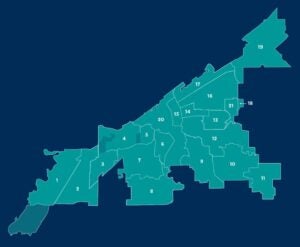
| # | Office |
| 1 | West Park Kamm’s Neighborhood Development |
| 2 | Jefferson-Puritas West Park Community Development Corporation |
| 3 | Westown Community Development Corporation |
| 4 | Northwest Neighborhoods CDC |
| 5 | Ohio City, Inc. |
| 6 | Tremont West Development Corporation |
| 7 | Metro West Community Development Organization |
| 8 | Old Brooklyn Community Development Corporation |
| 9 | Slavic Village Development |
| 10 | NuPoint Community Development Organization |
| 11 | Harvard Community Services Center |
| 12 | Burten, Bell, Carr Development, Inc. |
| 13 | Fairfax Renaissance Development Corporation |
| 14 | MidTown Cleveland, Inc. |
| 15 | Campus District, Inc. |
| 16 | Famicos Foundation |
| 17 | St. Clair Superior Development Corporation |
| 18 | Little Italy Redevelopment Corporation |
| 19 | Greater Collinwood Development Corp. |
| 20 | DOWNTOWN |
| Downtown Cleveland, Inc. | |
| Historic Gateway Neighborhood Corporation | |
| Historic Warehouse District Development Corporation | |
| Flats Forward Inc. | |
| 21 | University Circle, Inc. |
Source: https://clevelandnp.org/cleveland-cdcs/

Joy Johnson earned an MPA and a certificate in nonprofit management from CSU’s Levin College of Urban Affairs.
She serves as the executive director of Burten, Bell, Carr Development, Inc., a CDC where she leads efforts to revitalize underserved communities in Cleveland’s Central and Kinsman neighborhoods, along with Buckeye-Shaker and Buckeye Woodhill through real estate development and supportive social services.
Johnson previously worked as the organization’s associate director for six years before stepping into her current role in 2020. A native of Cleveland, she serves on several boards and committees including the Ohio CDC Association and the Greater Cleveland Human Services Chamber of Commerce.

Monserrat Monterrubio Ruiz, a Levin College alum, currently serves as the economic development director at Metro West Community Development Organization. With a background in architecture and urban planning, Monserrat’s work focuses on creating inclusive and sustainable economic development strategies.
Her journey at Metro West began as a small business coordinator, where she supported local businesses. Her skills and dedication led to her appointment as interim director, and eventually, as the permanent economic development director.
Watch Monserrat introduce herself and describe her work:
YouTube URL: https://www.youtube.com/watch?v=HI_smZ5Rvt4
Duration: 0:40
Cleveland Neighborhood Progress (CNP) is a crucial component of the community development ecosystem in Cleveland. It is an umbrella organization that supports a network of CDCs and other community organizations—helping them to collaborate, share resources, and amplify their impact. CNP provides funding, technical assistance, and strategic planning support to enhance the effectiveness of CDCs.
Cleveland’s CDC system has long been seen as a national model, thanks in part to Cleveland Neighborhood Progress and their regranting program. The regranting program is a way to fund smaller, community-based organizations. Cleveland Neighborhood Progress gets large grants from major foundations or the government and then redistributes these funds to local groups, like CDCs. This method helps target resources more effectively, allowing local organizations to address their community’s specific needs with development projects and initiatives. In Cleveland, the regranting program has helped local CDCs with neighborhood improvements, including housing repairs, economic growth, and community services, leading to sustainable community development.
One example of how the regranting process works in Cleveland involves the Cleveland Foundation, Cleveland Neighborhood Progress, and a local CDC.
First, the Cleveland Foundation awards a large grant to Cleveland Neighborhood Progress, an organization specializing in community development. Professionals at Cleveland Neighborhood Progress, who are experts in identifying effective community programs, assess various initiatives across the city. They select the best programs based on their potential impact and alignment with community needs.
For example, they might identify a housing rehabilitation program proposed by a specific CDC, like the Northwest Neighborhoods CDC. Cleveland Neighborhood Progress then allocates a portion of the grant money to the Detroit Shoreway CDC to fund this specific program. As a result, the Northwest Neighborhoods CDC can implement their housing rehabilitation project, improving housing conditions and supporting economic development in their neighborhoods.

Tania Manesse, a Levin College graduate, is the CEO of the Cleveland Neighborhood Partnership, the key organization you’ve already learned about. Tania began her career in the private sector before deciding to further her education. She went back to school and earned her graduate degree at the Levin College of Urban Affairs.
After completing her degree, Tania took on the role of economic development director in Shaker Heights, Ohio, where she successfully spearheaded the Van Aken District redevelopment project, transforming it into a vibrant mixed-use area. Her success in Shaker Heights led her to a similar position with the city of Cleveland, where she played a crucial role in the Flats East Bank project, revitalizing the waterfront and attracting new businesses and residents.
Now, as the CEO of the Cleveland Neighborhood Partnership, Tania uses her extensive experience in both government and nonprofit sectors to initiate positive change. She collaborates with local community development corporations (CDCs) to revitalize neighborhoods, support small businesses, and create affordable housing. Her leadership ensures that resources are used effectively to improve the quality of life for Cleveland residents.
Affordable housing refers to housing that costs no more than 30% of a household’s gross income, allowing residents to cover essential expenses such as food, healthcare, and transportation. For low-income families, finding housing that meets this standard can be challenging due to rising costs, stagnant wages, and limited availability. Nonprofit organizations address these challenges by developing and preserving affordable housing options and supporting homeownership.
In addition to CDCs, other nonprofits in Northeast Ohio provide affordable housing. These organizations work to improve living conditions, promote sustainable development, and support underserved populations. They often coordinate with CDCs to expand their impact across neighborhoods. Their efforts not only help individuals in need but also contribute to the overall stability of communities.
A prime example is Habitat for Humanity, which has helped hundreds of families in Northeast Ohio achieve homeownership through its home-building projects. Volunteers and future homeowners work together to construct these homes, fostering a sense of community and long-term stability. By increasing access to safe, affordable housing, Habitat for Humanity reduces vacancy rates and supports neighborhood revitalization.
Another organization is CHN Housing Partners, which takes a comprehensive approach to affordable housing. CHN develops and preserves rental and homeownership opportunities for low-income families, administers home repair and weatherization programs, and provides financial counseling and homebuyer education. In addition to building and managing housing units, CHN collaborates with public and private partners to address regional housing challenges. Its programs help families secure stable housing while also promoting financial empowerment, giving residents the tools to maintain long-term housing security.
John Litten, a CSU MPA alum, is the CEO of Greater Cleveland Habitat for Humanity, where he leads efforts to provide affordable housing and strengthen communities. In addition to his work with Habitat for Humanity, John has served as a city council member for Lakewood and held the position of council president. His leadership in both nonprofit housing and local government reflects his commitment to public service and improving the lives of residents. Drawing on his experience and education, John continues to make a significant impact on housing and community development in Northeast Ohio.
Watch this video to learn how Habitat is expediting the building process by installing modular homes:
YouTube URL: https://www.youtube.com/watch?v=LUjKbRp4EB8
Duration: 2:17
The United States is facing a rental crisis driven by steadily rising rents, a shrinking supply of affordable units, and increasing financial pressure on households. In many communities, rents have grown faster than wages, leaving families struggling to keep up. Nearly half of renters nationwide are considered “cost burdened,” meaning they spend more than 30 percent of their income on housing, which limits what they can spend on other necessities.
This crisis affects both large cities and smaller communities. Places once considered affordable are seeing higher demand for rental housing while new construction lags behind. At the same time, the number of low-cost rental units is falling as older buildings are renovated, demolished, or converted into more expensive housing. Assistance programs, such as housing vouchers, help some families, but the need far exceeds the resources available.
The result is growing instability. Many renters are forced to relocate more often, double up with relatives or friends, or face the threat of eviction and homelessness. The rental crisis highlights the ongoing challenge of ensuring that safe and stable housing is accessible for people across the country.
Evictions & Evicted
An eviction is a legal process by which a landlord forces a tenant to leave a rental property—usually because of nonpayment of rent, lease violations, or other issues. Landlords have a right to earn a return on their property and to hold irresponsible tenants accountable, but evictions can also disrupt lives, often pushing families into homelessness, making it harder for them to find new housing, and leaving lasting damage to their credit and rental history.
In his Pulitzer Prize–winning book Evicted: Poverty and Profit in the American City, sociologist Matthew Desmond follows low-income families in Milwaukee over several years to show how eviction is not just a symptom of poverty—it helps cause it. Desmond argues that eviction is a mechanism through which landlords extract wealth from the poor, and that the threat of eviction puts extreme pressure on families, disrupting work, health, and children’s schooling.
Desmond’s work has had wide influence in policy circles and public understanding. In interviews like his appearance on PBS NewsHour, he highlights the human cost behind eviction statistics: mothers forced into unsafe housing, children moved from school to school, and entire families pushed to the brink—even when they are trying to maintain housing stability.
Watch the PBS NewsHour interview:
YouTube URL: https://www.youtube.com/watch?v=qBT8GGhh2Tg&t=8s
Duration: 7:01
Evictions are not just one-time events—they ripple outward, affecting neighborhoods, social services, and the stability of communities.

Tanesha Hunter Seaborn works at the Fair Housing Center, where she leads education and outreach programs. She organizes trainings and helps people understand fair housing laws. She works with tenants, landlords, local governments, real estate professionals, social workers, and other community members.
Her interest in housing advocacy began while she was earning her MPA at CSU, where she received the Wallace G. Teare Prize for her dedication to fair and quality housing.
Before her current role, Tanesha managed outreach and public affairs for the City of Cleveland’s Department of Aging. She has also written about housing issues, including an article for the ACLU called “No Section 8 Means No Opportunities.”
Watch this testimonial video in which she talks about her experiences at CSU and her career trajectory:
YouTube URL: https://www.youtube.com/watch?v=kfXf_WFFgA8
Duration: 1:51
Homelessnessis the condition of lacking stable, safe, and adequate housing. It can result from economic hardship, job loss, mental health challenges, domestic violence, or a lack of affordable housing options. People experiencing homelessness may live in emergency shelters, transitional housing, vehicles, or on the streets. While affordable housing initiatives focus on long-term homeownership and stability, other nonprofits directly address homelessness by providing temporary housing and critical support services.
The City Mission is one such organization, offering shelter, meals, and programs for individuals and families in crisis. One of its key initiatives, Laura’s Home, serves women and children experiencing homelessness. In addition to providing a safe place to stay, the shelter offers job training, life skills development, and emotional support to help residents regain stability and independence. Through these services, The City Mission works to break the cycle of homelessness and equip individuals with the resources needed for long-term success.
Watch this report on Laura’s Home to learn more:
YouTube URL: https://www.youtube.com/watch?v=ABs-Orpx3vc
Duration: 4:29
In addition to the City Mission, several other nonprofits in Cleveland are actively addressing affordable housing and homelessness:
Through these initiatives, nonprofits in Northeast Ohio are making an impact by addressing both housing security and homelessness.
Linda Uveges, a distinguished Levin College alumna, serves as the CEO of The City Mission, a nonprofit organization dedicated to helping individuals and families experiencing homelessness in Cleveland. Under her leadership, The City Mission has expanded its reach and impact, providing critical services such as emergency shelter, rehabilitation programs, and pathways to self-sufficiency. Uveges’s compassionate leadership and strategic vision have been instrumental in advancing the organization’s mission to restore hope and transform lives.
Before becoming CEO, Uveges served in various roles at The City Mission, including Chief Operating Officer, where she played a key role in developing programs and services that address the root causes of homelessness. Her commitment to the community and her ability to inspire change have made her a respected leader in the nonprofit sector.
You’ve already watched an interview with Uveges. Now watch this short CSU promotional video in which she talks about her work and how her CSU degrees (BA and Master’s in nonprofit management) prepared her for leadership:
YouTube URL: https://www.youtube.com/watch?v=Ud4gJfIARVc
Duration: 2:27
Linda’s work earned her recognition as one of Crain’s Cleveland Business’ Notable Women in Nonprofits in 2019.
Working in nonprofit housing organizations involves a mix of responsibilities aimed at improving housing access and supporting communities. Professionals in roles such as housing coordinators, community outreach specialists, and project managers in CDCs engage in various tasks that require strong organizational skills, communication, and a deep understanding of the housing needs in their communities.
Take, for example, a Habitat for Humanity project manager overseeing a home build in Cleveland. Their day typically begins early with a site visit to the construction area. The project manager checks on the progress of the build, ensuring that everything is on schedule and that materials are available. They coordinate with contractors, volunteers, and future homeowners, addressing any issues that arise on-site. Safety checks are an essential part of the morning routine to ensure that all workers and volunteers are following safety protocols.
Check out this video in which local officials in Cleveland show what it’s like to volunteer:
YouTube URL: https://www.youtube.com/watch?v=7yfS1r4vIf4
Duration: 5:36
Throughout the day, the project manager meets with different teammates, from construction crews to volunteer coordinators, to keep everyone on track. They might also interact with the family receiving the home to provide updates and answer any questions they might have. Much of the day is spent troubleshooting—whether it’s addressing delays in material deliveries, handling weather-related setbacks, or resolving last-minute design changes. Flexibility and problem-solving are key skills in this role.
In the afternoon, the project manager shifts focus to administrative tasks. This could include updating timelines or communicating with Habitat for Humanity’s regional office about the project’s status. They also prepare reports and ensure that all paperwork for permits and inspections is in order. If time permits, the project manager might also meet with potential donors or attend community meetings to advocate for additional support for future builds.
By the end of the day in this scenario, the project manager has balanced hands-on work at the site and the behind-the-scenes tasks that ensure the project continues smoothly. This mix of fieldwork and administration is typical for many roles in nonprofit housing organizations.
Working for a CDC, a housing nonprofit, or an emergency housing nonprofit requires a blend of education, professional knowledge, and personal qualities.
Some positions call for a bachelor’s degree in a related field such as business administration, public administration, nonprofit management, or social work. Some roles value additional credentials, such as housing counseling certification, real estate licensure, or training in project management. Advanced degrees are sometimes preferred for leadership or technical positions.
People in these organizations often need to read budgets, track funding, and understand grant requirements. They are expected to communicate clearly with residents, community leaders, funders, and other partners. Many roles require comfort with regulatory programs and housing policy, particularly those involving federal or state funding streams. Staff in emergency housing programs benefit from case management training and familiarity with crisis intervention.
Personal qualities matter as much as formal training. People working in this field need to demonstrate empathy toward residents while also enforcing organizational rules. The ability to adapt to changing conditions, whether it’s a sudden funding shift or a family facing an unexpected eviction, helps staff succeed in stressful environments. These organizations rarely work alone, so employees must be comfortable building partnerships across government, nonprofit, and private sectors.
Persistence and a commitment to community well-being often determine whether someone thrives in this work.
For many people, working in a CDC, housing nonprofit, or emergency housing organization can be gratifying. Staff members get to know residents directly, help stabilize housing situations, and see projects take shape in their neighborhoods.
There is satisfaction in knowing that a rehabbed property, a new affordable housing unit, or an emergency shelter bed can make a real difference for individuals and families.
Another benefit is the chance to work alongside passionate, like-minded individuals. Nonprofit professionals often collaborate with community members, volunteers, and other organizations, building strong networks while advancing a shared mission. This can create a deep sense of purpose, making the work both professionally and personally meaningful.
However, the challenges of the profession cannot be overlooked. These organizations often lack the funding, staffing, and authority to address the deeper structural problems in their communities. This mismatch between daily effort and larger outcomes can be frustrating. Burnout is common when staff feel like they are always responding to crises without being able to change the conditions that create them.
Working with vulnerable populations, particularly people experiencing homelessness, can present significant emotional and physical challenges for professionals in the nonprofit housing sector. Many individuals facing homelessness have experienced trauma, mental health issues, or addiction, which can make supporting them complex and demanding. Nonprofit staff often work directly with people in crisis, and the stress of these interactions can take a toll on their emotional well-being. The risk of burnout is real, especially for those who may feel overwhelmed by the magnitude of the issues they are addressing and the limited resources available to help.
Additionally, there is an element of physical risk when working with certain populations. Some individuals may exhibit unpredictable behavior due to mental illness or substance use. While many organizations provide training on de-escalation techniques and safety protocols, nonprofit staff can still face difficult or potentially unsafe situations, especially in emergency shelter environments.
Preventing the Misuse of Funds
While most nonprofits operate with integrity, ethical failures can have serious consequences. Mismanagement or corruption in community development organizations can undermine trust, divert resources away from those in need, and harm the very communities they aim to serve. A case that underscores the importance of ethical leadership is the Buckeye Shaker Square Development Corporation (BSSDC) scandal in Cleveland. Former Cleveland City Councilman Kenneth Johnson, who represented Ward 4, was convicted in 2021 for his role in a corruption scheme involving BSSDC.
Johnson and his associates, including his executive assistant Garnell Jamison and BSSDC Executive Director John Hopkins, were found guilty of embezzling federal funds meant for community development and neighborhood services. Between 2010 and 2018, they allegedly submitted fraudulent expense reports and timesheets for services that were never provided, diverting approximately $127,200 in federal funds. In October 2021, Johnson was sentenced to six years in prison and ordered to repay $746,839.38 in restitution to the IRS and the Department of Housing and Urban Development.
Watch this News 5 Cleveland report about how this case negatively affected people in the community:
YouTube URL: https://www.youtube.com/watch?v=3xcHqFmZ1kA
Duration: 4:01
Cases like this highlight the need for transparency, oversight, and strong ethical standards in nonprofit housing organizations. Strong board governance, external audits, and ethical leadership are important for preventing fraud and ensuring that housing nonprofits fulfill their mission to serve residents. Upholding legal and ethical standards is not just about compliance—it is about ensuring that housing nonprofits remain trusted institutions that genuinely serve the communities they seek to uplift.
Displacement & Gentrification
Housing nonprofits often face complex ethical dilemmas as they work to improve communities and provide affordable housing. One of the most significant challenges is balancing development with the risk of displacement. While efforts to revitalize neighborhoods can bring new housing, businesses, and amenities, they can also lead to gentrification, where rising property values push out longtime residents who can no longer afford to live in the area.
There is a difference between community-led neighborhood revitalization and gentrification. Community-led neighborhood revitalization focuses on improving housing, infrastructure, and local economies while prioritizing the needs of existing residents. The goal is to make sure community members benefit from investment without being displaced. In contrast, gentrification often leads to rising costs that push out long-time residents as wealthier individuals move in, shifting the cultural and economic makeup of the neighborhood.
Watch Roy Wood, Jr.’s take on gentrification on the Daily Show:
YouTube URL: https://www.youtube.com/watch?v=kbkLi2kC5Ig
Duration: 6:52
If you want to get serious, watch Dr. Stacey Sutton’s 2015 TEDTalk. She is a professor urban planning at the University of Illinois Chicago:
Duration: 13:52
Nonprofits must carefully consider the impact of their projects to ensure that they benefit the current residents, rather than unintentionally displacing them.
For example, CDCs in Northeast Ohio have addressed this challenge by focusing on affordable housing development. These organizations work to create new housing options that are affordable for residents with lower incomes to try to make sure people aren’t forced out as neighborhoods improve. Burten Bell Carr Development Inc. (BBC), for example, has developed affordable housing in Cleveland’s Central and Kinsman neighborhoods while also engaging with residents to ensure their needs are prioritized. By involving the community in the planning process, CDCs can help avoid displacement and create solutions that benefit both new and existing residents.
Ensuring that housing developments are accessible to people of different income levels, races, and backgrounds is critical to fostering diverse, inclusive communities. Some organizations in Northeast Ohio, like Habitat for Humanity, address this by offering housing opportunities based on need, ensuring that families from all walks of life can access safe and stable homes.
Other local nonprofits also promote homeownership programs that allow longtime residents to stay in their neighborhoods as property values rise. Programs that help residents afford necessary home repairs or provide financial education are key to empowering individuals to remain in their communities. This approach helps maintain the fabric of the neighborhood while still allowing for positive development.
In the nonprofit housing field, ethical decision-making is essential to ensuring that development benefits all members of the community. By addressing concerns about displacement and working to provide equitable access to housing, local organizations are creating sustainable, inclusive neighborhoods for the future.
Starting out in a housing-focused nonprofit usually means taking on practical roles that support day-to-day operations. Common entry-level positions include volunteer coordination, community outreach, and project support.
Over time, people can move into positions with more responsibility, such as program manager, where they oversee several projects and help set priorities for the organization. With additional experience, some professionals advance to leadership roles like executive director of a nonprofit or department head within a CDC, guiding strategy and securing funding. Graduate study in fields such as urban planning, nonprofit management, or public administration can open further opportunities for leadership.
Careers in this field are challenging, but they provide a way to gain hands-on experience in community development while working toward longer-term goals of improving access to safe and affordable housing.
There is a wide disparity in compensation across nonprofit housing organizations. Salaries in this sector depend heavily on the role, the size of the organization, and its funding base.
Salaries in the nonprofit housing sector can vary widely depending on the role, organization size, and location. Entry-level positions, such as volunteer coordinators or community outreach specialists, typically offer salaries ranging from $35,000 to $45,000 per year. Mid-level roles, like project managers or program directors, can earn between $50,000 and $70,000 annually, while senior leadership positions, such as executive directors of nonprofits or CDCs, can earn upwards of $80,000 to $120,000. However, these salaries are generally lower than what similar roles might earn in private sector development firms.
Nonprofit housing jobs often include other benefits. Many organizations provide health insurance and retirement plans. Some offer flexible work schedules, which can help with work–life balance. Some do not. Employees also might have access to professional development opportunities, such as workshops, conferences, or certification programs, that allow them to build skills and strengthen their careers.
The future of the housing nonprofit sector is being shaped by several emerging trends that aim to address both current and future housing needs. One important trend is the rise of green building practices, where organizations are focusing on making housing more sustainable and energy-efficient. This includes using environmentally friendly materials, designing buildings that reduce energy use, and incorporating renewable energy sources like solar power. By adopting green practices, housing nonprofits can create homes that are both affordable and environmentally responsible, benefiting residents and the planet.
Another growing trend is affordable housing innovation. With housing costs continuing to rise, nonprofits are exploring new ways to create affordable housing. This includes using prefabricated homes, tiny houses, and modular construction techniques to reduce costs and build more efficiently. Many nonprofits are also advocating for policy changes that encourage affordable housing development, such as zoning reforms and tax incentives.
The ongoing rental crisis in America—driven by rising rental costs, stagnant wages, and a shortage of affordable housing—has intensified the need for nonprofit intervention. Many renters are cost-burdened, meaning they spend more than 30% of their income on rent, leaving them vulnerable to eviction and housing insecurity. Institutional investors purchasing rental properties have further driven up costs, reducing affordability and tenant protections.
Watch this report on outside investors buying up housing in Cleveland:
YouTube URL: https://www.youtube.com/watch?v=xJqzdhxf5a4
Duration: 5:10
In response, housing nonprofits are expanding efforts to provide stable, affordable rental options, prevent evictions, and advocate for stronger tenant protections. Addressing this crisis will require a combination of nonprofit initiatives, government policies, and innovative housing solutions.
The integration of housing with social services is also becoming more common. Nonprofits recognize that housing alone is not enough; many residents need additional support to succeed. This includes providing access to healthcare, job training, and financial literacy programs. By offering these services alongside housing, nonprofits can help individuals and families achieve long-term stability and improve their overall well-being.
Demographic shifts, economic changes, and new policies are also shaping the future of housing development, especially in Northeast Ohio. As populations age and household sizes shrink, there is an increasing demand for smaller, more accessible housing units. Economic changes, including wage stagnation and rising housing costs, are driving the need for more affordable housing options. Meanwhile, new policies at both the state and federal levels are pushing for greater investments in housing, which could lead to more funding opportunities for nonprofits.
Technology is playing a larger role in improving housing outcomes and streamlining operations for nonprofits. In housing development, technology is being used to design more efficient homes, manage construction projects, and track housing inventory. 3D printing and modular construction are making it faster and cheaper to build homes, while digital mapping tools help nonprofits identify areas of need and plan development projects more effectively.
In addition, technology is helping nonprofits improve their day-to-day operations. Data management systems allow organizations to track their impact more effectively, from the number of families housed to the success of community programs. Nonprofits are also using cloud-based tools to manage volunteers, coordinate fundraising efforts, and communicate with donors. This makes it easier for organizations to stay organized, reduce administrative costs, and focus more on their mission.
Furthermore, online platforms are increasing accessibility for residents. Housing nonprofits can use these platforms to help individuals apply for housing, access resources, or get updates on their housing status. By streamlining the application process and improving communication, technology can help ensure that more people get the housing support they need.
In conclusion, the future of the nonprofit housing sector will be shaped by green building practices, affordable housing innovations, and a greater focus on integrating social services. The rental crisis underscores the urgent need for nonprofits to expand affordable housing options, prevent evictions, and advocate for stronger protections. As demographic and economic changes continue to impact housing needs, and as new policies encourage housing development, the role of technology will be essential in improving housing outcomes and helping nonprofits operate more efficiently.
As you consider a career in nonprofit housing and community development, it’s important to take time to reflect on your own values and how they align with this field. Working in this sector means being committed to improving communities and helping individuals and families find safe, affordable housing. If you are passionate about making a difference in people’s lives and believe in the power of strong communities, a career in nonprofit housing might be a great fit for you.
However, it’s also important to think about the challenges that come with this work. Nonprofit housing professionals often face emotional stress, especially when working with vulnerable populations who are experiencing homelessness or housing insecurity. The emotional toll of seeing families struggle with unstable housing can be difficult, and maintaining personal resilience is key to succeeding in this field. You may also face public scrutiny, particularly when working on controversial projects or addressing sensitive community issues like gentrification and displacement. It’s important to ask yourself if you are prepared to handle these pressures while staying focused on your mission.
Consider whether you can envision yourself sustaining a career in nonprofit housing, despite the challenges. Reflect on whether the personal fulfillment of helping others outweighs the difficulties that may arise. Think about how your personal strengths, such as empathy, patience, and problem-solving, align with the needs of this profession. By understanding your values and anticipating the demands of this field, you can better determine whether a career in nonprofit housing and community development is the right path for you.
Housing development and administration span across multiple sectors. Therefore, there are a variety of career paths outside the nonprofit sector for professionals interested in shaping communities and addressing housing challenges. Whether working in local, state, or federal government or private industry, professionals can contribute to housing policy, urban planning, construction, and community development efforts. The following sections outline key roles and opportunities within each sector.
Local Government
Local governments play a key role in housing development and administration, offering a range of career opportunities. Many cities have housing departments or community development offices that oversee affordable housing projects, zoning regulations, and neighborhood revitalization initiatives. Professionals in roles like housing program managers, urban planners, or community development coordinators work to ensure that housing needs are met through planning, policy implementation, and collaboration with nonprofit organizations. These roles often involve working closely with residents, developers, and other government agencies to create sustainable housing solutions.
State Government
At the state level, housing agencies are responsible for allocating federal funds, such as those from the Low-Income Housing Tax Credit (LIHTC) program and implementing statewide housing initiatives. Careers in housing policy analysis, program administration, and grant management are common at this level. These professionals help develop state policies that address housing affordability, homelessness, and community development. They also ensure that local governments and nonprofits have the resources and guidance needed to meet housing goals.
Federal Government
The federal government provides significant support for housing through agencies like the Department of Housing and Urban Development (HUD). Careers in HUD and related agencies include roles such as housing specialists, policy analysts, and compliance officers. These positions involve overseeing national housing programs, ensuring fair housing practices, and working to reduce homelessness. Federal employees may also develop and enforce housing regulations, allocate funding for affordable housing projects, and collaborate with state and local governments to address housing challenges.
Private Sector
In the private sector, there are many career opportunities related to housing development. Private real estate development firms, construction companies, and property management firms are key players in building and maintaining housing. Careers in real estate development, project management, and urban planning offer competitive salaries and the opportunity to work on large-scale housing projects. Private sector professionals often collaborate with government agencies and nonprofits to develop housing solutions that meet community needs while ensuring profitability. Additionally, those with expertise in green building and sustainable housing are in demand as the industry increasingly focuses on environmentally responsible development practices.
Each of these areas offers unique opportunities to contribute to housing development and community improvement and allows professionals to align their careers with public service or private industry goals.
Not everyone needs to pursue a full-time career in housing and community development to make a meaningful impact. There are many ways to support this important work through volunteerism, philanthropy, and advocacy. Even if your professional career takes you in a different direction, you can still contribute to efforts that improve housing and strengthen communities.
One of the most accessible ways to get involved is through volunteering. Organizations like Habitat for Humanity rely heavily on volunteers to help build homes for families in need. By dedicating just a few hours of your time, you can be part of a project that provides stable, affordable housing for people in your community. Similarly, The City Mission offers opportunities to volunteer at their shelters, where you can help serve meals or provide other forms of support to individuals and families experiencing homelessness.
Philanthropy is another way to contribute. Many nonprofits rely on donations to fund their programs, and every contribution helps. Whether it’s a one-time donation to an organization like The City Mission or a monthly pledge to Habitat for Humanity, your financial support can have a lasting impact. Donations can help build homes, provide emergency shelter, or fund programs that support long-term housing stability.
Finally, you can support housing and community development through advocacy. This could involve raising awareness about housing issues, contacting your local representatives to support affordable housing policies, or participating in community events that promote housing rights. Advocacy doesn’t require a career commitment, but it can still drive meaningful change by influencing public policy and bringing attention to the needs of underserved populations.
In short, whether you choose to volunteer your time, donate to organizations, or advocate for housing issues, there are many ways to support housing and community development outside of a full-time career. For example, you might spend a weekend volunteering for a Habitat for Humanity build or donate to a shelter like The City Mission to help provide essential services for those in need. Even small actions can make a big difference in your community.
In this chapter, we explored the role that nonprofits play in addressing housing challenges and improving communities. Organizations like Habitat for Humanity, The Salvation Army, The City Mission, and CDCs work to provide affordable housing, support vulnerable populations, and revitalize neighborhoods. These nonprofits collaborate with local governments and communities to make lasting, positive changes in the housing landscape.
We also discussed the career opportunities available in the nonprofit housing sector. From entry-level roles in volunteer coordination and community outreach to leadership positions in project management and nonprofit administration, there are many paths to a fulfilling career in housing and community development. The field requires a combination of technical skills, like project management and urban planning, and soft skills, like communication and empathy.
As you consider your future, reflect on whether a career in housing and community development aligns with your values and aspirations. This field offers the chance to make a direct impact on people’s lives and create stronger communities. However, it also comes with challenges, such as emotional demands and resource limitations. Think about whether the rewards of this work—helping others, fostering community growth, and addressing critical social issues—match your personal goals and strengths.
The field of health and human services is essential to the well-being of individuals and communities. It includes a broad range of organizations and professionals who provide medical care, mental health services, addiction treatment, food assistance, housing support, and other social services. These services address public health challenges, reduce disparities in care, and improve quality of life, especially for vulnerable populations.
The nonprofit sector plays a major role in delivering health and human services, often filling gaps that government programs and private providers cannot. Hospitals, community health centers, food banks, behavioral health organizations, and housing nonprofits work to ensure that people receive the support they need, regardless of their ability to pay. Some nonprofit organizations focus on community-based care, while others operate more like corporations, balancing revenue generation, research, and public service.
As the field evolves, ethical challenges, funding constraints, and emerging technologies continue to shape how services are delivered. Professionals in health and human services must navigate complex issues, including privacy and confidentiality, access to care, and the role of artificial intelligence in medical decision-making.
This field offers a variety of career paths, from frontline service roles like social workers and healthcare providers to administrative and policy-driven positions that shape public health programs and nonprofit operations. Whether working at a large nonprofit hospital or a community-based service provider, professionals in this field play a crucial role in supporting individuals and strengthening communities.
Nonprofit organizations play an important role in delivering health and human services, particularly for underserved and vulnerable populations. While government agencies and private healthcare providers contribute to this sector, nonprofits often step in to fill service gaps, provide specialized care, and address social determinants of health.
In Cleveland and Northeast Ohio, several nonprofit organizations deliver essential services ranging from mental health counseling and addiction recovery to community-based healthcare and food assistance.
Community Health and Primary Care
Many Cleveland-area nonprofits focus on community-based healthcare, ensuring that low-income and uninsured individuals can access medical services.
Entry-level jobs in community health and primary care focus on assisting medical professionals and ensuring patients receive essential care. Roles like medical assistant and patient navigator involve helping individuals access medical services, educating communities on preventive care, and supporting clinics that serve uninsured or low-income populations. These positions are common in community health centers, nonprofit clinics, and federally qualified health centers (FQHCs) and provide a strong foundation for those interested in healthcare careers.
Mental Health and Addiction Recovery Services
Nonprofit organizations also play a significant role in mental health and addiction services, offering counseling, crisis intervention, and recovery programs.
Entry-level jobs in mental health and addiction recovery focus on supporting individuals in treatment and connecting them with needed resources. Positions such as peer support specialist, crisis hotline operator, and residential treatment assistant involve providing emotional support, helping individuals navigate recovery programs, and assisting clinical professionals in behavioral health settings. These roles are often found in mental health clinics, addiction treatment centers, and crisis intervention organizations and require compassion, patience, and strong communication skills.
Food Assistance and Nutritional Support
Access to healthy food is a key social determinant of health, and many nonprofit organizations work to reduce food insecurity in Northeast Ohio.
Careers in food assistance and nutrition offer entry-level roles such as food pantry coordinator, meal program assistant, and SNAP outreach worker. These jobs typically involve distributing food, coordinating meal services, educating individuals about food assistance programs, and supporting community nutrition initiatives. Many positions exist within food banks, community kitchens, and hunger relief organizations, requiring both organizational skills and a commitment to addressing food insecurity.
Housing and Social Services
Housing stability is directly connected to health outcomes, and nonprofits play a critical role in providing housing support, emergency shelter, and case management for individuals experiencing homelessness. While the previous chapter highlighted several organizations addressing this problem in Northeast Ohio, here are additional nonprofits making an impact. Despite the efforts of these organizations, the number of people experiencing homelessness each night still exceeds the available shelter beds, leaving many without a safe place to stay.
Entry-level jobs in housing and social services focus on supporting individuals and families facing housing insecurity. Positions like housing case manager, shelter advocate, and intake coordinator involve helping clients secure stable housing, navigate assistance programs, and connect with supportive services. Many of these roles are based in homeless shelters, housing nonprofits, and transitional living programs, requiring strong communication, problem-solving, and advocacy skills to assist those in crisis.
Public Health and Health Equity Initiatives
Several nonprofits advocate for health equity and public health improvements, addressing disparities in healthcare access and outcomes.
Entry-level positions in public health and health equity focus on education, outreach, and program coordination. Roles such as community health worker, public health outreach coordinator, and health educator involve connecting individuals to healthcare resources, promoting wellness programs, and addressing health disparities. Many of these positions are found in nonprofits, local health departments, and community organizations and often involve advocating for underserved populations, organizing health campaigns, and assisting with data collection for public health studies.
The Impact of Nonprofits in Health and Human Services
Nonprofits in the health and human services sector serve as a safety net, providing medical care, mental health support, food assistance, and housing solutions for those who might otherwise go without. Unlike government programs, which can be bureaucratically complex and slow to adapt, nonprofits often respond quickly to emerging health crises, tailor services to specific populations, and advocate for systemic change.
Through collaborations with hospitals, government agencies, and community partners, nonprofit organizations continue to play a critical role in improving health outcomes and addressing social determinants of health in Northeast Ohio. Their work ensures that all residents—regardless of income, background, or insurance status—have access to essential health services.
Northeast Ohio is home to some of the most well-known and influential hospitals in the country. While these institutions are legally classified as nonprofits, some operate more like large corporations than community-based healthcare providers. Nonprofit hospitals receive tax-exempt status in exchange for providing community benefits, such as free or reduced-cost care for low-income patients, public health initiatives, and medical education programs. However, some large nonprofit hospitals function similarly to for-profit health systems, generating billions in revenue and expanding globally while maintaining nonprofit status.
Cleveland Clinic
Founded in 1921, Cleveland Clinic is one of the largest and most recognized nonprofit hospital systems in the world. While it provides world-class healthcare and leads groundbreaking medical research, its business model closely resembles that of a major corporation. The Clinic generates billions of dollars in revenue annually, operates hospitals across multiple states, and has expanded internationally, with locations in Florida, Nevada, Canada, the United Arab Emirates, and London.
Despite its nonprofit status, Cleveland Clinic’s financial operations and executive compensation have drawn scrutiny. The institution reinvests much of its revenue into medical research, infrastructure, and expansion efforts, but critics argue that its focus on high-end medical procedures and specialty care sometimes overshadows community-based healthcare for low-income residents. The Clinic does provide community benefits, including charity care, health education, and outreach programs, but its role as a nonprofit is sometimes questioned due to its corporate-style management and vast financial resources.
University Hospitals
University Hospitals (UH), another major nonprofit healthcare provider in Northeast Ohio, operates a large network of hospitals, outpatient centers, and specialty care facilities. Unlike Cleveland Clinic, UH is more deeply integrated into Cleveland’s neighborhoods, with a stronger focus on local community engagement.
UH plays a key role in medical education and research, partnering with Case Western Reserve University’s School of Medicine. It also provides significant charity care and community health programs, including free screenings, chronic disease management services, and maternal health programs. While UH is still a large and financially powerful organization, it tends to maintain a more regionally focused mission compared to the global reach of Cleveland Clinic.
MetroHealth: A Publicly Owned Safety-Net Hospital
While MetroHealth is technically a public hospital rather than a nonprofit, it operates in many ways like a mission-driven nonprofit, focusing on underserved populations and community health initiatives. Unlike Cleveland Clinic and UH, which rely on a mix of private insurance, Medicare, and Medicaid reimbursements, MetroHealth provides care regardless of a patient’s ability to pay.
MetroHealth has led efforts to address racial and socioeconomic disparities in healthcare, investing in neighborhood clinics, mobile health units, and housing initiatives to improve public health. It remains one of the most accessible healthcare providers for uninsured and underinsured residents in Cleveland and continues to focus on equity-driven healthcare solutions.
Other Nonprofit Hospitals and Healthcare Providers
In addition to these major institutions, Northeast Ohio is home to several smaller nonprofit hospitals and healthcare networks that focus on community-based services:
The Corporate Nature of Large Nonprofit Hospitals
While nonprofit hospitals are required to provide community benefits to maintain their tax-exempt status, some large systems, such as Cleveland Clinic, operate like for-profit corporations in many ways:
The Role of Nonprofit Hospitals in Community Health
Despite their corporate-like operations, nonprofit hospitals in Northeast Ohio do provide significant public benefits. Many invest in:
In Summary
Nonprofit hospitals are a complex but essential part of Northeast Ohio’s healthcare landscape. Institutions like Cleveland Clinic, University Hospitals, and MetroHealth play distinct roles—ranging from global healthcare innovation to local safety-net services. While some operate more like corporate entities, their tax-exempt status obligates them to reinvest in healthcare services, education, and community programs. As healthcare continues to evolve, the role of nonprofit hospitals in balancing financial sustainability with their mission to serve the public will remain a topic of debate.
Government agencies play a critical role in providing health and human services, overseeing programs that address public health, housing, food assistance, mental health, and primary care. These agencies operate at the federal, state, and local levels, setting policies, funding initiatives, and managing programs that serve individuals and families in need. However, government agencies often rely on nonprofit organizations to fill gaps in service delivery, expand outreach efforts, and provide direct assistance to communities.
Community Health and Primary Care
While government agencies such as the Centers for Medicare & Medicaid Services (CMS) and the Health Resources and Services Administration (HRSA) oversee Medicaid, Medicare, and federally qualified health centers (FQHCs), many individuals still struggle to access affordable primary care, dental care, and specialty services.
Nonprofit organizations like Neighborhood Family Practice, Care Alliance Health Center, and Circle Health Services provide community-based healthcare for low-income, uninsured, and underinsured individuals. These organizations often receive government grants but operate independently, ensuring that underserved populations receive essential medical care without facing financial barriers.
Mental Health and Addiction Recovery Services
Public mental health services are primarily funded and overseen by government agencies such as the Substance Abuse and Mental Health Services Administration (SAMHSA) at the federal level and the Ohio Department of Mental Health and Addiction Services (OhioMHAS) at the state level. These agencies regulate and fund community mental health programs, addiction treatment centers, and crisis intervention services. However, government-funded programs can be understaffed or limited in availability, leaving many without timely access to care.
Nonprofits help fill this gap by offering free or low-cost mental health counseling, peer support programs, and addiction recovery services. Organizations like Recovery Resources, FrontLine Service, and NAMI Greater Cleveland provide crisis intervention, support groups, and case management, often working closely with public health agencies and law enforcement to serve individuals experiencing mental health crises.
Food Assistance and Nutritional Support
The federal government runs major food assistance programs like the Supplemental Nutrition Assistance Program (SNAP) and Women, Infants, and Children (WIC), which help low-income families buy groceries and access essential nutrition. These programs are administered through state agencies such as the Ohio Department of Job and Family Services, but nonprofits play a crucial role in bridging food security gaps for those who may not qualify for government benefits or need additional support. Organizations like the Greater Cleveland Food Bank and Hunger Network of Greater Cleveland distribute food through food pantries, mobile markets, and meal programs, often coordinating with local governments to ensure resources reach underserved populations.
Housing and Social Services
Government agencies such as the U.S. Department of Housing and Urban Development (HUD) and state and local housing authorities fund and regulate affordable housing programs, homelessness prevention services, and rental assistance programs. In Ohio, agencies like the Ohio Housing Finance Agency and Cuyahoga Metropolitan Housing Authority (CMHA) manage public housing developments and Section 8 housing vouchers. However, these programs often have long waitlists or eligibility barriers, leaving many in need of immediate housing assistance.
Nonprofits step in to provide emergency shelters, transitional housing, and case management services. Organizations such as EDEN (Emerald Development and Economic Network), Lutheran Metropolitan Ministry, and Family Promise of Greater Cleveland work alongside government agencies to ensure individuals experiencing homelessness receive safe housing, employment support, and long-term stability services.
Public Health and Health Equity Initiatives
At the federal level, agencies such as the Centers for Disease Control and Prevention (CDC) and the U.S. Department of Health and Human Services (HHS) develop public health policies, disease prevention programs, and health equity initiatives. State and local health departments, such as the Ohio Department of Health and Cuyahoga County Board of Health, oversee vaccination programs, public health education, and disease control efforts.
While these agencies establish health priorities, nonprofits help implement community-based programs by conducting health screenings, offering wellness education, and advocating for policy changes to address health disparities. Organizations like United Way and First Year Cleveland collaborate with public health agencies to improve maternal health, reduce infant mortality, and promote preventative care.
How Nonprofits Complement Government Services
Government agencies set policies, regulate services, and provide funding, but they often face bureaucratic challenges, limited funding, and strict eligibility requirements that prevent them from reaching everyone in need.
Nonprofits bridge this gap by offering direct, community-based services that are flexible, innovative, and responsive to urgent needs. They work alongside government programs, advocate for policy changes, and provide hands-on support to individuals who might otherwise fall through the cracks.
By combining the resources of government agencies with the grassroots efforts of nonprofits, communities are better equipped to address public health challenges, housing instability, food insecurity, mental health needs, and primary healthcare access. This public-nonprofit partnership ensures that essential services are delivered effectively and reach those who need them most.
While government agencies and nonprofit organizations play significant roles in providing health and human services, private sector businesses are also deeply involved in these areas. For-profit companies operate hospitals, healthcare facilities, housing developments, food supply chains, and mental health services, often working alongside public and nonprofit organizations. Private businesses contribute by offering specialized services, investing in innovation, and expanding access to care through market-driven solutions. However, because private sector companies must remain financially sustainable, their services are often more expensive and may not always be accessible to lower-income populations without subsidies or insurance.
Community Health and Primary Care
For-profit healthcare providers, including hospital systems, urgent care centers, and physician networks, play a dominant role in primary and specialty care. Companies like Cleveland Clinic and University Hospitals, while classified as nonprofits, often operate like major corporations, generating significant revenue through specialized services, research, and international expansion. Private insurance companies such as Aetna and UnitedHealthcare influence the sector by determining coverage options, reimbursement rates, and access to care.
While private healthcare providers contribute to innovation and high-quality medical care, they also face criticism for rising costs, medical billing complexity, and disparities in access. Many lower-income individuals, uninsured patients, and marginalized communities struggle to afford care, leading to increased demand for nonprofit health clinics and public insurance programs.
Mental Health and Addiction Recovery Services
Private businesses are increasingly involved in mental health care and addiction treatment, offering services ranging from teletherapy platforms to inpatient rehab centers. Companies like BetterHelp and Talkspace provide online therapy services, making counseling more accessible for those who can afford private care. Large hospital systems and behavioral health providers operate for-profit inpatient and outpatient treatment facilities, often catering to insured patients or those who can pay for premium services.
However, private mental health services can be expensive, and many lower-income individuals rely on nonprofit or public sector providers for affordable care. Some private providers work with employers and insurance companies to expand access through employee assistance programs (EAPs) or sliding-scale payment models, making treatment more affordable for a broader population.
Food Assistance and Nutritional Support
The private sector is essential in food production, distribution, and retail, influencing food security at every level. Grocery chains, food manufacturers, and logistics companies ensure that food reaches communities efficiently. Companies like Kroger and Walmart participate in hunger relief efforts by donating surplus food to food banks and offering discounted groceries through public assistance programs like SNAP.
Despite these contributions, private sector businesses operate on profit-driven models, which means that healthy, fresh food is often more expensive and less available in lower-income areas. Some companies address this through corporate social responsibility (CSR) programs, investing in food access initiatives and urban farming projects. However, food deserts—areas with limited access to grocery stores selling fresh, healthy food—remain a challenge in many communities, highlighting the need for continued partnerships between the private sector and nonprofits.
Housing and Social Services
The private sector plays a major role in housing development, property management, and affordable housing initiatives. Real estate developers and construction firms build rental properties, senior living facilities, and mixed-income housing developments, often financed through private investments and government incentives like Low-Income Housing Tax Credits (LIHTC).
However, market-driven housing developments often prioritize higher-income renters and homeowners, leaving lower-income individuals struggling to find affordable options. Many developers address this challenge by partnering with nonprofit housing organizations and public agencies to create mixed-income housing projects, provide rental assistance, or fund community development initiatives.
Public Health and Health Equity Initiatives
Private sector companies contribute to public health efforts by developing medications, medical devices, and healthcare technologies. Pharmaceutical companies, biotech firms, and health technology startups work on everything from vaccines and treatments to wearable health monitors and telemedicine platforms. Businesses such as CVS Health and Walgreens have expanded their services beyond retail pharmacy by offering walk-in clinics, vaccinations, and health screenings, sometimes in partnership with government programs.
However, for-profit health initiatives can sometimes create equity concerns, as many services are designed for insured patients or those who can afford out-of-pocket costs. Some companies work around this issue by collaborating with nonprofits and government agencies to provide discounted services or donate medications and medical supplies to community health organizations.
How Private Businesses Complement Public and Nonprofit Services
The private sector brings efficiency, innovation, and investment to health and human services, developing new treatments, expanding healthcare access, and improving service delivery. However, profit motives often mean that lower-income individuals and marginalized groups face barriers to access. To address these challenges, many private businesses:
By balancing business sustainability with social impact, private sector companies can contribute meaningfully to health and human services while ensuring that the most vulnerable populations are not left behind.
Ethics are central to the work of health and human services professionals, who often face difficult decisions that impact the well-being of individuals and communities. These challenges range from maintaining confidentiality while fulfilling legal responsibilities to addressing inequities in healthcare access and reducing administrative barriers that prevent people from getting the care they need.
Confidentiality vs. Mandatory Reporting
One of the most common ethical dilemmas in health and human services is balancing confidentiality with mandatory reporting laws. Professionals—such as social workers, mental health counselors, and healthcare providers—are legally required to keep client information private. However, if they learn that a client is at risk of harming themselves or others, experiencing abuse, or neglect, they may be legally obligated to report the information to the authorities.
For example, a mental health counselor working with a teenager struggling with depression must decide how to handle statements about self-harm or abuse at home. Reporting could provide the teen with necessary protection, but it might also break their trust and discourage them from seeking future help. Navigating this balance requires careful ethical decision-making, clear communication, and knowledge of both legal requirements and professional ethics.
Equitable Access to Healthcare
Another major ethical challenge is ensuring that everyone has access to quality healthcare, regardless of their income, race, or where they live. In Northeast Ohio, health outcomes vary widely based on socioeconomic status and location. For example:
Hospitals and other nonprofits—including MetroHealth and Neighborhood Family Practice—work to reduce these disparities by offering mobile health clinics, expanding Medicaid enrollment assistance, and providing sliding-scale payment options. However, limited funding and resources mean that healthcare professionals often must decide where and how to allocate services, making ethical decisions about who gets prioritized when resources are scarce.
Administrative Burdens
Even when healthcare services are available, administrative burdens can prevent people from receiving timely care. Administrative burden refers to the obstacles, challenges, and complexities individuals face when interacting with government programs or services. These burdens include:
For example, a single parent applying for mental health services for their child might face weeks of waiting due to extensive intake forms, income verification requirements, and insurance pre-authorizations. Meanwhile, a homeless individual trying to access medical care may struggle to provide identification or proof of residency—common requirements for public healthcare programs.
These barriers disproportionately impact those who already face the greatest health challenges, making it an ethical responsibility for professionals to advocate for simplified processes and help clients navigate the system. Some nonprofits, such as United Way of Greater Cleveland’s 211 helpline, specialize in connecting people with the right services, helping to reduce confusion and improve access to care.
Ethical Decision-Making in Crisis Situations
Health and human services professionals often have to make difficult choices during public health emergencies or funding shortages. Consider these real-world scenarios:
These scenarios illustrate the difficult trade-offs professionals must navigate daily. Ethical decision-making in these moments requires compassion, critical thinking, and a deep understanding of the laws and policies that shape the health and human services sector.
Ethics in health and human services go beyond following legal guidelines—they involve fighting for fair access to care, reducing bureaucratic barriers, and making difficult decisions about limited resources. Professionals in this field must continually assess how their choices impact the communities they serve, ensuring that those in the greatest need are not left behind.
Technology is reshaping how health and human services professionals deliver care, manage information, and reach underserved populations. While these advancements bring greater efficiency and expanded access to services, they also present challenges related to digital equity, data security, and ethical concerns.
Telehealth: Expanding Access to Care
One of the most transformative developments in health and human services is telehealth, which allows patients to consult with healthcare providers remotely. The COVID-19 pandemic accelerated its adoption, making virtual medical visits, mental health counseling, and chronic disease management more common. Telehealth has:
However, telehealth is not equally accessible to all populations. Many low-income individuals and older adults face barriers such as lack of internet access, digital literacy challenges, or difficulty navigating telehealth platforms. Health and human services professionals must ensure that technology-driven care does not worsen existing health disparities.
Electronic Health Records
Electronic Health Records (EHRs) have changed how patient data is stored, shared, and used. EHRs allow healthcare providers to access patient histories, coordinate care, and improve treatment accuracy. Benefits include:
However, data privacy and cybersecurity have become major concerns. Digital health records must be protected against hacking and unauthorized access, requiring professionals to stay informed about cybersecurity best practices and data protection laws.
Artificial Intelligence (AI) and Predictive Analytics
AI and machine learning are becoming more common in health and human services, with applications such as:
While AI has the potential to improve efficiency and accuracy, it also raises ethical concerns:
Watch the Cleveland Clinic CEO talk about their use of AI:
YouTube URL: https://www.youtube.com/watch?v=5lUSEBc6vbo
Duration 7:32
Future Considerations: Staying Ahead of Technological Change
As technology continues to evolve, health and human services professionals must remain adaptable and proactive. Ongoing education and training will be critical to ensuring that professionals can effectively use emerging tools while addressing ethical and equity concerns. Institutions must also invest in digital inclusion efforts, ensuring that all populations—regardless of income, age, or technical ability—can benefit from these advancements.
Ultimately, while technology offers new solutions to longstanding challenges, its success in health and human services depends on responsible implementation, continuous learning, and a commitment to equitable access.
Choosing a career in health and human services requires thoughtful reflection on your values, motivations, and resilience. Many professionals in this field are drawn to the work because they want to help others, reduce inequalities, and improve community well-being. If you are passionate about supporting vulnerable populations, advocating for social change, or expanding access to healthcare, this career path may be a good fit. Consider what drives you—whether it’s a commitment to public health, an interest in mental health care, or a desire to improve housing and food security—and how your skills can contribute to these goals.
However, this work also comes with emotional and physical challenges. Many roles involve working with people facing crisis, illness, addiction, or poverty, which can be both rewarding and emotionally draining. Long hours, heavy caseloads, and limited resources can contribute to stress and burnout. To thrive in this field, professionals must learn how to set boundaries, manage stress, and seek support when needed.
Practicing self-care, connecting with colleagues, and maintaining work-life balance are essential strategies for sustaining a long and fulfilling career. Before committing to this path, consider whether you are prepared for the emotional demands of the work and how you will care for yourself while caring for others.
Not everyone who values health and human services will choose it as a full-time career, but there are still many ways to contribute to the mission of helping others. Volunteering is a powerful way to make a difference, even if your primary career is in another field.
Organizations like the Greater Cleveland Food Bank and United Way of Greater Cleveland rely on volunteers to distribute food, assist with community outreach, and support public health initiatives. Whether you help at a homeless shelter, mentor a young person, or participate in local health initiatives, your time and effort can positively impact individuals and communities.
Philanthropy is another way to support this field. Many nonprofits depend on donations to fund healthcare services, mental health programs, addiction recovery efforts, and housing support. Financial contributions—whether large or small—can help organizations expand their reach and serve more people in need. Some professionals combine their careers with advocacy work, using their influence, skills, or financial resources to promote policies that improve public health, housing, and social services.
Whether through volunteering, donating, or advocating, you don’t need to work full-time in health and human services to make an impact. These efforts—large or small—help strengthen communities and ensure that essential services remain available to those who need them most.
Health and human services exist to address fundamental needs—healthcare, housing, food security, mental health, and social support—but the systems that provide these services are complex. Nonprofits, government agencies, and private sector businesses all contribute, but gaps remain, and access is often uneven. While some organizations focus on community-based services, others operate more like businesses, balancing financial sustainability with public service goals.
The work in this field is often difficult. Funding limitations, ethical dilemmas, and bureaucratic challenges shape daily decisions for those providing care and assistance. Many professionals face heavy caseloads, high emotional demands, and systemic barriers that can make lasting change difficult. At the same time, advances in technology, evolving policies, and new approaches to service delivery are reshaping how organizations respond to community needs.
For those working in health and human services, the reality of the job does not always match the ideal of helping others. The work is demanding, and progress can be slow. But whether through direct service, policy work, advocacy, or financial support, individuals and organizations continue to find ways to improve lives and expand access to care. While the challenges in this field are significant, so is the need for those willing to take them on.
Arts and culture nonprofits in Northeast Ohio provide spaces for creative expression, preserve artistic traditions, and make performances, exhibitions, and cultural programs accessible to the public. From internationally recognized institutions like the Cleveland Orchestra and the Cleveland Museum of Art to community arts centers and independent theaters, these organizations support artists, engage audiences, and contribute to the region’s cultural identity.
Beyond showcasing art and performance, these organizations also serve as educators and advocates. They offer arts education programs for students, professional development for emerging artists, and initiatives that bring the arts into public spaces. Many also work to expand access by making their programs more inclusive, ensuring that people of all backgrounds and abilities can participate. At the same time, digital technology is reshaping how the arts are created and experienced, with virtual exhibits, live-streamed performances, and interactive media playing a larger role in audience engagement.
This chapter explores the range of careers available in arts and culture nonprofits, from creative roles in performance and curation to behind-the-scenes jobs in production, administration, and fundraising. It also examines the challenges of sustaining arts organizations, particularly in funding and audience development, and how institutions across Northeast Ohio are adapting to a changing cultural landscape.
Northeast Ohio is home to a wide range of arts and culture nonprofits, each offering unique programs that support artists, engage communities, and preserve cultural heritage. These organizations provide educational opportunities, advocate for the arts, and bring performances and exhibitions to the public. This section highlights several key types of programs and the organizations behind them.
Arts Education and Community Engagement
Many arts organizations in Northeast Ohio focus on education, helping people of all ages develop artistic skills and explore creative expression.
Advocacy and Support for the Arts
Some organizations work behind the scenes to ensure that artists and cultural institutions have the funding, policies, and visibility they need to succeed.
Cultural Preservation and Performance
Performing arts and cultural institutions in Northeast Ohio not only entertain audiences but also preserve and celebrate history, heritage, and storytelling.
Funding and Philanthropy in the Arts
Foundations play a key role in sustaining arts organizations by providing grants that support both large institutions and smaller community-based programs.
Northeast Ohio’s arts and culture sector thrives because of the contributions of these organizations. Whether through education, advocacy, performance, or financial support, each plays a role in making the arts more accessible and impactful for the community.
Philanthropy is crucial for sustaining the arts as mentioned in the last section, but public funding can be a game changer. One of the most significant developments in Northeast Ohio’s arts and culture sector is the creation of Cuyahoga Arts & Culture (CAC), a public agency that provides financial support to arts organizations through a dedicated public funding stream. Established in 2006 after voters approved a countywide cigarette tax, CAC has invested over $200 million in arts and culture initiatives, making it one of the largest local arts funders in the nation.
How Cuyahoga Arts & Culture Supports the Arts
CAC distributes funding through two primary grant programs:
Through these grant programs, CAC funds more than 300 organizations each year, from major cultural institutions to small community-driven projects. This public investment helps ensure that Northeast Ohio remains a vibrant hub for artistic expression.
Expanding Access to the Arts
One of CAC’s key priorities is increasing access and equity in the arts. Recognizing that historically marginalized communities often have fewer opportunities to engage with cultural programming, CAC directs funding to initiatives that bring the arts to underrepresented audiences. This includes:
By supporting these initiatives, CAC helps ensure that the arts are not just for elite audiences but are woven into the daily life of Northeast Ohio communities.
Driving Economic Growth and Cultural Identity
Beyond fostering creativity, CAC’s investments have had a measurable impact on the region’s economy and identity. Studies have shown that the arts sector in Cuyahoga County generates hundreds of millions of dollars in economic activity each year, supporting jobs in arts administration, education, tourism, and hospitality. By providing consistent funding, CAC enables arts organizations to plan for the future, invest in local talent, and attract new audiences.
Moreover, the agency has helped solidify Northeast Ohio’s reputation as a national leader in arts funding and innovation. Few communities have such a robust public funding mechanism dedicated to the arts, and CAC’s model has been studied by other cities seeking to replicate its success.
The Future of Public Arts Funding
As the cigarette tax continues to generate revenue, CAC remains focused on adapting to the changing needs of the arts sector. With declining smoking rates, discussions about alternative funding sources—such as expanding the tax to include other products—have emerged. However, the agency continues to find innovative ways to distribute resources and sustain the arts for future generations.
Cuyahoga Arts & Culture demonstrates how public investment can make the arts more accessible, equitable, and economically beneficial. Through its continued support, CAC ensures that Northeast Ohio’s arts scene remains a powerful force in the community, shaping the cultural landscape for years to come.
Playhouse Square is one of the most significant performing arts centers in the United States and a driving force behind Cleveland’s cultural and economic revitalization. As the largest theater district outside of New York City, Playhouse Square is home to a collection of historic theaters that host Broadway shows, concerts, comedy performances, and locally produced works. Through its commitment to the performing arts, education, and economic development, Playhouse Square plays a vital role in supporting artists and enriching the cultural life of Northeast Ohio.
A Hub for Theater and Live Entertainment
Playhouse Square is a cornerstone of Cleveland’s performing arts scene, attracting top-tier productions and performers. The district’s historic theaters—including the State, Palace, Allen, Ohio, and Hanna Theatres—have been meticulously restored to their original grandeur, creating a world-class setting for performances. Playhouse Square regularly presents touring Broadway productions, making it a major destination for theatergoers and bringing in blockbuster shows that might otherwise only be seen in New York or Chicago.
Beyond Broadway, Playhouse Square supports a wide range of performances, including dance, classical music, comedy, and independent theater. Local performing arts organizations such as Cleveland Play House, Great Lakes Theater, and Cleveland Ballet call Playhouse Square home, further strengthening the region’s creative landscape. These resident companies provide opportunities for local actors, playwrights, and musicians while ensuring that Cleveland audiences have access to high-quality, locally produced performances.
Educational and Community Engagement
Playhouse Square is deeply invested in arts education and outreach. Through its educational programs, the organization introduces thousands of students each year to the performing arts. The Dazzle Awards, for example, celebrate excellence in high school musical theater, providing students with performance opportunities and mentorship from industry professionals. Additionally, programs like the Children’s Theater Series and sensory-friendly performances ensure that live theater is accessible to young audiences and individuals with disabilities.
Through partnerships with local schools, Playhouse Square also provides workshops, field trips, and in-classroom arts integration programs that connect students with the performing arts. These initiatives not only cultivate future audiences but also help young people develop creativity, confidence, and teamwork skills.
Economic and Cultural Impact
The restoration and growth of Playhouse Square have significantly contributed to the economic vitality of downtown Cleveland. The district draws more than one million visitors annually, generating substantial revenue for local businesses, including restaurants, hotels, and retail establishments. The presence of a thriving performing arts center has also spurred real estate development, attracting new residents and businesses to the surrounding area.
Playhouse Square’s impact extends beyond economics—it helps shape Cleveland’s cultural identity. By preserving historic theaters, supporting local artists, and bringing world-class performances to Northeast Ohio, Playhouse Square ensures that Cleveland remains a leading city for the performing arts. Its success demonstrates the power of cultural investment in transforming a city and enriching the lives of its residents.

Gina Vernaci, a distinguished leader in the performing arts industry, dedicated more than 39 years to Playhouse Square, ultimately serving as its President and CEO before retiring in 2023. Under her leadership, Playhouse Square solidified its status as one of the largest performing arts centers in the country, attracting world-class Broadway productions and fostering a thriving arts scene in Northeast Ohio.
Vernaci played a key role in expanding Playhouse Square’s Broadway programming, helping Cleveland become a top-tier market for national tours. She also led significant initiatives to enhance audience engagement, arts education, and community outreach. Her efforts helped ensure that Playhouse Square not only brought entertainment to the region but also contributed to economic development and cultural vibrancy.
A CSU Levin School alum, Vernaci exemplifies the impact of public service in arts leadership. Her career demonstrates how arts administrators can shape the cultural landscape of a city, creating opportunities for artists and enriching the community.
Northeast Ohio is home to arts institutions that have gained international recognition for their excellence. The Cleveland Orchestra and the Cleveland Museum of Art stand among the most respected cultural institutions in the world, drawing visitors, artists, and musicians from across the globe. Their contributions to the arts have not only enriched the region but have also cemented Cleveland’s reputation as a center for artistic and cultural achievement.
The Cleveland Orchestra: A Global Standard in Music
The Cleveland Orchestra is widely regarded as one of the finest orchestras in the world. Founded in 1918, it has built a reputation for its precision, warmth of sound, and innovative programming. The orchestra performs at Severance Hall, a venue known for its stunning architecture and acoustics, and at the Blossom Music Center during the summer season.
Under the leadership of legendary conductors such as George Szell, Christoph von Dohnányi, and Franz Welser-Möst, the Cleveland Orchestra has been praised for its recordings, international tours, and commitment to musical excellence. It regularly performs in major cities around the world, including Vienna, London, and Tokyo, where it is celebrated for its artistry and technical brilliance.
Beyond performances, the orchestra is committed to music education and community engagement. Programs like the Cleveland Orchestra Youth Orchestra and free neighborhood concerts provide access to high-quality music for local residents. These initiatives help maintain the orchestra’s connection to the community while continuing to cultivate the next generation of musicians and music lovers.
The Cleveland Museum of Art: A Global Collection, Free to All
The Cleveland Museum of Art (CMA) is one of the most prestigious art museums in the world. Established in 1913, the museum is renowned for its expansive collection, which spans more than 6,000 years of history and includes masterpieces from every major artistic tradition. The museum’s collection features works by artists such as Caravaggio, Monet, Van Gogh, and Picasso, along with an extraordinary selection of Asian, African, and Indigenous American art.
One of the defining features of the Cleveland Museum of Art is its commitment to public access. Unlike many other major museums, CMA offers free general admission, ensuring that world-class art is available to all. This policy reflects the museum’s mission to serve as a resource for the community and to make art education accessible to people of all backgrounds.
The museum is also a leader in innovation. Its award-winning ArtLens Gallery uses cutting-edge technology to create interactive exhibits that allow visitors to engage with art in new ways. Through digital tools and immersive experiences, the museum continues to find ways to bring art to life for modern audiences.
A Lasting Impact
Both the Cleveland Orchestra and the Cleveland Museum of Art contribute to the city’s international reputation and cultural vitality. They attract visitors from around the world, enrich the lives of local residents, and provide opportunities for education and artistic exploration. Their excellence ensures that Cleveland remains a major center for the arts, both nationally and globally.
While Cleveland is home to many renowned arts and culture institutions, Northeast Ohio’s artistic landscape extends far beyond Cuyahoga County. Museums, theaters, and arts organizations in surrounding communities play a significant role in providing cultural enrichment, education, and creative opportunities. These institutions help ensure that the arts remain accessible to residents across the region while fostering local artistic expression and engagement.
The Akron Art Museum
The Akron Art Museum is a dynamic cultural institution that blends historic and contemporary art. With a collection spanning modern and contemporary works, the museum is a key destination for art enthusiasts in Summit County. However, its impact goes far beyond exhibitions.
One of the museum’s standout initiatives is its youth engagement programs, which provide hands-on opportunities for young people to explore their creativity. These programs include interactive workshops, mentorship opportunities, and school partnerships that introduce students to the world of art. By fostering artistic skills and critical thinking, the Akron Art Museum helps inspire the next generation of artists, educators, and creative professionals.
Additionally, the museum offers community events, including free family days and artist talks, making the arts accessible to people of all backgrounds. Through these efforts, the Akron Art Museum strengthens the role of the arts in education and personal development.
The Butler Institute of American Art
Located in Mahoning County, the Butler Institute of American Art is one of the most important museums dedicated to American art. Founded in 1919, the museum houses an extensive collection of paintings, sculptures, and multimedia works that capture the evolution of American artistic expression.
The Butler Institute plays a crucial role in art education and community engagement. It offers workshops, lectures, and school programs that introduce visitors to American art history while fostering a deeper appreciation for creativity. The museum also hosts special exhibitions that highlight both emerging and established American artists, ensuring that its collection remains relevant and thought-provoking.
By providing free admission, the Butler Institute ensures that art remains accessible to all, reinforcing its mission to educate, inspire, and connect people through artistic expression. The museum’s commitment to inclusivity and lifelong learning makes it an essential cultural institution in Northeast Ohio.
Other Notable Arts Organizations
Beyond Akron and Youngstown, other arts institutions contribute to Northeast Ohio’s diverse cultural landscape:
These institutions demonstrate that the arts thrive in every corner of Northeast Ohio, not just in major urban centers. Whether through museums, music, theater, or community-based programs, the region’s artistic institutions ensure that culture and creativity remain a vibrant part of daily life.
The Rock & Roll Hall of Fame, located on the shores of Lake Erie in downtown Cleveland, is one of the most recognizable cultural landmarks in Northeast Ohio. Since opening in 1995, the museum has honored legendary musicians and showcased the history and impact of rock and roll.
As both a museum and an educational institution, the Rock Hall preserves artifacts, costumes, instruments, and recordings that tell the story of the evolution of rock music. Exhibits highlight the influence of artists across different genres, from classic rock and blues to hip-hop and pop. Interactive displays allow visitors to explore the careers of inductees and the broader history of the music industry.
Beyond its exhibitions, the Rock Hall plays a key role in music education and community engagement. Programs like Rock Hall EDU provide free resources to teachers and students, using music to teach history, social change, and cultural movements. The annual Induction Ceremony, held in Cleveland every few years, brings global attention to the city and celebrates new members who have shaped the music world.
As one of Cleveland’s most visited attractions, the Rock Hall reinforces the city’s deep connection to rock music and its place in shaping the industry. Through its museum, events, and education initiatives, it continues to inspire musicians and fans alike.
A career in the arts is not limited to performing on stage or creating visual masterpieces—many professionals contribute behind the scenes to make performances, exhibitions, and cultural programs possible. Entry-level jobs in arts and culture provide opportunities for both creative individuals and those with skills in administration, marketing, production, and education. Whether working directly in artistic expression or supporting artists and institutions, these roles are essential to keeping the arts sector vibrant and sustainable.
Performance and Artistic Roles
For those looking to begin careers as performers or artists, entry-level opportunities often start with contract-based, freelance, or part-time work. Many artists and performers take on multiple roles to gain experience and build their portfolios.
Behind-the-Scenes Roles
Artists and performers rely on a network of professionals who support their work in areas like production, management, and administration. Many of these roles serve as entry points into arts organizations.
Entry Points into the Field
Many entry-level jobs in the arts require internships, apprenticeships, or volunteer work to gain experience. Some common pathways include:
Starting in an entry-level position—whether as a performer, technician, or administrator—opens doors to career growth in the arts and culture sector. Many professionals advance from these roles into leadership positions, shaping the future of arts institutions and creative industries.
Working in the arts and culture nonprofit sector can be deeply rewarding, offering opportunities to support creativity, engage communities, and preserve cultural heritage. However, like any career path, it comes with both benefits and challenges. Understanding these factors can help individuals decide whether a role in this field aligns with their professional goals and personal values.
Pros of Working in Arts and Culture Nonprofits
Cons of Working in Arts and Culture Nonprofits
For individuals who are passionate about the arts, community engagement, and creative expression, working in an arts nonprofit can be highly fulfilling. However, it requires adaptability, dedication, and a willingness to navigate financial challenges. Those entering the field should be prepared to balance their passion with the practical realities of nonprofit work, ensuring they find roles that align with both their interests and career goals.
A day in the life of an arts administrator at Playhouse Square or a museum curator at the Cleveland Museum of Art is filled with both creativity and strategic planning.
For an arts administrator at Playhouse Square, the day might begin with a morning meeting to review the upcoming season’s performances, coordinating with marketing, fundraising, and production teams to ensure everything is on track. They spend time reviewing budgets, securing sponsorships, and meeting with community partners to collaborate on events. Throughout the day, they may interact with performers and theater staff, addressing logistical details and ensuring that all aspects of the productions run smoothly. Their work involves balancing the artistic vision of the shows with the practical needs of the organization, ensuring Playhouse Square remains a vibrant hub for performing arts in Cleveland.
At the Cleveland Museum of Art, a museum curator’s day might start by reviewing a new exhibition’s layout. They work closely with artists, historians, and exhibition designers to finalize details, making sure each piece is displayed in a way that tells a compelling story. Curators also spend time researching potential acquisitions, meeting with donors, and writing descriptions for the museum’s collections.
They may guide tours or give talks to visitors, explaining the significance of certain artworks and engaging the public in conversations about art and culture. Behind the scenes, curators collaborate with conservationists to ensure the preservation of artworks and work with educators to develop programs that connect the community to the museum’s resources. Both roles combine creativity, leadership, and public engagement, making every day dynamic and impactful.
Ethics are an important consideration in the arts sector, as organizations often work to represent diverse communities and preserve cultural heritage. One area of ethical focus is ensuring representation and equity in cultural programming. Many arts organizations aim to reflect the diversity of the communities they serve by offering programs and exhibitions that are inclusive and accessible. This can involve providing opportunities for underrepresented artists and ensuring that different cultural perspectives are acknowledged. When these considerations are overlooked, some communities may feel excluded or misrepresented.
Another ethical challenge involves the curation of cultural artifacts. Museums and galleries have a role in handling artifacts and artworks with care, particularly when they involve marginalized groups or have complex historical significance. Issues such as the repatriation of artifacts to their countries or communities of origin and ensuring that artwork is displayed in ways that honor its cultural context are ongoing discussions in the field.
In Northeast Ohio, many arts organizations have taken steps to address these ethical concerns. Some have worked to enhance diversity and inclusion in public art installations, helping to ensure that a variety of cultural narratives are represented. Institutions like the Cleveland Museum of Art and Cleveland Public Theatre have also made efforts to amplify underrepresented voices through their exhibitions and performances. These approaches reflect a broader commitment within the sector to fairness, inclusivity, and respect for cultural heritage.
The arts sector is evolving in response to emerging trends that are reshaping how art is created, shared, and experienced. One significant shift is the increasing role of digital technology in museums and performing arts. Virtual exhibitions, online performances, and interactive digital experiences allow arts organizations to reach broader audiences and enhance accessibility. Institutions like the Cleveland Museum of Art are incorporating technology to create immersive experiences that engage visitors in new ways. These innovations are not only changing how art is presented but also expanding opportunities for artists, curators, and administrators to develop new skills and creative approaches.
In the performing arts, live streaming and digital performances have become more common, extending the reach of theaters and concert venues beyond their physical locations. Northeast Ohio theaters now have the ability to broadcast productions globally, creating new revenue streams and broadening their audience base. This shift requires arts professionals to adapt by learning digital production techniques, coordinating hybrid events, and integrating technology into live performances in innovative ways.
Interactive and immersive art experiences are also becoming more prominent. Museums and galleries are using virtual reality (VR) and augmented reality (AR) to offer visitors deeper engagement with collections. AR applications can reveal hidden layers of meaning in a painting, while VR experiences allow visitors to step inside a recreated historical setting or an artist’s studio. These advancements are changing the role of museum curators and arts educators, requiring them to incorporate technology into exhibition design and public programming.
As digital platforms continue to grow in importance, arts professionals are increasingly expected to develop expertise in areas such as digital marketing, content creation, and audience analytics. The rise of digital engagement is not just transforming how art is consumed but also how arts organizations operate, making technological fluency an essential skill for the future workforce in the sector.
Equity and Accessibility in the Arts
Another key trend shaping the arts sector is the increasing emphasis on equity and accessibility. Many arts organizations are working to ensure their programming reflects the diverse communities they serve by amplifying underrepresented voices and making cultural spaces more inclusive. This includes offering accessible performances, creating bilingual programming, and ensuring that exhibition spaces accommodate people with disabilities. Northeast Ohio’s arts institutions have taken steps to integrate diversity and inclusion into their missions, programming, and leadership structures.
Demographic shifts and ongoing urban revitalization efforts are also influencing the future of the arts in the region. As Northeast Ohio’s population changes, arts organizations will need to adapt to evolving community needs and interests. In response, new funding models—including public-private partnerships, corporate sponsorships, and community-driven fundraising efforts—are becoming increasingly important to sustain arts programming.
While these trends present challenges, they also offer opportunities for growth and innovation. As technology, inclusion, and community engagement become central to arts organizations, the sector will continue to play a vital role in shaping Northeast Ohio’s cultural and economic landscape.
As you consider a career in the arts, it’s important to reflect on whether this path aligns with your personal interests and values. Working in the arts can be incredibly fulfilling, especially if you are passionate about creativity, culture, and community engagement. A career in this sector allows you to express ideas, work with talented individuals, and make a positive impact on society through cultural experiences. However, it also requires dedication, flexibility, and resilience, as it comes with unique challenges.
One of the biggest challenges is funding instability. Many arts organizations, especially smaller nonprofits, rely heavily on donations, grants, and public funding, which can fluctuate depending on the economy and changing priorities. This can make long-term job security uncertain. Additionally, arts professionals often face public scrutiny, as their work is open to interpretation and critique by the public. Balancing creative freedom with audience expectations can be difficult, and not every project will be universally appreciated.
As you reflect, ask yourself if you are comfortable with these potential challenges. Are you prepared to navigate periods of financial uncertainty or handle public criticism? At the same time, consider the rewards. If you value creative expression, personal fulfillment, and making a cultural impact, a career in the arts might be a perfect fit. Evaluating these factors will help you decide if the arts is a sector where you can thrive professionally and personally.
If you’re passionate about the arts but not interested in pursuing a full-time career in the field, there are still many ways to support Northeast Ohio’s vibrant arts scene. Volunteering, advocacy, and philanthropy offer opportunities to engage with the arts without making it your profession. Many arts organizations rely on volunteers to help with events, educational programs, and day-to-day operations. For example, you could volunteer at the Cleveland Museum of Art, assist with programming at the Beck Center for the Arts in Lakewood, or help out at local theater productions. These roles allow you to contribute your time and skills while staying connected to the arts community.
Advocacy is another way to make a difference. Supporting policies that promote funding for the arts or speaking out about the importance of arts education can have a powerful impact. You can also serve on the boards of arts nonprofits, where your voice can help shape the future of local arts organizations. Board members play a crucial role in decision-making, fundraising, and community outreach, and many arts nonprofits in Northeast Ohio, like the Cleveland International Film Festival or Ideastream Public Media, welcome community leaders to join their boards.
Philanthropy is another avenue for supporting the arts. Whether through individual donations, corporate sponsorships, or foundation grants, financial contributions help sustain arts organizations and ensure they can continue their work. No matter your level of involvement, there are countless ways to support and stay engaged with the arts in Northeast Ohio, allowing you to make a meaningful contribution to the cultural fabric of the region.
In this chapter, we explored the many facets of a career in the arts and culture sector in Northeast Ohio. We began by outlining the wide range of roles available, from arts administration to curation, and the historical and ongoing impact of arts institutions in the region. We also highlighted how the arts contribute to community development, social justice, and youth engagement, illustrating their positive impact on society. Through examples of role models and their diverse career paths, you saw the many opportunities for growth and leadership in this field.
Faith-based services cover a wide range of activities that help communities through charitable organizations, religious institutions, and outreach programs. These services often support people in need, offering everything from food and shelter to counseling and educational programs. The people who work in faith-based services hold various roles, including pastors, community organizers, nonprofit leaders, counselors, and program directors. These roles aim to strengthen communities and provide support to individuals who may otherwise be underserved. Through their work, they often partner with other organizations, both religious and secular, to address complex social issues.
Religious and faith-based services have played a crucial role in the development of Cleveland and Northeast Ohio. One of the most significant examples is the Catholic Charities Diocese of Cleveland, which has been a cornerstone of faith-based outreach since the 1800s. This organization has provided vital services to families, immigrants, and others in need for over a century. Other key organizations include Lutheran Metropolitan Ministry, which focuses on helping marginalized populations, and Jewish Family Services, which provides counseling, employment services, and support to families in the region. These institutions have evolved alongside the community, addressing the changing needs of the population while maintaining their core mission of service.
Faith-based services are incredibly diverse, reflecting the wide range of religions, denominations, and ideological perspectives that guide them. From Christian organizations to Jewish, Muslim, and other religious institutions, faith-based services are united by a common mission to serve their communities, though their approaches can vary greatly.
Each faith tradition brings its unique set of values and teachings to public service, influencing how they address issues like poverty, homelessness, healthcare, and education. Even within the same religion, there can be significant differences between denominations or sects. For example, Evangelical Christian groups might focus on pro-life advocacy, while other religious organizations, like Reform Jewish congregations, may prioritize social justice issues such as racial equality. This diversity allows faith-based services to meet a broad spectrum of needs while engaging people from various backgrounds and belief systems in the important work of improving society.
Faith-based services play a vital role in enhancing the well-being of communities. These organizations often step in to fill gaps in social services, offering critical support to those in need. They provide housing assistance for individuals facing homelessness, operate food pantries for families struggling with hunger, and run addiction recovery programs that help people regain control of their lives. In addition, faith-based groups often lead youth development programs, providing mentorship, education, and recreational activities that help young people build a strong foundation for their futures. The compassionate and holistic approach of these services not only meets immediate needs but also promotes long-term community stability.
You have already learned about The Cleveland City Mission in a previous chapter, which serves as a prime example of the impact faith-based organizations can have on addressing homelessness and poverty. The City Mission doesn’t just provide shelter; it offers life-changing services that aim to empower individuals to overcome the challenges of homelessness and rebuild their lives. Through job training, educational support, and counseling, the City Mission serves thousands of people each year, helping them achieve lasting transformation and stability. This organization illustrates how faith-based services can be a powerful force for positive change in the community.
A typical day for a faith-based nonprofit director at an organization like Lutheran Metropolitan Ministry (LMM) involves juggling a variety of responsibilities that all contribute to the organization’s mission of serving vulnerable populations. The day often begins with a team meeting to review ongoing projects and address any immediate concerns related to shelter operations, food services, or outreach programs. The director might then spend time coordinating with local shelters and other partner organizations, ensuring that services such as temporary housing and meal programs are running smoothly.
Managing volunteers is another critical aspect of the director’s role. This involves scheduling, training, and supporting volunteers who assist with everything from preparing meals to tutoring children. The director may also meet with community leaders or attend local events to strengthen partnerships and raise awareness about LMM’s services. Outreach is key, and part of the day is dedicated to connecting with marginalized groups, whether through organizing food drives or helping clients access social services.
Additionally, the director is responsible for the administrative side of nonprofit management. This includes reviewing budgets, writing grant proposals, and ensuring compliance with local and state regulations. Throughout the day, the director balances hands-on community work with high-level planning to keep the organization running efficiently while maintaining a focus on the organization’s mission of social justice and care for all.
To work as a director of a faith-based nonprofit, individuals typically need a strong educational background and a diverse skill set. Common degrees for this type of work include theology, social work, nonprofit management, and counseling. These fields provide a foundation in understanding both the spiritual and practical needs of the populations served, as well as the managerial skills necessary to run a nonprofit organization effectively. Coursework in these programs often includes nonprofit governance, community organizing, and program development.
Beyond formal education, certain certifications are beneficial. For example, directors involved in pastoral care or counseling may seek certifications in pastoral care or chaplaincy to provide spiritual support to those they serve. Additionally, nonprofit leaders often benefit from certifications in nonprofit leadership, which offer training in areas like fundraising, strategic planning, and board relations.
In terms of soft skills, empathy is essential for understanding the challenges faced by the individuals served. Strong communication skills are also crucial for interacting with community members, volunteers, staff, and external stakeholders. Leadership skills are important for guiding teams, making strategic decisions, and inspiring others to work toward the organization’s mission. Adaptability, conflict resolution, and the ability to build meaningful relationships are equally vital in this role.
These qualifications and skills allow nonprofit directors to lead with compassion while managing the operational and administrative demands of their organizations effectively.
Leaders in faith-based communities—whether they are pastors, priests, or nuns—can serve as spiritual guides and community advocates and make significant contributions to both their congregations and the broader society.
Sister Kathleen Ryan, SND, has made significant contributions through her work with Catholic Charities in Cleveland, where she served for over 25 years. As part of the Social Action Office, she focused on advancing social justice initiatives, particularly in areas such as refugee resettlement, peace advocacy, and environmental stewardship. Her leadership in Catholic Charities allowed her to create programs that addressed the needs of marginalized communities.
In addition to her work with Catholic Charities, Sister Kathleen co-chairs the Justice, Peace, and Integrity of Creation (JPIC) Committee for the Sisters of Notre Dame, continuing her lifelong commitment to justice and service.
A prominent active rabbi in Northeast Ohio is Rabbi Joshua Skoff, who has been serving as the Senior Rabbi at Park Synagogue in Cleveland Heights since 1990. Rabbi Skoff is highly regarded for his intellectual depth, warm leadership, and ability to make Judaism relevant in the everyday lives of his congregants. Recognized by The Jewish Forward as one of “America’s Most Inspiring Rabbis,” Rabbi Skoff leads a wide range of programs, from religious services to community outreach and education. He has built a strong connection with both his synagogue and the greater Cleveland community, engaging people of all ages and fostering a sense of unity and spiritual growth.
Pastor Dr. Joe Coffey of Christ Community Chapel in Hudson, Ohio leads a large evangelical church with multiple campuses in Northeast Ohio. He is known for his conservative theology and commitment to community outreach, including programs that address local poverty, support for foster children, and missionary work. Under his leadership, Christ Community Chapel has become a hub for both spiritual guidance and community service, engaging in projects that reflect traditional Christian values.
Rev. Dr. Jawanza Colvin is the pastor of Olivet Institutional Baptist Church in Cleveland. Known for his strong leadership in the community, Dr. Colvin has been a driving force behind numerous initiatives aimed at promoting social justice and improving the lives of Cleveland residents. Through his work, he has led programs that address issues such as poverty, racial inequality, and education.
Father Dean Kokanos is an active Greek Orthodox priest serving as the presiding priest at Annunciation Greek Orthodox Church in Akron, Ohio. After completing his Master of Divinity degree with high distinction from Holy Cross Greek Orthodox School of Theology, Father Dean dedicated his ministry to community outreach. Under his leadership, Annunciation Church has expanded its social programs, including monthly food distributions, clothing pantries, and seasonal outreach events that serve thousands of individuals in need.
Faith-based groups have been deeply involved in political advocacy, leveraging their moral authority and large networks to influence public policy. Across religious traditions, these organizations advocate for a wide range of issues based on their religious values, including poverty alleviation and pro-life efforts.
Faith-based advocacy often involves lobbying government officials, organizing grassroots movements, and mobilizing faith communities to support specific legislative initiatives. These organizations not only provide direct services but also seek systemic changes that address the root causes of social problems. Through partnerships with secular organizations and participation in coalitions, faith-based groups continue to play a significant role in shaping public discourse and influencing legislative outcomes across the political spectrum.
For example, faith-based advocacy in poverty relief may focus on expanding government assistance programs like SNAP or housing initiatives, while other groups may concentrate on issues related to family values or healthcare access. This wide range of advocacy underscores the important role that religious organizations play in both political life and community service.
Anti-Poverty Efforts
Faith-based organizations have long been at the forefront of anti-poverty efforts, advocating for policies and programs that address economic inequality and support vulnerable populations. Drawing from religious teachings that emphasize compassion, justice, and care for the poor, many faith-based groups see combating poverty as a moral imperative. These organizations work across different levels—local, national, and global—to advocate for systemic change and provide direct services.
For instance, Catholic Charities USA is a prominent voice in advocating for policies that address poverty in America. Rooted in Catholic social teaching, the organization promotes initiatives like affordable housing, healthcare access, and economic justice. They lobby for government programs that provide critical support to low-income families, such as the Supplemental Nutrition Assistance Program (SNAP) and Medicaid, while also engaging in direct service efforts like food banks and homeless shelters.
The Jewish Council for Public Affairs (JCPA) also advocates for poverty alleviation, often emphasizing social justice within Jewish values. They work with government agencies to push for policies that address income inequality and support initiatives such as raising the minimum wage and expanding affordable housing options.
In the Evangelical Christian community, groups like Sojourners focus on both advocacy and direct action to reduce poverty. Sojourners advocates for living wages, healthcare access, and criminal justice reform, often lobbying Congress and organizing grassroots movements. The group sees fighting poverty as central to living out the gospel and frequently partners with secular organizations to push for broader policy reforms.
In Northeast Ohio, local organizations such as Lutheran Metropolitan Ministry and The City Mission engage in both political advocacy and direct service. They work to influence local policies on homelessness, affordable housing, and healthcare while providing immediate support for individuals in need. These organizations mobilize communities of faith to advocate for systemic changes that can address the root causes of poverty.
Faith-based groups use their moral authority and large networks to push for long-term, sustainable solutions to poverty, often working alongside government agencies and secular nonprofits. Their efforts highlight the role of religious organizations in not just providing charity, but in advocating for justice and equality at a systemic level.
Focus on Anti-Abortion and Pro-Life Efforts
Faith-based organizations have been central to the pro-life movement in the United States, particularly in advocating against abortion. Rooted in religious principles that emphasize the sanctity of life, many faith-based groups actively work to influence public policy, support anti-abortion legislation, and provide services to women facing unplanned pregnancies. These organizations often view their advocacy as not only a political mission but a moral and spiritual duty to protect the unborn.
Catholic organizations, such as the United States Conference of Catholic Bishops (USCCB), have long been vocal in the pro-life movement, advocating for laws that restrict or ban abortion. The Catholic Church teaches that life begins at conception, and this belief drives much of their political advocacy. The USCCB, along with other Catholic groups, frequently campaigns for anti-abortion legislation, lobbies politicians, and organizes rallies like the annual March for Life in Washington, D.C.
Evangelical Christian groups are also deeply involved in pro-life advocacy. Organizations like Focus on the Family and Family Research Council promote pro-life policies through grassroots efforts, media campaigns, and political lobbying. These groups work to influence both public opinion and legislation at the state and federal levels, often supporting laws that limit access to abortion or increase restrictions on abortion providers. They also support crisis pregnancy centers that provide alternatives to abortion, offering counseling and resources to expectant mothers.
Pro-life advocacy by faith-based groups often intersects with broader religious teachings on family and morality. Many of these organizations also emphasize the importance of supporting women after birth, offering services such as adoption resources, parenting classes, and financial assistance to help women choose life over abortion. These services aim to create a comprehensive approach to supporting both the mother and child.
However, the advocacy efforts of faith-based pro-life groups have also faced opposition and controversy. Critics argue that these groups impose religious beliefs on broader society, particularly in secular legal contexts. Despite this, faith-based groups remain steadfast in their mission, viewing their political advocacy as an extension of their religious duty to protect vulnerable life.
One of the greatest benefits of working as a faith-based leader, such as a pastor, priest, or nun or as a nonprofit leader, is the deep personal fulfillment that comes from helping others and living out one’s spiritual calling. Many find immense satisfaction in providing spiritual guidance and making a meaningful impact in their communities through charitable work, counseling, and outreach programs. This profession often leads to spiritual growth, as individuals have the opportunity to deepen their own faith while guiding others on their spiritual journeys.
However, the profession also comes with challenges. Addressing the complex social and emotional needs of individuals can be emotionally taxing, especially when dealing with issues like poverty, addiction, or family crises. This can lead to emotional strain over time. Another downside is that compensation for pastors, priests, and nuns is generally lower compared to other service sectors, which can make it difficult to achieve financial security. Additionally, the demands of the role can lead to burnout, as faith leaders are often required to be available around the clock for their congregations, leaving little time for rest and personal reflection.
Balancing the spiritual rewards with the emotional and financial challenges is key to sustaining a long-term career in this profession.
Faith-based service leaders often encounter complex ethical dilemmas in their roles, requiring them to balance their religious beliefs with the needs and expectations of their communities. One common challenge is ensuring the equitable distribution of resources. For example, when a faith-based organization runs a food pantry or provides housing assistance, leaders must decide how to allocate limited resources fairly. This can be difficult when the demand for help exceeds the available supply, and they must make tough choices about who gets assistance.
Another ethical dilemma arises in balancing religious beliefs with community inclusiveness. Faith-based leaders may encounter situations where their religious values conflict with broader community norms. For instance, a religious organization might struggle with how to welcome and serve LGBTQ+ individuals while adhering to traditional teachings. This requires careful consideration of both the faith’s doctrine and the ethical responsibility to treat all community members with dignity and respect.
These examples illustrate the challenging ethical terrain that faith-based service leaders navigate, as they strive to uphold their spiritual values while serving diverse populations with fairness and compassion.
There are various entry points for individuals seeking a career in faith-based organizations. Entry-level positions such as program coordinator or volunteer manager are common starting points. In these roles, individuals are responsible for organizing community programs, managing volunteers, and ensuring that services are delivered effectively to those in need. These positions offer valuable experience in nonprofit management and community service, providing a solid foundation for career growth within faith-based organizations.
For those feeling called to religious life, the process to become a nun, pastor, or priest involves more formal steps. To become a nun, individuals typically undergo a period of discernment, followed by postulancy and novitiate training within a religious order, which can last several years. Pastors and priests generally require a combination of theological education and practical experience. Most pastors earn degrees in theology or divinity from seminaries, while priests within denominations like the Catholic or Orthodox Church must complete additional religious training and ordination.
As professionals gain experience, there are opportunities to move into senior roles such as executive director or director of programs. These leadership positions involve overseeing entire departments or organizations, managing budgets, developing strategy, and ensuring that the organization stays true to its mission. Faith-based leaders in these roles often have years of experience, advanced degrees in fields like nonprofit management, and a deep commitment to both their faith and the communities they serve.
This career path allows individuals to grow both professionally and spiritually, offering opportunities to take on greater responsibilities while continuing to serve others.
Leadership in faith-based services requires a unique set of competencies that go beyond traditional management skills. A deep commitment to social justice is essential, as leaders in this field often work with marginalized communities and advocate for those in need. This commitment helps guide the organization’s mission and ensures that its programs address critical issues like poverty, inequality, and access to essential services.
Strong administrative skills are also vital for leadership roles. Managing a faith-based organization involves overseeing budgets, staffing, program development, and strategic planning. Leaders must be capable of handling these responsibilities while ensuring that the organization stays true to its values and mission. This requires both organizational expertise and the ability to make sound decisions that benefit the community.
Another critical skill is the ability to mobilize communities. Effective leaders inspire others—whether staff, volunteers, or the community at large—to take action and support the organization’s mission. This includes building strong relationships, communicating a clear vision, and fostering a sense of shared purpose. Leaders in faith-based services must be able to engage with diverse groups and rally support around common goals, from local initiatives to larger social movements.
In summary, leading in this sector requires a combination of ethical leadership, administrative proficiency, and the ability to inspire and mobilize communities toward meaningful change.
Faith-based organizations are playing an increasingly important role in addressing systemic issues such as poverty, racial inequity, and social justice. These organizations have long been at the forefront of providing essential services, and now, more than ever, they are involved in advocating for change at a societal level. For example, faith-based groups are leading initiatives to address housing insecurity, food deserts, and educational disparities in underrepresented communities. Organizations like Cleveland’s City Mission are expanding their role, not just by providing immediate assistance but by working to tackle the root causes of poverty through long-term support programs and partnerships with local governments and nonprofits.
A growing trend is the adoption of technology for outreach and advocacy. Many faith-based organizations are utilizing digital tools to expand their reach, engage with younger audiences, and increase their advocacy efforts. Social media platforms, online fundraising tools, and virtual services have become essential for maintaining connection and growing their influence. For instance, Cleveland’s City Mission has used digital platforms to share stories of those they help, raise awareness, and fundraise for ongoing projects, allowing them to reach a broader audience than ever before.
However, the future of faith-based organizations also faces potential challenges. One of the primary concerns is the difficulty in maintaining donor bases in an increasingly secular society. As religious participation declines in some regions, these organizations may struggle to secure the financial support needed to sustain their services. Additionally, shifting societal values and generational differences in views on religion may lead to fewer volunteers and participants in faith-based activities, further complicating efforts to maintain a robust community presence.
As these organizations continue to evolve, they must adapt to changing societal and technological landscapes while staying true to their missions of service and advocacy. Balancing tradition with modern needs will be key to their future success.
As you consider a potential career in faith-based services, it’s important to take time to reflect on your personal values and spiritual goals. Faith-based work often involves more than just a job; it requires a deep commitment to serving others, promoting social justice, and working within a framework that is guided by religious or spiritual principles. Ask yourself whether these align with your personal mission and the kind of impact you want to have on the world.
Think about your experiences with service, community involvement, and faith. Do you feel drawn to work that supports marginalized populations, advocates for equity, or helps meet the basic needs of those in crisis? Are you comfortable working in a role where spiritual growth and religious beliefs may guide your daily activities? Reflecting on these questions will help you determine if a career in faith-based services fits with your long-term personal and spiritual aspirations.
Ultimately, choosing this path is about more than finding a job—it’s about living your values in a meaningful way. If your personal goals include making a difference in the lives of others and working in a role that reflects your deepest beliefs, a career in faith-based services may be the right choice for you.
Not everyone may pursue a full-time career in faith-based services, but there are still many meaningful ways to get involved. Whether through volunteering, donating, or participating in local outreach programs, individuals can make a significant impact without committing to a full-time role.
One way to contribute is by volunteering with local organizations that focus on helping others. For example, Catholic Charities in Cleveland offers various volunteer opportunities, from serving meals at food pantries to assisting with refugee resettlement programs. Similarly, Habitat for Humanity provides opportunities to build homes for families in need, helping to improve the community through direct service. These organizations rely on volunteers to support their efforts and offer flexible opportunities for people who want to make a difference in their spare time.
In addition to volunteering, individuals can also get involved through donations. Many faith-based organizations depend on financial support to run their programs. Donating to organizations like Lutheran Metropolitan Ministry or The City Mission helps fund services such as homeless shelters, addiction recovery programs, and job training initiatives. Contributions, whether big or small, enable these groups to continue their work and reach more people in need.
For those looking to engage at a deeper level without pursuing a full-time vocation, joining a faith-based board or advisory council can also be a rewarding option. These roles allow individuals to share their skills and expertise in areas such as fundraising, program development, or community outreach.
By choosing to support these organizations through volunteering, donations, or other forms of participation, people can still align their personal values with meaningful service, even without making it their full-time profession.
Religious and faith-based services play a crucial role in promoting community wellbeing and addressing important societal issues like poverty, homelessness, and racial inequity. Those who work in these organizations, whether as full-time leaders or volunteers, contribute to public service by offering spiritual guidance, advocating for social justice, and providing direct services to those in need. Faith-based services often bridge the gap in support for vulnerable populations, offering everything from shelter and food to education and counseling.
As we look to the future of this profession, faith-based organizations continue to expand their impact through the use of technology for outreach, advocacy, and fundraising, while adapting to societal changes and challenges. Whether through leadership roles or volunteer involvement, there are numerous ways to contribute to this vital sector.
Faith-based work not only addresses immediate community needs but also fosters long-term positive change. Reflecting on how these roles align with your personal values and goals can help you determine how you might contribute to the public good, whether as a career path or through meaningful acts of service.
Nonprofit fundraising is a profession dedicated to securing the financial resources organizations need to fulfill their missions. Fundraisers generate support from individuals, corporations, foundations, and government grants to ensure nonprofits have the funding to sustain vital programs and services. Whether providing shelter, advancing education, promoting the arts, or delivering healthcare, nonprofits rely on fundraising to meet both immediate needs and long-term goals.
Fundraising is the lifeblood of the nonprofit sector, enabling organizations to expand their impact in ways that would be impossible without financial support. Skilled fundraisers are in high demand, as their ability to secure resources directly influences a nonprofit’s ability to thrive.
Unlike businesses that generate revenue through sales, most nonprofits depend on donations, grants, and sponsorships to fund their work. Fundraising allows organizations to serve vulnerable populations, expand educational opportunities, protect the environment, and address countless other pressing needs. Without effective fundraising, many nonprofits would struggle to operate—or cease to exist altogether. This reliance underscores the critical role of fundraising professionals, whose efforts ensure that nonprofits can make a meaningful, lasting impact.
Fundraising Roles and Specializations
Fundraising encompasses a variety of specialized roles, each contributing uniquely to a nonprofit’s success:
Each role requires a combination of strategic planning, relationship-building, and a deep commitment to the nonprofit’s mission.
The Evolution of Fundraising
Fundraising has evolved from simple donation drives to a structured profession requiring specialized skills and training. In regions like Cleveland and Northeast Ohio, fundraising has long played a central role in building community resources and supporting diverse causes. The rise of foundation giving in the early 20th century and the establishment of professional fundraising associations have shaped the field into what it is today.
Modern fundraisers leverage advanced techniques, including data-driven decision-making and digital engagement strategies, to navigate an increasingly complex funding landscape. As the profession continues to grow, skilled fundraisers remain essential to sustaining and strengthening nonprofit organizations across the region.
A typical day for a major gift officer or grant writer is dynamic and centered on securing funding for their organization.
A major gift officer may begin their day reviewing potential donors, analyzing their interests, and preparing personalized outreach. This might include crafting emails, planning phone calls, or arranging in-person meetings to discuss how a donor’s contribution could make a meaningful impact.
They often spend time in meetings with their team to strategize on campaigns and review current fundraising goals, ensuring efforts align with the organization’s mission. Meanwhile, a grant writer’s day involves researching potential funding sources and drafting proposals. They focus on clearly conveying the organization’s goals and the specific impact funding will have, tailoring each proposal to meet the unique requirements of each grantor.
Both roles also require regular financial tracking, keeping detailed records of progress and ensuring funds are managed effectively. Throughout the day, these professionals engage deeply with strategic planning and relationship-building, vital components for securing long-term support.
A career in nonprofit fundraising typically requires a strong educational foundation, with common degree backgrounds in fields such as communications, business, or nonprofit management. These areas of study provide skills in strategic thinking, financial management, and effective communication—essential for engaging donors and managing resources. Fundraising roles also benefit from coursework or certifications in areas like marketing, grant writing, or public relations, all of which contribute to a well-rounded skill set for successful fundraising.
Fundraising professionals need a mix of interpersonal and technical skills to thrive. Soft skills such as relationship-building, strong communication, and a commitment to ethical practices are crucial. Fundraisers must establish trust with donors and stakeholders, demonstrating both sincerity and transparency.
Attention to detail is the ability to thoroughly and accurately complete tasks by focusing on small but critical elements. In fundraising, it is also vital, as fundraisers manage complex donor information, draft precise grant proposals, and maintain accurate financial records. Even small errors can affect credibility and relationships with donors, making meticulousness essential.
Technical skills play a significant role as well, especially proficiency with data analysis and CRM tools. A Customer Relationship Management (CRM) tool is software designed to help organizations track and manage relationships with donors, volunteers, and stakeholders. For nonprofit fundraisers, CRM tools streamline donor engagement, automate fundraising efforts, and provide insights to improve donor retention and campaign effectiveness. These systems centralize data, making it easier to manage fundraising campaigns, outreach, and donor stewardship.
Key Features of CRM Tools for Nonprofit Fundraising:
Popular CRM Tools for Nonprofits:
How Nonprofit Fundraisers Use CRM Tools:
By using CRM tools, nonprofits can build stronger relationships, increase fundraising efficiency, and optimize donor engagement.
A career in nonprofit fundraising offers a structured progression from entry-level roles to senior leadership positions. Each stage presents opportunities to develop key skills, build relationships, and contribute to an organization’s financial sustainability.
Entry-Level Fundraising Positions
Entry-level fundraising roles focus on administrative support, donor outreach, and event coordination. These positions serve as a foundation for gaining experience in nonprofit development and understanding donor engagement strategies.
These entry-level roles provide exposure to different aspects of nonprofit fundraising, allowing professionals to build the skills necessary for more advanced positions.
Midlevel Fundraising Positions
As fundraisers gain experience, they transition into midlevel roles that involve donor stewardship, strategic planning, and greater responsibility in securing funding. These positions require strong relationship-building and project management skills.
Midlevel fundraising roles offer opportunities for specialization, allowing professionals to deepen their expertise and take on leadership responsibilities in securing funding.
Senior-Level Fundraising Positions
Senior fundraisers lead nonprofit development efforts, setting overall fundraising strategies and managing teams. These roles require extensive experience, strategic vision, and the ability to cultivate relationships with major donors, corporate partners, and board members.
Senior fundraising professionals are critical to an organization’s success, providing strategic leadership and securing major financial commitments that sustain nonprofit missions.
Advancing in a Fundraising Career
A successful career in nonprofit fundraising requires continuous learning, networking, and professional development. Many fundraisers pursue certifications such as the Certified Fund Raising Executive (CFRE) to enhance their credentials and demonstrate expertise. Others gain experience by working across different areas of development, from grant writing to donor stewardship.
Whether starting as a development assistant or leading as a chief development officer, fundraisers play a vital role in ensuring nonprofits have the resources to make a lasting impact. With strong communication skills, a commitment to relationship-building, and a passion for mission-driven work, fundraising professionals can create meaningful change in their communities and beyond.
Salaries and Benefits
In Cleveland and Northeast Ohio, salaries for fundraising professionals vary based on experience, organization size, and specific role. Entry-level positions, such as fundraising assistants or social media assistants, typically offer annual salaries ranging from $30,000 to $40,000. Mid-level roles, like grant writers and event coordinators, generally earn between $45,000 and $60,000, reflecting specialized skills and experience.
For senior positions, such as major gift officers or corporate relations managers, salaries tend to range from $65,000 to $85,000, while development directors in large organizations may earn upwards of $90,000. Executive roles, including chief development officers, often command salaries exceeding $100,000, depending on the nonprofit’s size and funding capacity.
Along with salary, fundraising roles often come with attractive benefits. Many positions offer flexible working hours, with some organizations allowing remote or hybrid work arrangements, which can enhance work-life balance. Fundraising careers also provide a strong sense of job security, as most nonprofits rely on consistent fundraising to operate.
Beyond these tangible benefits, fundraisers may find personal fulfillment in knowing their work supports meaningful causes, directly contributing to community betterment and positive social change. These rewards make fundraising a professionally and personally enriching career choice for those passionate about making a difference.
A career in fundraising offers unique rewards but also comes with its own set of challenges. On the positive side, fundraisers experience deep satisfaction in helping communities by securing resources for causes they believe in, from educational programs to healthcare initiatives. Knowing that their work directly supports impactful projects can make the job extremely fulfilling. However, fundraising also comes with pressures, especially the responsibility to meet financial targets that sustain the organization’s operations. The need to continuously reach or exceed these goals can be demanding and, at times, stressful.
Work-life balance can vary widely depending on the role and organization. During peak fundraising seasons, such as year-end campaigns or major events, fundraisers may face long hours and tight deadlines. Additionally, the profession requires ongoing engagement with donors, whose interests and availability can be unpredictable, adding an element of variability to the work.
For some personalities, the act of asking for donations can be a difficult hurdle. Individuals who feel uncomfortable directly requesting financial support might struggle with parts of the job, finding it challenging to approach donors assertively. Many fundraisers overcome this discomfort by focusing on the positive impact of contributions and viewing donor engagement as an opportunity to connect people with meaningful causes.
Additionally, fundraising offers a variety of roles, such as grant writing or event planning, which may allow those who prefer behind-the-scenes work to contribute without direct solicitation. While the challenges are real, the rewards of advancing worthy causes often make the demands of the profession worthwhile for those passionate about making a difference.
Fundraisers are held to high ethical standards to maintain trust with donors and uphold the reputation of their organizations. Key ethical considerations include donor confidentiality, transparency, and integrity. Protecting donor confidentiality means keeping personal and financial information secure and using it responsibly. Transparency is equally important; fundraisers must clearly communicate how donations will be used and ensure they are applied according to the donor’s intentions. Integrity, which includes honesty and accountability, is essential for building strong relationships with donors and ensuring that the organization’s actions align with its stated mission and values.
Significant ethical challenges in nonprofit fundraising include allocation of funds, influence of large donors, deceptive fundraising practices, and donor intent conflicts.
Addressing these ethical challenges requires ongoing commitment to transparency, communication, and upholding the nonprofit’s mission above all else. By openly navigating these dilemmas, fundraisers can build stronger, more trusting relationships with their supporters and maintain the integrity of their organizations.
Applying for fundraising roles in the nonprofit sector requires a targeted approach that highlights both your skills and your commitment to the mission. On your resume, focus on relevant experience in communication, event planning, data management, or any customer service role that shows transferable skills for donor engagement. Be sure to include specific achievements, such as increasing social media followers, helping plan successful events, or assisting in grant writing.
Tailor your cover letter to the organization’s mission, demonstrating a genuine interest in its work and an understanding of its impact. For example, if applying to a position with the Greater Cleveland Food Bank, emphasize any experience or commitment related to hunger relief, community service, or volunteer work.
Interviewers in Northeast Ohio nonprofit organizations, such as Cleveland Clinic Foundation or United Way of Greater Cleveland, typically look for candidates who display a strong commitment to their cause and a clear understanding of donor relations. Be prepared to discuss your experience working with people, whether that’s in customer service, volunteer work, or direct donor interactions.
Interviewers may ask how you would connect with donors and share the organization’s mission authentically. Show your familiarity with tools like CRM software and describe how you track interactions or relationships, as this is a valuable skill in fundraising. Finally, emphasize your adaptability and proactive mindset, which are essential in managing the varied and sometimes unpredictable nature of fundraising events and campaigns. Tailoring your responses to reflect these qualities will show your readiness to contribute meaningfully to their team.
Fundraising offers numerous avenues for professional development, allowing individuals to expand their skills and advance their careers. Many professionals pursue certifications in areas such as nonprofit management or fundraising. For example, the Certified Fund Raising Executive (CFRE) credential, a widely respected certification in the field, demonstrates a fundraiser’s expertise and commitment to ethical standards.
Programs in nonprofit management, like those offered by CSU, provide training in budgeting, grant writing, and leadership, equipping fundraisers with well-rounded skills for success. Attending workshops, conferences, and networking events also offers opportunities to learn best practices and stay updated on industry trends.
As fundraisers gain experience and develop strong donor relationships, there are clear paths to leadership within the field. Advancement often relies on demonstrating a strategic vision for fundraising efforts and the ability to build and maintain relationships with major donors. Professionals who excel in roles like major gift officers or grant writers can move up to become development directors, where they oversee all fundraising activities for the organization. For those with proven success in fundraising strategy and donor engagement, executive roles like Chief Development Officer or Executive Director are attainable. These leadership positions require fundraisers to set organizational goals, guide the development team, and foster relationships that support long-term success, making strategic thinking and relationship-building essential competencies for those aspiring to lead.
Successful leaders in nonprofit fundraising possess several key qualities that enable them to inspire teams, connect with donors, and drive an organization’s mission forward. Resilience is essential, as fundraising often involves managing setbacks and navigating challenges in meeting financial goals. Donor stewardship—the practice of nurturing and maintaining relationships with donors—is another critical quality. Effective leaders ensure that donors feel appreciated, informed, and connected to the organization’s mission through regular communication and transparency. This stewardship fosters trust and encourages long-term support.
Mission alignment, or the alignment of an individual’s values and goals with the purpose of the organization, is equally important. Leaders with strong mission alignment are genuinely committed to advancing the nonprofit’s cause, which inspires trust from both donors and team members.
Several fundraising leaders in Cleveland have demonstrated how resilience, stewardship, and mission alignment can propel one’s career. For example, David Simpson, former CEO of Hospice of the Western Reserve, began his career in nonprofit health services and worked his way up by building strong community and donor relationships, which fueled his journey to an executive role.
Another example is Margaret Mitchell, who, after leading fundraising efforts at United Way of Greater Cleveland, eventually became the CEO of YWCA Greater Cleveland. Her career showcases how relationship-building, coupled with a deep commitment to social justice, enabled her transition from development roles to executive leadership. These leaders highlight how a focus on donor relations, strategic growth, and a genuine passion for the cause can open doors to high-impact positions within the nonprofit sector.
Emerging Trends
The field of nonprofit fundraising is rapidly evolving, with new technologies transforming how organizations engage with donors and raise funds. Digital donation platforms are now standard, making it easier for people to contribute directly through websites, social media, and mobile apps. These platforms simplify the donation process, enabling one-click contributions and recurring donations, which allow nonprofits to build steady, reliable funding streams. Additionally, social media apps like Facebook, Instagram, and YouTube now offer integrated donation features, letting nonprofits connect with younger, tech-savvy donors who prefer digital interactions.
Another significant trend is the rise of data-driven campaigns. With the help of CRM applications, fundraisers can track donor preferences, engagement history, and giving patterns, allowing for highly personalized fundraising efforts. Data analysis enables nonprofits to segment their donor base, tailoring campaigns to specific interests or past giving behaviors. For example, if data shows that certain donors frequently support educational initiatives, targeted messaging can encourage additional gifts or promote specific projects. This targeted approach not only improves efficiency but also helps cultivate stronger donor relationships.
Fundraisers are also adopting AI-driven tools to optimize outreach. Artificial intelligence can help nonprofits predict donor behavior, automate responses to common inquiries, and even suggest ideal times to reach out to supporters. Some organizations are using AI chatbots to engage donors instantly, answering questions or guiding them through the donation process. These advancements help organizations use limited resources more effectively, ensuring their message reaches the right audiences.
Opportunities and Threats
As technology reshapes the landscape of nonprofit fundraising, it brings both opportunities and challenges. Changing donor demographics, particularly the rise of millennial and Gen Z donors, create a significant opportunity. These younger donors are generally more comfortable with digital giving, expect transparency, and often prefer contributing to specific causes or projects rather than making unrestricted donations. Nonprofits that embrace digital platforms, data-driven insights, and transparency will be well-positioned to engage this growing demographic.
However, the shift toward technology also presents some threats. Increased reliance on data and digital platforms raises concerns about donor privacy and cybersecurity. Nonprofits must carefully manage and protect donor information, as data breaches can severely damage trust and reputation. Additionally, as fundraising becomes more technology-driven, there is a risk of alienating older donors who may prefer traditional giving methods. Fundraisers will need to strike a balance, ensuring they continue to engage all donor groups effectively.
Looking forward, nonprofit fundraisers may need new skills in data analysis, digital marketing, and cybersecurity to stay competitive. As technology continues to shape donor expectations, fundraisers who embrace these emerging tools and adapt to shifting demographics will be essential in keeping the profession relevant and effective.
Impact of Tax Policy on Fundraising
Another factor influencing the future of fundraising is changing tax codes. Tax policy plays a major role in shaping donor behavior, as deductions for charitable contributions can encourage or discourage giving. Changes in tax laws in 2017, such as adjustments to the standard deduction or itemized deductions, may affect whether donors receive tax benefits for their contributions. For example, if fewer taxpayers itemize deductions, smaller and midlevel donors may be less inclined to give. Conversely, new incentives—such as expanded deductions for charitable giving—could encourage greater generosity, particularly among high-net-worth individuals.
Nonprofits must stay informed about tax law changes and educate donors on how they can maximize their charitable impact under current regulations. Additionally, fundraisers may need to adjust their strategies, such as promoting donor-advised funds, planned giving options, or matching gift programs that provide tax advantages while supporting nonprofit missions.
Adapting to a Changing Landscape
Looking forward, nonprofit fundraisers may need new skills in data analysis, digital marketing, tax law awareness, and cybersecurity to stay competitive. As technology and policy changes continue to shape donor expectations, fundraisers who embrace emerging tools and understand the financial incentives that drive giving will be essential in keeping the profession relevant and effective.
A career in fundraising offers unique rewards but also comes with challenges that may not be suited to everyone. It’s important for students considering this path to reflect on whether the work aligns with their personal values and goals. Fundraising can be deeply fulfilling, as fundraisers play a direct role in helping organizations make a positive impact, whether through supporting health services, education, the arts, or community programs. Knowing that their work supports meaningful causes often gives fundraisers a strong sense of purpose and accomplishment.
However, the profession also requires resilience and adaptability. Fundraisers often work under pressure to meet financial targets and may need to navigate setbacks and manage challenging relationships with donors. Those who thrive in fundraising tend to be passionate about their organization’s mission, skilled in relationship-building, and comfortable with continuous goal-setting and accountability. Reflecting on these aspects can help students assess whether the role’s rewards and demands align with their values and personal strengths, guiding them toward a fulfilling career choice.
Not everyone needs to pursue a full-time career in fundraising to make a meaningful impact. There are many ways to support nonprofit fundraising efforts without a career commitment.
Volunteering is a great option; many nonprofits need volunteers to help with events, manage donor communications, or provide administrative support, which can be invaluable during busy fundraising seasons. Advocacy is another powerful way to contribute—by sharing a nonprofit’s mission and activities on social media, talking about it within your community, or inviting friends to support a cause, you can increase awareness and broaden the organization’s reach.
Finally, financial contributions, whether one-time donations or recurring gifts, allow you to directly support causes you care about, even if you’re not involved in the organization’s daily operations. Each of these actions helps nonprofits thrive, offering ways to engage in fundraising and support meaningful missions outside of a traditional career path.
Fundraising is essential to the nonprofit sector, providing the financial support needed to sustain programs and services that benefit communities. Careers in fundraising span a range of roles, from grant writing to donor relations, each requiring strong communication, strategic thinking, and persistence. While fundraisers enjoy the reward of supporting meaningful causes, they also face the challenge of securing financial resources and maintaining donor relationships.
The field is constantly evolving with new technologies and changing donor expectations, creating both opportunities and the need for adaptability. Students considering a career in fundraising should reflect on whether it aligns with their skills and values, as success in this profession requires dedication, problem-solving, and a passion for mission-driven work.
Philanthropy is the practice of giving resources, such as money, time, or expertise, to support causes that improve the welfare of individuals and communities. It encompasses a wide range of activities, from direct donations to strategic investments that aim to address social challenges. Grantmaking is a specific form of philanthropy where foundations, corporations, or individuals provide financial grants to nonprofit organizations, projects, or initiatives that align with their charitable goals. Grantmaking allows philanthropic organizations to focus resources on causes they believe will have significant and measurable impacts, fostering long-term solutions for social, economic, and environmental issues.
Philanthropy and grantmaking serve as essential support systems for social services, education, and community development, directing vital resources to programs that improve lives and strengthen communities. Philanthropic and grantmaking organizations in Cleveland and Northeast Ohio advance local initiatives by funding nonprofits, community programs, and innovative solutions that address complex social issues.
Professionals in this field fulfill varied roles to ensure funds are allocated effectively and sustainably. Program officers evaluate grant proposals, collaborate with nonprofit leaders, and monitor funded projects to confirm that resources drive meaningful impact. Grantmakers within foundations align funding decisions with the foundation’s mission and long-term vision, focusing on causes that meet both immediate community needs and long-term goals. Other roles, such as development directors, work within foundations to secure additional funding, while philanthropic advisors support donors in aligning their personal giving with effective and impactful projects. Each of these roles combines to form a robust system that bolsters Cleveland’s commitment to community growth and resilience.
The evolution of philanthropy and grantmaking in the United States reflects a shift from direct family giving to a more organized, strategic approach through foundations and grantmaking organizations. Initially led by family foundations that distributed wealth for specific charitable causes, the field has since expanded to include community foundations, corporate foundations, and social impact funds. These models bring new approaches to tackling social issues, from strategic grantmaking focused on systemic solutions to partnerships that amplify social impact.
Cleveland has a rich philanthropic legacy, establishing itself as one of the earliest philanthropic hubs in the United States. This legacy began with the founding of the Cleveland Foundation in 1914, the first community foundation in the nation. The Cleveland Foundation pioneered the concept of pooling resources from multiple donors to create sustainable, community-wide impact, funding projects in areas like economic development, education, and the arts. The George Gund Foundation, established in 1952, has since added to Cleveland’s philanthropic landscape by focusing on social justice, public education, and environmental sustainability, contributing further to the region’s social progress.
Over time, Cleveland has evolved into a model for organized, impactful philanthropy. Today, Northeast Ohio is home to a network of foundations and grantmaking organizations that continue to drive social change and community development. This tradition positions Cleveland as a philanthropic leader, where professionals and organizations collaboratively leverage resources, expertise, and strategic vision to make a measurable difference in the lives of residents.
Northeast Ohio has a long history of philanthropy, with foundations and charitable organizations playing a crucial role in supporting community development, education, the arts, health initiatives, and social services. The region is home to a diverse array of philanthropic institutions, from large, well-established foundations to smaller family-led and corporate giving programs. These organizations direct funding toward initiatives that address pressing social and economic challenges while fostering innovation and long-term solutions.
Major Foundations and Their Impact
Corporate Philanthropy and Giving Programs
Many of Northeast Ohio’s leading businesses have established philanthropic arms to invest in local communities:
These corporate foundations provide funding, employee volunteer programs, and in-kind donations that contribute to the strength and sustainability of the nonprofit sector.
Community Foundations and Grassroots Giving
In addition to large foundations and corporate philanthropy, Northeast Ohio is home to smaller community foundations and grassroots funding initiatives that address local needs at a neighborhood level:
These community-based philanthropic efforts ensure that funding reaches organizations working on the front lines of social change, addressing issues such as poverty, education gaps, and neighborhood revitalization.
A career in philanthropy offers a structured progression from entry-level roles to senior leadership positions. Each stage presents opportunities to develop key skills, deepen community engagement, and shape the distribution of resources to nonprofit organizations and social initiatives. Professionals in philanthropy may start in administrative or program support roles, advance to grantmaking and donor relations positions, and eventually lead strategic initiatives within foundations or corporate giving programs.
Early-Career Roles in Philanthropy
Entry-level positions in philanthropy focus on administrative support, grant processing, and donor communications. These roles provide foundational experience in grantmaking, nonprofit operations, and community engagement.
These entry-level positions provide exposure to the core functions of philanthropy, from donor management to grant administration, helping professionals build the skills necessary for midlevel roles.
Mid-Career Roles in Philanthropy
As professionals gain experience, they take on greater responsibilities in managing grants, cultivating donor relationships, and shaping funding strategies. Midlevel roles require strong analytical skills, relationship-building expertise, and a deep understanding of nonprofit needs.
Midlevel roles in philanthropy require a combination of strategic thinking, relationship management, and financial oversight to ensure funding decisions create meaningful impact. Professionals at this stage often specialize in particular fields, such as education, healthcare, or social justice grantmaking.
Senior Leadership Roles in Philanthropy
Senior roles in philanthropy focus on shaping long-term funding strategies, guiding organizational leadership, and building partnerships that drive systemic change. These positions demand expertise in philanthropy, nonprofit management, and financial stewardship.
Senior leaders in philanthropy shape the field by influencing funding priorities, guiding large-scale social investments, and fostering cross-sector collaborations that drive meaningful change in communities.
Advancing in a Philanthropy Career
A successful career in philanthropy requires continuous learning, strong analytical skills, and deep community engagement. Many professionals pursue advanced degrees, such as a Master of Public Administration (MPA) or Master of Business Administration (MBA), to develop expertise in nonprofit management and fundraising strategies. Others obtain certifications like the Certified Fund Raising Executive (CFRE) or gain experience in grant writing, financial analysis, or impact evaluation.
Whether starting as a grants assistant or leading as a foundation president, philanthropy professionals play a vital role in directing resources toward meaningful social impact. Those who combine strategic vision with a passion for community development can build rewarding careers in this field, helping to shape a more equitable and sustainable future.
Compensation & Benefits
Salaries in Cleveland’s philanthropic sector vary based on the type and size of the organization, as well as the level of responsibility in a given role.
While salaries in philanthropy are often competitive with nonprofit management roles, they tend to be lower than equivalent positions in the private sector. However, the opportunity to work toward mission-driven goals and create meaningful community impact makes philanthropy an attractive career path.
Beyond salary, philanthropy professionals in Cleveland enjoy several unique benefits that enhance both career growth and work-life balance:
These benefits not only contribute to career advancement and skill-building but also foster deeper connections with Cleveland’s nonprofit sector, reinforcing a sense of purpose and community involvement.
Salaries in Cleveland’s philanthropic sector vary based on the type and size of the organization, as well as the level of responsibility in a given role.
While salaries in philanthropy are often competitive with nonprofit management roles, they tend to be lower than equivalent positions in the private sector. However, the opportunity to work toward mission-driven goals and create meaningful community impact makes philanthropy an attractive career path.
Beyond salary, philanthropy professionals in Cleveland enjoy several unique benefits that enhance both career growth and work-life balance:
These benefits not only contribute to career advancement and skill-building but also foster deeper connections with Cleveland’s nonprofit sector, reinforcing a sense of purpose and community involvement.
A typical day for a program officer, development director, or philanthropic advisor in Cleveland is a blend of strategic planning, community engagement, and collaboration with local nonprofits and community partners.
Program Officer
Program officers start their day reviewing grant applications, assessing which proposals align with their foundation’s mission and goals. They might then visit a local nonprofit, such as a youth center or health clinic, to meet with staff and evaluate the progress of a funded project. During these site visits, program officers observe how resources are being used, gather insights on project impact, and discuss potential challenges or areas where additional support is needed. Back at the office, they’ll report on their findings, helping the foundation adjust strategies to improve outcomes for the community.
Development Director
A development director has a different rhythm, focusing primarily on securing funding to sustain and expand their organization’s programs. They might begin their day by preparing a presentation for a corporate sponsor, highlighting recent successes and demonstrating how continued support will further the organization’s goals. The afternoon may involve a meeting with a local foundation, such as the George Gund Foundation, to discuss potential partnerships and explore grant opportunities. Development directors often spend time crafting compelling proposals and overseeing fundraising events, ensuring that every dollar raised aligns with the organization’s mission.
Philanthropic Advisor
Meanwhile, a philanthropic advisor works closely with individual donors or corporate clients, helping them make informed decisions about their charitable contributions. In the morning, they may review tax guidelines or research causes that align with a client’s interests. Later, they meet with clients to discuss their giving goals, outline potential impact areas, and connect them with local nonprofits that align with their values. Philanthropic advisors also keep an eye on ongoing projects funded by their clients, offering guidance and ensuring transparency so donors feel confident in the outcomes of their investments.
Each of these roles highlights a unique aspect of philanthropy, where Cleveland professionals collaborate closely with community members and organizations, actively contributing to the area’s growth and resilience through hands-on work and strategic support.
Philanthropy and grantmaking are highly competitive fields, particularly in Cleveland, where numerous established foundations, nonprofits, and community organizations vie for talented professionals. To stand out, candidates often need a strong educational foundation, typically with degrees in nonprofit management, public administration, social work, or business administration. These fields provide essential skills in organizational management, financial analysis, and community outreach, all of which are highly valued by foundations.
Additionally, advanced degrees, such as a master’s in public administration (MPA) or a master’s in business administration (MBA), can be advantageous, demonstrating both depth of knowledge and dedication to the profession. Many Cleveland-based foundations also look favorably on candidates with specialized certifications like the Certified Fund Raising Executive (CFRE), which signals expertise in development and donor relations, or credentials in grant writing and impact evaluation, which showcase skills in managing and assessing funded projects effectively.
Success in this field also requires a range of critical soft skills. Strategic thinking is essential, as professionals must assess, prioritize, and allocate resources to projects that align with their foundation’s goals and offer substantial impact. The ability to analyze complex social issues and devise creative solutions is key, as foundations strive to address root causes rather than surface-level symptoms of community challenges. Empathy is another indispensable skill, allowing professionals to understand the experiences and perspectives of Cleveland residents, particularly in underserved communities. Empathy fosters stronger relationships with nonprofit partners and helps foundation staff genuinely connect with the community’s needs.
Equally important is a deep familiarity with Cleveland’s community landscape, including knowledge of local nonprofits, available resources, and specific social, cultural, and economic challenges. This insight helps philanthropic professionals make informed decisions and invest in programs that will make a lasting difference. Strong communication and collaboration skills are also essential, as professionals regularly work with a diverse range of stakeholders, from nonprofit leaders and board members to community advocates and donors. The field’s competitive nature makes these qualifications and skills all the more crucial, as foundations seek candidates who bring both expertise and a clear understanding of how to drive meaningful change within Cleveland and Northeast Ohio.
Pros
Working in philanthropy and grantmaking is deeply rewarding for those passionate about driving social change. Professionals in this field play a critical role in funding initiatives that improve education, public health, economic development, environmental sustainability, and social justice. By directing resources to impactful projects, philanthropy professionals help address pressing community needs and create lasting change.
One of the greatest advantages of working in philanthropy is the opportunity to collaborate with a strong network of nonprofit organizations, community leaders, and corporate partners. In Cleveland and Northeast Ohio, the philanthropic sector is well-established and fosters a collaborative environment where professionals can exchange ideas, share best practices, and leverage resources for greater impact.
Additionally, philanthropy careers often provide a sense of purpose and job satisfaction. Unlike many sectors that focus on revenue generation, philanthropic work is mission-driven, meaning professionals see the tangible results of their efforts in stronger communities, expanded social programs, and improved quality of life for residents. Many foundations also offer competitive salaries, strong benefits, and professional development opportunities, making philanthropy an attractive career choice for those who want to combine social impact with long-term career growth.
Cons
Despite its many rewards, philanthropy also presents significant challenges. One of the most complex aspects of the field is balancing donor priorities with community needs. While donors and foundations often have specific funding interests—such as education, the arts, or healthcare—these priorities may not always align with the most urgent needs in the community. Philanthropy professionals must navigate these differences, ensuring that funding decisions honor donor intent while maximizing impact.
Resource limitations pose another challenge. The demand for funding often exceeds the resources available, meaning that grantmakers must make difficult decisions about which programs to support and which to decline. Saying no to a well-intentioned project can be one of the toughest parts of the job, especially when it involves initiatives that could significantly benefit underserved populations.
Measuring impact and ensuring accountability can also be difficult. Funders and donors increasingly expect data-driven results, yet many social issues—such as poverty reduction, educational attainment, and public health improvements—require long-term, systemic change that is not easily quantifiable in the short term. Philanthropy professionals must work closely with grantees to track progress, assess impact, and communicate meaningful results, all while acknowledging that some changes take years to materialize.
Additionally, philanthropy professionals must navigate complex relationships with nonprofit leaders, government agencies, and private sector partners. Effective grantmaking requires strong diplomacy, as different stakeholders may have competing priorities or expectations. Managing these relationships while ensuring that funding remains mission-focused requires strategic communication and adaptability.
Finally, ethical considerations can arise in philanthropy, particularly regarding donor influence and power dynamics. Foundations hold significant financial resources, which can shape public policy, community development, and nonprofit priorities. Ensuring that philanthropy remains community-centered—rather than driven solely by donor interests—is an ongoing challenge that requires transparency, accountability, and ethical leadership.
Final Thoughts
Success in philanthropy requires strategic thinking, resilience, and a deep understanding of both donor expectations and community needs. While the profession comes with challenges, it offers a unique opportunity to drive meaningful change and support the long-term well-being of communities. For those committed to advancing social good, a career in philanthropy is both fulfilling and impactful.
Ethical Standards
Ethics in philanthropy and grantmaking play a critical role in maintaining public trust and ensuring positive community impact. Common ethical standards include transparency and community accountability. Transparency means that philanthropic organizations are open about their goals, funding sources, and decision-making processes. It involves clear communication with both donors and the community about where funds are going and how they are being used. Community accountability is equally essential, as it emphasizes that philanthropic initiatives should genuinely serve the needs and interests of the communities they aim to support, not just the preferences of the donors or the foundation’s board. When foundations prioritize these ethical standards, they build trust with the community, ensuring their work has a meaningful and lasting impact.
Ethical Challenges
However, professionals in Cleveland’s philanthropic landscape often encounter ethical dilemmas that can be difficult to navigate. One common challenge is managing donor influence on public policy. For example, a foundation may receive substantial donations from an individual or corporation with specific political or social views, and that donor might expect the foundation to fund projects aligned with those views. While these projects may support the donor’s goals, they may not fully align with the community’s broader needs or values. Philanthropy professionals must carefully balance donor intentions with the foundation’s mission and the community’s needs, which can sometimes lead to difficult choices and compromises.
Another ethical issue is the risk of overpromising to communities. To address pressing community challenges, foundations may announce ambitious projects or make commitments that require significant funding and resources. While the intentions are good, limited budgets and unforeseen obstacles can make it challenging to deliver on these promises. Overpromising and under-delivering can harm the community’s trust in the foundation, as residents may feel misled or disappointed if anticipated support doesn’t materialize. For instance, if a foundation pledges to revitalize a struggling neighborhood but doesn’t follow through due to funding cuts, the community might be left worse off than before, with broken trust and unmet expectations.
To address these ethical challenges, philanthropy professionals in Cleveland and beyond must set realistic goals, communicate openly with both donors and communities, and remain steadfast in prioritizing the community’s best interests. By fostering an ethical environment rooted in transparency and accountability, Cleveland’s philanthropic organizations can continue to serve as trusted allies and effective advocates for positive change.
Here are some additional ethical challenges often encountered in philanthropy and grantmaking:
These challenges underscore the importance of ethical practices in philanthropy, as foundations navigate complex relationships and responsibilities. Addressing these issues thoughtfully strengthens foundations’ commitment to meaningful, community-centered work and enhances their reputation as reliable, ethical stewards of social impact.
Leading philanthropic initiatives in Cleveland requires a blend of strategic vision, a deep understanding of local challenges, and strong relationship-building skills. Leaders in this field need to be skilled at vision-setting—establishing clear, impactful goals that align with both the foundation’s mission and the needs of the community.
In Cleveland, where issues like economic revitalization, public health, and education are priorities, effective leaders must also have knowledge of regional dynamics, understanding the historical and social factors that shape the city’s needs. Additionally, collaboration and communication skills are essential, as leaders often work closely with nonprofit organizations, government agencies, and community groups to create broad-reaching, sustainable change. Finally, leaders must be adaptable, able to navigate the complexities of philanthropic funding, measure impact, and adjust strategies as community needs evolve.
Cleveland is home to several philanthropic leaders whose work has driven meaningful change in the community. Ronn Richard, the former President of the Cleveland Foundation, is recognized for his commitment to revitalizing Cleveland through projects that address key issues like public health, education, and environmental sustainability. His leadership reflects a strategic approach to philanthropy, using foundation resources to promote long-term development and inclusive growth in Northeast Ohio.
Another notable leader is India Pierce Lee, the former Senior Vice President for Program at the Cleveland Foundation. With a focus on equitable economic development and youth empowerment, she has overseen initiatives that enhance opportunity for Cleveland’s underserved populations. Lee’s work highlights the importance of aligning foundation resources with the specific needs of the community and collaborating closely with local organizations to achieve lasting impact. Both Richard and Lee exemplify the leadership skills required to navigate Cleveland’s philanthropic landscape, driving strategic philanthropy that creates tangible benefits for the region.
Timothy L. Tramble, Sr., a Levin College alum, is the President and CEO of the Saint Luke’s Foundation, an organization dedicated to advancing health equity in the Saint Luke’s neighborhoods and across Cuyahoga County. Since taking on this role in June 2020, Tramble has focused on addressing the critical health disparities faced by the communities Saint Luke’s serves.
Prior to his current position, Tramble was a highly regarded leader in community development, having made a significant impact as the head of Burten, Bell, Carr Development, Inc. (BBC). During his tenure at BBC, he oversaw multimillion-dollar real estate development projects in some of Cleveland’s most underserved neighborhoods. His innovative approach led to the founding of WOVU 95.9 FM Community Radio Station and the creation of BoxSpot, a micro-enterprise development initiative, among other successful community revitalization efforts.
Tim’s career began with roles at the Cleveland Department of Public Health and as an environmental planner for CT Consultants, where he facilitated comprehensive water management system assessments. His academic background includes an MPA and a graduate certificate in nonprofit management, along with a Bachelor’s degree in environmental science from Central State University. Additionally, Tramble is certified as an Economic Development Finance Professional by the National Development Council.

Bob Jaquay recently retired from his impactful role at the George Gund Foundation, where he served as associate director since 1996. The George Gund Foundation is a private philanthropic organization that supports efforts to advance education, economic development, the arts, and social justice in Cleveland and across Northeast Ohio.
During his tenure, Bob helped guide the foundation’s initiatives. His career at the Gund Foundation was marked by a strong commitment to aligning resources with community needs across the region.
Bob’s contributions extended beyond grantmaking; he was known for building partnerships across sectors and fostering collaboration that amplified the foundation’s impact. His work has left a lasting legacy in Cleveland’s philanthropic landscape. Bob earned his bachelor’s degree from John Carroll University and both an MPA and JD from Cleveland State University.
The philanthropic sector in Northeast Ohio is evolving in response to emerging trends such as social impact investing, public-private partnerships, and data-driven grantmaking.
Opportunities and Challenges
Cleveland’s changing demographics and economic landscape present both opportunities and challenges for the future of philanthropy.
Opportunities
Challenges
Looking Ahead
The future of philanthropy in Northeast Ohio will depend on how well funders adapt to shifting donor expectations, economic realities, and community needs. By embracing innovation, supporting diverse and inclusive grantmaking, and remaining flexible in funding approaches, Cleveland’s philanthropic organizations can continue to drive positive, lasting change for generations to come.
Before pursuing a career in Cleveland’s philanthropic sector, it’s important for students to assess how well this path aligns with their personal values and interests. A career in philanthropy often appeals to those who are passionate about helping others and contributing to the public good. Students should consider whether they feel motivated by work that involves addressing community needs, supporting nonprofits, and working closely with diverse groups to drive positive change.
Those interested in Cleveland’s specific issues—such as economic development, public health, and social justice—may find added satisfaction in working for local foundations that prioritize these areas. Reflecting on past experiences, such as volunteer work, internships, or involvement in community organizations, can help students determine if they’re drawn to the collaborative, mission-driven work typical of the philanthropic sector.
A career in philanthropy is rewarding, but it can also bring its own set of stress factors. One of the biggest challenges is that community needs often outpace available resources. Foundations face limitations in funding and must make difficult decisions about which programs to support. This scarcity can be stressful, as professionals might feel they’re unable to address all the needs they encounter, particularly in areas like poverty reduction, healthcare, and housing. Balancing donor expectations with community priorities can also be complex, requiring sensitivity, diplomacy, and adaptability.
Additionally, those in philanthropy may experience pressure to show measurable results quickly, even when addressing long-term issues. Foundations are increasingly expected to track outcomes and demonstrate impact, which can be challenging in areas where real progress takes time. Reflecting honestly on one’s ability to navigate these pressures—and considering whether they are driven by a mission that aligns with these challenges—can help students make an informed decision about whether a career in philanthropy suits their goals and values.
Supporting Cleveland’s philanthropic scene doesn’t require a full-time commitment; there are several impactful ways to contribute without making it a career. Volunteering with local foundations or nonprofits is a meaningful option for those who want to give back. Many Cleveland foundations and charities welcome volunteers to assist with projects, events, or community outreach, allowing individuals to make a difference while gaining insight into the philanthropic world.
Another way to get involved is by serving on nonprofit boards. Board members play a crucial role in guiding nonprofit organizations, making decisions on programs, and helping with fundraising efforts. Board service allows individuals to use their professional skills and experience to strengthen organizations and enhance their impact on the community. This is a powerful way to support local causes, especially for those with expertise in areas like finance, law, or marketing.
For individuals who are financially established, endowing funds at places like the Cleveland Foundation offers a lasting way to address community needs. By creating an endowed fund, donors can support specific causes—such as education, healthcare, or environmental initiatives—that matter most to them. These funds generate ongoing support for selected projects and provide long-term stability for programs addressing critical issues in Northeast Ohio. Whether through volunteering, board service, or financial contributions, there are many ways to support Cleveland’s philanthropic landscape and make a lasting impact.
Philanthropy and grantmaking in Cleveland offer a variety of career opportunities for those who want to make a difference. From entry-level roles like grants assistant and program associate to leadership positions in foundations, this field provides a chance to support social change. Philanthropy in Northeast Ohio addresses key issues such as economic development, public health, education, and social justice, working closely with nonprofits, government agencies, and community organizations to improve lives.
Students considering a career in philanthropy should reflect on their values, interests, and long-term goals. Success in this field requires a commitment to service, an understanding of community needs, and strong problem-solving skills. Those who are motivated by collaboration and creating lasting impact may find philanthropy to be a fulfilling and meaningful career path.
For students considering careers in state government, this chapter showcases available opportunities. You will explore working in different state agencies.
Agencies are government organizations created to carry out specific tasks or responsibilities.
State agencies are part of the executive branch and are responsible for putting laws into action and providing services that affect people’s daily lives.
Careers in Ohio state government often share themes across agencies. Most departments need employees who can manage programs, budgets, and staff. Administrative roles are common, with people coordinating operations.
Financial and human resources positions are found throughout state government. Budget analysts and accountants monitor how money is spent, while procurement officers handle the purchase of goods and services that agencies need to operate. Procurement means acquiring items such as technology, vehicles, or contracts with outside vendors in a way that is cost-effective and transparent.
Human resources professionals recruit and train employees and support the workforce. Policy and program staff also play a key role by turning state laws into services, whether through health programs, education initiatives, or safety standards.
These themes show that while each agency has its own mission, the types of jobs that support those missions are often similar. This makes it possible to build a career that moves across departments while continuing to serve the public.
Common job titles include:
These positions appear in many different agencies, giving students flexibility to move across departments while building a career in public service.
Data analytics is the practice of using information to discover patterns, answer questions, and guide decisions. In Ohio state government, employees in these roles collect and interpret data that agencies need to carry out their work. Analysts may track health information to monitor disease or study traffic flow to improve road safety. Their work relies on software that can handle large amounts of information and present results in a way that leaders and the public can understand. By applying data analytics, the state is able to base decisions on evidence and manage resources more effectively.
Today, many government employees are expected to use data in some form, even if it is not their main job. At the same time, there are specialists who focus on this work, such as data scientists, performance analysts, GIS specialists, and innovation officers. These roles are not limited to Ohio’s state government but are also found in city governments and federal agencies. Together, they show how important data has become to the daily work of public service.
Student Note
The data skills you learn in college such as working with spreadsheets, creating charts, or interpreting statistics can transfer directly to state government jobs. Building comfort with data now can open the door to careers where your analysis helps shape policies and improve public services across Ohio.
Many careers in Ohio state government reflect the needs of today’s digital age. Information systems and technology roles are now central in nearly every agency. Staff in these positions maintain databases, manage networks, and keep services running smoothly for both employees and the public. Cybersecurity has also become a priority, with specialists working to protect sensitive data and defend against attacks on the state’s systems.
Other common positions focus on data and analytics. Agencies rely on employees who can collect, interpret, and share information to guide decision-making. These roles support everything from tracking health outcomes to monitoring traffic patterns. Traditional administrative, financial, and human resources work remains important, but it is increasingly supported by modern technology.
Some common positions include:
Looking at these themes, students can see that state government careers are not only about carrying out policy but also about keeping up with advances in technology and safeguarding the systems that make public services possible.
Student Note
Technology skills are highly valued in state government. Experience with computer systems, databases, or cybersecurity tools can lead to careers where you keep public services running and protect sensitive information. Developing these abilities now can position you for jobs that are in growing demand in government.
Ohio’s state government operates through a wide range of agencies that deliver services, regulate industries, and support communities. Each offers distinct career opportunities for people interested in public service.
Department of Administrative Services (DAS)
Mission & Role: Provides centralized services to state agencies, including procurement, human resources, IT, and facilities management.
Public Service Opportunities: Organizational management, procurement, technology support, HR, and facilities administration.
Department of Agriculture (ODA)
Mission & Role: Oversees food safety, farming standards, plant and animal health, and even amusement ride inspections.
Public Service Opportunities: Food inspection, agricultural policy, consumer protection, and environmental compliance.
Department of Children & Youth (DCY)
Mission & Role: Coordinates services for Ohio’s children, youth, and families, including early childhood programs, foster care, and adoption.
Public Service Opportunities: Child welfare, program administration, case management, policy development, and family support services.
Department of Commerce
Mission & Role: Regulates businesses, financial institutions, and markets. Its Division of Unclaimed Funds helps Ohioans reclaim lost or forgotten assets.
Public Service Opportunities: Regulatory enforcement, consumer outreach, financial services, and licensing oversight.
Department of Development (ODOD)
Mission & Role: Promotes economic growth and community development through workforce initiatives, business support, and housing programs.
Public Service Opportunities: Economic development, grant administration, housing programs, and business outreach.
Department of Education & Workforce (DEW)
Mission & Role: Oversees Ohio’s public schools, curriculum standards, and assessments, while also connecting education to workforce development.
Public Service Opportunities: Policy analysis, curriculum development, workforce alignment, and data systems.
Department of Health (ODH)
Mission & Role: Protects and improves public health through disease prevention, emergency preparedness, health inspections, and community health initiatives.
Public Service Opportunities: Epidemiology, health education, emergency management, regulatory enforcement, and program coordination.
Department of Job and Family Services (ODJFS)
Mission & Role: Administers programs such as unemployment insurance, Medicaid, food assistance, child support, and workforce development.
Public Service Opportunities: Social services, benefits administration, workforce programs, and policy implementation.
Department of Natural Resources (ODNR)
Mission & Role: Manages parks, forests, waterways, wildlife, and oversees mineral resources, dam safety, and recreational programs.
Public Service Opportunities: Conservation, environmental planning, outdoor recreation, and regulatory roles.
Department of Public Safety (ODPS)
Mission & Role: Promotes safety through emergency response coordination, homeland security, licensing, and oversight of the Ohio State Highway Patrol.
Public Service Opportunities: Law enforcement, emergency management, highway safety, homeland security, and licensing.
Department of Rehabilitation and Correction (ODRC)
Mission & Role: Oversees Ohio’s prison system and rehabilitation programs for inmates.
Public Service Opportunities: Correctional management, rehabilitation services, parole supervision, and facility operations.
Department of Transportation (ODOT)
Mission & Role: Maintains Ohio’s highway system and supports public transit, aviation, and other transportation infrastructure.
Public Service Opportunities: Civil engineering, project management, transportation planning, and operations management.
Environmental Protection Agency (Ohio EPA)
Mission & Role: Enforces state and federal environmental laws, regulates pollution control, and manages emergency environmental response.
Public Service Opportunities: Environmental regulation, compliance, water and air quality analysis, and emergency response.
Ohio State Highway Patrol (OSHP) (Division of Public Safety)
Mission & Role: Enforces traffic laws, investigates crashes, and provides emergency and investigative support services.
Public Service Opportunities: Troopers, investigators, aviation support, and public safety communications.
State Agencies
Finding links to all state agencies here.
Not all state employees need to move to Columbus. While Columbus is the state capital and home to many state government offices, Ohio has a decentralized approach to state employment, with job opportunities spread across the state. Let’s explore opportunities in Northeast Ohio.
State Jobs in Northeast Ohio
State jobs outside Columbus allow residents to serve our state while benefiting from stable government employment.

Dr. Roberta Steinbacher is a renowned professor emerita at Cleveland State University, where she founded the Levin College of Urban Affairs and designed its first undergraduate programs.
Over her career, she empowered thousands of students to pursue careers in public service, providing opportunities previously unavailable to many students. For example, Dr. Steinbacher created the Push to Achievement Program, a collaboration between CSU and the Cuyahoga County Department of Human Services Welfare Division. This initiative enabled 130 women receiving public assistance to earn a four-year degree.
She also created the AAPLE program to recognize students’ prior learning and expedite their degree completion.
Beyond her academic contributions, Dr. Steinbacher was a distinguished practitioner. She served in Governor Richard Celeste’s cabinet from 1983 to 1988 as the Executive Director of the Ohio Department of Human Services. In this role, she oversaw various state social service programs and initiatives, addressing critical issues related to public assistance, child welfare, and social services. Her tenure in the department underscored her deep commitment to public service and social equity, and her work continues to inspire students and professionals dedicated to improving the welfare of Ohio’s residents.
Remember, if you choose to pursue one of our undergraduate majors, you’ll benefit from the expertise of a distinguished leader in the field who dedicated herself to CSU. When you walk into the Urban Building’s atrium, look up, and you’ll see it’s named after her. As a senior, you can also earn a full ride through the Campbell-Steinbacher Fellowship program, which she and another founding professor, Dr. Thomas Campbell, personally endowed.
This chapter identified different state government opportunities. For students, these agencies offer diverse entry points. In the next semester, we will explore how to apply for state jobs.
This chapter identifies federal government career opportunities.
The federal government operates through a wide range of departments and agencies that serve the nation, regulate industries, provide security, and support communities. Each offers distinct career opportunities for people interested in public service.
Department of Defense (DoD)
Mission & Role: Provides military forces needed to deter war and protect national security. The DoD oversees the Army, Navy, Air Force, Marine Corps, and Space Force.
Public Service Opportunities: National security, logistics, engineering, intelligence, technology development, and civilian administrative roles.
Department of State (DOS)
Mission & Role: Leads foreign policy and international relations, managing diplomacy, embassies, and global partnerships.
Public Service Opportunities: Foreign service officers, policy analysts, international development specialists, and public affairs professionals.
Department of Health and Human Services (HHS)
Mission & Role: Protects public health, provides essential human services, and administers programs like Medicare and Medicaid. Agencies include the CDC, FDA, and NIH.
Public Service Opportunities: Public health, scientific research, program administration, social services, and regulatory enforcement.
Department of Justice (DOJ)
Mission & Role: Enforces federal law, defends the interests of the United States, and ensures fair and impartial justice. Includes the FBI, DEA, and U.S. Marshals Service.
Public Service Opportunities: Law enforcement, legal services, investigation, policy analysis, and corrections.
Department of Education (ED)
Mission & Role: Promotes student achievement and preparation for global competitiveness by fostering educational excellence and equal access.
Public Service Opportunities: Policy analysis, education program administration, civil rights enforcement, and research.
Department of Homeland Security (DHS)
Mission & Role: Ensures the safety and security of the nation, focusing on border protection, immigration services, cybersecurity, and disaster response.
Public Service Opportunities: Emergency management, cybersecurity, immigration services, law enforcement, and infrastructure protection.
Department of Transportation (DOT)
Mission & Role: Oversees national transportation systems, including highways, aviation, railroads, and public transit.
Public Service Opportunities: Civil engineering, project management, transportation planning, policy development, and safety regulation.
Department of Agriculture (USDA)
Mission & Role: Supports farming, ensures food safety, manages nutrition programs, and protects natural resources.
Public Service Opportunities: Food inspection, agricultural research, rural development, conservation, and nutrition services.
Department of the Interior (DOI)
Mission & Role: Manages federal lands, natural resources, wildlife conservation, and Native American affairs.
Public Service Opportunities: Park management, conservation science, land use planning, and resource policy.
Environmental Protection Agency (EPA)
Mission & Role: Protects human health and the environment by enforcing environmental laws and promoting sustainability.
Public Service Opportunities: Environmental regulation, compliance, research, policy analysis, and community outreach.
Social Security Administration (SSA)
Mission & Role: Administers retirement, disability, and survivor benefits for millions of Americans.
Public Service Opportunities: Benefits administration, program analysis, customer service, and IT systems support.
Not all federal employees work in Washington, D.C. While the nation’s capital is home to many headquarters offices, many federal jobs are decentralized across the United States. In fact, more than 80 percent of federal employees work outside of Washington, D.C.
Federal Jobs in Northeast Ohio
Federal jobs across Ohio and the Midwest allow residents to serve the nation while remaining connected to their communities.
This chapter highlights careers in the federal government and the many roles available in areas like security, health, education, and the environment. Most jobs are located outside Washington, D.C., including opportunities in Northeast Ohio.
Elected officials in the United States Congress and state legislatures create the laws and many of the policies that govern our nation and individual states.
Members of Congress, including U.S. Senators and Representatives, are responsible for drafting, debating, and voting on federal laws that affect every aspect of American life—from national security to healthcare to education.
Similarly, state legislators work within their state to address issues that directly impact their state’s residents, such as education funding, transportation, and public safety. In Ohio, the state legislature is called the General Assembly. These elected officials are are representatives of the people, tasked with making decisions that reflect the needs and values of their constituents—or the people who reside within their electoral district.
Behind every elected official in Congress or the General Assembly are legislative staffers who provide critical support. A legislative staffer is a professional who assists lawmakers by conducting research, drafting bills, managing the lawmaker’s schedule, and communicating with constituents. They gather the information and expertise needed to make informed decisions on complex issues.
Congress and the Ohio General Assembly are both legislative bodies, but they operate at different levels of government with distinct responsibilities and locations.
Congress is the federal legislature of the United States, composed of two chambers: the Senate and the House of Representatives. It is based in Washington, D.C., where its members work in the U.S. Capitol Building to create laws that apply to the entire nation.
On the other hand, the Ohio General Assembly is the state legislature of Ohio. It also consists of two chambers: the Ohio Senate and the Ohio House of Representatives. The General Assembly is based in Columbus, Ohio, where its members work in the Ohio Statehouse to focus on state-specific issues, such as education policy, state taxes, and local infrastructure.
While Congress enacts laws that impact all 50 states, the Ohio General Assembly enacts laws that only affect the residents and affairs of Ohio.
Again, Congress is made up of two chambers: the Senate and the House of Representatives. The Senate consists of 100 members, with each state having two Senators who serve six-year terms. The House of Representatives has 435 members, with the number of Representatives from each state based on its population. Representatives serve two-year terms. Senators and Representatives are responsible for creating and passing laws that impact the entire country. Senators often focus on broader issues, such as foreign policy, while Representatives usually concentrate on concerns that directly affect their specific districts.
The Ohio General Assembly is made up of two chambers: the Senate and the House of Representatives. The Senate has 33 members, each elected to a four-year term. The House of Representatives has 99 members, with each member serving a two-year term. Districts for both chambers are drawn based on population, ensuring that all areas of the state have representation in the legislative process.
Both Congress and state legislatures use committees to handle specific areas of policy and legislation. Committees are smaller groups of legislators that focus on particular issues, such as education, healthcare, or the environment. They review proposed bills, hold hearings to gather information, and make recommendations to the full chamber. Committees are useful because they allow for more detailed examination of complex issues and help manage the large volume of legislation that lawmakers must consider. In both Congress and state legislatures, much of the important work of lawmaking and oversight happens in these committees.
Both Congress and state legislatures share three key functions: lawmaking, budgeting, and oversight.
These functions help government function at both the federal and state levels.
The process of turning an idea into a law follows several key steps in both Congress and state legislatures.
It all begins with drafting, where lawmakers or their staff put the idea into a written proposal called a bill. Next, the bill is introduced into either the House or the Senate, where it is assigned to a relevant committee for detailed review. Committees are smaller groups of legislators who specialize in specific areas, such as education or healthcare. They closely examine the bill, hold hearings, and may suggest changes.
After the committee finishes its work, the bill moves to the full chamber for debate, where all members can discuss its merits and suggest further changes. Following debate, the bill is put to a floor vote. If it passes one chamber, it then goes to the other chamber for a similar process. If both chambers approve the bill, it is sent to the president or governor for enactment, where it is either signed into law or vetoed.
If the bill passes both chambers but with different versions, the two versions must be reconciled in a conference committee, where members from both chambers work out the differences.
Once a single version of the bill is agreed upon, it goes back to both chambers for final approval. If both chambers approve the reconciled bill, it is sent to the president or governor for enactment, where, again, it is either signed into law or vetoed.
“I’m Just a Bill” is a famous educational video from the “Schoolhouse Rock!” series. It explains the legislative process at the federal level. Yes, we’re going to watch it.
YouTube URL: https://www.youtube.com/watch?v=OgVKvqTItto
Duration: 3:00
To learn more about state lawmaking, read Chapter 7 in my textbook the Ohioan’s Guide to State and Local Government.
How Legislative Staffers Supporting the Lawmaking Process
Legislative staffers support lawmakers at every step of the lawmaking process. They begin by conducting research to gather detailed information on the issue and help lawmakers understand the complexities before drafting the bill. Aides often assist in the actual drafting of legislation, ensuring that the language is precise and effective. Throughout the process, staffers manage schedules, making sure that lawmakers are prepared for debates, committee meetings, and votes. They also coordinate with stakeholders, including other legislators, interest groups, and constituents, to build support for the bill or address concerns.
By handling these tasks, legislative aides enable lawmakers to focus on decision-making and strategic planning, ensuring that the legislative process runs smoothly and efficiently.
Watch this video to learn more directly from Congressional staffers.
YouTube URL: https://www.youtube.com/watch?v=zDEkSE-_1Os
Duration: 2:07
Budgeting is one of the most important responsibilities in both Congress and the Ohio General Assembly. A budget isn’t just a financial document; it’s a reflection of policy priorities and the values of the government.
Through the budgeting process, legislators decide how to allocate funds to various programs and services, such as education, healthcare, infrastructure, and defense. These decisions determine which areas will receive more support and which might face cuts, directly impacting the lives of citizens. The budget process also involves making tough choices about raising or lowering taxes and addressing deficits or surpluses.
The constitutional authority granted to Congress and state legislatures to allocate money—sometimes referred to as the power of the purse—gives these elected officials significant influence over government priorities and the direction of public policy.
Legislative aides play a role in helping lawmakers navigate the complexities of the budgeting process. Aides start by conducting budget analysis, where they review financial data and projections to provide lawmakers with a clear understanding of the current fiscal situation. They help draft budget proposals, ensuring that the numbers align with policy goals. During budget negotiations, aides often work behind the scenes, coordinating with other legislators, agencies, and interest groups to reach agreements.
Aides also take on the critical task of communicating budget priorities to the public and stakeholders, helping to explain how budget decisions will affect various programs and services.
To learn more about state lawmaking, read Chapter 8 in my textbook The Ohioan’s Guide to State and Local Government.
Oversight is the process by which legislators ensure that government agencies carry out laws and spend public funds responsibly. In Congress, oversight often takes place through hearings where lawmakers question agency leaders. In the Ohio General Assembly, legislators use similar tools to review agency performance and respond to concerns from the public. Staffers support this work by researching issues, drafting questions, and reviewing reports so legislators can hold agencies accountable.
Example: Congressional Oversight
Congressional committees hold hearings to review the work of federal agencies. For example, members of Congress have questioned leaders of the Federal Emergency Management Agency (FEMA) about how disaster relief funds are distributed. These hearings give lawmakers a chance to identify problems and demand improvements.
Example: State Oversight
In Ohio, the General Assembly conducts oversight through committee hearings and budget reviews. Lawmakers have called in officials from the Ohio Department of Education to explain how funds are used for schools and to answer questions about student outcomes. This process helps legislators track how state agencies perform and whether tax dollars are being used effectively.
Working in a legislative role, whether as an elected official or a staffer, comes with significant ethical responsibilities.
One common challenge is managing conflicts of interest. This occurs when a legislator or aide has a personal or financial interest that could improperly influence their decision-making. For example, a lawmaker might own stock in a company that could benefit from legislation they are helping to pass. Another ethical issue is lobbying, where lobbyists—people paid to influence lawmakers—may offer gifts, campaign contributions, or other incentives in hopes of swaying a vote or policy decision. Elected officials and aides must navigate these situations carefully to maintain public trust and uphold the integrity of the legislative process.
Ethical dilemmas are not just hypothetical. They happen in real life and can have serious consequences. For example, in Congress, there have been cases where lawmakers were accused of accepting bribes in exchange for political favors, leading to investigations and, in some cases, criminal charges.
In state legislatures, similar issues arise. For example, a state legislator might push for a law that benefits a business they secretly own, only to be exposed later, damaging their reputation and career. These examples show how important it is for those in the legislative profession to act ethically, not just to avoid legal trouble but to preserve the public’s trust in government.
For Elected Officials
Many elected officials start their careers in local government, such as serving on a city council or school board, before running for higher office. Others may begin in the private sector or nonprofit organizations, gaining experience and building networks before deciding to enter politics. Often, individuals with a background in law, business, or public service find themselves well-prepared to run for positions in Congress or state legislatures. Successful candidates usually have strong communication skills, a deep understanding of the issues, and the ability to connect with voters.
For Staffers
Legislative staffers typically start with a strong educational background in fields like political science, public administration, or law. They need to have excellent research, writing, and organizational skills, as well as the ability to think critically about complex policy issues. Many aides begin their careers through internships or entry-level positions in government offices, where they learn the ropes and gain valuable experience. Networking and a demonstrated commitment to public service are also important for securing a position as a legislative aide.
In Congress, there are a variety of roles that legislative aides can pursue. Entry-level positions often include working as a staff assistant, where duties might involve answering phones, managing schedules, and handling administrative tasks. As aides gain experience, they might move into roles such as legislative correspondent, responsible for managing communications with constituents, or legislative assistant, where they work directly on specific policy issues, conducting research and helping draft legislation.
Opportunities also exist in constituent services within a Member of Congress’s home office, including roles like district director, who manages the district office and oversees outreach to local constituents. At the top of the staff hierarchy is the chief of staff, who acts as the senior advisor and manages the entire legislative team. Additionally, there are staff positions available at the committee level, where aides specialize in specific areas of policy and work closely with multiple legislators. Getting a foot in the door through volunteering on a campaign or interning in a congressional office is a common pathway to these positions.
Common Congressional Staffer Positions
Many staffers get their start by volunteering on a campaign or completing a congressional internship.
In the Ohio General Assembly, opportunities for staff work are more limited, as each legislator is typically allowed only one staffer. This staffer must often handle a wide range of responsibilities, from policy research to constituent services. However, there are opportunities to serve as a dedicated committee staff person, where you can specialize in supporting the work of legislative committees, similar to committee staff roles in Congress. Just like in Congress, volunteering on a campaign or interning in the office of a state legislator is an excellent way to start building connections and gaining experience in the legislative process.
Working as a legislative aide can open the door to various opportunities within public service. Some aides use their experience and connections to run for elected office themselves. Others may move into higher-level staff positions, such as chief of staff or policy director, where they take on more responsibility and influence. Additionally, aides might transition to roles in advocacy, lobbying, or public policy analysis, where they can continue to work on the issues they are passionate about from a different angle. The skills and experience gained as a legislative aide are highly transferable and can lead to a wide range of career paths in and around government.

Grace Flajnik (Republican), a Levin alum, has carved an early path in public service as a legislative aide at the Ohio House of Representatives. After earning her BA in Political Science from Youngstown State University, Grace furthered her education with a Master of Public Administration (MPA) from the Levin College. Her academic background provided her with a strong foundation in government and public policy. She also had volunteered on political campaigns in the Mahoning Valley.
Following her graduation, Grace secured a sought-after fellowship with the Ohio Legislative Services Commission, which is a great starting point for aspiring legislative aides and other state government employees. Fellows typically develop strong skills in policy analysis and research.
Grace then worked for State Representative Nick Santucci, a Republican from Howland Township in Trumbull County. Currently, Grace works for Rep. Justin Pizzulli, who represents Scioto, Adams, and parts of Brown County. In her role, she wears many hats, from helping constituents with their concerns to analyzing policies and drafting legislation. Grace’s daily tasks include responding to citizens’ questions, preparing reports on legislative issues, and assisting in the creation of new laws.
Here’s then-House Speaker Jason Stephens presenting Grace with the “Employee of the Quarter” award in 2024.
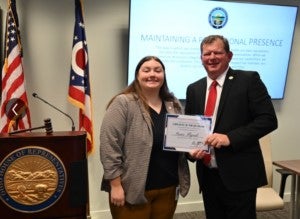
Grace’s journey shows that a combination of relevant education, practical experience through fellowships and political campaigns, and a passion for public service can lead to rewarding positions in the legislature.
Photos from Rep. Santucci’s Instagram account: https://www.instagram.com/p/CoNJhMBN8jI/ and Grace Flajnik’s LinkedIn account.
Fred Moore (Republican) has earned experience at both the state and federal levels since earning his BA from John Carroll and his MPA from CSU. He began as a legislative aide for Ohio Representative Andrea White. He then served as a legislative affairs assistant in Governor Mike DeWine’s office.
Fred later transitioned to Washington, D.C., where he worked as a staff assistant for U.S. Representative French Hill of Arkansas, a member of the House Financial Services Committee. Today, Fred is a committee staffer for Chairman Tim Scott (R, South Carolina) on the U.S. Senate Committee on Banking, Housing, and Urban Affairs.

State Senator Nickie Antonio (Democrat) is a prominent figure in Ohio politics, known for her dedication to equity and public service. She represents the 23rd District, which includes parts of Cuyahoga County.
She earned her Bachelor’s degree from Cleveland State University and later a Master’s degree in Public Administration from the Maxine Goodman Levin School of Urban Affairs at CSU, where she developed her passion for urban planning and community development. It was during the Columbus Seminarcourse for her MPA program at CSU that she first realized she could be a state senator.
Before her tenure in the Ohio Senate, Antonio served as a state representative and on the Lakewood City Council, where she worked tirelessly to improve the community and address local issues. Her leadership skills and dedication to her constituents earned her a reputation as a proactive and compassionate public servant. As a council member, she focused on economic development, public safety, and social services, making significant contributions to the city’s growth and welfare.
Reference: https://ohiosenate.gov/members/nickie-j-antonio/biography
Congressman Max Miller (Republican), a CSU alumnus, is building a career in politics and government. He first worked on President Donald Trump’s 2016 campaign and later served in the administration as a special assistant to the president. Concurrently, Miller was a member of the Marine Corps Reserves until 2019.
In 2022, Miller returned to Northeast Ohio, where he resides in Rocky River, and was elected to the U.S. House of Representatives. Since taking office, his legislative priorities include issues related to national security, veterans’ affairs, and economic development in Northeast Ohio. Miller’s background in both the military and the executive branch informs his approach to policymaking, aiming to address the needs of his district while contributing to broader national discussions.
References
https://en.wikipedia.org/wiki/Max_Miller_(politician)
Compensation for those working in legislative roles can vary widely depending on the position and level of government. Members of Congress generally earn a salary of around $174,000 per year, with leadership positions like the Speaker of the House or Senate Majority Leader earning more.
In the Ohio General Assembly, members earn a base salary of around $68,000 per year. This compensation is for their work as state legislators, which includes creating laws, voting on legislation, and serving their constituents.
Leadership positions, such as the Speaker of the House or Senate President, typically earn more due to the additional responsibilities. Legislative aides in Ohio also have varying salaries based on their role and experience.
Entry-level positions might start around $30,000 to $40,000 per year, while more experienced aides can earn higher salaries, reflecting their responsibilities and expertise.
While the salaries might not always match those in the private sector, working in a legislative role offers several non-monetary benefits. Job satisfaction is a significant perk, as these roles allow individuals to directly influence policy and impact public life.
Additionally, legislative positions provide opportunities to build valuable networks and gain influence, which can be beneficial for future career advancements. The experience and skills developed in these roles—such as understanding the legislative process, conducting policy analysis, and honing strategic communication—offer considerable professional development. These roles often serve as important stepping stones to higher positions within government or related fields, making the experience itself a valuable benefit.
Vocation refers to a person’s main occupation or career, often one that requires significant dedication and is considered a calling. Avocation, on the other hand, is an activity someone engages in outside of their primary job, typically as a hobby or secondary interest, which may also be pursued with passion but does not require full-time commitment.
Full-Time Commitment (Vocation)
Pursuing a full-time career as an elected official or legislative aide in Congress or state legislatures requires significant dedication. The demands are high, often involving long hours, constant communication with constituents, and the pressure to make decisions that can impact thousands, or even millions, of people.
Elected officials and their aides must be prepared to make sacrifices, including time away from family and personal interests, to meet the responsibilities of their roles. However, the rewards can be substantial. Those who commit themselves fully to legislative work often find deep fulfillment in shaping policies, advocating for their communities, and making a tangible difference in the lives of others. The impact of their work can be felt not just in their immediate districts, but also on a broader scale, contributing to the governance and direction of the country or state.
Part-Time Involvement (Avocation)
For those who cannot commit to a full-time role in the legislative process, there are still many ways to contribute. Volunteering on political campaigns or engaging in advocacy work and unpaid lobbying are all meaningful ways to get involved without making it a full-time career.
These roles allow individuals to support the legislative process, influence policy, and stay engaged in public service, all while maintaining other professional or personal commitments. Part-time involvement can also be a stepping stone to greater roles in public service, providing valuable experience and insights into how government works.
Balancing Public Service with Other Life Goals
Balancing a commitment to legislative service with other life goals can be challenging, but it is possible. Many professionals manage to maintain careers in other fields, such as law, business, or education, while actively participating in legislative public service. For example, some individuals work full-time in their chosen profession and volunteer on political campaigns or engage in advocacy and unpaid lobbying efforts in their spare time. This approach allows them to pursue their passion for public service without sacrificing their career or personal life. By setting clear priorities and managing their time effectively, these professionals contribute to their communities and the legislative process while continuing to advance in their primary careers.
Fundraising
One of the most significant challenges in pursuing a legislative career today is the necessity of fundraising. The costs of running for federal or state elected office have skyrocketed in recent years, which makes fundraising an essential part of any campaign. Candidates must raise substantial amounts of money to cover expenses like advertising, travel, staff salaries, and more. Costs will only get more expensive moving forward.
This financial pressure often forces candidates to spend a significant portion of their time seeking donations and support from individuals, political action committees (PACs), and other organizations. The increasing costs can be a barrier for many potential candidates, particularly those who are not independently wealthy or lack established networks of donors.
If you’re interested in learning more, watch this Last Week Tonight episode on Congressional fundraising.
YouTube URL: https://www.youtube.com/watch?v=Ylomy1Aw9Hk
Duration: 21:24
Polarization & Partisanship
Entering a legislative career today also means navigating an increasingly hostile and uncivil work environment. The political climate has become more polarized, which leads to heightened tensions and less collaboration among lawmakers. Disagreements over policy are often more intense, and personal attacks have become more common, both in public and behind the scenes.
How Polarization and Partisanship Shape Politics
Polarization and partisanship both shape how government works and often limit opportunities for compromise. Polarization is the widening divide between political parties and their supporters, where people cluster at opposite ends of the political spectrum and grow less willing to find common ground. Partisanship refers to strong loyalty to one political party, which can guide how people vote, how lawmakers make decisions, and how debates are framed. When polarization deepens and partisanship hardens, elected officials face pressure to stick with their party’s position instead of working across the aisle, which makes it harder to solve problems together.
This environment can be challenging for anyone considering a career in public service, as it requires not only thick skin but also a strong commitment to working through conflicts and finding common ground. Despite these challenges, those who choose to pursue a legislative career can still find opportunities to make a positive impact, though it may require more resilience and determination than in the past.
Harassment & Political Violence
Being a politician or working as a staffer increasingly involves dealing with online harassment, including threats and public shaming on social media. Elected officials also are experience more direct forms of abuse.
For a better understanding of the impact of abuse, you can watch this video:
YouTube URL: https://www.youtube.com/watch?v=u_pjO_5grDw
Duration: 7:58
The video was produced by the Brennan Center for Justice, which is a nonpartisan law and policy institute based at New York University School of Law.
Technology
Technology is changing the profession in several ways. For one, digital communication tools, such as social media, allow legislators to connect with constituents more directly and frequently than ever before. This increased connectivity can be both a blessing and a challenge, as it requires legislators and their aides to manage constant communication and respond quickly to public concerns.
Additionally, technology is streamlining the legislative process itself. Digital platforms now allow for the easier drafting, tracking, and amending of legislation, which make the process more efficient. However, this also means that legislative aides and officials must be adept at using these tools and staying updated on the latest technological advancements.
Finally, technology is changing how campaigns are run, with data analytics playing a larger role in targeting voters and shaping campaign strategies. As technology continues to evolve, those in the legislative profession will need to adapt to new tools and methods to remain effective and relevant.
AI Policy
Another instance of technology affecting the future is the rise of artificial intelligence (AI). It and other technological advances pose both significant opportunities and risks for society. AI has the potential to revolutionize industries, but it also raises concerns about privacy, job displacement, and ethical decision-making.
As these technologies continue to develop, federal and state lawmakers must stay on top of these changes and ensure that the tech industry is regulated in a way that protects the public good. This includes creating laws and policies that address issues like data security, algorithmic bias, and the ethical use of AI. Legislators will need to balance fostering innovation with safeguarding the rights and well-being of citizens, making it crucial for those in the profession to be informed and proactive in this rapidly changing landscape.
Before committing to a career in Congress or a state legislature, it’s important to take a step back and reflect on whether this path aligns with your values and long-term goals.
Consider what motivates you—are you passionate about public service and making a difference in your community? Do you have the resilience to handle the challenges of a political environment, including long hours, public scrutiny, and the need for compromise?
It’s also essential to think about your personal values and whether they align with the demands of a legislative career. If you value public service and the ability to influence policy, a career in Congress or a state legislature could be a fulfilling choice. However, it’s important to be honest with yourself about the sacrifices required and whether this career path will bring you the satisfaction and impact you seek in your professional life.
This chapter has explored the critical roles and responsibilities of elected officials and legislative aides in both Congress and state legislatures. As you reflect on these roles, consider how your own values and goals align with a potential career in this challenging work environment.
This textbook is a work in progress. Check back for content.
In this textbook, we focus on the parts of the private sector that most directly contribute to the public good. Students will learn about corporate social responsibility, environmental sustainability, and social entrepreneurship, and how these areas create opportunities to align profit with purpose. The goal is to show how careers in business can support both economic growth and community well-being.
What do we mean by the private sector?
The private sector includes businesses owned and operated by individuals, families, or groups—not by government or nonprofits. These companies create goods or offer services for customers and make their own decisions about how to operate. Private-sector organizations influence employment, investment, and the availability of products and services in communities.
When we talk about companies and businesses, we are usually referring to the same thing. A company or business is an organization that sells products or services, hires workers, and seeks to earn a profit. Businesses can take many forms: large corporations that operate internationally, firms that focus on a single region, or small shops owned by one person.
The private sector is different from the public sector, which includes government agencies funded by tax dollars, and the nonprofit sector, which includes organizations that use donations or grants to serve communities rather than earn profits.
Private enterprise has long been a source of economic prosperity in the United States. Businesses generate wealth that supports wages and gives people choices in the goods and services they use every day. This prosperity has created a historically-high standard of living.
In this textbook, we highlight the areas where the private sector most clearly intersects with the public good: corporate social responsibility, environmental sustainability, and social entrepreneurship. While the private sector as a whole is vital to the economy and to maintaining high standards of living, most business activity is centered on profit-making and shareholder return. Those functions are important, but they fall outside the scope of a book that is designed to help students understand careers in public service.
By focusing on these three areas, we can show how private organizations contribute to the broader public good in ways that go beyond their core profit-making activities.
These three topics offer students a clear lens for understanding where the values of public service and the objectives of private business align. They also highlight a set of career opportunities for students who want to work in the private sector while advancing the public good.
Why We Focus Here
This textbook highlights the ways the private sector contributes directly to the public good through corporate social responsibility, environmental sustainability, and social entrepreneurship. While all businesses drive economic growth and raise living standards, most private-sector activity is focused on profit and shareholder return. Our emphasis is on the areas where business values overlap most clearly with public service values.
By studying these three topics, students can see how companies:
These focus areas also showcase where meaningful career opportunities exist for students who want to contribute to society while working in the private sector.
Some of the ideas in this chapter may be controversial. Terms like corporate social responsibility and environmental sustainability have become politically charged in recent years. Critics question whether businesses should engage in efforts that go beyond their traditional role of maximizing profit for shareholders.
But the idea that businesses have broader responsibilities is not limited to one political perspective.
President Donald Trump, for example, has often calls on companies to act in the national interest by keeping jobs in the United States. He encourages businesses to reshore manufacturing and invest in American workers. While these appeals were often framed as part of an “America First” economic strategy, they reflect the broader idea that companies have responsibilities beyond profit.
This textbook is not calling for government intervention. We are exploring real-world strategies that private companies have adopted on their own. These are voluntary choices made by businesses that believe such actions can reduce risk, improve reputation, attract talent, meet customer expectations, or lead to long-term profitability.
In a free country, companies are allowed to act based on what they think is best. If they believe they can make or save money through these strategies, they have the freedom to pursue them. If executives, their boards or other entrepreneurs choose to act based on moral conviction, that is also within their rights.
Businesses make decisions every day based on values, long-term goals, and market pressures. If those decisions also help communities or the environment, then they are worth studying. Not because they are required, but because they reflect what is already happening in the private sector.
Pushback Against Corporate Social Responsibility
Some companies and states have recently moved away from CSR practices. A number of states have passed laws that limit or ban the use of CSR considerations in government investing, contracting, or procurement. These laws restrict public agencies from working with firms that incorporate social or environmental goals, especially when those goals are viewed as conflicting with state economic priorities.
For example, Texas pulled $8.5 billion in public school funds from BlackRock because state leaders argued the firm’s investment approach did not align with Texas’s support for the oil and gas industry.
If you’re interested, read this Reuters article: https://www.reuters.com/sustainability/sustainable-finance-reporting/texas-schools-fund-pulls-85-billion-blackrock-over-esg-policies-2024-03-19/
After facing additional political and regulatory pressure, BlackRock left a major climate-focused investor coalition.
If you’re interested, read this Reuters article: https://www.reuters.com/sustainability/blackrock-quits-climate-group-wall-streets-latest-environmental-step-back-2025-01-09/
These actions show that CSR commitments are becoming more contested. For students preparing for public service, this shift illustrates how political context can influence whether companies engage—or disengage—from broader community and social responsibilities.
The private sector creates wealth, jobs, and innovations that raise living standards. Some businesses contribute to society even more through other initiatives. These areas show how careers in business can align with public service values and help build stronger communities.
Corporate social responsibility (CSR) is the idea that businesses consider social and environmental concerns in their operations and relationships. It goes beyond profit-making by promoting ethical behavior, fair labor practices, and other positive contributions to society.
By engaging with employees, customers, and communities in responsible ways, companies can build trust, strengthen their reputation, and support long-term success. This chapter focuses on the social side of CSR, including labor standards and community engagement. The next chapter turns to the environmental dimension, examining how businesses reduce their ecological impact and promote sustainability.
Walmart’s past business decisions show what can happen when a company focuses only on profit for its shareholders. To keep prices low and increase earnings, Walmart pushed its suppliers to cut costs. Many companies moved their manufacturing overseas to meet Walmart’s demands.
One example is Rubbermaid, a once Ohio-based company. When the cost of materials went up, Walmart refused to accept higher prices. Instead, it bought cheaper versions of Rubbermaid’s products from suppliers in China. As a result, Rubbermaid lost business, and closed its Ohio factories.
These decisions hurt workers, local communities, and longtime suppliers. At the same time, customers benefited. Lower prices made Walmart a favorite for many shoppers, especially those with limited income. This shows how one group of stakeholders can gain while others lose.
The bigger question is how to balance these interests. Should businesses only serve shareholders, or should they also consider their employees, suppliers, customers, and communities? Obviously, businesses need to make a profit. They need to maintain their competitive advantage over competitors. But the idea of social responsibility encourages companies to think beyond profit and make choices that help more people.
If you’d like to learn more, watch this 2004 documentary by PBS Frontline entitled Is Wal-Mart Good for America?
YouTube URL: https://www.youtube.com/watch?v=n224P8snMkA
Duration: 54:56
Corporate social responsibility (CSR) involves several important components that help businesses operate in a way that benefits society and the environment.
One key component is ethical labor practices, which ensure fair labor standards and safe working conditions. Companies must treat their employees fairly by paying fair wages, providing safe work environments, and respecting workers’ rights. Additionally, promoting diversity, equity, and inclusion within the workplace is essential. This means valuing and respecting differences among employees and ensuring everyone has equal opportunities regardless of their background.
Another critical aspect of CSR is community engagement. Businesses can significantly impact local communities by supporting them through various initiatives, such as sponsoring local events, supporting small businesses, and collaborating with community organizations. Investing in education, health, and community development programs is also crucial. Companies can provide scholarships, fund health initiatives, and support projects that improve local infrastructure, thereby contributing to the overall well-being of the community.
Environmental sustainability is also a vital component of CSR. Companies need to adopt practices that reduce their environmental footprint, such as minimizing waste, conserving resources, and reducing pollution. Using renewable energy sources, like solar or wind power, helps decrease reliance on fossil fuels and lowers greenhouse gas emissions, which is essential for protecting the environment and promoting long-term sustainability.
Lastly, ethical business practices are fundamental to CSR. Maintaining transparency and accountability means companies should be open about their operations and decisions and take responsibility for their actions and their outcomes. Ensuring compliance with laws and regulations is also critical. By following all relevant laws and operating ethically, companies can maintain the trust of their stakeholders and contribute positively to society.
Implementing corporate social responsibility (CSR) initiatives provides numerous advantages for businesses. Here are some key benefits:
Enhanced Reputation & Brand Loyalty
One of the main benefits of CSR is the enhancement of a company’s reputation and the loyalty of its brand. By engaging in ethical practices and contributing positively to society, companies build trust and foster positive relationships with their stakeholders, including customers, employees, and the community. This trust can lead to increased customer loyalty, as consumers are more likely to support businesses that align with their values.
Increased Employee Engagement & Retention
CSR initiatives also lead to higher employee engagement and retention. When companies create a positive work environment and show a commitment to social and environmental responsibility, employees are more likely to feel proud and motivated to work there. This sense of purpose and well-being can increase job satisfaction and reduce turnover rates, as employees prefer to stay with companies that reflect their values.
Long-Term Financial Performance
Lastly, CSR can contribute to long-term financial performance. By adopting ethical practices and focusing on sustainability, businesses can achieve sustainable growth and success. Ethical practices can lead to cost savings, such as through energy efficiency and waste reduction, and can also mitigate risks associated with legal issues or reputational damage. Companies that prioritize CSR are better positioned for long-term success and resilience in a changing market.
Child labor is defined as the employment of children in work that deprives them of their childhood, potential, and dignity, and is harmful to their physical and mental development. It is a major social problem that affects millions of children worldwide, often forcing them to work in hazardous conditions for long hours and little pay. This practice not only violates basic human rights but also impedes children’s access to education, thereby perpetuating cycles of poverty and limiting future opportunities for economic advancement.
Child labor is prevalent in various industries, including agriculture, manufacturing, mining, and services, and is driven by factors such as economic hardship, lack of education, and inadequate labor laws. Addressing this issue requires comprehensive strategies, including stronger regulations, enforcement of labor standards, access to education, and socio-economic support for affected families.
Watch this video posted by the newspaper, the Toronto Star:
YouTube URL: https://www.youtube.com/watch?v=afpiUBMZZtY
Duration: 2:15
At one point, Nike’s supply chain was riddled with products made by child labor. A supply chain encompasses the entire process of producing and delivering a product, from the initial gathering of raw materials to the final delivery to the consumer. In Nike’s case, child labor was found at various stages, including sewing and assembling products, as well as packaging and preparing them for shipment.
As reports of child labor within Nike’s supply chain became public, the company faced significant pressure to reform. Initially, Nike was criticized for its lack of oversight and the poor working conditions in factories producing its products. In response, Nike undertook several measures to eliminate child labor and improve conditions across its supply chain:
Transparency – Nike began by disclosing the names and locations of its factories, a move aimed at increasing transparency and accountability. This allowed external parties to monitor and verify labor practices.
Code of Conduct – Nike revised its factory code of conduct to include stricter labor standards. This code was enforced across all supplier factories and included provisions against child labor, forced labor, and unfair wages.
Independent Audits – Nike hired independent auditing firms to conduct regular safety and labor condition checks. These audits helped identify and address violations in real-time.
Internal Monitoring – Nike established its own team to conduct frequent and unannounced inspections of supplier factories to ensure compliance with its labor standards.
Remediation Programs – Nike developed programs to support the transition of child workers to school, providing education and support for affected children and their families.
Supplier Training – Nike implemented training programs for suppliers to educate them about labor standards, ethical practices, and the importance of compliance with international labor laws.
Partnerships – Nike partnered with various non-governmental organizations (NGOs) and industry groups to promote better labor practices and to develop industry-wide standards against child labor.
These actions represented a significant shift in Nike’s approach to managing its supply chain and addressing labor issues. While challenges remain, these measures have helped Nike make substantial progress in eliminating child labor and improving working conditions in its supply chain.
Here are some other notable examples of companies that have successfully implemented corporate social responsibility (CSR) initiatives:
Patagonia’s Ethical Labor Practices
Patagonia is renowned for its dedication to fair labor practices and community engagement efforts. The company ensures that all employees work in safe conditions and receive fair wages. Patagonia is also deeply committed to community engagement, supporting various environmental causes and donating a percentage of its profits to grassroots environmental groups. These efforts highlight how Patagonia integrates ethical labor standards and community involvement into its business model.
IKEA’s Environmental Sustainability Initiatives
IKEA has made significant investments in environmental sustainability through its renewable energy and sustainable sourcing initiatives. The company aims to produce as much renewable energy as it consumes, with many stores equipped with solar panels. IKEA is also committed to using sustainably sourced materials, such as cotton and wood, to reduce its environmental footprint. These efforts demonstrate IKEA’s commitment to reducing its impact on the planet and promoting sustainable practices.
Unilever’s Sustainable Living Plan
Unilever’s Sustainable Living Plan shows how a company can balance making money with being socially and environmentally responsible. The plan aims to grow the business without increasing its negative impact on the environment. Unilever focuses on reducing waste, conserving resources, and improving social conditions while still achieving strong financial performance. This case study illustrates that businesses can successfully integrate CSR into their operations and maintain profitability.
Diversity, equity, and inclusion (DEI) refers to efforts by organizations to create fair, welcoming, and representative workplaces and communities. Diversity emphasizes the presence of differences among people, including race, gender, age, disability status, sexual orientation, and cultural background. Equity involves ensuring fair treatment and access to opportunities by addressing barriers that disadvantage certain groups. Inclusion focuses on building environments where individuals feel respected, supported, and able to contribute fully.
Connection to CSR
DEI is often considered part of CSR. Just as CSR asks companies to reduce environmental impact, invest in local communities, and act responsibly toward stakeholders, DEI requires organizations to examine how they treat employees, customers, and people who live in the areas they serve. Many employers see DEI as a way to create fairer workplaces, strengthen teams, and improve decision-making by bringing in a wider set of perspectives and experiences.
For some businesses, DEI and CSR strategies are carried out together. For example:
These efforts extend beyond internal hiring goals. They reflect a broader belief that responsible business practices include how companies contribute to the economic and social health of the communities where they operate, not just their bottom line.
Political Backlash & Policy Changes
While DEI programs have expanded over the past two decades, they also face substantial criticism. Some opponents argue that DEI efforts go beyond the proper role of business or give certain groups an unfair advantage. This backlash has led to a wave of legal and policy changes across states and at the federal level.
Several states have passed laws that limit or ban DEI offices, restrict certain types of training, or narrow the ability of public institutions to gather and use data related to diversity. These laws commonly prohibit mandatory training or the use of public funds to support DEI staff. At the federal level, recent executive actions have tightened what agencies and federal contractors may include in hiring practices or staff development. Taken together, these actions show how divided policymakers remain on the question of whether organizations should address issues tied to diversity and equity.
When Some View DEI as Going Too Far
A common example used by critics to portray DEI as extreme involves mandatory training sessions that ask employees to participate in activities they find uncomfortable or overly personal. In some organizations, outside consultants have led exercises that require employees to sort themselves by racial identity or speak about their own “privilege” in front of coworkers. Supporters saw these activities as opportunities for reflection; opponents argued the methods were inappropriate because they asked people to share sensitive information, made some feel singled out, and created pressure to agree with ideas they did not fully support.
Outlook
For companies, the future of DEI is mixed. In some industries, DEI continues to be woven into hiring, retention, and community engagement strategies. Other organizations are scaling back or reshaping their programs to comply with new laws or sidestep political controversy, sometimes replacing formal DEI efforts with broader leadership or workplace-culture training.
For students preparing for CSR-related careers, it is important to recognize both the possibilities and the limits. DEI will continue to evolve, and it will remain part of how many organizations think about fairness, representation, and their responsibilities to the communities they serve.
When companies adopt CSR policies, they take on both opportunities and risks. Here are some of the key risks:
Higher Costs
Implementing CSR programs often requires significant investment in areas such as sustainability, community engagement, or employee benefits. These costs may reduce short-term profits, which can create tension with shareholders focused mainly on financial returns.
Accusations of “Greenwashing” or “Woke Capitalism”
Greenwashing refers to a company presenting itself as environmentally responsible while its actual practices do not match those claims. This can involve exaggerated marketing or misleading labels that make products or policies seem more sustainable than they are.
Woke capitalism is a term used by critics to describe companies that take public positions on social or political issues as part of their branding. Supporters see these actions as part of corporate responsibility, while opponents view them as counter to their own political views, insincere, or distracting from a company’s core mission.
Either perception can harm a company’s reputation if stakeholders believe the efforts lack substance or authenticity.
Competitive Disadvantage
Companies that raise wages, improve benefits, or adopt stricter environmental practices might face higher operating costs than competitors who do not make the same commitments. In highly competitive industries, this can make it harder to compete on price.
Legal Risks
Public commitments to CSR can create legal obligations. For example, if a company pledges to reduce emissions or improve labor standards but fails to meet those goals, it could face lawsuits, or loss of consumer trust.
Stakeholder Expectations
Once a company commits to CSR, employees, customers, and the public expect it to follow through. Falling short of those expectations can damage credibility and trust more than if no promises had been made in the first place.
CSR efforts depend on contributions from professionals across many disciplines. While titles like “CSR Manager” exist, most people working in this field apply training from their primary profession to advance a company’s social or environmental commitments.
Accountants and Financial Analysts – These professionals measure and report on a company’s CSR performance. They track sustainability metrics, evaluate the financial impact of environmental and social programs, and ensure compliance with evolving reporting standards such as ESG (environmental, social, and governance) disclosures. ESG refers to a framework used by investors, regulators, and stakeholders to assess how responsibly a company operates in three areas: its impact on the environment, its relationships with employees, customers, and communities, and the quality of its internal governance and accountability practices.
Engineers – Engineers play a direct role in reducing environmental impact by designing cleaner technologies, energy-efficient systems, and safer production processes. For example, mechanical engineers may develop energy-saving equipment, while environmental engineers focus on waste treatment, air quality, or renewable energy systems.
Architects and Designers – These roles influence how products, buildings, and spaces reduce harm to the environment. Architects incorporate green building standards such as LEED, while product designers may use recyclable or sustainable materials. Their decisions shape how responsibly a company interacts with its surroundings.
Human Resources Specialists – HR professionals integrate CSR into workplace culture by advancing fair labor practices, diversity and inclusion, and employee volunteer programs. They help align internal policies with broader social responsibility goals.
Lawyers and Compliance Officers – Legal professionals ensure companies meet labor, environmental, and ethical standards. They guide organizations through regulatory requirements and help craft policies that protect workers, communities, and the environment.
CSR Managers and Sustainability Leaders – Some companies employ dedicated managers or executives responsible for CSR strategy. These leaders coordinate across departments, set measurable goals, and ensure the organization’s practices align with stated commitments.
Ethical Standards & Dilemmas
Ideally, ethics guide corporate social responsibility (CSR) practices. Key ethical standards that shape CSR include transparency, accountability, and sustainability.
Real-world examples highlight the ethical challenges companies face. For example, sourcing materials from suppliers in developing countries often raises questions about fair labor practices while keeping costs low.
A well-known case is Apple’s response to reports of excessive overtime, unsafe working conditions, and low wages in its supplier factories. Apple addressed these problems by introducing strict supplier codes of conduct, increasing oversight, and working to improve conditions across its supply chain.
Another example is the challenge of greenwashing, where companies exaggerate or falsely claim their products or practices are environmentally friendly. This was seen in the case of Volkswagen’s emissions scandal, where the company falsely marketed its cars as low-emission. Volkswagen faced significant backlash and legal consequences.
Promoting Ethical Practices
Compliance officers promote ethical practices within companies. They work to ensure that the company adheres to relevant laws and regulations. Compliance officers monitor the company’s activities, conduct regular audits, and provide training to employees on ethical standards and practices.
By maintaining high ethical standards and addressing challenges transparently, companies can build trust with their stakeholders and contribute positively to society. Promoting ethical practices not only enhances a company’s reputation but also ensures long-term success and sustainability.
Compensation in public service and CSR varies significantly by discipline and level of responsibility. Most roles track closely with broader industry salary norms, enriched by emerging sustainability demands.
Accountants specializing in sustainability or ESG reporting typically align with standard accounting salaries. In general, accountants earn a median salary around $79,900, with those holding certifications like CMA or CPA earning more. In sustainability-specific roles, entry-level Sustainability Analysts earn between $52,000 and $88,000, while senior roles may reach $136,000 or more.
Sustainability specialists or CSR professionals command median salaries near $89,000. With a bachelor’s degree, starting pay is typically around $54,500, rising to $63,700 for master’s-level candidates. With experience, total compensation can top $110,000.
CSR Managers and chief sustainability officers often earn between $85,000 and $120,000, with senior directors commanding between $150,000 and $250,000. Senior sustainability managers typically make $132,500 to $162,400.
Renewable Energy / Energy Engineers
Beyond base pay, most CSR-related roles include strong benefit packages—health insurance, retirement plans, paid leave, wellness benefits, and often support for volunteering or transit.
Corporate social responsibility (CSR) continues to evolve, but its future is shaped by both opportunities and growing skepticism. The rise of ESG (environmental, social, and governance) reporting has created a framework for measuring and communicating sustainability performance. Investors and regulators are paying close attention to ESG metrics, which creates pressure on companies to adopt responsible practices. At the same time, critics argue that ESG can be overly complex or politicized, which has fueled a conservative backlash against mandatory disclosures and certain social initiatives.
Changing Landscape
Despite the conservative backlash, demographic shifts and cultural expectations continue to push CSR forward, even as critics push back. Younger generations, particularly Millennials and Gen Z, expect the companies they work for and buy from to demonstrate a commitment to sustainability, diversity, and fairness. This creates strong incentives for businesses to adopt CSR practices.
However, political polarization in the United States has also led some companies to pull back on public commitments, especially around social issues such as diversity, equity, and inclusion (DEI). In some cases, businesses are rebranding or narrowing CSR programs to avoid backlash, which may signal a decline in highly visible initiatives.
Technology
Technology is another driver of change. Data analytics and blockchain tools allow for more accurate and transparent tracking of social and environmental outcomes. For example, blockchain can confirm whether raw materials were ethically sourced, and analytics platforms can measure carbon emissions or community impacts in real time. These tools enhance accountability but also require significant investment and technical expertise, which not every organization is ready to commit.
Future Roles and Opportunities
Despite these challenges, new professional roles are emerging. ESG analysts and sustainability technologists will likely remain in demand, especially in larger organizations and industries subject to regulation. Many companies will also continue to hire engineers, accountants, lawyers, and designers with specialized CSR knowledge to integrate responsibility into their core operations rather than treat it as a separate program. Cross-sector collaboration—between business, nonprofits, and government—will remain important, though its pace and scope may depend on political and economic conditions.
Outlook
The future of CSR is not guaranteed to be a steady expansion. While global challenges such as climate change and human rights create strong pressures for continued action, economic downturns and political backlash could slow progress or even reverse certain commitments. Professionals entering this field should be prepared for shifts in emphasis, from expansive CSR programs in some companies to scaled-back or restructured approaches in others. Still, for those with strong disciplinary skills and a commitment to social and environmental outcomes, CSR-related work will continue to offer meaningful career opportunities—even if its scope and visibility fluctuate over time.
As you consider a career in corporate social responsibility (CSR), it’s important to reflect on whether this path aligns with your interests, values, and long-term goals. Ask yourself what drives you. Are you passionate about making a positive impact on society and the environment? Do you value ethical practices and want to work for a company that prioritizes social and environmental responsibility? If so, a career in CSR might be a good fit for you.
Think about your long-term goals as well. Do you see yourself growing in a field that is constantly evolving and requires continuous learning and adaptation? CSR can offer a fulfilling and dynamic career, but it also comes with challenges.
Consider the potential negative impacts of working in CSR, such as stress and the risk of burnout. The pressure to meet high ethical standards and make meaningful changes can be intense. You might face difficult decisions and resistance from stakeholders who are more focused on profit than purpose. It’s important to evaluate whether you can manage these challenges and maintain your well-being.
To help you determine if a career in CSR is sustainable for you, consider your coping strategies and support systems. Are you good at managing stress and balancing work with personal life? Do you have a strong network of friends, family, or mentors to support you during tough times? Being realistic about these aspects can help you make an informed decision about pursuing a career in CSR.
Reflecting on these questions can guide you in evaluating whether a career in CSR aligns with your personal and professional aspirations. If you find that it does, you may be on the path to a rewarding and impactful career.
In this chapter, we explored the importance and impact of CSR. As you reflect on these points, consider how a career in CSR aligns with your values and aspirations, and whether it offers the fulfillment and impact you seek.
In the last chapter, we explored corporate social responsibility (CSR). One part of CSR is limiting the negative impact businesses have on the environment. This chapter expands on that idea by looking more closely at environmental sustainability in the private sector.
Environmental sustainability means operating in ways that protect natural resources and reduce environmental harm. In practice, this includes managing water, energy, and raw materials carefully, cutting waste, and recycling whenever possible. It also involves shifting to renewable energy sources such as wind and solar when efficient, and designing products that are environmentally friendly from production through disposal.
In this chapter, we will look at how businesses put these practices into action. We will see how companies are reducing their environmental footprint, what kinds of careers are connected to sustainability, and why these efforts matter for the future.
The concept of environmental sustainability in business has evolved significantly over time.
In the early 20th century, many businesses operated without considering their environmental impact. Factories often released pollutants into the air and water, and there were few regulations to control this. As industrialization grew, so did the negative effects on the environment, leading to serious problems such as air and water pollution.
What Is Environmental Degradation?
Environmental degradation refers to the decline in the quality of the natural environment caused by human activity. It happens when resources like air, water, and soil are damaged or depleted faster than they can recover. Examples include polluted rivers from factory waste, smog from burning coal, or deforestation that destroys wildlife habitats.
In the early 20th century, industrial growth often came at the expense of the environment, with little thought given to long-term consequences. Understanding environmental degradation is important because it highlights why sustainability practices are necessary to prevent further damage and protect resources for future generations.
In the 1960s and 1970s, awareness of environmental issues began to increase. The publication of Rachel Carson’s book Silent Spring in 1962 highlighted the dangers of pesticides, sparking public concern about environmental health. This period also saw the first Earth Day in 1970, which aimed to raise awareness about environmental protection. As a result, governments started to introduce laws to reduce pollution and protect natural resources. The U.S. Environmental Protection Agency (EPA) was established in 1970 under President Richard Nixon to enforce these laws.
The U.S. Environmental Protection Agency (EPA)
The U.S. Environmental Protection Agency (EPA) was created in 1970 to enforce laws that protect the environment and public health. The agency sets and enforces standards for clean air, safe drinking water, and the management of hazardous waste. It also oversees regulations that limit pollutants released by factories, vehicles, and other sources.
Protecting the environment is not only about preserving natural resources. It is also about protecting people. Polluted air can cause asthma and heart disease, while contaminated water can spread illness. By reducing pollution and promoting cleaner practices, the EPA helps safeguard both ecosystems and human health.
In the 1980s, the United Nations commissioned a study on the long-term impacts of environmental degradation on economic and social development. The Brundtland Commission’s 1987 report, “Our Common Future,” introduced the concept of sustainable development, emphasizing the integration of economic, social, and environmental considerations. The commission’s primary goal was to address the accelerating deterioration of the human environment and natural resources, and the consequences of that deterioration for economic and social development.
Their plan laid the groundwork for how businesses and other organizations perceived their responsibilities beyond mere profit generation, integrating broader social and environmental impacts into their strategic considerations. The Brundtland Commission Report, introduced the concept of sustainable development, defined as “development that meets the needs of the present without compromising the ability of future generations to meet their own needs.”
Businesses started to recognize the importance of sustainability. Companies began adopting practices to reduce waste and pollution. The idea of corporate social responsibility became popular, where businesses took responsibility for their impact on society and the environment. Many companies started to report on their environmental performance and set goals to improve it.
In the 21st century, the focus on environmental sustainability has become even more critical. Climate change, resource depletion, and pollution are major global challenges. Businesses are now expected to play a significant role in addressing these issues. This includes reducing greenhouse gas emissions, conserving water, and using sustainable materials. Many companies are also investing in clean energy technologies and developing products that are easier to recycle.
Today, being environmentally sustainable is not just about compliance with regulations; it is also about innovation and leadership. Companies that lead in sustainability often gain a competitive advantage. Consumers and investors are increasingly favoring businesses that are committed to protecting the environment. As a result, sustainability has become an integral part of business strategy, shaping how companies operate and grow in the modern world.
Reference
Gleeson-White, Jane. 2015. Six Capitals, or Can Accountants Save the Planet? Rethinking Capitalism for the Twenty-First Century. WW Norton & Company.
Many companies take intentional steps to operate more sustainably. Some focus on reducing the resources they use, while others redesign products or adopt cleaner technologies to cut waste and pollution. Together, these actions help protect natural systems and support a greener economy.
Reducing Energy Use
Companies lower their energy consumption through better building design, efficient lighting and equipment, and smart sensors that adjust heating and cooling. Using less energy reduces demand on natural resources and cuts pollution.
Switching to Renewable Energy
Many businesses now power their operations with solar, wind, or geothermal energy instead of fossil fuels. Some install solar panels on site; others purchase renewable energy through utility programs or renewable energy credits.
Careers in this area are growing. Solar photovoltaic technicians install and maintain solar panels on homes and commercial buildings. Wind turbine technicians and engineers keep wind farms operating and help design new projects. These jobs support the transition away from fossil fuels and help lower greenhouse gas emissions. Companies such as Tesla, First Solar, and GE Renewable Energy employ workers in these fields.
Net Zero
A growing number of companies have set net zero goals. Net zero means that the emissions a company produces are balanced by the amount removed from the atmosphere. Reaching this goal typically involves improving efficiency, using renewable energy, and offsetting what cannot be eliminated. For example, Unilever plans to reach net zero across its operations and supply chain by 2039.
This video from The Economist magazine explains how difficult it is to get to net zero.
YouTube URL: https://www.youtube.com/watch?v=aM31RyxSSCw
Duration: 7:20
Conserving Water
Industries use water-saving fixtures, recycle wastewater, and redesign production processes to use less water. Companies in agriculture and manufacturing often monitor water use carefully to prevent waste and protect local water supplies.
Sustainable Sourcing
Firms choose raw materials that are harvested or produced responsibly. Examples include using certified sustainable wood, ethically sourced minerals, or recycled materials instead of new ones.
Waste Reduction & Recycling
Companies reduce packaging, reuse materials, and recycle metal, paper, and plastics. Some move toward a circular economy model, where products are designed so parts can be repaired, reused, or remanufactured instead of thrown away. This approach reduces waste and conserves resources. In manufacturing, this means designing products that can be easily taken apart and repurposed, or using materials that can be continuously recycled without losing quality.
Watch this CNBC video in which they describe the circular economy as a make, use, and return model.
YouTube URL: https://www.youtube.com/watch?v=__0Spwj8DkM
Duration: 3:42
Careers in this area might include product designers and materials scientists who help companies implement circular economy principles. IKEA has committed to becoming a fully circular business by 2030, focusing on sustainable product design and resource efficiency.
Reducing Single-Use Plastics
Some companies have phased out disposable plastic items such as straws, bags, cups, packaging, and shipping materials. Some have switched to reusable or compostable alternatives, while others redesign products to eliminate the need for plastic packaging altogether. This helps keep plastics out of landfills, waterways, and the Great Lakes.
Plastic Pollution & the Great Lakes
Plastic pollution is one of the fastest-growing environmental challenges. Single-use plastics and microplastics often end up in rivers and lakes, where they break down slowly and harm wildlife. The Great Lakes, which provide drinking water for millions of people, are especially affected. Studies have found high concentrations of microplastics in these waters, showing how everyday waste can ripple through ecosystems and into human communities.
The documentary Ripples of Plastic highlights this issue by focusing on the Great Lakes region. The film shows how plastic waste moves through waterways, how it impacts fish and other wildlife, and how microplastics enter the food chain. It calls attention to the urgent need for better prevention, waste management, and public awareness.
Watch the trailer for the film.
YouTube URL: https://www.youtube.com/watch?v=rnY1dgl4qmU
Duration: 1:34
Careers in sustainability, waste management, and environmental education all play a role in tackling this problem and protecting the health of both people and ecosystems.
Additional Pollution Prevention
Beyond reducing energy use and plastics, companies also work to limit other forms of pollution. This may include switching to safer chemicals, upgrading equipment to prevent leaks or spills, and redesigning industrial processes to produce fewer hazardous byproducts. Some firms install filtration or scrubber systems to keep pollutants out of the air and water. Environmental compliance specialists monitor these efforts and ensure the company meets state and federal regulations.
Tracking & Reporting Environmental Impact
Many businesses measure their carbon footprint, water use, and waste generation. They publish sustainability reports so the public, investors, and regulators can see their progress.
Sustainable building construction focuses on designing and constructing buildings in ways that reduce their environmental impact and enhance their efficiency. This approach incorporates a variety of practices and technologies aimed at minimizing energy consumption, reducing waste, and utilizing eco-friendly materials.
Key elements of sustainable building include:
Examples of companies leading in sustainable building construction include Skanska, which incorporates green building practices into its projects worldwide, and Interface, known for its commitment to sustainability and creating environmentally friendly building materials. These companies demonstrate how sustainable building construction not only benefits the environment but also leads to healthier, more efficient, and more resilient structures.
Watch this PBS video on sustainable housing. Host Ari Wallach goes to Amsterdam to show a unique urban village.
PBS URL: https://www.pbs.org/video/the-future-of-sustainable-housing-j7s4qz/
Duration: 9:35
LEED accreditation is a globally recognized certification program that promotes sustainable building and design practices. LEED stands for Leadership in Energy and Environmental Design. Administered by the U.S. Green Building Council (USGBC), LEED sets rigorous standards for energy efficiency, water conservation, materials selection, and indoor environmental quality. Buildings can earn different levels of certification—Certified, Silver, Gold, and Platinum—based on their sustainability performance. For professionals, LEED offers credentials like the LEED Green Associate and LEED Accredited Professional (AP) to signify expertise in green building practices. Overall, LEED ensures buildings are designed and constructed to reduce environmental impact, lower costs, and create healthier spaces.
Retrofitting Existing Buildings for Energy Efficiency
Retrofitting existing buildings for energy efficiency involves upgrading systems and structures to reduce energy consumption and improve overall performance. This can include installing energy-efficient windows, adding insulation, updating heating, ventilation, and air conditioning (HVAC) systems, and integrating renewable energy sources like solar panels. Advanced lighting solutions, such as LED fixtures and smart lighting controls, can also significantly reduce energy use.
Watch this PBS News Hour report about a European effort to retrofit existing builders.
YouTube URL: https://www.youtube.com/watch?v=sLWttUxoYJI
Duration: 8:37
Additionally, retrofitting can involve sealing leaks and improving the building envelope to prevent energy loss. These improvements not only lower utility bills and reduce greenhouse gas emissions but also extend the life of the building. Importantly, retrofitting supports historic preservation projects by enhancing the energy efficiency of older buildings while maintaining their architectural integrity and cultural significance.
Another important part of environmental sustainability is sustainable agriculture. Environmental sustainability in agriculture involves adopting practices that protect the environment, conserve resources, and ensure long-term food security.
Watch this TED-Ed video on the farms of the future.
YouTubeURL: https://www.youtube.com/watch?v=xFqecEtdGZ0
Duration: 7:09
These practices not only reduce the environmental impact of agriculture but also promote the resilience and productivity of farming systems, ensuring that we can meet the food needs of future generations.
Urban agriculture, which involves growing food in city environments, is also a key part of sustainable agriculture. Practices like vertical farming and hydroponics allow for efficient use of space and resources.
Watch this WKYC Channel 3 story on urban agriculture in Cleveland’s Kinsman neighborhood.
YouTube URL: https://www.youtube.com/watch?v=HKQbO3-xiIo
Duration: 2:55
Learn more about the Rid-All organizations here.
This CBS Sunday Morning story shows vertical farming practices.
YouTube URL: https://www.youtube.com/watch?v=EGd8-_0CpEA
Duration: 3:50
These practices and businesses demonstrate how sustainable agriculture can thrive both in rural and urban settings, contributing to a healthier planet and more resilient food systems.
Based on the key areas we’ve covered in environmental sustainability, here are several career options to pursue:
Sustainable Agriculture Specialist – Work with agricultural businesses to implement practices that conserve resources, enhance soil health, and reduce environmental impact. They advise on techniques such as crop rotation, organic farming, and integrated pest management to promote sustainable food production. Examples include working for companies like Gotham Greens or BrightFarms that focus on urban agriculture and hydroponics.
Renewable Energy Specialist – Focus on developing, implementing, and managing renewable energy projects like solar, wind, and geothermal power. These specialists work on designing efficient systems, managing installations, and ensuring that renewable energy projects meet regulatory standards and environmental goals. Notable companies in this field include Tesla and various solar energy firms.
Sustainability Consultant – Advise businesses on how to reduce their environmental footprint through sustainable practices and policies. They assess current operations, recommend improvements, and help companies implement strategies to become more eco-friendly and efficient. This role is crucial across various industries, including manufacturing and services.
Environmental Engineer – Design and implement solutions to environmental problems, such as pollution control and waste management systems. These engineers develop technologies and systems that minimize environmental impact and improve sustainability in industrial processes.
Sustainable Product Designer – Create products that use eco-friendly materials and processes, promoting a circular economy. They focus on designing products that are durable, recyclable, and made from renewable resources, reducing waste and environmental harm. Patagonia is a leading example, using recycled materials in its products and ensuring fair labor practices throughout its supply chain.
Energy Efficiency Analyst – Evaluate and improve energy usage in buildings and manufacturing processes to reduce waste and costs. They conduct energy audits, recommend efficiency upgrades, and monitor the performance of energy-saving measures to ensure optimal results. This role is vital in companies looking to reduce their carbon footprint and operating costs.
Environmental Compliance Specialist – Ensure that companies adhere to environmental laws and regulations, minimizing legal risks and promoting sustainability. They monitor compliance, conduct audits, and provide guidance on environmental best practices to help companies avoid fines and improve their environmental performance.
Green Building Architect – Design and construct buildings that are energy-efficient, use sustainable materials, and have minimal environmental impact. These architects incorporate green building practices such as passive solar design, water conservation, and the use of non-toxic materials. Leading companies in sustainable building construction include Skanska and Interface.
Supply Chain Sustainability Manager – Oversee the sourcing and procurement processes to ensure that materials and products are obtained sustainably. They work with suppliers to promote ethical practices, reduce resource consumption, and minimize the carbon footprint of the supply chain. This role is crucial in companies like IKEA, which has committed to becoming a fully circular business by 2030.
Retrofitting Specialist – Focus on upgrading existing buildings to improve their energy efficiency and environmental performance. This includes installing energy-efficient windows, updating HVAC systems, and integrating renewable energy sources. Retrofitting also supports historic preservation projects by enhancing the energy efficiency of older buildings while maintaining their architectural integrity.
As a CEO, business owner, or executive, you can emphasize environmental sustainability in your company’s mission and operations. By driving corporate strategy and decision-making processes that prioritize sustainability, you can make a significant impact not only within your organization but also in the broader market and community. This leadership approach ensures that businesses can thrive while protecting the planet for future generations.
Working in environmental sustainability offers numerous benefits but also comes with its challenges.
One major advantage is the opportunity to make a positive impact on the planet, which can lead to high job satisfaction and a sense of fulfillment. People can find their work meaningful as they contribute to solving or preventing environmental problems. Additionally, the growing demand for sustainability experts can provide job security and career growth opportunities.
However, there are challenges to consider as well. The field can be highly demanding, with potential stressors including tight deadlines, complex problem-solving, and the need to stay updated with constantly evolving regulations and technologies.
Work-life balance may be difficult to maintain, especially in roles that require extensive fieldwork or travel. Furthermore, sustainability professionals may face resistance from stakeholders who prioritize economic gains over environmental concerns.
One core ethical principle is the commitment to do no harm to the environment. Real-world examples highlight the ethical dilemmas faced in sustainability. For example, a company might encounter a situation where the cheapest method of waste disposal is harmful to the environment. Imagine a manufacturing firm for discharging pollutants into a local river.
Another example involves the dilemma of balancing economic development with environmental preservation. In the construction of a new infrastructure project, planners might be pressured to cut costs by bypassing environmental impact assessments. Ethically, they should resist such pressures.
Professional Development
In the field of sustainability, there are numerous opportunities for professional development. You can enhance your skills through various certifications, such as becoming a LEED Accredited Professional or obtaining a certification in energy management. Many universities and organizations offer continuing education courses in topics like renewable energy, sustainable agriculture, and environmental policy. Attending workshops, conferences, and seminars also helps you stay updated on the latest trends and technologies in sustainability, making you more valuable in your role.
Personal Fulfillment & Professional Accomplishment
Career growth in sustainability isn’t just about climbing the corporate ladder; it’s also about making a meaningful impact. Working on projects that help protect the environment and promote sustainable practices can be deeply fulfilling. Achieving personal satisfaction and a sense of accomplishment comes from knowing that your work contributes to a healthier planet. Whether you’re developing a new recycling program, designing energy-efficient buildings, or promoting clean energy solutions, the positive impact of your efforts can be a significant source of professional pride.
Leadership Opportunities
There are clear pathways to leadership roles within the field of sustainability. With experience and advanced skills, you can move into positions such as a sustainability manager, director of sustainability, or even a chief sustainability officer. These roles involve overseeing sustainability initiatives, developing strategic plans, and leading teams to achieve environmental goals. Leadership opportunities also exist in policymaking, where you can influence environmental regulations and standards. Building strong communication and management skills, along with your technical expertise, will prepare you for these advanced roles.
Emerging Trends & Technologies
The field of sustainability continues to change, shaped by both innovation and politics. Renewable energy technologies such as solar and wind power are becoming more efficient and affordable, and smart grid systems are modernizing how electricity is distributed. Advances in sustainable agriculture, including precision and vertical farming, are boosting food production while lowering environmental impact. Artificial intelligence and big data are also helping organizations measure and manage their environmental footprint more effectively, though they also require tremendous amounts of electricity.
Opportunities & Threats
These trends create opportunities but also bring new challenges. On the positive side, renewable energy, sustainable agriculture, and green building create jobs in engineering, project management, and design. Yet, political decisions directly affect the growth of these sectors.
Recent cuts to federal funding for alternative energy programs have slowed investment in certain business models, especially those that relied on government support. At the same time, rapid technological change requires workers to update their skills, and the production and disposal of new technologies, such as batteries for electric vehicles, raise environmental concerns of their own.
Demographic Shifts & Societal Expectations
Public expectations continue to drive demand for sustainability. Younger generations, in particular, favor companies and communities that adopt sustainable practices. However, U.S. policies vary widely depending on political leadership, which means regulatory environments can shift quickly. While some states and cities are pushing forward with aggressive climate and energy goals, others are scaling back requirements, creating uneven opportunities across the country.
Future Roles & Opportunities
Despite these challenges, careers in sustainability are expected to grow. Roles such as sustainability data analysts, renewable energy technologists, and urban sustainability planners remain in demand, but growth may depend on where funding and political support exist. Professionals who can adapt to changing regulations, diversify their skills, and balance environmental goals with financial realities will be best prepared for leadership. The ability to navigate political uncertainty is becoming just as important as technical expertise in shaping the future of this profession.
Politics and Sustainability Careers
Government policy has a direct impact on career opportunities in sustainability. Federal cuts to renewable energy funding can reduce demand for certain jobs, while state or local governments may expand opportunities through their own programs. Students interested in sustainability careers should pay close attention to political shifts, since policy changes can determine where jobs grow.
The future of profession has to deal with problems like fast fashion.
Fast fashion refers to a system where brands rapidly produce trendy clothing at affordable prices, initially seen with companies like H&M and Zara bringing runway trends to racks quickly. With the rise of e-commerce, this concept has been turbocharged, which has led to companies like Shein producing an astounding 1.5 million new styles annually, far outpacing traditional brands.
Fast fashion causes widespread environmental damage. It drives the mass production of cheap clothing, often designed for short-term use. Many of these garments are made from synthetic fabrics, which shed microplastics during washing and contribute to long-term pollution in rivers and oceans. The industry also uses vast amounts of water for cotton growing and fabric dyeing, and it depends on toxic chemicals that pollute rivers and soil in production regions. Because garments are made to be worn briefly and then discarded, millions of tons of clothing end up in landfills or are shipped abroad as waste each year.
This cycle of overproduction and overconsumption harms ecosystems, depletes natural resources, and adds to climate change through heavy energy use and greenhouse gas emissions.
Watch this video from Vox learn more.
YouTube URL: https://www.youtube.com/watch?v=VaS-iVwaOLw
Duration: 7:44
The video claims the fast fashion industry deliberately conceals the actual cost of items from consumers, including material and labor costs, the exploitation of workers, and the stunning amount of waste generated, with estimates of 92 million tons of clothing ending up in landfills each year. This deliberate lack of transparency also hides the fact that the quality of items has dropped, meaning they do not last as long.
If this topic interests you, watch this BBC documentary How Fast Fashion Is Destroying The Planet.
YouTube URL: https://www.youtube.com/watch?v=q3Zp0M7l3EQ
Duration: 57:14
Based on this chapter and the CSR chapter, consider what strategies companies might use to reduce this type of pollution.
Here’s a BBC report about recycling that might information our discussion.
YouTube URL: https://www.youtube.com/watch?v=7i0QMnz4ExY
Duration: 3:52
As you think about a career in sustainability, it’s important to reflect on whether this path matches your interests, values, and long-term goals. Consider what drives you and whether you are passionate about protecting the environment and promoting sustainable practices. A career in sustainability can be incredibly rewarding. However, it also requires a strong commitment and resilience, as you may face complex challenges and resistance from various stakeholders.
It’s also crucial to recognize the potential negative impacts of working in sustainability. The profession can be stressful, especially when dealing with tight deadlines, limited resources, and the need to stay updated with rapidly changing technologies and regulations. Public scrutiny is another factor to consider, as sustainability professionals often work in high-visibility roles where their decisions and actions are closely watched.
To decide if you can sustain a career in sustainability despite these challenges, take time to evaluate your strengths and weaknesses. Are you adaptable and able to handle pressure? Do you have strong problem-solving skills and a passion for continuous learning? Reflect on your ability to cope with stress and whether you can maintain a work-life balance in a demanding field. By carefully considering these factors, you can make a more informed decision about whether a career in sustainability is the right fit for you.
In this chapter, we’ve explored the fundamental concepts of environmental sustainability. Consider your passion for the environment, your commitment to making a positive impact, and whether you see yourself thriving in a field dedicated to creating a more sustainable future.
Social entrepreneurship is the practice of creating and running businesses that pursue both social impact and financial sustainability. Unlike traditional entrepreneurship, which focuses mainly on maximizing profit, social entrepreneurship begins with the goal of solving a social or environmental problem and uses business tools to achieve that mission. The purpose is to generate revenue while also producing measurable benefits for communities, such as reducing poverty, improving health, or promoting sustainability.
This approach shares some common ground with corporate social responsibility (CSR), but the two are not the same. CSR refers to established companies integrating social or environmental concerns into their operations, often as part of broader branding, compliance, or stakeholder relations. Social entrepreneurship places the social mission at the center of the enterprise. Profit is not the end goal but a means of sustaining and expanding the impact.
The idea has evolved over time. In the past, social problems were addressed mainly through charities or government programs. As these problems grew more complex, new approaches were needed. Social entrepreneurship developed as a way to combine the innovation and efficiency of business with the values of service and community improvement. Today it is recognized worldwide as a way to tackle urgent issues with sustainable, market-based solutions.
References
Barreiro, Terri D., and Melissa M. Stone. 2013. Social Entrepreneurship: From Issue to Viable Plan. Business Expert Press.
Gordon, Michael. 2019. Becoming a Social Entrepreneur: Starting Out, Scaling Up and Staying True. Routledge.
Social entrepreneurs and nonprofits both work to solve social problems, but they are not the same. Nonprofits rely mainly on donations, grants, and government funding to carry out their work, and any surplus revenue is reinvested in the mission rather than distributed as profit. Social entrepreneurs, by contrast, use business models to generate income, which makes them more self-sustaining and less dependent on outside funding.
The two approaches can overlap. A nonprofit may use social entrepreneurial strategies to strengthen its financial stability, while social entrepreneurs keep a distinct focus on financial viability alongside their social mission.
Social entrepreneurship addresses societal challenges and contributes to the public good through businesses known as social enterprises. A social enterprise is a company that prioritizes positive social or environmental outcomes alongside financial performance.
By combining business principles with a mission to solve social and environmental problems, social entrepreneurs create sustainable solutions that have a lasting positive impact on communities.
One prominent example is TOMS Shoes, founded by Blake Mycoskie. TOMS original operated on a “buy one, give one” model, where for every pair of shoes sold, another pair was donated to a child in need. This model provided millions of shoes to children in impoverished areas and also raised awareness about global poverty and inspired other companies to adopt similar business practices.
Watch this video on social entrepreneurs and TOMS.
YouTube URL: https://www.youtube.com/watch?v=XregtxLNj2k
Duration: 4:26
Reference
Gordon, Michael. 2019. Becoming a Social Entrepreneur: Starting Out, Scaling Up and Staying True. Routledge.
Northeast Ohio has social enterprises that show how business models can be used to address community issues in practical ways.
Rust Belt Riders is a Cleveland-based social enterprise that focuses on reducing food waste. They provide composting services for businesses, schools, and households, collecting food scraps and other organic material. Instead of sending this material to landfills, they process it into compost that supports local gardens and farms. Their work reduces the environmental impact of food waste while contributing to a stronger local food system.
Learn more about Rust Belt Riders by watching this Ideastream video.
YouTube URL: https://www.youtube.com/watch?v=04wsdSBunes
Duration: 3:13
Evergreen Cooperatives is a network of worker-owned businesses that aims to create stable jobs in low-income neighborhoods. Their ventures include a laundry service for hospitals and nursing homes, a solar installation and energy efficiency company, and a large urban greenhouse. By offering living-wage jobs and employee ownership, Evergreen helps residents build wealth while supporting environmentally sustainable practices.
Some Cleveland nonprofits exhibit social entrepreneurship strategies to generate revenue.
EDWINS Leadership & Restaurant Institute provides formerly incarcerated individuals with training in the culinary arts and hospitality industry. They raise a significant portion of their revenue from their fine dining French restaurant originally located in Cleveland and now in Cleveland Heights. The restaurant provides a real-world training environment for its students while generating income from diners. Their goal is to reduce recidivism and support reintegration into society through education and job training.
Watch founder Brandon Chrostowski share his idea about EDWINS.
YouTube URL: https://www.youtube.com/watch?v=_vSocdIKmpc
Duration: 7:07
You’ll hear EDWINS’ draws funding from a combination of restaurant revenue and private donations.
The Oscar-nominated 2018 documentary Knife Skills tells the story about Brandon and EDWINS first cohort of students. The film focuses less on business strategy and more on the personal journeys. So, you don’t have to watch the entire film. But it’s worth knowing this Cleveland story.
YouTube URL: https://www.youtube.com/watch?v=U7cW60vhP4Y
Duration: 39:53
Lucie Basch is the co-founder of Too Good To Go, a social enterpirse with a mission to reduce food waste. Too Good To Go connects consumers with surplus food from restaurants and stores at a discounted price. Their goal is to save food, reduce waste, and promote sustainable consumption.
Listen to how Lucy Basch built the business. Click the link below or access How I Built This with Guy Raz where ever you get your podcasts.
URL: https://muckrack.com/podcast/how-i-built-this/episodes/9793751-hibt-lab-too-good-to-go-lucie-basch/
Duration: 40:00
This podcast represents a significant portion of your work today. It’s worth a listen. Take time to learn more about social entrepreneurship through the Too Good to Go case.
To become a successful social entrepreneur, having the right educational background can be important. Many social entrepreneurs have degrees in business, social work, public administration, or related fields. These educational paths provide a solid foundation in understanding how to run a business and address social issues.
More importantly, social entrepreneurs need strong business acumen, including skills in management, finance, marketing, and operations, to successfully run and grow their businesses. Additionally, they must possess creativity and resilience to innovate, solve problems, and navigate challenges effectively. Soft skills like empathy, adaptability, and resilience are important. Empathy allows social entrepreneurs to understand and connect with the communities they serve, fostering trust and collaboration.
Reference
Barreiro, Terri D., and Melissa M. Stone. 2013. Social Entrepreneurship: From Issue to Viable Plan. Business Expert Press.
Gordon, Michael. 2019. Becoming a Social Entrepreneur: Starting Out, Scaling Up and Staying True. Routledge.
Choosing a career in social entrepreneurship comes with a unique set of benefits and challenges. One of the most significant benefits is the profound societal impact that social entrepreneurs can have. By addressing pressing social issues, they contribute to positive changes in communities and often experience a deep sense of personal fulfillment from their work. Additionally, while the primary goal is to create social value, successful social entrepreneurs can also achieve financial rewards, as their innovative solutions can attract investors and generate sustainable revenue streams.
However, social entrepreneurship is not without its challenges. Securing funding can be difficult, as social enterprises often rely on a mix of grants, donations, and revenue from their products or services. Market competition is another hurdle, with social entrepreneurs needing to distinguish their ventures in a crowded marketplace. Balancing social and financial goals can be complex, requiring careful management to ensure that the mission remains central while achieving financial sustainability.
Work-life balance can also be a concern for social entrepreneurs, as the demands of starting and running a social enterprise can be intense. The drive to make a significant impact can lead to long hours and high stress levels. Job satisfaction can be high due to the meaningful nature of the work, but the pressure to succeed and the challenges faced can also lead to burnout. Despite these potential stressors, many social entrepreneurs find the rewards of their work outweigh the difficulties, as they are driven by a passion to make a difference in the world.
Reference
Barreiro, Terri D., and Melissa M. Stone. 2013. Social Entrepreneurship: From Issue to Viable Plan. Business Expert Press.
Gordon, Michael. 2019. Becoming a Social Entrepreneur: Starting Out, Scaling Up and Staying True. Routledge.
Ethical standards in this field emphasize integrity, fairness, and respect for all stakeholders. Social entrepreneurs often face dilemmas where they must balance the needs of their beneficiaries with financial sustainability and organizational growth. These dilemmas can include decisions about sourcing materials, setting fair wages, and managing conflicts of interest.
Real-world examples of ethical challenges in social entrepreneurship illustrate the complexity of these decisions. For example, a social enterprise focused on providing affordable housing might face the ethical dilemma of choosing between using cheaper, less sustainable building materials to lower costs or investing in eco-friendly options that align with their environmental mission. In addressing such challenges, social entrepreneurs must weigh the immediate benefits against long-term impacts, striving to uphold their ethical commitments while ensuring the viability of their enterprise.
Transparency, accountability, and social responsibility are foundational principles for social enterprises. Transparency involves openly sharing information about the organization’s operations, financial status, and decision-making processes. This openness builds trust with stakeholders, including beneficiaries, employees, investors, and the broader community. Accountability means being responsible for the outcomes of the enterprise’s activities and being answerable to stakeholders for both successes and failures. Social responsibility involves actively contributing to the well-being of society and the environment, going beyond profit motives to prioritize the greater good.
By adhering to these ethical principles, social entrepreneurs can navigate the complexities of their work, make informed and fair decisions, and maintain the trust and support of their communities.
Reference
Barreiro, Terri D., and Melissa M. Stone. 2013. Social Entrepreneurship: From Issue to Viable Plan. Business Expert Press.
Opportunities for starting one’s own social enterprise are abundant for those with entrepreneurial spirit and a clear vision for addressing a social issue. Aspiring social entrepreneurs can begin by identifying a pressing need in their community or beyond, conducting thorough research to understand the problem, and developing a sustainable business model to address it. Resources such as incubators, accelerators, and social impact investors can provide support in the early stages of development. By leveraging their skills, networks, and dedication, individuals can create impactful social enterprises that drive meaningful change.
The future of social entrepreneurship is being shaped by a combination of technological, social, and economic forces. Advances in digital tools such as blockchain, artificial intelligence, mobile platforms, and data analytics are giving social entrepreneurs new ways to measure impact, reach customers, and manage operations. For example, mobile apps make it easier to connect people to services that reduce waste, expand access to health care, or promote fair trade. At the same time, data-driven methods are improving accountability and helping organizations demonstrate their outcomes to funders and partners.
These developments also bring challenges. Rapid changes in technology require constant adaptation, and smaller social enterprises may lack the resources to keep pace. There is also a risk of widening inequality if access to digital tools is limited by geography, income, or education. Social entrepreneurs will need to be intentional about addressing the digital divide so that their solutions remain accessible to the communities they aim to serve.
Beyond technology, demographic and cultural shifts are influencing the profession. Younger generations often look for work that aligns with their values, and many consumers now prefer to support businesses that demonstrate social and environmental responsibility. This is increasing the pressure on all companies, not just social enterprises, to adopt practices that promote diversity, equity, and inclusion. Social enterprises are well positioned to lead in this area, showing how business can respond to changing expectations around fairness and representation.
Global trends also point to growth in the sector. Climate change, migration, and public health challenges are creating new demands for entrepreneurial solutions that can scale across borders. International networks, impact investors, and social enterprise incubators are expanding, giving entrepreneurs more support to test ideas and grow sustainable models. However, as the sector expands, it will face greater scrutiny regarding transparency, ethics, and long-term effectiveness.
These broad shifts are visible in Northeast Ohio as well. Rust Belt Riders has begun to explore digital tools for tracking compost collection and measuring the environmental benefits of their work, which could eventually help connect customers more directly to impact data. Evergreen Cooperatives is looking to expand its model through partnerships that could be replicated in other cities, showing how local worker-ownership strategies can scale nationally. Meanwhile, local universities and foundations are supporting new social enterprises with incubators, seed funding, and mentorship, ensuring that the next generation of entrepreneurs has opportunities to test ideas.
Overall, social entrepreneurship is likely to become more visible and mainstream in the coming decades. The profession will continue to evolve as entrepreneurs respond to emerging problems with new ideas, balancing the opportunities and risks of innovation. Those entering the field will need flexibility, creativity, and a strong commitment to the communities they serve.
It’s important for you to reflect on whether a career in social entrepreneurship aligns with your interests, values, and long-term goals. Consider your passion for addressing social issues, your willingness to take on the risks and uncertainties of starting and running a social enterprise, and your capacity for enduring potential stress and public scrutiny.
While the work can be deeply fulfilling and impactful, it also comes with challenges that require resilience and adaptability. By honestly evaluating these factors, you can determine if you are well-suited for a career in social entrepreneurship and if you can sustain your commitment to creating social change despite the obstacles.
In this chapter, you explored the various aspects of social entrepreneurship. You are encouraged to reflect on how social entrepreneurship aligns with your values and career aspirations.
Note: This chapter is forthcoming. It will examine journalism’s role in democracy, from informing the public to exposing corruption.
In addition to careers at home, public service also extends across borders. Many students are drawn to opportunities that let them serve abroad. Opportunities include (a) protecting our national interests through military service, (b) representing the United States in the foreign service, and (c) working in international development, whether for a federal government agency or an international nongovernmental organization to address global challenges.
These paths demonstrate how government and nonprofit service can take on an international dimension.
Coming soon.
Coming soon.
Coming soon.
This is where you can add appendices or other back matter.