7. Academic Integrity in the Era of AI
Introduction: Why is this important?
Following the release of ChatGPT in 2022 (Lee et al. 2024) and the quick adoption of generative AI technology in higher education, instructors must realize that students are using various Artificial Intelligence (AI) tools. This shift in access to generative technologies introduces ethical and pedagogical concerns for those in higher education. Workplace partners share that there is an increasing demand for AI literacy among those they employ. Employers expect new hires to be able to effectively leverage AI tools to promote productivity. And while students do seem to have at least baseline knowledge of how to use these AI tools, educators are also seeing an increase in cognitive offloading, when students ask AI to complete the cognitive, critical thinking process for them. This shortcut means that students are bypassing the mental processing required to build new neural connections. Some common generative AI tools include ChatGPT, Claude, Gemini, CoPilot, OpenClaw.
While there is still a lack of coherent policies concerning the implementation in many educational institutions, in a survey of 256 college students there seems to be a hint at higher acceptance rates of generative AI in education among future-teacher track students, although these students were also found to be more reserved in their optimism compared to their non-teacher track college peers (Alvarez et al 2024). Furthermore, in their 2025 study, Gomez et al discover that Generative AI use is widespread in academia for both students and Instructors, but that the quickness of adoption is uneven, with students doing so at record speed and instructors more slowly and deliberately trying to place within the contexts of best pedagogical practices. But even with that, they state “Overall, these findings portray a landscape of increasing acceptance and recognition of the transformative potential of generative AI in higher education, balanced by an awareness of its ethical, methodological, and pedagogical implications.” Indicating that no matter what concerns AI may pose in the sphere of education that adoption in various forms is surely becoming more widely accepted and instead of working to ban educators must change with the times and work out how to soundly integrate into their curriculum and address with students how to use these new tools in an ethical manner.
Anti-AI Movement
Workplace Expectations vs. Student Critical Thinking Skills
Principles of Academic Integrity and Ethics
Academic integrity includes the ethical standards and behaviors in academia while teaching, conducting research, and in service to the institution and profession (Macfalane, Zhang & Pun, 2012). In essence, academic integrity means one is responsible for their own work and acknowledges the ideas and words of others’ work through references and credit (Campbell & Waddington, 2024). Academic dishonesty has historically been a persistent problem in academia. As early as the 1990s, 13-95% of all college students reported engaging in at least some form of academic dishonesty (McCabe & Trevino, 1993). The changing nature of education, such as the digital learning environment and availability of “instructor-only” test banks, is often cited as further diminishing academic integrity behavior (Harper et al, 2019; Awdry and Newton, 2019). Some argue that generative AI poses may pose similar risks and add to the commoditization of higher education.
Fortunately, common institutional academic integrity policies may already be poised to account for academic dishonesty infractions. At its root, dishonest AI use includes failure to follow ethical procedures in applying critical thinking and cognitive effort through academic exercises and assessments. These actions, in principle, are already disallowed by current academic integrity policies. We have compiled a list of common definitions within an academic integrity policy and how each item may directly relate to unethical generative AI use. (Table 1 below)
Table 1
| Unethical Behavior | Definition | Relation to AI |
| Cheating | Using or attempting to use or possessing any aid, information, resources, or means in the completion of any graded course content such as, but not limited to, an academic assignment, quiz, examination, paper, portfolio, project, thesis, dissertation, or assessment (collectively defined as “assessment”) that are not explicitly permitted by the instructor, or facilitating cheating by another student. | Using an AI tool to generate answers during a closed-book exam. |
| Plagiarism | Presenting as one’s own work, the ideas, the representations, or the words of another person/source without proper attribution. | Some results from generative AI may not include proper citations or references for information and ideas; Pasting raw AI-generated text directly into an assignment without disclosing the use of an AI tool |
| Fabrication | Falsification, invention, or manipulation of any information, citation, data, or method. | Generative AI practices hallucinations or illustrative citations or references when returning data or information. |
| Unauthorized Collaboration | Working with another individual or individuals in any phase of or in the completion of an individual academic assessment without explicit permission from the instructor to complete the work in such a manner | Without permission from the instructor, individuals using AI may be using other individuals’ work inappropriately. |
| Misrepresentation | Falsely representing oneself or information | Without acknowledging the use of AI, students may misrepresent their own writing or critical thinking skills in academic assessments. |
| Gaining an unfair advantage | Completing an academic assessment through use of information or means not available to other students or engaging in any activity that interferes with another student’s ability to complete his or her academic work | Using generative AI against the instructor’s policy or intention may lead to cognitive off-loading, preventing students from learning and growing through practice. |
How to Implement AI Expectations in Courses
A large part of instructor expectations of AI use should be shaped by clear communications between both parties. Thus, having clear guidelines outlined in both an instructor’s syllabus, and even on future assignment sheets, can play a role in shaping student use and understanding of what can be considered acceptable. See below some detailed examples of syllabus statements for AI use in various courses at Cleveland State University.
Example from a Writing Intensive Graduate Nursing Course:
Use of AI to generate content for written assignments (papers, discussion posts) and presentation is NOT allowed. All written assignments must be submitted to undetectable AI prior to submission for grading. Assignments with over 20% must be rewritten prior to submission. Papers submitted with over 20% AI in Turnitin will be returned to the student to rewritten.
Use of AI programs such as Grammarly for proofreading, grammar, and checking APA formatting IS allowed.
Example of AI Syllabus Statements from the First-Year Writing Program at CSU
When it is OKAY to use AI in this course
- You may use AI programs e.g., ChatGPT and Co-Pilot to help generate ideas and brainstorm. However, you should note that the material generated by these programs may be inaccurate, incomplete, or otherwise problematic.
- Passages of text that are AI-generated are not original; therefore, any submitted essay containing AI-generated text not otherwise approved by the instructor will be considered plagiarized and subject to the policies outlined in the FYW plagiarism policy. Any plagiarism or other form of cheating will be dealt with severely under relevant CSU policies.
- Outside of those circumstances listed above, or otherwise indicated by your instructor, you are not permitted to use AI tools to generate content (text, video, audio, images) for any assignment (assignments, activities, responses, etc.) that is part of your evaluation in this course.
- Any student work submitted using AI tools should clearly indicate what work is the student’s and what part is generated by the AI. AI sources must be properly quoted and cited every time they are used. Failure to do so constitutes an academic integrity violation.
- You may not submit any work generated by an AI program as your own. If you include material generated by an AI program, it should be cited like any other reference material (with due consideration for the quality of the reference, which may be poor). Some assignments may require specific formatting for this. See instructor and associated possibly eligible assignments for details. If done incorrectly and/or on an assignment where not permitted points will be deducted.
- If the instructor suspects that a student has used AI in an unethical and/or unauthorized way, students may be asked to engage in one (or more) of the following:
- Show their document history (track changes) demonstrating their writing process(es)
- Answer questions verbally related to the content of the assignment (to test comprehension of the subject)
- Write a short paragraph with me demonstrating their usage of tone, style, etc.
- Meet during office hours to discuss the issue and other possible opportunities
- Possibly Rewrite the entire assignment by hand during office hours for partial credit
- Possibly have to appear in several meetings before a panel through the Academic Integrity through the office of Community Standards and Advocacy
Example from an Introductory Business Management Course:
Academic honesty is vital to an academic community and for my fair evaluation of your work. All work submitted in this course must be your own, completed in accordance with the University’s academic regulations. Use of AI tools, including ChatGPT, is permitted in this course. Nevertheless, you are only encouraged to use AI tools in limited capacities, such as early stages of writing, exploration of a new topic, or to revise existing work you have written. It is solely your responsibility to make all submitted work your own, maintain academic integrity, and avoid any type of plagiarism. Be aware that the accuracy or quality of AI generated content may not meet the standards of this course, even if you only incorporate such content partially and after substantial paraphrasing, modification and/or editing. Also keep in mind that AI generated content may not provide appropriate or clear attribution to the author(s) of the original sources, while most written assignments in this course require you to find and incorporate highly relevant peer-reviewed scholarly publications following guidelines in the latest publication manual of the APA. Lastly, as your instructor, I reserve the right to use various plagiarism checking tools in evaluating your work, including those screening for AI-generated content, and impose consequences accordingly.
Ideas for Implementation
- AI statements in each assignment for allowed use and citation or tracking expectations for students to prove their work is theirs
- Disclosure statements: Teach students that whether they’re sharing their AI-generated content on social media or in an assignment, it’s important to be clear to their end reader/viewer that what they’re seeing is AI-generated. This transparency is important for the immediate viewer, and for any subsequent viewers who might see the text, image, or video and come to a misinformed conclusion.
- Specify the exact tasks the AI assisted with—brainstorming, outlining, editing, summarizing, generating draft text, etc. This helps instructors or readers understand the scope of AI involvement
Examples:
“I used M365 Copilot to brainstorm topic ideas.”
“ChatGPT assisted in generating initial draft wording, which I then edited.”
- Include the AI tool (e.g., M365 Copilot, ChatGPT) and, if available, the model or version. This keeps the disclosure transparent and aligns with citation‑style recommendations.
- State that the content was reviewed, verified, and edited — This reinforces academic integrity and clarifies that the final submission reflects your own understanding.
- Have students use Track changes, version history (Microsoft office), suggesting mode (Google docs) and turn in assignments with those features on so you can review their creation timeline, edits, and see whether or not parts of the artifact were put together in a human manner or if large swaths of text and content suddenly appear which could indicate unethical AI use (approach with caution though as some students work in multiple formats from phone to computer and may copy and paste from one thing to another – telling them not to do this can help with false AI positive suspicions)
- Teaching students how to cite in different manners (in-text, references, appendixes) and including a link to a free online source such as Purdueowl for citing AI can also be helpful.
- Cite the AI Tool According to Your Citation Style: Different styles have slightly different formats.
- As a general practice:
-
- Include name of original prompt (for MLA)
- Include the name of the tool
- The company/developer
- The version or model (if known)
- The date accessed
- Include A URL from initial AI chat
Example (APA-style):
OpenAI. (2024). ChatGPT (GPT-4 model) [Large language model]. https://chat.openai.com/
Example (MLA-style)
“Summary of the symbolism in The Great Gatsby based on user prompt.” ChatGPT, version 3.5 (15 Aug. 2025), OpenAI, 15 Mar. 2026, https://chat.openai.com/.
- Use APA Appendix Style recording for AI use
– in APA style, an appendix should clearly document your AI prompts and the corresponding outputs so readers can see exactly what the tool generated. Label the section Appendix (or Appendix A, Appendix B, etc.) and give it a descriptive title such as “AI Prompts and Outputs.”
Present each prompt–response pair in a readable format (e.g., block quotes or labeled sections) and ensure the appendix is referenced in the main text.
Example: Appendix A
AI Prompts and Outputs
1. Prompt: “Summarize the key argument of my thesis on community literacy practices.”
AI Output (from M365 Copilot, generated March 15, 2026):
The AI produced a concise summary highlighting collaborative literacy networks, community identity formation, and learner‑driven meaning‑making.
Examples in Teaching
Use and thoughts concerning AI use differ from discipline to discipline. Here are some real thoughts on how students might be using AI and what real instructors think and feel about the matter in their respective topics and how it will have real-life implications not only for the course, but also the students’ ability to be successful in their future and as a contributing member of society.
Nursing
The integration of generative artificial intelligence (AI) in graduate nursing education has reached a critical inflection point, with its prevalence now spanning across all facets of the curriculum. While early concerns focused primarily on writing-heavy courses such as Evidence-Based Practice (EBP), AI utilization has rapidly penetrated high-stakes, core clinical courses including advanced assessment and pharmacology. Professors routinely encounter student submissions—ranging from discussion posts to complex case analyses—where AI detection software flags the content as 100% machine-generated. In a recent study exploring the use of generative AI among undergraduate nursing students, 89% of student reporting using AI (Khatun et al., 2026). Despite the ubiquity of the issue, faculty attempts to institute a standardized, enforceable AI policy remain stalled without official approval, leaving educators to navigate a complex academic landscape without uniform guidelines.
In the absence of a dedicated policy, many professors have adopted existing plagiarism protocols to manage highly suspect submissions, often requiring students to rewrite papers that exhibit extreme AI signatures. However, this approach is fraught with administrative and professional tension. Faculty members are increasingly hesitant to definitively accuse students of academic dishonesty because AI detectors are notoriously imperfect and prone to both false positives and false negatives (Erol et al., 2025). This lack of definitive proof creates an environment of apprehension, where educators must balance the imperative of academic integrity against the legal and procedural risks of leveling unprovable charges against graduate students. The current syllabus template includes a section for use of AI, however, this is to be completed by the faculty member teaching the course. Many instructors are noting that use of AI is not allowed in the course, however, there is not a clear, across the board policy on this.
The widespread reliance on AI for critical coursework carries profound, real-world implications for the preparation of advanced practice nurses, particularly those in Nurse Practitioner (NP) tracks. When students bypass the cognitive heavy lifting of synthesizing advanced pharmacology and diagnostic reasoning by outsourcing assignments to AI, they risk severe deficits in foundational knowledge. This lack of deep processing directly threatens their ability to succeed on rigorous national certification exams, as these tests require clinical judgment that cannot be replicated by shortcuts. Ultimately, a drop in certification pass rates inflicts a compounding negative impact: it stalls the graduate’s career and creates immense financial and professional strain, while simultaneously damaging the reputation, accreditation status, and ranking of the school of nursing. On a broader societal level, the graduation of students who rely on external algorithms rather than internalized expertise introduces significant vulnerabilities into the healthcare system, directly compromising patient safety and the quality of complex clinical care.
The CHECK approach to developing guidelines for use of AI is one strategy nurse educators can use to create a learning environment with clear policies on the use of AI. The CHECK acronym stands for Collaborative, Harmonius, Ethical, Clear, and Kind. This framework encourages collaboration and harmony when integrating AI into the curriculum, while emphasizing ethical use and clear guidelines for both instructors and students. The framework emphasizes incorporating kindness with academic rigor (Bosun-Arije et al., 2024).
Music Therapy
Within music therapy practice, the use of generative AI has changed the clinical preparation landscape. Initially, many faculty concerns surrounded whether students were using AI to write traditional research papers. However, AI tools have rapidly spread to experiential and clinical courses. Educators frequently flag student submissions that exhibit the tell-tale signs of AI. However, educators lack the standardized institutional policy to handle these dilemmas and often leave the instructor deciding the consequences. It is crucial to instill in students the expectation of adhering to federal regulations like HIPAA to ensure that Protected Health Information (PHI) is not pasted into any generative models. Additionally, the reliance on these tools carries implications for the preparedness of future music therapists. Clinical competency relies heavily on internalized, in-the-moment reasoning. It is imperative that students understand the ethical implications behind using AI tools in ways that directly compromise patient safety.
Good use of AI: A student uses a generic prompt to ask AI for a baseline overview of common clinical challenges when researching a new setting. In this instance, there is no identifying client information, and once AI generates the draft of the text, the student can act as the fact checker to double check that the information received is accurate.
Unethical Use of AI: Student copies clinical data from a referral notes including client names, medical histories, etc. And places them into a generative AI tool. Putting client data into AI violates federal HIPAA regulations because the student is using protected health information (PHI) in a public server.
Business Administration & Management
Generative AI use within the field of business is certainly possible and at times, prudent. With many business managers and leaders seeking evidence-based solutions and data driven decision-making, students are tasked with understanding the latest findings in the field. Often these findings may be buried within long, detailed, and complex academic research articles and reports, written in complicated and discipline-specific prose. AI tools may be especially poised to highlight and summarize the key findings from such research, so individuals can use the information for more enlightened decision making.
Valuable benefits may be obtained from AI summarization tools, but individuals must still follow ethical and preventative measures to ensure accuracy. Some AI tools can pull information from all sources available on the Internet while other tools, specifically source-grounded or RAG-based (Retrieval Augmented Generation) platforms, are limited only to the sources specified and supplied by the user. These types of AI are less likely to hallucinate, or fabricate, results and sources. Students are still tasked with the important activity of finding relevant and appropriate sources and verifying the AI summaries are representative and unbiased.
Furthermore, business managers and leaders may struggle with communicating complex and difficult information with a variety of stakeholders, including executives, suppliers, auditors, and front-line employees. Generative AI may aide in designing easy to read graphics and presentations for such purposes. Though, source-grounded AI tools are still recommended, along with careful review and revision, to ensure the generated materials are accurate.
Despite considerable ethical uses, unethical use of generative AI use may greatly impede decision-making an understanding. Without proper prompting and the appropriate AI tools, students may submit inaccurate and fabricated results. These results can lead to failed decision-making skills and logical reasoning abilities. Furthermore, while RAG-based AI tools may greatly reduce hallucinations compared to general-purpose chatbots, they have still been documented to hallucinate 17% to 33% of the time (Magesh et al., 2025).
Composition
The use of AI in writing classes, especially at an undergraduate level, continue to polarize faculty. For some there is the fear that students will lose valuable skills in information literacy, reading comprehension, critical thinking, and writing ability. In addition to feeling that students are losing on necessary skills that can later on help them identify whether or not their use of AI is actually giving them anything of value, faculty can feel that to grade content generated by AI is an insult to their purpose and discipline. The point of the course is to learn how to comprehend information and learn how to write. But if the students are using GenAI to do that for them, students will not learn how to do these items on their own. The problem here is that if they do not know how to comprehend the original information or how an end product should look, how can they recognize whether or not the output given to them by the GenAI is correct or of the necessary quality? The argument then is that students should learn the basics first, then they can switch to collaborative work with various technologies because they will then be able to better assess the quality of those outputs to fit the needed communicative tasks at hand.
On the other hand, there are many writing instructors embracing the augmentation collaborating with AI allows. With clear communication on expectations and a focus on teaching students the important of multiple iterations and fine-tuning, as well as how to craft disclosures and proper citations, these instructors argue that Gen AI used properly allows the students to focus on higher-level aspects of writing. Here the focus is not on banning or demonizing, but teaching student proper integration in an ethical manner, making sure they are still including their ideas, their voice, and taking pride in maintaining a human-in-the-loop throughout their process. The work then becomes focused on the stories being told, the clarity of ideas shared, and a clearly organized flow that does not obscure the student in the work, but accentuates their abilities beyond mere grammar and mechanics. Because GenAI speeds up the process of projects as well by helping students fine-tune their work and assist with basics, these instructors argue that the possibilities of having students learn even more at a faster pace and also then compose even more, is possible, making GenAI use not a killer of a discipline, but a multiplier of ideas, learning, and talent.
Common Pitfalls
As there is likely no escape from the current realities of student AI use, it is important that instructors learn how to navigate this new world. Meaning that not only should instructors set clear expectations for their students, model appropriate use, but also be sure to not be punitive in unfair ways. Thus, instructors should consider common pitfalls in academia so as not to fall prey to these.
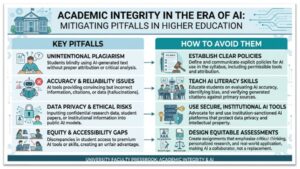
Pitfall 1: Over-Reliance on AI Content Detectors
A foundational error in managing AI in the classroom is treating AI detection software as a definitive diagnostic tool. Independent research repeatedly demonstrates that AI detectors are not 100% accurate and carry a substantial risk of false positives. According to empirical studies on algorithmic detection, these tools often possess a baseline false-positive rate where completely human-written text is flagged as machine-generated. Furthermore, research from Stanford University highlights a systemic bias: AI detectors disproportionately flag writing by non-native English speakers or those utilizing highly formal, structured, and conventional academic syntax—the exact style rewarded in graduate-level coursework. Because leading developers (including OpenAI) have discontinued or publicly distanced themselves from the reliability of their own text classifiers, relying on a percentage score to level academic integrity charges creates severe legal and ethical vulnerabilities for faculty.
LLF National Law Firm+ 3
- How to Avoid It: Shift away from a “catch-and-punish” model toward alternative assessment methodologies. Instead of relying on a post-submission scanner, require students to submit multi-stage drafts that leverage version-history tracking (such as Google Docs edit history or tracked changes in Word) to prove their authentic drafting process. Additionally, pivot toward localized, context-specific prompts that connect directly to unique classroom discussions, real-time clinical experiences, or hyper-local institutional data that a generalized large language model cannot access or accurately predict.
Pitfall 2: Leaving “AI Use” Undefined
Many instructors mistakenly assume that terms like “brainstorming” or “assistance” have a universal definition. If a syllabus simply states that AI can be used for “initial ideas,” a student may interpret that as permission to generate an entire paragraph outline and paste it directly into their paper, arguing that the concept was the brainstorm. Without explicit boundaries, faculty have no objective grounds to penalize students whose definition of “collaboration” includes substantial text generation.
- How to Avoid It: Co-create or clearly articulate an “AI Permission Spectrum” for every major assignment type. Explicitly define what constitutes permissible support versus academic dishonesty. For example:
- Permissible: Using an LLM to generate a bulleted list of potential differential diagnoses to research independently.
- Impermissible: Prompting the AI to draft the clinical rationale or synthesize the evidence-based practice critique paragraph-by-paragraph. Provide concrete examples of both acceptable and unacceptable prompts in the syllabus.
Pitfall 3: Failing to Deliver the “Why” behind AI Restrictions
When students are barred from using AI without a transparent rationale, they often perceive the restriction as arbitrary busywork. This disconnect drastically increases the likelihood that they will offload the cognitive work to an algorithm. In online or accelerated graduate courses, students frequently default to efficiency over engagement if the intrinsic value of a task is left unstated.
- How to Avoid It: Adopt evidence-based pedagogical frameworks like Transparency in Learning and Teaching (TILT), developed by Dr. Mary-Ann Winkelmes. TILT research confirms that explicitly detailing the Purpose (the specific skills and long-term career benefits gained), the Task (the exact steps to take), and the Criteria for Success dramatically improves student buy-in and academic equity. Instructors must explicitly explain the clinical rationale: “You must master the diagnostic reasoning for advanced pharmacology manually now, because a machine will not be there during your national certification board exams or when making split-second decisions at a patient’s bedside.” Tying the restriction directly to future professional survival builds real student buy-in.
Pitfall 4: Instructional Hypocrisy (Double Standards)
Instructors undermine their own academic authority when they enforce strict bans on student AI use while simultaneously utilizing generative tools to write lecture notes, generate discussion board responses, or draft student feedback. Students quickly detect the incongruence, which erodes trust and diminishes their willingness to follow AI policy boundaries.
- How to Avoid It: Faculty must hold themselves to the same ethical and operational standards dictated to the class. If you use AI to assist in course design or formatting, disclose it transparently to model ethical utilization. If you require original, organic human synthesis from your students, ensure that the feedback, grading commentary, and guiding prompts you provide to them are equally authentic and human-crafted.
Pitfall 5: Faculty Hesitancy Due to Lack of Institutional Protection
Upholding academic integrity in the AI era introduces substantial professional risk, particularly for vulnerable faculty populations. Instructors are frequently hesitant to confront suspected AI misuse due to fear of departmental retaliation, protracted grievance processes, or retaliatory student evaluations. This vulnerability is highly asymmetrical, disproportionately impacting adjunct professors, lower-level lecturers, and pre-tenure faculty whose job security and contract renewals are heavily tied to quantified student satisfaction metrics. When the college or department fails to provide clear procedural safeguards, it inadvertently incentivizes educators to ignore blatant AI manipulation rather than risk their livelihoods.
- How to Avoid It: Shift the burden of proof from the individual instructor to a structured departmental framework. Faculty senates and program leadership must establish unified, institutionally backed policies that grant explicit immunity to instructors who follow standard academic review processes. Furthermore, colleges should implement holistic evaluation methods for vulnerable faculty—such as peer-review observations and portfolio assessments—ensures that an isolated drop in course evaluation numbers caused by enforcing rigorous academic standards cannot be used to penalize an educator’s employment or tenure trajectory.
To effectively navigate the integration of generative AI into university classrooms, shift focus away from predictive policing and move toward evidence-based pedagogy and structural assessment design. Several high-quality, practical resources provide concrete toolkits, templates, and frameworks specifically tailored for higher education faculty.
1. Groundwork & Pedagogical Frameworks
The TILT Higher Ed Project (Transparency in Learning and Teaching)
- What it is: While not exclusively an AI resource, Dr. Mary-Ann Winkelmes’s TILT framework is widely recognized as a premier antidote to AI over-reliance. TILT focuses on clearly defining the Purpose, Task, and Criteria of an assignment.
- How it helps: Faculty use the TILT framework to explicitly explain to students why they must perform a task manually first (e.g., developing cognitive neural pathways in pharmacology) before utilizing AI tools later. Giving students the “why” heavily increases buy-in and reduces unauthorized offloading.
- Access: tilthighered.com
The AI Pedagogy Project (by Harvard’s metaLAB)
- What it is: A curated collection of assignments, activities, and institutional perspectives designed specifically for educators trying to figure out what AI use looks like in practice.
- How it helps: It provides concrete examples of the “AI Spectrum,” helping faculty move past vague terms like “brainstorming.” It helps you visually and textually define for students exactly where human thought ends and machine generation begins on a specific assignment.
- Access: aipedagogy.org
2. Institutional Research & Strategic Guides
EDUCAUSE Research & Horizon Reports
- What it is: EDUCAUSE regularly publishes comprehensive data on the higher education tech landscape, including detailed multi-year reports on AI maturity, workforce upskilling, and policy roadblocks.
- How it helps: Their publications, such as The Impact of AI on Work in Higher Education, provide excellent data to bring to department heads or deans when advocating for clear faculty protections, uniform academic integrity policies, and structural immunity for instructors dealing with high-stakes AI violations.
- Access: educause.edu/research
Feedback Fruits: Higher Ed AI Leadership Hub
- What it is: An instructional design resource hub focused on building AI-resilient assessments.
- How it helps: This platform moves entirely away from standard surveillance methods. It offers actionable guides on how to restructure writing-heavy or clinical courses by implementing multi-stage drafting, version-history tracking (such as Google Docs edit history), and oral/performative components that a large language model cannot replicate.
- Access: feedbackfruits.com/blog
3. Evidence to Cite When Combating “Detector Reliance”
When presenting to curriculum committees or addressing student grievances, it is crucial to support your policy with empirical peer-reviewed research proving that AI classifiers are unreliable.
Key Research to Reference:
- On General Unreliability: A study published in the International Journal for Educational Integrity evaluated leading commercial detectors against authentic student work, concluding that they suffer from a severe lack of robustness and drop significantly in accuracy when text is lightly edited or paraphrased. None achieved 100% reliability, making them insufficient as standalone proof of misconduct (Hadra et al., 2026).
- On Bias Against Non-Native Writers: Stanford University research (Liang et al., 2023) empirically demonstrated that AI detectors systemically misclassify and flag writing by non-native English speakers due to the low perplexity and predictable nature of non-native linguistic syntax, creating profound equity concerns in higher education.
References
Alvarez, L., Ortoleva, G., Sutter Widmer, D., Fritz, M., Bugmann, J., Boéchat-Heer, S., & Ramillon, C. (2024). Future teachers’ beliefs about generative AI. Assessing technology acceptance as students or as aspiring professionals. Journal of Technology and Teacher Education, 32(3), 383–408. https://doi.org/10.70725/379206cljimb
Baumer, E. P., Cha, I., Khovanskaya, V., Steup, R., Vertesi, J., & Wong, R. Y. (2025, October). Exploring Resistance and Other Oppositional Responses to AI. In Companion Publication of the 2025 Conference on Computer-Supported Cooperative Work and Social Computing (pp. 156-160).
Bosun-Arije SF, Mullaney W, Ekpenyong MS. Developing a CHECK approach to artificial intelligence usage in nurse education. Nurs Educ Pract. 2024;79:104055. doi:10.1016/j.nepr.2024.104055
Campbell, C., & Waddington, L. (2024). Academic integrity strategies: Student insights. Journal of Academic Ethics, 22(1), 33-50. https://link.springer.com/article/10.1007/s10805-024-09510-1
CSU Policy on Academic Misconduct – https://www.csuohio.edu/sites/default/files/2024-10/iv-bb-3344-21-02-policy-on-academic-misconduct.pdf
D. McCabe and L.K. Trevino, 1993. “Academic dishonesty: Honor codes and other contextual influences,” Journal of Higher Education, volume 64, number 5, pp. 522–538.
doi: https://doi.org/10.2307/2959991, accessed 19 February 2022.
Educause. (2024). The impact of AI on work in higher education. Educause Research. https://www.educause.edu/research
Erol G, Ergen A, Gülşen Erol B, Kaya Ergen Ş, Bora TS, Çölgeçen AD, Araz B, Şahin C, Bostancı G, Kılıç İ, Macit ZB, Sevgi UT, Güngör A. Can we trust academic AI detective? Accuracy and limitations of AI-output detectors. Acta Neurochir (Wien). 2025 Aug 7;167(1):214. doi: 10.1007/s00701-025-06622-4. PMID: 40773066; PMCID: PMC12331776.
FeedbackFruits. (2024). Designing AI-resilient assessments: A guide for higher education faculty. FeedbackFruits Higher Ed AI Leadership Hub. https://feedbackfruits.com/blog
Gómez Gómez, J., Salas Álvarez, D., & Hernández Riaño, V. (2025). A study on the perception of Generative AI in higher education students and teachers. Ingenieria y Competividad, 27(3). https://doi.org/10.25100/iyc.v27i3.15137
Harvard’s metaLAB. (2023). The AI pedagogy project. Harvard University. https://aipedagogy.org/
Khatun F, Rios E, Sun C. Widespread, Helpful, and Unclear: Student Use of Generative AI in Nursing Education. Comput Inform Nurs. 2026 Mar 24. doi: 10.1097/CIN.0000000000001500. Epub ahead of print. PMID: 41895256.
Lee, V. R., Pope, D., Miles, S., & Zárate, R. C. (2024). Cheating in the age of generative AI: A high school survey study of cheating behaviors before and after the release of ChatGPT. Computers and Education: Artificial Intelligence, 7, 100253. https://www.sciencedirect.com/science/article/pii/S2666920X24000560
Liang, W., Yuksekgonul, M., Mao, Y., Wu, E., & Zou, J. (2023). GPT detectors are biased against non-native English writers. Patterns, 4(7), 100779. https://doi.org/10.1016/j.patter.2023.100779
LoBiondo-Wood, G., & Haber, J. (2022). Nursing research: Methods and critical appraisal for evidence-based practice (10th ed.). Elsevier.
Macfarlane, B., Zhang, J., & Pun, A. (2014). Academic integrity: A review of the literature. Studies in higher education, 39(2), 339-358. https://www.tandfonline.com/doi/abs/10.1080/03075079.2012.709495
Magesh, V., Surani, F., Dahl, M., Suzgun, M., Manning, C. D., & Ho, D. E. (2025). Hallucination‐free? Assessing the reliability of leading AI legal research tools. Journal of empirical legal studies, 22(2), 216-242. https://onlinelibrary.wiley.com/doi/abs/10.1111/jels.12413
R. Awdry and P.M. Newton, 2019. “Staff views on commercial contract cheating in higher education: A survey study in Australia and the UK,” Higher Education, volume 78, number 4, pp. 593–610.
doi: https://doi.org/10.1007/s10734-019-00360-0, accessed 19 February 2022.
R. Harper, T. Bretag, C. Ellis, P. Newton, P. Rozenberg, S. Saddiqui, and K. van Haeringen, 2019. “Contract cheating: A survey of Australian university staff,” Studies in Higher Education, volume 44, number 11, pp. 1,857–1,873.
doi: https://doi.org/10.1080/03075079.2018.1462789, accessed 19 February 2022.
Weber-Wulff, D., Anohina-Naumeca, A., Bjelobaba, S., Foltýnek, T., Guerrero-Dib, J., Popoola, O., Šamoylenko, P., & Waddington, L. (2024). Testing of detection tools for AI-generated text. International Journal for Educational Integrity, 20(1), 1-14. https://doi.org/10.1186/s40979-023-00146-z
Winkelmes, M. A. (n.d.). Transparency in learning and teaching (TILT) higher ed project. https://tilthighered.com/
AI statement

AI was used for: in finding resources and surfacing relevant information, writing instructional text concerning the pitfalls to avoid in judging student’s work as concerning AI use, and helped generate a table with information for what constitutes unethical use of AI and assisted with a decorative image for the pitfalls to avoid when grading student work concerning AI use