4. AI as a Course Design Partner
Case Study: Designing a Lesson Plan in Crisis Communication Using Generative Artificial Intelligence
Elizabeth Thomas
I first prompted Google Gemini to create a lesson and this is the response I received:
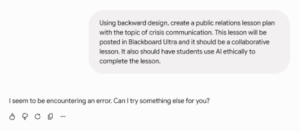
Since Gemini was unsuccessful in completing the task, I moved onto another AI platform. I used the same prompt in Anthropic’s Claude and it was much more successful in providing a lesson plan. The following crisis communication lesson plan was 100% created by Claude. You also can download the lesson plan as a Word doc.
Crisis Communication
A Collaborative Lesson Plan Designed Using Backward Design (UbD)
PR Capstone Course | Delivered in Blackboard Ultra | Collaborative, AI-Integrated Lesson
Suggested Duration: 5 Class Sessions Across Two Weeks (Blended Synchronous / Asynchronous)
Lesson Overview
Students function as external crisis communication counsel retained by a client facing a breaking-news crisis. Working in Blackboard Ultra Groups, teams research, strategize, and produce a full Crisis Communication Response Plan under realistic time pressure — while learning to use generative AI as a research and drafting aid without surrendering professional judgment or ethical accountability to it.
Stage 1 — Desired Results
Established Goals
- Aligns to PRSA Universal Accreditation Board competencies in crisis communication planning, ethical decision-making, and strategic writing.
- Capstone-level outcome: students apply integrated public relations skills to a live, time-pressured crisis scenario as they would in professional practice.
- Prepares students to make informed, disclosed decisions about generative AI use consistent with emerging industry standards for AI transparency in client work.
Essential Questions
- How does an organization maintain trust and credibility when the facts are incomplete and time is short?
- What ethical obligations do PR practitioners have to the public, the client, and the truth during a crisis — and how do those obligations change when AI tools help draft the response?
- How do audience, channel, and timing shape whether a crisis message lands or backfires?
Enduring Understandings
Students will understand that…
- Crisis communication success is measured by speed, honesty, and empathy — not by how tightly the message is controlled.
- Effective crisis response is a team sport; no single writer, however skilled, replaces cross-functional collaboration under pressure.
- Generative AI can accelerate research, brainstorming, and drafting, but it cannot verify facts, absorb accountability, or make the ethical call — that responsibility stays with the practitioner.
Student knowledge outcomes
| Students Will Know | Students Will Be Able To |
| The three-stage crisis lifecycle (pre-crisis, response, post-crisis)
Coombs’ Situational Crisis Communication Theory (SCCT) response strategies Core components of a crisis communication plan (holding statement, key messages, FAQ, spokesperson protocol, channel plan) Relevant provisions of the PRSA Member Code of Ethics (disclosure, honesty, competence) Industry norms and institutional policy on disclosing generative AI use in professional communication |
Draft a holding statement within a hard time constraint
Select and justify an SCCT response strategy for a given scenario Collaborate under pressure to produce one unified team deliverable Critically evaluate AI-generated text for accuracy, tone, and ethical risk before using or editing it Give and receive structured peer critique through Blackboard Ultra discussions |
Stage 2 — Assessment Evidence
Performance Task
Presented to students using the GRASPS framework:
Goal: Your team has been retained as external PR counsel to help a client respond to a breaking crisis within a 24-hour window.
Role: Senior members of a crisis communication team.
Audience: The client’s CEO and board (for message approval), the news media, and the public.
Situation: A scenario packet posted in Blackboard Ultra presents a breaking-news brief specific to your team’s assigned industry.
Product: A Crisis Communication Response Plan (holding statement, key messages, FAQ, one social media post, and spokesperson talking points), submitted with a completed AI Use & Ethics Log.
Standards: Evaluated against the rubric below, distributed to students before work begins.
Assessment Rubric
| Criterion | Exemplary (4) | Proficient (3) | Developing (2) | Beginning (1) |
| Strategic Response (SCCT fit) | Response strategy is precisely matched to crisis type and attribution of responsibility; reasoning is explicit and persuasive | Response strategy fits the crisis type; reasoning is present but not fully developed | Response strategy is generic or only loosely connected to the scenario | No clear strategic rationale; response reads as boilerplate |
| Message Clarity, Tone & Accuracy | Messages are clear, empathetic, factually consistent, and audience-appropriate across every channel | Messages are clear and appropriate with minor inconsistencies in tone or channel fit | Messages are understandable but uneven in tone or contain minor factual gaps | Messages are confusing, tonally mismatched, or contain unverified claims |
| Ethical Use of AI | AI Use Log is complete and specific; team shows clear critical evaluation and revision of AI output; no unearned reliance on AI judgment | AI Use Log is complete; team shows some evaluation of AI output before use | AI Use Log is incomplete or vague about how output was evaluated | No AI Use Log, or AI-generated text appears to be submitted without disclosure or revision |
| Collaboration & Process | Clear evidence of shared ownership, task division, and use of feedback from peers and instructor | Evidence of shared work and some incorporation of feedback | Uneven participation or limited use of feedback | Little evidence of collaboration; one or two members carried the task |
| Professionalism & Timeliness | Plan is publication-ready, on time, and formatted to brief a real executive audience | Plan is complete, on time, with minor polish needed | Plan is late or missing minor required elements | Plan is substantially incomplete or missing required elements |
Other Evidence
- Individual reflection journal entry submitted through the Blackboard Ultra Journal tool: what the team got right, what they would do differently, and one specific instance where the team accepted, edited, or rejected AI-generated content and why.
- Structured peer critique of another team’s draft holding statement, posted to the Blackboard Ultra discussion board.
- Peer evaluation form rating each teammate’s contribution, submitted individually and confidentially.
Stage 3 — Learning Plan
Sequenced using the WHERETO elements: Hook, Equip, Rethink/Revise, Evaluate, Tailor, and Organize.
Session-by-Session Sequence
| When | Format (Blackboard Ultra) | What Happens | AI / Collaboration Checkpoint |
| Session 1 (synchronous or recorded lecture) | Announcement
Recorded video lecture Discussion board |
Hook: students react to a real composite crisis headline/video on the discussion board. Instructor delivers mini-lecture on SCCT, the crisis lifecycle, and the PRSA Code of Ethics. Crisis Communication Plan template and AI Use Policy are posted. | Instructor models responsible AI use by showing an AI-drafted statement and critiquing it live as a class exercise. |
| Sessions 2–3 (asynchronous, 2 days) | Groups tool
Collaborate Ultra Shared file link |
Blackboard Ultra Groups (4–5 students) are released along with differentiated scenario packets (healthcare, food/beverage, technology/data breach, higher education, manufacturing). Teams begin drafting the Crisis Communication Response Plan. | AI Checkpoint 1: teams may use AI tools to research comparable past crises and brainstorm messaging angles. Every use is logged in the AI Use Log. |
| Session 4 (synchronous, in Collaborate) | Collaborate Ultra breakout groups
Discussion board |
Timed simulation: teams have a compressed window to produce a holding statement. Instructor injects a plot twist (new fact) mid-session, forcing revision. Teams post draft holding statements; two peer teams critique using the provided protocol. | AI Checkpoint 2: teams may use AI only for clarity/grammar passes on their own drafted language, not to generate new claims under time pressure. |
| Session 5 (synchronous or recorded) | Collaborate Ultra
Assignment submission (rubric attached) Journal |
Teams present their final Crisis Communication Response Plan to the class acting as the client’s board. Class asks follow-up questions. Teams submit final plan, AI Use Log, and individual reflection journal entries. | Final disclosure: AI Use Log is submitted as a graded artifact alongside the plan. |
Collaboration Design
- Teams of 4–5 are formed using Blackboard Ultra Groups, with each team assigned a different industry scenario so class presentations expose students to a range of crisis types.
- Each team divides four working roles for the duration of the lesson: Lead Strategist, Message Drafter, Media/Channel Lead, and Ethics & AI Auditor (responsible for maintaining the AI Use Log and flagging any output that raises accuracy or ethical concerns).
- Team drafting happens in a shared document linked from Blackboard Ultra so the instructor can view real-time progress and version history.
- The mid-simulation plot twist in Session 4 is intentionally designed to require the team to renegotiate roles and messaging on the fly, mirroring real crisis conditions.
Ethical AI Use Guidelines for This Lesson
Distributed to students alongside the lesson materials in Session 1.
Permitted Uses
- Researching comparable past crises and how organizations responded.
- Brainstorming multiple messaging angles or headline options for the team to evaluate.
- Checking grammar, clarity, or reading level of language the team has already drafted.
Required Disclosure
- Every AI query used in producing the deliverable is recorded in the AI Use Log, including the tool, the prompt, and how the team evaluated and used (or discarded) the output.
Not Permitted
- Submitting AI-generated text as final client-facing language without team review, editing, and fact-verification.
- Using AI to invent quotes, statistics, or facts not present in the scenario packet.
- Allowing AI output to stand in for the team’s own strategic or ethical judgment about how to respond.
This policy mirrors a live professional debate: several PR industry bodies now recommend disclosure of AI-assisted work to clients, and the PRSA Code of Ethics obligates practitioners to honesty and accuracy regardless of what tool produced a draft. Students should be prepared to explain, not just follow, this policy.
Differentiation and Support
- Scenario packets are written at a consistent difficulty level but vary by industry so teams can lean into prior coursework or personal interest.
- A sentence-starter version of the holding statement template is available in Blackboard Ultra for any team that requests it during Session 2–3.
- The instructor holds an optional Collaborate Ultra office hour between Sessions 3 and 4 for teams that want strategy feedback before the timed simulation.
Appendix A — AI Use & Ethics Log Template
Teams submit this log alongside the final Crisis Communication Response Plan. It is graded as part of the rubric’s Ethical Use of AI criterion.
| AI Tool Used | Prompt or Task Given to AI | How the Team Evaluated / Edited the Output | Final Use (kept as-is, revised, or discarded) |
AI Use and Ethics Log Template
Appendix B — Crisis Communication Response Plan Template
- Holding Statement (issue within the first hour)
A brief, approved statement acknowledging the situation, expressing concern, and committing to follow-up information — issued before all facts are confirmed.
- Key Messages (3–5 total)
Short, consistent statements that every spokesperson and channel will repeat, addressing what happened, what the organization is doing, and what the audience should do or expect next.
- Frequently Asked Questions
Anticipated questions from media and the public, each paired with an approved, honest answer.
- Spokesperson Talking Points
Bullet-form guidance for whoever speaks on the record, including the two or three points they must land regardless of what they are asked.
- Channel and Timing Plan
Which message goes where and when: newsroom statement, social media post, employee communication, and any direct stakeholder outreach, sequenced against the 24-hour window.
Appendix C — Peer Critique Protocol (Session 4 Discussion Board)
Each team posts its draft holding statement to the discussion board. Two assigned peer teams respond using this structure:
- One thing this statement does well for the audience it needs to reach.
- One place where the tone, clarity, or timing could be strengthened.
- One question you would ask this team before they finalize their plan.
Peer critique should reference the rubric criteria directly rather than personal opinion, and must be posted before the team’s revision window opens.