
Module 1 Reading – Promoting Patient Well-being
Module 1 Learning Objectives
The primary aim of healthcare is to promote patient health and well-being, and clinicians must also try to avoid causing harm when treating their patients. The duties to promote patient well-being and avoid causing harm are best expressed by the bioethical principles of beneficence and non-maleficence. This module is focused on helping you to understand the duties related to these two principles and how to apply them when navigating moral conflicts in healthcare.
Upon completing the Module 1 reading, you should be able to:
- Define the bioethical principles of beneficence & non-maleficence
- Explain the differences between health and non-health related benefits & harms
- Discuss the different considerations that go into calculating the net-benefit
Module 1 Table of Contents / Section Jump Links:
1.2) The Principles of Beneficence & Non-maleficence
1.3) Applying the Bioethical Principles
Module 1 Introduction
It is often said that the main goal of healthcare is to “promote patient health and well-being.” This is no doubt a worthy goal, and it may even seem quite obvious with relatively few “ethical issues” to explore. Yet I assure you that figuring out how exactly to achieve this goal can, at times, be quite complicated. For example, take a moment to puzzle about the following questions:
- Is it ever acceptable to cause harm to a patient? If it is never acceptable to cause harm to a patient, what should we do in cases where causing (or risking harm) might be necessary in order to treat the patient’s condition, such as cutting into a patient in order to perform surgery? But if causing harm is sometimes acceptable, how much harm is too much harm? Is the amount of harm always proportional to the expected benefit for that patient, or are certain types of harms always unjustified regardless of the potential benefit?
- Should “promoting patient well-being” only relate to the patient’s health? If two treatment options have a similar expectation of success, but one option is significantly less expensive than the other, should the cost difference be taken into account when making a recommendation? Or what if one option would be significantly less painful for the patient? Or what if one treatment option has a lower rate of success than another, yet it would better align with the patient’s other care goals and lifestyle preferences?
- Can we make trade-offs between promoting physical health and mental health? How should we proceed if a mental health treatment will have a significant negative impact on the patient’s physical health, or if a treatment for a physical condition will have a significant negative impact on the patient’s mental health? When a patient’s physical health and mental health come into conflict, how do we decide which one to prioritize treating?
 The above questions are meant to demonstrate the everyday challenges in determining precisely which of several possible actions might best promote the health, welfare, or well-being of a patient. As such, the aim of Module 1 is to help you to feel more comfortable in recognizing nuance & thinking through important considerations when determining which course of action will best promote patient well-being.
The following sections will help to untangle these complexities by distinguishing between different types of benefits and harms, considering different approaches to weighing benefits against harms, considering the moral implications of causing harm vs. allowing harm to a patient, and ultimately bringing these ideas together in understanding how they inform our application of two bioethical principles: beneficence and non-maleficence. Because even when healthcare professionals aren’t using these moral terms directly, clinicians are almost always applying these principles when making assessments about what diagnostic tests or therapeutic treatments are most likely to benefit their patients and determining which course(s) of action they ought to recommend for their patient’s care.
Something to Consider…
The questions and ideas in this module might not be the “significant ethical issues” you hear about in the news, but keep in mind that not every ethical challenge is big and bold and highly controversial. This is because “being ethical” isn’t just about making “the right choice” in high-stakes situations (don’t worry, we’ll discuss some of those later); rather, “being ethical” is about recognizing nuance and aiming to do the right thing in every situation, no matter how small or insignificant it might appear to you at the time. Because even if something might seem insignificant to you, it could mean a great deal to someone else.
To easily see how much “small things” can matter, try surprising someone with a compliment today. Giving a compliment is a simple & easy thing on your part, yet it can have a significant impact and potentially brighten the recipient’s whole day! The best compliments are often about appreciating the choices the other person has made – such as a cool outfit or hairstyle – rather than pointing out something they had no control over or can’t easily change.
1.1) Benefits & Harms
On a basic level, we all understand the idea of “benefits & harms.” Without thinking too hard, you can probably list at least three different things that would benefit to you & three different things that would harm you. (Go on, take a moment to give it a try!)
For our purposes, we will define a benefit as something that improves a person’s well-being by promoting “the good” for them, and a harm as something that diminishes a person’s well-being by setting back their interests. With this in mind, it is easy to see that healthcare is fundamentally about assessing harms and providing benefits, such as diagnosing a patient’s illness/ailment and then providing the appropriate treatment(s) to promote their health and well-functioning. For example, consider the following scenario:
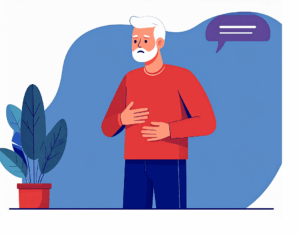 Importantly, the above example is specifically focused around assessing “health related” benefits and harms. Just as it sounds, describing a benefit or harm as “health related” means that it directly affects a person’s health, either positively or negatively. A more precise way to think about “health related” benefits and harms is to recognize that these are about the person’s physiological functioning, making them objective and measurable:
As we can see in the above example, assessing health related benefits and harms involves objective measurements and testing in order to gain data and information about the way that illness and potential treatments affect the functioning of the human body. Assessing and managing health-related benefits and harms is what doctors, nurses, physical therapists, and even clinical psychologists are most directly trained and licensed to do (hence the many long years of medical school they are required to complete). All clinicians must be licensed and/or certified, as a medical licenses and certifications ensure that they have the necessary training in understanding how various health issues affect the human body and how to properly address those issues.
 From this perspective, clinicians do not need to know much about who their patients are as unique individuals in order to run tests and assess health related benefits & harms. This is because all humans have similar anatomy and physiology, meaning ailments such as CHF affect all bodies similarly. For example, imagine if Ms. Greenwood had come into the emergency department instead of Mr. Redman that day, similarly complaining of severe chest pains, lethargy, and shortness of breath. Dr. Sun would have proceeded to run the same diagnostic tests, in just the same way, in order to diagnose the severity and class of CHF and determine which of the treatment options would be most appropriate for helping to improve the blood flow to Ms. Greenwood’s heart. From a strictly health perspective, it doesn’t matter whether the patient is Mr. Redman or Ms. Greenwood, Dr. Sun is simply focused on diagnosing what is harming the patient’s body and recommending the treatment that will best treat the condition in order to promote the patient’s health.
However, there is also a second category of benefits & harms that we can describe as “non-health related.” Think back to when I asked you to list 3 different things that would benefit and harm you; how many of the things that you thought about were actually about your health? Perhaps a few were, but I bet you also thought about other things such as money, friends, or hobbies. These are examples of “non-health related” benefits & harms. Describing a benefit or harm as “non-health related” means it relates to a person’s experience of something, either positively or negatively. So rather than being about the person’s physiological functioning, “non-health related” benefits and harms are about how things affect a person’s goals, values, or the quality of their life. This makes non-health benefits and harms subjective to each individual:
As we can see in the above example, the same treatment option might work similarly well for both patients from a health perspective, given their similar health conditions, yet the differences in lifestyles and goals of care could nevertheless result in different recommendations for each patient. Mr. Redman might prefer starting with the least invasive option such as medical management (also referred to as “drug therapy”) because it can help to manage his condition without surgery and allow him to continue living a comfortable life at home. But given Ms. Greenwood’s active lifestyle, even if medical management could similarly manage her condition, she might prefer a surgical option such as an angioplasty if it is more likely to relieve the pain associated with physical activity.
 This shows us that assessing non-health related benefits and harms is subjective, meaning it is about understanding the ways in which illnesses and treatment options can affect a patient’s broader goals, values, and experiences. Ms. Greenwood values being physically active, so her goal of care is to pursue the treatment that will best relieve the pain associated with her physical exertions (even if it carries higher risks). On the other hand, Mr. Redman values being at home and wants to avoid being in the hospital as much as possible, so his goal of care might be better met through a non-surgical management of his disease (even if more could be done to relieve his pain). Because non-health benefits and harms are subjective to each patient, based on their experiences and the things they care about, we cannot know what might benefit or harm a patient from a non-health perspective until we meet with that patient and begin to discuss their goals of care. This is what most significantly distinguishes health and non-health benefits and harms.
Other examples of non-health related benefits and harms can include the amount of time a patient may have to take-off from work to undergo a procedure, the overall cost of the procedure or medication, any changes in physical appearance such as surgical scars, or the level of post-surgical care required (such as having to go to a rehabilitation facility versus being able to go back home right away). There are myriad things that patients care about and take into account when thinking about different treatment options, so the best approach is often going to be the one that accounts for both health and non-health considerations. But because non-health benefits and harms can’t be objectively “measured” and are different for each patient, incorporating these into a treatment recommendation first requires a clinician to spend time communicating with their patient about goals of care, and then thinking about how to balance the health and non-health considerations to best promote their patient’s overall well-being.
1.2) The Principles of Beneficence & Non-maleficence
It is now clear why thinking in terms of both health and non-health benefits & harms is central for clinicians in order to promote patient well-being. However, identifying all of the relevant benefits and harms is only the first step, because the clinician must then sort through these considerations when making a judgement about how to proceed or what to recommend. To provide guidance for thinking about how to organize and weigh relevant the considerations, we can utilize the bioethical principles of “beneficence” and “non-maleficence.”[1]
The Principle of Beneficence
The principle of beneficence represents a duty to promote patient well-being & to prevent or remove harm from patients.
This means that when prioritizing the principle of beneficence, clinicians should act in ways that benefit their patients such as taking steps to appropriately diagnosis health concerns, through the provision of healthcare therapies & treatments (to remove harm), or by taking proactive steps toward preventative care by identifying and managing future health concerns the patient is at risk to develop (to prevent harm).
 The principle of beneficence is the driving force of healthcare; it’s what directs healthcare professionals to take appropriate action in order to meet the needs of their patients, thereby promoting patient well-being. Without the duty of beneficence, clinicians could simply choose not to treat patients when it seems inconvenient, might take half-measures that fail to appropriately address patient’s health needs, or might skip over regular or necessary diagnostic screenings that are important to prevent future health concerns from arising. Namely, without the duty of beneficence, clinicians wouldn’t have any obligation to meet the care needs of their patients and might allow future health issues to arise undetected. And that doesn’t sound much like healthcare anymore.
You might be tempted to say, “clinicians should still do those things even without a duty of beneficence,” but this is agreeing that you think taking active steps to help others is morally important! That is simply another way of saying that you think healthcare professionals DO in fact have a duty of beneficence, even if we don’t often say it explicitly. In fact, we don’t often say it explicitly because the principle of beneficence is a basic tenant of morality itself – it’s the idea that it is morally right to help others when we can.[2] The word “beneficence” even has the same root as words like “benefit,” “beneficial,” and “benevolent.”
However, some might argue that this idea doesn’t ALWAYS hold true – for example, you might not be doing anything morally wrong if you choose not to pull over on the highway to help someone change a flat tire. And to be fair, there is reasonable debate about the extent to which people have a moral obligation to go out of their way to help others. Some people might argue that we should always help others when it is easy to do so, while others might argue that going out of our way help others is supererogatory (meaning it is beyond the basic requirements of morality).
Fortunately, we don’t need to settle this larger debate about general moral obligations to help others in order to agree that when someone decides to become a healthcare professional, they are choosing to take on a special responsibility to help others, even when doing so is not easy or convenient. That’s what it means to become a healthcare professional, and healthcare couldn’t function properly if healthcare professionals didn’t have a special obligation to act based on the duty of beneficence. This is why we can say that beneficence is the driving force (or beating heart) of healthcare – it is the recognition that when someone becomes a healthcare professional, they knowingly accept a duty to actively promote patient well-being and to prevent harm to patients.
The Principle of Non-maleficence
The principle of non-maleficence represents a duty to avoid causing harm or to minimize any risks of harm to patients.
This means that when prioritizing the principle of non-maleficence, clinicians should avoid causing harm to their patients when taking steps to diagnose health concerns or when providing therapies & treatments. This includes avoiding causing both intentional and accidental harms, because clinicians have a moral duty not to inflict avoidable injury on individuals under their care.
 The principle of non-maleficence is the counterbalance to the principle of beneficence. Rather than focusing on benefitting others, the principle of non-maleficence directs us to be aware of the ways in which our actions may harm others, so that clinicians can try to avoid causing harm or can minimize any risks of harm associated with their actions. If the principle of beneficence is the driving force of healthcare, then the principle of non-maleficence is the caution sign on the highway to helping patients. It tells us to slow down and think about the possible consequences of our actions, because even actions with good intentions can sometimes lead to undesirable outcomes.
And just like beneficence, the duty of non-maleficence is also a basic tenant of morality itself – it’s the idea that we should avoid causing unnecessary harm whenever possible.[3] The idea that we should avoid causing harm to others is one of the most fundamental ideas of morality; even if there is disagreement about the extent to which we have an obligation to actively help others, virtually everyone agrees that we should try to avoid hurting others when it can be avoided. Any disagreement with this idea is a rejection of morality itself. It can also be helpful to break down the phrase “non-maleficence.” The prefix “non” means “not,” and the word “maleficence” is the noun of “maleficent” which means “causing harm,” so taken together the phrase “non-maleficence” literally translates to “do not cause harm.”
The duty of non-maleficence even forms the cornerstone of professional codes of conduct in almost every profession. From law to engineering to professional wrestling, any profession that takes itself seriously sets standards to ensure that the professionals in that field and those they severe can all interact safely. Additionally, many institutional rules and regulations also aim at minimizing risk, government organizations such as the Occupational Safety and Health Administration (OSHA) aim at ensuring safe work environments, and requirements of professional licensing and credentials help to ensure an adequate level of training for professionals to perform their jobs correctly. In healthcare, the Hippocratic Oath historically set the standard of professionalism and is often quoted as instructing “First, do no harm.” While the historical accuracy of this quote is questionable, the fact that this idea persists over time is a testament to the recognized importance of non-maleficence.
Lastly, it is important to recognize that the duty of non-maleficence goes beyond simply ensuring that you do not cause harm in the given moment. It also requires exercising “due care” by taking precautions to identify any foreseeable risks associated with your actions and to minimize those risks of harm to the extent possible. For example, this is why clinicians use an alcohol swab before administering a shot, in order to reduce the risk of the patient contracting an infection at the puncture site.
1.3) Applying the Bioethical Principles
Now that the basic idea behind each principle is clear, the next step is to think about when and how to apply each of these principles in order to navigate complex ethical situations in healthcare. As you might suspect, applying these principles relates back to the previous discussion about benefits and harms.
Thinking in terms of benefitting patients is fairly straightforward, given that it always relates back to the principle of beneficence. There can be some complexities in terms of weighing different degrees or types of benefits, as well as weighing potential benefits against likely harms, but those are questions about how best to apply the principle of beneficence which we will save for the next section. For the moment, it is enough to remember that whenever your aim is to benefit the patient, whether at present or in the future, you will inherently be applying the principle of beneficence.
 Thinking in terms of harms is more complex, given that both beneficence and non-maleficence include a duty to limit harm to the patient. At this point you might wonder, “shouldn’t we just simply avoid harm entirely?” While that would certainly be ideal, it is unfortunately not very realistic. This is because almost every action we take creates at least some minimal risk of harm, especially actions that directly or indirectly affect others. Cars are a simple, everyday example of this. When you drive a car, you are in essence operating a heavy, fast object that can seriously injure others if they end up in its path. And even if you’re a very careful driver, unexpected hazards can still crop up such as a blown tire, a deer jumping into the road, or a patch of black ice. There are some precautions you can take to try and minimize the risk of a crash, such as keeping up with regular maintenance and staying off your phone while driving, but even these measures cannot completely eliminate the risk of an accident.
While some actions only involve the risk of harm to yourself, such as driving in the woods with no other people around, other actions also risk harm to others, such as distracted driving on a busy interstate. Because healthcare is about performing actions that aim at benefitting others, the actions healthcare providers take almost always directly affect their patients, meaning the risks of harm in healthcare are often fall to the very patients that providers are attempting to help.
Almost every action that a healthcare provider takes in order to treat a patient also risks causing at least some harm to that patient. But because most patients seek healthcare because of some acute or ongoing health issue, a provider choosing not to act also risks allowing the health issue to worsen which can further harm the patient. So once a healthcare provider meets with a patient in need of care, both acting and failing to act can result in harm to that patient. This raises the question “to what degree is the healthcare provider morally responsible for those harms?” The bioethical principles of beneficence and non-maleficence can help us to answer this question, and in doing so they help providers to know how best to act. But as it happens, the principles of beneficence and non-maleficence often give competing answers to this question. And in order to understand how to apply each of these principles, we first need to be clear about the source of the harm.
Applying the principle of beneficence would suggest that the provider should act to address the health issue before it worsens, in order to prevent ongoing or future harm to the patient. While the provider isn’t responsible for the initial harm the patient comes in with (aka – the provider didn’t give the patient cancer), they become responsible for the continuation of that harm given their obligation to benefit their patient. This means that providers are failing to fully satisfy the duty of beneficence when they allow harm to come to the patient, often by refraining from an action.
Conversely, applying the principle of non-maleficence would suggest that providers should refrain from acting as much as possible, given that their actions almost always risk exposing the patient to new harms. For example, treating a patient’s cancer with chemotherapy can compromise the patient’s immune system and make them more susceptible to other illnesses, and performing surgery to remove a cancerous tumor directly harms the patient by creating an open wound. In these scenarios, the provider is directly responsible for the harms that befall the patient as a result of their actions (aka – the harm is a direct result of the provider’s actions). This means that providers are failing to fully satisfy the duty of non-maleficence whey they cause harm to the patient, often by acting to provide treatments/therapies.
1.4) Calculating the Net-Benefit
It is now apparent that healthcare providers often face an ethical dilemma when attempting to promote patient well-being; because nearly every action risks some amount of harm, if a provider tries to satisfy the principle of beneficence by providing treatments they also risk causing new harms to the patient, but if a provider tries to satisfy principle of non-maleficence by withholding an action they might allow some harms to continue untreated. As it turns out, the principles of beneficence and non-maleficence can rarely be fully satisfied at the same time, despite each offering an important moral directive. Like two sides of a coin, if one principle is fully satisfied then the other principle cannot be. So how do we move forward from here? By weighing the relevant benefits and harms in order to ensure that each action is expected to produce a “net-benefit” before proceeding with it.
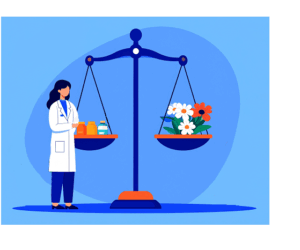 The key to applying the bioethical principles is to understand that they are prima facie, meaning that there is no set hierarchy among the principles. More specifically, each principle offers an important moral directive that should always be considered, but when the principles come into conflict with one another, each principle can be justifiably overridden by another competing principle. This means that when providers are unable to satisfy two or more of the principles at the same time, they must determine which principle(s) to prioritize and which principle(s) can be justifiably overridden. The justification for prioritizing one principle over another should be based on a reasoned judgement about which principle carries more “moral weight” in the situation given relevant considerations. This approach of determining which principle(s) to prioritize of others is referred to as “weighing and balancing” the principles.[4] One way to communicate your weighing of the principles, as shown below, is to write the principle being prioritized over top and the principle being overridden:
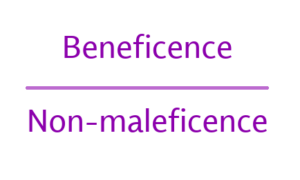
In many cases, it is common to argue that the principle of beneficence outweighs the principle of non-maleficence, or that we should sometimes prioritize the principle of beneficence even when it overrides our duty of non-maleficence. We are justified in prioritizing beneficence over non-maleficence when the likely benefits of the action are substantial enough to justify inflicting some harm through the intervention.
For example, if a 23-year-old generally healthy patient suddenly experiences cardiac arrest, performing cardio-pulmonary resuscitation (CPR) is likely to benefit them (aka, it will likely save their life). However, because CPR is also likely to result in broken ribs, deciding to perform CPR would be an example of prioritizing beneficence over non-maleficence. This is because we would focus on providing a benefit despite knowing the action is likely to also cause some harm, given that the amount of benefit would likely outweigh the amount of harm caused.
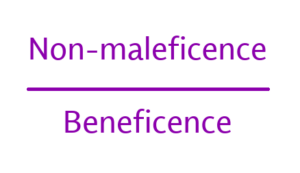
However, in some cases, we may argue that the principle of non-maleficence outweighs the principle of beneficence, or that we should sometimes prioritize the principle of non-maleficence even when it overrides our duty of beneficence. We are justified in prioritizing non-maleficence over beneficence when the likely harms inflicted by the action would substantially outweigh the benefits of the intervention.
For example, if a 93-year-old patient with congestive heart failure suddenly experiences cardiac arrests, performing cardio-pulmonary resuscitation (CPR) is statistically very unlikely to benefit them (aka, it is not expected to save their life). And because CPR is also likely to result in broken ribs, deciding not to perform CPR would be an example of prioritizing non-maleficence over beneficence. This is because we would focus on not causing any harm, knowing the amount of harm caused by the action would likely outweigh the amount of benefit provided.
But how does a provider know which principle to prioritize and which option to recommend in a given situation? By calculating the “net-benefit” (sometimes referred to as “utility”) of each action. Calculating the net-benefit means determining the amount of benefit relative to the amount of harm, and an action produces a net-benefit when it is likely to produce more benefit than harm. However, calculating the net-benefit isn’t always easy or straightforward, as will be discussed below, and often multiple different actions might all be expected to produce a net-benefit. This means that there might be several reasonable alternatives to present to a patient, and the option that should be most highly recommended is the one is most likely to maximize the net-benefit for the patient by producing the biggest benefit relative to the amount of harm.
Calculating the net-benefit is important because in most cases it is impossible to benefit the patient without also risking harm, and the greater the potential benefit of an action, the greater the risk of harm often associated with it. For example, surgery can offer a much bigger benefit than a cortisone shot, but surgery also has significantly greater risks associated with it. Healthcare providers therefore need to ensure that on balance, each action they perform is expected to produce more benefit than harm to the patient. When the likely benefits outweigh the potential harms, thereby producing a net-benefit, we are justified in prioritizing beneficence over non-maleficence and moving forward with that action. But when the likely harms outweigh the potential benefits, failing to produce a net-benefit, we are instead justified in prioritizing non-maleficence over beneficence and should not proceed with that action. In the above example, performing CPR on the younger patient is likely to produce a net-benefit and would be appropriate, while performing CPR on the elderly patient is not likely to produce a net-benefit and would therefore be inappropriate. This calculation is what helps to justify the prioritization of the principles as seen in the above examples.
Because benefice aims at maximizing well-being and non-maleficence aims at avoiding causing any harm, a healthcare provider must ultimately think about both the potential benefits and harms of the possible actions (or inactions) in order to determine which will likely produce the best balance of benefit over harm. Just like you want your bank account to always have a “net positive” in terms of funds, patients should always come away with a “net-benefit” from the healthcare they receive. In order to determine whether an action is likely to produce a net-benefit, we must start by listing out the potential benefits and harms associated with the action in order to then think about how to compare or weigh these considerations against each other:
For example, if Mr. Gray is diagnosed with lung cancer, his oncologist would need to consider the benefits and harms associated with chemotherapy, radiation, surgery, as well as possibly withholding treatment.
When thinking about chemotherapy the oncologist might determine that the main health related benefits are stopping the spread of the cancer, reducing the damage caused by the cancer, and ideally extending his life by eliminating the cancer from his body. There can also be a number of non-health benefits including an improved quality of life, being able to continue with meaningful projects and activities, feelings of hope and determination, connecting with family and friends, etc.
However, chemotherapy is also very hard on the body and risks a number of health side-effects including nausea & vomiting, constipation, fatigue, hair loss, loss of appetite, easy bruising, excessive bleeding, abdominal pain, a compromised immune system, nerve damage, and possible strain on the lungs, heart, kidneys, and other organs. There can also be a number of non-health related harms including pain and discomfort, the financial cost of care, arranging appointments and transportation, changes in appearance, the inability to socialize, easily feeling overwhelmed, etc.
In order to calculate the net-benefit, once the potential benefits and harms have been determined, we then need to consider relative number of benefits vs. harms, the significance of each benefit and harm, and the likelihood that each benefit or harm will in fact occur. And in many cases, this calculation will also include thinking about both the health and non-health benefits and harms.
 Given these considerations, calculating the net-benefit is not always simple or straightforward. It’s unlikely that a patient will experience every possible side-effect/harm associated with an action, but they may not receive all the benefits either. And not all benefits and harms are created equal; the harms of organ failure or death are much more significant than a benefit such as nasal decongestion, while the benefit of shrinking or removing a cancerous tumor is much more significant than the harm of abdominal pain or even a small amount of bleeding. Looking back at the benefits and harms associated with chemotherapy, we can see that many of the benefits quite significant while some of the harms are more significant than others. This is what often justifies providers in providing chemotherapy despite the many unpleasant side-effects. However, the less the chemotherapy is expected to actually improve the patient’s condition, the less justified we are in exposing the patient to those harms.
Going back to the CPR example, we might think that the benefit of resuscitating someone by re-starting their heart is much more significant than the harm of a few broken ribs, which is what justifies us in performing CPR on the 23-year-old by prioritizing beneficence over non-maleficence. However, if CPR is highly unlikely to actually resuscitate the patient due to their age or co-morbidities, which is true in the case of the 93-year-old, then the harm of breaking their ribs becomes more significant when there is unlikely to be a benefit to off-set that harm. The unlikely benefit is why we are justified in prioritizing non-maleficence over beneficence instead.
And keep in mind that while many of these examples focus on health related considerations, given that they are more easily quantifiable and similar between patients, we also need to factor in non-health considerations when the patient has clear goals or values that would be affected by the action. These might include things such as being free from pain, the amount of recovery time, their level of activity following the intervention, how soon they can leave the hospital and go home, whether they will need to be discharged to another medical facility for rehabilitation or continued care, and even the cost of the intervention. All of these can be significant considerations for the patient, and some patients may even care more about certain non-health considerations and be willing to make trade-offs with their health. For example, a patient experiencing severe elbow pain may prefer to try cortisol shots rather than surgery because the shots don’t require any recovery time and are much less expensive. And this may be true even if the surgery offers a more significant health related benefit as compared to the cortisol shots, given that patients are sometimes willing to make trade-offs between their health and their non-health goals of care.
This examples brings us to our last point, which is that we can also compare the expected net-benefits between different options when making a recommendation. As the above example demonstrates, in most cases, there will actually be multiple reasonable treatment options that each provide a net-benefit, but which offer different degrees/types of benefit and which expose the patient to different degrees/types of harms. So long as a treatment option produces a net-benefit it is reasonable and appropriate to provide, but some treatment options might be a better fit or more preferable for a particular patient. Calculating the net-benefit will often give us a range of reasonable options to present to the patient, so determining which of these reasonable options to recommend depends on how we weigh the likely health and non-health benefits and harms between the different options. And it may turn out that one option better maximizes the net-benefit from a health perspective while another maximizes the net-benefit from a non-health perspective. In these cases, the provider must make a judgement about which better maximizes the net-benefit, or they can have a discussion with the patient to determine which option best meets their goals of care. Ideally, healthcare works best when it is a successful collaboration between the patient and provider, ensuring that all relevant considerations are accounted for when determining the best approach to promoting the patient’s well-being.
Module 1 Key Concepts & Takeaways
You should now be able to answer the following questions:
- What distinguishes health related from non-health related benefits and harms?
- What are some examples of health and non-health benefits and harms?
- What does the principle of beneficence say we should do?
- What is the aim when prioritizing the principle of beneficence?
- What does the principle of non-maleficence ask us not to do?
- What is the aim when prioritizing the principle of non-maleficence?
- What is the difference between causing harm and allowing harm?
- What does it mean for a moral principle to be prima facie?
- What is the main idea behind the concept of a net-benefit?
- What are some key considerations when calculating the net-benefit?