Chapter 3: The Writing Process, Composing, and Revising
3.4 Creating the Thesis
Yvonne Bruce and Emilie Zickel
Now that you have begun or are well into the process of reading and drafting, you will have to create a thesis for any paper you are assigned. A thesis is simply an expression of the main idea of what you are writing about.
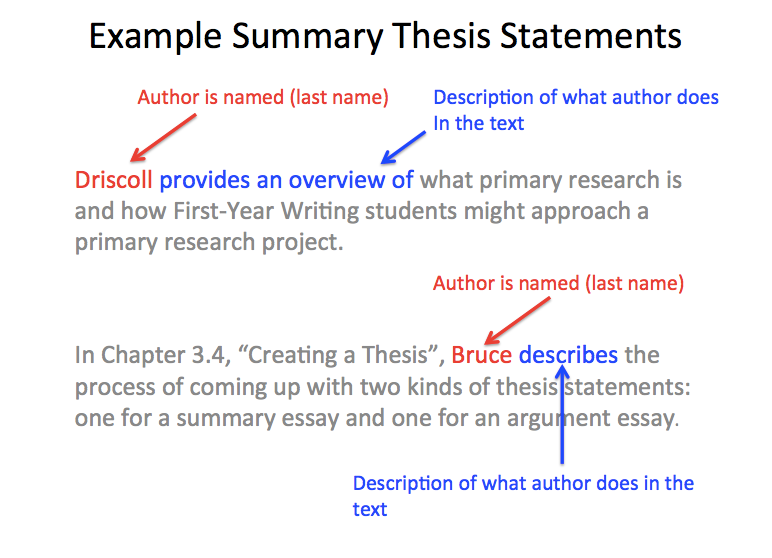
The thesis will be determined by the kind or genre of paper you are asked to write, but even a summary assignment—a paper in which you summarize the ideas of another writer without adding your own thoughts—must have a thesis. A thesis for a summary would be your expression of the main idea of the work you are summarizing. The presence of a thesis, and paragraphs to support that thesis, is what distinguishes a summary from a list.
Imagine, for example, that you are summarizing last night’s football game to a friend. You would not summarize it this way, unless you wanted to put your friend to sleep: “First the Falcons came out on the field, and then the Steelers came out on the field, and then there was a coin toss, and then the Falcons kicked off, and then the Steelers returned the ball for thirty yards, and then . . .”
What you would do instead is organize your summary around what you thought was the most important element of that game: “Last night’s game was all defense! The Steelers returned the ball for thirty yards on the first play, but after that, they hardly even got any first downs. The Falcons blocked them on almost every play, and they managed to win the game even though they only scored one touchdown themselves.”
For most papers, however, you will take a more active role in the content of the composition, creating a thesis that expresses your main idea about a topic, often in response to what others think about that topic.
In some cases you will be allowed to create a thesis about a topic of your choice; in most cases, you will required to create a thesis about a topic related to the subject or theme of the class.
Let’s say you have to create a thesis on a topic like The American Dream or Technology and Society or The Rhetoric of Climate Change. Maybe you’ve already read some essays or material on these subjects, and maybe you haven’t, but you want to start drafting your thesis with a claim about your subject. Bring to your claim what you know and what you think about it:
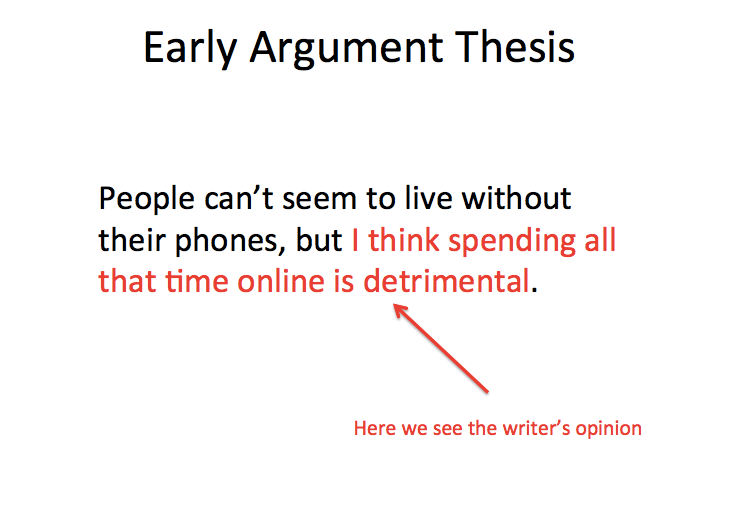
You’re already off to a good start: this thesis makes a claim, it demonstrates some knowledge or authority, and it includes two sides to the issue. How can you make it better? Remember, you have to be able to write a paper in support of your thesis, so the more detailed, concrete, and developed your thesis is, the better. Here are a couple suggestions for improving any thesis:
- Define your terms
- Develop the parts of your thesis so it answers as many who, what, when, where, how, and why questions as possible
Defining your terms
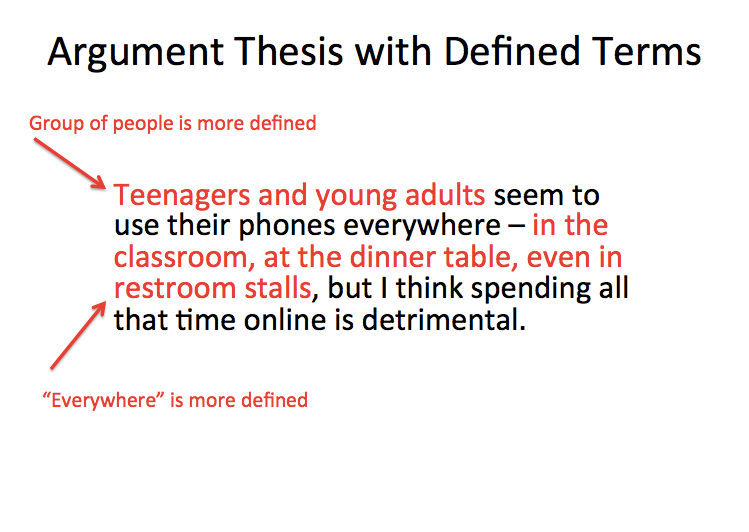
In your draft or working thesis above, are there any terms that would benefit from more definition? What do you mean by people, for example? Can that word be replaced with young people, or teenagers and young adults? If you replaced people with these more specific terms, couldn’t you also then write your paper with more authority, as you are one of the people you’re writing about?
You might also define “can’t seem to live without,” which sounds good initially but is too general without explanation, with something more exact that appeals to your reader and can be supported with evidence or explained at greater length in your paragraphs: people “use their phones in the classrooms, at the dinner table, and even in restroom stalls.”
Making sure your thesis answers questions
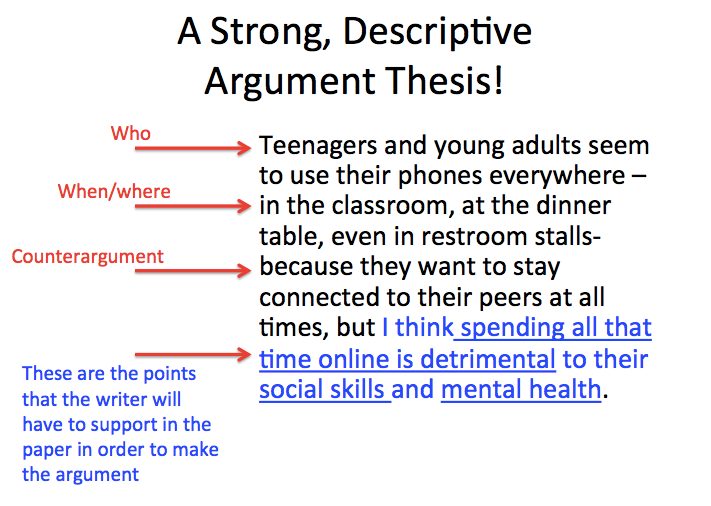
Your thesis is a snapshot or summary of your paper as a whole. Thus, you want your thesis to be something you can unfold or unpack or develop into a much longer work. And if your thesis makes a claim, that means it also answers a question. Thus, you want your thesis to answer or discuss the question as deeply and fully as possible. You can do this grammatically by adding prepositional phrases and “because” clauses that bring out the specifics of your thinking and tell your reader who, what, when, where, how, and/or why:
“Teenagers and young adults seem to use their phones everywhere—in the classroom, at the dinner table, even in restroom stalls—because they want to stay connected to their friends and peers at all times, but I think spending that much time online is detrimental to their social skills and mental health.”
Notice that this thesis, while not substantially different from the draft or working thesis you began with, has been substantially revised to be more specific, supported, and authoritative. It lays out an organized argument for a convincing paper. Because it is so complete and specific, in fact, it can be easily changed if you find research that contradicts your claim or if you change your mind about the topic as you write and reflect:
“Teenagers and young adults seem to use their phones everywhere—in the classroom, at the dinner table, even in restroom stalls—because they want to stay connected to their friends and peers at all times, and research suggests that this connection has primarily positive psychological and emotional benefits.”
Thesis Statement Activity
The following interactive activity uses H5P. While efforts have been made to ensure accessibility, some H5P content may present challenges for users of certain assistive technologies. If you are unable to access or complete the activity, please contact your instructor to request an alternative way to engage with the material.
In this activity, you are asked to choose the best argumentative thesis statement.