Ostentatious and Ordinary: EAC Object Stories
Calvin Hellesen and Miriam Light
Section 1: Harvest 1952.399
By Calvin Hellesen
Metadata
Creator
Liebhold Wallach inc.
Date
1951
Culture
Germany, Munich, 20th century
Medium
Printed cotton, plain weave
Credit Line
The Harold T. Clark Educational Extension Fund
Description
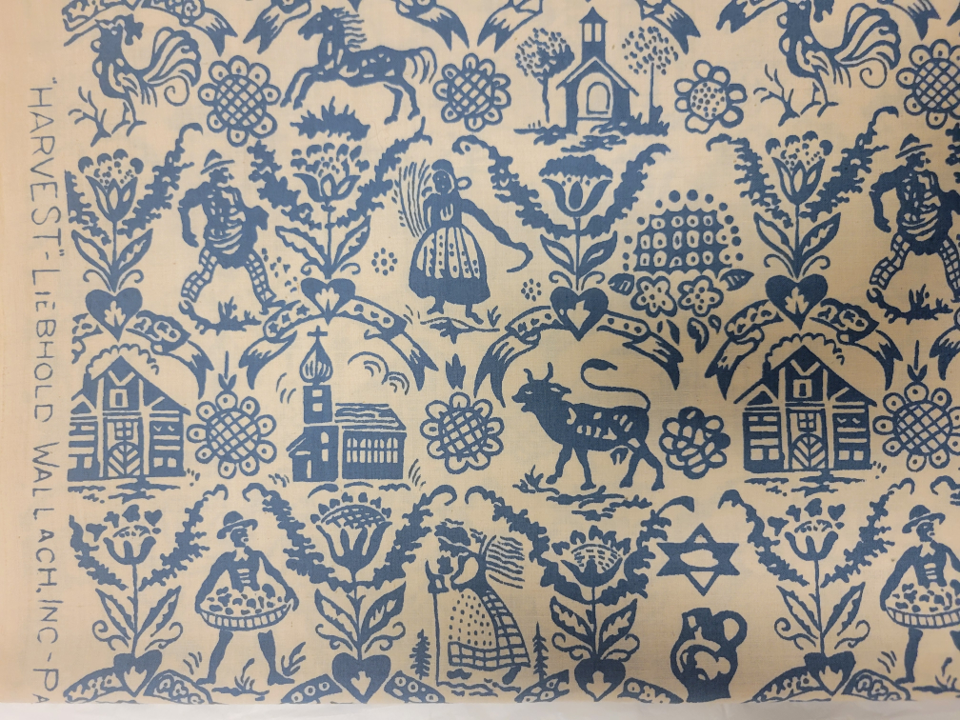
A white fabric with a blue printing of several simple adaptations of German cultural symbols associated with harvest. Includes depictions of a man and a woman, farm animals, houses, places of worship, and bands of flowers and banners in between depictions. Includes one Star of David per repetition of the print in the lower right. Print is repeated several times across the whole piece.
Fun Fact
This print design was not made for the first time in 1951, and had been a sample print of Liebhold and Wallach for an unknown amount of time. The original sampler print, featuring only a small segment of the overall piece, does not feature the Star of David that is so prominent in the final piece.
Click here for a brief 5-minute discussion on the piece
Section 2: An Ethnoreligious Analysis of Jewish Symbolism
By Miriam Light
Magen David (Sheild of David)
There is a large Star of David, in Hebrew called a Magen David (Sheild of David), in the center of this fabric. The star of David is a six-sided star created by two overlapping triangles, one flipped downward while the other points upward. The Magen David is a sign of divine protection, or the inter-relationship between God and humanity within the Jewish religion. During the Holocaust, yellow stars were forced onto the clothing of Jews as a form of discrimination by the Nazi regime. This cloth, made in the 1950s by a Holocaust survivor, now proudly displays the Magen David in the center of the piece, reinventing the symbol as a form of resilience, ethnic pride, and God’s absolute sovereignty.
Ties to Jewish Holidays
Hannukah (Festival of Lights)
There are many elements of this cloth that reflect symbols associated with Hannukah, a Jewish festival of lights that takes place in late Autumn to early Winter every lunar year. First, in the bottom, middle of the image, there is a blue heart with an organic looking negative-space element. The element looks like a triangle that has been flipped upside down and then given a handle. This shape is almost identical to that of a dreidel, a spinning top with four sides. The dreidel is used in a traditional gambling game during Hannukah, where the different Hebrew letters on each side determine how much gelt or money one can take. Wherever the dreidel lands decide one’s fate in the game. The letters are Nun, Gimel, Hey, and Shin.
Nun, or Nisht, means nothing, so the player would not get any gelt. A Nun is geometric in nature, almost looking like a backwards C in the English alphabet if it was more rectangular. In the animal directly below the heart that looks like it is a stylized cow, there is a shape near the nape leading towards the back of the cow that looks identical to the letter Nun.
This could be a mere coincidence, however, look at the center of the woman’s top. This shape looks very similar to a W in the English alphabet, but if you look in the Hebrew, it is a Shin. A Shin means Stell in or put a piece of your gelt into the center of the game.
Next, there is a Hey, meaning Halb, or put half of your gelt into the center of the game, to the right of the blue heart, inside of an organic blue shape to the left of a flower-like figure. The Hey is like a rectangle with no bottom and has a slight break in its line near the top left corner.
The Gimel was the hardest to find. However, if you look to the right of the heart with the leaf -like shape, on the ribbon element, there appears to be a Gimel on its side. In the game of Dreidel, a Gimel means Gantz, or that the player of the game gets all the gelt.
I find it absolutely fascinating that not only is a Magen David present, but a dreidel and all four Hebrew letters found on a dreidel are included in this piece.
Sukkot (Fall Harvest Festival)
Sukkot is a festival of the harvest celebrated in the lunar month of Tishrei. During Sukkot, the Jewish people create Sukkahs, or huts that one can still see the stars through, and preform a ritual where they shake the Etrog, a lemon like citrus fruit, and a Lulav, a frond of a date palm, in all six directions (north, south, east, west, up, and down) as a way of acknowledging God’s divine sovereignty or his presence everywhere all at once, as commanded. It is a celebration of agricultural abundance and thanks to God for providing food and a harvest to His people.
The Etrog, a lemon-like fruit that is shaped like a football, can be seen to the right of the woman who appears to be harvesting grains, in the center of the floral like element. Extending from either side looks almost identical to a Lulav, with its long, extending branches and tightly place, skinny leaves. Even more interesting is the direction in which the viewer’s eyes travel. First up, to where a cloud-like organic shape hovers. Then down, where the heart is. Then, there appears to be not quite perpendicular lines, but lines that outstretch in four different directions. That would mean there was an Etrog and Lulav, with elements guiding the eyes in six different directions surrounding it. Returning to the ritual Jews preform, the Etrog and the Lulav is shook in six different directions as biblically commanded.
While I do not see a representation of a Sukkah on this cloth, I do see three stars in a row above a building with a perpendicular structure on top of it. Three stars is significant because for a Sukkah to be considered kosher, or appropriate to use for Jewish rituals, one must have to look up inside of a Sukkah and see at least three stars. Above the building on this piece, on the right side of the ribbon-like form underlapping the heart, there are three stars. Unlike the Magen David, these are five-pointed stars, typical to ones depicted when thinking of space. These are understood as secular stars or a geometric shape often associated with science, while the Magen David is religious. Including both, however, alludes to the “three-star rule” in Judaism that is not only used on Sukkot, but also used to welcome and conclude Shabbat, the Jewish day of rest.
Conclusion
Looking at the elements, unity is easily created by visual literacy. The word harvest is in the name of the title, and each element flows together to create farm visuals. There is a man and a woman who appear to be carrying crops, hard at work, with the man’s sleeves pulled back to show his muscles. The woman is holding a tool for harvesting and is dressed in a work apron. Farm animals such as roosters, cows, and horses appear in pattern, as well as floral shapes that resemble nature. Combining this secular imagery with more esoteric symbols such as the Etrog and Lulav, along with the three stars, suggests a religious meaning behind this cloth.
Further Reading
Braz, Michael, and Stanley E. Romanstein. “Additional Chanukah Literature (Other Publishers).” The Choral Journal 32, no. 4 (1991): 54–56.
Ding, Peng. “Three Occurrences of the Hyperbolic-Secant Distribution.” The American Statistician 68, no. 1 (2014): 32–35.
Greene, Dana M., and James R. Peacock. “Judaism, Jewishness, and the Universal Symbols of Identity: Re-Sacralizing the Star of David and the Color Yellow.” Studies in American Jewish Literature (1981-) 30 (2011): 80–98.
Rubenstein, Jeffrey L. “The Origins and Ancient History of Sukkot.” In A History of Sukkot in the Second Temple and Rabbinic Periods. Brown Judaic Studies, 2020.
Palm, Rose. “On the Symbolic Significance of the Star of David.” American Imago 15, no. 2 (1958): 227–31.