Assignments
Narrative in the Archive
Shelley Rose
Archives & Narrative Project
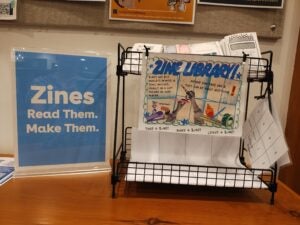
Figure 1: Whitney Britenbucher, Zine Library, Gates Mills Branch | Cuyahoga County Public Library. Photo: Shelley Rose. September 15, 2026.
Overview
The historical profession is grounded in archival research and narratives. Historians conduct primary source analysis, use secondary sources to contextualize and corroborate their findings, and craft narratives that highlight their argument and evidence. In this project you will practice all of these skills through zines. Zines are primary sources and are found in many archival collections. They are typically unpublished or self-published so they fall outside the purview of libraries.
Instructions
Day 1: Archive Visit
- Visit CSU Special Collections during class time. Beth Piwkowski will provide overview of the archives.
- Familiarize yourself with archival documents and how to find them using finding aids.
- (in your learning group) Choose one or two zines showcased in the session to photograph and use as primary sources in your narrative project.
- Think about the steps of historical thinking as you work with the zines
- o Sourcing: Who created it? What is the audience? How do you corroborate this source.
Day 2: Craft Your Narrative
- Review the photographs of your chosen zine from special collections in your learning group.
- As a group, answer the historical thinking worksheet questions using your primary source zine.
- Create your own narrative as a “zine.” You can choose your own topic. Ground your zine in a historical topic or methodology. Possible ideas include zines on historical thinking, a fan-zine about your favorite historian or group of historians, zine about historical debates, Zine about how you use your historical thinking skills in a unique way, zine about what you can do with your degree, etc.
- You may use the physical templates available in class or a digital template such as the Canva mini-zine https://www.canva.com/design/DAGsWR7jvJk/NTaTr8HwlGegAc95E7AU8w/edit. NOTE: All CSU students can use their CSU credentials to sign in to Canva.
- Post your zine to your Teams learning channel by Friday 9/25 at 11:59 pm.
Resources
Celia Perez, “How to Make a Zine: A Kid Friendly DIY Guide,” Brightly. Accessed September 13, 2026. https://www.readbrightly.com/how-to-make-zine/.
Eastern Michigan University, “Your Hands. Your Brain. Your Stories.- Let’s Make a Zine!” Accessed September 13, 2026. https://www.emich.edu/ccw/documents/zineinstructions.pdf .
Heyzine, Flipbook Maker. Accessed September 13, 2026. https://heyzine.com/
Canva, “Mini Zine Template.” Accessed September 13, 2026. https://www.canva.com/design/DAGsWR7jvJk/NTaTr8HwlGegAc95E7AU8w/edit.
Purdue, “Loud on Paper Library Guide: What is a Zine?” Accessed September 13, 2026. https://guides.lib.purdue.edu/loudonpaper/what-is-a-zine.
Products
Share a link to your zine with your class as instructed by your instructor.