Main Body
12 CH 12 – MBA
Introduction
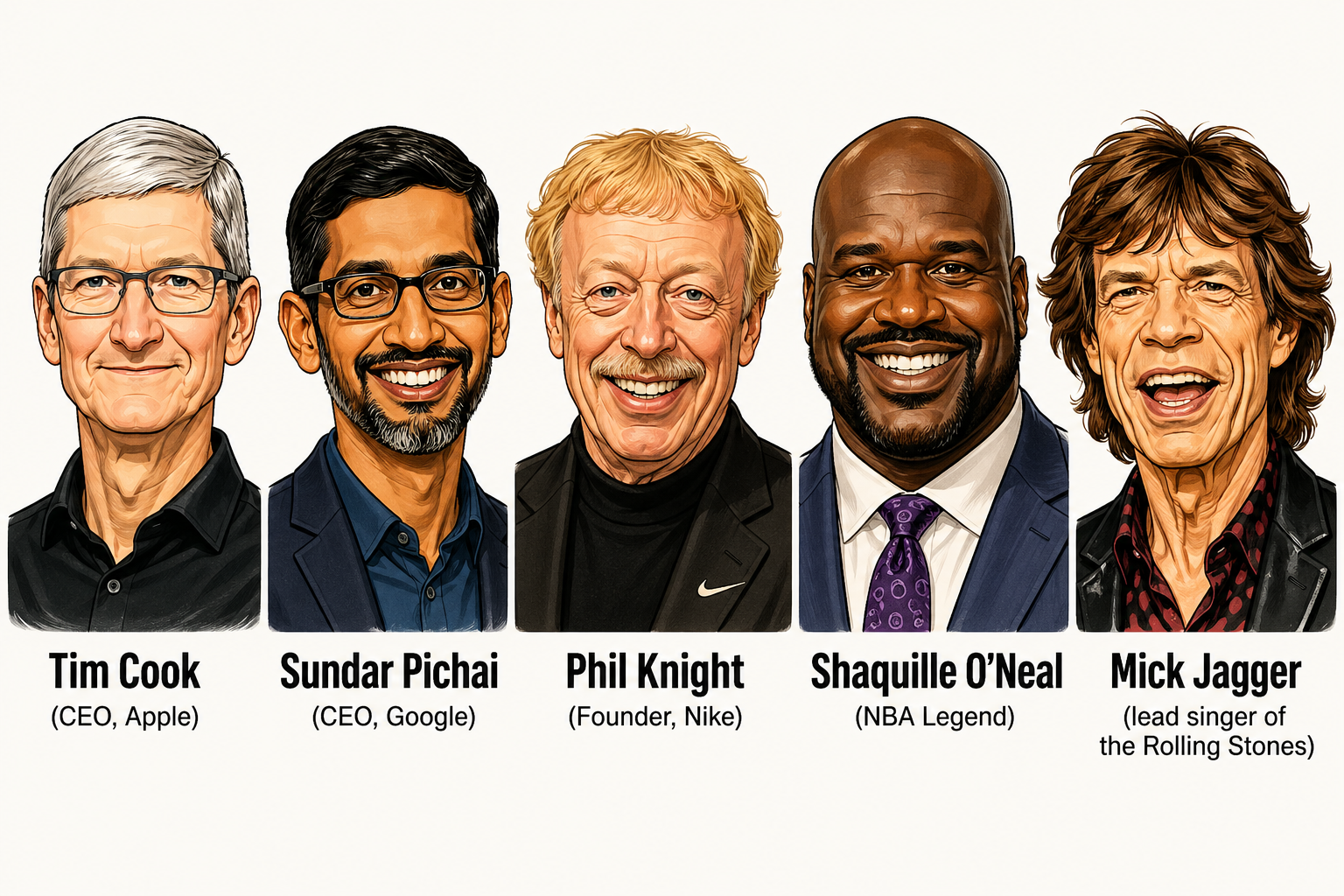
What do these people have in common?!
The MBA
Everything you need to know about the degree that could change your career
Picture this: you graduate with your bachelor’s degree, work for a few years, and then go back to school for two more years. At the end, you walk out with a degree that could bump your salary by $40,000 or more. Sound worth it? That’s the basic pitch for an MBA.
MBA stands for Master of Business Administration. It’s a graduate-level degree designed to sharpen your business skills, build your network, and open doors to higher-level jobs and bigger paychecks. Think of it as a serious upgrade from your undergraduate degree.
From the image up above, you see tech leaders who run the apps, brands, and companies in your life every day; but you also see an NBA star who was quoted saying, “Someday I’ll put down the ball. I needed a backup plan,” and even a famous singer. Most people think rock stars just get lucky and spend all their money. Jagger understood contracts, negotiation, and business from day one, and it showed. The Stones never got taken advantage of the way so many other artists did.
This chapter will walk you through everything you need to know, so that when the time comes, you’re ready to decide whether this is a path for you.
If you’re just starting out, an MBA might feel like a lifetime away. But understanding it now helps you make smarter decisions from day one, like what jobs to take, what skills to build, and how to set yourself up for the fast track.
CHAPTER OUTLINE
12.1: MBA 101: The Basics
Where Does It Fit?
TYPICAL EDUCATION PATH
- Finish your bachelor’s degree
- Get 2 to 5 years of real work experience
- Apply to an MBA program
- Complete the program (usually 2 years full-time)
- Graduate and level up your career
Types of MBA Programs
Not all MBAs are created equal. Here’s a quick breakdown:
| Program Type | Timeline | Best For |
| Full-Time MBA | 2 years | Career changers, big recruiters |
| Part-Time MBA | 3-4 years | Working professionals |
| Online MBA | 2-3 years | Flexibility, lower cost |
| Executive MBA (EMBA) | 1.5-2 years | Senior pros, 10+ years exp |
| Accelerated MBA | 12-16 months | Fast-trackers |
Quick FactThe most common MBA path is full-time, two years, with an internship between year one and year two. That internship is often how students land their post-MBA job. |
12.2: The Money Talk
Let’s be real: this is probably the section you actually care about.
So let’s get into the numbers.
Before vs. After: The Salary Bump
| Career Stage | Average Salary | Notes |
| Pre-MBA (avg) | $65,000-$75,000 | Varies by industry |
| Post-MBA (avg) | $115,000-$130,000 | Source: GMAC 2023 |
| Top MBA Grad (M7) | $175,000+ | Consulting/Finance/Tech |
Hottest Industries for MBA Grads
- Management Consulting: Consulting
Think McKinsey, BCG, Bain. Starting salaries of $190,000+ with bonuses. Brutal hours, but the pay is real.
- Investment Banking/PE: Finance
Goldman Sachs, JP Morgan, private equity firms. Expect $150,000 to $200,000+ right out of school.
- Big Tech: Tech
Google, Amazon, Meta, Microsoft all recruit MBA grads heavily. Product management roles often start around $160,000 to $180,000.
- Brand Management: Consumer Goods
Companies like P&G and Unilever hire MBAs to manage brands. Slightly lower pay but strong work-life balance.
ROI Reality CheckThe average top-20 MBA program costs $100,000 to $150,000 in tuition. That sounds like a lot. But if your salary jumps by $50,000 a year, you break even in about 2 to 3 years. Over a 30-year career, the financial return is massive. |
12.3 What You Actually Learn
Forget the stuffy textbooks. MBA programs are actually pretty hands-on.
Here’s what a typical curriculum looks like:
Core Classes (Everyone Takes These)
| Subject | What It Covers | Why It Matters |
| Financial Accounting | Reading financial statements, P&L | Know if a company is healthy |
| Corporate Finance | Valuation, capital structure | How money moves in business |
| Marketing Management | Strategy, consumer behavior | Selling stuff at scale |
| Operations | Supply chains, process design | How businesses actually run |
| Organizational Behavior | Leadership, team dynamics | Managing people is hard |
| Business Strategy | Competitive advantage, growth | The big picture thinking |
| Statistics/Data Analysis | Decision-making with data | Data runs the world now |
Electives (You Pick These)
After your first year, you get to focus on what actually interests you.
Common elective tracks include:
- Entrepreneurship and startups
- Healthcare management
- Real estate
- Social impact and nonprofit management
- Luxury goods and retail
- Technology and innovation
The Real Classroom: Beyond the Lectures
Some of the best learning in an MBA program happens outside the classroom:
- Case Studies: You analyze real business problems from companies like Netflix, Nike, or Apple and figure out what you’d do differently.
- Group Projects: You’ll work constantly in teams, which is annoying sometimes but mirrors exactly what real jobs are like.
- Guest Speakers: CEOs, VCs, and executives come in to share war stories. It’s basically free mentorship.
- Consulting Projects: Many programs let you work on actual problems for real companies for course credit.
Soft Skills Are the SecretMBA programs are just as much about communication, leadership, and negotiation as they are about spreadsheets. The ability to walk into a room, present an idea confidently, and persuade people is worth its weight in gold. |
12.4 The Application Process
Getting into a top MBA program is competitive.
Here’s what schools are actually looking for and how the process works.
When to Apply
Most applicants have 2 to 5 years of work experience before applying. You CAN apply right out of undergrad, but most schools prefer that you’ve actually worked in the real world first. The typical application timeline is to start preparing 12 to 18 months before your target start date.
What Schools Look For
- GPA: There’s no hard cutoff, but top programs average around 3.5 to 3.7. A lower GPA can be offset by strong work experience or a high test score.
- GMAT or GRE: The GMAT is the traditional MBA admissions test. Most top programs accept the GRE too. Average GMAT scores at elite schools range from 720 to 740 (out of 800).
- Work Experience: Quality matters more than quantity. Leadership, impact, and progression in your career carry a lot of weight.
- Essays: This is where your personality has to come through. Schools want to know who you are, why you want an MBA, and what you plan to do with it.
- Letters of Recommendation: Usually 2 to 3 from managers or colleagues who can speak to your work and character.
- Interviews: If you get this far, congratulations. Schools want to confirm you’re who you say you are on paper.
School Tiers: A Quick Breakdown
| Tier | Schools | Avg Starting Salary |
| M7 (Elite) | Harvard, Wharton, Stanford, Booth, Kellogg, Sloan, Columbia | $175,000+ |
| Top 25 | Tuck, Ross, Fuqua, Anderson, Darden, Stern, etc. | $120,000-$160,000 |
| Regional Programs | Strong local reputation, more affordable | $80,000-$110,000 |
You Don’t Need a Business Degree to Apply!Seriously. MBA programs love diverse backgrounds. Engineers, nurses, teachers, and liberal arts majors all get in. In fact, having an unusual background can make you stand out in the application process. |
12.5 The MBA Experience
Okay, so you’ve been accepted. Now what?
The MBA experience is a lot more than just classes. It’s basically two years of intense professional development, networking, and figuring out your next move.
The Cohort Model
Most MBA programs group you into a cohort of 60 to 90 students who take the same classes together in the first year.These are your people.You’ll study together, stress together, celebrate together, and honestly, they’ll probably be some of your closest professional contacts for the rest of your career. Alumni networks from top programs are incredibly powerful.
Recruiting and Internships
One of the biggest reasons people get an MBA is access to recruiting. Companies like McKinsey, Goldman Sachs, and Amazon come directly to campus and interview students. Your first-year summer internship is huge because it’s often a direct path to a full-time offer. This is why choosing the right program matters: better school usually means better recruiting access.
Clubs, Treks, and More
MBAs are not just hitting the books. There’s a whole ecosystem of clubs, events, and travel:
- Clubs: Investment clubs, tech clubs, social impact clubs, consulting clubs. There’s something for every interest.
- Treks: Organized trips to cities like New York, San Francisco, or even international destinations to meet companies and explore industries.
- Case Competitions: Compete against teams from other schools to solve a real business problem. Great for your resume … and your confidence.
A Typical Week in MBA Life
| Day | What’s Happening |
| Monday | Morning classes, afternoon recruiting prep or club meeting |
| Tuesday | Case study group session, career center workshop |
| Wednesday | Classes, company info session in the evening |
| Thursday | Group project work, networking event or social |
| Friday | Half day of classes, start of the weekend hustle |
| Pro Tip
The MBA social scene is real. Happy hours, dinners, weekend trips, startup competitions. You’ll be busy. Time management becomes one of the most important skills you develop. |
TESTIMONIALS OF MBA GRADS
Matthew Smith, MBA
When I graduated with a bachelor’s degree in Telecommunications, earning an MBA was not part of the plan. At the time, I was working full-time as an assistant manager for a movie theater company and making $12 an hour. The company offered to pay for a master’s degree as long as it related to my job, and an MBA certainly qualified. It seemed like an opportunity worth taking, especially knowing that it could open doors later, even though I had no idea where my career would eventually lead.
I began the online MBA program through Florida Institute of Technology in 2011 while continuing to work full-time. Money was so tight that I could not afford a laptop. During my entire first semester, I wrote papers, completed coursework, participated in online discussions, and even took exams on a cell phone with a five-inch screen. Balancing graduate school with a full-time management job was not easy, but it taught me that progress does not require perfect circumstances. Sometimes you simply have to use what you have and keep moving forward.
While completing the program, I continued moving up in the movie theater industry and eventually became the general manager of several locations. Then, in 2014, another theater company advertised a Director of Operations position that required applicants to have an MBA. I was hired and moved from managing individual theaters to overseeing operations for a multimillion-dollar company with hundreds of employees. That was the first time I saw the degree directly open a door that otherwise may not have been available to me.
Life changed direction again in 2016 after a one-week mission trip to Haiti. By the end of that week, I felt strongly that God was calling me to leave my career and move there full-time. It was not the direction I had expected my life to take, and I assumed that my MBA probably would not be especially useful in mission work.
That assumption turned out to be completely wrong.
My wife and I founded The CAMP Haiti, Inc., a nonprofit community center serving children and teenagers in Cayes-Jacmel, Haiti. For nearly ten years, we have served as its in-country directors. The business knowledge gained through the MBA helped us incorporate the organization, create strategic plans, manage accounting and budgets, develop our own branding and marketing materials, handle legal and administrative needs, and build systems that allowed the ministry to grow. It also helped us avoid thousands of dollars in outside costs because we were able to handle much of the business work ourselves rather than having it outsourced.
In 2026, another unexpected opportunity came through a simple conversation with a friend in Port-au-Prince. Quisqueya Christian School, widely recognized as the leading private American school in Haiti, was searching for a Director of Finance & Administration. After interviewing with the Head of School, I was offered the position on the spot.

Today, my responsibilities include finance, budgeting, accounting, human resources, operations, internal controls, risk management, strategic planning, and the school’s long-term financial sustainability. The setting is very different from the movie theater industry, but many of the leadership, financial, and problem-solving skills developed during the MBA program are still part of my daily work.
Completing the MBA while working full-time and dealing with financial limitations also changed the way I viewed education. Finishing the degree under those circumstances gave me the confidence to continue learning and later earn a Master of Arts in Theology.
Looking back, it is remarkable how useful the degree has been across three very different areas of life. It opened doors in the corporate world, helped my wife and me build and operate a nonprofit, and prepared me for leadership in international education. An MBA may not determine where life leads, but it can provide practical skills, confidence, and opportunities that remain valuable wherever that journey takes you.
Matthew Smith, MBA
Director of Finance & Administration
Haiti Quisqueya Christian School
David Navy, MBA
I worked on my University of Dayton MBA in the evenings while working for the Comptroller of the Currency (OCC) as a Bank Examiner. The OCC paid for the courses that were considered to improve my examining skills such as Managerial Accounting. My goal during the three years was to obtain this degree to help me compete for future promotions and opportunities. I also wanted to learn more about business and be able to teach business classes in the future. I worked on a team project and presentation and experienced all the issues that go with completing a project with people from different backgrounds, careers, and schedules. 
During my banking career I always felt like I had a competitive background as I advanced in my career and competed for new positions. I was able to advance to managerial/team lead positions in the areas of bank examination, bank credit risk review and commercial credit underwriting.
In 2019 I started teaching business classes at Cleveland State University. This allowed me to make numerous connections with people who can cover other subjects like entrepreneurship to help students with their business careers. Last fall, I worked as a judge for Start Up Vikes to help select the student team with the best new business idea.
I would recommend an MBA to anyone for the business coursework, contacts, and experiences. The degree will help you compete for positions and opportunities and enable you to teach business classes.
David Navy, MBA
Business Professor
Cleveland State University
More Testimonials of MBA grads
….coming soon!
12.6: Is It Worth It?
Real Talk
Honestly, an MBA is not the right move for everyone.
Let’s break it down.
The Costs
Tuition: Top programs can run $80,000 to $100,000 per year. Add in living expenses and you could graduate with $150,000 to $200,000 in debt.
Opportunity Cost: Two years out of the workforce means two years of lost salary and work experience.
Time: It is intense. You will be stretched. If you have big family obligations or health concerns, that matters.
When an MBA Makes Total Sense
- You want to break into a new industry (like finance or consulting) and the MBA is the standard entry point.
- You want to move into management and leadership roles faster.
- You want access to a powerful alumni network and top recruiters.
- Your company is willing to sponsor part of your tuition.
When an MBA Might NOT Be the Move
- You’re already on a fast track in your current career and the degree wouldn’t add much.
- You want to start a company. Many successful entrepreneurs skip the MBA entirely.
- The cost doesn’t make financial sense given your target industry’s salary range.
- You’d rather spend that time getting promoted and gaining real experience.
Alternatives Worth Knowing
- Specialized Master’s Degrees (like a Master of Finance or Master of Marketing): cheaper, faster, focused.
- Online certifications from Coursera, LinkedIn Learning, or Google: low cost, high flexibility.
- Just working hard and getting promoted: underrated strategy.
Quick Quiz: Should You Get an MBA?
Ask yourself these three questions: (1) Do I want to change industries or move into senior leadership? (2) Is the ROI worth it given my career goals? (3) Am I ready to commit 2 years and potentially $150,000+?
If you answered yes to all three, it might be time to start researching programs. |
12.7 How to Start Thinking About It NOW
Set Yourself Up Starting Now
You don’t need to decide today whether you want an MBA.
But the actions you take in the next few years will make a big difference in your options later.
Here’s how to think about it:
Build the Right Resume
- Take on leadership roles whenever you can, even in clubs and organizations right now.
- Look for work experiences that show growth, impact, and responsibility.
- Quantify your achievements: numbers tell a story that vague descriptions don’t.
Keep Your GPA Up
It doesn’t have to be perfect. But a strong undergrad GPA gives you more options later. If you’re struggling, prioritize your core business classes since those are what MBA programs pay most attention to.
Start Exploring Programs
- Check out rankings fromUS News,Poets & Quants, and theFinancial Times.
- Research schools based on what you want to do after, not just prestige.
- Look into GMAT prep resources likeManhattan PreporTarget Test Prep.
*I recommend:Cleveland State University MBA program!
Heads Up
Some companies have MBA sponsorship programs where they pay for part or all of your MBA if you commit to working for them afterward. Ask about these when you’re evaluating job offers. It’s a massive financial advantage.
Chapter Recap / Key Takeaways
• An MBA is a graduate business degree that can significantly boost your salary, expand your network, and open doors to leadership roles.
• Most programs take 2 years and require prior work experience. There are also part-time and online options.
• Top MBA grads in consulting, finance, and tech can earn $150,000 to $200,000+ right out of school.
• The core curriculum covers finance, marketing, strategy, operations, and leadership. Electives let you specialize.
• Getting in requires strong test scores (GMAT/GRE), work experience, compelling essays, and recommendations.
• An MBA is worth it for career changers, future leaders, and people targeting high-paying industries. It’s not for everyone.
• Start preparing now by building leadership experience, keeping your GPA solid, and exploring programs that fit your goals.
Words to Know
💡 Discussion Questions
- What career goals might make an MBA worth the investment for you personally?
- Looking at the salary data, which industry would you want to target with an MBA and why?
- What are the biggest risks of getting an MBA? What would you need to know before committing?
- If an MBA is not the right path, what other options could help someone advance their career?
- What steps could you start taking RIGHT NOW to set yourself up for a strong MBA application someday?