Main Body
1 CH 1 – General Business
Business Is Everywhere
How the World of Commerce Shapes Your Life
Think about the first 10 minutes of your day. You woke up, checked your phone (Apple? Samsung?), scrolled social media (Meta? IG?), maybe ordered coffee through an app. Before you even got dressed, you had already interacted with dozens of businesses.

Business is not some abstract thing that happens in boardrooms far away from you. It is the fabric of everyday life. And understanding it might be the most practical thing you do in college. Let’s dig in.
CHAPTER OUTLINE
Section 1: What Even Is Business?
Core definitions
Section 2: Why Business Actually Matters
Connecting business to what you actually care about
Section 3: The Four Building Blocks – Factors of Production
The “ingredients” every business needs.
Section 4: A (Brief, Actually Interesting) History of Business
A walk through of the five eras in order; each told as a mini-story with a clear “so what?”
Section 5: The World Business Operates In
The five environments as interconnected forces, not isolated definitions
Section 6: Communication Is a Business Skill
Why communication matters, the power of nonverbal cues, barriers that derail messages, and how to write high-impact messages….Hint- it’s not about you.
Closing Activity: Connect Your Passions to a Career
Motivational and personal reflection activity
1.1: What Is Business, Anyway?
Before we go any further, let us get on the same page with a few key terms. These are not just vocab words for a quiz. They are the rules of a game you are already playing.
|
|
Any organization or activity that provides goods or services in an effort to earn a profit. |
|
|
Money earned from sales (revenue) minus expenses like materials and salaries. Revenue – Expenses = Profit (or Loss). |
Here is the thing about profit: it is not a dirty word. Profit is what allows businesses to grow, hire people, pay taxes, and yes, take risks on new ideas. No profit, no business. It is that simple.
|
|
What happens when a business spends more than it earns. Every business faces this risk. |
|
|
Someone who risks their time, money, and energy to start and run a business. |
*Real Talk = Entrepreneurs do not just start businesses for the money. They spot problems and build solutions. Every company you love, from Nike to Netflix, started with someone who saw a gap and took a risk.
1.2: Why Business Actually Matters
So why should you care? Because business affects your everyday life more than almost anything else.
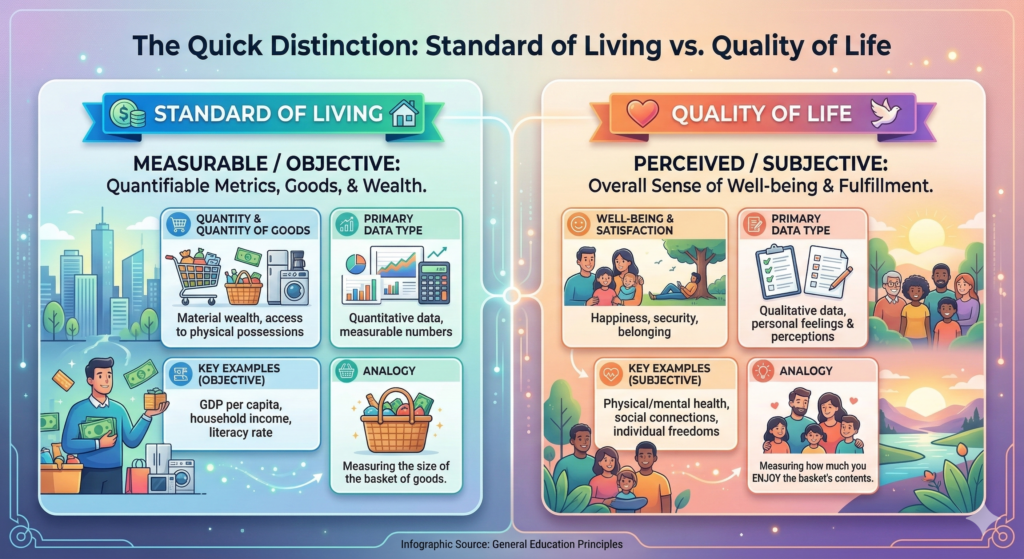
These two ideas sound similar, but they mean different things.
|
|
The quality and quantity of goods and services available to a population. |
|
|
The overall sense of well-being experienced by an individual or a group. |
Business raises both. More businesses competing means more products, lower prices, and better options. And when businesses pay taxes, that money funds schools, roads, hospitals, and public parks. Some companies go even further, actively investing in the communities they operate in.
Businesses don’t just sell things. They solve problems. And when they solve problems in entirely new ways, something bigger happens: innovation.
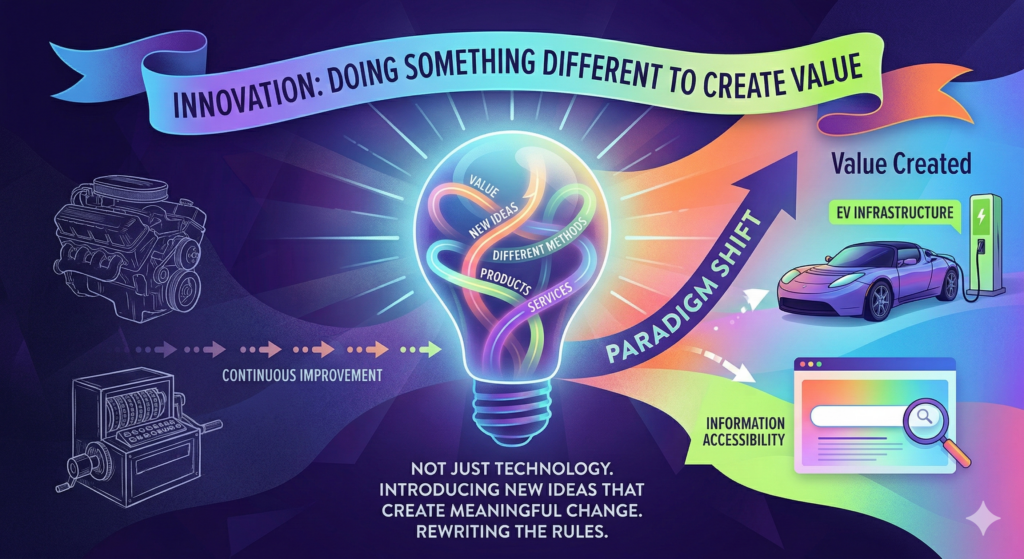
: Doing something different to create value
Innovation is not just about technology. It is about introducing a new idea, method, product, or service that creates meaningful change.
Consider Tesla’s bet on electric vehicles in 2008, when most people thought it was a long shot. Or Google launching a search engine in 1998 and completely changing how humans find information. Both were paradigm shifts, meaning they did not just improve on what existed…. they rewrote the rules.
1.3: The Four Building Blocks of Business
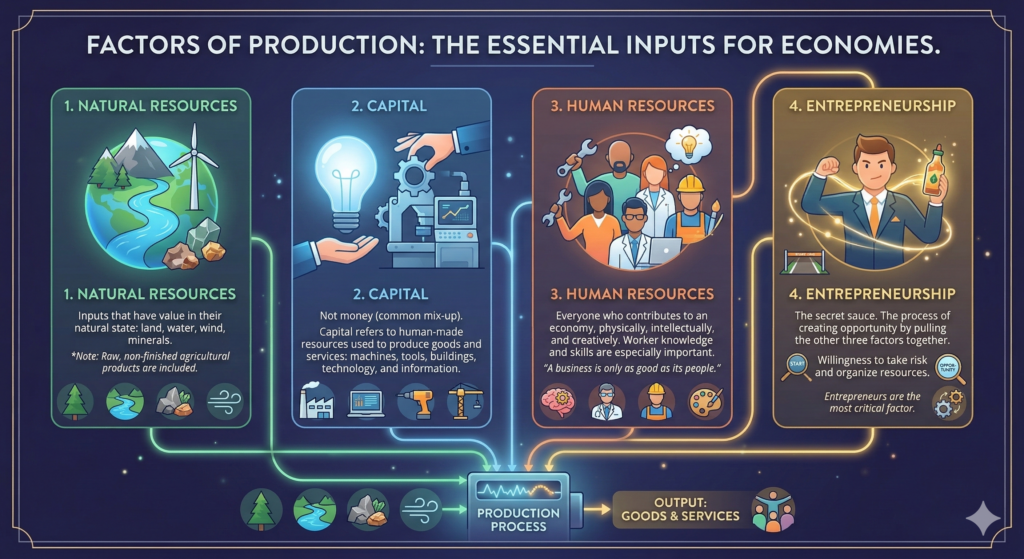
Every business, from a lemonade stand to Amazon, needs the same four fundamental ingredients to operate. These are called the Factors of Production.
1.
Inputs that have value in their natural state: land, water, wind, minerals. Note that this does not include finished agricultural products, just the raw stuff from nature.
2.
Not money (that is a common mix-up). Capital refers to the human-made resources used to produce goods and services: machines, tools, buildings, technology, and information.
3.
Everyone who contributes to an economy: physically, intellectually, and creatively. Worker knowledge and skills are especially important here. A business is only as good as its people.
4.
This is the secret sauce. Entrepreneurship is the process of creating opportunity by pulling the other three factors together. Without someone willing to take a risk and organize resources, nothing happens. This is why entrepreneurs are considered the most critical factor of all.
1.4: A (Brief, Actually Interesting) History of Business
To understand where business is today, it helps to know where it came from. American business has moved through five distinct eras, each one a reaction to what came before.
The Industrial Revolution: A Total System Reboot
New machines replaced skilled craftsmen. Factories replaced workshops. People flooded into cities. Everything changed fast, and people were equal parts excited and terrified.
From the mid-1700s to the mid-1800s, America industrialized fast. New machines changed how people worked, old jobs disappeared, new ones appeared, and society reorganized around factories. It was exciting, disorienting, and absolutely transformative.
The Entrepreneurship Era: The Original Startup Boom
Giant business empires rose. Railroads, steel, and oil created the first mega-wealthy Americans. Competition was wild and mostly unregulated.
In the second half of the 1800s, new technology opened the door to entire new industries. Railroads. Steel. Oil. A small group of entrepreneurs built massive companies and changed everyday life.
- Cornelius Vanderbilt built a railroad empire that connected the country.
- John Rockefeller dominated the oil industry through Standard Oil.
- Andrew Carnegie controlled more steel production than any single person in U.S. history.
Competition was fierce, and there were almost no rules yet. It was messy, exciting, and sometimes deeply unfair to workers and consumers, which is exactly why the government eventually stepped in with regulation.
Spotlight: Andrew Carnegie, A Walking Contradiction
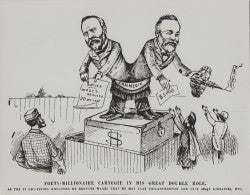
Carnegie started with nothing and became one of the wealthiest men of his era. He revolutionized the steel industry, building factories that made steel faster and cheaper than anyone thought possible.
But he also crushed labor unions and paid workers as little as possible. He was, by many accounts, ruthless.
Then, in the final decades of his life, he gave almost all of it away. He funded over 3,000 public libraries, endowed universities, and became one of history’s greatest philanthropists.
Carnegie Mellon University bears his name. So does Carnegie Avenue in Cleveland. His story raises a question worth sitting with: Can a person do great harm and great good at the same time? Business history is full of people like this.
The Production Era: Make It Fast, Make It Cheap
Mass production became king. Make it fast, make it cheap, sell as much as possible. Customer opinions? Not really the priority.
In the early 1900s, businesses got obsessed with efficiency. Ford’s assembly line became the gold standard. The idea was simple: produce enormous quantities at low cost and sell them to as many people as possible.
It worked, until it did not. Companies that ignored what customers actually wanted left the door wide open for competitors who did not make the same mistake. The Great Depression and World War II accelerated the shift.
The Marketing Era: It’s Not About What We Want to Make
Businesses finally started listening to customers. The focus shifted from what companies wanted to make to what customers wanted to buy.
Starting in the 1940s, businesses had a realization: customers have power. If your product does not solve their problem, they will find someone else whose does.
The 1950s economic boom exploded with this new mindset. The economy grew 37% during the decade. Unemployment stayed around 4.5%. Iconic brands launched one after another.
- 1940: McDonald’s
- 1945: U-Haul
- 1948: Dick’s Sporting Goods
- 1950: Dunkin’ Donuts
- 1953: Sonic Drive-In
- 1958: Trader Joe’s
- 1962: Walmart
- 1964: Nike
Advertising got smarter too. Instead of just listing product features, ads started selling lifestyles and emotions. The TV show Mad Men captures this era perfectly, if you want a vivid (and sometimes uncomfortable) look at 1960s marketing culture.
The Relationship Era: Your Customer Is Your Marketing Team
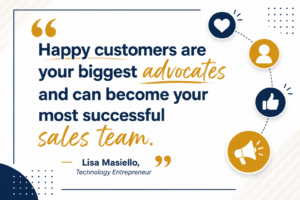
The goal is not just a sale. It is a loyal customer for life. Happy customers are your best marketing team.
Today, the smartest businesses are not just chasing transactions. They are building relationships. A loyal customer who tells their friends about you is worth far more than a one-time buyer. Social media has made this even more powerful, and more complex.
1.5: The World Business Operates In
No business exists in a vacuum. Every company operates within multiple overlapping environments, and what happens in those environments shapes every decision a business makes.
The Economic Environment
Governments actively shape the economic environment through legislation, spending, and regulation. A key feature of the U.S. economy is the ability to enforce contracts, meaning if someone agrees to do something in writing, there are legal consequences for backing out.
Economic instability, corruption, and unethical business practices can damage the entire environment, not just individual companies. The economy is connected.
Example: The bipartisan CHIPS and Science Act (2022) invested billions in U.S. semiconductor manufacturing to strengthen the American tech supply chain. One law, massive ripple effects across dozens of industries.
The Competitive Environment
Global competition has never been more intense. To win, businesses focus on creating value, meaning the benefits of a product must be equal to or greater than what the customer pays.
Speed-to-market matters too. The faster a company can move from idea to product in customers’ hands, the bigger the competitive advantage.
|
|
|
|
Innovative AND reliable enough to use now. Risk level: Lower Examples: First iPhone, cloud computing in the 2010s, AI plagiarism detection tools. |
So new it is experimental and often unstable. Early adopters may “bleed” money. Risk level: Very High Examples: VR classrooms in 2016, blockchain for everything, quantum computing for startups today. |
Big opportunities often come from reframing the problem. The $5 Stanford Experiment is a famous entrepreneurship and innovation exercise created at Stanford University that highlights resourcefulness and how constraints can sometimes force creativity to get ahead in a competitive environment.
The Technology Environment
Digital technology has not just changed business. It has remade it entirely. New industries emerge constantly while others become obsolete.
|
|
Business transactions conducted online, typically via the internet. |
E-commerce growth was already accelerating before 2020. Then the COVID-19 pandemic hit, and online shopping exploded almost overnight. Businesses that had not invested in digital channels scrambled to catch up. Many did not make it.
E-commerce, however, is projected to grow. US Ecommerce Market Size, Forecast Report (2026-2031)
The Social Environment
Business does not happen in a cultural vacuum. The values, attitudes, customs, and beliefs of a society influence what people buy, who they buy from, and what they expect from companies.
Example: A few years ago, Stanley tumblers exploded in popularity on social media. As demand grew, stores sold out, competitors introduced similar products, and retailers adjusted their inventory to keep up…. at times even getting a little out of hand. Businesses constantly watch social trends because consumer preferences can change almost overnight.
|
|
Measurable characteristics of a population: size, density, age, gender, race, and more. |
The Global Environment
Technology and free trade have effectively erased many of the old boundaries between national economies.
|
|
International trade without extra taxes (tariffs), import limits (quotas), or excessive barriers between countries. |
The logic of free trade: each country produces what it does best, then trades. Everyone gets more variety at lower prices. The U.S. currently has active trade agreements with 20 countries, including Canada, Mexico, South Korea, and Australia. The USMCA (United States-Mexico-Canada Agreement) alone covers over 85% of U.S. trade with those two neighbors.
GATT and the WTO: A Quick Explainer
You will hear about GATT (General Agreement on Tariffs and Trade) in business classes. Here is the short version:
GATT was created in 1947 to reduce tariffs and make international trade easier. In 1995, it was absorbed into the World Trade Organization (WTO), which is the permanent institution that oversees global trade rules today.
Think of it this way: the WTO is the house. GATT is one of the main rooms inside it. GATT still governs trade in physical goods. Other agreements inside the WTO handle services and intellectual property.
The global environment also brings real risks. Economic nationalism, rising geopolitical tensions, climate-related disruptions, and global health crises (COVID-19) can all send shockwaves through international trade almost instantly.
1.6: Communication Is a Business Skill
Here is something no one tells you enough:

Strong communication affects your relationships, your reputation, your ability to lead, and your effectiveness in almost every role you will ever hold. It is not soft. It is essential.
It Is Not Just What You Say. It Is How You Say It.
Most people focus on the words. But communication has two channels running simultaneously.
|
|
The words you choose, your tone, your pace, and your vocabulary. |
|
|
Everything that is not words: eye contact, posture, facial expressions, gestures, and silence. |
Research consistently shows that nonverbal signals carry at least as much weight as words, often more. A confident message delivered with crossed arms and zero eye contact will land very differently than the same message delivered with open body language and direct engagement.
The goal of nonverbal communication is simple: reinforce your message. Everything your body does should support what your words are saying, not contradict it.
Barriers That Break Down Communication
Even with the best intentions, messages get lost. Here are the most common culprits:
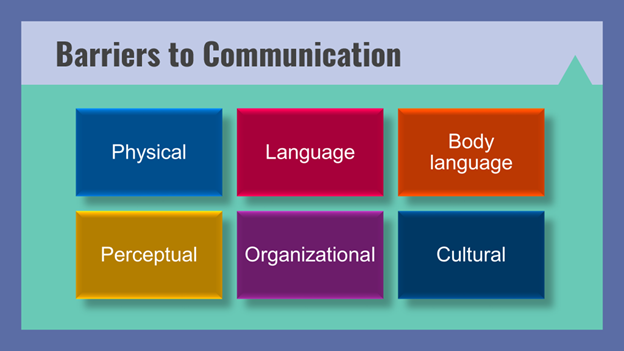
- Room temperature, seating, document appearance. If someone is uncomfortable, they are not fully listening. (Physical)
- Jargon, slang, accents, or a completely different language. Example: saying ‘it’s fixin’ to rain cats and dogs’ to someone from another region. They may nod and have no idea what you mean. (Language)
- Crossed arms, lack of eye contact, or nervous ticks all send signals you may not intend. (Body Language)
- Different points of view or hidden agendas affect how a message is received. (Perceptual)
- Unspoken workplace rules, rigid hierarchies, and physical location all shape communication. *Unspoken rule example: do not block doorways. Do not scroll someone’s phone when they show you something. (Organizational)
- Different cultures have very different norms around greetings, eye contact, dress, and directness. Intercultural communication requires awareness and humility. A handshake in one country is a bow in another and a kiss on both cheeks in a third. (Cultural)
Know Your Audience
This is possibly the most important rule in all of communication:
It is not about you. It is about your audience.
Before you write an email, give a presentation, or make a pitch, ask: Who is receiving this? What do they already know? What do they care about? What do they need from me?
When you understand your audience, you save time, avoid confusion, and dramatically increase the chances that your message actually works.
Writing High-Impact Messages
Good business writing is not about sounding impressive. It is about being clear, fast, and easy to act on. Here is what that looks like in practice:
- Use plain language, active voice, personal pronouns, and contractions. Write like a smart human, not a corporate robot. Strike the right tone.
- Grammar mistakes distract your reader and undermine your credibility. One typo can shift the focus from your idea to your error. Proofread.
- Skip the indents. Leave a space between paragraphs. It looks clean and professional. Use block paragraphs.
- Headings & Bullets increase skim value. Most business readers are moving fast. Help them find what they need quickly. Use headings and bullets.
Ch1 Closing Activity
Connect Your Passions to a Career
You just covered a lot of ground. Before you close this chapter, take a few minutes to connect what you have learned to your own life.
3 Step Exercise
Step 1: Write down three things you love to do. Think about what energizes you, what you would do even if no one paid you. Hobbies, skills, activities you genuinely enjoy.
Step 2: For each passion, brainstorm business careers that connect to it. Even if the connection feels like a stretch, write it down. If you love traveling, think about hospitality, tourism, global marketing, or logistics.
Step 3: Ask yourself: What is stopping me? Name the barrier. Is it money? Time? Confidence? Not knowing the next step? Once you can name an obstacle, you can start planning around it.
Here is the thing about passions: they are not just hobbies. They are clues. Every career starts with someone daring to connect what they love with what they do. You are already doing that work right now growing your knowledge in the college classroom. Take advantage of the opportunities presented to you during your academic journey; have coffee with a business professional, go to your professor’s office hours, keep up to date on current events.
Dream big. The rest of this course is here to help you figure out how.
EXTRA LEARNING RESOURCES
Any organization or activity that provides goods or services in an effort to earn a profit.
Money earned from sales (revenue) minus expenses like materials and salaries.
When a business spends more than it earns
Someone who risks their time, money, and energy to start and run a business.
The quality and quantity of goods and services available to a population.
The overall sense of well-being experienced by an individual or a group.
Doing something different to create value
Land, water, wind, minerals; inputs that have value in their natural state
Human-made resources used to produce goods and services: machines, tools, buildings, technology, and information
Everyone who contributes to an economy: physically, intellectually, and creatively
The process of creating opportunity by pulling together natural resources, capital, and human resources
Innovative and reliable product
A product that is so new, it is experimental and often unstable
Business transactions conducted online
Measurable characteristics of a population: size, density, age, gender, race, and more
International trade without extra taxes (tariffs), import limits (quotas), or excessive barriers between countries
The words you choose, your tone, your pace, and your vocabulary
Eye contact, posture, facial expressions, gestures, and silence