Main Body
4 CH 4 – Management
Introduction
The Make-or-Break Factor in Every Business

Picture this: You’ve landed your dream job. The company is exciting, the pay is good, and you were thrilled on day one. But six months later, you’re dreading Monday mornings. The work hasn’t changed. The pay hasn’t changed. So, what has?
Your manager has.
Here’s a sobering reality. Studies show that the number one reason employees quit their jobs isn’t pay. It’s their manager. That means every year, billions of dollars walk out the door not because of bad products or tough markets, but because of bad management. Companies lose their best people not to competitors, but to poor leadership sitting one desk away.
That’s the power of management done right.
Now flip that around. Think about the best boss you’ve ever had or ever heard of. Chances are they didn’t just tell people what to do. They inspired them. They had a vision. People wanted to follow them.
How many of you plan to have a job someday, and how many of you plan to keep it? Better yet, how many of you plan to lead others someday?
Whether you end up in marketing, finance, healthcare, or running your own business, one truth cuts across every industry: people don’t leave companies. They leave managers. And the good news? Great management is a skill, and like any skill, it can be learned.
That’s exactly what this chapter is about.
CHAPTER OUTLINE
4.1: Why Management Matters
Universal application across all business functions
Connects economics, psychology, ethics, and strategy
Real-world decision-making relevance
4.2: The Management Hierarchy
Top, middle, and first-line management roles
How responsibility and planning differ at each level
4.3. The Four Core Functions of Management
Planning
Organizing
Leading
Controlling
4.4: Planning in Depth
Strategic, tactical, and operational planning
Mission statements: purpose and best practices
SWOT Analysis as a planning tool
Strategic goals and implementation
Contingency planning
Short story hook: Blockbuster vs. Netflix
4.5: Essential Management Skills
Technical skills
Human skills
Conceptual skills
How skill priorities shift across management levels
4.6: Organizing the Business
Organization charts
Centralized vs. decentralized structures
Span of control
4.7: Leading and Motivating
A. Theories of Motivation
Maslow’s Hierarchy of Needs
Theory X vs. Theory Y (McGregor)
Expectancy Theory (Vroom)
Equity Theory (Adams)
B. Modern Motivation Practices
Work/life balance and company culture
Nontraditional employee benefits
Job enrichment (with examples)
4.8: Leadership Styles
Democratic
Autocratic
Free-rein (Laissez-faire)
Characteristics of effective leaders
4.1: Why Management Matters
Think about every job you will ever have. You will work alongside other people. You will be part of a team, a department, or an organization. You will have deadlines, limited resources, and goals to hit. And at some point, whether you are ready for it or not, someone will look to you for direction.
That is management. And it matters more than most people realize.
Management is not just a job title or a corner office. It is the force that turns a group of individuals into a functioning, productive team. It is what separates a company that thrives from one that merely survives. Without effective management, even the best ideas, the strongest products, and the most talented employees will fall short of their potential.
IRL EXAMPLE
In 2004, the United States sent a roster full of NBA superstars to the Athens Olympics, including Allen Iverson, Tim Duncan, Carmello Anthony, and LeBron James. On paper, it was one of the most talented basketball teams ever assembled. They lost to Puerto Rico, Lithuania, and Argentina, and came home with the bronze medal. Four years later, with largely the same talent pool but a completely rebuilt team culture, coaching philosophy, and management structure under coach Mike Krzyzewski, the U.S. won gold in Beijing and did not lose another Olympic game for over a decade. Same talent. Better management. Completely different results.

Here is what makes management so essential, no matter what career path you choose.
It applies everywhere. Whether you end up in marketing, finance, accounting, operations, or entrepreneurship, you will need to manage people, projects, time, and resources. Management principles are not limited to one industry or one type of job. They are universal.
It teaches you how organizations actually work. At the heart of every business, from a small startup to a multinational corporation, are four core functions: planning, organizing, leading, and controlling. Understanding these functions gives you a mental model for how any organization operates, and how you can contribute to it more effectively.
It develops the skills employers value most. Communication, motivation, delegation, conflict resolution, and decision-making are all rooted in management. These are not soft extras. They are the skills that determine whether a person advances in their career or stalls out.
It prepares you for leadership. Most people do not start their careers managing others, but that changes quickly. Understanding management early means you are already thinking about what effective leadership looks like before you are asked to step into it.
It connects every other business discipline. Management draws from economics, psychology, ethics, strategy, and organizational behavior. It is the thread that ties together everything you will study in a business program, making it one of the most valuable lenses you can develop.
The bottom line is this: regardless of your specific career path, you will work within organizations, alongside other people, and eventually in charge of something. Management is not just a topic for future executives. It is essential knowledge for anyone who plans to work, grow, and lead in the modern world.
4.2: The Management Hierarchy
Every organization needs structure. Without it, decisions don’t get made, communication breaks down, and nobody is quite sure who is responsible for what. That is where the management hierarchy comes in.
In most medium and large companies, management is divided into three distinct levels: top management, middle management, and first-line management. Think of it as a pyramid. Each level has its own responsibilities, its own focus, and its own way of contributing to the success of the organization. Understanding how these levels work together is one of the first steps to understanding how any business actually functions.
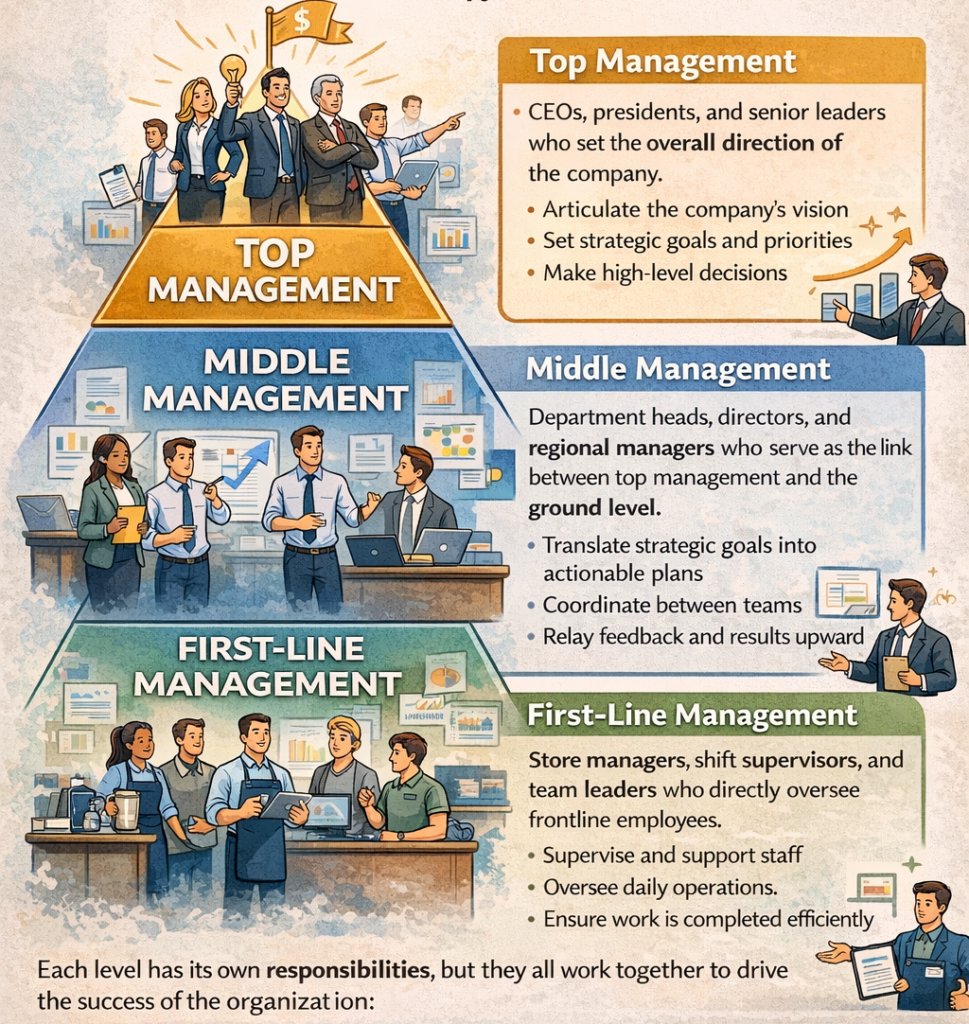
Top Management
At the peak of the pyramid sit the . These are the CEOs, presidents, executive vice presidents, and other senior leaders who set the overall direction of the company. Their job is not to manage day-to-day tasks. It is to think big. Top managers articulate a vision for where the company is going, establish priorities, and make the high-level decisions that shape everything below them. When a company decides to enter a new market, launch a major initiative, or change its core strategy, that decision starts at the top.
Consider Apple as an example. When Steve Jobs returned to the company in 1997, he did not sit down and write code or design products himself. He set a vision: simplicity, innovation, and products that people love. Every decision made below him was filtered through that vision. That is top management at work.
Middle Management
In the middle of the pyramid are the managers who serve as the critical link between the vision at the top and the work happening at the ground level. have one of the most demanding jobs in any organization because they communicate in both directions. They take the goals and priorities handed down from top management and translate them into actionable plans for the teams below them. At the same time, they gather feedback, challenges, and results from first-line managers and relay that information back up to the top. That’s why they have to be constantly evolving (see: The Middle Manager of the Future).
Middle managers go by many titles: department heads, regional managers, directors, and division managers, among others. Their ability to communicate clearly, coordinate across teams, and keep everyone aligned is what keeps the middle of the organization from falling apart. Research shows that organizations with strong managers realize 21 times greater total shareholder return than those with weak managers.
First-Line Management
At the base of the pyramid are , the people who work most directly with the employees doing the day-to-day work of the company. These are the store managers, shift supervisors, team leaders, and department supervisors who are in the trenches every day. Their primary focus is on training, motivating, and supporting the nonmanagement employees who report to them.
First-line managers are often the most visible face of management to frontline workers. For many employees, their first-line manager is the only manager they ever really interact with. That makes this level of management enormously important. A great first-line manager can inspire a team to perform at its best. A poor one can drive good employees right out the door, (ex: The Passive-Aggressive Micromanager or the manager who views leadership as a game of power and control rather than a way to support and grow their team)
…….which brings us back to where we started.
How the Levels Work Together

The three levels of management are not separate silos. They are designed to work as a connected system. Top management sets the vision. Middle management translates and coordinates. First-line management executes and supports. When all three levels are functioning well and communicating clearly, organizations can move with purpose and consistency. When one level breaks down, the entire system feels it.
Consider a national restaurant chain as an example. The executive team at headquarters decides to launch a new menu focused on healthier options. Regional managers work with individual locations to plan training schedules, adjust supply orders, and update marketing materials. Store managers then train their servers, communicate the changes to kitchen staff, and make sure the new menu rolls out smoothly. One decision at the top ripples all the way down to the customer’s table, but only because each level of management did its part.
That is the power of a well-functioning management hierarchy.
4.3 The Four Core Functions of Management
Management can feel like an abstract concept until you break it down into what managers actually do every day. And when you do that, a clear picture emerges.
III. The Four Core Functions of Management
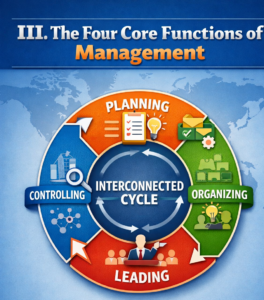
Regardless of industry, company size, or management level, every manager’s job revolves around four core functions: planning, organizing, leading, and controlling.
These four functions are not separate activities that happen in isolation. They are an interconnected cycle that drives everything an organization does, from the biggest strategic decision to the smallest daily task.
The Blockbuster fail is an example. Back in 2000, Blockbuster had the chance to buy Netflix for $50 million. They laughed and passed. Ten years later, Blockbuster was bankrupt. The difference? Management and vision.
Understanding these four functions is the closest thing there is to a universal blueprint for how any business operates. Master them, and you have a framework for making sense of almost any management challenge you will ever face.
Planning: Deciding Where You Are Going
The first and most foundational function of management is planning. Planning means determining the goals of the organization and figuring out the best way to achieve them. It is the function that gives everything else its direction. Without a plan, organizing is guesswork, leading has no destination, and controlling has nothing to measure against.
Think of planning as the answer to the question: what are we trying to accomplish, and how are we going to get there?
Great planning requires more than optimism or ambition. It requires an honest look at where the organization currently stands, a clear-eyed assessment of the environment it operates in, and the discipline to set goals that are specific, measurable, realistic, and tied to a meaningful time frame. It also requires flexibility. A plan that cannot adapt to changing circumstances is not a plan. It is a gamble.
We will explore planning in much greater depth in Section IV, including the different types of planning, how organizations use tools like SWOT analysis, and why the mission statement is the starting point for everything.
Organizing: Building the Structure to Succeed
Once a plan is in place, the next question becomes: how do we set ourselves up to actually execute it? That is where organizing comes in. Organizing means determining the structure of both individual jobs and the overall organization.
Organizing answers the question: who does what, and how does everything fit together?
At the individual level, organizing involves designing jobs in a way that makes sense for the work that needs to be done. What tasks does each role include? What authority does each person have? Who reports to whom? At the organizational level, it involves creating a structure, often represented visually in an organizational chart, that shows how different roles, departments, and levels of management relate to one another.
In a typical company, management happens at three main levels:
Top Management: These are the big-picture people (think CEOs). They set the vision and priorities for the whole company.
Middle Management: These guys are the bridge. They coordinate teams and make sure information flows up and down.
First-Line Management: This is where many of you will start. These managers train and motivate the employees who do the daily work.
One of the key decisions in organizing is how centralized or decentralized the organization should be. In a centralized structure, decision-making authority is concentrated at the top. A small group of senior leaders makes the major calls, and the rest of the organization executes. This approach can create consistency and clear direction, but it can also slow things down and leave frontline employees feeling disconnected from the decision-making process.
In a decentralized structure, authority is distributed more broadly throughout the organization. Managers and employees at lower levels are empowered to make decisions within their areas of responsibility. This approach tends to produce faster responses and higher engagement, but it requires strong communication and a shared sense of direction to keep everyone aligned.
Another important organizing concept is span of control, which refers to how many people a manager directly supervises. A manager with a wide span of control oversees many employees. A manager with a narrow span oversees just a few. The right span depends on a number of factors, including the complexity of the work, the skill and experience of the employees, and the degree of coordination required between team members.
There is no single correct way to organize a company. The right structure is the one that best supports the organization’s goals, its culture, and the people within it. What matters most is that the structure is intentional, that it was designed with purpose rather than inherited by accident.
Leading: Inspiring People to Achieve
A plan can be brilliant, and a structure can be perfectly designed, but if the people within the organization are not engaged, motivated, and pointed in the right direction, none of it matters. That is why leading is one of the most critical and most human of the four management functions. Leading means directing and motivating people to achieve organizational goals.
Leading is the function that answers the question: how do we get the best out of the people we work with?
Leading is where management becomes personal; the relationship between a manager and their team is built or broken. It involves communication, motivation, coaching, conflict resolution, and countless daily interactions that shape how people feel about their work and their workplace.
Great leaders understand that people are not simply resources to be deployed. They are individuals with needs, aspirations, fears, and the capacity to contribute far beyond what any job description captures, if they are given the right environment to do so. The manager who understands this, and leads accordingly, consistently outperforms the one who sees people as interchangeable parts.
Leading draws heavily on an understanding of motivation. What drives people to give their best effort? What makes them disengage? Different people are motivated by different things, and effective leaders take the time to understand what makes each member of their team tick. We will explore the major theories of motivation in much greater depth in Section VII.
Leading also involves choosing the right leadership style for the situation. Sometimes a collaborative, democratic approach is exactly right. Other times, a more decisive and directive approach is what the moment calls for. The most effective leaders are not rigid in their style. They read the situation, consider their people, and adapt. We will examine the three core leadership styles in detail in Section VIII.
Controlling: Making Sure It All Stays on Track
The fourth and final core function of management is controlling. It is also one of the most misunderstood, because the word itself can sound negative, as though it is about limiting people or micromanaging their every move. In reality, controlling in management has nothing to do with that. Controlling means monitoring performance and making adjustments as needed to keep the organization on course toward its goals.
Controlling answers the question: are we doing what we said we were going to do, and if not, what do we need to change?
Think of controlling like the navigation system in a car. It does not drive for you. It tracks where you are, compares your current position to your intended destination, and alerts you when you have veered off course so you can correct. Without that feedback, you might not realize you have taken a wrong turn until you are miles out of the way.
In practice, controlling involves setting performance standards based on the goals established during planning, measuring actual performance against those standards, identifying gaps and understanding why they exist, and taking corrective action to close those gaps. That corrective action might mean adjusting the plan, reallocating resources, providing additional training, or addressing a problem that nobody had anticipated when the plan was first developed.
Controlling also plays a crucial role in organizational learning. When managers take the time to carefully evaluate results, not just to judge performance but to genuinely understand what worked and what did not, they generate insights that make the next planning cycle sharper and more effective. Organizations that skip this step, or treat evaluation as a formality, miss one of the most valuable opportunities they have to get better over time.
*It is worth noting that controlling is not the end of the management cycle. It feeds directly back into planning. What managers learn through monitoring and evaluation becomes the foundation for the next round of goal setting and strategy development. In this way, the four functions of management are not a straight line with a beginning and an end. They are a continuous loop, each function informing and strengthening the others.
The Four Functions Working Together
It would be a mistake to think of planning, organizing, leading, and controlling as four separate jobs that happen to share a job description. In practice, they are deeply interconnected, and a weakness in any one of them creates problems throughout the others.
A company with brilliant plans but poor organizing will struggle to execute. A company with strong structure but weak leadership will find that people go through the motions without genuine engagement or creativity. A company that plans and leads well but never seriously evaluates its results will keep making the same mistakes, unable to learn and grow.
Consider a professional sports team as an example. The coaching staff develops a game plan before every match, that is planning. The team is organized into specific positions and roles, with clear responsibilities for each player, that is organizing. The head coach motivates the players, builds team culture, and makes real-time decisions during the game, that is leading. And after every game, the coaching staff reviews film, analyzes what worked and what did not, and adjusts their approach accordingly, that is controlling.
Remove any one of those elements and the team suffers. A team with no game plan plays reactively. A team with no clear roles collapses into confusion. A team with no motivation underperforms its talent. And a team that never learns from its losses keeps losing.
The same is true in business. The four core functions of management are not a checklist. They are a system. And like any system, they are only as strong as their weakest part.
That is why understanding all four, not just the ones that come naturally or feel comfortable, is so essential for anyone who plans to lead people, manage resources, or build something worth building.
KEY TAKEAWAY
How do you actually “manage”? You focus on these four things:
-
Planning: Setting goals and figuring out how to reach them.
-
Organizing: Setting up the structure. Who does what?
-
Leading: The “people” part. Keeping everyone motivated and focused.
-
Controlling: Checking the results. Are we hitting our goals? If not, how do we fix it?
4.4: Planning in Depth
Every journey needs a destination. You would not get in a car, start driving, and hope you end up somewhere good. Yet that is exactly what businesses do when they operate without a plan. They move fast, work hard, and stay busy, but without a clear sense of where they are going or how they intend to get there.
Planning is the foundation of everything in management. It is the function that gives all the others their direction. Organizing, leading, and controlling only make sense once you know what you are actually trying to accomplish. And while planning might sound like a straightforward process, great planning is one of the most demanding and consequential things a leader can do.
What Planning Actually Is
At its core, planning means determining the goals of the organization and figuring out the best course of action for achieving them. But good planning is more than writing a to-do list or setting a few targets at the start of the year. A good plan is one that keeps an organization on track without sacrificing flexibility. It provides direction and focus while still leaving room to adapt when circumstances change, because they always do.
The business landscape shifts constantly. New competitors emerge. Consumer preferences evolve. Economies contract. Technologies disrupt entire industries overnight. A plan that cannot respond to those kinds of changes is not a plan. It is a wish.
That is why the best organizations build planning processes that encourage feedback to flow freely up and down the hierarchy. Frontline employees often see things that top managers cannot. Middle managers spot patterns that neither group notices alone. When everyone has a voice in the planning process and leaders actually listen, the resulting plan is sharper, more realistic, and far more likely to succeed.
The Three Levels of Planning
Just as management itself is divided into levels, so is planning. Each level of the organization is responsible for a different type of planning, and all three must work together for the organization to function effectively.
is the responsibility of top management. It is high-level, long-term thinking that establishes a vision for the company, defines broad priorities and objectives, and allocates major resources. Strategic plans typically look years into the future and answer the fundamental question: where are we going, and why? Everything else in the organization flows from the strategic plan. It is the foundation on which all other decisions are built.
falls to middle management. Where strategic planning sets the destination, tactical planning maps the route. Middle managers take the broad goals handed down from the top and translate them into specific, actionable plans for their departments and teams. Tactical plans tend to cover shorter time horizons, typically one to three years, and focus on how the organization will actually execute on its strategy.
is carried out primarily by first-line managers. This is the most immediate and detailed level of planning, focused on the day-to-day and week-to-week activities that keep the organization running. Operational plans are highly specific: schedules, staffing, procedures, and processes that ensure the work gets done on time and to standard.
Think of it this way. The executive team of a national retail chain decides strategically to expand into three new regional markets over the next five years. Regional managers develop tactical plans for each market, identifying target locations, hiring timelines, and marketing approaches. Store managers then create operational plans for each new location covering daily staffing schedules, inventory processes, and customer service procedures. One strategic decision ripples through every level of the organization, taking a different but equally important form at each one.
The Mission Statement: Where Planning Begins
Before any goals can be set or any plans can be made, an organization needs to answer one foundational question: why do we exist?
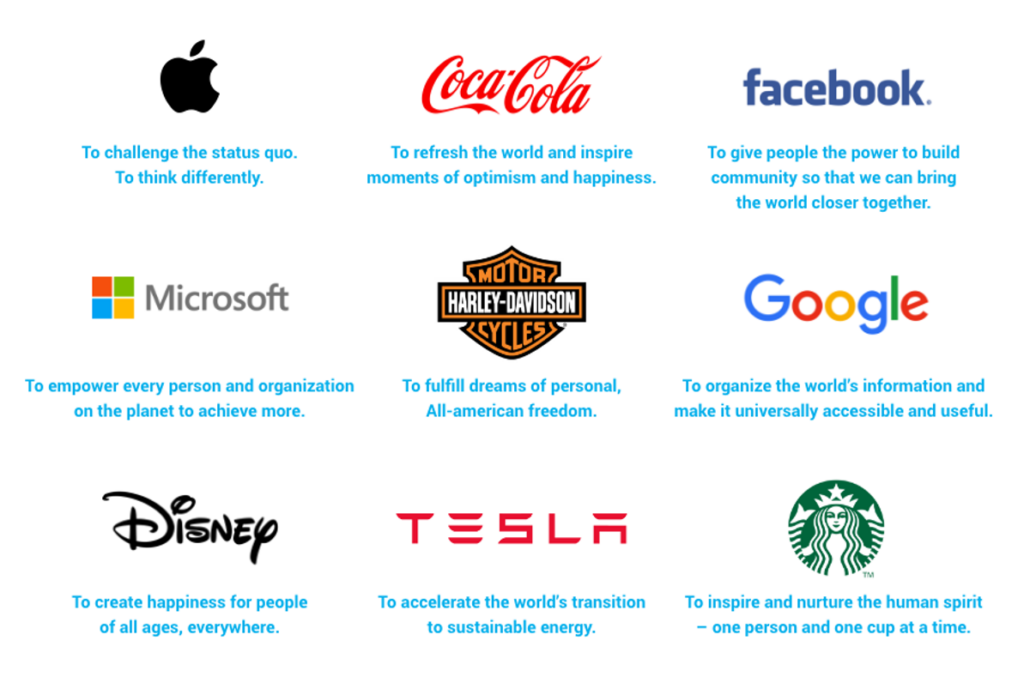
That answer lives in the mission statement. A mission statement defines the organization’s purpose, its core values, and the fundamental goals that guide everything it does. It is the starting point for all strategic planning and the lens through which every major decision should be filtered.
The most effective mission statements share a few key qualities. They are simple enough that anyone in the organization can understand and remember them. They are vivid and specific enough to actually mean something. And they are compelling enough to inspire genuine commitment from everyone involved, from the newest hire on the floor to the CEO in the boardroom.
A vague or generic mission statement is worse than no mission statement at all, because it creates the illusion of direction without providing any. A powerful mission statement acts like an invisible guide that shapes decision-making at every level of the organization, even when no manager is in the room.
EXAMPLE:
The Blockbuster Story: Why Strategic Planning Matters
In 2000, Blockbuster was at the top of the video rental world. Thousands of locations. Millions of loyal customers. A brand that almost every household in America recognized. That same year, a small startup called Netflix approached Blockbuster with an offer to be acquired for 50 million dollars. Blockbuster’s leadership turned them down and reportedly laughed the idea out of the room.
Ten years later, Blockbuster filed for bankruptcy. Netflix, meanwhile, was well on its way to becoming one of the most valuable entertainment companies in the world.
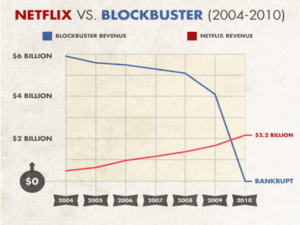
What went wrong at Blockbuster? It was not a lack of money or talent or brand recognition. It was a failure of strategic planning. Blockbuster’s leadership looked at the present and assumed the future would look the same. They did not take seriously the possibility that the way people consumed entertainment was about to change forever. Netflix did. And that difference in strategic thinking changed everything.
The lesson is not that every business needs to predict the future perfectly. That is impossible. The lesson is that strategic planning requires leaders to lift their eyes off the present and ask hard questions about where the world is heading, what their customers will need tomorrow, and what threats are emerging that they are not yet taking seriously enough.
SWOT Analysis: Knowing Where You Stand
One of the most practical and widely used tools in strategic planning is the . SWOT stands for Strengths, Weaknesses, Opportunities, and Threats. It gives organizations a structured way to honestly assess both their internal capabilities and the external environment they are operating in.
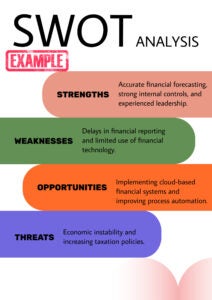
Strengths are what your organization does well. These are your competitive advantages, your points of difference, the reasons customers choose you over someone else.
Weaknesses are where your organization falls short. These might be gaps in capability, resources, technology, or talent. The value of this part of the analysis depends entirely on honesty. Organizations that refuse to acknowledge their weaknesses cannot address them.
Opportunities are external factors or trends that could help the organization grow or succeed. A shift in consumer behavior, an emerging technology, a competitor stumbling, or a new market opening up are all examples of opportunities waiting to be seized.
Threats are the external challenges and risks that could hurt the organization. New competition, rising costs, regulatory changes, economic downturns, or market shifts that work against your current position all qualify as threats.
The SWOT analysis does not make decisions for you but rather gives information to make better ones.
Strategic Goals: Turning Vision Into Action
A mission statement tells you why you exist. tell you what you are going to accomplish. And for goals to actually drive results, they need to meet a few important standards.
Good strategic goals are specific and measurable. “We want to grow” is not a strategic goal. “We want to increase revenue by 15 percent over the next two years by expanding into two new markets” is. The difference matters because a measurable goal gives you something concrete to work toward and a clear way to know whether you got there.
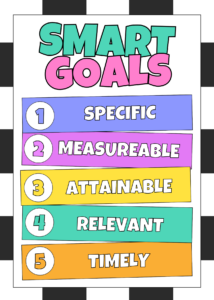
Good strategic goals are also tied to a realistic time frame. Open-ended goals tend to drift. When everyone knows a goal needs to be accomplished by a specific date, accountability becomes real.
And good strategic goals are ambitious but achievable. Goals that are too easy do not push the organization forward. Goals that are completely unrealistic demoralize the people working toward them. The sweet spot is a goal that stretches the organization without breaking it.
Once strategic goals are set, implementation falls primarily to middle and first-line managers, who translate those goals into the tactical and operational plans that make them real. Strategy without execution is just an idea. Execution without strategy is just activity. They must work together.
Contingency Planning: Preparing for the Unexpected
Even the best plans run into trouble. Suppliers fall through. Key employees leave. Natural disasters disrupt operations. Economic conditions shift. A global pandemic shuts everything down. No matter how carefully an organization plans, unexpected events will happen.
That is why smart organizations do not just plan for the future they expect. They also plan for futures they hope to avoid. This is called , and it is the responsibility of senior management, though it draws on input from managers at every level.
A contingency plan answers the question: if things do not go as planned, what do we do? It identifies the most significant risks the organization faces and establishes in advance how leadership will respond if those risks become reality. Having those answers ready before a crisis hits means the organization can respond quickly and decisively rather than scrambling to figure out a plan in the middle of a disaster.
Think about how differently companies fared during the early days of the COVID-19 pandemic. Businesses that had contingency plans for supply chain disruptions, remote work, or sudden drops in foot traffic were able to adapt quickly. Those that had never considered such scenarios were often caught completely flat-footed.
Planning will not prevent every problem. But it gives you a fighting chance of surviving the ones you did not see coming.
4.5: Essential Management Skills
You have probably heard the phrase “people skills” thrown around before. Maybe a teacher told you that you have great people skills, or maybe a job listing asked for them and you were not entirely sure what that meant. In the world of management, people skills are just one piece of a larger puzzle. Effective managers need three distinct types of skills to do their jobs well: technical skills, human skills, and conceptual skills. And here is what makes it interesting: the higher you climb in an organization, the more the balance between those three shifts.
Technical Skills: Knowing How the Work Gets Done
are the specific, specialized abilities required to perform a particular task or job. They are the “how to” skills. How to write code. How to operate equipment. How to read a financial statement. How to edit a video. Technical skills are usually learned through education, training, or hands-on experience, and they tend to be specific to a particular field or function.
For first-line managers, technical skills are especially important. If you are managing a team of graphic designers, it helps enormously to understand design. If you are supervising a kitchen, knowing how to cook matters. Your team will respect you more, you will make better decisions, and you will be able to train and support the people working under you far more effectively.
Think about a social media manager at a marketing agency. She needs to know how the platforms work, how to read analytics, how to write copy that performs, and how to use design tools. Those are all technical skills. Without them, she cannot do her job, let alone lead others doing the same work.
As people move up in an organization, technical skills become relatively less critical. A CEO does not need to know how to write code or operate every piece of equipment in the building. But at the ground level and in first-line management, technical competence is often what earns you credibility with your team in the first place.
Human Skills: Working Well With People
, sometimes called interpersonal skills, are the abilities that allow managers to work effectively with other people. This includes communicating clearly, listening actively, motivating team members, resolving conflicts, giving and receiving feedback, and building trust. Human skills are what separate a manager who gets results through people from one who simply gets results despite them.
Here is the thing about human skills that surprises a lot of people: they matter at every single level of management. Whether you are a shift supervisor at a coffee shop or the chief operating officer of a Fortune 500 company, your ability to connect with people, earn their trust, and bring out their best is going to determine how far you go and how much impact you have.
Consider a customer service team leader at a retail store. Half of his job is technical, knowing the systems, the return policies, the inventory process. But the other half, and arguably the more important half, is human. He has to motivate a team that deals with frustrated customers all day. He has to have difficult conversations when someone is underperforming. He has to build enough trust that his team comes to him with problems before those problems become crises. None of that shows up on a technical training checklist, but all of it determines whether his team succeeds or struggles.
Human skills are also the ones most closely tied to what we discussed in the motivation and leadership sections. Understanding what drives people, communicating a vision, and creating a culture where people feel valued are all expressions of strong human skills in action.
EXAMPLE: Ted Lasso (Apple TV+)

Ted is the walking definition of Theory Y management, high Emotional Intelligence, and strong human skills in action.
-
The Scene: In the famous “Darts Scene” from Season 1, Ted is being bullied by a former team owner. Instead of getting angry, Ted stays calm and uses a quote: “Be curious, not judgmental.” Ted Lasso Darts Scene – Be Curious Not Judgemental
-
The Skill in Action: Ted uses active listening and empathy to lead a team where he technically knows very little about the sport (soccer). He focuses entirely on the “human” side: building trust, resolving conflicts between ego-driven players, and motivating them through belief rather than fear.
-
The Takeaway: It proves that you can be a successful leader even if your technical skills are lacking, as long as your human skills are elite.
Conceptual Skills: Seeing the Big Picture
are the ability to think abstractly, see the organization as a whole, and understand how all the different pieces fit together. Managers with strong conceptual skills can analyze complex situations, recognize patterns, anticipate problems before they arise, and make decisions that account for the ripple effects across the entire organization.
While technical skills are most important at the lower levels of management, conceptual skills become increasingly critical as you move toward the top. A CEO has to be able to look at the entire business, its finances, its people, its market position, its competitive threats, and make strategic decisions that affect everything and everyone within it. That requires a level of abstract thinking that goes well beyond knowing how any one part of the business works.
Here is a relatable example. Imagine you are the manager of a popular campus food truck. A technical skill would be knowing how to prepare the food and operate the equipment. A human skill would be keeping your small team motivated during a slow Tuesday lunch rush. But a conceptual skill would be noticing that a new food truck has started parking nearby, recognizing that your sales have dipped on the days they are there, understanding that your current menu overlaps too heavily with theirs, and deciding to pivot toward a different cuisine that sets you apart. You are not just reacting to a problem. You are seeing the whole picture and making a strategic move.
How Skill Priorities Shift Across Management Levels
One of the most useful things to understand about these three skill types is that their relative importance changes depending on where you are in the management hierarchy.
First-line managers, the supervisors and team leaders working closest to the frontline employees, rely most heavily on technical skills. They need to understand the work deeply enough to train others, solve problems, and maintain quality standards.
Middle managers need a strong blend of all three. They still need enough technical knowledge to be credible and effective, but human skills become increasingly important as they coordinate across teams, manage upward and downward, and navigate the often competing demands of the people above and below them.
Top managers rely most heavily on conceptual skills. Their job is to set direction, make big-picture decisions, and position the organization for long-term success. They depend on the managers below them to handle the technical details and day-to-day people management. What they need is the ability to think strategically, see around corners, and lead an entire organization toward a shared vision.
The practical takeaway for you as a student entering the workforce is this. Start building all three types of skills now. Get good at the technical skills required in your field. Practice your human skills in every team project, group presentation, and job you take. And start developing your conceptual thinking by paying attention to the bigger picture, asking why decisions get made, and thinking about how the pieces of any organization you are part of connect to one another.
The managers who rise the fastest are almost never the ones who are simply the best at their technical job. They are the ones who combine solid technical knowledge with exceptional people skills and the ability to think beyond the task in front of them.
KEY TAKEAWAY
The Skills You Need
To be a great manager, you need a mix of three skills:
-
Technical Skills: Knowing how to do specific tasks (like fixing a server or writing a marketing plan).
-
Human Skills: The ability to work with people, communicate, and solve conflicts. These are vital at every single level.
-
Conceptual Skills: Seeing the big picture and how all the departments fit together. This is a must for top leaders.
4.6 Organizing the Business
Once a plan is in place, someone has to figure out how to set the organization up to actually execute it. Who is responsible for what? Who reports to whom? How many people should each manager oversee? How much decision-making authority should flow to the top, and how much should be pushed down to the people closest to the work?
These are the questions that organizing is designed to answer. And the decisions made here, about structure, hierarchy, and authority, shape everything from how fast a company can respond to a problem to how engaged its employees feel on a daily basis.
Organization Charts: Making Structure Visible
The most common way to visualize how an organization is structured is through an organization chart, or org chart. An org chart is a diagram that maps out the formal structure of a company, showing the different roles and positions within it, how they are grouped, and who reports to whom.
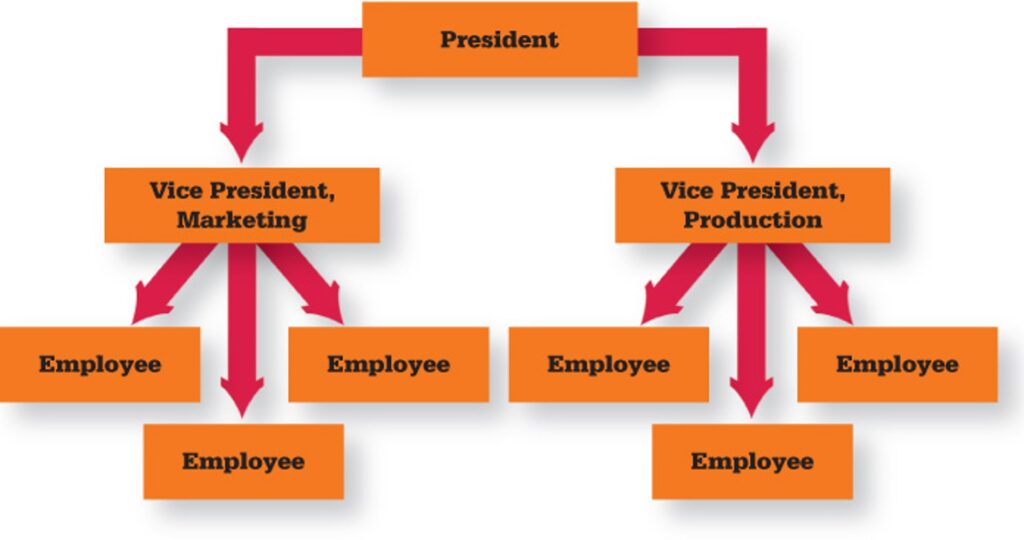
At the top of a typical org chart sits the CEO or president. Below that, the chart branches out into departments or divisions, each with its own management structure that continues to branch downward until you reach the frontline employees at the base.
Org charts are useful for a number of reasons. They make accountability clear. When everyone knows who reports to whom, there is less confusion about who is responsible for what. They also make communication pathways visible. If a frontline employee has a concern that needs to reach senior leadership, the org chart shows the chain of command that information should travel through.
But org charts have limits too. They show the formal structure of an organization, the official lines of authority and reporting. They do not show the informal networks, the relationships, the unwritten rules, and the real-world communication patterns that actually drive how things get done day to day. A new employee who understands the org chart but ignores the informal dynamics of the workplace will often find themselves confused about why things do not work the way the chart suggests they should.
Span of Control: How Many Is Too Many?
A key organizing decision is , which refers to how many employees a single manager directly supervises. A manager with a wide span of control oversees a large number of employees. A manager with a narrow span oversees just a few.
Both approaches have advantages and disadvantages, and the right choice depends on the context.
A wide span of control means fewer managers are needed, which reduces costs and can create a flatter, more efficient organization. It also tends to give employees more autonomy, since a manager who is responsible for fifteen people cannot possibly micromanage all of them. The downside is that each employee gets less individual attention, and it can be harder for the manager to stay on top of everything happening across a large team.
A narrow span of control allows for closer supervision, more frequent communication, and greater support for each individual employee. This works well when the work is complex, when employees are new or still developing their skills, or when tight coordination between team members is critical. The tradeoff is that it requires more managers, which adds cost and can create more layers of hierarchy that slow things down.
There is no magic number for the ideal span of control. The right answer depends on the complexity of the work, the capabilities of the employees, the management style of the leader, and the goals of the organization.
Putting Structure to Work
Organizational structure might sound like a dry, administrative topic, but it has real consequences for the people who work within it every day. A well-designed structure empowers employees, speeds up decision-making, and creates clarity about who is responsible for what. A poorly designed structure creates confusion, slows things down, and frustrates the people trying to do good work within it.
The most important thing to remember is that structure should serve strategy, not the other way around. The right structure is the one that best positions the organization to achieve its goals, support its people, and respond to the world around it. When leaders start with the strategy and build the structure to support it, organizations tend to thrive. When structure becomes rigid and unchanging regardless of shifting goals or circumstances, it becomes an obstacle rather than an asset.
As you move into your career, pay attention to how the organizations you work for are structured. Notice what works and what creates friction. The ability to look at an organization’s structure and understand why it is designed the way it is, and what it would take to make it better, is one of the most valuable conceptual skills a manager can develop.
4.7 Leading and Motivating
Managing people is about more than handing out assignments and checking off tasks. Anyone can tell someone what to do. The real challenge of leadership is getting people to want to do it, and to do it well. That is the difference between managing and leading. And at the heart of great leadership is one of the most important and most studied questions in all of business:
what actually motivates people?
The answer has changed significantly over time. In the early 1900s, business thinkers focused almost entirely on efficiency. Workers were seen largely as parts of a machine, and motivation was simple: work hard or lose your job. But as research evolved, a much more complex and human picture emerged. Thoughts, feelings, fairness, purpose, and belonging all turned out to matter enormously. Today, the most successful companies understand that motivation is not one size fits all, and that keeping people engaged requires attention to the whole person, not just the paycheck.
The Major Motivation Theories
One of the most enduring frameworks for understanding human motivation comes not from a business school, but from psychology. In the 1940s, Abraham Maslow proposed that human needs fall into a hierarchy, and that people are motivated to meet each level of need before moving up to the next.
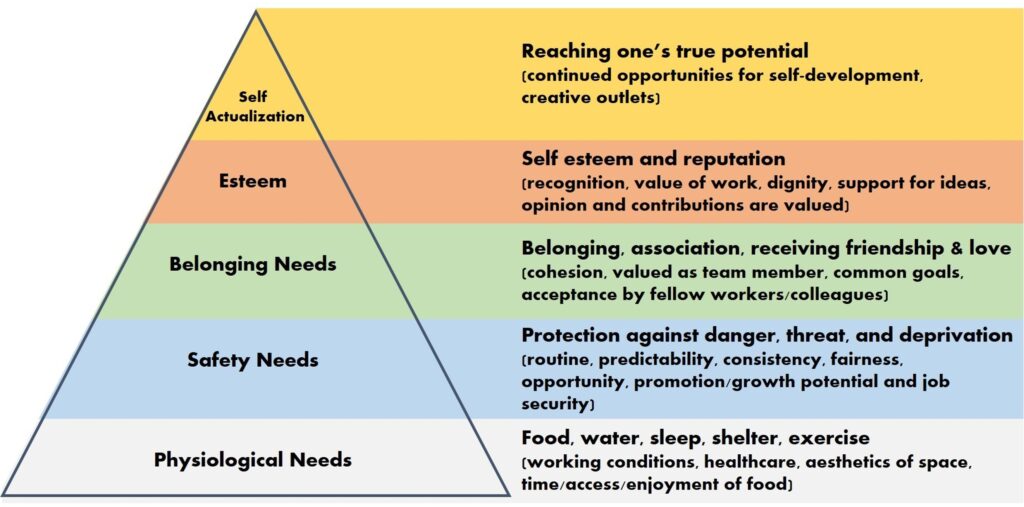
In the context of work, Maslow’s hierarchy looks like this.
At the base are physiological needs, the basics of survival. A job that pays a fair, livable wage addresses this level. If an employee is struggling to afford rent or groceries, no amount of team-building activities or motivational speeches will matter much. The foundation has to be in place first.
The next level is safety needs, which in the workplace means job security, a safe working environment, and access to healthcare. Employees who feel their jobs are constantly at risk, or who work in physically dangerous conditions without proper protections, cannot fully focus on contributing at a higher level.
Above that are social needs, the human desire for belonging, friendship, and connection. Companies that build positive workplace cultures, encourage teamwork, and create opportunities for employees to connect with one another are addressing this level. A monthly team lunch, a culture of genuine camaraderie, or simply a manager who takes time to know their people as individuals can go a long way.
Next come esteem needs, the desire to feel valued, recognized, and respected for one’s contributions. This is where employee recognition programs, performance bonuses, public acknowledgment, and opportunities for advancement come into play. People need to feel that their work matters and that others notice it.
At the very top of the pyramid is self-actualization, the desire to reach one’s full potential. This is the level where employees are not just doing a job. They are growing, creating, and finding deep meaning in their work. Companies that offer professional development, leadership training, and genuinely challenging work help employees reach this level.
The practical takeaway for managers is straightforward. Do not assume that a raise will fix every problem, or that a pizza party will make up for a toxic culture. Ask yourself where your employees are on the pyramid, and address those needs first.
While Maslow looked at what people need, psychologist Douglas McGregor looked at something equally important: what managers believe about people. His research, known as Theory X and Theory Y, revealed that a manager’s underlying assumptions about human nature directly shape how they lead, and how their employees respond.
believe that people are inherently lazy, dislike work, and must be closely supervised and controlled to be productive. They tend to rely on strict rules, tight oversight, and the threat of consequences to get results. The problem with this approach is that it often becomes a self-fulfilling prophecy. When employees are treated as though they cannot be trusted, many of them stop trying to prove otherwise.
believe something very different. They see people as naturally motivated, capable of self-direction, and willing to take on responsibility when given the chance. They lead with trust, autonomy, and encouragement (Ted Lasso example from earlier). And more often than not, their employees rise to meet those expectations.
Think about the best manager you have ever had or ever heard of. Chances are they operated from a Theory Y mindset. They believed in you before you fully believed in yourself. That belief changes everything.
Expectancy Theory
Victor Vroom’s Expectancy Theory takes a more calculated look at motivation. According to Vroom, employees are motivated when they believe three things at the same time.
First, they must believe that their effort will lead to good performance. Second, they must believe that good performance will lead to a meaningful reward. Third, they must actually value that reward.
Here is a relatable example. Imagine a college student working a part-time sales job. If she believes that putting in extra hours will help her hit her sales targets, and that hitting those targets will earn her a bonus she genuinely cares about, she will be motivated to put in the effort. But if she doubts that working harder will actually lead to better numbers, or if she does not care about the bonus at all and would rather just have the time off, the motivation disappears.
The lesson for managers is clear. Do not assume that the rewards you are offering are the ones your employees actually want. And make sure the path from effort to reward is clear, fair, and believable.
John Stacey Adams developed Equity Theory around a simple but powerful observation: people pay close attention to whether they are being treated fairly, and they compare themselves to the people around them.
According to this theory, employees are constantly weighing what they put into their work against what they get out of it and then comparing that ratio to their coworkers. When things feel balanced, motivation stays strong. When things feel unequal, motivation suffers.
*The message for managers is not that everyone needs to be treated identically. It is that people need to feel that the relationship between their contributions and their rewards is fair, and that leadership is paying attention.
Motivation in Practice: What Great Companies Do
Understanding motivation theory is one thing. Putting it into practice is another. Today’s most successful companies approach motivation on multiple fronts.
They prioritize work and life balance. Employees are not just workers. They are people with families, health, and lives outside the office. Companies that respect that boundary attract and keep better people.
They build distinctive, positive cultures. A strong culture creates a sense of identity and belonging that no paycheck alone can replicate. Employees who genuinely love where they work tend to be more productive, more loyal, and more willing to go the extra mile.
They offer meaningful compensation. Pay matters, and pretending otherwise is a mistake. But meaningful compensation goes beyond salary to include benefits, flexibility, recognition, and growth opportunities.
They invest in nontraditional perks. A growing number of companies have expanded their benefits to include things like student loan repayment assistance, mental health support, flexible scheduling, pet-friendly offices, and generous parental leave. These perks signal to employees that the company sees them as whole people, not just workers.
Many companies are expanding their benefits to offer nontraditional perks that go beyond basic health insurance and retirement plans. Here are some examples:

Known for its unique benefits, Google offers on-site wellness facilities, including gyms, nap pods, massage therapy, and even laundry services. They also provide employees with generous parental leave and fertility support programs, as well as on-site childcare options to help working parents.
AIR BNB

This company introduced a $2,000 annual travel stipend for employees to encourage them to explore new places and embrace Airbnb’s mission of belonging anywhere. They also offer flexible work options, which allow employees to work from almost any location, aligning with today’s shift toward remote work.
STARBUCKS
 Starbucks offers benefits tailored to support the well-being of its employees, like mental health counseling, college tuition assistance, and transgender-inclusive health coverage. Their mental health support includes free counseling sessions and access to mental health apps like Headspace.
PATAGONIA
 This outdoor apparel company offers paid volunteer time and actively supports environmental initiatives. Employees can take paid time off to volunteer for environmental causes and receive funding if they want to join eco-friendly events and rallies. Patagonia also provides on-site childcare, helping parents balance work and family.
Job Enrichment: Making the Work Itself More Motivating
One of the most powerful and often overlooked tools in a manager’s toolkit is , which means designing jobs so that the work itself is more meaningful, challenging, and fulfilling. The idea is simple. When people find their work genuinely interesting and significant, they do not need to be pushed nearly as hard from the outside.
Effective job enrichment typically includes five key elements. Workers should be able to use a variety of skills rather than repeating the same narrow task all day. Their work should have a clear beginning and end so they can experience the satisfaction of completing something. They should understand how their work impacts others. They should have a reasonable degree of autonomy over how they do their job. And they should receive regular, honest feedback on how they are doing.
These principles apply across all kinds of jobs. A server at a restaurant might be given the chance to help design a seasonal menu item, mentor new hires, or gather customer feedback to share with management. An entry-level retail employee might take on responsibility for visual merchandising, inventory tracking, or training new team members. In both cases the job expands in ways that keep the employee engaged, growing, and invested in the outcome.
The result is not just happier employees. It is better performance, lower turnover, and a workplace where people actually want to show up.
Bringing It All Together
The theories and practices in this section all point toward the same fundamental truth: people are not just resources to be managed. They are human beings with needs, beliefs, comparisons, and aspirations. The managers and companies that understand this, and build their leadership approach around it, are the ones that attract the best people, keep them the longest, and get the most out of them.
Leadership is not about authority. It is about creating the conditions where people can do their best work. And that, more than any strategy or system, is what separates great organizations from average ones.
4.8: Leadership Styles
Every manager makes decisions. But how they make those decisions, who they involve, and how they communicate with their team reveals something fundamental about who they are as a leader. That approach is what we call leadership style, and it shapes everything from employee morale to company culture to the bottom line.
There is no single right style of leadership. The most effective leaders understand that different situations call for different approaches, and that reading the room is just as important as having the right answer. But before a leader can adapt their style, they need to understand the three foundational approaches that form the basis of how managers lead.
The Three Core Leadership Styles
Democratic Leadership
In a democratic leadership style, the leader involves the team in the decision-making process. Employees are encouraged to share ideas, voice concerns, and contribute to the direction of the group. The leader listens, facilitates discussion, and then makes a final decision that is informed by the input of others.
This style tends to produce strong results in environments where creativity, collaboration, and buy-in matter. When people have a voice in decisions that affect them, they are more likely to feel invested in the outcome and committed to making it work.
Consider a marketing manager who is planning a new campaign. Rather than dictating the approach from the top down, he holds a team meeting, invites everyone to pitch ideas, and builds the final strategy from the best of what the group contributes. The team walks away feeling heard and energized. That is democratic leadership at work.
The tradeoff is time. Gathering input, facilitating discussion, and building consensus takes longer than simply making a call and moving on. In fast-moving or high-pressure situations, that slower pace can be a real liability.
Autocratic Leadership
At the opposite end of the spectrum is autocratic leadership, where the leader makes decisions independently with little to no input from others. Instructions flow from the top down, expectations are clearly defined, and employees are expected to follow them without a great deal of debate.
This style often gets a bad reputation, but it has genuine value in the right context. In situations that require fast, decisive action, a clear chain of command, or strict adherence to safety and quality standards, autocratic leadership can be exactly what is needed. A pilot landing a plane in an emergency does not stop to take a vote. Neither does a surgeon in the middle of a procedure, or a manager dealing with a crisis that demands an immediate call.
Think of a restaurant owner who has developed a precise system for service, plating, and customer interaction. She trains her staff on exactly how things should be done and expects those standards to be followed consistently. Customers receive the same high-quality experience every time they visit. That consistency is the product of autocratic leadership applied well.
The risk is that over time, a strictly autocratic approach can stifle creativity, reduce employee engagement, and create a culture where people feel like replaceable parts rather than valued contributors. When employees never have a voice, the best ones often find somewhere else to work.
Free-Rein Leadership
Free-rein leadership, also known as laissez-faire leadership, gives employees a high degree of freedom and autonomy to make their own decisions, manage their own work, and direct their own efforts. The leader is available for support and guidance but does not closely supervise or direct day-to-day activities.
This style works best with highly skilled, self-motivated, and experienced teams who do not need, and often resent, close oversight. Creative industries, research environments, and technology companies frequently use this approach because the work itself requires independent thinking and the people doing it are often more knowledgeable about their specific area than their manager is.
A good example from the world you are growing up in is how many gaming and app development studios operate. A studio head might communicate the vision for a new game and set a deadline, then trust the design and engineering teams to figure out how to get there. She checks in periodically to discuss progress and remove obstacles, but she does not hover. The team thrives because they have the freedom to do their best work without someone looking over their shoulder at every step.
The danger of free-rein leadership is that without enough structure or guidance, some teams drift. Deadlines get missed, priorities become unclear, and accountability can dissolve. This style demands a high level of trust in the team, and that trust needs to be earned and warranted.
No Leader Uses Just One Style
Here is something important to understand. The three styles described above are not rigid categories that a leader picks once and sticks with forever. In reality, effective leaders move fluidly between styles depending on the situation, the people involved, and the goals at hand.
A manager might use a democratic approach when brainstorming a new product strategy, switch to a more decisive and directive style when a safety issue demands an immediate response, and give a trusted senior employee complete freedom on a project they have owned for years. The ability to read the situation and adjust accordingly is one of the defining marks of a truly skilled leader.
Most leaders naturally gravitate toward one style more than the others, shaped by their personality, their experiences, and the culture of the organization they work in. But the best ones never stop asking themselves whether the approach they are using is actually the right one for the moment.
What Makes a Leader Truly Effective?
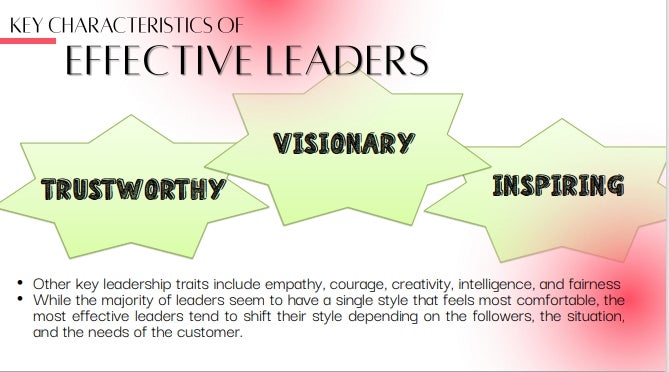
Beyond style, research and experience consistently point to three core characteristics that the most effective leaders share regardless of industry, company size, or management level.
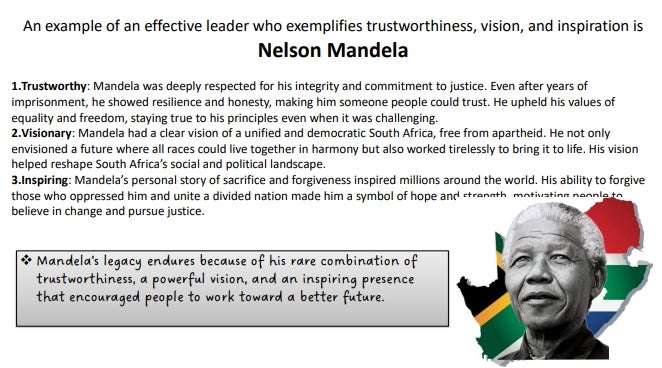
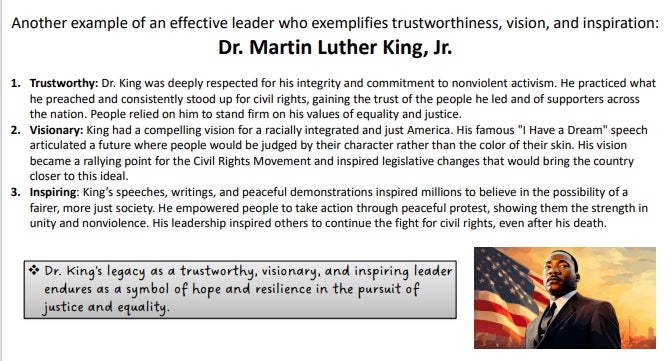
Trustworthy. Effective leaders do what they say they will do. They are honest with their teams, even when the news is difficult. They do not take credit for others’ work or shift blame when things go wrong. Trust is built slowly through consistent action and destroyed quickly through a single act of dishonesty. Employees follow leaders they trust. They merely endure leaders they do not.
Visionary. Great leaders know where they are going and can articulate that direction in a way that others find compelling. They do not just manage the present. They anticipate the future and position their teams to meet it. Think back to Blockbuster and Netflix. The difference between those two companies was not talent or resources. It was vision, and the willingness to act on it before it was obvious.
Inspiring. Perhaps most importantly, effective leaders make the people around them want to be better. They do not motivate through fear or pressure alone. They connect with people on a human level, recognize what each person is capable of, and create an environment where people feel genuinely excited about the work they are doing and the team they are part of. As Simon Sinek argues in his widely watched TED Talk, the best leaders make their people feel safe, valued, and part of something worth believing in.
Leadership and Management: Two Sides of the Same Coin
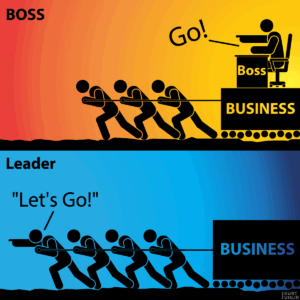
It is worth pausing here to draw a distinction that often gets overlooked. Management and leadership are related, but they are not exactly the same thing.
Management tends to be about systems, processes, and structure. It is about planning, organizing, and controlling to make sure the work gets done efficiently and correctly. Leadership is about people. It is about vision, influence, and inspiration. It is about making others want to follow.
The best managers are also great leaders. They can build a solid plan and inspire a team to execute it. They can establish structure and still make people feel seen and valued within it. They understand that the technical side of management means very little if the people doing the work are not engaged, motivated, and pointed in the right direction.
That combination, sound management paired with genuine leadership, is what builds the kinds of organizations where people do their best work, stay for the long haul, and look back years later saying that working there was one of the best experiences of their careers.
And it all starts with understanding that leadership is not a title. It is a choice you make every single day about how you show up for the people counting on you.
CEOs, presidents, executive vice presidents, and other senior leaders who set the overall direction of the company.
They take the goals and priorities handed down from top management and translate them into actionable plans for the teams below them. At the same time, they gather feedback, challenges, and results from first-line managers and relay that information back up to the top.
the people who work most directly with the employees doing the day-to-day work of the company
high-level, long-term thinking that establishes a vision for the company, defines broad priorities and objectives, and allocates major resources
road goals from the top translated into specific, actionable plans for departments and teams
immediate and detailed level of planning, focused on the day-to-day and week-to-week activities that keep the organization running
Strengths, Weaknesses, Opportunities, and Threats. It gives organizations a structured way to honestly assess both their internal capabilities and the external environment they are operating in.
what you are going to accomplish
Senior management planning how they will respond for futures they hope to avoid
specific, specialized abilities required to perform a particular task or job; the “how to” skills.
the abilities that allow managers to work effectively with other people; sometimes called interpersonal skills
the ability to think abstractly, see the organization as a whole, and understand how all the different pieces fit together.
how many employees a single manager directly supervises
Motivation theory that says: human needs fall into a hierarchy, and that people are motivated to meet each level of need before moving up to the next.
Motivation theory that found that a manager’s underlying assumptions about human nature directly shape how they lead, and how their employees respond.
believe that people are inherently lazy, dislike work, and must be closely supervised and controlled to be productive
see people as naturally motivated, capable of self-direction, and willing to take on responsibility when given the chance
Motivation Theory that says: people pay close attention to whether they are being treated fairly, and they compare themselves to the people around them.
designing jobs so that the work itself is more meaningful, challenging, and fulfilling