Main Body
5 CH 5 – International Business
Introduction
“Made in Where?”
Take a second and look at what you’ve got on you right now. Flip over your phone, check the tag on your hoodie, glance at the bottom of your water bottle. Where was it made?
If you checked a few things, you probably noticed the same countries popping up over and over. That’s not a coincidence. Some countries are just better at making certain things, whether it’s because of cheaper labor, available materials, or government support for specific industries.
So here’s something to think about: Why does that happen? What does a country need to be the go-to source for electronics, or clothing, or steel? And what does it mean for you as someone who buys these products, and someday, someone who works in an economy shaped by them?
The takeaway: International business isn’t some abstract boardroom concept. It’s your AirPods, your Nike Dunks, and your IKEA desk. It’s already part of your life, and this chapter will help you understand why.
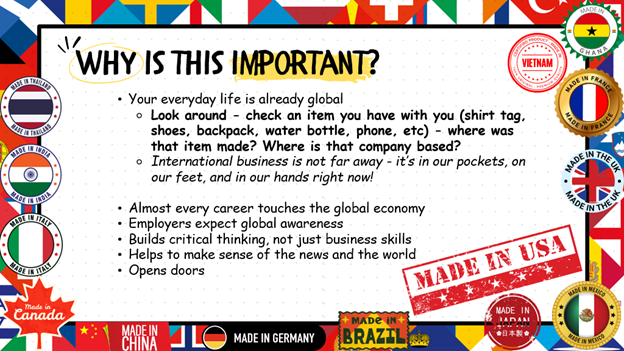
International business isn’t about becoming a CEO …. it’s about understanding how the world works, because the world you’re entering is global whether you choose it or not.
CHAPTER OUTLINE
5.1: Why Companies Go Global
5.2: Measuring the Impact of Global Trade
5.3: Strategies for Reaching Global Markets
5.4: Barriers to International Trade
5.5: The Free Trade Movement
5.6: The United States in Global Trade
Key Vocabulary
5.1: Why Companies Go Global
In the late 1800s, a German pharmacist named Eduard Buchner wasn’t trying to build a global brand. He was just experimenting with yeast in his lab.
Around the same time, another German pharmacist, Henri Nestlé, was working on a powdered milk formula to help infants who couldn’t be breastfed. It worked. Word spread quickly across Europe. Parents trusted it. Demand grew.
But here’s where the story gets interesting.
Instead of staying local and serving just his town or even just Germany, Nestlé made a bold move. He started exporting his product to other countries. That meant dealing with different languages, different regulations, different transportation challenges, and completely new customers. 
It paid off.
By the early 1900s, Nestlé products were being sold across continents. Today, Nestlé operates in nearly every country in the world.
Now think about that.
This wasn’t a tech company. There was no internet. No overnight shipping. No social media marketing.
Just a simple idea: if your product solves a real problem, why limit it to one place?
That decision to go beyond borders turned a small pharmacy product into one of the largest food companies in the world.
And Nestlé isn’t unique.
From spices traded along ancient routes to modern brands expanding into new markets, the pattern is the same.
Companies go global because opportunity doesn’t stop at borders.
Reasons for Going Global
- Access to factors of production not available at home (right amount, right price)
- Competitive advantage as a driving motivation
COMPETITIVE ADVANTAGE
Here’s a question: why does the U.S. dominate software and tech, while Bangladesh leads in textile manufacturing, and Saudi Arabia controls oil production? It’s not luck. Each of those countries has a competitive advantage in that industry, meaning they can produce it more efficiently or at a lower cost than most other countries.
But here’s the catch: that edge doesn’t last forever. Twenty years ago, China’s biggest competitive advantage was dirt-cheap labor. As Chinese wages have risen, companies have started moving manufacturing to Vietnam, Bangladesh, and India instead. The advantage shifted.
Understanding competitive advantage also means understanding opportunity cost, the idea that choosing to produce one thing means giving up the chance to produce something else. Countries, just like people, have to make choices about where to focus their resources. The smartest ones double down on what they do best and trade for the rest.
Other Reasons for Going Global
So why do companies bother expanding beyond their home country in the first place? There are four big motivators.
The most obvious one is market expansion. A company can only grow so much selling to the same customers. Going international opens the door to entirely new consumer bases, more revenue streams, and a stronger global brand presence. Think about how McDonald’s or Nike aren’t just American brands anymore; they’re household names on every continent.
Companies also go global for access to resources. Sometimes what a business needs, whether that’s a specific raw material, cutting-edge technology, or highly skilled labor, simply isn’t available or affordable at home. Overseas operations solve that problem.
Then there’s cost efficiency. Production and labor costs vary dramatically from country to country. Setting up manufacturing in a place with lower operating costs can significantly boost a company’s profit margins, which is exactly why so many goods are produced overseas rather than domestically.
Finally, going global can sharpen a company’s competitive advantage. Operating in international markets pushes companies to innovate, scale up, and compete at a higher level than they ever would staying local. The companies that go global often come back stronger, with better products and more efficient operations than the competitors who stayed home.
5.2: Measuring the Impact of Global Trade
Measuring the impact of international trade on individual nations requires a clear understanding of balance of trade, balance of payments, and exchange rates.
Balance of Trade
- Definition: Difference between a country’s exports (what it sells to other countries) and imports (what it buys from other countries).
- If a country exports more than it imports, it has a trade surplus. If it imports more than it exports, it has a trade deficit.
- U.S. has had an overall trade deficit since 1976
- 2023 U.S. trade deficit: ~$948 billion (one of the largest in history)
- Largest contributor: trade deficit with China (~$383 billion in 2023)
- Debate: Does a high deficit hurt domestic industries or give consumers access to cheaper goods?
Balance of Payments (BOP)
- Definition: A record of all the money coming into and going out of a country from the rest of the world.
- It tracks what a country earns from other countries (like exports, investments, tourism) and what it spends on other countries (like imports, foreign aid, or investments abroad).
- Balance of trade determines balance of payments
- Ideally BOP should balance; persistent deficits lead to foreign borrowing or asset sales
Exchange Rates
- Definition: value of one nation’s currency relative to another
Factors Affecting Exchange Rates
- ◦ Interest rates
- ◦ Inflation rates
- ◦ Economic stability
- ◦ Political stability
- ◦ Trade balances
- ◦ Government debt
- ◦ Market speculation
📌 Link to live exchange rates tool
Shows real-time rates and lets you convert between 140+ currencies instantly
Countertrade
- Definition: International trade using barter of products rather than currency
- Common when customers lack access to hard currency or credit (ex: developing nations)
- Classic example: PepsiCo traded Pepsi syrup for Soviet vodka in the 1970s
5.3: Strategies for Reaching Global Markets
Once a company decides to go global, the next question is: how? There are four main strategies, and each comes with a different level of investment, risk, and control.
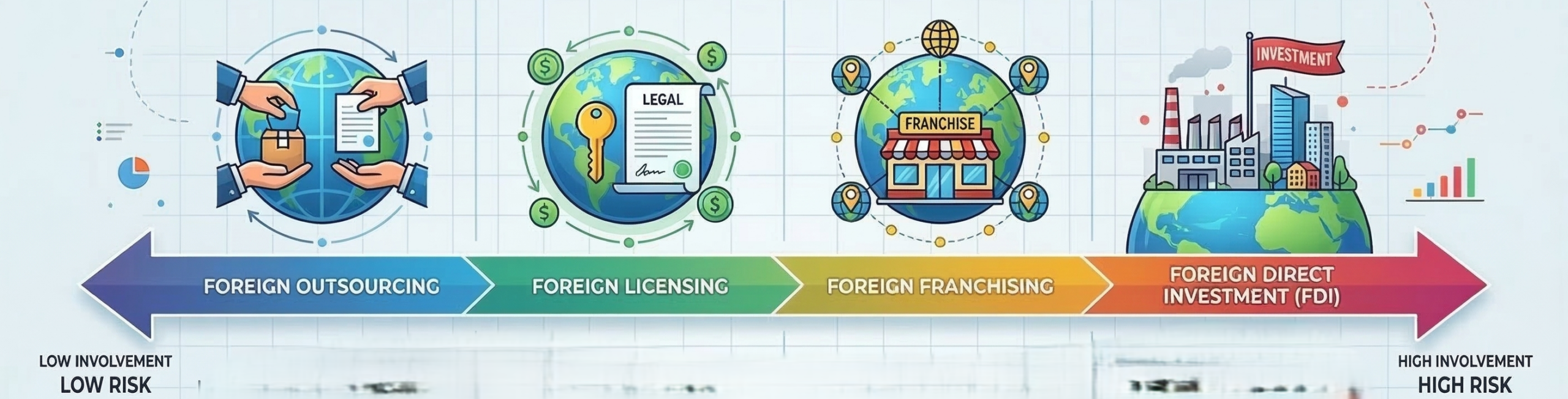
Think of these strategies on a spectrum: the further right you go, the more time, money, and commitment a company puts in, but also the more control and potential reward they get back.
Lowest Risk
Foreign outsourcing
Hiring a foreign company to produce your goods – usually because it’s way cheaper than doing it at home.
Real example
Apple assembles most iPhones in China and India through partners like Foxconn which keeps costs low while focusing its own team on design and software.
Low Risk
Foreign licensing
Letting a foreign company use your brand, product, or technology in exchange for a fee or royalty. You don’t have to do much: they do the work, you collect a cut.
Real example
Disney licenses Mickey Mouse and Elsa to manufacturers in other countries, who make and sell the merchandise. Disney earns royalties without running a single factory.
Medium Risk
Foreign franchising
A foreign business pays to operate under your brand and business model, but they have to follow your rules, systems, and standards exactly.
Real example
McDonald’s franchises its restaurants globally. Whether you’re in Tokyo or Paris, you get the same menu, same branding, same experience because franchisees follow McDonald’s playbook.
Highest Risk
Foreign direct investment
A company puts its own money into a foreign country by buying an existing company there or building new operations from scratch. Most control, most cost.
Real example
Toyota built factories in the U.S. (Kentucky, Texas, Indiana) rather than just exporting cars, giving them full control over production and helping them avoid import tariffs.
5.4: Barriers to International Trade
Breaking Into the World Market: Why Going Global Is Harder Than It Looks
So, you want to sell your stuff internationally. Makes sense – billions of potential customers, bigger markets, more money. But here’s the thing nobody tells you upfront: getting a product from one country to another is way more complicated than just slapping a shipping label on a box. There are real barriers standing between you and global success, and they usually fall into three buckets: sociocultural differences, economic differences, and political and legal differences.
Here’s the silver lining though. The more barriers a country has, the less competition you’ll face once you break through. First mover advantage is very real in international trade. Think of it like being the first pizza place in a small town – it takes work to get established, but once you’re in, you own the market.
The Culture Problem
Let’s start with the stuff that trips people up most often: culture. Every country has its own language, values, and unwritten social rules. If you don’t know them, you’ll embarrass yourself at best and tank your business at worst.
And it goes way deeper than just speaking the language. Think about nonverbal communication…. a thumbs up means “great” in the US but can be offensive in parts of the Middle East and West Africa. Forms of address matter too. In some cultures, calling a business contact by their first name right away is totally normal and friendly. In others, it’s disrespectful and signals that you don’t take them seriously.
Punctuality is another one that catches people off guard. Show up five minutes late to a meeting in Germany and you’ve already made a bad impression. Show up exactly on time in some Latin American or Middle Eastern business cultures and your host might not even be there yet because a more relaxed attitude toward time is completely normal and expected.
Then there are religious customs and celebrations. Major holidays vary by country and religion, and scheduling a product launch or business trip during Ramadan, Lunar New Year, or Diwali without knowing what those holidays mean to your partners or customers is a rookie mistake. Same goes for meals and gifts in that what’s a generous, thoughtful gesture in one culture can be awkward or even offensive in another. In Japan, for example, gift-giving is a refined art with its own etiquette, while in other places it might raise questions about bribery.
The fix? Do your homework before you ever book a flight. Talk to people who actually live and work in that market. Read, research, and then go experience it firsthand. And most importantly, approach it all with genuine curiosity instead of assuming your way of doing things is the default.
The Money Problem
Even if you nail the cultural side, you still have to deal with economic reality. Not every market is built the same, and assuming otherwise is how companies lose money fast.
Before entering a new market, smart businesses look at a handful of key numbers. Population tells you how big the potential customer base is. Per capita income tells you how much people actually have to spend. Economic growth rate tells you whether the market is expanding or shrinking. And the currency exchange rate? That one can quietly eat your profits if you’re not watching it closely. A deal that looks profitable on paper can look very different once you factor in what’s happening between the dollar and whatever local currency you’re dealing with.
The stage of economic development matters a lot too. A wealthy, highly developed economy and an emerging one require completely different strategies. In less developed markets, the goal isn’t just to transplant your existing product and pricing. You often have to reimagine how your product works, what it costs, and how it gets delivered. Companies that do this well (that innovate specifically for those markets rather than just altering their existing product) are the ones that win.
And then there’s infrastructure, which sounds like a dry, textbook word until you realize it literally determines whether your product can reach customers at all. We’re talking about four major systems. Transportation includes roads, airports, railroads, and ports (without reliable ways to move goods, your supply chain falls apart). Communication covers TV, radio, internet, and cell phone coverage (without it, marketing and customer service become nearly impossible). Energy means utilities and power plants (inconsistent electricity alone can derail manufacturing or retail operations). And finance covers banking, checking accounts, and credit access (if customers can’t easily pay you, or if you can’t reliably move money in and out of the country, the whole operation gets complicated in a hurry).
In some markets, one or more of those systems is underdeveloped or flat-out unreliable. That’s not necessarily a dealbreaker, but it does mean you need a plan for working around it.
The Rules Problem
Last but definitely not least: the legal and political landscape. This one can make or break you fast, and unlike culture or economics, getting it wrong can land you in serious legal trouble.
Every country has its own laws governing everything from labor practices and product safety to advertising standards and data privacy. As an international business, you don’t get to pick and choose which rules apply to you. You have to follow the laws of your home country and the laws of whatever country you’re operating in, and in some cases, international legal standards on top of that. That’s a lot of legal homework, and it’s exactly why global companies employ entire teams of lawyers who specialize in specific regions.
REAL WORLD EXAMPLE: When the Rules Don’t Match
One of the clearest examples of legal trade barriers? Food. The U.S. and European Union have very different ideas about what’s safe to eat and that disagreement costs exporters millions.
Hormone-treated beef is sold in the U.S., yet banned in the EU
U.S. ranchers use growth hormones to raise cattle faster. The EU banned this practice over health concerns, blocking most American beef exports.
Chlorinated chicken
U.S. poultry is rinsed in chlorine to kill bacteria. The EU sees this as a hygiene shortcut and prohibits it entirely.
GMO crops
Genetically modified crops are standard in U.S. agriculture, but the EU requires strict approval, labeling, and in many cases bans them outright.
Certain food dyes
Artificial colorings like Red 40 and Yellow 5 are common in U.S. snacks and drinks. The EU restricts or bans them, requiring warning labels where they are allowed.
*Neither side is necessarily “wrong,” they just have different standards. But for U.S. exporters, navigating these differences means extra compliance costs, reformulated products, or losing access to the market entirely.
Political stability matters just as much as the laws themselves, maybe more. A country dealing with civil unrest, riots, or outright conflict is an extremely risky place to invest time, money, and resources, no matter how attractive the market looks on paper. Property can be seized, supply chains can be disrupted, and employees can be put in danger. Businesses have to honestly assess political risk before committing to a market.
Even stable, peaceful governments can create obstacles though. Many countries have national policies specifically designed to restrict foreign competition and protect their own domestic industries. These can show up as tariffs (extra taxes on imported goods that make foreign products more expensive), import quotas (limits on how much of a product can come into the country), or outright bans on certain foreign goods or services. The logic is usually to give local businesses a fighting chance against larger, more established international competitors. Understanding those policies and figuring out how to navigate or work within them, is a core part of any successful global strategy.
-
FOR UPDATED INFORMATION:
- The U.S. Trade Representative website ustr.gov has a dedicated “Presidential Tariff Actions” page that compiles tariff proclamations and trade agreements in one place.
- For embargoes specifically, the Office of Foreign Assets Control (OFAC) at treasury.gov/ofac maintains the official list of sanctioned countries
The bottom line? Going global is absolutely possible, but only for companies that do their homework on all three fronts. Nail the culture, understand the economics, and respect the rules. That’s the playbook.
5.5: The Free Trade Movement
The Dream vs. The Reality
Here’s an idea that sounds almost too good to be true: what if countries could just trade freely with each other, no strings attached, no extra fees, no government roadblocks? That’s the basic idea behind free trade, and while we’re not quite there yet, the world has been slowly but steadily moving in that direction.
So What Is Free Trade, Exactly?
Free trade means the unrestricted movement of goods and services across international borders. No tariffs, no quotas, no artificial barriers. Just countries exchanging products based on what they’re each best at producing. The logic is pretty straightforward: if Mexico is great at growing avocados and the U.S. is great at making semiconductors, everyone wins when both countries can trade freely without penalties.
The economic benefits are real too. Free trade opens access to wider international markets, allows countries to import raw materials and technology at lower costs, and generally boosts economic growth. The catch? Truly free trade is more of an ideal than a current reality.
The Big Players: International Organizations
A few major international organizations were created specifically to manage and promote global trade. Here’s who they are and what they actually do.
GATT and the WTO
It started in 1948 when 23 nations signed the General Agreement on Tariffs and Trade (GATT), an international treaty designed to encourage worldwide trade among its members. Think of it as the original rulebook for global commerce.
Eventually, that rulebook needed a permanent referee. Enter the World Trade Organization (WTO), which today has 164 member countries and monitors the rules laid out by GATT. The WTO meets every two years and serves as the go-to institution for resolving trade disputes between countries.
That said, the WTO isn’t without its critics. Its decision-making process has been called out for lacking transparency, and enforcement is tricky since it ultimately depends on member countries actually being willing to follow through. It’s a little like having a referee who can blow the whistle but can’t actually make anyone leave the field.
The World Bank
Created in 1944 to help rebuild economies after World War II, the World Bank is now the world’s largest international public agency. It’s a cooperative of 189 member countries focused on reducing poverty in the developing world, mostly through low-interest loans and financial and technical advice to developing governments.
The results, though, are debated. Critics point out that while China and India have lifted hundreds of millions of people out of poverty since 1990, that success came from internally driven economic reforms, not World Bank aid. Meanwhile, the bank directed significant resources toward Africa, with results that have been far less impressive. Global poverty and income inequality are rising again, which has led many to question whether the institution is actually delivering on its mission.
The IMF
The International Monetary Fund is a 190-member organization focused on keeping the global economy stable and growing. It does this by supporting stable exchange rates, encouraging sound economic policies, and most importantly, lending money to countries in financial trouble. During COVID-19, for example, the IMF provided immediate debt relief to 25 of its poorest member countries.
The key difference between the IMF and the World Bank comes down to timing and focus. The IMF handles short-term financial crises and economic stability. The World Bank focuses on long-term development and poverty reduction. Both matter, and they often work together.
Trading Blocs: Strength in Numbers
One of the biggest moves toward freer trade has been the rise of trading blocs, which are agreements between groups of countries to reduce or eliminate trade barriers among themselves. Here’s a quick tour of the major ones.
The European Union is the big one. Twenty-seven European countries operating as a single market where goods, services, money, and people can move freely across borders. The EU also speaks with one voice on trade policy with the rest of the world, which gives it serious negotiating power.
NAFTA, which linked the U.S., Canada, and Mexico, was replaced in 2020 by the USMCA, a modernized version of the same agreement. Critics argue it has increased the U.S. trade deficit and weakened environmental and worker protections, so it’s not without controversy.
ASEAN connects 10 Southeast Asian countries including Indonesia, Vietnam, Thailand, and the Philippines, with the goal of reducing tariffs and deepening regional economic ties. Mercosur does something similar for South America, linking Argentina, Brazil, Paraguay, and Uruguay. The African Continental Free Trade Area (AfCFTA) is one of the newest and most ambitious, covering 54 of 55 African nations and aiming to create a single continental market.
Other blocs include EFTA (Iceland, Norway, Switzerland, and Liechtenstein), CARICOM (15 Caribbean nations), the Pacific Alliance (Chile, Colombia, Mexico, and Peru), and the Commonwealth of Independent States, which loosely ties together former Soviet republics like Russia, Kazakhstan, and Ukraine.
Common Markets: Going Even Further
A trading bloc is a good start, but a common market goes deeper. It’s not just about removing tariffs on goods. It also allows the free movement of labor and capital across borders, harmonizes trade rules, and creates a unified external trade policy with non-members. Think of it as a trading bloc that actually decided to fully commit.
The EU is the world’s best example of a common market in action. With a combined GDP of roughly $15 trillion, it is the largest common market on the planet. Its goals include removing all trade restrictions among members, standardizing import and export policies, and using a single currency, the euro, to make cross-border commerce seamless.
The EU has also become a global standard-setter on environmental protection, product quality, and human rights, which means its policies ripple far beyond Europe’s borders.
One notable recent development: the United Kingdom left the EU in 2020, the famous “Brexit,” driven largely by concerns about immigration and national self-determination. It was a reminder that even the most integrated economic partnerships can come apart when political tensions run high.
The Bottom Line
Complete free trade may still be an ideal rather than a reality, but the world has built a surprisingly elaborate system to get as close as possible. International organizations like the WTO, IMF, and World Bank set the rules and keep things stable. Trading blocs and common markets chip away at barriers region by region. It’s messy, sometimes controversial, and definitely imperfect, but it represents decades of countries deciding that cooperation beats going it alone.
5.6: The United States in Global Trade
Why the United States Matters in Global Trade
The United States is one of the world’s largest economic powers, playing a major role in global trade. With an economy worth more than $25 trillion, the country has a major influence on the flow of goods, services, and capital around the world.
MAJOR EXPORTS OF THE UNITED STATES
The United States is a major player in global trade, with exports spanning a wide range of strategic economic sectors. As the world’s largest economy, the United States leverages not only its innovation advantage but also its abundant natural resources to produce high-quality products that are in demand globally.
STRENGTHS IN GLOBAL TRADE
The United States has a number of advantages that make it a leader in global trade. With a combination of abundant resources, technological innovation, and a large market, the US continues to dominate the international market.
These advantages allow the country to overcome global competition and remain the center of the world economy.
CHALLENGES IN GLOBAL TRADE
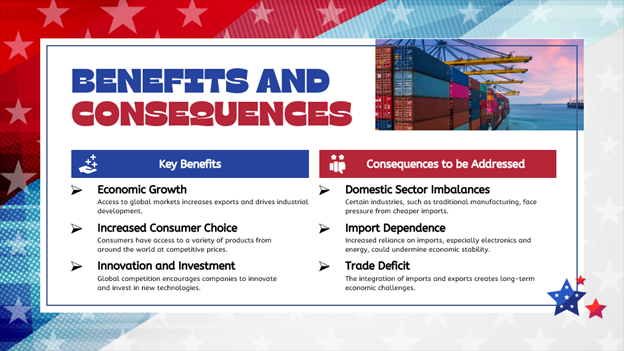
Although the United States has a significant advantage in global trade, it also faces a number of challenges that could affect its position in the international market. These factors include geopolitical changes, increasing competition, and internal issues that affect global competitiveness. Fierce Global Competition, Changes in Trade Policy, Global Supply Chain Crisis, Trade Inequality and Environmental and Energy Issues.
FUTURE OF U.S. GLOBAL TRADE
The future of U.S. global trade depends on innovation and adaptation to a changing world. With technological advances, poverty needs, and intense global competition, the U.S. must continue to strengthen its position through progressive strategies.
Key Vocabulary
Extra Learning Resources: