Main Body
3 CH 3 – Entrepreneurship
Introduction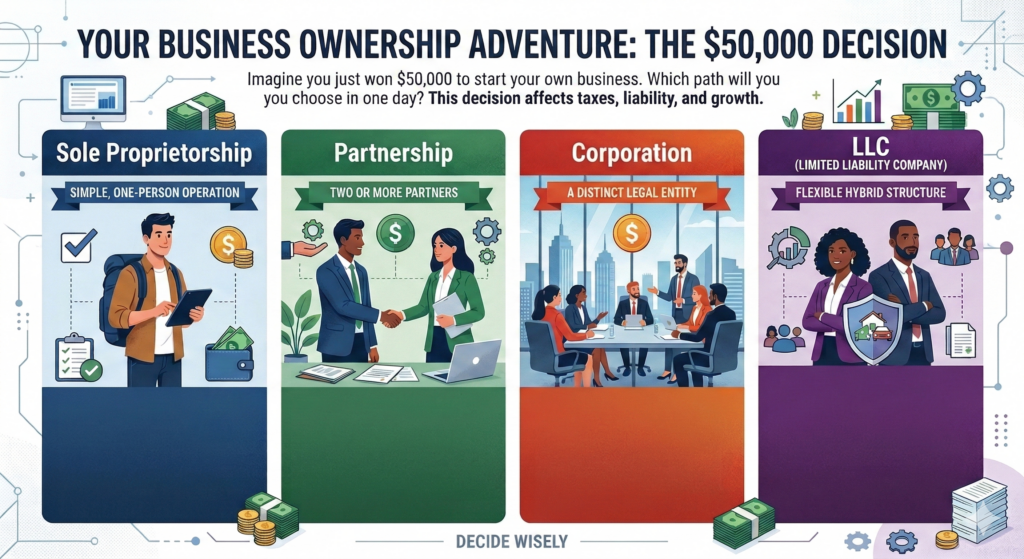
As it turns out, this decision can make or break your business before you ever open your doors.
Here’s a sobering statistic: over 70% of small businesses fail within the first 10 years. While many people assume bad ideas are the primary culprit, research suggests that choosing the wrong business structure is one of the most overlooked – and costly – mistakes a new entrepreneur can make. Understanding your options from the start gives you a critical edge.
That’s exactly what this chapter is designed to do. By the end of it, you’ll have the foundation you need to start, manage, and grow a business successfully.

This quote captures the spirit of entrepreneurship: taking risks, believing in your vision, and having the courage to build something from nothing. With that mindset in place, let’s start with the most fundamental decision every entrepreneur faces – how to structure their business.
3.1: Sole Proprietorships

Of all the business ownership types, the sole proprietorship is by far the most common form of business organization in the United States, accounting for over 72% of all businesses formed. That said, despite their sheer numbers, sole proprietorships account for only about 4.34% of total business revenues and 10.27% of total profits, reflecting the fact that most are small, owner-operated ventures.
To understand why so many entrepreneurs choose this structure, consider the following real-world example.
A Dorm Room and a Dream
The year is 1984. Less than 10% of college students own a personal computer – but for those who did, it represented a significant entrepreneurial advantage. Michael was a 19-year-old student at the University of Texas at Austin with an idea: build and sell customized PCs directly to customers, cutting out the middleman entirely. Operating out of his dorm room, he needed a business structure that matched his situation. He wanted something easy to set up with minimal paperwork. He wanted full control over his decisions – no partners, no board of directors. And he wanted to keep all of his earnings. A sole proprietorship checked every box, offering him simplicity, autonomy, and direct access to his profits.
Can you guess his last name?
Dell – as in Michael Dell, who went on to found Dell Technologies and remains its chairman and CEO today.
So what exactly is a sole proprietorship, and why did it make sense for a college student building computers in his dorm room? In a , there is a single owner who maintains full control of the business and keeps all of its profits. Startup costs and paperwork are minimal, and the business’s earnings are treated as the owner’s personal income. On the flip side, the business’s debts are also the owner’s personal responsibility. Sole proprietors tend to work long hours and carry significant stress, since every decision and every problem lands on one person’s shoulders.
There is one other important limitation worth noting: a sole proprietorship lacks permanence. If the owner dies, retires, or steps away from the business, the business legally ceases to exist. What’s built is tied directly to the person who built it.
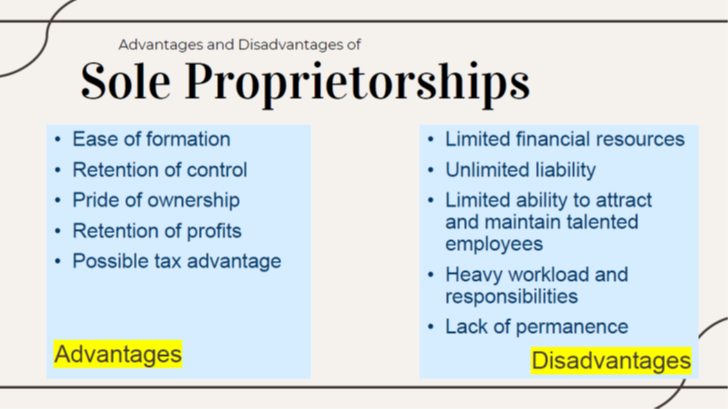
As you can see, a sole proprietorship works well in the right circumstances, but it has real limitations as a business grows. That brings us back to Michael Dell. While a sole proprietorship was the right fit for a dorm-room startup in 1984, it was never going to be the right fit for a global technology company. As Dell Computers expanded, it needed outside investors to bring in more capital, legal protections to shield the owners from liability, and a structure that could scale. In 1987, Dell Computers was incorporated as a corporation and is valued at approximately $80 billion dollars today.
Dell’s story is a perfect reminder that choosing a business structure isn’t just a one-time decision. It’s something entrepreneurs revisit as their business evolves. With that in mind, let’s look at the next ownership structure: partnerships.
3.2: Partnerships
Michael Dell’s story shows what one person with a clear vision can accomplish on their own. But what happens when no single person has all the skills, resources, or capital needed to get a business off the ground? That’s where partnerships come in.
A is a business owned by two or more people who share in both the profits and the responsibilities of running it. Unlike a sole proprietorship, a partnership allows entrepreneurs to pool their money, divide up the work, and bring complementary skills to the table. Partnerships are relatively easy and inexpensive to form, and like a sole proprietorship, profits pass directly through to the partners’ personal tax returns, avoiding what is known as “double taxation” (more on that when we get to corporations).
In a , all partners share equal management responsibilities and are equally liable for the business’s debts. This means that if the business owes money and cannot pay, creditors can go after any partner’s personal assets, not just their share of the business.
In a , there is at least one general partner who runs the business and assumes full liability, while one or more limited partners contribute capital but stay out of daily operations. A limited partner’s personal liability is capped at the amount they invested.
In a , all partners receive some protection from the actions of the other partners. If one partner makes a costly mistake, the others are shielded from personal liability for it. This structure is especially common among professionals such as lawyers, doctors, and accountants.
In a , two or more businesses form a temporary partnership, usually for a specific project or purpose. This is common when risks / costs are high, specialized expertise is needed, or entering a new market is difficult. May be strongly encouraged by government officials (ex: The U.S. government push for domestic semiconductor manufacturing)
In a , two or more businesses agree to collaborate on a particular goal while remaining independent of one another. A well-known example is Star Alliance, formed in 1997 of United Airlines, Lufthansa, and Air Canada. The airlines remain separate companies, yet they share customers and coordinate internationally. They are able to reduce costs and expand global reach without merging.
*As you can see, no two partnerships look exactly alike. The right structure depends on the goals of the business, the level of involvement each party wants, and how much legal protection is needed.
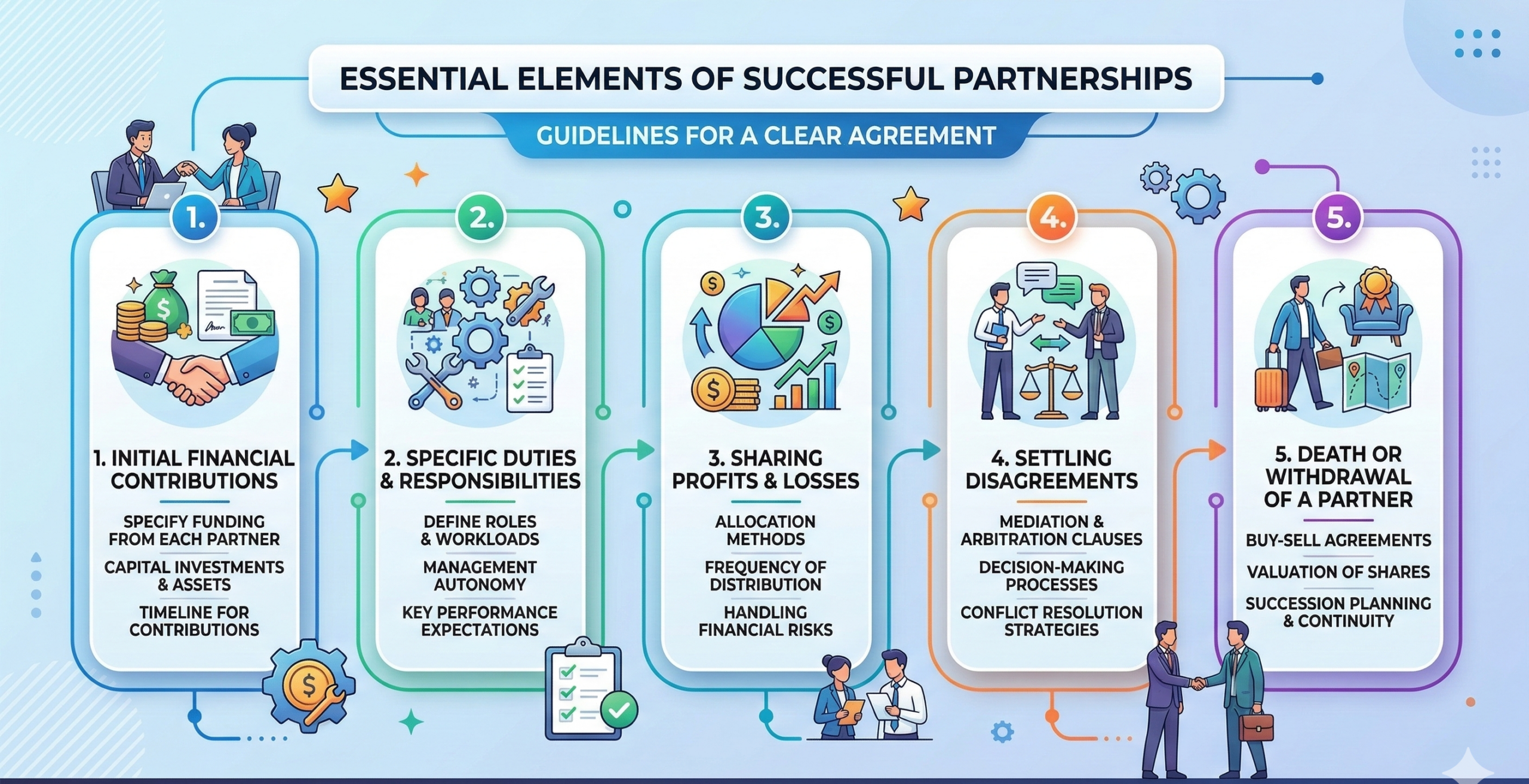
As useful as partnerships can be, they also come with real challenges. Shared decision-making can lead to disagreements. Shared profits mean no one takes home everything they earn. And in a general partnership, one partner’s bad decision can legally become every partner’s problem. This is why a written partnership agreement, even when it isn’t legally required (verbal agreements can be legitimate), is strongly recommended before going into business with anyone. Well-written agreements can prevent common misunderstandings.
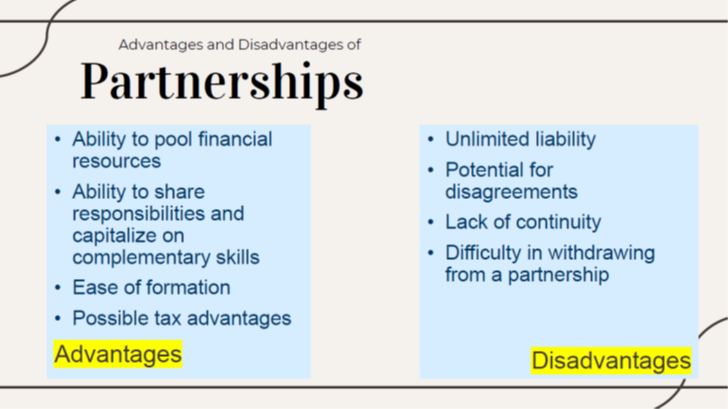
With those trade-offs in mind, let’s look at a real-world example that brings all of this to life.
Two Friends, a Gas Station, and a $5 Course
The year is 1977. Cohen is a college dropout trying to sell pottery. Greenfield has just been rejected from medical school. The two childhood friends from Long Island, New York, decide that if neither of their original plans is working out, they might as well go into business together. They pool their savings and take a correspondence course in ice cream making from Penn State University. The entire course costs them five dollars.
With a total investment of $12,000, the two partners convert an old gas station in Burlington, Vermont into an ice cream shop. A partnership made sense for them for several reasons: neither had enough money to start alone, they had complementary skills, and they trusted each other completely after years of friendship. By going into business together, they could share the financial risk and divide up the work.
On May 5, 1978, they opened their doors for the first time. The lines stretch out the door.
Can you guess the name of the company?

Ben and Jerry’s – now one of the most recognizable ice cream brands in the world. The company was eventually acquired by Unilever in 2000 for $326 million, a long way from a $5 ice cream course and a converted gas station in Vermont.
Ben and Jerry’s story is a great reminder of what a partnership can make possible. When one person’s resources or skills aren’t enough to get started, finding the right partner can be the difference between staying on the sidelines and opening your doors. Of course, as the business grew, so did its need for a more complex structure. Just like Dell, Ben and Jerry’s eventually outgrew its original form. That brings us to our next business type: corporations.
3.3: Corporations
A is a business that legally exists as its own separate entity, independent from whoever owns or runs it. Unlike a sole proprietorship, where the business and its owner are essentially the same in the eyes of the law, a corporation has its own legal identity. This distinction may sound like a technicality, but it has enormous practical consequences for everyone involved.
Consider the story of Ben Cohen and Jerry Greenfield, founders of Ben & Jerry’s ice cream. When they operated as a small business, any lawsuit or debt incurred by the company could potentially reach their personal finances. A customer who slipped outside their shop, for example, could sue not just the business but Ben and Jerry personally, putting their savings, homes, and other assets at risk. After incorporating, however, the business became its own legal entity. Lawsuits and debts are directed at the corporation itself, not at the individuals behind it. This protection is known as limited liability, and it is one of the primary reasons entrepreneurs choose to incorporate.
Corporations are also unique in how ownership is structured. Rather than having one or two owners, a corporation divides ownership into shares of stock. Think of it like slicing a pizza into 100 pieces: if you own 50 of those slices, you own 50% of the company. Those shares can be sold to raise money, offered to investors to fund growth, or granted to employees as part of their compensation. This system is, at its core, how the stock market works. When a company lists its shares on a public exchange, everyday people can buy a small ownership stake in that business.
Another defining feature of a corporation is that it can outlive the people who created it. When a founder retires, sells the company, or passes away, the corporation continues on. It maintains its own contracts, bank accounts, and legal identity regardless of who is in charge at any given moment. This concept, known as perpetual existence, makes corporations well-suited for building organizations designed to last for generations rather than a single lifetime.
Starting and maintaining a corporation does come with trade-offs. The process involves legal filings, ongoing paperwork, and more complex tax obligations than simpler business structures. The requirements also vary significantly from state to state, which is why many businesses strategically choose where to incorporate based on cost, taxes, and legal environment.
Delaware is by far the most popular choice, with 66% of Fortune 500 companies incorporated there. Its appeal lies in a well-developed body of corporate law, business-friendly courts, and a straightforward incorporation process. Nevada attracts businesses with no state corporate income tax, no personal income tax, and strong privacy protections for company officers and directors. Wyoming has also emerged as a competitive option, offering low fees, no state income tax, and minimal reporting requirements. Businesses do not need to physically operate in a state to incorporate there, which is why these states have attracted companies from across the country.
The core takeaway is this: a corporation creates a legal wall between you and your business. That wall protects your personal assets, makes it easier to attract investment, and provides a stable foundation for long-term growth.
CASE STUDY: Dropbox
The story of Dropbox illustrates how a simple frustration can become the foundation of a billion-dollar corporation. In 2006, MIT student Drew Houston boarded a bus and realized he had forgotten his USB drive, leaving him unable to work on the files he needed. Rather than simply accepting the inconvenience, he opened his laptop and began writing code on the spot. His idea was novel: what if your files lived in the cloud and were automatically accessible from any device, anywhere, without USB drives or emailing documents to yourself?
Houston built an early version of the product and in 2007 posted a demo video to Hacker News, a popular online forum for the tech community. The response was immediate and overwhelming. The beta waiting list jumped from a few thousand to roughly 75,000 signups overnight, confirming that Houston had identified a problem people genuinely wanted solved.
Around this time, Houston brought on fellow MIT student Arash Ferdowsi as co-founder. Ferdowsi made a striking bet on the company’s potential: he dropped out of MIT with just one semester remaining to join full-time. The two were soon accepted into Y Combinator, a renowned Silicon Valley startup accelerator that provided early funding, mentorship, and the credibility needed to attract investors. Because outside investors require a formal corporate structure before committing capital, Dropbox incorporated as a C-Corporation at this stage, allowing it to issue shares and accept venture funding.
What truly propelled Dropbox’s growth was a clever referral program: invite a friend to sign up and both of you receive extra free storage. The program cost little to run but proved remarkably effective, enabling the company to grow its user base dramatically without relying on traditional advertising.
The company’s early momentum did not go unnoticed. In 2009, Apple co-founder Steve Jobs offered to acquire Dropbox for a nine-figure sum. Houston declined. Jobs, reportedly unimpressed, warned Houston that Dropbox was “a feature, not a product,” predicting that Apple and others would simply build the same functionality into their own platforms. He was not entirely wrong. Competition from Google Drive, iCloud, and Microsoft OneDrive intensified over the following decade, eroding some of Dropbox’s dominance. But the company adapted, refined its focus, and survived where many doubted it would.
By 2018, Dropbox went public on the stock market, valued at approximately $9 billion on its first day of trading. The forgotten USB drive had become one of the more successful corporate origin stories in Silicon Valley history – and like many companies that reach that scale, Dropbox’s growth was made possible in part by the legal and financial protections that come with being a corporation.
Types of Corporations
When deciding to incorporate, one of the most important early decisions is choosing the right type of corporation. The most common is the C Corporation (C Corp), which offers significant advantages: limited liability, easier access to investment capital, no ownership limits, tax flexibility such as deducting business expenses, and perpetual existence. The main drawback is double taxation; the business pays taxes on its profits, and owners pay taxes again on any dividends received. For many businesses, the advantages outweigh this cost.
Ownership in a C Corporation is represented by shares of stock, with any owner of a corporation known as a The corporation’s mission and objectives are established by the – individuals who are elected by stockholders to represent their interests. The purpose of the Board of Directors is to provide oversight, guidance, and governance to ensure the company’s success and protect the interests of shareholders. They set strategy, hire and evaluate leadership, provide financial oversight and risk management, and ensure legal and ethical compliance.
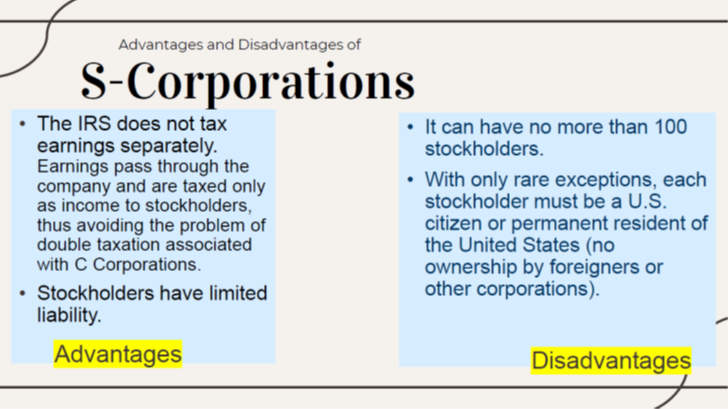
The S Corporation (S Corp) addresses the double taxation problem by passing profits directly to the owners, who then report them on their personal tax returns. The business itself pays no federal income tax. Owners can be treated as employees and paid a “reasonable salary.” Payroll taxes (Social Security and Medicare) are paid only on that salary, not on owner’s share of profits remaining in the business.
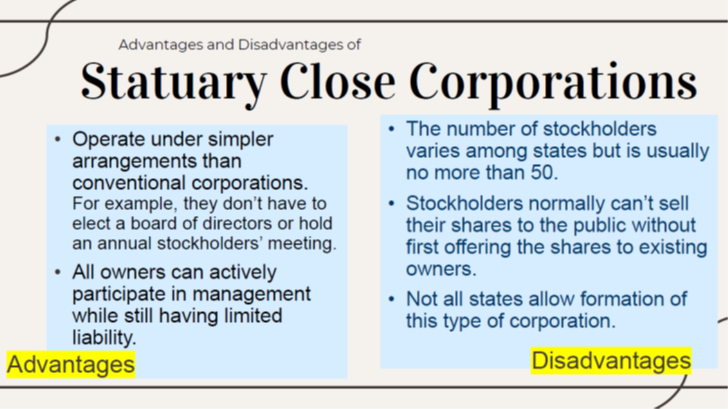
The Statutory Close Corporation is designed for small private businesses, offering a simpler and less formal structure with a limited number of owners and fewer regulatory requirements. This structure allows owners to manage the company more like a partnership, bypassing the need for a formal board of directors and frequent shareholder meetings while still maintaining limited liability protection.
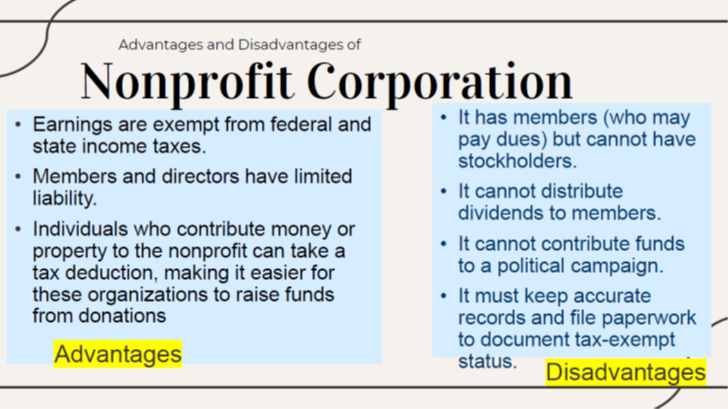
Finally, the Nonprofit Corporation operates without the goal of earning a profit and is exempt from taxation – differing fundamentally from the other corporation types in both purpose and structure. Instead of giving profits to owners, any extra money the group makes must go right back into its community work or charity goals.
Ways for Corporations to Grow and Achieve Competitive Advantage
3.4: Limited Liability Company (LLC)
The next business ownership option is the . This type of business ownership is relatively new, having started in Wyoming in 1977. In 1978, a partnership was started by 2 guys, but they grew bigger and wanted liability protection. They converted to an LLC in Vermont, and they were one of the first companies to test out how the new LLC model worked for small businesses. They showed that it did and it became available to other states around 1984. Those 2 guys names? (We talked about them earlier!) ……
……..Ben & Jerry!
The LLC is a form of business ownership that offers limited liability to its owners and flexible tax treatment. An LLC can be treated as a corporation, partnership, or sole proprietorship depending on the elections made.
You might want to start an LLC because it offers personal liability protection, meaning your personal assets are usually safe if the business faces legal or financial trouble. It’s also flexible in how you manage and tax the business, allowing profits and losses to pass directly to your personal tax return, avoiding double taxation like a corporation. Additionally, it has fewer formalities and paperwork compared to corporations, making it simpler to operate while still appearing professional. Many celebrities and athletes, such as Beyoncé with Parkwood Entertainment LLC, also use LLCs to manage their brand and assets efficiently.
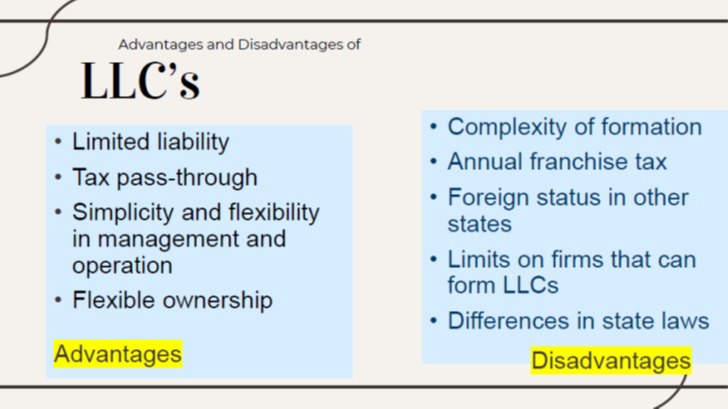
To form an LLC, documents have to be filed and filing fees have to be paid in the state where the business is organized. Different states have different laws; with California considered to have the strictest LLC laws (high filing fees, strict naming rules, minimum $800 in annual taxes regardless off income, and detailed record keeping requirements). Wyoming, in contrast, has some of the loosest laws with low fees, no state income tax, strong privacy protections, and flexible management structures. These differences affect how LLC’s operate and maintain compliance in each state.
3.5: Franchising
Another ownership type is the Franchise. This is not a partnership in the traditional sense but operates using a partner-like model. Franchising is less risky because it offers access to a proven business system and product. Franchising is one of the most popular ways of operating a business. 820,000 US businesses (2025) are franchised.
Almost any business with a proven, replicable model and brand can be franchised.
In 1965, 17-year-old Fred DeLuca needed money for college. A family friend, Dr. Peter Buck, had a wild idea: open a sandwich shop. He threw in $1,000 and became Fred’s business partner – and just like that, one of the top 10 franchises in the world was born…..

Their first location opened in Bridgeport, Connecticut, and the two set an ambitious goal: 32 stores in 10 years. Fred quickly learned the essentials: good food, great service, low costs, good locations. Pretty much the same formula Subway still runs on today.
By 1974, they had 16 shops across Connecticut. With their 32-store goal slipping out of reach, they decided to start franchising. That move launched Subway into one of the biggest fast-food empires in the world.
Example: To franchise a Subway, you’ll need to:
- Submit an application: Start on the Subway franchise website.
- Financial requirements: Have a net worth of $80,000-$310,000 and liquid assets of at least $30,000.
- Training: Complete Subway’s training program.
- Sign agreements: Review and sign the Franchise Disclosure Document (FDD) and franchise agreement.
- Secure a location: Find an approved location for your store.
- Set up: Build and equip your Subway with guidance.
Franchising in Today’s Economy
Opportunities for franchise growth can be greater in foreign countries because competition is less intense and markets are less saturated than in the United States. Differences in culture, language, laws, demographics, and economic development require adjustments in business methods. African Americans, Hispanics, Asian Americans, and Native Americans make up close to 40% of the population and now own about 30% of franchises.
POLLING ACTIVITY
Which factor do you believe is the most important to ensure the success of the franchise you are about to purchase?
- The willingness to work hard
- A firm understanding of the risks involved
- Careful research
Answers will vary.
The most successful franchisees are entrepreneurs who engage in all of the following: do careful research, understand the risks involved, and are willing to work hard.
DO YOU LOVE THIS?
Consider making it your career!
EXTRA LEARNING RESOURCES
Optional Reading
A single owner who maintains full control of the business and keeps all of its profits
A business owned by two or more people who share profits and responsibilities
all partners share equal management responsibilities and are equally liable for the business's debts
When there is at least one general partner who runs the business and assumes full liability, while one or more limited partners contribute capital but stay out of daily operations
all partners receive some protection from the actions of the other partners
two or more businesses form a temporary partnership, usually for a specific project or purpose
two or more businesses agree to collaborate on a particular goal while remaining independent of one another
a business that legally exists as its own separate entity, independent from whoever owns or runs it
Owner of a corporation
individuals who are elected by stockholders to represent their interests
a form of business ownership that offers limited liability to its owners and flexible tax treatment